Joy to the World (Advent 24-2014)

Joy to the World! is probably my all-time favorite Christmas carol in our Carol Me, Christmas (2014 Advent Devotional Series).  I don’t know if it’s the upbeat melody or if it’s the emphasis on joy, but it’s fully appropriate that as Advent progresses, we moved from anticipation in a dark world desperate for salvation from our earliest week, to the announcement of Jesus’ birth, to the adoration of Christ…now to exhilaration at how amazing it is that the Lord is come.

I always wondered why it is the Lord is come when it seemed like it should be “did” or “has” or simply “came.”  I’m guessing that Isaac Watts (who could arm-wrestle Charles Wesley for the title of Most Noted Hymn Writer) knew exactly what he was doing.

Of course!  Why didn’t I think of it before?  It’s the present tense!

Exactly what one would expect from a pastor and theologian.  The Lord is come.  Once for all time.  Jesus is alive in heaven at the right hand of the Father.  He came into the human struggle at a singular point in the past (what we call the Incarnation), but He is come (as an ongoing presence) in the hearts of an increasing population of saints.  He will never be re-incarnated.  One time in the flesh accomplished salvation forever!  The is connotes a continual presence.

Isaac Watts wrote more than 700 hymns plus numerous theological books during his time as a Nonconformist pastor in England.  Like the Puritans before him and the Reformed Protestants, Congregationalists, Baptists and Methodists after him, he did not conform to the uniform governance set forth by the Church of England.  Rather, he devoted himself to the Scriptures and to the proclamation of the Gospel’s truth in the footsteps of his father who was jailed as a Nonconformist pastor.

Most hymnals have many of his hymns including When I Survey the Wondrous Cross and O God Our Help in Ages Past.  Two classics to be sure!

The score is often noted as “from George Frederick Handel” which isn’t really a Handel composition but was likely inspired by the works of Handel.  In our modern world known for plagiarizing and pirating music without a second thought, it’s actually rather refreshing that credit would be given even for the inspiration for the music entitled Antioch (yes, after the place where believers were first called Christians according to Acts 11:26).  Today, Antioch is presumed composed by, and not simply arranged by, Lowell Mason (1839).

Consider the lyrics below and read Psalm 98 which inspired it.  Enjoy this version of Joy to the World! by the George Fox University Music Department Christmas program while pondering our Thought Focus for Today.

Thought Focus for Today:  How does a continual present accurately depict what Jesus has done for us in His Incarnation?

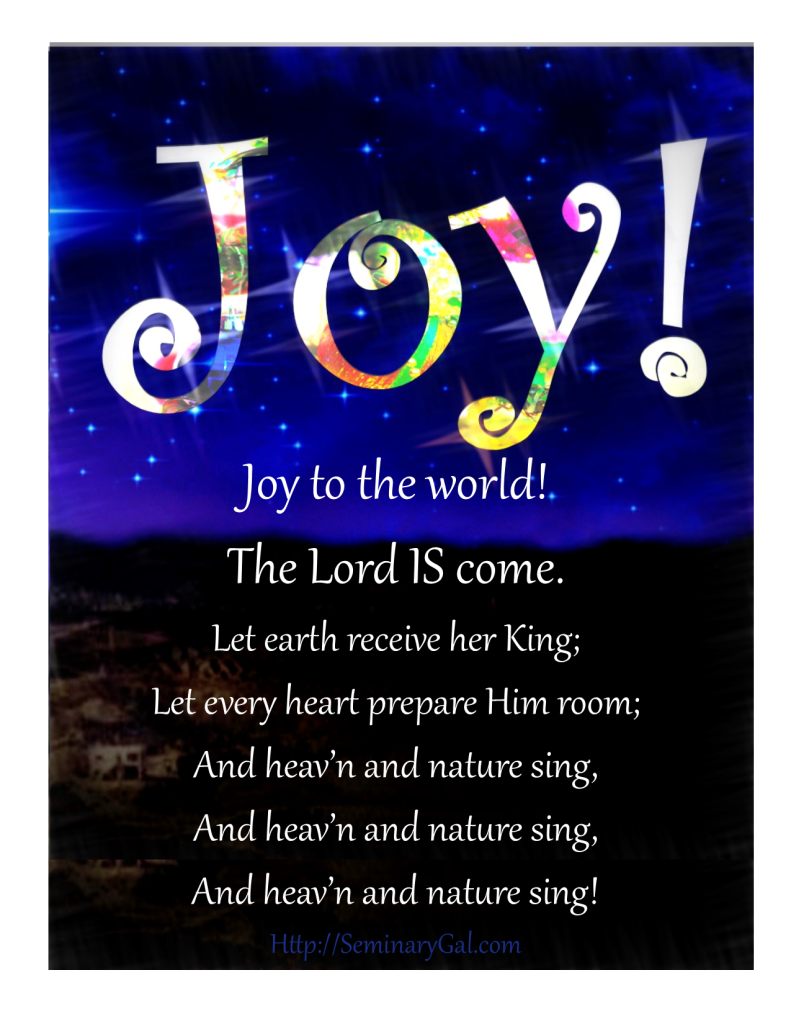
joy to the world1. Joy to the world! The Lord is come.
Let earth receive her King;
Let every heart prepare Him room;
And heav’n and nature sing,
And heav’n and nature sing. And heav’n and heav’n and nature sing.

2. Joy to the world, the Savior reigns
Let men their songs employ.
While fields and floods, rocks, hills, and plains
Repeat the sounding joy,
Repeat the sounding joy

3. No more let sin and sorrows grow,
Nor thorns infest the ground;
He comes to make His blessings flow
Far as the curse is found,
Far as, far as the curse is found.

4. He rules the world with truth and grace,
And makes the nations prove
The glories of His righteousness.
And wonders of His love,
And wonders, wonders of His love.

=====

Carol Me, Christmas (2014 Advent Devotional Series) began November 30th.  There are only a few days left.  If you haven’t signed up yet, you can receive these devotional studies in your email by entering your email address on the SeminaryGal.com home page in the space provided in the sidebar.  Or “Like” the SeminaryGal Facebook page to access them there.  I will do another devotional series for Lent and will continue to post the sermons from the Acts of the Holy Spirit and Apostles series as well.  If you like these devotionals, I’d really appreciate your letting others know so I can continue to spread the Good News far and wide.  Blessings to you, in Christ always, Barbara <><

Continue Reading

Once in Royal David’s City (Advent 23-2014)

As we continue our Carol Me, Christmas (2014 Advent Devotional Series), we are in Bethlehem and seeing the Christ Child as the story of Christmas unfolds.  Once in Royal David’s City points to that royal city Bethlehem where both Joseph and Mary, both from the line of David, would register for the census.  Mary was over 12 years old, the legal age to be taxed.  She had to go to Bethlehem too.  She had to go personally and couldn’t leave the responsibility to Joseph to whom she was “pledged to be married.”

Luke 2:1 In those days Caesar Augustus issued a decree that a census should be taken of the entire Roman world. 2 (This was the first census that took place while Quirinius was governor of Syria.) 3 And everyone went to his own town to register. 4 So Joseph also went up from the town of Nazareth in Galilee to Judea, to Bethlehem the town of David, because he belonged to the house and line of David. 5 He went there to register with Mary, who was pledged to be married to him and was expecting a child. 6 While they were there, the time came for the baby to be born, 7 and she gave birth to her firstborn, a son. She wrapped him in cloths and placed him in a manger, because there was no room for them in the inn.

Mary and Joseph were legal citizens of the province of Syria, the part of the Roman Empire in which Palestine was located.  Mary and Joseph were both from the line of David, as were their parents.  One can only assume that since everyone went to his own town to register, both Joseph’s and Mary’s parents and their families would have been participating in the legal census too, especially since they were likely righteous Jews, having raised devout and observant children.

The fact that there was “no room” at the inn suggests that neither Mary nor Joseph were any longer welcomed by their families.  After all, what kind of parents would allow their pregnant daughter to sleep in the cold if they had a room at the inn to share?

Righteous and observant doesn’t necessarily mean faithful in the eyes of God.  Sometimes people don’t and won’t understand that God does things in ways incomprehensible to us.  And that’s because our brains are far too small—even the smartest among us—to fathom the miraculous of God.

Instead, shepherds—the lowest of the pecking order—get it.  They hear the news.  They believe.  Meanwhile we have no record of Mary’s or Joseph’s parents ever coming to see this baby, Mary’s parents’ grandchild and Joseph’s parents’ presumed grandchild.  If the silence of Scripture is an indication, the Messiah comes—the One these righteous people would have been waiting for—and they miss it.  Completely.

Luke 18:10 “Two men went up to the temple to pray, one a Pharisee and the other a tax collector. 11 The Pharisee stood up and prayed about himself: ‘God, I thank you that I am not like other men– robbers, evildoers, adulterers– or even like this tax collector. 12 I fast twice a week and give a tenth of all I get.’ 13 “But the tax collector stood at a distance. He would not even look up to heaven, but beat his breast and said, ‘God, have mercy on me, a sinner.’ 14 “I tell you that this man, rather than the other, went home justified before God. For everyone who exalts himself will be humbled, and he who humbles himself will be exalted.” 15 People were also bringing babies to Jesus to have him touch them. When the disciples saw this, they rebuked them. 16 But Jesus called the children to him and said, “Let the little children come to me, and do not hinder them, for the kingdom of God belongs to such as these. 17 I tell you the truth, anyone who will not receive the kingdom of God like a little child will never enter it.”

Is it coincidence that Jesus says we need to have a childlike faith immediately after an example of the self-righteous and the self-abased?  This childlike faith is what Mrs. Cecil Frances Alexander’s poem Once in Royal David’s City (first published in 1848) talks about.

As you listen to this version by Ecclesium consider the Thought Focus for Today.

Thought Focus for Today:  The same God who says, “’Come now, let us reason together,’ says the LORD. ‘Though your sins are like scarlet, they shall be as white as snow; though they are red as crimson, they shall be like wool’” (Isaiah 1:18) also tells us to demonstrate childlike faith that simply and humbly believes.  Where are you today?  Is it possible to spend so much time attempting to reason out the miraculous that we might miss the Miracle of Christ Jesus?

once in royal davids cityOnce in royal David’s city,

Stood a lowly cattle shed,

Where a mother laid her Baby,

In a manger for His bed:

Mary was that mother mild,

Jesus Christ, her little Child.


He came down to earth from heaven,

Who is God and Lord of all,

And His shelter was a stable,

And His cradle was a stall:

With the poor, and mean, and lowly,

Lived on earth our Savior holy.


For He is our childhood’s pattern;

Day by day, like us, He grew;

He was little, weak, and helpless,

Tears and smiles, like us He knew;

And He cares when we are sad,

And he shares when we are glad.


And our eyes at last shall see Him,

Through His own redeeming love;

For that Child so dear and gentle,

Is our Lord in heaven above:

And He leads His children on,

To the place where He is gone.

====

Carol Me, Christmas (2014 Advent Devotional Series) began November 30th.  By way of reminder, if you haven’t signed up yet, you can receive these devotional studies in your email throughout Advent 2014 by entering your email address on the SeminaryGal.com home page in the space provided in the sidebar.  Or “Like” the SeminaryGal Facebook page to access them there.  If you like these devotionals, I’d really appreciate your letting others know so I can continue to spread the Good News far and wide.  Blessings to you, in Christ always, Barbara <><

Continue Reading

Good Christian Men Rejoice (Advent 22-2014)

Good Christian Men Rejoice, our latest traditional carol for Carol Me, Christmas (2014 Advent Devotional Series), is an interesting example of how music evolves from an original through translations and into the present day.  I won’t often do a citing straight out of Wikipedia, but today’s is really fascinating, presented in a way one cannot duplicate.  In describing the carol as the Latin In dulci jubilo dating back to the 14th century, they offer this comparison chart. 


First verse textual comparison

German/Latin   text
by Heinrich Seuse,   c.1328
[8]

English   literal translation

Translation   by Wedderburn,   c.1567[9]

Translation   by Pearsall,   1837[10]

Good   Christian Men Rejoice
by Neale, 1853
[11]

In dulci jubilo,
Nun singet und seid froh!
Unsers Herzens Wonne
Leit in praesepio;
Und leuchtet wie die Sonne
Matris in gremio.
Alpha es et O!
In sweet rejoicing,
now sing and be glad!
Our hearts’ joy
lies in the manger;
And it shines like the sun
in the mother’s lap.
You are the alpha and omega!
Now let us sing with joy and   mirth,
In honour of our Lordes birth,
Our heart’s consolation
Lies in præsepio,
And shines as the sun,
Matris in gremio.
Alpha is and O, Alpha is and O.
In dulci jubilo,
Let us our homage show!
Our heart’s joy reclineth
In praesepio;
And like a bright star shineth
Matris in gremio.
Alpha es et O!
Good Christian men, rejoice
With heart, and soul, and voice;
Give ye heed to what we say:
News! News!
Jesus Christ was born to-day:
Ox and ass before Him bow,
And He is in the manger now.
Christ is born today! Christ is born today.

Returning to my thoughts now:

Of course, the irony is that the addition of “men” in Neale’s version has now been changed in the gender-inclusive modern hymnals as Good Christian Friends Rejoice.  Frankly, it never bothered me to have it be “men,” especially among Christian friends.

Probably more curious to me is why “the manger” and “mother’s lap” remain the Latin even into the 1800s.  And what I think is more disturbing, theologically speaking, is the removal of “the Alpha and Omega” (the Beginning and the End), except for the version by Robert Lucas [de] Pearsall, the “de” being an ennobling addition by his daughter to his given name.

Fascinating for the times, is that the Enlightenment occurred between the translations by Wedderburn and Neale.  Why then did Pearsall’s version still have the Alpha and Omega?  Well, it turns out that Pearsall was a Romantic in the truest sense of the 19th century Romantics.  He was a throwback of sorts, having a fondness for antiquarian interests, spurning the industrialization occurring all around him, and embracing historical aesthetics in his musical compositions.  While he began life as a Quaker, he was interred in a Roman Catholic cemetery which may explain why he returned to the Latin when he was received in the Catholic Church.

The Alpha and the Omega is a great title for who Jesus is.  It’s informative that 9 of the 12 New Testament references to the Alpha and the Omega, including ones where Jesus applies this title to Himself, occur in the book of Revelation. To remove the “last days” notion from Good Christian Men Rejoice rather diminishes the amazing truth of why we rejoice!  To Enlightenment sorts, the fact that Jesus Christ is the Beginning (truly before all recorded time) and He is the End (of all earthly history) doesn’t compute with their scientific understandings.  The Alpha and the Omega is also a title conveying both sovereignty and all authority.  Something that would be offensive to those of Enlightenment mindsets, and even today worthy of ridicule by those who worship science, this Alpha and Omega is Who was lying in a manger and in Mary’s lap.  Just amazing!

As you listen to this version by The Salvation Army Brass Quintet  ponder our Thought Focus for Today.

Thought Focus for Today: Jesus Christ is the Alpha and the Omega. 

How does it change your view of Christmas to know that the One who created everything…was chosen before time began…to be born, to enter into our human struggle as a baby, and to save us in His adulthood?  Then, of course, this baby at Christmas is also the One who sits on the throne with all power and glory as Eternal Judge to judge us.  Does it give Good Christian Men Rejoice a new meaning?

good christian men rejoiceGood Christian men, rejoice with heart and soul, and voice;
Give ye heed to what we say: News! News! Jesus Christ is born today;
Ox and ass before Him bow; and He is in the manger now.
Christ is born today! Christ is born today!

Good Christian men, rejoice, with heart and soul and voice;
Now ye hear of endless bliss: Joy! Joy! Jesus Christ was born for this!
He has opened the heavenly door, and man is blest forevermore.
Christ was born for this! Christ was born for this!

Good Christian men, rejoice, with heart and soul and voice;
Now ye need not fear the grave: Peace! Peace! Jesus Christ was born to save!
Calls you one and calls you all, to gain His everlasting hall.
Christ was born to save! Christ was born to save!


=====

Carol Me, Christmas (2014 Advent Devotional Series) began November 30th.  By way of reminder, if you haven’t signed up yet, you can receive these devotional studies in your email throughout Advent 2014 by entering your email address on the SeminaryGal.com home page in the space provided in the sidebar.  Or “Like” the SeminaryGal Facebook page to access them there.  If you like these devotionals, I’d really appreciate your letting others know so I can continue to spread the Good News far and wide.  Blessings to you, in Christ always, Barbara <><

Continue Reading

O Come All Ye Faithful (Advent 21-2014)

Everything sounds more theological in Latin.  Today’s Carol Me, Christmas (2014 Advent Devotional Series) hymn, O Come All Ye Faithful (also known as Adeste Fideles), is no exception.  I remember singing it in our high school choir…in Latin.  I especially liked singing Venite adoremus Dominum.

O Come All Ye Faithful is attributed to John F. Wade with the English translation by Frederick Oakeley and William T. Brooke among others.  The scene depicted in this carol is that of the angels having announced the birth of the Christ to the shepherds,

Luke 2:15 So it was, when the angels had gone away from them into heaven, that the shepherds said to one another, “Let us now go to Bethlehem and see this thing that has come to pass, which the Lord has made known to us.”

Some authors report that this was not designed as a pilgrimage to Bethlehem, but rather a carefully decipherable call to revolt by Wade, a Catholic exiled in France, to fellow faithful Jacobeans in exile to rise up against the English throne which was oppressing Catholics of the day.  Personally, I find this fairly incongruous with the plain words of the song.  Some people just can’t stand to let Jesus be worshiped without politicizing the whole thing.

The tune itself is regal and almost like a march, suitable for a pilgrimage.  It has been attributed to John Wade, or John Reading, as well as to Simao Portogallo which gives rise to another name for this hymn as being The Portuguese Hymn.

All of this said, the lyrics fit with the biblical story, but not for today.  Theologically speaking, Christianity is one religion in which pilgrimages no longer happen.  God would want it that way.  In the flow of Scripture, we don’t have Noah’s ark, the original copies of the Ten Commandments, the budded staff of Aaron, the golden jar of manna, or the Ark of the Covenant.  We don’t have Moses’ basket or the bronze snake.  We don’t have the stones lifted out of the River Jordan as a memorial.  We don’t have a Ripley’s Wax Museum marking the exact spot where the Christ Child was laid in the manger, which is a good thing because that’s kind of creepy.

Why wouldn’t God want us going to Bethlehem in a pilgrimage?

Jesus is Emmanuel, God with us.  Christianity is the only religion in which God reached down for us and came to us, Himself, to save us.  That’s what Christ, Messiah, means.

Isaiah 9:6 For unto us a Child is born, Unto us a Son is given; And the government will be upon His shoulder. And His name will be called Wonderful, Counselor, Mighty God, Everlasting Father, Prince of Peace. 7 Of the increase of His government and peace There will be no end, Upon the throne of David and over His kingdom, To order it and establish it with judgment and justice From that time forward, even forever. The zeal of the LORD of hosts will perform this.

As you ponder our Thought Focus for Today and listen to the Christmas Eve Service of Eucharist at Westminster Abbey, remind yourself about how wonderful it is that God accomplished for us what no human pilgrimage ever could.

Thought Focus for Today:  We don’t need to go on pilgrimages in a physical sense to worship God: Father, Son, and Holy Spirit. How can Christians go on a spiritual pilgrimage without ever leaving home?

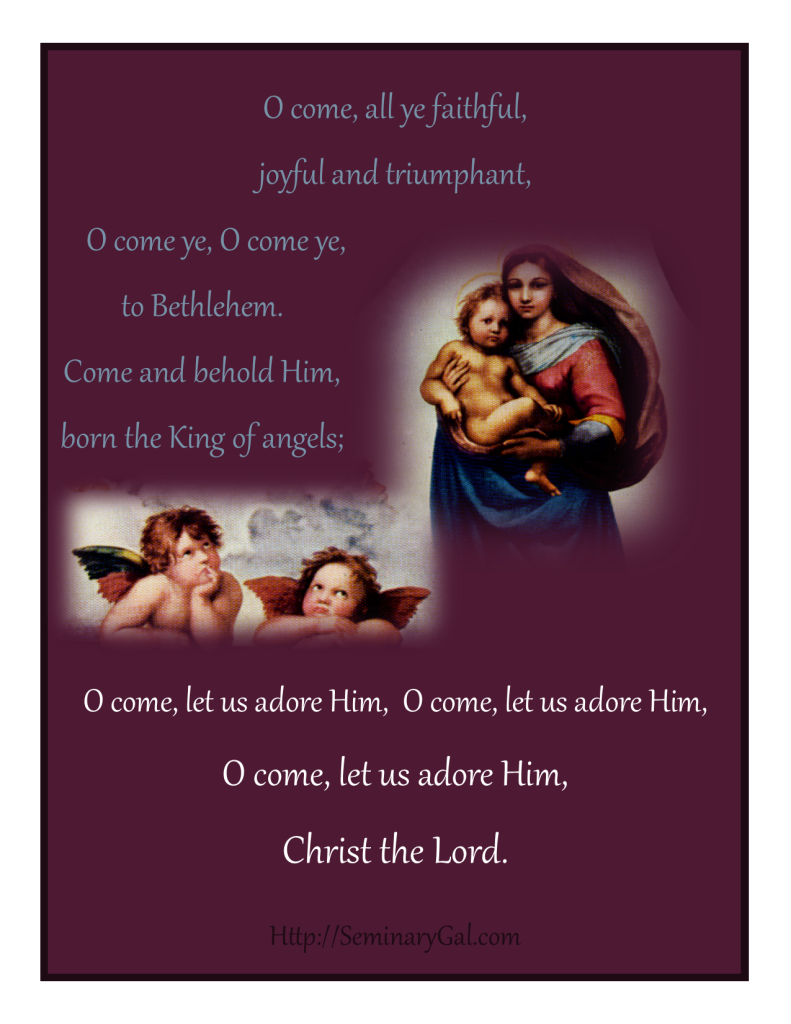
o come all ye faithfulO come, all ye faithful, joyful and triumphant,
O come ye, O come ye, to Bethlehem.
Come and behold Him, born the King of angels;

Refrain

O come, let us adore Him,
Christ the Lord.

True God of true God, Light from Light Eternal,
Lo, He shuns not the Virgin’s womb;
Son of the Father, begotten, not created;

Refrain

Sing, choirs of angels, sing in exultation;
O sing, all ye citizens of heaven above!
Glory to God, all glory in the highest;

Refrain

See how the shepherds, summoned to His cradle,
Leaving their flocks, draw nigh to gaze;
We too will thither bend our joyful footsteps;

Refrain

Lo! star led chieftains, Magi, Christ adoring,
Offer Him incense, gold, and myrrh;
We to the Christ Child bring our hearts’ oblations.

Refrain

Child, for us sinners poor and in the manger,
We would embrace Thee, with love and awe;
Who would not love Thee, loving us so dearly?

Refrain

Yea, Lord, we greet Thee, born this happy morning;
Jesus, to Thee be glory given;
Word of the Father, now in flesh appearing.

Refrain

=====

Carol Me, Christmas (2014 Advent Devotional Series) began November 30th.  By way of reminder, if you haven’t signed up yet, you can receive these devotional studies in your email throughout Advent 2014 by entering your email address on the SeminaryGal.com home page in the space provided in the sidebar.  Or “Like” the SeminaryGal Facebook page to access them there.  If you like these devotionals, I’d really appreciate your letting others know so I can continue to spread the Good News far and wide.  Blessings to you, in Christ always, Barbara <><

Continue Reading

Infant Holy Infant Lowly (Advent 20-2014)

Today’s carol, Infant Holy Infant Lowly,  is the first one we’ve explored as of Polish origin through the course of our Carol Me, Christmas (2014 Advent Devotional Series).

It’s a good time to pause and remember that Christmas is a worldwide celebration.  From Jesus’ humble human beginning in the womb of virgin and His laying in a manger in Bethlehem, how did this Child’s birth become a worldwide event that we remember annually?

It’s due to what He did during His thirty-three years of walking this earth. 

We’re still talking about Him two thousand years later.

I, for one, really love that Christmas is celebrated around the globe by people of different nationalities, in different languages, and with hymns of different cultural flavor.  It’s a taste of heaven where there will be a great diversity!

Revelation 7:9 After this I looked and there before me was a great multitude that no one could count, from every nation, tribe, people and language, standing before the throne and in front of the Lamb. They were wearing white robes and were holding palm branches in their hands.

Not much is known about Infant Holy Infant Lowly which was originally written as W żłobie leży.  The words were recorded in 1908 and translated into English by Edith Margaret Gellibrand Reed in 1921.

If “brevity is the soul of wit” (Shakespeare), consider how much of the Bible story is conveyed in Infant Holy Infant Lowly through only two short verses.   Enjoy this version by the King’s College Cambridge in their Lessons and Carols and ponder our Thought Focus for Today.

Thought Focus for Today: Have you ever thought about increase?  From an egg in a virgin’s womb in the first century to an international phenomenon still going two thousand years later, the increase goes from personal to local to international to the cosmos.  Someday, when Jesus returns, all the heavens will be resounding with the voices of angelic worship not unlike what happened at Jesus’ birth as the increase of His government reaches fulfillment in His eternal Kingdom.

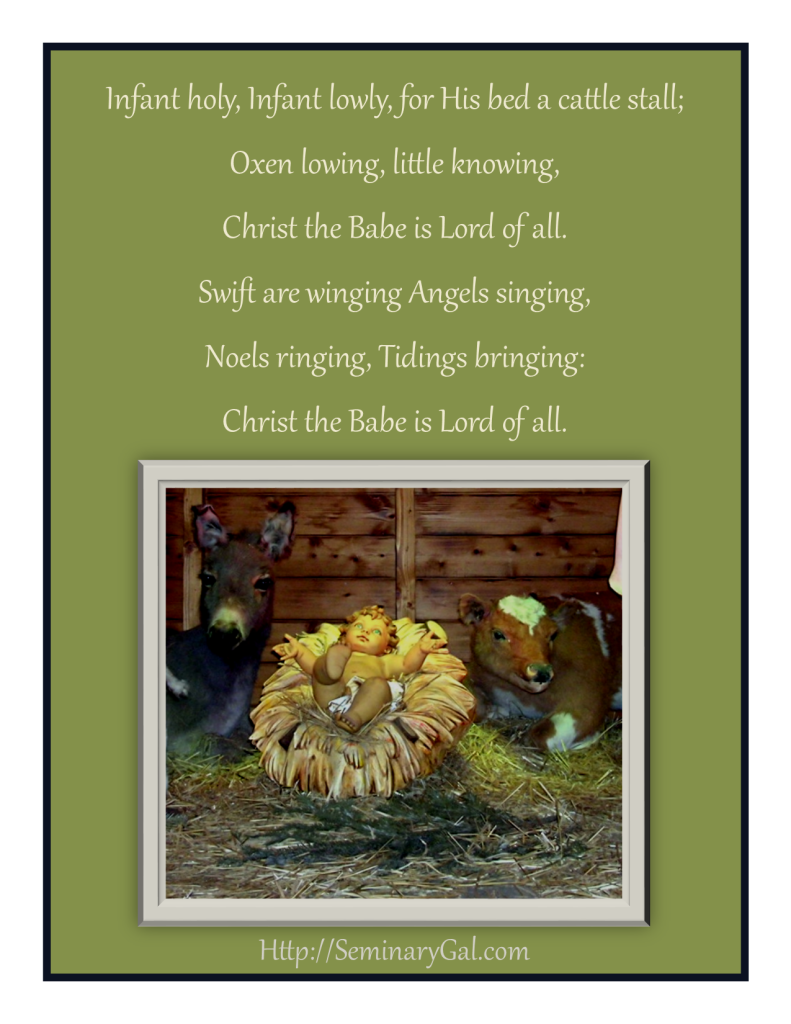
infant holy1. Infant holy, Infant lowly, for His bed a cattle stall;

Oxen lowing, little knowing, Christ the Babe is Lord of all.

Swift are winging Angels singing, Noels ringing, Tidings bringing:

Christ the Babe is Lord of all.


2. Flocks were sleeping, Shepherds keeping vigil till the morning new

Saw the glory, heard the story, tidings of a gospel true.

Thus rejoicing, free from sorrow, praises voicing, greet the morrow:

Christ the Babe was born for you.

=====

Carol Me, Christmas (2014 Advent Devotional Series) began November 30th.  By way of reminder, if you haven’t signed up yet, you can receive these devotional studies in your email throughout Advent 2014 by entering your email address on the SeminaryGal.com home page in the space provided in the sidebar.  Or “Like” the SeminaryGal Facebook page to access them there.  If you like these devotionals, I’d really appreciate your letting others know so I can continue to spread the Good News far and wide.  Blessings to you, in Christ always, Barbara <><

Continue Reading

The Believers’ Prayer (sermon text version)

dartboardwordsnoborderHave you ever been hated?  I have.  In fact, if I tell you the truth and that’s my policy: 

I am regularly hated by quite a few people. 

It’s not a particularly happy experience, that’s for sure.  But, if you’re hated by the right people for the right reasons, it can actually be a good thing.  It’s kind of a back-handed compliment.

Jesus never won any popularity contests when He walked the earth. 

And He told us that if we genuinely follow Him, you know what?  We’ll probably face the same thing.

Such is the case of Peter and John in the flow of the Book of Acts.  They’ve been following Jesus’ Great Commission and His command to take the Gospel to the entire known world.  So they start off in the local temple and on the way in, they heal a 40 year old guy who had been crippled since birth—a guy they found begging at the temple gate called Beautiful.

Suddenly they find themselves in prison.  They’re pretty unpopular guys with a crowd of religious hoity-toity sorts who try to figure out how best to punish these two evangelists.  Thus we have the beginning of Christian persecution that would continue what Jesus had told them while He was still walking the earth:

John 15: 17 This is my command: Love each other. 18 “If the world hates you, keep in mind that it hated me first. 19 If you belonged to the world, it would love you as its own. As it is, you do not belong to the world, but I have chosen you out of the world. That is why the world hates you. 20 Remember the words I spoke to you: ‘No servant is greater than his master.’ If they persecuted me, they will persecute you also. If they obeyed my teaching, they will obey yours also. 21 They will treat you this way because of my name, for they do not know the One who sent me. 22 If I had not come and spoken to them, they would not be guilty of sin. Now, however, they have no excuse for their sin.

So, just as Jesus was hated, so now Peter and John also are hated.  Even the crippled guy was probably hated because if he’d just minded well enough alone, and he was still begging and still crippled, none of this uproar would be happening.  So threats and intimidation are necessary to shut up the former cripple and the disciples of Jesus.

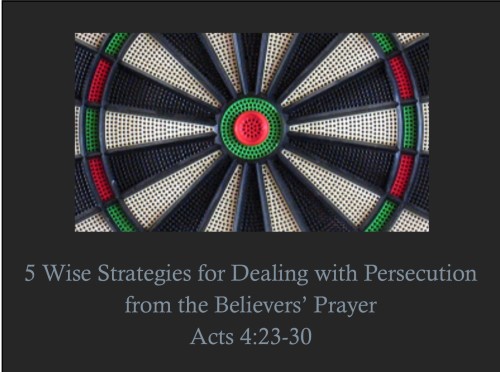
Today, I’d like to look at the Believers’ Prayer found in Acts 4:23-30 and learn some wise strategies for coping with persecution, accusation, unpopularity, and being hated because of your relationship with Jesus.

Sometimes the actions against you are designed by our adversary Satan to dispirit you, like when I was scheduled to speak at a major event to hundreds of people.  The discouragement and hurtful comments can even take the form of someone who means well.  Just before speaking, one woman walked up to me and said,

I must say, you’re not nearly as unattractive in person as you are in that photo.”

I said “Thank you!” and then pondered how that really wasn’t a compliment as I went up to the microphone to begin a Bible teaching program.

Then sometimes you’re doing the Lord’s work as best as you know how and then the punishment comes after the fact.  I’ve lived a strange life.  For a season, I was actively involved in the charter school movement in IL, trying to give parents options for a quality education for their children that had all the academics and as little of the agenda as possible.  Consequently I was a guest a few times on the Milt Rosenberg radio program broadcast out of the WGN studios in Chicago throughout the nation.  Afterward, I received a piece of hate mail.  My first piece in which the man writing it was a linguistics professor who told me that I have an “annoying vocal lilt, common in children though most outgrow it by adulthood.”  I obviously didn’t in this guy’s view and then he went on to say that I “probably picked it up from some snappy cartoon character.”  Sometimes, if taken the right way, even hate mail can be hilarious.

But the point is that opposition will come in many ways—not just with knives and guns and wars–but sometimes in the form of hurtful words and accusations, even by other self-professed Christians who are losing their witness by loving the world more than loving Jesus.  You know what?  If we don’t find strategies for dealing with it, we too can become sidelined or stalled in our Christian walk, or worse get wrapped up in the culture to where we lose our witness entirely.

It’s actually fitting to look at this during Advent because Mary would be shunned by all good society and she risked even being stoned for adultery because, after all, who would believe her story?  “Well, you see, there was this angel…”

Mary—as we heard in our Advent reading this morning– adopts some of these very same strategies that we see in Acts.  We can too.  Let’s take a look at these strategies.  Beginning in

Acts 4:23 On their release, Peter and John went back to their own people

Strategy #1:  Stick together.  Seek fellowship and encouragement by finding those who will understand. 

It was kind of like a support group.  Peter and John went back to their own people (i.e. other disciples).  Mary fled to see Elizabeth not only to double check that it was true since Elizabeth was identified by the angel as someone who would understand and be external evidence.  If Elizabeth was 6 months pregnant when she was way too old to be a mother, Mary would know that at least that part wasn’t a dream.  It would give her strength and confidence.

So Peter and John leave the temple area and seek the fellowship of other believers.

4:23 (continued) and reported all that the chief priests and elders had said to them.

In other words, they told the group of believers the persecution they were beginning to face.  When Mary ran to Elizabeth, Mary didn’t have to get beyond the “Hi Elizabeth” before the encouragement started!

Why do we need to stick together when persecution is happening?  We support one another and can feed off of each other’s encouragement.  We need each other.  There’s safety in numbers.  Isolation and “divide and conquer” are Satan’s favorite tools for destroying the Church.  But we can avoid these if we stick together in love and truth.

Continuing in Acts 4,

24 When they heard this, they raised their voices together in prayer to God.

Strategy #2: Praising God always helps.

Elizabeth blesses Mary and in the process, Elizabeth praises God.  Mary then launches into a full-blown song.

It’s not quite like that scene from the King and I when Anna sings, “Whenever I feel afraid, I hold my head erect.  And whistle a happy tune, so no one will suspect, I’m afraid.”  It’s not just the song.  It’s who we’re singing to.  Who we’re praying to.  Whose praise we’re engaging in.  The most powerful thing we can do as Christians is to praise God and let Him work on our behalf!

In a few weeks, we’ll get to Acts 5:40 … [The Sanhedrin] called the apostles in and had them flogged. Then they ordered them not to speak in the name of Jesus, and let them go. 41 The apostles left the Sanhedrin, rejoicing because they had been counted worthy of suffering disgrace for the Name. 42 Day after day, in the temple courts and from house to house, they never stopped teaching and proclaiming the good news that Jesus is the Christ.

Remember how I said that if you’re hated by the right people, for the right reasons, it can be a good thing?  It’s not like we’re trying to be as offensive as we can possibly be.  That is unchristian!  But the Gospel is offensive even when spoken in truth and love.  It’s not like we’re purposely trying to be a thorn in the side of society, but if we’re preaching the Gospel and sharing the Good News, opposition will happen.  When Christians shine Jesus’ light into the world it reveals both the flowers on the table and the spiders on the wall.  And the spiders don’t like the light.  Some will run, but others will bite.  So praise God.  We suffer disgrace for the Name.  In our passage today, the disciples break into a spontaneous prayer as the response to persecution.

 “Sovereign Lord,” they said, “you made the heaven and the earth and the sea, and everything in them.

Strategy #3: Remind yourself of God’s sovereignty!

The believers recount many instances of God’s sovereignty.  They even begin by addressing this prayer:

“Sovereign Lord,” they said, “you made the heaven and the earth and the sea, and everything in them.” [He is the Creator—doesn’t get more sovereign than that.]

25 You spoke by the Holy Spirit through the mouth of your servant, our father David:   [He is the Living Word who spoke prophetically then and who speaks to us today!  This same sovereign God intervened with the prophets and the apostles and He speaks through us to a culture that would rather be its own god.  Reminding the world that God alone is sovereign is likely to ruffle some feathers.]

 “‘Why do the nations rage and the peoples plot in vain? 26 The kings of the earth take their stand and the rulers gather together against the Lord and against his Anointed One.’ . [He is sovereign over all the nations and while God’s enemies may take a stand and gather to fight God, but ultimately that’s a losing battle because He is sovereign and they are not.  They are like a mist, a flower of the field that is here today and gone tomorrow.  We may not know our future, but we can know who holds it: our sovereign Lord.]

27 Indeed Herod and Pontius Pilate met together with the Gentiles and the people of Israel in this city to conspire against your holy servant Jesus, whom you anointed. 28 They did what your power and will had decided beforehand should happen. [He is architect of His own will and no one surprises God on any of this.  Even suffering fits in God’s plan, oddly enough.]

All of this points to the fact that God knows what’s going on and He’s got it all under control even if we don’t understand how.

That’s what Mary praised God for!  God sovereignly remembered to be faithful to all of His promises and in the process lifted the humble and taught those self-righteous savior/king-wannabes a lesson.

Strategy #4: Press On!  Don’t let the discouragement prevent your following Jesus!

29 Now, Lord, consider their threats and enable your servants to speak your word with great boldness. 30 Stretch out your hand to heal and perform miraculous signs and wonders through the name of your holy servant Jesus.”

These disciples asked for God—not to take away the threats—but to show Himself present in greater boldness.  Evidence that would be undeniable to others.

31 After they prayed, the place where they were meeting was shaken. And they were all filled with the Holy Spirit and spoke the word of God boldly.

This doesn’t mean that they became indwelled with the Holy Spirit since they were already believers.  This filling was like filling their spiritual gas tank.  They needed empowering to press on!

The final strategy becomes apparent only as we look at the entire prayer.  These disciples knew their Bibles.

Strategy #5: Immerse yourself in God’s Word.  There’s power there. 

This whole section is filled with Scripture quotations.  In fact, the whole Book of Acts is one OT reading after another.  There is a reason why I always want to have an OT reading as part of our Sunday worship.  We can find strength there.  Just like in today’s reading, the Lord is David’s strength and David strengthened himself up in the Lord.

You see, sometimes, we have no accountability group, no support, no friends to stand by our side, we’re deserted…a lot like Jesus was abandoned.  Standing alone is unpleasant stuff.   It happens more often for those who are in leadership roles or who are called to be a voice in the wilderness like John the Baptist.  But whether we’re leaders or just in places where safety in numbers isn’t available, it helps to know that God’s Word is planted in our hearts and it is the best weapon we have against discouragement, depression, loneliness, uncertainty, fear, and feelings of confusion.  There’s power there because Hebrews 4:12 For the word of God is living and active. Sharper than any double-edged sword, it penetrates even to dividing soul and spirit, joints and marrow; it judges the thoughts and attitudes of the heart.

2 Timothy 3:16 All Scripture is God-breathed and is useful for teaching, rebuking, correcting and training in righteousness, 17 so that the man of God may be thoroughly equipped for every good work.

It can also help us to stand firm in the day of battle, even battling confidently by standing still.  Ephesians 6: 10 Finally, be strong in the Lord and in his mighty power. 11 Put on the full armor of God so that you can take your stand against the devil’s schemes. 12 For our struggle is not against flesh and blood, but against the rulers, against the authorities, against the powers of this dark world and against the spiritual forces of evil in the heavenly realms. 13 Therefore put on the full armor of God, so that when the day of evil comes, you may be able to stand your ground, and after you have done everything, to stand. 14 Stand firm then, with the belt of truth buckled around your waist, with the breastplate of righteousness in place, 15 and with your feet fitted with the readiness that comes from the gospel of peace. 16 In addition to all this, take up the shield of faith, with which you can extinguish all the flaming arrows of the evil one. 17 Take the helmet of salvation and the sword of the Spirit, which is the word of God. 18 And pray in the Spirit on all occasions with all kinds of prayers and requests. With this in mind, be alert and always keep on praying for all the saints.

In this simple prayer of Acts 4:23-30, we see 5 great strategies for standing firm and living life with boldness.

  1. Stick Together
  2. Praise God
  3. Remember His Sovereignty and that He knows the end of the story
  4. Press On!
  5. Know Your Bible

If we do these things, we’ll be fully equipped to deal with standing firm and standing alone.  We can cope with being hated, isolated, accused, insulted…because Jesus said this would happen when we truly follow Him.

Let’s pray.
 

Continue Reading

The Believers’ Prayer (audio version)

dartboardwordsnoborderThe audio version of The Believers’ Prayer (click link) with 5 Strategies for Dealing with Persecution is now available on YouTube.  For those of you receiving these emails for the Advent Devotional Series, Carol Me Christmas! I still post both the audio and the sermon text versions of messages I preach on Sundays along with the day’s Advent devotionals.  I hope you enjoy these sermons and are blessed by them.  The Believers’ Prayer  (Acts 4:23-30) continues the sermon series of Acts of the Holy Spirit and the Apostles which began in August and can be accessed through the August-December archives.

===

Carol Me, Christmas (2014 Advent Devotional Series) began November 30th.  By way of reminder, if you haven’t signed up yet, you can receive these devotional studies in your email throughout Advent 2014 by entering your email address on the SeminaryGal.com home page in the space provided in the sidebar.  Or “Like” the SeminaryGal Facebook page to access them there.  If you like these devotionals, I’d really appreciate your letting others know so I can continue to spread the Good News far and wide.  Blessings to you, in Christ always, Barbara <><

Continue Reading

Away in a Manger (Advent 19-2014)

Yesterday, in our Carol Me, Christmas (2014 Advent Devotional Series), I suggested that carols could be used as theological education for children.  Just don’t use this one.

Away in a Manger is a favorite of adults and children alike (despite its being wrong on two counts):

  1. Its attributed subtitle as Luther’s Cradle Hymn
  2. Its theology as a whole

That said, the little lullaby tune combined with sweet baby lyrics makes it a popular choice for children’s programs and Christmas pageants.

Let’s just be blunt: there is no way that Martin Luther–the same guy of 15 verses yesterday of pristine theology–would have written 2-3 verses of something so inaccurate. 

Some people have suggested that it was written for the anniversary of Luther’s birth with his name thrown in as a marketing plus, but either way, it was first published as two verses in Evangelical Lutheran Sunday School collection, Little Children’s Book for Schools and Families.  The Lutherans love Luther so much that perhaps these wanted to find him everywhere including in the Cradle Hymn.  Kind of like how Baptists find Satan under every rock and in the vast majority of US political offices.  (Aw, go ahead, insert a wink and a smile here.  Christians can laugh at ourselves without going to hell.)

Why do I say that the theology is inaccurate?

The cattle are lowing, the Baby awakes,

 But little Lord Jesus, no crying He makes;

Frankly, the little Lord Jesus did not wake up and say to his mother, the virgin Mary, in a calm soothing God-voice

Verily I say unto thee, I have food to eat that you don’t know about.”

Because Lord knows, the Son of God never had a dirty diaper (insert sarcasm here).  This is patently ridiculous.  Crying is not a sin!  Crying is how babies talk and Jesus was as human a baby as any other baby born in the completely natural way.  His conception in Mary’s womb by the Spirit of God was the only miracle here.

Luke 1:35 The angel answered, “The Holy Spirit will come upon you, and the power of the Most High will overshadow you. So the holy one to be born will be called the Son of God. 36 Even Elizabeth your relative is going to have a child in her old age, and she who was said to be barren is in her sixth month. 37 For nothing is impossible with God.”

Jesus was not a miracle baby who never cried, always slept through the night, and never had diaper issues.  He probably experienced teething pain, coughs, colds and flu during the span of His life.  He didn’t spoil His mother Mary by giving her an impossible frame of reference for her other children who would come after Him to fail to achieve.  Jesus was not superhuman.  He was human.  He only added complete humanity to His already complete divinity.

It’s not just a minor theological point.  It’s central.

But Away in a Manger is a cute song.  It’s cute when kids sing it and they love this one.  If you’re on the English side of the pond, the tune is one by William J. Kirkpatrick Cradle Song (1895) which was an adaptation of another known as Sweet Afton, and if you’re on the American side of the pond, the one most commonly used is James R. Murray’s Mueller (1887).  Some hymnals are bi-polar and include both variations.

As you read through the lyrics below, enjoy this Kirkpatrick version sung by children dressed in festive red and green with red Santa hats and Santa playing piano, and ponder our Thought Focus for Today.

Thought Focus for Today:  Why is it theologically important that Jesus was fully human and yet, not some superhuman being?

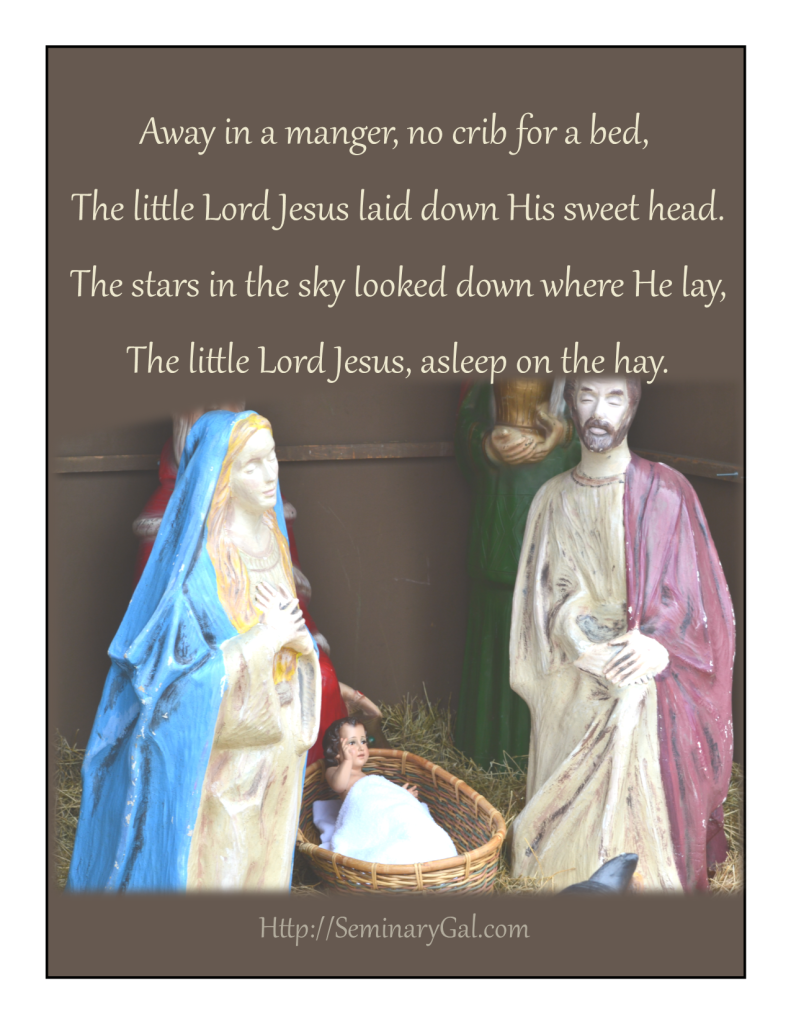
away in a mangerAway in a manger, no crib for a bed,

The little Lord Jesus laid down His sweet head.

The stars in the sky looked down where He lay,

The little Lord Jesus, asleep on the hay.


The cattle are lowing, the Baby awakes,

But little Lord Jesus, no crying He makes;

I love Thee, Lord Jesus, look down from the sky

And stay by my cradle till morning is nigh.


Be near me, Lord Jesus, I ask Thee to stay

Close by me forever, and love me, I pray;

Bless all the dear children in Thy tender care,

And fit us for Heaven to live with Thee there.

=====

Carol Me, Christmas (2014 Advent Devotional Series) began November 30th.  By way of reminder, if you haven’t signed up yet, you can receive these devotional studies in your email throughout Advent 2014 by entering your email address on the SeminaryGal.com home page in the space provided in the sidebar.  Or “Like” the SeminaryGal Facebook page to access them there.  If you like these devotionals, I’d really appreciate your letting others know so I can continue to spread the Good News far and wide.  Blessings to you, in Christ always, Barbara <><

Continue Reading

From Heaven Above to Earth I Come (Advent 18-2014)

Today’s carol in our Carol Me, Christmas (2014 Advent Devotional Series) is less familiar to me.  Perhaps that’s because it was written by Martin Luther and A Mighty Fortress is Our God eclipses his other hymns outside of Lutheran circles.

From Heaven Above to Earth I Come was written by Martin Luther (yes, of Reformation fame) for family devotionals.  It is said Luther wrote this carol especially for his five year old son Hans and was performed a man dressed up as an angel (or sung by the parents) pronouncing the opening verses that one would expect would be straight out of Scripture.  (After all, this is Martin Luther we’re talking about.  Mr. Sola Scriptura—by Scripture alone!)

Luke 2:1 In those days Caesar Augustus issued a decree that a census should be taken of the entire Roman world. 2 (This was the first census that took place while Quirinius was governor of Syria.) 3 And everyone went to his own town to register. 4 So Joseph also went up from the town of Nazareth in Galilee to Judea, to Bethlehem the town of David, because he belonged to the house and line of David. 5 He went there to register with Mary, who was pledged to be married to him and was expecting a child. 6 While they were there, the time came for the baby to be born, 7 and she gave birth to her firstborn, a son. She wrapped him in cloths and placed him in a manger, because there was no room for them in the inn. 8 And there were shepherds living out in the fields nearby, keeping watch over their flocks at night. 9 An angel of the Lord appeared to them, and the glory of the Lord shone around them, and they were terrified. 10 But the angel said to them, “Do not be afraid. I bring you good news of great joy that will be for all the people. 11 Today in the town of David a Savior has been born to you; he is Christ the Lord. 12 This will be a sign to you: You will find a baby wrapped in cloths and lying in a manger.” 13 Suddenly a great company of the heavenly host appeared with the angel, praising God and saying, 14 “Glory to God in the highest, and on earth peace to men on whom his favor rests.” 15 When the angels had left them and gone into heaven, the shepherds said to one another, “Let’s go to Bethlehem and see this thing that has happened, which the Lord has told us about.” 16 So they hurried off and found Mary and Joseph, and the baby, who was lying in the manger. 17 When they had seen him, they spread the word concerning what had been told them about this child, 18 and all who heard it were amazed at what the shepherds said to them.

According to the Virginia Lutherans ELCA,

This Christmas hymn is Luther’s own composition, dated around 1535 when Luther’s own children would have been old enough to sing. The scholarly conjecture is that the hymn originated in Luther’s family devotion, with the part of the angels in verses one to five being sung by the parents, individual children singing the various verses eight through fourteen, and all together singing verse seven and fifteen (LW 53: 267). Luke’s depiction of the angels’ proclamation of the good news to the shepherds structures the first part. Thus the parents lead the children to sing their parts to the Christ‐child by concluding the introductory verses with the exhortation of the shepherds in verse six “to go and see this thing which the Lord has made known.” The hymn concludes with all voices joining the angels in the praise of God.

This carol was sung not only for the an­nu­al Christ­mas Eve fes­ti­val at the Lu­ther home, but 4 years later would be published to a folk tune and then to the one written by Luther himself,  Vom Himmel hoch, da komm’ ich her. Variations on this tune were written by Johann Sebastian Bach and the carol itself was later translated for us into English in 1855 by Catherine Winkworth (who we’ve seen before as a great translator of the German chorale tradition for English audiences).

While present in a few hymnals in all fifteen verses (!), the only hymnals that I have even containing this carol will include only the 4 verses highlighted below.

As you read all 15 verses, listen to this version on double-bass by deaf performer Hector Tirado and ponder our Thought Focus for Today.

Thought Focus for Today: Here we see a prime example of how Christmas carols can teach the Bible.  How might you do family devotions (especially for children) using Christmas carols?

from heaven above to earth i come1. “From heaven above to earth I come

 To bear good news to every home;

 Glad tidings of great joy I bring,

 Whereof I now will say and sing:


2. “To you this night is born a child

 Of Mary, chosen virgin mild;

 This little child, of lowly birth,

 Shall be the joy of all the earth.


3. “This is the Christ, our God and Lord,

Who in all need shall aid afford;

He will Himself your Savior be

From all your sins to set you free.


4. “He will on you the gifts bestow

Prepared by God for all below,

That in His kingdom, bright and fair,

You may with us His glory share.


5. “These are the tokens ye shall mark:

The swaddling-clothes and manger dark;

There ye shall find the Infant laid

By whom the heavens and earth were made.”


6. Now let us all with gladsome cheer

Go with the shepherds and draw near

To see the precious gift of God,

Who hath His own dear Son bestowed.


7. Give heed, my heart, lift up thine eyes!

What is it in yon manger lies?

Who is this child, so young and fair?

The blessed Christ-child lieth there.


8. Welcome to earth, Thou noble Guest,

Through whom the sinful world is blest!

Thou com’st to share my misery;

What thanks shall I return to Thee?


9. Ah, Lord, who hast created all,

How weak art Thou, how poor and small,

That Thou dost choose Thine infant bed

Where humble cattle lately fed!


10. Were earth a thousand times as fair,

Beset with gold and jewels rare,

It yet6 were far too poor to be

A narrow cradle, Lord, for Thee.


11. For velvets soft and silken stuff

Thou hast but hay and straw so rough,

Whereon Thou, King, so rich and great,

As ’twere Thy heaven, art throned in state.


12. And thus, dear Lord, it pleaseth Thee

To make this truth quite plain to me,

That all the world’s wealth, honor, might,

Are naught and worthless in Thy sight.


13. Ah, dearest Jesus, holy Child,

 Make Thee a bed, soft, undefiled,

 Within my heart, that it may be

 A quiet chamber kept for Thee.


14. My heart for very joy doth leap,

My lips no more can silence keep;

I, too, must sing with joyful tongue

That sweetest ancient cradle-song:


15. Glory to God in highest heaven,

 Who unto us His Son hath given!

 While angels sing with pious mirth

 A glad new year to all the earth.

=====

Carol Me, Christmas (2014 Advent Devotional Series) began November 30th.  By way of reminder, if you haven’t signed up yet, you can receive these devotional studies in your email throughout Advent 2014 by entering your email address on the SeminaryGal.com home page in the space provided in the sidebar.  Or “Like” the SeminaryGal Facebook page to access them there.  If you like these devotionals, I’d really appreciate your letting others know so I can continue to spread the Good News far and wide.  Blessings to you, in Christ always, Barbara <><

Continue Reading

O Holy Night (Advent 17-2014)

Continuing our theme of the holy night (with holiness meaning set apart) today’s selection in Carol Me, Christmas (2014 Advent Devotional Series) is O Holy Night, known also as Cantique de Noël.  The words in the original French poem by Placide Cappeau would be literally translated as:

Midnight, Christians, it is the solemn hour,

When God as man descended unto us

To erase the stain of original sin

And to end the wrath of His Father.

The entire world thrills with hope

On this night that gives it a Saviour.

People kneel down, wait for your deliverance.

Christmas, Christmas, here is the Redeemer,

Christmas, Christmas, here is the Redeemer!

May the ardent light of our Faith

Guide us all to the cradle of the infant,

As in ancient times a brilliant star

Guided the Oriental kings there.

The King of Kings was born in a humble manger;

O mighty ones of today, proud of your greatness,

It is to your pride that God preaches.

Bow your heads before the Redeemer!

Bow your heads before the Redeemer!

The Redeemer has broken every bond:

The Earth is free, and Heaven is open.

He sees a brother where there was only a slave,

Love unites those that iron had chained.

Who will tell Him of our gratitude

For all of us He is born, He suffers and dies.

People stand up! Sing of your deliverance,

Christmas, Christmas, sing of the Redeemer,

Christmas, Christmas, sing of the Redeemer!

These lyrics are beautiful and yet ironic.  Here’s why:  Cappeau was invited by a parish priest in Roquemaure to write a poem because Cappeau was a home town favorite as an occasional poet and wine merchant.  You’d never know given the beauty of the poem that Cappeau was both anticlerical and an atheist according to published reports.  He was also an abolitionist and there is a hint in verse 3 of his passion in that area.

Truly He taught us to love one another;

His law is love and His gospel is peace.

Chains shall He break

for the slave is our brother;

And in His name all oppression shall cease.

To add further intrigue, the musical composer, Adolphe Adam, was kind of a carousing sort and best remembered for Giselle (a ballet dating to 1841).  He was considered a rogue because of his lifestyle and his compositions for light and comedic opera.  Consequently, many churches shunned this carol as inappropriate due to Adam’s wild living.  Nevertheless, the carol premiered in Roquemaure in 1847.

Oh, but we’re not done.  The most common translation into English was done by John Sullivan Dwight who was another Unitarian pastor with the resulting lyrics talking about Jesus as the Christ.  The Unitarians do not believe that Jesus is God so either Dwight did a translation without believing a word of it, or maybe he didn’t adhere closely to Unitarian teachings.

Here is his translation.

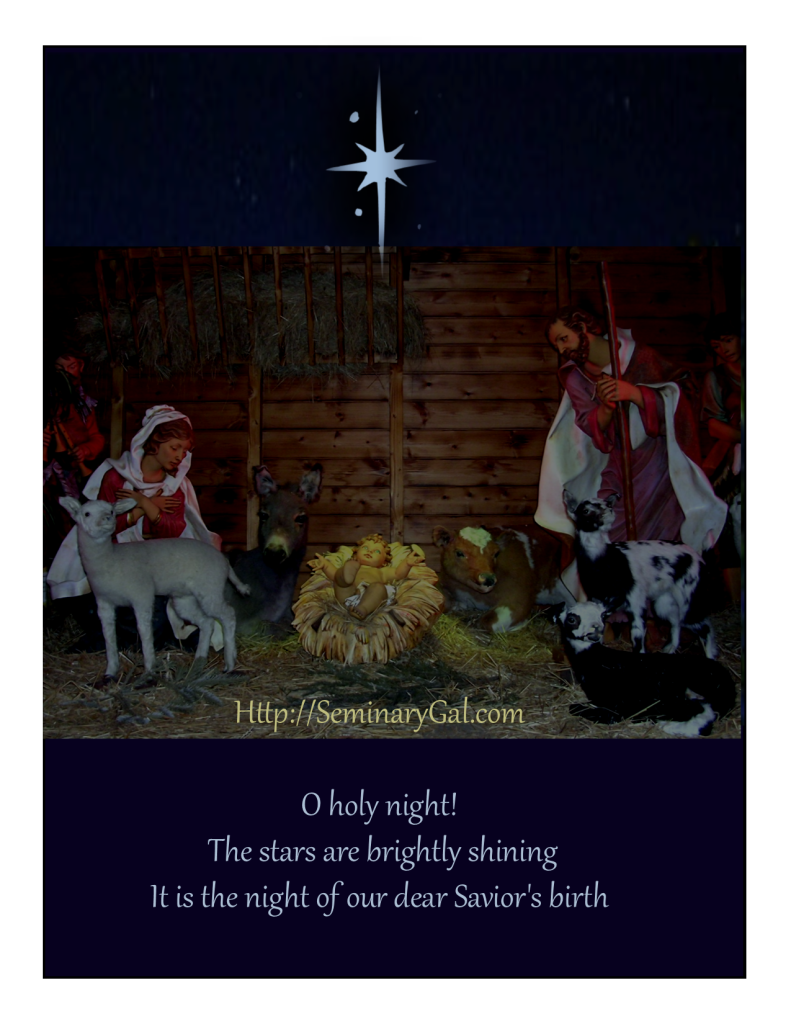
O holy night!

 The stars are brightly shining

It is the night of our dear Saviour’s birth

Long lay the world in sin and error pining

‘Til He appear’d and the soul felt its worth

A thrill of hope the weary world rejoices

For yonder breaks a new and glorious morn

Fall on your knees!

O hear the angel voices!

O night divine,

O night when Christ was born;

O night divine, O night,

O night Divine.


Led by the light of Faith serenely beaming

With glowing hearts by His cradle we stand

So led by light of a star sweetly gleaming

Here come the wise men from Orient land.

The King of Kings lay thus in lowly manger;

In all our trials born to be our friend.

He knows our need,

 our weakness is no stranger,

Behold your King!

Before Him lowly bend!

Behold your King,

Before Him lowly bend!


Truly He taught us to love one another;

His law is love and His gospel is peace.

Chains shall He break

for the slave is our brother;

And in His name all oppression shall cease.

Sweet hymns of joy in grateful chorus raise we,

Let all within us praise His holy name.

Christ is the Lord!

O praise His Name forever,

His power and glory evermore proclaim

His power and glory evermore proclaim.

This brings us to a really important point for us today.  What makes music sacred?  Is it the lyrics?  Is it the tune?  Is it the meter or beat of the music?  Must the people writing it be Christians?  What kind of litmus test must we place upon their lives in order to judge whether they’re sufficiently Christian in their practice as well as in their theology?  Does the spirit of the music still speak, just differently for those who have the Spirit of Christ dwelling in them?

1 Corinthians 2:14 But the natural man does not receive the things of the Spirit of God, for they are foolishness to him; nor can he know them, because they are spiritually discerned.

When I was in seminary, we were required to do a cross-cultural field education experience and I begged to break with traditional field eds and to do my 13 week cross-cultural experience by attending Shabbat services at our local Reform Jewish synagogue.  It was a real highlight of my time at seminary.  The rabbi’s wife, who was also Jewish, taught the New Testament at a local seminary that was more liberal than where I was being educated.  I remember talking with the rabbi and asking him,

How is that possible?

He said she could teach what the words on a page say without believing a word of its veracity in her life.  As I began to ponder that, I figured it’s the flip side of my telling you what Unitarians believe without agreeing with them.

o holy night1All of this to say that this hymn might not be in many hymnals and the rationale may be varied by the hymnbook editors, but it’s still a lovely poem.  It does point to holiness, to the Christ as the Kings of Kings and of His Lordship.  To His birth as what we celebrate at Christmas.  It’s a night Divine, a holy night.  Sure, it’s got the wise men coming to the manger, but it’s not the only hymn that did that and those are hymns that we include without a second thought.

As you listen to Sam Tsui on piano accompanied by Yasmeen Al-Mazeedi  on violin, reflect upon our Thought Focus for today and reread the two sets of lyrics above.

Thought Focus for Today: 

What makes a carol sufficiently religious for Christmas?

=====

Carol Me, Christmas (2014 Advent Devotional Series) began November 30th.  By way of reminder, if you haven’t signed up yet, you can receive these devotional studies in your email throughout Advent 2014 by entering your email address on the SeminaryGal.com home page in the space provided in the sidebar.  Or “Like” the SeminaryGal Facebook page to access them there.  If you like these devotionals, I’d really appreciate your letting others know so I can continue to spread the Good News far and wide.  Blessings to you, in Christ always, Barbara <><

Continue Reading