
In the Garden with Seminary Gal

I believe God is the ultimate conservationist.  He wastes nothing.  He makes everything beautiful in its season.  Since part of my background is horticulture, it should be no surprise that I love gardens and all the plant imagery in the Bible.   It’s wonderful that mankind’s first home after Creation was the Garden of Eden…and their job was to tend it as God’s sanctuary.  (Genesis 2:15 The LORD God took the man and put him in the Garden of Eden to work it and take care of it.)
 
I live in USDA Zone 5b and invite you to enjoy my garden along with me.  It’s February and the big snow from earlier in the month is melting just enough so that my thoughts turn to spring gardening.
 
This month, I’m harvesting branches of forsythia for forcing in water with floral preservative in it.  I cut branches with plump buds and brought them inside, letting them warm to room temperature.  Then, I moistened each branch, placed them in a vase of water with preservative, and situated them in a location with indirect light where I can watch them burst forth in a sunny yellow riot of flowers.  Depending on light and warmth and the date on which they are harvested, it takes between 1-2 weeks to see the lime green buds popping through the scaly wood followed by the emergence of forsythia’s characteristic yellow flowers.
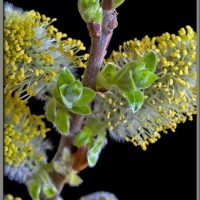
 
 
I’m also excited that the pussy willow I bought last year has its flower buds swelling.  The fuzzy buds of a pussy willow are actually flowers called “catkins” and are present on male pussy willow plants.  Eventually, they will shed their pollen and leaves will emerge.  For more beautiful close-up photos of pussy willows, check out the link.


Recently, I brought my tulip and hyacinth bulbs in from their 12 week cold treatment for forcing indoors.  They make beautiful and cheerful spring flower arrangements with their leaves and flower stalks arising from bulbs atop decorative pebbles in a glass vase.  Speaking of bulbs, soon the first of my outdoor bulbs will be emerging:  winter aconite, snowdrops, and early snow crocus.  Check out this page every month for my garden update.

Continue Reading

The Harrowing of Hell

The Harrowing of Hell (Summary Version):

Harrowing of Hell

Thank you, Simon, for asking the interesting question about  the “Harrowing of Hell.”   First, I’ll offer a short summary answer followed by two pages going progressively deeper into the topic.

The term “Harrowing of Hell” refers to the time after Christ’s victory over death through which He was able to secure freedom for righteous men and women imprisoned by sin since the Fall of Man.  The timing happened sometime after His death, but before His resurrection.  Some theologians do not want to taint Christ with Hell…even by a temporary visit…so they disregard this as not being in Scripture.

The bottom line is that the answer to the question “Where did Jesus go after He died?” is that His body lay in the ground for three days prior to His resurrection while His Spirit went elsewhere.

Jesus Christ secured freedom for all of God’s faithful people by His death on the Cross –even if it doesn’t specifically say how Christ went to release them from hell.

 But there’s more to this and if you’d like to go deeper, join me on the next page.

Continue Reading

Being Resolved

The meaning of resolution can vary dramatically depending on the sphere in which it is used. Interestingly, Daniel experienced resolution in many ways when he resolved to serve God continually…even in Babylon.

Being resolved is critical to our daily walk with God…and Daniel shows us that nothing can prepare us for a lion’s den of troubles like cultivating a rhythm of worship, a continual serving of God.

Daniel 1:8 records that Daniel resisted the carnal temptation to personal luxury by making a prior resolution of will to serve God continually, not just in the corners of his life, but at the epicenter of his every action. In a world of political pressures, he had one master, not two. No division. No competition for his allegiance. God alone mattered. Can we say the same?

A pattern of serving God is visible to others (Daniel 6). Daniel’s critics saw and plotted a lion’s den, but in Daniel 6: 16b, “The king said to Daniel, ‘May your God, whom you serve continually, rescue you!’”

God rescued Daniel and in light of this, the king proclaimed, “In every part of my kingdom people must fear and reverence the God of Daniel. For he is the living God and he endures forever” (Daniel 6:26).

A rhythm of worship anchors our souls so that when dissonant voices call out in conflict, confusion, or criticism, we will find our hope in God and trust in Him as our ultimate resolution.

Continue Reading

The Deep, Deep Love of Jesus

Suffering has been a hallmark of God’s faithful people throughout history. Loved by God and yet appointed to suffer for Him. Why is that a logical connection?

In Romans 8:36, “it is written: “For your sake we face death all day long; we are considered as sheep to be slaughtered.” This statement of suffering is placed in the middle of what looks like a multiple choice question in a test of faith:

Who shall separate us from the love of Christ? (v. 35)

a) Trouble
b) Hardship
c) Persecution
d) Famine
e) Nakedness
f) Danger
g) Sword
h) None of the above, “No, in all these things we are more than conquerors through him who loved us” (v. 37).

Look at the list again. Christians are on a constant, irrevocable trajectory of eternal life. Things may happen along the way to highlight the Deep, Deep Love of Jesus which can only be plumbed in its every dimension by facing the physical, emotional, spiritual, and perseverance multiple choice testing of our faith.

Our hope in Christ will not be changed by anything. His love is deep and unchanging so we can proclaim along with the Apostle Paul, “I am convinced that neither death nor life, neither angels nor demons, neither the present nor the future, nor any powers, neither height nor depth, nor anything else in all creation, will be able to separate us from the love of God that is in Christ Jesus our Lord” Romans 8:38-39.

Continue Reading