 There’s nothing like a New Year. All kinds of hopes and dreams and diets are reborn. All kinds of plans are made that will soon be forgotten, lost in the shuffle, or stripped of every ornament and left out at the curb.
But still, we love the idea of a New Year. There’s something happy about it: the dawn of a New Year always brings with it the idea of a clean slate—a new beginning.
Even if it’s just an accounting gimmick since really it’s that one day flows to the next.
Our Christian lives, however, are no mere gimmick. When we become Christians, we are not gently tweaked versions of what we were before. We are not slight improvements. We are not last year’s model polished up for eBay or a garage sale. We are not the same person only thinner, thanks to Nutrisystem.
We are reborn into an entirely new life, a new start, a new attitude, a clean slate, new manner of living, and we are born into a whole new thing: the Church. This is one new thing that God cares VERY deeply about.
And this new thing called the Church demands our most careful attention to keeping the good thing going and not allowing it to become polluted. As believers in our day, we’re not too good at keeping it from being polluted. When you think of the Church these days, you see probably see headlines of scandals and abuses and all kinds of pollution that grieve the heart of God. Pollution takes what Jesus died to give us and turns it into hypocrisy at best and fraudulent, self-aggrandizing ineffectiveness that defames the Name of Christ on the other. How God must weep over what we have done… with what His Son… did!
Have you ever noticed that pollution is a one-way street?
Put clean clothes accidently on the dirty laundry and it’s all dirty. It never miraculously makes the dirty laundry clean. When we go to the mall and we put our clean hand on the railing of the escalator, we don’t make the escalator suddenly free of flu germs, we catch the flu if we’re not careful.
Which brings us to the passage of Scripture that I referred to last week. You may remember that last week we talked about how Christians are supposed to share and share alike. That a really good guy named Barnabas, the Son of Encouragement, was a role model, an encourager, who sold some property, brought the money to the disciples for it to be distributed to the needy. In the Church at Jerusalem, there were many needs since it was a poor place with many elderly Jews coming to Jerusalem to die in the Holy City and be buried there. There was an abundance of widows and not enough money to go around…if it weren’t for people like Barnabas.
No doubt people saw what Barnabas did and wanted to be like him. They wanted the recognition that Barnabas received, the favor of all the people…to be known as a good person, an encourager!
Let’s look at Acts 5:1-11 and learn 7 principles regarding the early Church and for our lives today as a New Year Holiness Challenge.
But first, let’s backtrack a bit to the prior verses to put today’s passage in its proper context and then explore these principles. Acts 4:34 There were no needy persons among them. For from time to time those who owned lands or houses sold them, brought the money from the sales 35 and put it at the apostles’ feet, and it was distributed to anyone as he had need. 36 Joseph, a Levite from Cyprus, whom the apostles called Barnabas (which means Son of Encouragement), 37 sold a field he owned and brought the money and put it at the apostles’ feet
Acts 5:1 Now a man named Ananias, together with his wife Sapphira, also sold a piece of property.
Principle 1: Encouragement is contagious.
Barnabas didn’t have to parade what he did. He just had to do what he did and it encouraged others to want to do likewise. Others wanted to imitate, emulate his behavior because they saw the favor he received from doing the right thing.
Encouragement is contagious! But it’s not a one way street or unidirectional. You see, we often view encouragement as being something good, but things like “peer pressure” and bullying are nothing more than encouragement to conform to someone else’s standards or expectations. So for example, three-quarters of the Florida State Seminoles in a show of poor sportsmanship followed the leader—whoever the first one was–into the locker room instead of crossing the field to shake hands with the team from Oregon that defeated them in the Rose Bowl.
You may have heard the quote “Imitation is the sincerest [form of] flattery”. But what you may not know is the author Charles Caleb Colton was an English cleric whose curacy was the vicarage of Kew and Petersham. Colton’s job performance was profoundly erratic, described as “at times conscientious and brilliant while at other times cursory and indulgent.” Eventually, he fell away. He left formal church employment, fled from his creditors, invested money he owed others in an art gallery and fine wines in France where he took up residence. He gambled his life away in the gaming salons of the “Palais Royal” –at first being quite successful, but eventually he became destitute, living off of family members until he died. Not a life worth imitating.
Colton obviously didn’t imitate the right things. He must have been sleeping in his theological education when they covered Ephesians 5:1 Be imitators of God, therefore, as dearly loved children 2 and live a life of love, just as Christ loved us and gave himself up for us as a fragrant offering and sacrifice to God. 3 But among you there must not be even a hint of sexual immorality, or of any kind of impurity, or of greed, because these are improper for God’s holy people.
In our passage today, you know what? Ananias and Sapphira were little different. They didn’t choose to imitate the good. Acts 5:1 Now a man named Ananias, together with his wife Sapphira, also sold a piece of property. 2 With his wife’s full knowledge he kept back part of the money for himself, but brought the rest and put it at the apostles’ feet.
“Why is this bad?,” you might wonder. After all, it was their property. It was their money! Didn’t we talk about this last week that property rights are A-OK? Yes we did. Now we will see what makes Ananias and Sapphira’s actions bad.
Principle 2: Deception is contagious and dangerous.
Ananias and Sapphira wanted the full recognition for doing what Barnabas had done, but as a show for their own glory and accolades and not at all as sincerity. They decided to deceive the Church, letting the other believers think that Ananias and Sapphira were doing exactly what Barnabas had done…while not being completely forthright about the truth of what they were doing.
Is this really that bad?
Yes it actually is.
Pure hearts and holy people are what God wants, not a culture of deception. But, in our present-day culture, deception is the name of the game. Lies are thought to be fine so long as you get away with it.
 It hasn’t always been like this.
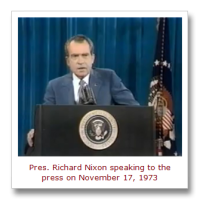
When Richard Nixon lied to the American people, it was a headline. His name became synonymous with “I am not a crook!” even as he lied to the American people. Nixon is probably best remembered for lying to the nation he swore to uphold and protect, ending with his resignation and receiving a Presidential pardon.
* * *
Back then, lying was a huge deal.
* * *
 Today, however, we still don’t know the truth about any of the present-day “phony” scandals, we cannot keep our doctor or our insurance as we were promised, and Chicago probably runs a close second to Washington, DC in numbers of lies told per political official. OK, well, maybe New York City and Detroit are in there, too…because you see, unchecked– deception is contagious and dangerous! It’s like invasive cancer and people get hurt.
So Principle 3: Purity matters. Encouragement is contagious, Deception is contagious and dangerous. And Purity matters.
3 Then Peter said, “Ananias, how is it that Satan has so filled your heart that you have lied to the Holy Spirit and have kept for yourself some of the money you received for the land? 4 Didn’t it belong to you before it was sold? And after it was sold, wasn’t the money at your disposal? What made you think of doing such a thing? You have not lied to men but to God.”
Was Peter being greedy as the overseer in charge of the finances of the Church?
Did he just want more money than they were giving him? No. He pointed out that it belonged to Ananias both before and after he sold it. What Ananias and his wife did, however, was to deceive others intentionally, to pretend to do exactly what Barnabas had done as the full amount…and get equal accolades for doing it…all the while keeping some for themselves in a secret way. Deception.
One way that we can tell that Peter wasn’t being greedy is that he didn’t have x-ray vision to see in Ananias’ heart. He had no way of knowing what we know thanks to the narration in the verses. Rather, it was God was speaking through Peter. Ananias didn’t lie to Peter. He lied to God. And God was watching.
God doesn’t want money. He wants pure hearts and pure lives…and a pure Church!
Principle 4: Accountability prevents contamination. Encouragement is contagious, so is deception. Purity matters so God demands accountability.
I don’t particularly like this section of the story. It seems to me rather harsh. No second chances, no explanations, no nothin’. Peter recounts what God thinks and then boom,
5 When Ananias heard this [You have not lied to men but to God] he fell down and died.
That’s a pretty instantaneous consequence. No elongated Pinocchio nose to let everyone know he’d been caught. No 3 strikes and you’re out. No warning this time before a ticket. No excuse even allowed to be offered. Why? Because the same God who knew about the property, who knew about the sale, who knew about the money and the decision to deceive…also knew the heart of Ananias –a heart that would choose to lie to God in the first place. God doesn’t need to be further insulted by having some deceiver offer a flimsy excuse…which Pastor Greg Laurie says and excuse is a “skin of a reason stuffed with a lie.”
Ananias died. Why did God take such drastic action? Well, first, one thing’s for sure, Ananias is never going to do that again. The death penalty guarantees it. But look what else happened:
And great fear seized all who heard what had happened.
Principle 5: God doesn’t mess around when it comes to holiness. His Church will be pure if people must be destroyed to make that happen.
I know that doesn’t sound like the God of love we all know and love. But we must understand the intricate balance of love and wrath in the Godhead–love for God’s image bearers but wrath against sin. If the God of love wants His pure gospel and His pure Church to reach people to communicate His love, He can’t have an impure gospel or an impure Church doing it. Our actions have consequences. Just like cancer requires drastic measures to get rid of it, deception in the church must be dealt with.
Sometimes destroying people or letting them destroy themselves will happen gradually as those who contaminate the Church fall away. Maybe they leave the church and move to France like Charles Caleb Colton of Imitation and flattery fame, to gamble and drink their lives away. Maybe those people move to another church that will catch them in what they’ve been doing all along which is what we see in the headlines of sex abuse scandals. Maybe it will involve getting caught and going to jail for a little while. But maybe it will be redemptive because the heart of the person is willingly changed and takes a Holiness Challenge.
And one thing we can say about God is He knows what’s going on, what’s required, and what it will take to keep the Church alive and holy.
6 Then the young men came forward, wrapped up his body, and carried him out and buried him. 7 About three hours later his wife came in, not knowing what had happened. 8 Peter asked her, “Tell me, is this the price you and Ananias got for the land?” “Yes,” she said, “that is the price.” 9 Peter said to her, “How could you agree to test the Spirit of the Lord? Look! The feet of the men who buried your husband are at the door, and they will carry you out also.” 10 At that moment she fell down at his feet and died. Then the young men came in and, finding her dead, carried her out and buried her beside her husband.
God doesn’t mess around when it comes to holiness in His Church which brings us to a 6th principle:
Principle 6: If Holiness is important to God it should be important to us.
11 Great fear seized the whole church and all who heard about these events.
Great fear seized people after Ananias died.
Great fear seized people after Sapphira died.
God intended that it would be this way so that the cancer of deception would be cut out before it spread.
Chances are really good that the same encouragement to share and share alike that Barnabas and his actions showed in the positive, was displayed in the negative by the case in point of Ananias and Sapphira—also recorded for all history as deceivers. Everyone noticed the good and the encouragement of Barnabas. Everyone was scared to death to follow the examples of deceivers.
God doesn’t tolerate sin in His Church. His Son Jesus died for the Church and will be the bridegroom in the last day, marrying His Bride (the Church). The purity of this Bride is paramount! We need to take God’s holiness seriously!
Which brings us to the final principle for today:
Principle 7: Live Pure or Die.
That’s the principle for the Church. The Wall Street Journal just had an article yesterday about all the big empty church buildings in Europe. Big buildings. Lights are on. Nobody’s home. Young people don’t go to church. They close the doors and die out. Nothing left behind but a big, empty building.
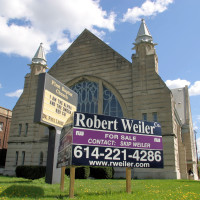 In the US, we don’t have to look too far to find a lot of mainline church denominations in decline.
Live Pure or Die.
Harsh words, but if Ananias and Sapphira’s example teaches us anything, it’s that God has absolutely no problem—whatsoever—with letting pretenders die. And frankly, there are a lot of churches out there with fancy robes and large crowds and dark, deceptive hearts. They aren’t preaching Jesus at all. Pretenders. Deceivers. God is not impressed. He wants pure hearts, not crowds. They’re dying from the inside out.
Live Pure or Die.
Consider the holiness of the One we’re coming to worship. If He were to walk through that back door right now and walk up here to the microphone, I dare say we’d all be scared to death. We don’t know what holiness is truly like. We don’t see purity very often in our lives. We’re so accustomed to pollution in our world, in our lives, in our governments, and in our churches, that we don’t even know what holiness is anymore. We don’t expect it of our churches, ourselves, or others from the federal government on down to our kitchen table.
Live Pure or Die.
God doesn’t want any of us to play church.
To show up when we feel like it and to treat it as just another day-planner item, something to fill up a Sunday morning slot between the newspaper and the football game.
On this Communion Sunday, let’s remember that Christ died for this church. So, let’s get rid of anything impure.
Live Pure or Die. Each of us, in the silence of our hearts would be wise to bring our failings and deceptions before God and ask His forgiveness. Each of us should look at our lives at the start of this New Year and see where we can take the New Year Holiness Challenge to Live Pure. As individuals.
But also to look around this church and ask whether we’re a church that honors Christ and whether we’re displaying the name Christian with the beauty and purity that He gave His life to create. He paid for our sin so we’d be pure. New life. New Beginning. The Church universal matters deeply to God. This church matters to God. And as uncomfortable as these 7 principles are—from the examples of Barnabas (positive) and Ananias and Sapphira (negative)—we’d be wise to remember:
- Encouragement is contagious,
- Deception is contagious and dangerous.
- Purity matters.
- Accountability prevents contamination.
- God doesn’t mess around when it comes to holiness.
- If Holiness is important to God it should be important to us.
- With the result that we’d choose to Live Pure, rather than die.
 I like patterns. Maybe it’s that some of us never outgrow Sesame Street or mind-puzzlers, but I always liked those assignments in school where we had to figure out what comes next in the sequence by figuring out the pattern.
 But God always starts from a place of purity and grows us from there. God will not revive any church that doesn’t start with pure worship, for that is the source of the Church’s power. Pure Church Powerful Church, the power flowing from God being glorified! A light in darkness!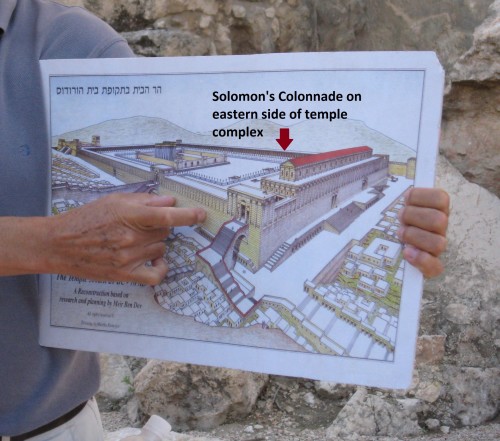
 So these believers met in Solomon’s Colonnade, right there outside the Temple in Jerusalem.