Day 1 of Blessing for 2015
Share and Share Alike–sermon text version
I suppose most of my recurring nightmares are school-related:
 Skipping Class All Semester Nightmare in which I find I don’t know any of the subject matter–even where the final exam is being held, which in my nightmare is always RIGHT NOW.
- Then there’s the Procrastination Nightmare with a whole bunch of assignments announced the first day of class on a clearly written syllabus…assignments which I didn’t end up starting until 15 minutes before the assignment is due.
- The Passing Note Nightmare which involves my getting caught by the teacher who reads some content in my note that is totally tabloid in nature and humiliating in every way known to man, and then says, “Should we share this with the rest of the class?”
- And finally The Chewing a Piece of Gum in Class Nightmare and having the teacher ask if I’d brought enough to share and then being chewed out publically for disobeying school rules which always seemed to be “Bring enough gum for everyone!” Humiliating to show up in class with a single pack of Wrigley’s and being more than a dozen sticks short.
Given these recurring nightmares, you’d think that I was probably a really poor student. Given these nightmares still occurring decades after the fact, you’d think it had really happened and I was traumatized by it. But no. I always liked school.
And what you’re probably really wondering about right now is what on earth it has to do with Acts 4:32-37. I’d say, “Nothing, just a cheap attention getting ploy,” except that it ironically applies. The applications are parallel:
- Don’t skip the education.
- Don’t procrastinate thinking there’s always time later to do things.
- Share only what is good.
- And follow the rules for sharing: Share and Share alike!
In the book of Acts today, we see a church actively engaged in the fellowship of believers as a function of their Christian education. It means these believers know what the Word says, they act on it, they share what they’ve learned, and they share in actions, too. They do it willingly. Share and Share alike!
We’re ust coming off Christmas and all the gift giving. Heading to the year-end close for tax donations. And I didn’t want to close the year with what we’re talking about next week, a counterexample to this week’s sharing and giving. Although next week, it will be “Happy New Year, Ananias and Sapphira are dead.”
Many preachers hate talking about money, but Jesus talked about it a lot…and not just on some “Stewardship Sunday.”
Stewardship is more than just money. It’s a whole life deal and foundational to the early church. As the church is getting launched, there are rules of the road and principles to live by. In our passage today, we see the idea presented, reiterated, and displayed in a personal example of a man named Barnabas. It isn’t the first time we’ve seen it. Bill Slater preached on it as New Life Leads to New Living. And if Luke points it out a second time, we’re wise to pay attention.
Let’s recap where we are: The believers had just seen Peter and John and maybe even the formerly crippled guy who used to beg at the gate called Beautiful be thrown in jail. They got scolded, prohibited from evangelizing, and were released with the idea they should never do that again. Their worst nightmare.
So they get out, they pray, they praise God, and then ask Him to empower them do it some more…even more boldly next time. The persecution of the church begins and it’s going to be very important during the infancy of the church that people understand how the church works. It works by share and share alike.
That’s a summary of the Great Commission:
Matthew 28:18 Then Jesus came to them and said, “All authority in heaven and on earth has been given to me. 19 Therefore go and make disciples of all nations, baptizing them in the name of the Father and of the Son and of the Holy Spirit, 20 and teaching them to obey everything I have commanded you. And surely I am with you always, to the very end of the age.”
Jesus gets all authority in heaven and shares it with believers in the form of His teachings and His commission to spread His good news! The Father shared with Jesus. Jesus shared with us. Our job is to share alike. To pass it along to others.
As I read these verses from our passage today, beginning in Acts 4:32, I want for you to listen to the unity going on. The sharing. The commonality.
Acts 4:32 All the believers were one in heart and mind. No one claimed that any of his possessions was his own, but they shared everything they had.
All the believers, one heart, one mind. No one claimed possession as greed, but as something worth sharing with everyone. Share and Share alike!
What we’re about to delve into is one of the most misunderstood passages of Scripture, a conservative theologian’s nightmare, and it’s where my school examples will help inform the distinction between social engineering and Christian living. This passage has sometimes been called “Christian communism,” but it’s totally different! It’s not social engineering. It’s Christian living. And they are as different as night and day.
In our passage, v 32 is a first description showing that people learned what Jesus said and they put it into practice. Every moment was a time to learn and apply. They didn’t skip class, they didn’t procrastinate. They learned and applied it NOW. They understood that every moment is exam time. Every moment will be a test of what you’ve learned and who you love. What’s the result?
33 With great power the apostles continued to testify to the resurrection of the Lord Jesus, and much grace was upon them all.
New Life Leads to New Living. It witnesses! When we do what Jesus says, His grace will flow from Him, to us, and out to others. These disciples in the early church knew it all began with witness and it flowed as grace from Jesus to us to others. Share and share alike. It witnesses more and there’s power for the church in that.
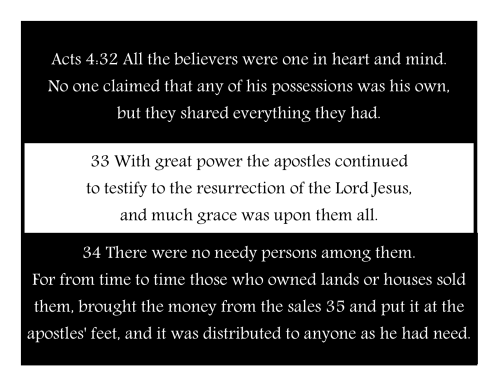 The other bookend description in v 34 says basically the same thing as v 32, both of which serve to highlight the stuff in the middle. Kind of like an Oreo. The cookies are there to support the filling. Not the other way around. What’s the good stuff in the middle? It’s verse 33. Acts 4:33 With great power the apostles continued to testify to the resurrection of the Lord Jesus, and much grace was upon them all.
Here begins the other cookie: 34 There were no needy persons among them.
When we know and we share, no one is need. Not all of us are in the giving category. God has made some of us in the dependent-upon-others category so that grace might be upon all of us. If we get plugged up by someone not sharing what God gave them specifically to share, it becomes an abscess in the church and the infection takes hold and robs us of power. We’ll see next week what God thinks of that. Verse 34 continues
For from time to time those who owned lands or houses sold them,
It’s important to take a bit of a time out to mention that we do not see a problem with ownership or ownership rights. It says from time to time, no indication of by compulsion. Ownership was viewed with a clear understanding of where belongings come from in the first place. Psalm 24:1 “The earth is the LORD’s, and everything in it, the world, and all who live in it.” When we view all belongings as originating with God, by His grace, we will be more likely to hold them loosely.
For from time to time those who owned lands or houses sold them, brought the money from the sales 35 and put it at the apostles’ feet, and it was distributed to anyone as he had need.
Isn’t this beautiful?! People, totally free to own and sell, they were totally free to give away as well.
It was an outflow of being of one heart and one mind. The Church is one body. No stomach would withhold nourishment from the arms, eyes, and lungs. One body! So people brought money that they didn’t worship… to the One True God whom they did worship. Not worshiping money. Worshiping God. Of course, God puts people in positions of authority to be able to act on His behalf. That’s what pastors and stewards are supposed to do. The apostles too. The Bible calls them Overseers because God is a God of order.
In God’s economy, we learn to be charitable by having someone to be charitable toward. Let me say that again.
We learn to be charitable by having someone to be charitable toward. If there is no recipient, there is no giving.
 And by seeing someone’s needs being met, it reinforces the desire to do what one can. That’s why some receive God’s grace directly in the form of ownership and material blessing, and others receive God’s grace indirectly as those who have learned what it means to be Christian live out the Great Commission and share everything with others. Share and share alike!
I have had instances in my life in which a need comes to my attention, maybe even a Christian friend is in need. (Like in our passage, which importantly refers to people in the Church!) Maybe I could make a car payment for someone so their car didn’t get repossessed or help with a mortgage payment or bring someone’s account from below zero to help them survive until the next paycheck without a bank overdraft charge. I say I…but truly I can only be a time steward. Financially, in our family, it’s we. Warren is our check-writer and oversees the whole gamut of stewardship even back at our church in IL. Seeing how help—in a very tangible and clear way—meets a specific need–makes the act of helping even more rewarding. It doesn’t go into a black hole somewhere. Rather, it is visible in the life of someone in the Church. It produces fruit. It produces grace.
Charity has, in our modern age, received a bad name. As we’ve shifted from the Church and their ministries doing redistribution of God’s grace (share and share alike)…to a current system of various entities with political priorities doing the redistribution, God’s economy has become profoundly warped.
- Ownership gets replaced with greed on one hand, and adverse possession on the other where belongings get taken from one and given to another without the consent, will, or joy of the one whose property rights were violated. God gets completely removed from this whole equation! And you know what? All the joy of personally, materially helping someone and being encouraged by it… gets diluted until it’s really not visible at all.
- God’s economy also gets warped when selling freely gets replaced by compulsory taxation. By ripping the freedom out of the giving, you know what? All that’s left quite often is a bitter resentment of someone else deciding for you when you want to do what you are called by God to do.
- God’s economy gets warped when charity and sharing that once characterized the early church got stripped of its grace and now receiving charity is considered to be bad. Too insulting, embarrassing, or humiliating. So we’ve replaced “the needy” with “the entitled.” We’ve swapped the word charity for someone else telling us what is “doing our fair share.” We call grace recipients, otherwise known as the needy, “clients” as if what’s important is the transaction, not the grace! We’ve replaced gift and giving, with obligation and expectation. We’ve replaced alms with taxes. It’s all in the same category: graceless giving, graceless receiving. But what did our passage say happens in the important middle of the cookie? 33 With great power the apostles continued to testify to the resurrection of the Lord Jesus, and much grace was upon them all.
Charity witnesses.
Charity is the Church’s powerful testimony.
Charity brings about grace and more grace. Share and Share alike!
But today, what do many people see? A Church that has either dropped the ball on charity, or a Church that has willingly forsaken its witness by giving their God-given function over to the government.
People ought to see what is happening inside the Church –a whole lotta grace goin’ on— so that they will want to be part of the learning, the sharing, and the grace that form God’s economy. But if they don’t see grace as share and share alike, we lose our witness and we miss the important stuff at the center of our scripture, witness and grace!
It’s a lesson we don’t want to skip. We’ve heard it in principle. God shows it to us in action. 36 Joseph, a Levite from Cyprus, whom the apostles called Barnabas (which means Son of Encouragement), 37 sold a field he owned and brought the money and put it at the apostles’ feet.
Do you see how we’ve moved from a principle to an example? From time to time, some people did sell what they owned and they brought the proceeds to the Church to minister to the needy…and one of those people was Encouragement’s son, named Barnabas (Son of Encouragement). He did exactly what some others did, too…from time to time…as God blessed and inspired them to do.
We all need encouragers and living examples in our lives. Barnabas was a great one. He helps us to see the joys and encouragement of such living so that we might share and share alike. Barnabas was a Levite (part of the religious order) and he was from Cyprus which will become important as the missionary journeys outlined in Acts unfold. But for now, the best thing to note about Barnabas was that he was an encourager, a role model, and people noticed his setting an example for others and the positive recognition he likely received—Scripture even remembers Barnabas by name. As a good and faithful steward of God’s material blessings.
 Let’s take a time out to revisit my school nightmares and tie it to the outcome of stripping the grace out of charity. I wanted to apply it to something about which many of us can relate because money is a really uncomfortable subject for many people. Jesus, however, talked about money even more than He talked about hell, the devil, or sex. Money was a big deal to Jesus because it has the terrible potential to confuse the gift with the Giver, the blessing with the Blesser, and money forms even today the most seductive and insidious idol of this world’s economy. It sneaks up on us and draws us away from worshiping the One True God whose economy runs–not on money–but on grace.
So my nightmares show that we cannot skip classes on Christian living, avoid the final exam, and still get a passing grade in the class. We’ll know the material if we learn it and apply it day by day, and from time to time. Charity is something we need to always be on the lookout to provide as God enables us…and not always in the form of money. It can be acts of service or a million other things. But the bottom line is that the answer to the Skipping Class Nightmare is to learn the material.
Second, we cannot procrastinate to the very last moment before our death before deciding to be charitably minded and still experience the fullness of Grace. Share and share alike needs to be now, not later. It needs to be a reflection of unity.
Third, share and share alike doesn’t look like my Passing Note Nightmare of a teacher grabbing a note I’m passing in private and the teacher sharing the contents with the entire class. Wrong as passing a note was, yet, it wouldn’t have been the teacher’s news to share. Possessions that God has shared with you aren’t someone else’s to share with anyone. We do not take and redistribute. We are to share and share alike as God leads us.
Which brings me to the fourth, Not Enough Gum for Everyone Nightmare. This Scripture doesn’t say that Barnabas sold all of his fields and became one of the needy dependent upon others. Dependency is not the goal! Grace is! Not one of us has the resources to meet every need that exists. God, instead, gives both blessing and responsibility to share His grace with others…in the perfect amounts as a body of believers. Grace doesn’t always take the form of money. Knowledge and witness never get exhausted. Possessions, on the other hand, require stewardship. God can always outdo us in giving, but He also wants us to be wise and to use resources where they will do the most good, exactly as He calls us to use them. What matters is that we’re of one heart and one mind of honoring God. Our hearts and motivations need to be right. That’s where a third party can never discern for you or me where we ought to give…what is our fair share. We don’t give to placate others and cannot judge them. We give to bless others with the grace of God. Share and share alike!
In God’s economy, the time is NOW to know and learn what it means to live as one heart and one mind. There’s time NOW to do acts of charity for the blessing of others. We share with others flowing out of Christian unity …all the while remembering that we are only redistributing God’s grace as share and share alike!
Acts 4:33 With great power the apostles continued to testify to the resurrection of the Lord Jesus, and much grace was upon them all.
Share and Share Alike–audio version
This message entitled Share and Share Alike–on the beauty of charity in God’s economy of grace–was first preached at Plymouth Congregational Church of Racine on 12.28.2014 by Barbara Shafer. Click this link to enjoy the audio version of Share and Share Alike on YouTube. Let’s be the Church by learning to share and share alike.
Because He Came–audio version
The message Because He Came was first preached by Barbara Shafer at Plymouth Congregational Church of Racine on December 21, 2014. You can read the text version already posted or listen to this message now on YouTube by clicking this link.
New Year Benediction
Happy New Year to you from Seminary Gal!
Get Ready for 7 Days of Blessing
Beginning with the New Year, 7 Days of Blessing! A great way to start 2015.
In the Bible, the number 7 is associated with completion, fullness, and perfection. Let’s start 2015 with 7 Days of Blessing by recalling famous blessings in Scripture.
I Heard the Bells on Christmas Day (2014)
Merry Christmas!
Easy words to say.
Hard words to live out in the lives of so many around the world.
We’re a world of darkness and fear. A world of terror and trouble. A world of discord and destruction. A world of social media and unfathomable loneliness.
We are a world careening toward anarchy and lawlessness.
Yet, there’s hope because of what happened on Christmas Day.
Isaiah 9: 5 Every warrior’s boot used in battle and every garment rolled in blood will be destined for burning, will be fuel for the fire. 6 For to us a child is born, to us a son is given, and the government will be on his shoulders. And he will be called Wonderful Counselor, Mighty God, Everlasting Father, Prince of Peace. 7 Of the increase of his government and peace there will be no end. He will reign on David’s throne and over his kingdom, establishing and upholding it with justice and righteousness from that time on and forever. The zeal of the LORD Almighty will accomplish this.
No more suitable carol would match Christmas than a carol arising from such dark depths. Its origin is a poem called Christmas Bells, penned by Henry Wadsworth Longfellow on Christmas Day in 1863. He was going through personally dark days following the death of his beloved wife Fanny and the injury sustained by his eldest son Charles Appleton Longfellow in the Civil War.
Fanny died in 1861 and Longfellow’s journal that year at Christmas was silent.
The following Christmas, showing the enduring nature of grief, his journal stated, “’A merry Christmas’ say the children, but that is no more for me.”
Finally in 1863 on Christmas Day, Christmas Bells put ink to the longstanding grief and pointed Longfellow clearly upward to God.
The poem reads,
 I heard the bells on Christmas Day
Their old familiar carols play,
And wild and sweet
The words repeat
Of peace on earth, good-will to men!
And thought how, as the day had come,
The belfries of all Christendom
Had rolled along
The unbroken song
Of peace on earth, good-will to men!
Till ringing, singing on its way, The world revolved from night to day,
A voice, a chime,
A chant sublime
Of peace on earth, good-will to men!
Then from each black, accursed mouth
The cannon thundered in the South,
And with the sound
The carols drowned
Of peace on earth, good-will to men!
It was as if an earthquake rent
The hearth-stones of a continent,
And made forlorn
The households born
Of peace on earth, good-will to men!
And in despair I bowed my head;
“There is no peace on earth,” I said;
“For hate is strong,
And mocks the song
Of peace on earth, good-will to men!”
Then pealed the bells more loud and deep:
“God is not dead, nor doth He sleep;
The Wrong shall fail,
The Right prevail,
With peace on earth, good-will to men.”
You’ll note that the carol—with powerful music supplied by John Baptiste Calkin—has omitted the two stanzas which specifically referenced the American Civil War. (Longfellow was a staunch abolitionist and Christmas Bells strongly reflects Longfellow’s life and times). Calkin rearranged the 5 resulting stanzas in 1872, set them to music, and gave us a carol called I Heard the Bells on Christmas Day.
How appropriate that we conclude our series of Carol Me Christmas with words of hope that no matter how dark our world, God is not dead. He doesn’t sleep. We might want to cry out,
God, where are you?”
Why can’t you do something?”
But on Christmas Day, God’s answer would be
I am Immanuel which you’ll remember means ‘God with us.’ And I did something already: I came to you as the True Light in darkness. If you believe in Me, there is eternal life ahead. No one can snatch you out of my hands.
As you listen to this version by The Carpenters, read through the poem. Think about how Jesus’ coming as a baby in a manger changed everything. Because of Him, there is hope. Though the world is a dark one, the darkness is passing and the true light is already shining (1 John 2:8).
Merry Christmas!
Because He Came–sermon text version
It is appropriate on this 4th Sunday of Advent to take a bird’s eye view of why Jesus came. It is hinted at in the final verses of the prayer in our Acts passage (Acts 4:27-30) and therefore, I thought it was fitting that today we pause to see the bigger picture.
How often do we rush through Christmas without truly taking time to ponder the incredible difference His birth made?
I spend a lot of time driving to the airport. There’s a billboard that always catches my attention. It says “Become a Difference-Maker.” On my drive up here each week, I pass a billboard that says, “Because the world needs more strong women.” Both are from educational institutions. While both catch my attention, neither one points to the education we really need!
That’s the role of the Church: to teach Who is the real Difference-Maker…the One that the world really needed then and still needs today.
Because the truth is that—on our own as humanity—we’re just a mist, vapor in the air that sunlight diminishes to nothing. Absorbed into the atmosphere. Here one minute. Gone the next.
Or as the punishment in Genesis outlined, we’re dust to dust. To the serpent (the architect of evil) God says,
Genesis 3:15 And I will put enmity Between you and the woman, And between your seed and her Seed; He shall bruise your head, And you shall bruise His heel.” [This is called the protoevangelion, the first mention of the Christ, the Messiah, the Redeemer, the Savior…even as God continues to outline the punishment!] 16 To the woman He said: “I will greatly multiply your sorrow and your conception; In pain you shall bring forth children; Your desire shall be for your husband, And he shall rule over you.” 17 Then to Adam He said, “Because you have heeded the voice of your wife, and have eaten from the tree of which I commanded you, saying, ‘You shall not eat of it’: “Cursed is the ground for your sake; In toil you shall eat of it All the days of your life. 18 Both thorns and thistles it shall bring forth for you, And you shall eat the herb of the field. 19 In the sweat of your face you shall eat bread Till you return to the ground, For out of it you were taken; For dust you are, And to dust you shall return.”
In our Advent reading, we saw this Seed as Immanuel, “God with us.”
Matthew 1:20 But after he had considered this, an angel of the Lord appeared to him in a dream and said, “Joseph son of David, do not be afraid to take Mary home as your wife, because what is conceived in her is from the Holy Spirit. 21 She will give birth to a son, and you are to give him the name Jesus, because he will save his people from their sins.” 22 All this took place to fulfill what the Lord had said through the prophet: 23 “The virgin will be with child and will give birth to a son, and they will call him Immanuel”–which means, “God with us.”
He will save his people from their sins.”
Jesus is the Difference-Maker. He makes an eternal difference!
In today’s passage of Acts we see this Seed of woman as the holy servant Jesus. But as a world of evil would do,
Acts 4:27 Indeed Herod and Pontius Pilate met together with the Gentiles and the people of Israel in this city to conspire against your holy servant Jesus,
The Whole World was Against Him.
4:27 (cont) whom you anointed.
But God was For Him.
Acts 4: 28 They did what your power and will had decided beforehand should happen.
They crucified Him.
But God raised Him from the dead.
29 Now, Lord, consider their threats and enable your servants to speak your word with great boldness. 30 Stretch out your hand to heal and perform miraculous signs and wonders through the name of your holy servant Jesus.”
 The World Still Hates Him. But God still loves us and reaches out to save us. He is God with us, Immanuel!
Let’s recap our situation:
-
The Whole World was Against Him. But God was For Him.
-
The Whole World crucified Him. But God raised Him from the dead.
-
The World Still Hates Him. But God still loves us and reaches out to us continually….to save us. He is God with us, Immanuel!
Take a look at this Difference-Maker, the One the world truly needs!
John 3:16 “For God so loved the world that He gave His only begotten Son, that whoever believes in Him should not perish but have everlasting life.
What an amazing statement! It ought to give us pause, like it did the Grinch:
“And the Grinch, with his Grinch-feet ice cold in the snow, stood puzzling and puzzling, how could it be so? It came without ribbons. It came without tags. It came without packages, boxes or bags. And he puzzled and puzzled ’till his puzzler was sore. Then the Grinch thought of something he hadn’t before. What if Christmas, he thought, doesn’t come from a store? What if Christmas, perhaps, means a little bit more.”
Here’s what Christmas means: Jesus was born as our Difference Maker. Because the world needed Him!
Because He came, dust to dust doesn’t need to be our final and only destiny.
Because He came, sin’s perpetual curse doesn’t need to be our lot.
Because He came, we can be forgiven, once for all time!
Because He came, humanity’s attempts at saving ourselves never need to be our only resource.
Because He came, the True Light penetrated the darkness and the darkness will never overcome Him.
Because He came,, God demonstrated that His love is so magnificent it would show supremely in the ultimate sacrifice. And it’s while we were still sinners, Christ died for us!
Because He came, the death the world conspired to achieve would be the very means by which God desired to save us.
Because He came, there is a tomorrow. Of hope. Of peace. Of joy. Of love. Of everlasting life.
Because He came, sin no longer rules over us.
Because He came, death has been defeated.
Because He came, the gates of hell will not overcome us.
Because He came, the gates of heaven are open wide! And the angels sing each time someone who has been lost is found!
Because He came, the good news is really, really Good! It’s good for you. And it’s good for me.
Because He came, we have seen the Father!
Because He came, we know the Way, the Truth, and the Life.
Because He came,, we can know, enjoy, and take part in the Resurrection!
Because He came, we can find the narrow door and have access to the very throne room of God in prayer.
Because He came, the Holy Spirit can dwell in our hearts and remind us of everything Jesus taught in His lifetime.
Because He came, we know what Love looks like.
Because He came, our lives have purpose and meaning!
Because He came, we can wrestle through the splendid mystery of how the Almighty God—the very One who created the entire universe– fit in such a tiny package as this Infant Holy, Infant Lowly, lying in a manger.
Because He came, God’s angels sing, God’s people rejoice, and demons tremble with fear.
Because He came, Christmas means far more than what money can buy or what comes from a store. Jesus is the Difference Maker!
Because He came, our greatest joy on Christmas morning can be found in a manger, and not under a tree.
Because He came, we know the very meaning of Merry Christmas!
Let’s pray.
====this message was first preached by Barbara Shafer at Plymouth Congregational Church of Racine, WI on Sunday, December 21, 2014.
Go Tell It on the Mountain (Christmas Eve 2014)
It’s Christmas Eve. I can’t think of a better carol to honor today than Go Tell It On the Mountain. The exhilaration of joy at having heard proclaimed by the angels the birth of our Lord and Savior…the joy at seeing Him and adoring Him… ought to prompt us forward to share the Good News of great joy that we have heard.
Isaiah 52:7 How beautiful on the mountains are the feet of those who bring good news, who proclaim peace, who bring good tidings, who proclaim salvation, who say to Zion, “Your God reigns!”
Our greatest joy on Christmas morning is that Jesus entered into our human struggle as fully God but fully human. His life and His death changed everything.
Romans 10:4 Christ is the end of the law so that there may be righteousness for everyone who believes. ..8 But what does it say? “The word is near you; it is in your mouth and in your heart,” that is, the word of faith we are proclaiming: 9 That if you confess with your mouth, “Jesus is Lord,” and believe in your heart that God raised him from the dead, you will be saved. 10 For it is with your heart that you believe and are justified, and it is with your mouth that you confess and are saved. 11 As the Scripture says, “Anyone who trusts in him will never be put to shame.” 12 For there is no difference between Jew and Gentile– the same Lord is Lord of all and richly blesses all who call on him, 13 for, “Everyone who calls on the name of the Lord will be saved.” 14 How, then, can they call on the one they have not believed in? And how can they believe in the one of whom they have not heard? And how can they hear without someone preaching to them? 15 And how can they preach unless they are sent? As it is written, “How beautiful are the feet of those who bring good news!”
It doesn’t matter whether we’re male or female, young or old, Jew or Gentile…and there is no difference in God’s love for us. His love is immeasurable and magnificent and given to us no matter what color is our skin, what social strata we’re from, where we live, or what language we speak. Every human bears the Image of God. God’s Image is colorblind and His love is big enough for all.
For God so loved the world that he gave his one and only Son, that whoever believes in him shall not perish but have eternal life.” (John 3:16)
Go Tell It on the Mountain was first published in a collection of slave songs and spirituals entitled New Jubilee Songs and Folk Songs of the American Negro (1907) by John Wesley Work, Jr.. His family before him and after him were devoted to preserving spirituals and he was actively involved with the Fisk Jubilee Singers whose name you might remember from the Overcomer’s series devotional on Swing Low Sweet Chariot.
As you read through the lyrics to this spiritual and enjoy this version from the incomparable Mahalia Jackson, ponder our Thought Focus for Today.
Thought Focus for Today: In a world that seems to divide and tear apart on superficial demographics, what does it mean to you that there is no difference…that the same Lord is Lord of all?
How ought our views of others along national and racial lines be changed by remembering that Jesus entered this human struggle as a Jewish man to save the entire world?
Will you Go Tell It On the Mountain that Jesus Christ is born?
 Go, tell it on the mountain,
Over the hills and everywhere
Go, tell it on the mountain,
That Jesus Christ is born.
While shepherds kept their watching
Over silent flocks by night
Behold throughout the heavens
There shone a holy light.
Refrain
The shepherds feared and trembled,
When lo! above the earth,
Rang out the angels chorus
That hailed the Savior’s birth.
Refrain
Down in a lowly manger
The humble Christ was born
And God sent us salvation
That blessèd Christmas morn.
Refrain