Silent Night Holy Night (Advent 16-2014)

Today’s carol in our Carol Me, Christmas (2014 Advent Devotional Series) is arguably the all-time favorite Christmas carol of many people.  It’s often sung as the final song at Christmas Eve services to the glow of handheld candles.  It’s beautiful.  It’s peaceful.  It’s sentimental.  It’s Silent Night, Holy Night.

I don’t want to be the one to destroy all the romanticized stories regarding its origin.  So I’ll let hymns and carols of Christmas.com break the news.

The traditional story is that Rev. Josef Mohr (1792-1848) and Franz Xaver Gruber (1787-1863) wrote it in Oberndorf, Austria, on Christmas Eve when they discovered the church organ was damaged (different versions say it rusted out, or mice chewed through vital parts3). Charming as those stories are, they are fiction. In fact, in a letter written by Franz Gruber, son of the composer, he noted that “During the time when my father was the organist of the church of St Nikola, there was a very poor almost unusable organ there. This may well explain why the Reverend Mohr preferred to accompany the carol on a well-tuned guitar than on an off-pitch organ.”

An old manuscript has reportedly been discovered that shows Rev. Mohr wrote the lyrics in 1816, and that Franz Gruber wrote the score two years later at Rev. Mohr’s request (the manuscript is now located at the Salzburg Museum, Carolino Augusteum; unfortunately, the English version has disappeared).  Mohr never said what his inspiration was. Gruber did not disclose why Mohr made the request to add music to the poem (and you can safely disregard as purest fiction any stories about Mohr walking through the forest on a snowy night, or that invent any dialogue between the two men).

Seriously?  Of course, the original song was entitled Stille Nacht, Heilige Nacht (yes, it’s German like many of the other hymns and carols we’ve enjoyed).  It all began when Joseph Mohr who was the curate of a church in Oberndorf gave his poem to Franz Gruber requesting a composition for two solo voices, a choir, and accompanied by guitar.

It was first performed in 1818 at the midnight mass on Christmas Eve.  Mohr played the guitar and was the tenor solo, Gruber was the bass solo with the church choir singing the refrains.

Every hymnal I have lists the English translation by Rev. John Freeman Young with the dates of translation and publication listed as 1863 though hymns and carols asserts it was published in 1859.  Who knows what to believe on the Internet?  (OK, I’m still in shock from the mice not chewing the organ.  I’d pictured Cinderella’s mice…)

Theologically, I’d like to trust this hymn…even more than the stories of how the carol came about.  Although, no one really knows if the night was actually silent.  After all, stop and think about it: Bethlehem was buzzing about with a whole crowd of people who had come to register.

Luke 2:1 In those days Caesar Augustus issued a decree that a census should be taken of the entire Roman world. 2 (This was the first census that took place while Quirinius was governor of Syria.) 3 And everyone went to his own town to register. 4 So Joseph also went up from the town of Nazareth in Galilee to Judea, to Bethlehem the town of David, because he belonged to the house and line of David. 5 He went there to register with Mary, who was pledged to be married to him and was expecting a child

Why were they registering? To pay their taxes.  The Romans wanted a detailed understanding of who existed for both military service (from which Jews were exempted) and who could fund the government. A census to them wasn’t like the US Census where they’re looking to find out race, education, and household income.  Nope.  A census then was for the purpose of collecting taxes from both men and women.  (Yes, Mary had to go too.)  So here is the great irony, the most powerful man on earth, Caesar Augustus, issues a decree with the result that the most powerful man ever to be born would have His humble earthly beginnings in a manger.   And Bethlehem as prophesied in Micah 5:2 would be fulfilled.

Micah 5:2 “But you, Bethlehem Ephrathah, though you are small among the clans of Judah, out of you will come for me one who will be ruler over Israel, whose origins are from of old, from ancient times.”

Whether the night was silent, calm, or bright, we will never know.  But we do know it was holy because that’s how God would come to be among us.  And it was certainly clear enough for a star.  Jesus was the Holy Infant, He is our Savior, and He is Lord at His birth.  Strange to think that a baby would be Lord, but that’s the truth and we don’t need to take the Internet’s word for it.

I hope I haven’t ruined this hymn for you since I’m still reeling from that whole Cinderella’s mice revelation, but maybe listening to this version will help you like it helped me.  Since I’ve spent recent days ripping Europe as in spiritual decline, this group is Dutch and sings Silent Night Holy Night as Stille Nacht.

Thought Focus for Today:  Consider how amazing it is that God uses such mundane things as registering both Joseph and Mary, both from the line of David, at Bethlehem to fulfill the prophecy regarding Jesus’ birth.  What mundane thing in your life is God looking to use?

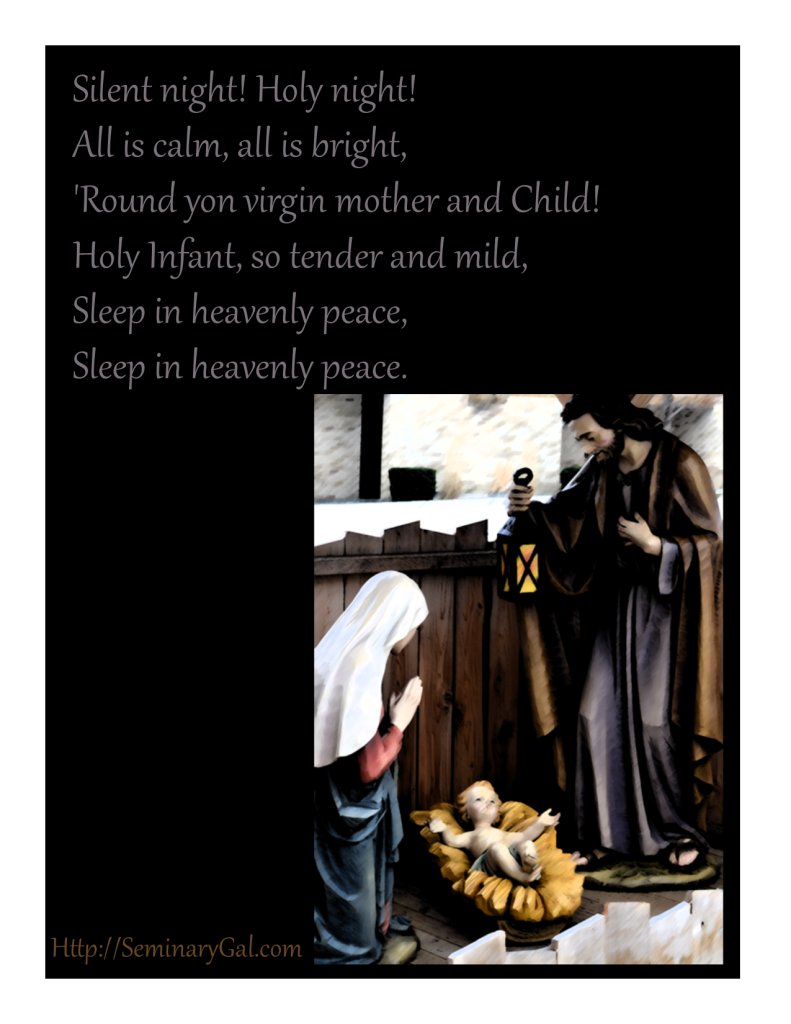
silent nightSilent night! Holy night!

All is calm, all is bright

Round yon virgin mother and Child

Holy Infant so tender and mild

Sleep in heavenly peace!

Sleep in heavenly peace


Silent night! Holy night!

Shepherds quake at the sight

Glories stream from heaven afar

Heavenly hosts sing Alleluia

Christ the Savior is born

Christ the Savior is born!


Silent night! Holy night!

Son of God love’s pure light

Radiant beams from Thy holy face

With the dawn of redeeming grace,

Jesus, Lord at Thy birth

Jesus, Lord at Thy birth

======

Carol Me, Christmas (2014 Advent Devotional Series) began November 30th.  By way of reminder, if you haven’t signed up yet, you can receive these devotional studies in your email throughout Advent 2014 by entering your email address on the SeminaryGal.com home page in the space provided in the sidebar.  Or “Like” the SeminaryGal Facebook page to access them there.  If you like these devotionals, I’d really appreciate your letting others know so I can continue to spread the Good News far and wide.  Blessings to you, in Christ always, Barbara <><

Continue Reading

O Little Town of Bethlehem (Advent 15-2014)

Today’s carol in our Carol Me, Christmas (2014 Advent Devotional Series) is one of the more famous of the Christmas carols, O Little Town of Bethlehem.  The words to this carol were written in 1868 by an Episcopal priest by the name of Phillips Brooks who was Rector of the Church of the Holy Trinity, Philadelphia, PA.  The inspiration for this hymn was Brooks’ reflection back to a trip he had taken to the town of Bethlehem in 1865. Notes by Louis Redner on this hymn state,

“As Christmas of 1868 approached, Mr. Brooks told me that he had written a simple little carol for the Christmas Sunday-school service, and he asked me to write the tune to it. The simple music was written in great haste and under great pressure. We were to practice it on the following Sunday. Mr. Brooks came to me on Friday, and said, ‘Redner, have you ground out that music yet to “O Little Town of Bethlehem”?’ I replied, ‘No,’ but that he should have it by Sunday. On the Saturday night previous my brain was all confused about the tune. I thought more about my Sunday-school lesson than I did about the music. But I was roused from sleep late in the night hearing an angel-strain whispering in my ear, and seizing a piece of music paper I jotted down the treble of the tune as we now have it, and on Sunday morning before going to church I filled in the harmony. Neither Mr. Brooks nor I ever thought the carol or the music to it would live beyond that Christmas of 1868.

Redner’s composition, which another pastor—Rev. Dr. Huntington—asked to publish in his Sunday-school hymn book called The Church Porch, became titled by Huntington simply as Saint Louis.  The music’s simplicity accounts for a good deal of the carol’s ongoing popularity.

The theology is solidly present, although the song itself is addressed to the town of Bethlehem.  Odd as that sounds, it’s not without biblical precedent.

Micah 5:1 Marshal your troops, O city of troops, for a siege is laid against us. They will strike Israel’s ruler on the cheek with a rod. 2

But you, Bethlehem Ephrathah, though you are small among the clans of Judah, out of you will come for me one who will be ruler over Israel, whose origins are from of old, from ancient times.”

3 Therefore Israel will be abandoned until the time when she who is in labor gives birth and the rest of his brothers return to join the Israelites. 4 He will stand and shepherd his flock in the strength of the LORD, in the majesty of the name of the LORD his God. And they will live securely, for then his greatness will reach to the ends of the earth. 5 And he will be their peace. When the Assyrian invades our land and marches through our fortresses, we will raise against him seven shepherds, even eight leaders of men. 6 They will rule the land of Assyria with the sword, the land of Nimrod with drawn sword. He will deliver us from the Assyrian when he invades our land and marches into our borders. 7 The remnant of Jacob will be in the midst of many peoples like dew from the LORD, like showers on the grass, which do not wait for man or linger for mankind. 8 The remnant of Jacob will be among the nations, in the midst of many peoples, like a lion among the beasts of the forest, like a young lion among flocks of sheep, which mauls and mangles as it goes, and no one can rescue. 9 Your hand will be lifted up in triumph over your enemies, and all your foes will be destroyed. 10 “In that day,” declares the LORD, “I will destroy your horses from among you and demolish your chariots. 11 I will destroy the cities of your land and tear down all your strongholds. 12 I will destroy your witchcraft and you will no longer cast spells. 13 I will destroy your carved images and your sacred stones from among you; you will no longer bow down to the work of your hands. 14 I will uproot from among you your Asherah poles and demolish your cities. 15 I will take vengeance in anger and wrath upon the nations that have not obeyed me.”

Not exactly the picture of stillness and lullaby sounds.  This is the dark side of Christmas.  We are in the dark streets but the everlasting Light is shining.  At some point, those of us alive will experience the Second Advent, the Return of Christ. It will not be the peaceful quiet Bethlehem of the hymn, but with righteousness as Christ’s banner, He will enter in as victorious.

As you read the poem by Brooks and listen to this version on cello by Nicholas D. Yee, ponder our Thought Focus for Today.

Thought Focus for Today:  Sometimes you’ll hear proverbs like “It’s always darkest before the dawn” or “There’s always calm before the storm.”  How does O Little Town of Bethlehem remind us of the dark stillness before the Advent and Second Advent of Christ?

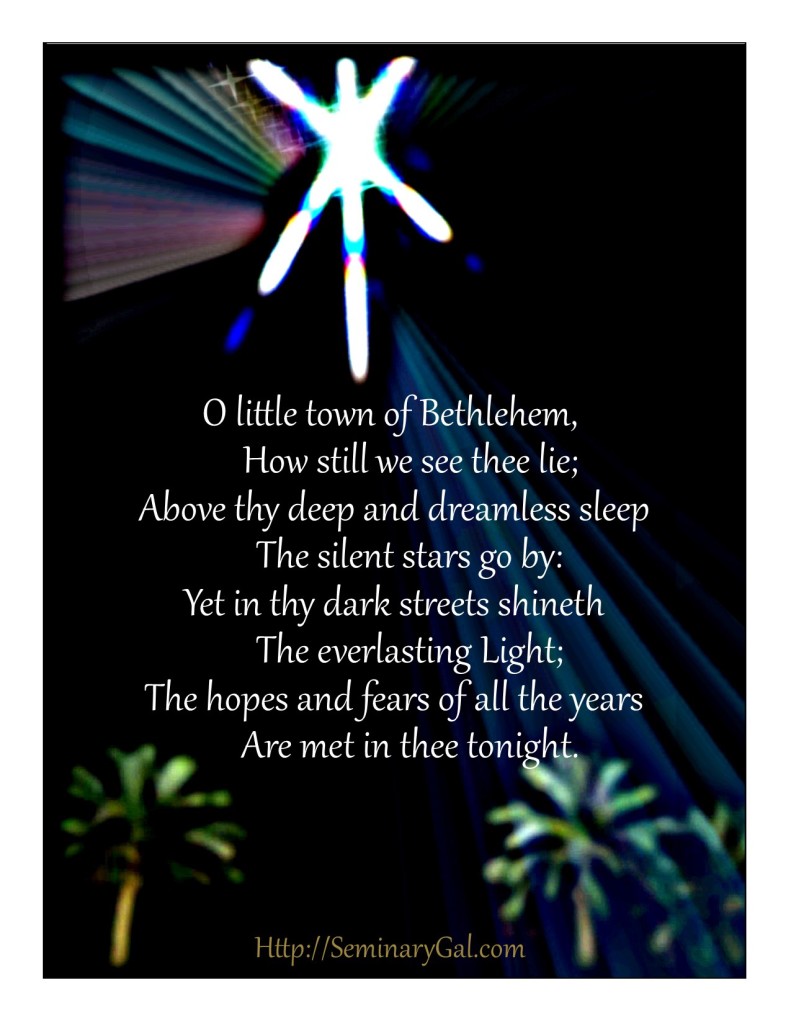
1. o little townO little town of Bethlehem,

How still we see thee lie;

Above thy deep and dreamless sleep

The silent stars go by:

Yet in thy dark streets shineth

The everlasting Light;

The hopes and fears of all the years

Are met in thee to-night.


2. For Christ is born of Mary;

And gathered all above,

While mortals sleep, the angels keep

Their watch of wondering love.

O morning stars, together

Proclaim the holy birth;

And praises sing to God the King,

And peace to men on earth.


3. How silently, how silently,

The wondrous gift is given!

So God imparts to human hearts

The blessings of His heaven.

No ear may hear His coming,

But in this world of sin,

Where meek souls will receive Him still,

The dear Christ enters in.


4. O holy Child of Bethlehem,

Descend to us, we pray;

Cast out our sin, and enter in,

Be born in us to-day.

We hear the Christmas angels

The great glad tidings tell;

O come to us, abide with us,

Our God Emmanuel.

=====

Carol Me, Christmas (2014 Advent Devotional Series) began November 30th.  By way of reminder, if you haven’t signed up yet, you can receive these devotional studies in your email throughout Advent 2014 by entering your email address on the SeminaryGal.com home page in the space provided in the sidebar.  Or “Like” the SeminaryGal Facebook page to access them there.  If you like these devotionals, I’d really appreciate your letting others know so I can continue to spread the Good News far and wide.  Blessings to you, in Christ always, Barbara <><

Continue Reading

How Great Our Joy! (Advent 14-2014)

In our Carol Me, Christmas (2014 Advent Devotional Series), we’re still looking at the shepherds in the field hearing the Good News proclaimed by the angels regarding Christ’s birth.  These shepherds are never named.  They’re just shepherds watching their flocks.  They could have been anybody.

Today’s carol goes by four different titles:  (1) How Great Our Joy! (2) While by the Sheep, (3) While by My Sheep, and (4) The Echo Carol.  Even the author is uncertain.

The words are apparently part of a traditional German carol dating back to the 1600s, but the music arrangement most common in our hymnals is one from 1890 by composer Hugo Jüngst who was born and raised in Dresden, Germany.  This is his only hymn of note.

All of this may be uncertain or certainly unspectacular, but this hymn is a great tribute to a spectacular event.

Luke 2:8 And there were shepherds living out in the fields nearby, keeping watch over their flocks at night. 9 An angel of the Lord appeared to them, and the glory of the Lord shone around them, and they were terrified. 10 But the angel said to them, “Do not be afraid. I bring you good news of great joy that will be for all the people. 11 Today in the town of David a Savior has been born to you; he is Christ the Lord. 12 This will be a sign to you: You will find a baby wrapped in cloths and lying in a manger.” 13 Suddenly a great company of the heavenly host appeared with the angel, praising God and saying, 14 “Glory to God in the highest, and on earth peace to men on whom his favor rests.” 15 When the angels had left them and gone into heaven, the shepherds said to one another, “Let’s go to Bethlehem and see this thing that has happened, which the Lord has told us about.” 16 So they hurried off and found Mary and Joseph, and the baby, who was lying in the manger.

I selected this hymn for two reasons.  First, it highlights that each of us must respond to the Good News.  The shepherds didn’t just hear the Good News and say,

Oh well, so many sheep, so little time.  I’m not going to herd all these sheep together to go see this.  I don’t have a baby gift, time to shop for one, and really, I don’t even know this couple.  I guess I can wait to go to Bethlehem next year when maybe I’ll know the family.  When you’ve seen one baby, you’ve seen them all.”

Even the lowest on the social scale among the Jews knew that the birth of the Messiah was a profound event, one that was not to be missed!  It was a drop-everything-and-go spectacular that they were privileged to witness.  They went and are only recorded in Scripture as shepherds.  We don’t even know who they were, but we do know their response.  They drop everything and go.

The second reason I chose this hymn is kind of sad, really.  It’s about opportunities lost.  So many of our hymns have been German, French, and English ones.  Those places were at one time the epicenter of the growth of Christ’s Kingdom.  Not anymore.

Today, Europe leads the way in moral relativism, secularism, and intellectual opposition to the Gospel.  America is rapidly becoming a contender for first place in those same categories.  I cannot help but reflect on the Germany that produced some of these great choral traditions and how much of Germany today greets the Gospel with a mighty yawn, if not a sneer.  It doesn’t excuse us from trying to echo the past and remind Europe of why the Gospel is Good News.  It doesn’t excuse us from trying to save America from the same apostasy and apathy we see overseas.

I like this hymn especially when performed the way the Expressions Choir and orchestra music  ministry of Calvary Lutheran Church, Golden Valley, MN does it.  It’s full of exuberance and a perfect echo response!  This is the kind of joy that we ought to know—just as the shepherds did—that we are blessed with an opportunity to respond to the best news one could ever have: the Savior is born!  It’s Good News that we should be joyfully echoing worldwide!

Thought Focus for Today:  That the shepherds are not named allows us to place ourselves in their sandals.  Can you remember the first time you heard the Good News?  How have you responded to it?  Do you know the Messiah, the Christ who is born on Christmas Day?  Do you know How Great Our Joy?

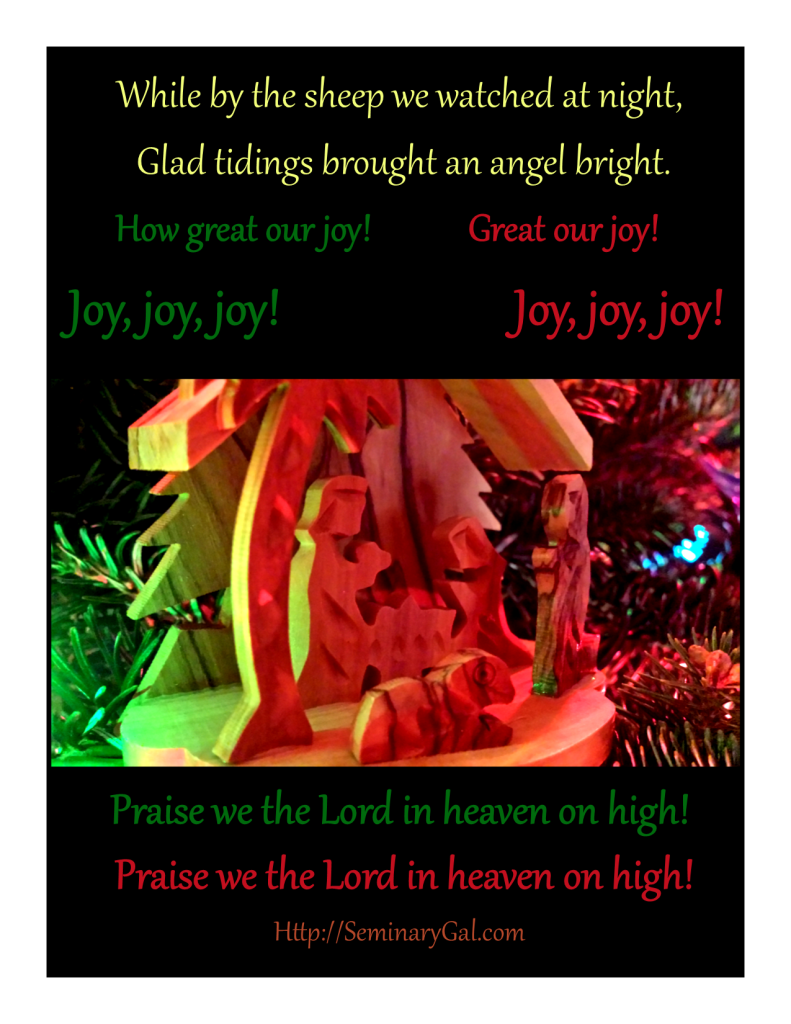
how great our joyWhile by the sheep we watched at night,

Glad tidings brought an angel bright.

Refrain

How great our joy! (Great our joy!)

 Joy, joy, joy! (Joy, joy, joy!)

Praise we the Lord in heaven on high!

 (Praise we the Lord in heaven on high!)


There shall be born, so he did say,

In Bethlehem a Child today.

Refrain


There shall the Child lie in a stall,

This Child who shall redeem us all.

Refrain


This gift of God we’ll cherish well,

That ever joy our hearts shall fill.

Refrain

=====

Carol Me, Christmas (2014 Advent Devotional Series) began November 30th.  By way of reminder, if you haven’t signed up yet, you can receive these devotional studies in your email throughout Advent 2014 by entering your email address on the SeminaryGal.com home page in the space provided in the sidebar.  Or “Like” the SeminaryGal Facebook page to access them there.  If you like these devotionals, I’d really appreciate your letting others know so I can continue to spread the Good News far and wide.  Blessings to you, in Christ always, Barbara <><

Continue Reading

Lo How a Rose E’er Blooming (Advent 13-2014)

Lo How a Rose E’er Blooming is the next traditional Christmas carol in our Carol Me, Christmas (2014 Advent Devotional Series telling of the birth of Christ.  This time the focus is on His being born from the Virgin Mary.  Lo How a Rose E’er Blooming is not in all the Protestant hymnals with good reason: there’s debate about whether the Rose is Jesus (as asserted by Protestants) or Mary (as preferred by some Catholics).  I cannot explain it any better than in the notes offered here on a web site called Hymns and Carols of Christmas:

Originally published in 1582 (or 1588) in Gebetbuchlein des Frater Conradus, this 19-stanza Catholic hymn’s focus was Mary, who is compared to the mystical rose praised in the Song of Solomon 2:1: “I am a rose of Sharon, a lily of the valleys.” The hymn is believed to have originated in Trier, and once [sic] source stated that on one Christmas Eve, a monk in Trier found a blooming rose while walking in the woods. He placed the rose in a vase, and placed it before the alter [sic] to the Virgin Mary. Some sources indicate the hymn might date back into the 14th Century.

By 1609, however, the Protestants had adopted the hymn, and changed its focus from Mary to Jesus (citing Isaiah 11:1). According to Keyte and Parrott, in medieval iconography, the tree of Jesse is often depicted as a rose plant. They also note that it’s unclear whether Ros’ (rose) or Reis (branch) was the original reading of line 1. The revision first appeared in Michael Praetorius’ Musae Sioniae in 1609. Praetorius is occasionally mistaken as the author.

The words and music of Es ist ein Ros entsprungen (Lo, How a Rose E’er Blooming) first appeared as 23 verses in the Alte Katholische Geistliche Kirchengesäng, (Cologne, 1599).  Gradually reduced to nineteen verses and then to six in the Catholic Church, it was translated into English as only verses 1 and 2 by Theodore Baker (1894).  A third stanza appears in some hymnals written by Harriet Krauth Spaeth as Behold, a Branch Is Growing.

The music itself has a madrigal sound—the tune appearing in most Protestant hymnals as an arrangement written by the aforementioned German composer Michael Praetorius.

Theologically, this is another weaker hymn in many regards.  Much of its focus has been devoted to the Virgin Mary (in the Feast of the Annunciation of the Blessed Virgin Mary) but I include it for a specific reason.  The prophecy from Isaiah underpinning this hymn points to something truly important.

Isaiah 11:1 A shoot will come up from the stump of Jesse; from his roots a Branch will bear fruit. 2 The Spirit of the LORD will rest on him– the Spirit of wisdom and of understanding, the Spirit of counsel and of power, the Spirit of knowledge and of the fear of the LORD– 3 and he will delight in the fear of the LORD. He will not judge by what he sees with his eyes, or decide by what he hears with his ears; 4 but with righteousness he will judge the needy, with justice he will give decisions for the poor of the earth. He will strike the earth with the rod of his mouth; with the breath of his lips he will slay the wicked. 5 Righteousness will be his belt and faithfulness the sash around his waist.

This Messianic prophecy goes back to Jesse, King David’s father.  That is the stump…and the Holy Seed will be the stump remaining in the land.  That comes a few chapters earlier in Isaiah.

Isaiah 6:8 Then I heard the voice of the Lord saying, “Whom shall I send? And who will go for us?” And I said, “Here am I. Send me!” 9 He said, “Go and tell this people: “‘Be ever hearing, but never understanding; be ever seeing, but never perceiving.’ 10 Make the heart of this people calloused; make their ears dull and close their eyes. Otherwise they might see with their eyes, hear with their ears, understand with their hearts, and turn and be healed.” 11 Then I said, “For how long, O Lord?” And he answered: “Until the cities lie ruined and without inhabitant, until the houses are left deserted and the fields ruined and ravaged, 12 until the LORD has sent everyone far away and the land is utterly forsaken. 13 And though a tenth remains in the land, it will again be laid waste. But as the terebinth and oak leave stumps when they are cut down, so the Holy Seed will be the stump in the land.”

At a time when the world is at war, when desolation seems everywhere, when houses are deserted, fields ruined, lives torn up by discord, violence, and hatred, God’s solution is the Holy Seed in the stump.  A precious Branch that bears fruit.

This is the Messiah, Jesus Christ, whose birth we celebrate. 
He alone is the answer to the discord and chaos of the world then and our world today.

Jesus may be a son of David, but interestingly David isn’t the stump, his father Jesse is.  Jesus doesn’t come about as a man of human origin alone whose ancestry can be explained by simple human lineage.  He skipped generations spiritually, going back to the stump to prove that God didn’t send a really good regular guy who would grow up to be the Messiah by living a good life.  He sent His Son, born as our Savior; born as our Lord, and born as our King–all of which He was even before His birth because He is God.  He is Immanuel, God with us.  He is the eternal Word made flesh.  He is the Holy Seed, born of a virgin whose name was Mary.

As you listen to this version by the Baylor Bronze Hand Bell Choir, ponder the Thought Focus for Today.

Thought Focus for Today: Jesus’ Incarnation was miraculous.  He was born of a virgin named Mary.  It’s an event that never happened before and will never happen again.  God went back to the stump in the land in a spiritual sense and yet the Holy Seed Jesus does have a physical lineage too. 

How does veneration of the Virgin Mary risk jumping the gap to becoming worship of a woman who was a really good woman, but not divine like her son Jesus, the unique Son of God?

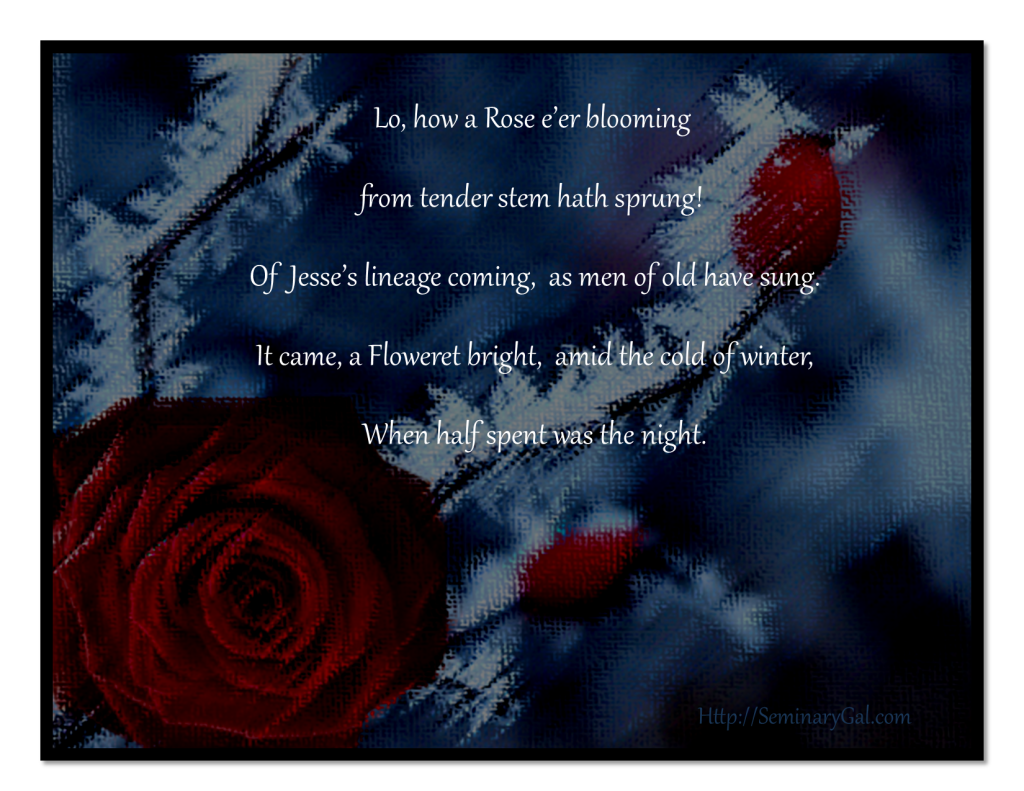
lo how a roseLo, how a Rose e’er blooming from tender stem hath sprung!

Of Jesse’s lineage coming, as men of old have sung.

It came, a floweret bright, amid the cold of winter,

When half spent was the night.


Isaiah ’twas foretold it, the Rose I have in mind;

With Mary we behold it, the virgin mother kind.

To show God’s love aright, she bore to men a Savior,

When half spent was the night.


This Flower, whose fragrance tender with sweetness fills the air

Dispels with glorious splendor the darkness everywhere

True man, yet very God, from sin and death He saves us

And lightens every load.

====

Carol Me, Christmas (2014 Advent Devotional Series) began November 30th.  By way of reminder, if you haven’t signed up yet, you can receive these devotional studies in your email throughout Advent 2014 by entering your email address on the SeminaryGal.com home page in the space provided in the sidebar.  Or “Like” the SeminaryGal Facebook page to access them there.  If you like these devotionals, I’d really appreciate your letting others know so I can continue to spread the Good News far and wide.  Blessings to you, in Christ always, Barbara <><

Continue Reading

What Child is This? (Advent 12-2014)

What Child Is This? is proof positive of the old Sunday School joke that the answer to every question is “Jesus.”  It’s the next carol in our Carol Me, Christmas (2014 Advent Devotional Series).  The lyrics are actually select verses from a poem by William Chatterton Dix entitled The Manger Throne written in 1865.

Born in Bristol, England, Dix was given a middle name that was not a family name, but rather from Dix’ father’s biography of the poet Thomas Chatterton, demonstrating that family names may not always be passed on to the next generation, but avocations and passions often do.

Dix worked as a marine insurance company manager but was, in God’s strange providence, afflicted with a severe illness, leaving him bedridden and depressed, but during which he experienced the saving grace of God.  His spiritual rebirth resulted in writing lyrics and poetry to some of the most beloved hymns we know: today’s carol, What Child is This?, Alleluia! Sing to Jesus!, and As with Gladness Men of Old.  His near-death experience had brought him through the depths of depression and What Child is This? is one of the most evangelistic carols of Christmas.  Dix would carry his passion for Christ through the remainder of his life.

What Child is This? may have been written in England, but its popularity in the United States surpasses that of its country of origin.  Perhaps it’s due to the haunting beauty, the soulful sentiment of the tune Greensleeves which was, even at the time, a well-known traditional English folk song.

No one seems to know who associated the lyrics with Greensleeves, but this tune is quite old and this link will take you to an extensive history of the tune with talk of Tudors and disputes dating back to the 1500s regarding ownership rights.

Far more certain than who owned the actual rights to the tune, however, is the carol’s theology.  The lyrics discuss the adoration of the shepherds who visited the Christ Child at the manger, and in true Victorian tradition, it suggests the Wise Men come (although less explicitly) to the manger.

The question and response characterizing this carol’s style is what each of us does when we come to meet Jesus.  The question is:

What Child is this?  (And by association, “Who is Jesus?”)

To this question, each of us individually responds by answering who we believe He is.  Ironically, in most hymnals even, the powerful refrain to the second verse of Dix’ poem has been changed to

This This is Christ the King
Whom shepherds guard and angels sing
Hail, hail the Word made flesh,
The Babe, the Son of Mary.

By doing so, many secular artists embrace this as a less religious song of Christmas and many Christian hymnals strip this carol of its most powerful words, removing the Cross, the nails, and the spear—all of which point to the sacrifice of Christ which made Him our Savior.  Dix’ words made clear that each of us must come to know Jesus, the babe, the Son of Mary as the unique Son of God, as the perfect Sacrifice for sin, born to be our Savior, and born to be Christ our King.

As you listen to this version by the incomparable Norwegian soprano  Sissel Kyrkjebø, ponder the Thought Focus for Today.

Thought Focus for Today:  What Child is This?  Who is He?  Why do we celebrate His birth?

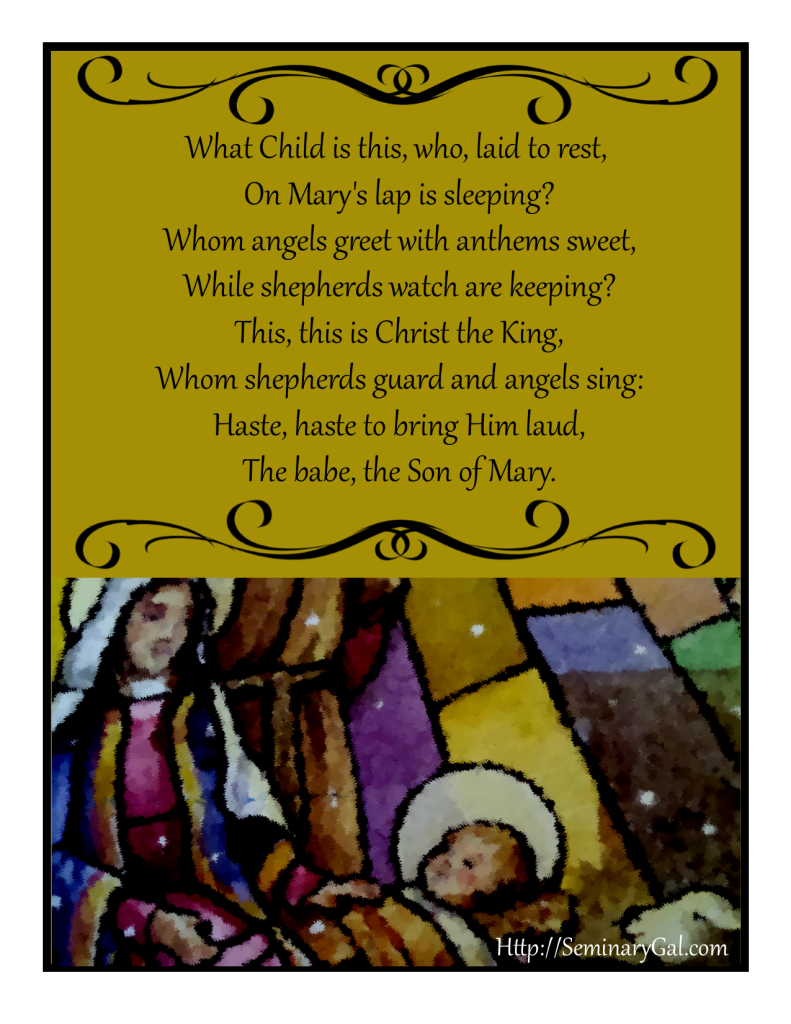
what child is this1. What Child is this who, laid to rest

On Mary’s lap is sleeping?

Whom angels greet with anthems sweet,

While shepherds watch are keeping?

This, this is Christ the King,

 Whom shepherds guard and angels sing;

 Haste, haste, to bring Him laud,

 The Babe, the Son of Mary.


2. Why lies He in such mean estate,

Where ox and ass are feeding?

Good Christians, fear, for sinners here

The silent Word is pleading.

Nails, spear shall pierce Him through,

 The cross be borne for me, for you.

 Hail, hail the Word made flesh,

 The Babe, the Son of Mary.


3. So bring Him incense, gold and myrrh,

Come peasant, king to own Him;

The King of Kings salvation brings,

Let loving hearts enthrone Him.

Raise, raise a song on high,

 The virgin sings her lullaby.

 Joy, joy for Christ is born,

 The Babe, the Son of Mary.


====

Carol Me, Christmas (2014 Advent Devotional Series) began November 30th.  By way of reminder, if you haven’t signed up yet, you can receive these devotional studies in your email throughout Advent 2014 by entering your email address on the SeminaryGal.com home page in the space provided in the sidebar.  Or “Like” the SeminaryGal Facebook page to access them there.  If you like these devotionals, I’d really appreciate your letting others know so I can continue to spread the Good News far and wide.  Blessings to you, in Christ always, Barbara <><

Continue Reading

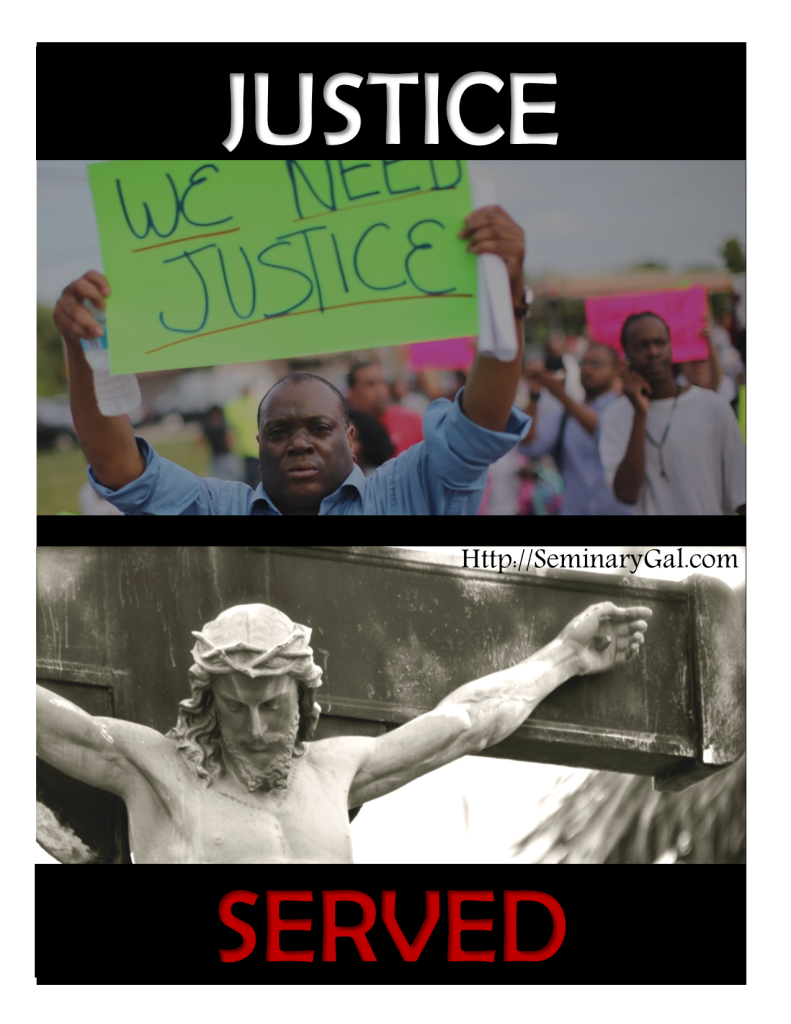
Justice. Served.

justice served


No matter where your politics take you, the Bible still speaks volumes into it.  Just a timely reminder that Christmas was necessary because people sin.  Cry out for Justice, knowing what that truly means, but always remember that Justice without a Savior would be something none of us wants.

Philippians 2:1 If you have any encouragement from being united with Christ, if any comfort from his love, if any fellowship with the Spirit, if any tenderness and compassion, 2 then make my joy complete by being like-minded, having the same love, being one in spirit and purpose. 3 Do nothing out of selfish ambition or vain conceit, but in humility consider others better than yourselves. 4 Each of you should look not only to your own interests, but also to the interests of others. 5 Your attitude should be the same as that of Christ Jesus:

6 Who, being in very nature God, did not consider equality with God something to be grasped, 7 but made himself nothing, taking the very nature of a servant, being made in human likeness. 8 And being found in appearance as a man, he humbled himself and became obedient to death– even death on a cross! 9 Therefore God exalted him to the highest place and gave him the name that is above every name, 10 that at the name of Jesus every knee should bow, in heaven and on earth and under the earth, 11 and every tongue confess that Jesus Christ is Lord, to the glory of God the Father.

Praise God for the birth of our Savior, Lord, and King! 

Let’s learn to forgive one another as we have been forgiven.

For if you forgive men when they sin against you,

your heavenly Father will also forgive you.

But if you do not forgive men their sins,

your Father will not forgive your sins.”

(A promise from Jesus in Matthew 6:14-15)

Continue Reading

The First Noel (Advent 11-2014)

I have been wrong a lot in my life.  I had always thought that The First Noel was French because Noël sounded French and had the dieresis above the letter ë like the French sometimes do.  I guess I was naïve.  A lot of carols were French after all, including the Cantique de Noël.  But not The First Noël.

The First Noel is a traditional English carol, of Cornish origin apparently.  It is well known, having been brought again to public attention in Carols Ancient and Modern (1823) by William Sandys whose book offered the first appearance of traditional English carols such as God Rest Ye Merry Gentlemen, I Saw Three Ships, and yes, The First Noel during the Victorian revival of the Christmas holiday.

Perhaps this is where the confusion arose.  Many people have thought that The First Noel is much older, even back to the 13th century.  Why?  Largely due to writers such as Charles Dickens, for whom the revival of Christmas was steeped in a nostalgia of uncertain origin, even from within the mind of the writer himself.  Books like A Christmas Carol (1843), looked back on the past and encouraged child-centric reminiscing in many Christmas traditions.  In such an environment, these hymns developed reputations for being sixteenth century or even earlier as Christmases past were romantically rewritten.

In the minds of writers who wanted the dream-like Christmas of the imaginary childhood, the Christmas narrative of England was in need of fixing.  You see, they were living in the aftermath of the time Christmas had been publically banned.

According to Time-travel Britain here’s reality:

In January 1645 parliament enlisted the help of a group of ministers to create a Directory of Public Worship establishing a new organisation of the church and new forms of worship that were to be adopted and followed in both England and Wales…

As well as disliking the waste and debauchery that went along with the celebration of Christmas, the Puritans viewed the festival (Christ’s mass) as an unwanted remnant of the Roman Catholic Church and, therefore, a tool of encouragement for the dissentient community that remained in both England and Wales. They argued that nowhere in the Bible had God called upon his people to celebrate the nativity in this manner. They proposed a stricter observance of Sundays, the Lord’s Day, along with banning the immoral celebration of Christmas — as well as Easter, Whitsun and saints’ days. Preferring to call the period Christ-tide, and thus removing the Catholic ‘mass’ element, the Puritans reasoned that it should remain only as a day of fasting and prayer.

The Victorian Web goes on to describe how Christmas had become, for a period of time, a non-holiday:

Christmas, with its apparently timeless customs and traditions, often seems to have been around forever. However, as late as the 1820s, the writer Leigh Hunt labeled it an event “scarcely worth mention,” (Qtd in Pimlott, 85), and it was widely believed that the holiday, both in England and throughout Europe and North America, was destined to die out. Banned under Oliver Cromwell, Christmas in England was restored with the monarchy in 1660, where it appears to have flourished as an increasingly less and less religious event. Nonetheless, by the 1800s, it had shrunk almost beyond recognition. In the 1840s, holidays observed by governmental departments had decreased from roughly a week in 1797 to just Christmas day itself (Pimlott, 77). But in a remarkable turn of events, under the Victorians Christmas flourished to an extent unprecedented in earlier centuries. This reemergence during the nineteenth-century gave birth to many of the traditions that are today indistinguishable from the holiday itself. Christmas trees, cards, dinners, presents, and carols are all either products of, or were revived during, the Victorian period.

Christmas, a less and less religious event.  Does that sound like today, or what?

The theology of The First Noel is right out of Scripture and the inclusion of “Born is the King of Israel” and pointing to the Crucifixion are both helpful in filling in the Christmas story.

That said, the timing is inaccurate.  Here we have introduced—taught through song—the notion that the Three Wise Men came to our nativity scenes with gold, frankincense, and myrrh.   In reality, the un-numbered Magi (aka 3 Wise Men) didn’t show up until later…in the unromanticized version we see in the Bible where Jesus is at home already.  Not in the manger.

Matthew 2:1 After Jesus was born in Bethlehem in Judea, during the time of King Herod, Magi from the east came to Jerusalem 2 and asked, “Where is the one who has been born king of the Jews? We saw his star in the east and have come to worship him.” 3 When King Herod heard this he was disturbed, and all Jerusalem with him. 4 When he had called together all the people’s chief priests and teachers of the law, he asked them where the Christ was to be born. 5 “In Bethlehem in Judea,” they replied, “for this is what the prophet has written: 6 “‘But you, Bethlehem, in the land of Judah, are by no means least among the rulers of Judah; for out of you will come a ruler who will be the shepherd of my people Israel.'” 7 Then Herod called the Magi secretly and found out from them the exact time the star had appeared. 8 He sent them to Bethlehem and said, “Go and make a careful search for the child. As soon as you find him, report to me, so that I too may go and worship him.” 9 After they had heard the king, they went on their way, and the star they had seen in the east went ahead of them until it stopped over the place where the child was. 10 When they saw the star, they were overjoyed. 11 On coming to the house, they saw the child with his mother Mary, and they bowed down and worshiped him. Then they opened their treasures and presented him with gifts of gold and of incense and of myrrh. 12 And having been warned in a dream not to go back to Herod, they returned to their country by another route.

The gold, incense, and myrrh would come in very handy to fund the family’s escape to Egypt, demonstrating that where God sends, He also aims to provide.  So the timing on God’s part was perfect.  Sandys’ was a little off.

Furthermore, in the final verses less commonly included in our hymnals we see perpetuated the belief that our good works contribute to our salvation when they do not.  There is also a hint at universal salvation when that doesn’t happen either.  So most hymnals leave that verse out.

Still, the carol is among the best known and favorite hymns of Christmas.  It’s been performed in many different genres from jazz to choral to pop to gospel to classical.  To prove my point, enjoy these versions by

Thought Focus for Today: How has the true meaning of Christmas disappeared in favor of traditions?  How might we regain the Christmas story from within our traditions?

The first Noel the angel did say

Was to certain poor shepherds in fields as they lay;

In fields where they lay tending their sheep,

the first noelOn a cold winter’s night that was so deep.

Refrain 

Noel, Noel, Noel, Noel,

Born is the King of Israel.

They lookèd up and saw a star

Shining in the east, beyond them far;

And to the earth it gave great light,

And so it continued both day and night.

Refrain 

And by the light of that same star

Three Wise Men came from country far;

To seek for a King was their intent,

And to follow the star wherever it went.

Refrain 

This star drew nigh to the northwest,

Over Bethlehem it took its rest;

And there it did both stop and stay,

Right over the place where Jesus lay.

 Refrain

 Then did they know assuredly

Within that house the King did lie;

One entered it them for to see,

And found the Babe in poverty.

Refrain

Then entered in those Wise Men three,

Full reverently upon the knee,

And offered there, in His presence,

Their gold and myrrh and frankincense.

Refrain 

Between an ox stall and an ass,

This Child truly there He was;

For want of clothing they did Him lay

All in a manger, among the hay.

Refrain 

Then let us all with one accord

Sing praises to our heavenly Lord;

That hath made Heaven and earth of naught,

And with His blood mankind hath bought.

Refrain 

If we in our time shall do well,

We shall be free from death and hell;

For God hath prepared for us all

A resting place in general.

Refrain 

====

Carol Me, Christmas (2014 Advent Devotional Series) began November 30th.  By way of reminder, if you haven’t signed up yet, you can receive these devotional studies in your email throughout Advent 2014 by entering your email address on the SeminaryGal.com home page in the space provided in the sidebar.  Or “Like” the SeminaryGal Facebook page to access them there.  If you like these devotionals, I’d really appreciate your letting others know so I can continue to spread the Good News far and wide.  Blessings to you, in Christ always, Barbara <><

Continue Reading

When the Ordinary Meets the Extraordinary (sermon text version)

(Note:  For those of you receiving these emails for the Carol Me, Christmas (2014 Advent Devotional Series) I still post both the audio and the sermon text versions of messages I preach on Sundays along with the day’s Advent devotionals.  I hope you enjoy these sermons and are blessed by them.  When the Ordinary Meets the Extraordinary (Acts 4:13-22) continues the sermon series of Acts of the Holy Spirit and the Apostles which began in August and can be accessed through the August-November archives.)

* * *

When the Ordinary Meets the Extraordinary

Every once in a while, someone basically accuses me, “Who are you…?”  A lot of the time, it’s said with a sneer. (Fill in the blank):

  • cookie cutterWho are you…to judge?
  • Who are you…to say?
  • Who are you…to try?
  • Who are you…to think that?

Indeed, I often ask myself,

Who am I?”

Oftentimes, my answer to “Who am I?” is “Nobody…”  (Fill in the blank)

  • Nobody special
  • Nobody important
  • Nobody worthy
  • Or just Plain Nobody

In the realm of humanity, with our horizontal comparisons, we’re often just plain nobodies.  The bad news for humanity is we’re constantly comparing ourselves on some sort of worthiness scale.

Maybe your personal worthiness scale is Mother Teresa (good!) and Hitler (all the way down on the bad end) and you hope to at least be in the upper half of your graduating class.  More on the Mother Teresa end and leaving the lower half Hitlers to everyone else.

While I was away in Florida for the birth of my grandson, Ryan, I had the opportunity of driving my daughter to Ryan’s first pediatric visit.  While we were in the waiting room another young family came in.  With a baby about the same age.  The mom was beyond talkative about her baby doing this or that, having had her first bath plus clipped fingernails and loving it all, sleeping so well, and excelling at everything that a newborn can excel at!  After a vocal outburst…at the reception desk about how they have an appointment and need to be seen immediately, they were ushered away and I looked at my daughter and her beautiful baby and said, “Welcome to the world of competitive motherhood.”  We go from feeling like nobodies raising nobody children compared to somebody’s miracle child who will appear in every family Christmas newsletter as the star of amazing accomplishments, previously unknown to the human race.
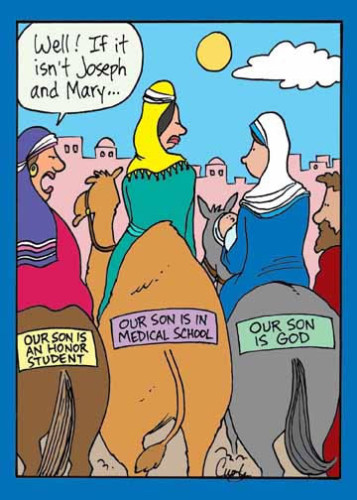
cartoon son of godThe Good News is that God turns Nobodies into Somebodies. 

That’s what happens when the Ordinary Meets the Extraordinary.

Oh it’s not like the cartoon I saw of 3 women riding on mules back to Nazareth with bumper stickers on the back ends of the mules.  One woman mutters, “Well! If it isn’t Joseph and Mary…” The bumper stickers said, “Our son is an honor student.”  “Our son is in medical school.”  Mary’s said, “Our Son is God.”  The real Mary was much more humble than that, but when the Ordinary meets the Extraordinary we do become changed people.

We become Somebody special.  Somebody important.  Somebody worthy of receiving God’s particular notice and favor, even though–in and of ourselves–we’re unworthy from horn to hoof in the eyes of God and man.  In God’s eyes, though, we’ve always been His precious Image bearers and that’s what He sees when He looks at you and He looks at me, sinners though you and I are.

We go from being Nobodies to Somebodies with 5 important results. 

As we look at those on the second Sunday of Advent and I’d like to publically thank Bill Slater for having continued our series of Acts during the month of November.  I’m glad to be back among you as friends.  It feels good to be home. At home, nobody cares that we’re nobodies.  Among friends in church, we’re always somebodies because we’re a family of equally loved children in the eyes of God.

Today, we’re in Acts 4:13-22 and in the flow of Acts we’ve seen how Peter addressed a crowd of Nobodies and they became Somebodies in Christ.  3000 of them, Scripture says.  They devoted themselves to a study of the Word and praised God and grew from the earliest beginnings of a few Nobodies to a whole bunch of people God sees as Somebody chosen for heavenly dwelling because of Jesus Christ.

Peter and John were two such Nobodies who were plucked out of their fishing boats to follow Jesus.  But after following Him as His chosen disciples, what did they do?  They abandoned Jesus while He was reduced to a Nobody on a Cross in the eyes of man.

Psalm 22:6 But I am a worm and not a man, scorned by men and despised by the people.

This Messianic Scripture speaks to His being—in the eyes of man at least–pretty much a Nobody.

But after Jesus’ Resurrection, His reinstatement of Peter and His encouragement of John the beloved disciple who abandoned Jesus too, Peter and John proved that changed lives make great testimonies!

Result #1 when the Ordinary Meets the Extraordinary: we go from Nobodies we are in the eyes of mankind in our competitive world to knowing we’ve always been Somebodies in the eyes of God.  Not because of who I am, as our song said this morning, but because of who God is.

But Result #2 when the Ordinary Meets the Extraordinary is that we get sent on an important mission!  Peter and John boldly went to the temple to evangelize.  They were Somebodies with a mission: to demonstrate the Life-Changing Jesus Christ!

What more powerful witness to the Life-Changing Jesus Christ than to heal a crippled man with no life other than to beg?  So they heal him, giving credit to God of course, and what happens?  This formerly crippled man becomes a source of contention among the people who thought they were definitely Somebodies in this world.  The religious leaders had quite a high view of themselves.  They didn’t quite like that the numbers of people listening to these Nobodies had grown from 3000 to 5000 when the leaders weren’t experiencing ministry growth!  It’s not fair.  Those disciples are Nobodies and we’re Somebodies!  Yet those Nobodies are doing nothing but continuing to grow in numbers with Peter and John talking about their journey to Somebodyhood by the power of Jesus Christ….the Son of God, the One treated as a Nobody—the stone the builders rejected—that has now become the Capstone.   Indeed, Peter proclaims,

Acts 4:12 Salvation is found in no one else, for there is no other name under heaven given to men by which we must be saved.”

When the Ordinary Meets the Extraordinary, Nobodies turn into Somebodies with a mission and purpose.

If we were to look at the Christmas Story, we see Mary—a nobody from nowhere—and yet God finds something in her (a wholehearted devotion to God) that makes her a Somebody in God’s sight.  She is the most blessed among women and will bear the Christ Child we will celebrate on Christmas and the Savior whom we worship week after week here.

Mary was a brave and devout woman in a culture that viewed women as Nobodies.  And in Acts today we see nothing less than the story of Nobodies who became Somebodies because the Ordinary men met the Extraordinary Savior!  Let’s take a look at Result #3: These Nobodies turned Somebodies have uncommon courage:

Acts 4:13 When [the religious leaders] saw the courage of Peter and John and realized that they were unschooled, ordinary men, they were astonished and they took note that these men had been with Jesus.

Bill did a great job last week of showing that God uses ordinary people!  Peter and John were two such men.  While I was away, one of the preachers I heard was talking about how the Peter we see here in Acts and the Peter from the triple denials of the night before the rooster crowed with the Crucifixion bear little resemblance to one another.  Stop and think about it:  If the Peter of the Gospel story was all we knew, the church never would have started.  He was a coward.  He was a lyin’ three times deny’n man with selective amnesia blues.  He couldn’t even recall ever knowing Jesus, amazingly enough!

Oh, but what difference happens when the Ordinary Meets the Extraordinary!  Oh yes, Nobodies turn into Somebodies …and Somebodies with a mission and purpose.  The Resurrection changes everything and Peter is reinstated by the Extraordinary Risen Lord.  Suddenly this same coward becomes a man with purpose, with boldness, with total recall!  Amazingly enough.

When the Ordinary Meets the Extraordinary, denying cowards become professing leaders.   And what do the religious leaders do?  Acts 4 continues,

14 But since they could see the man who had been healed standing there with them, there was nothing they could say. 15 So they ordered [Peter, John, and the former cripple] to withdraw from the Sanhedrin and then conferred together. 16 “What are we going to do with these men?” they asked. “Everybody living in Jerusalem knows they have done an outstanding miracle, and we cannot deny it. 17 But to stop this thing from spreading any further among the people, we must warn these men to speak no longer to anyone in this name.” 18 Then they called them in again and commanded them not to speak or teach at all in the name of Jesus.

The religious leaders’ solution?  We cannot deny it so we’ll squelch it.  We’ll threaten them and bring out that old inner coward that’s waiting to rear its head in Peter (especially since he’s the one speaking!)  We’ll silence them through intimidation!

But instead of responding by shutting up, Peter and John suddenly get a case of boldness:

19 But Peter and John replied, “Judge for yourselves whether it is right in God’s sight to obey you rather than God. 20 For we cannot help speaking about what we have seen and heard.”

When the Ordinary Meets the Extraordinary, Result #4 is that Nobodies are free from fear to become Somebodies with boldness and who can’t stop talking about what has happened because of God.

The Sanhedrin didn’t know what to do:

21 After further threats they let them go. They could not decide how to punish them, because all the people were praising God for what had happened. 22 For the man who was miraculously healed was over forty years old.

Result #5 is that it results in praise of God!  Remember what Scripture says about the crippled beggar who had been healed?  Back in

Acts 3:8 He jumped to his feet and began to walk. Then he went with them into the temple courts, walking and jumping, and praising God. 9 When all the people saw him walking and praising God, 10 they recognized him as the same man who used to sit begging at the temple gate called Beautiful, and they were filled with wonder and amazement at what had happened to him.

Yes, when the Ordinary Meets the Extraordinary, Nobodies become Somebodies filled with praise of God!  And other people take notice.

What’s your take home lesson from all this?

First, so long as you have breath in your body, God’s not done with you yet.  When the Ordinary you and the Ordinary me Meet the Extraordinary Jesus Christ, Nobodies are turned into Somebodies.  Not one of us is undervalued or unnoticed by God. If you’re lonely and feeling like you’re invisible, God says No way!  You’re Somebody important to Him!

Second, when the Ordinary Meets the Extraordinary, Nobodies become Somebodies on a mission and with a purpose!  Oh, not all of us will have a famous purpose like Mary, or the apostles Peter and John, but we all have purpose to use what God has given for His and our use for His mission of spreading the Gospel and the purpose of impacting a world and ushering in the Kingdom through our witness!

Third, when the Ordinary Meets the Extraordinary, denying cowardly Nobodies become professing leaders and truly Somebodies.  Fear doesn’t command us.  We have the Holy Spirit’s command over our own hearts and minds and because of Him, we can rise to lead in little and big ways!  Maybe your leadership will be to invite a family member …or a neighbor to our Christmas Eve presentation which will be a totally unique take on the traditional Christmas story.  We’ll be joined in worship by Jesus’ mother Mary who will remember along with us the story of the birth of the Savior!  Maybe your leadership will be to read the Christmas story aloud to your kids and grandkids from the Gospel of Luke.  Maybe your leadership will be to serve in GROW Plymouth or in a committee role to make Plymouth everything God desires it to be!

When the Ordinary Meets the Extraordinary, Nobodies who are silent–with nothing to say– are turned into Somebodies who speak boldly and are given words by God to say!  For some of you that will be letters to the editor, for some of you, that will be rounding up your friends for an apologetics seminar in the New Year, and for some of you maybe your place of leadership is in your workplace or social media, introducing the most healing words ever spoken, the Gospel!

And finally, When the Ordinary Meets the Extraordinary, people see Nobodies (Peter, John, the crippled beggar) who have become Somebodies praising God.  This is one all of us can do.  Let’s praise God in our every moment and for every blessing and know that God can cause a world of Nobodies…even those who already think they’re Somebody…to sit up and take notice.

That’s what happens When the Ordinary man Meets the Extraordinary Savior. 

Let’s pray.

(This message was first preached at Plymouth Congregational Church of Racine, WI by Barbara Shafer on December 7, 2014)
Continue Reading

When the Ordinary Meets the Extraordinary (audio version)

The audio version of When the Ordinary Meets the Extraordinary (click link) is now available on YouTube.  For those of you receiving these emails for the Advent Devotional Series, Carol Me Christmas! I still post both the audio and the sermon text versions of messages I preach on Sundays along with the day’s Advent devotionals.  I hope you enjoy these sermons and are blessed by them.  When the Ordinary Meets the Extraordinary (Acts 4:13-22) continues the sermon series of Acts of the Holy Spirit and the Apostles which began in August and can be accessed through the August-November archives.

===

Carol Me, Christmas (2014 Advent Devotional Series) began November 30th.  By way of reminder, if you haven’t signed up yet, you can receive these devotional studies in your email throughout Advent 2014 by entering your email address on the SeminaryGal.com home page in the space provided in the sidebar.  Or “Like” the SeminaryGal Facebook page to access them there.  If you like these devotionals, I’d really appreciate your letting others know so I can continue to spread the Good News far and wide.  Blessings to you, in Christ always, Barbara <><

Continue Reading

While Shepherds Watched Their Flocks (Advent 10-2014)

Today in Carol Me, Christmas (2014 Advent Devotional Series) we continue our look at the angels communicating the good news of great joy to the shepherds.  One of the great surprises of the Christmas story is that it was announced to shepherds who were considered the dregs of society.  Seriously, shepherds?  (That might have been the popular reaction at the time.)  You’ve got the birth announcement of royalty—the King of Kings—being announced… to shepherds?  (Insert hysterical laughter here.)

While Shepherds Watched Their Flocks was versified by Irishman Nahum Tate, a hymn writer and Poet Laureate.  Of the many works with which Tate was involved, this time in collaboration with Nicholas Brady, While Shepherds Watched Their Flocks is really the only one to endure and appear in our present-day hymnals at all. Tate, in spite of his continual striving for public favor, ended his years fleeing from his creditors.  Perhaps it’s a good time to revisit our own ideas of what it means to be a success.  For many of us, our legacy won’t be a hymn or carol; it won’t even be money or property of any kind, but rather our legacy will be in the lives we touched with the Gospel message that the angels proclaimed!

Luke 2:8 Now there were in the same country shepherds living out in the fields, keeping watch over their flock by night. 9 And behold, an angel of the Lord stood before them, and the glory of the Lord shone around them, and they were greatly afraid. 10 Then the angel said to them, “Do not be afraid, for behold, I bring you good tidings of great joy which will be to all people. 11 “For there is born to you this day in the city of David a Savior, who is Christ the Lord. 12 “And this will be the sign to you: You will find a Babe wrapped in swaddling cloths, lying in a manger.” 13 And suddenly there was with the angel a multitude of the heavenly host praising God and saying: 14 “Glory to God in the highest, And on earth peace, goodwill toward men!”

Do you see how the angels pointed to Jesus?  They succeeded in the most important way possible: showing the Way, the Truth, and the Life even though at the time, He was but a baby in a manger.

In the Church of England at the time of this carol, only the Psalms of David were permitted to be sung.  Therefore, this work was included in a supplement to New Version of the Psalms of David (1696) and became the only Christmas hymn permitted to be sung in addition to the Psalms.  The reason for that is many carols (like some of the French ones we’ve seen) had their roots in folk music.  Therefore, they were considered commoner’s secular music, insufficiently holy to be used in church services.  This persisted until the end of the 18th century as Christianity moved to the wider culture of the unchurched (folk, commoners, seculars and the slave community) in revivals such as those in the Great Awakening.

The carol is most commonly sung to Winchester Old (United Kingdom) and an arrangement of a George F. Handel aria arranged by Lowell Mason (United States).  Two other tunes Martyrdom and Shackelford—both from the 1880s—are less commonly associated with While Shepherds Watched Their Flocks.

Theologically, not surprisingly given the Church of England’s tight control over what was sung at the time, While Shepherds Watched Their Flocks is pretty much straight out of the Gospel of Luke.  As you enjoy this beautiful version on harp ponder our Thought Focus for Today:

Thought Focus for Today: the angels proclaimed a message that they were compelled to share though they had no stake in its blessing.  Yet they rejoice in this Good News and praise God….in the presence of shepherds.  If they had any reservations about sharing the Good News with the lowest of society, they certainly did not show it.  What is known about angels is that the angelic host of God do exactly what God tells them to do!  God says, share the Good News with shepherds.  Boom.  Done. 

How ought we view sharing the Good News, even with those who are from different social circles?

while shepherds watchedWhile shepherds watched their flocks by night,

All seated on the ground,

The angel of the Lord came down,

And glory shone around,

And glory shone around.


“Fear not!” said he, for mighty dread

Had seized their troubled mind.

“Glad tidings of great joy I bring

To you and all mankind

To you and all mankind.


“To you, in David’s town, this day

Is born of David’s line

A Savior, who is Christ the Lord,

And this shall be the sign,

And this shall be the sign.


“The heavenly Babe you there shall find

To human view displayed,

All meanly wrapped in swathing bands,

And in a manger laid,

And in a manger laid.”


Thus spake the seraph and forthwith

Appeared a shining throng

Of angels praising God on high,

Who thus addressed their song,

Who thus addressed their song:


“All glory be to God on high,

And to the Earth be peace;

Good will henceforth from Heaven to men

Begin and never cease,

Begin and never cease!”

====

Carol Me, Christmas (2014 Advent Devotional Series) began November 30th.  By way of reminder, if you haven’t signed up yet, you can receive these devotional studies in your email throughout Advent 2014 by entering your email address on the SeminaryGal.com home page in the space provided in the sidebar.  Or “Like” the SeminaryGal Facebook page to access them there.  If you like these devotionals, I’d really appreciate your letting others know so I can continue to spread the Good News far and wide.  Blessings to you, in Christ always, Barbara <><

Continue Reading