 The story of Joseph told by Stephen (the 1st martyr of the Church) is more than just a nice story of reconciliation among brothers. Stephen presents Joseph as a “type of Christ,” a foreshadowing of Jesus. This message was first preached at Plymouth Congregational Church of Racine, WI on March 15, 2015 by Barbara Shafer. You can listen on YouTube by clicking on this link.
On Testimony-Lent 23, 2015
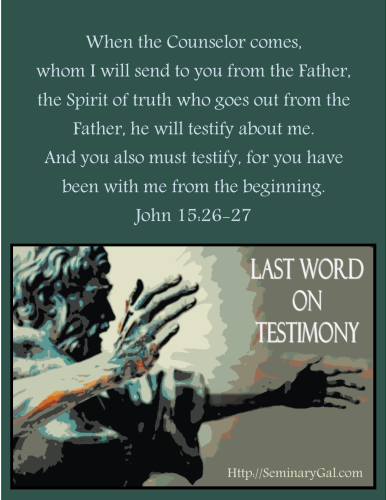
John 15:26 “When the Counselor comes, whom I will send to you from the Father, the Spirit of truth who goes out from the Father, he will testify about me. 27 And you also must testify, for you have been with me from the beginning.
We often see court cases presented on TV. Fictional ones and real ones. The purpose of testimony by witnesses is to make the case, either for the defense or the prosecution.
In this case, it’s both defense and prosecution. The Holy Spirit is testifying on behalf of Jesus as a prosecuting attorney and we’re all guilty! But He’s also testifying as the defense, His presence shows our sentence has been commuted.
The Holy Spirit is looking for a guilty judgment: guilty of sin, guilty of rebellion, and guilty of belonging to Christ.
Huh? How does all that fit together?
 Returning to the 22nd devotional in our Lenten Devotional Series, With Christ in the Upper Room,
John 15:18 “If the world hates you, keep in mind that it hated me first. 19 If you belonged to the world, it would love you as its own. As it is, you do not belong to the world, but I have chosen you out of the world. That is why the world hates you. 20 Remember the words I spoke to you: ‘No servant is greater than his master.’ If they persecuted me, they will persecute you also. If they obeyed my teaching, they will obey yours also. 21 They will treat you this way because of my name, for they do not know the One who sent me. 22 If I had not come and spoken to them, they would not be guilty of sin. Now, however, they have no excuse for their sin. 23 He who hates me hates my Father as well. 24 If I had not done among them what no one else did, they would not be guilty of sin. But now they have seen these miracles, and yet they have hated both me and my Father. 25 But this is to fulfill what is written in their Law: ‘They hated me without reason.’
The Gospel of Jesus Christ–that’s what we are testifying about. But what good is a Gospel? Why would it be Good News except that we’ve got a sin problem…and a rebellion problem? And why would that be Good News if we remained guilty?
There’s only one way to escape eternal judgment and that’s by having sufficient evidence in the Holy Spirit. His presence proves that we belong to Christ as His Gospel testifies. His presence is evidence that declared us both guilty of sin and forgiven by Christ. This is what we proclaim as Jesus’ witnesses. We are guilty…and…forgiven! That’s every Christian’s testimony!
* * *
Give it Up for Lent: Feeling like we don’t need a Savior
Put it On for Lent: Willingness to testify
For further thought:
- If you were to win on Wheel of Fortune, wouldn’t you be thrilled to relive that moment over and over in the retelling of the story? Why not the joy of retelling your being saved by Christ? Isn’t that more valuable than vacations to Aruba?
- Is there enough evidence in your Christian life to convict you of belonging to Christ?
- What types of things hold you back from testifying to what Jesus has done in your life?
* * *
You can receive these devotional studies in your email (Monday through Saturday during Lent) by entering your email address on the SeminaryGal.com home page in the space provided in the sidebar. Let’s meet With Christ in the Upper Room.
On Opposition-Lent 22, 2015
John 15:18 “If the world hates you, keep in mind that it hated me first. 19 If you belonged to the world, it would love you as its own. As it is, you do not belong to the world, but I have chosen you out of the world. That is why the world hates you. 20 Remember the words I spoke to you: ‘No servant is greater than his master.’ If they persecuted me, they will persecute you also. If they obeyed my teaching, they will obey yours also. 21 They will treat you this way because of my name, for they do not know the One who sent me. 22 If I had not come and spoken to them, they would not be guilty of sin. Now, however, they have no excuse for their sin. 23 He who hates me hates my Father as well. 24 If I had not done among them what no one else did, they would not be guilty of sin. But now they have seen these miracles, and yet they have hated both me and my Father. 25 But this is to fulfill what is written in their Law: ‘They hated me without reason.'”
 Jesus is offering some final instructions to the disciples who are With Christ in the Upper Room. He has spoken to them about the full extent of His love as reflecting the great measure of the Father’s love for us. Now He turns again to the topic of showing the full extent of His love, not in words only, but in actions.
At this point, Jesus knows the Cross is ahead. He’s spoken of it before, but the disciples still don’t understand. To them, He’s still the Messianic figure from Palm Sunday, cheered by the crowds, beloved by the little guy. He’s a people’s Messiah! The One they’ve been waiting for. And they’ve been His disciples and groupies.
Now, however, He’s starting to say some things that are really troubling. Opposition. Persecution. Hate.
Where is all this hate coming from?
Re-read this passage. The word hate appears 7 times! The world hates Him and the world hates them. He’s going to be persecuted. They are going to be persecuted. Things are about to become really serious really fast. This isn’t quite what they’d signed up for.
* * *
Give it Up for Lent: Thinking we can avoid being hated by accommodation with the world.
Put it On for Lent: Acting like chosen people–chosen for salvation, chosen to suffer
For further thought:
- Has anyone ever said they hate you or accused you of hate…and really meant it? How did that make you feel?
- What is the best way of dealing with opposition that Jesus outlines for us? From where do we get our encouragement?
- Can we ever resolve religious conflicts? Why or why not? What would have to happen to resolve a religious conflict?
* * *
You can receive these devotional studies in your email (Monday through Saturday during Lent) by entering your email address on the SeminaryGal.com home page in the space provided in the sidebar. Let’s meet With Christ in the Upper Room.
On Greater Love-Lent 21, 2015
John 15:9 “As the Father has loved me, so have I loved you. Now remain in my love. 10 If you obey my commands, you will remain in my love, just as I have obeyed my Father’s commands and remain in his love. 11 I have told you this so that my joy may be in you and that your joy may be complete. 12 My command is this: Love each other as I have loved you. 13 Greater love has no one than this, that he lay down his life for his friends. 14 You are my friends if you do what I command. 15 I no longer call you servants, because a servant does not know his master’s business. Instead, I have called you friends, for everything that I learned from my Father I have made known to you. 16 You did not choose me, but I chose you and appointed you to go and bear fruit– fruit that will last. Then the Father will give you whatever you ask in my name. 17 This is my command: Love each other.”
 With Christ in the Upper Room, the disciples are being shown the full extent of the love of Christ. “As the Father has loved me, so have I loved you.” That’s a greater measure of love, for sure!
- Love is mentioned 9 times in this short passage.
- Commands are mentioned 5 times.
- Obedience is mentioned directly or indirectly 3 times.
- Friendship is presented 3 times as well.
- Joy is mentioned twice and so is fruit.
What connects them all is abiding in the love of Christ, in His greater love!
The word abiding is translated as remaining in the NIV but irrespective of translation, the key to abiding/remaining in His love is obedience to His commands.
Re-read today’s passage, pondering every line. It is full of important ideas. Most of all, however, Jesus is showing them the full extent of His love, His greater love.
* * *
Give it Up for Lent: an intellectual Christianity full of doctrine and rules but suspiciously lacking in love for others.
Put it On for Lent: Greater love
For further thought:
- What types of things cause us to become disconnected from the love of Christ?
- What would laying one’s life down for his friends look like in your life and mine? What does it mean in practice?
- If your life lacks joy (as distinct from happiness which is more surface and environmental), what types of things can you do to have complete joy?
- Have you ever met someone who claimed to be Christian…who always spouted doctrine, but whose spirit had an element of meanness? Someone, perhaps, who demeaned or defamed other people or called them names? Read 1 John 2: 3 We know that we have come to know [Christ] if we obey his commands. 4 The man who says, “I know him,” but does not do what he commands is a liar, and the truth is not in him. 5 But if anyone obeys his word, God’s love is truly made complete in him. This is how we know we are in him: 6 Whoever claims to live in him must walk as Jesus did. What does Jesus command in today’s passage?
- How does it make you feel to know you were chosen by God?
* * *
You can receive these devotional studies in your email (Monday through Saturday during Lent) by entering your email address on the SeminaryGal.com home page in the space provided in the sidebar. Let’s meet With Christ in the Upper Room.
On Abiding-Lent 20, 2015
John 15:1 I am the true vine, and my Father is the gardener. 2 He cuts off every branch in me that bears no fruit, while every branch that does bear fruit he prunes so that it will be even more fruitful. 3 You are already clean because of the word I have spoken to you. 4 Remain in me, and I will remain in you. No branch can bear fruit by itself; it must remain in the vine. Neither can you bear fruit unless you remain in me. 5 “I am the vine; you are the branches. If a man remains in me and I in him, he will bear much fruit; apart from me you can do nothing. 6 If anyone does not remain in me, he is like a branch that is thrown away and withers; such branches are picked up, thrown into the fire and burned. 7 If you remain in me and my words remain in you, ask whatever you wish, and it will be given you. 8 This is to my Father’s glory, that you bear much fruit, showing yourselves to be my disciples.
 Yesterday, Jesus said “Come now; let us leave.” While there is some uncertainty where they went immediately as they left, we now enter into a second thematic section of the Upper Room Discourse, even if they aren’t in the Upper Room per se.
This second section focuses on the testimony, the fruit if you will, of the life of a genuine Christ-follower. Jesus gives us the image of a vine bearing fruit and stresses the importance of abiding.
Previously we saw we show the world that we are disciples by loving one another.
This is action-based.
We choose to love others and love God.
Now we show ourselves and others that we are disciples by bearing fruit for Christ.
This is abiding-based.
All we do is abide.
A branch doesn’t have to work at doing all the fruiting, it happens as the vine does its work in a branch fully connected. The branch simply bears the fruit the vine produces. If you cut a branch off a tree, it will not produce apples awaiting the yard waste hauler. But if a branch stays on the tree, or a branch stays connected to the vine, apples or grapes or figs or cucumbers get produced by the tree or the vine. It’s as if the branch and the vine are one…and the fruit is evidence that the connection is real.
Remember the other day we had that confusing statement? John 14:20 On that day you will realize that I am in my Father, and you are in me, and I am in you.
Connected. Like a branch into a vine. Not complicated at all, really.
That connection is called abiding and it is our key to producing fruit.
* * *
Give it Up for Lent: Thinking you can be disconnected and still be a disciple
Put it On for Lent: Abiding
For further thought:
- If a connected apple branch bears apples and a connected grape branch bears grapes, what does a connected Christian produce?
- If loving others is the testimony to the world, what kind of fruit would demonstrate to ourselves, God, and the world that we are disciples of Jesus Christ?
- In verse 7, is Jesus promising to be our personal genie? If not, what kinds of things does He mean by “whatever you wish”?
- What might be the kind of fruit that is to the Father’s glory?
* * *
You can receive these devotional studies in your email (Monday through Saturday during Lent) by entering your email address on the SeminaryGal.com home page in the space provided in the sidebar. Let’s meet With Christ in the Upper Room.
On Leaving-Lent 19, 2015
John 14:27 Peace I leave with you; my peace I give you. I do not give to you as the world gives. Do not let your hearts be troubled and do not be afraid. 28 “You heard me say, ‘I am going away and I am coming back to you.’ If you loved me, you would be glad that I am going to the Father, for the Father is greater than I. 29 I have told you now before it happens, so that when it does happen you will believe. 30 I will not speak with you much longer, for the prince of this world is coming. He has no hold on me, 31 but the world must learn that I love the Father and that I do exactly what my Father has commanded me. “Come now; let us leave.”
 How often we fail to see how greatly Jesus looked forward to being freed from the constraints of the Incarnation and the immense joy He had anticipating a return to His Father!
Jesus was looking forward to this and dearly wanted His disciples to set aside their confusion and worry and instead, to share in His joy.
Wait a minute, are you saying that Jesus was actually looking forward to His own Crucifixion?
Not as an event per se, but for what it signified, yes, He was.
For this heralded several things immediately following His Crucifixion:
- He’d be reunited with His Father!
- He’d be back in His glory and in the presence of His Father’s glory!
- He’d have fulfilled His entire mission by finishing perfectly what He’d come here to do!
- He’d have offered to the world and to the disciples a complete picture of the full extent of His love. First and foremost, His love for the Father. But also, His love for us.
In their place of grief, Jesus leaves peace behind. His peace! In their place of trouble and fear, Jesus wants them to have joy in the Lord. In their place of confusion, Jesus wants them to learn just how immensely He loves the Father…and to learn that obedience is the surest evidence of love.
Jesus is leaving soon. He has done all that He can while the disciples are With Christ in the Upper Room to prepare them for the events to come which surely will be a shock to them. He doesn’t want their faith to fail even as He continues to prepare them for His leaving.
* * *
Give it Up for Lent: The world revolving around us and our feelings
Put it On for Lent: Peace and Joy because Jesus was reunited with His Father.
For further thought:
- Read Philippians 2:5 Your attitude should be the same as that of Christ Jesus: 6 Who, being in very nature God, did not consider equality with God something to be grasped, 7 but made himself nothing, taking the very nature of a servant, being made in human likeness. 8 And being found in appearance as a man, he humbled himself and became obedient to death– even death on a cross! 9 Therefore God exalted him to the highest place and gave him the name that is above every name, 10 that at the name of Jesus every knee should bow, in heaven and on earth and under the earth, 11 and every tongue confess that Jesus Christ is Lord, to the glory of God the Father.” Why did God exalt Jesus to the highest place?
- Hebrews 12:2 “Let us fix our eyes on Jesus, the author and perfecter of our faith, who for the joy set before him endured the cross, scorning its shame, and sat down at the right hand of the throne of God.” Is it possible that the joy of doing the Father’s will is what gave Jesus perseverance through the excruciating Crucifixion?
- Luke 22: 67 “If you are the Christ,” they said, “tell us.” Jesus answered, “If I tell you, you will not believe me, 68 and if I asked you, you would not answer. 69 But from now on, the Son of Man will be seated at the right hand of the mighty God.” 70 They all asked, “Are you then the Son of God?” He replied, “You are right in saying I am.” Jesus knew He was returning to the Father. He spoke as if it was already done. How could He be so sure?
* * *
You can receive these devotional studies in your email (Monday through Saturday during Lent) by entering your email address on the SeminaryGal.com home page in the space provided in the sidebar. Let’s meet With Christ in the Upper Room.
On the Holy Spirit-Lent 18, 2015
John 14:25 “All this I have spoken while still with you. 26 But the Counselor, the Holy Spirit, whom the Father will send in my name, will teach you all things and will remind you of everything I have said to you.”
Jesus knows that the disciples who are With Christ in the Upper Room are beyond baffled. Jesus understands their limitations and in His grace, He gives them encouragement in His own words before He dies. They hear it from His own lips. After that, the Holy Spirit will take over making things understandable. And with the Trinity, there’s a lot left to comprehend.
I love the Holy Spirit. I’ve often called Him the best kept secret of Evangelical Christianity.
He’s the closest I’ll ever get to being in the presence of Christ…in this lifetime at least….since Jesus ascended to heaven almost 2000 years ago.
So many of us treat the Holy Spirit like the crazy uncle of the Trinity and are embarrassed to talk about Him out of fear that we’ll be seen as people who have lost our minds or are living in some bizarre fantasy world. Other people turn Him into the litmus test of charismatic Christianity and worship the Holy Spirit more than the Father or Jesus Christ, God’s Son.
But I love the Holy Spirit. Without Him, the Church wouldn’t be the Church. Without Him, we could not adequately understand our Bibles. Without Him, we wouldn’t have a decent prayer life. Without Him, we’d be missing our guarantee of belonging to Christ.
While there was human breath in His body, Jesus tells the disciples all this confusing stuff, yet He knows they don’t and won’t understand…until later. So He gives this beautiful promise: this Counselor is coming and He’ll help them from that point on.
The Father will send the Holy Spirit in Jesus’ Name in order to teach what they were not capable of learning while Jesus was still in the flesh. This Counselor will remind them of everything Jesus said…because the Holy Spirit is God and so is Jesus.
Do you love the Holy Spirit?
***
Give it Up for Lent: Treating the Holy Spirit as a second rate deity or a litmus test
Put it On for Lent: Love of who the Holy Spirit is
For further thought:
Read these words by Pastor AW Tozer and pray about the reflection points:
- “When Jesus is glorified, the Holy Spirit comes. He does not have to be begged—the Holy Spirit comes when the Savior is glorified.” Is Jesus glorified in your life?
- “Now a plain word here about the Christian Church trying to carry on in its own power. That kind of Christianity makes God sick, for it is trying to run a heavenly institution after an earthly manner…The church that wants God’s power will have something to offer besides social clubs, knitting societies, the Boy Scout troops and all of the other side issues.” Is your church carrying on in human power?
- “The cross of Jesus Christ always changes men’s plans. The cross of Christ is revolutionary, and if we are not ready to let it be revolutionary in us nor let it cost us anything or control us in any way, we are not going to like a church that takes the things of God seriously.” Are you willing to let the Cross of Christ change your plans?
- “The Holy Spirit is an Illuminator. He is Light to the inner heart and He will show us more of God in a moment than we can learn in a lifetime without Him…He won’t throw out what we have learned if it is truth—He will set it on fire.” When’s the last time the Holy Spirit set a truth on fire in your heart?
* * *
You can receive these devotional studies in your email (Monday through Saturday during Lent) by entering your email address on the SeminaryGal.com home page in the space provided in the sidebar. Let’s meet With Christ in the Upper Room.
Stephen’s Defense-sermon text version
What would you do if you were accused of a crime as an innocent person? That’s what Stephen faced. What would you do if you were falsely accused? Would you put up the best defense you possibly could? That’s what Stephen did. He’s dragged before the Sanhedrin and since they couldn’t stand up to his arguments and his angel face, boom!
Acts 6:13 They produced false witnesses, who testified, “This fellow never stops speaking against this holy place and against the law. 14 For we have heard him say that this Jesus of Nazareth will destroy this place and change the customs Moses handed down to us.”
Acts 7:1 Then the high priest asked him, “Are these charges true?”
“Are these charges true?” says the high priest. (Seriously? The high priest knows these are false witnesses! Of course their charges aren’t true, right?) “Are these charges true?” It’s like the proverbial loaded question, “Have you stopped beating your wife?” Likewise in this case, a simple Yes-or-No answer just won’t do.
 Rather than evading the question, Stephen takes them deeper into their question in order to point out two important considerations:
- When you start from the wrong place, don’t be surprised if your digging doesn’t bring you to the right conclusion.
- Customs and traditions have their place, but they are not the basis for whether God is being honored
These two considerations form the major themes, the Cliffs Notes, if you will, to the early part of Stephen’s defense.
So first, when you start from the wrong place, don’t be surprised if your digging doesn’t bring you to the right conclusion.
It reminds me of that scene from Indiana Jones in Raiders the Lost Ark where they’re in Egypt and they’re trying to dig up the Ark of the Covenant. He and his coworkers are speaking with an old man who reads the back of a medallion that states part of the staff on which the medallion will sit must be removed before using it. The enemy, a man named Balloq, was already digging away having used a replica of the medallion to find the precise digging location. But there was a problem:
- Indiana: Balloq’s medallion only had writing on one side? You sure about that?
- Sallah: Positive!
- Indiana: Balloq’s staff is too long.
- Indiana, Sallah: They’re digging in the wrong place!
When you start digging in the wrong spot don’t be surprised if you come up empty and end with the wrong conclusion. That’s what Stephen will show today in his answer. It’s not a simple yes or no because the high priest is starting from the wrong spot (the temple) when he should be starting with worship of God.
That’s the situation with the temple, but what about the second part of the accusation: the customs of Moses? Customs and traditions have their place, but they shouldn’t be the basis for whether God is being honored.
Traditions can lead us down the wrong path too. The Sanhedrin and all the religious leaders had accepted these customs as true by way of tradition that didn’t hold water in reality.
It reminds me of the woman who was preparing a ham at Easter and her little daughter asked her, “Mommy, why do you cut the end off the ham?” The mother said, “I don’t know. My mother always did it.” So the next time they were at grandma’s house, they asked her “Why do you cut the end off the ham?” and she said, “I don’t know. My mother always did it.” So great grandma came to dinner that afternoon and they all asked her, “Why do you cut the end off the ham?” and she said, “Because I never had a pan big enough otherwise.” We can easily make assumptions based upon traditions that don’t hold up under examination of the truth and the facts.
 So Stephen begins his defense against false accusations. His defense is not a politician’s evading of the question because Stephen doesn’t want to escape. He wants to be guilty as charged to a different accusation!
Stephen wants to be found guilty of the true accusation of following Jesus of Nazareth!
When it comes to our being Christians, if our lives were on trial and our actions as exhibits in a criminal trial, would our lives show enough evidence to convict us as Bible-believing Christians? Stephen wants to be convicted of being a genuine disciple of Jesus.
So, with all that as our Cliffs Notes to Stephen’s speech so you can follow along, we’ll see why his defense is much longer than a simple yes or no answer. Stephen’s accusers
Acts 6:13 They produced false witnesses, who testified, “This fellow never stops speaking against this holy place and against the law. 14 For we have heard him say that this Jesus of Nazareth will destroy this place and change the customs Moses handed down to us.”
And the question “Are these charges true?”
2 To this [Stephen] replied: “Brothers and fathers, listen to me!
Remember Peter’s speech at Pentecost and how he began by using words of inclusion? Stephen is doing the same thing, returning to their Jewish roots, his and theirs: the patriarchs, the great founding fathers and heroes of the Jewish people. It gives common ground and reasons for them to agree. Keeping the customer agreeing is always good salesmanship and good apologetics and after all, who wouldn’t agree with:
2 To this he replied: “Brothers and fathers, listen to me! The God of glory appeared to our father Abraham while he was still in Mesopotamia, before he lived in Haran. 3 ‘Leave your country and your people,’ God said, ‘and go to the land I will show you.’
The Sanhedrin don’t realize it yet, but Stephen points out that the temple he’s being accused of maligning hasn’t always been around, that worship of God happened long before that and in a variety of places. Clearly worship of God happened even before the land was the land of the Jews.
How could worship happen only at a holy place, a temple in Jerusalem, when God appeared to Abraham to start the faith in Mesopotamia, not even here in Jerusalem?
So Stephen continues: 4 “So [Abraham] left the land of the Chaldeans and settled in Haran. After the death of his father, God sent him to this land where you are now living. 5 He gave him no inheritance here, not even a foot of ground. But God promised him that he and his descendants after him would possess the land, even though at that time Abraham had no child.
Worship happened in Mesopotamia in the Chaldeans, and later in Haran. Furthermore, God was worshiped by Abraham, the great patriarch, even before the second patriarch, Isaac, was even born. God has been worshiped in foreign lands long before He was worshiped in Jerusalem, even before Israel was Israel. Jacob the patriarch of the 12 tribes hadn’t even been born yet. (As a teaser for weeks to come, this is setting the stage for the Gospel going to the Gentile world.)
Worship of God was not restricted then, why should it be restricted now… to a place?
Stephen goes on telling their history and speaking logic: 6 God spoke to [Abraham] in this way: ‘Your descendants will be strangers in a country not their own, and they will be enslaved and mistreated four hundred years. 7 But I will punish the nation they serve as slaves,’ God said, ‘and afterward they will come out of that country and worship me in this place.’
That’s Egypt that God was talking about when He referred to “the country…and the nation”. The same Egypt where Moses would be born. But at the time God promised it, there was no Moses. More than 400 years spanned the time told to Abraham from the enslavement to the exodus which is a long time after Abraham.
You see, what’s happening is that Stephen is getting the Sanhedrin to agree with the history of the Jews and is leading them to a “yes” answer to the real question of where worship takes place: God is too big to be contained in a temple.
God is too big to be contained in a temple.
But what about that whole idea of the customs of Moses? Do you, Stephen have a defense for that?
Worship at the temple had just become so much of a routine for the Jewish leaders that they never stopped to consider that worship of God had been going on for a really long time in many different places before the temple was ever even built! And the customs of Moses didn’t even show up for many years after the patriarchs. The customs just developed after Moses was leader. The Law itself was good, but by now, a bunch of things were added to the Law to where the spirit of the Law was muddled. People followed the customs because of tradition.
It reminds me of that scene from A Few Good Men where Defense Attorney Kaffee is offering a rebuttal to Jack Ross’s assertion that Code Reds aren’t part of a Marine’s obligation at Gitmo because it’s not in the book. On the stand is Cpl. Barnes.
- Kaffee: Corporal, would you turn to the page in this book that says where the mess hall is, please.
- Cpl. Barnes: Well, Lt. Kaffee, that’s not in the book, sir.
- Kaffee: You mean to say in all your time at Gitmo you’ve never had a meal?
- Cpl. Barnes: No, sir. Three squares a day, sir.
- Kaffee: I don’t understand. How did you know where the mess hall was if it’s not in this book?
- Cpl. Barnes: Well, I guess I just followed the crowd at chow time, sir.
We just follow the crowd at worship time. There are traditions and customs given us by God in His Word and ones we’ve just followed because the people ahead of us did them. But there are some given by God directly and the Law eventually through Moses, long after Abraham.
8 Then [God] gave Abraham the covenant of circumcision. And Abraham became the father of Isaac and circumcised him eight days after his birth. Later Isaac became the father of Jacob, and Jacob became the father of the twelve patriarchs.
The Sanhedrin could not argue with Stephen’s recounting of early Jewish history. They were probably nodding in agreement all along, completely unaware that Stephen’s argument was building the case and leading them to a place where they must acknowledge this truth: worship of God, is not something new, or local, or geographical. Stephen is reclaiming worship that is something very old. It’s revolutionary…because it bucked with current tradition….but it was not a new truth at all.
 The Bible is like that.
Filled with truths we rediscover anew with extended reading.
God is not confined to a geographical land, or a temple made by human hands. God has never set up holy sites or shrines like people will set up to various fake deities. So the accusation regarding the destruction of the temple wasn’t blasphemy because it never contained God to begin with. It was just a building. God is too big and the temple itself was never to substitute for God.
When you stop to think about a pilgrimage, like Muslims to Mecca, what does that say about their view of their god? Small. Local. Not a god at all. Pilgrimages and temples and customs risk substituting something we can do for who God is. Our God is not manmade! The temple? Just a place to worship alongside others. Customs of Moses? Just things to help us remember how to worship. Neither one is an acceptable substitute for the living God and the outreaching Gospel of Good News to an entire world–a universe really– in which God is at work and worthy of worship.
So what about us? I read a blog post this past week from a pastor about the painful process of closing a church. Pastor John Frye writes,
Last Sunday the local church where I have served as pastor for nine years closed…the decision to close was a “severe mercy.” Severe in that it is always hard to end a church’s history and merciful because the faithful folks who hung in to the end were fatigued and needed a clear, sharp decision about their future….As the ministry entered into its final two years, issues in the church’s DNA, frictions with members, and the inability of the church to negotiate healthy change, the church entered into what our denomination calls an “at risk” status. Using a medical metaphor, the church went into cardiac arrest and was on life support in the last eight months to a year. It’s hard to get a church on life support to become more missional. Energy levels drop and morale flounders. I came to a hard realization: churches do die and this one was dying under my care.
It was a longstanding church in a different denomination. The people were exhausted. Nice, but exhausted. There was no missional, outward looking to share the Gospel. Nice people with a largely empty building and rather empty traditions, a sort of temple-and-customs-of-Moses. Poor substitutes for the Living God.
What about us? Worship of God will go on, even if Plymouth were to close its doors, so long as there are people whose focus is on worship. I will continue to worship God (Father, Son, and Holy Spirit) wherever I can as would be the case for all who worship God. Much of what we do isn’t related to worship at all. It’s not just us. It’s at many, if not most, if not all churches in the US.
In America, in our largely comfortable lives, we’re comfortable with all temple and customs of Moses and remarkably little of the Spirit of God who brings life to the Church.
The famous author AW Tozer once said,
If the Holy Spirit was withdrawn from the church today, 95 percent of what we do would go on and no one would know the difference. If the Holy Spirit had been withdrawn from the New Testament church, 95 percent of what they did would stop, and everybody would know the difference.”
This is what is radical about Stephen’s defense: worship has always been about God and wherever we engage in true worship of Him—in spirit and in truth, the kind of worshipers the Father seeks, Jesus says (John 4:23). This type of worship? The world would notice if we stopped. At least that’s how the early church was. The temple? The customs of Moses? Stephen, with his knowledge of the Scriptures and Jewish history, his deep faith, and his radical defense… Stephen wanted to be “Guilty as Charged,” of worshiping God in spirit and in truth which beats the temple and Moses any day of the week and twice on Sunday. Let’s pray.
Stephen’s Defense (audio version)
In Part 1 of Stephen’s Defense (Acts 6:13-7:8), Stephen begins addressing the accusations of blasphemy against the temple and the customs of Moses. This message was first preached at Plymouth Congregational Church of Racine, WI on March 8, 2015 by Barbara Shafer. You can listen to the audio on YouTube by clicking this link https://www.youtube.com/watch?v=i2jBBWLa8tY&feature=youtu.be
On the Trinity-Lent 17, 2015
John 14:18 I will not leave you as orphans; I will come to you. 19 Before long, the world will not see me anymore, but you will see me. Because I live, you also will live. 20 On that day you will realize that I am in my Father, and you are in me, and I am in you. 21 Whoever has my commands and obeys them, he is the one who loves me. He who loves me will be loved by my Father, and I too will love him and show myself to him.” 22 Then Judas (not Judas Iscariot) said, “But, Lord, why do you intend to show yourself to us and not to the world?” 23 Jesus replied, “If anyone loves me, he will obey my teaching. My Father will love him, and we will come to him and make our home with him. 24 He who does not love me will not obey my teaching. These words you hear are not my own; they belong to the Father who sent me.
By now, the disciples are probably like deer in the headlights. Their heads are spinning. Jesus seems to be talking in circles. He’s going away. He’s coming back. He’s sending a Counselor who is going to be with them forever, but where is Jesus? He’s going away, but He’s not telling them where He’s going! They don’t know this Counselor from Adam, and they do want Jesus whom they have been devoted to following.
Now He says that He won’t leave them as orphans and He will come to them. But He’s going to be quasi-invisible. The world can’t see Him but they can.
 He’s alive but He’s going away and because He lives they will live. (Huh? Wait a minute. Is there a death in here we don’t know about? We’re totally confused!!)
Then He dumps the whole Trinity on’em and suggests there is a relationship they are part of that they cannot presently comprehend, even in the slightest.
On that day you will realize that I am in my Father, and you are in me, and I am in you.”
What does this mean?? Stop the merry go round and let me off! I don’t understand any of this! That would have been my reaction. It’d be like that shell game where something is hiding under one of the shells. Where is Jesus in all of this?
“If anyone loves me, he will obey my teaching. My Father will love him, and we will come to him and make our home with him.” Wait a minute. I thought it was the Counselor coming. Aaaieee!
John 14:24 “He who does not love me will not obey my teaching.”
Ok, familiar territory. We love You and will obey You. If only we could understand what You’re saying.
“These words you hear are not my own; they belong to the Father who sent me.” OK….(?!) We’ve kind of heard this before… John 8:42 Jesus said to [the Pharisees], “If God were your Father, you would love me, for I came from God and now am here. I have not come on my own; but he sent me.”
Well, one thing is certain, they’ll have plenty to think about after He dies.
* * *
Give it Up for Lent: The need to have understanding before faith
Put it On for Lent: Faith seeking understanding.
For further thought:
- Read about Jesus’ baptism Luke 3:21 When all the people were being baptized, Jesus was baptized too. And as he was praying, heaven was opened 22 and the Holy Spirit descended on him in bodily form like a dove. And a voice came from heaven: “You are my Son, whom I love; with you I am well pleased.”
- Read about the Transfiguration: Luke 9:35 A voice came from the cloud, saying, “This is my Son, whom I have chosen; listen to him.” 36 When the voice had spoken, they found that Jesus was alone. The disciples kept this to themselves, and told no one at that time what they had seen.
- If they had understood the baptism of Jesus and the Transfiguration, how would that have helped them to understand the Trinity?
- At what point, must we be content to know enough to affirm our faith? How would you address those who seem to always want more information before they’ll believe?
- When Jesus says “On that day you will realize that I am in my Father, and you are in me, and I am in you,” what do you think it means?
* * *
You can receive these devotional studies in your email (Monday through Saturday during Lent) by entering your email address on the SeminaryGal.com home page in the space provided in the sidebar. Let’s meet With Christ in the Upper Room.