On Coming & Going-Lent 31, 2015

John 16:27 No, the Father himself loves you because you have loved me and have believed that I came from God. 28 I came from the Father and entered the world; now I am leaving the world and going back to the Father.”

on coming and goingLet’s face it: Jesus was no ordinary man.  To the disciples, He was their Rabbi and Messianic hope.

But Jesus was far more than that.  He is the unique Son of God.

Never having met the Son of God before and never again being able to be in the presence of God in the person of Jesus after His ascension, we can’t fault the disciples for being slow to understand this.  We have the Holy Spirit, time, and history to teach us what this means.  The disciples didn’t have any of that.  Instead they were privileged to have Jesus in the flesh.  God, as the Son, walked with them and taught them.

Jesus’ coming from the Father is more than just a commissioning. Coming from the Father is more than being an emissary, a negotiator, or an ambassador.  Even more than a simple missionary or preacher. 

He would be the supreme sacrifice for our sin, once for all time.

Jesus gets as close here as He gets anywhere in Scripture to speaking about His own Incarnation.

He was not created.  He was not born as just a human who would be raised to deity.  No, and this is critically important: He was God from before His birth.

If His Incarnation is a mystery and His coming to this world is a birth like no other, His Crucifixion and Resurrection are a mystery and His return to His Father will be a going like no other.  He came born through the Spirit of God overshadowing a virgin.  He goes through the shame of the Cross and does battle with death in a realm unseen in the cold of a tomb.

* * *

Give it Up for Lent: Treating Jesus as a mere human

Put it On for Lent: Humble acceptance of the supreme sacrifice of the unique Son of God

For further thought:

Read Hebrews 7:23 Now there have been many of those priests, since death prevented them from continuing in office; 24 but because Jesus lives forever, he has a permanent priesthood. 25 Therefore he is able to save completely those who come to God through him, because he always lives to intercede for them. 26 Such a high priest meets our need– one who is holy, blameless, pure, set apart from sinners, exalted above the heavens. 27 Unlike the other high priests, he does not need to offer sacrifices day after day, first for his own sins, and then for the sins of the people. He sacrificed for their sins once for all when he offered himself. 28 For the law appoints as high priests men who are weak; but the oath, which came after the law, appointed the Son, who has been made perfect forever.

How does Jesus’ coming and going as the unique Son of God mean more and do more than any sinful human efforts could?  Read through that passage in Hebrews again paying close attention to sufficiency and fullness.

Read this hymn to the Incarnation, Crucifixion, Resurrection, and Exaltation and marvel at the mystery!  Philippians 2:5 Your attitude should be the same as that of Christ Jesus: 6 Who, being in very nature God, did not consider equality with God something to be grasped, 7 but made himself nothing, taking the very nature of a servant, being made in human likeness. 8 And being found in appearance as a man, he humbled himself and became obedient to death– even death on a cross! 9 Therefore God exalted him to the highest place and gave him the name that is above every name, 10 that at the name of Jesus every knee should bow, in heaven and on earth and under the earth, 11 and every tongue confess that Jesus Christ is Lord, to the glory of God the Father.

* * *

You can receive these devotional studies in your email (Monday through Saturday during Lent) by entering your email address on the SeminaryGal.com home page in the space provided in the sidebar.  Let’s meet With Christ in the Upper Room.

Continue Reading

On Plain Talk-Lent 30, 2015

John 16:23 In that day you will no longer ask me anything. I tell you the truth, my Father will give you whatever you ask in my name. 24 Until now you have not asked for anything in my name. Ask and you will receive, and your joy will be complete. 25 “Though I have been speaking figuratively, a time is coming when I will no longer use this kind of language but will tell you plainly about my Father. 26 In that day you will ask in my name. I am not saying that I will ask the Father on your behalf.

on plain talkWay back, Pastor Marvin invited me to the church where he preaches.  I was the only white face in the crowd and I loved every minute of the service.  I liked full gospel black church even if it was outside of the box of what I typically experienced on a Sunday morning.  To this day, I remember clapping and singing a Fred McDowell song, Jesus Is On The Mainline (click link to listen, a long version is in the “further thought” section) .

  • Jesus is on the mainline. Tell Him what you want.  (3x)
  • Call Him up and tell Him what you want
  •  
  • Well, the line ain’t never busy, Tell Him what you want (3x)
  • Keep on calling Him up And tell Him what you want

And then the lyrics repeated with verses beginning with:

  • Well, if you want His kingdom …
  • Well, if you’re sick and want to get well …
  • And if you’re feeling down and out …

Today’s passage of Scripture With Christ in the Upper Room is kind of like that.  The disciples were worried and confused, thinking (perhaps) more about themselves, painfully ignorant of the future for Jesus that they never could have imagined, though He told them about it on a number of occasions.

Jesus won’t be with them much longer in person.  Even after He rises from the grave, things will be different.  In His Name, the Father will answer us directly.  In His Name, we pray and have a mainline to the Father through Jesus Christ!  We have the privilege of directly entering the throne room of God because of what Jesus did and the love of God flows directly back to us through His Mainline, Jesus Christ, the Son of God.  He’s not a middleman.  He’s the Mainline Man.

What we ask—in His Name (in alignment with His will)—will be done on earth as it is in heaven.  It’s not wrong when we’re praying in accordance with His will to tell Him what we want.  Because He wanted it first, before we ever thought of it.  Most of all, God wants people to come to repentance and faith.  He wants us to be truly well, not just in the physical sense of healing, but more than that!  It’s in the spiritual sense first and foremost.

No more figures of speech or spiritual language we cannot understand.  Jesus Is On The Mainline.  We can hear and speak with plain talk and full access.

* * *

Give it Up for Lent: Fear of entering the throne room of God in prayer

Put it On for Lent: Bold humility of asking in Jesus’ Name

For further thought:

  • This is the fourth prayer-promise of Christ.  (John 14:13-14, John 15:7, John 15:16, and today’s, John 16:23-26)  What is the condition of the promise?  We must pray in…
  • What types of things might be asked in alignment with Jesus’ will?  What does God desire for us?
  • How is a sprint different from a relay?  Think of a race in which you run directly from start to finish versus one in which you pass the baton to another.  In Christ, which type do we run?  Why does it help that there is no middleman?  How is Jesus’ being the Way better than His being an intermediary?
  • When the Holy Spirit comes and the Spirit of Christ dwells in our hearts, how does that help us to have bold access?
  • For a longer version of Jesus Is On the Mainline, click here.

* * *

You can receive these devotional studies in your email (Monday through Saturday during Lent) by entering your email address on the SeminaryGal.com home page in the space provided in the sidebar.  Let’s meet With Christ in the Upper Room.


Continue Reading

Stephen’s Speech: Remember Moses (text version)

For those of you who have been following our sermon series at Plymouth Congregational Church of Racine (WI) on the Acts of the Holy Spirit and the Apostles, you’ll recall we’re in the midst of Stephen’s speech before the Sanhedrin.  I had a week off from sermon writing but will include a text version to keep the momentum going as Stephen works his way to deliver the one-two punch line next week.

Stephen’s Speech: Remember Moses 

Acts 7:17 “As the time drew near for God to fulfill his promise to Abraham, the number of our people in Egypt greatly increased.  18 Then another king, who knew nothing about Joseph, became ruler of Egypt. 19 He dealt treacherously with our people and oppressed our forefathers by forcing them to throw out their newborn babies so that they would die. 20 “At that time Moses was born, and he was no ordinary child. For three months he was cared for in his father’s house. 21 When he was placed outside, Pharaoh’s daughter took him and brought him up as her own son. 22 Moses was educated in all the wisdom of the Egyptians and was powerful in speech and action. 23 “When Moses was forty years old, he decided to visit his fellow Israelites. 24 He saw one of them being mistreated by an Egyptian, so he went to his defense and avenged him by killing the Egyptian. 25 Moses thought that his own people would realize that God was using him to rescue them, but they did not. 26 The next day Moses came upon two Israelites who were fighting. He tried to reconcile them by saying, ‘Men, you are brothers; why do you want to hurt each other?’ 27 “But the man who was mistreating the other pushed Moses aside and said, ‘Who made you ruler and judge over us? 28 Do you want to kill me as you killed the Egyptian yesterday?’ 29 When Moses heard this, he fled to Midian, where he settled as a foreigner and had two sons. 30 “After forty years had passed, an angel appeared to Moses in the flames of a burning bush in the moses burning bush rt.jpgdesert near Mount Sinai. 31 When he saw this, he was amazed at the sight. As he went over to look more closely, he heard the Lord’s voice: 32 ‘I am the God of your fathers, the God of Abraham, Isaac and Jacob.’ Moses trembled with fear and did not dare to look. 33 “Then the Lord said to him, ‘Take off your sandals; the place where you are standing is holy ground. 34 I have indeed seen the oppression of my people in Egypt. I have heard their groaning and have come down to set them free. Now come, I will send you back to Egypt.’ 35 “This is the same Moses whom they had rejected with the words, ‘Who made you ruler and judge?’ He was sent to be their ruler and deliverer by God himself, through the angel who appeared to him in the bush. 36 He led them out of Egypt and did wonders and miraculous signs in Egypt, at the Red Sea and for forty years in the desert. 

If you’ll recall, the first martyr of the Church, Stephen, is in the middle of his powerful self-defense speech in front of the Sanhedrin.  Accusations have been leveled against him.  Charges that Stephen was both blaspheming the temple (this holy place) and the Law (customs of Moses).

Stephen has been pointing out that some of God’s greatest work has been bringing people out…to bring people in.  Out of Egypt and into the Promised Land.  This holy land hasn’t always been where God is at work.  God did some of His best work back in Egypt and on a slow timetable.  Long before the Law was ever given to Moses.

In fact, on the manmade time table of Moses, v 23, the people rejected him, the Sanhedrin’s beloved Moses.  Deliverance—at the time–just didn’t look like what God was bringing through the actions of the great leader Moses.

But God was in it and He had His own timetable.  After God appeared to Moses in a burning bush in the desert near Mount Sinai where the Law would be given, God sent Moses back to Egypt.  Sometimes, God’s greatest work has been bringing people out (of slavery) to bring people in (to freedom).  Out of pagan Egypt and into a covenant community, delivered miraculously, and a people group who would later receive the Law to teach them how to be a holy people worthy of being God’s treasured possession.

Listening to God rather than man hasn’t been mankind’s strongest suit.  Adam didn’t do it right.  The patriarchs didn’t do it.  Even Moses, beloved Moses, was rushing things along and taking matters into his own hands.  It didn’t go well until it was God’s timing and not Moses’.  Look at it this way: If God’s timing was the final second of the game at age 80 for Moses, Moses wanted to run on the field during half time at age 40.  God is never late and seldom does things early.  Even then, after crossing the Red Sea, Moses still ended up wandering about in overtime for another 40 years because the people rebelled against God.   Rebellion.  All too familiar a story.

So what things can we take home from Stephen’s ongoing defense?

  1. First, in the proper context of Stephen’s speech, he’s pointing out to the Sanhedrin that Moses didn’t start on God’s timetable.  And then their beloved Moses was rejected on his first visit, if you will, when he tried to deliver them in his own way and in his own strength.  But when he returned on God’s timetable, that’s when he’d deliver the Israelites up and out and they’d follow God (sort of…even after being delivered through a miraculous means!)
  2. Second, God does some of His greatest work in the territory of sinners to bring them out in order to bring them into a community of the delivered.  God’s ways are not our ways.  His timing is not our timing.  It’s better to trust Him all the way to the final moment of the game than to try to outperform Him as part of the marching band at half-time.
  3. And finally, while listening to God is not always our strongest suit, it’s infinitely preferable to our listening to man.

Stephen is peaking the curiosity of the Sanhedrin in advance of the big wrap-up.  They don’t know it yet, but Stephen is about to turn the tables on them and point out that if anyone is guilty before God, it’s them.  They’re the guilty ones.

They are guilty for not having recognized God’s Deliverer,

in God’s timing to bring about the real holy place,

through the real Savior, Jesus Christ!

We are no less guilty today.  We have all the information we need, if we’ll only heed it.  We can decide to accept Christ on the basis of His first visit because when He returns for a second visit, it’s going to be Promised Land time!  Yet, a whole lot of people will be caught dabbling and dying in the wilderness.  We can choose to trust that God’s timing and His ways are perfect even when they don’t look like it to us.  You see, the problem is never with God.  It’s always with me and you.

So as our season of Lent is wrapping up for the big finish of the empty tomb, let’s be found faithful and humble.  Let’s be found looking and waiting for His ways and His timing.  Let’s be found as ones who are waiting for the Second visit of Christ—His Return—with eagerness and faith.

Continue Reading

On Seasons of Tears & Joy-Lent 29, 2015

John 16:19 Jesus saw that they wanted to ask him about this, so he said to them, “Are you asking one another what I meant when I said, ‘In a little while you will see me no more, and then after a little while you will see me’? 20 I tell you the truth, you will weep and mourn while the world rejoices. You will grieve, but your grief will turn to joy. 21 A woman giving birth to a child has pain because her time has come; but when her baby is born she forgets the anguish because of her joy that a child is born into the world. 22 So with you: Now is your time of grief, but I will see you again and you will rejoice, and no one will take away your joy.

on seasons of tears and joyI love this promise of Jesus.

He knows they’re confused.  He even knows what they’re asking each other.  He knows that they don’t feel comfortable asking Him what He means.  Maybe they don’t want to bring up a bad subject.  Maybe they don’t want to appear stupid.  Maybe they don’t even know what they’re thinking and feeling in their grief.  The shock and the fear are like that raging wind back when they were in the boat with Jesus.  They need for Him to calm the wind and the seas, that storm in their spirits this time.

So He tells them that there are seasons of tears and joy.  The tears last for the moment and true, they don’t even know the tears fully yet, but He promises their grief will turn to joy!

Then, He gives this beautiful picture of a woman in labor, giving birth to a healthy baby.  All the labor pains will become a distant memory.  Joy swallows up any tears.

Pain gives way.  Good triumphs.  Joy triumphs.  And even better, Jesus promises

I will see you again and you will rejoice, and no one will take away your joy.”

This joy is forever.

* * *

Give it Up for Lent:  Expectations of monotony, every day is the same, it’s gray, it’s sad, and it’s always winter

Put it On for Lent: Hope that springs eternal

For further thought:

  • How does Jesus teach them to be more than simply optimists?
  • What is the difference between what Jesus is saying and blind optimism?
  • In what ways is it reassuring that Jesus already knew their questions?
  • What questions of yours does Jesus know, too?
  • Be reassured and read Psalm 30:5 “For his anger lasts only a moment, but his favor lasts a lifetime; weeping may remain for a night, but rejoicing comes in the morning.”  Even when it seems like anger takes its stand against you, or weeping over life’s circumstances is getting the better of you…look at the duration of His favor.  Look for the Son rise and the rejoicing in the morning with He is Risen!  Good Friday was pretty dark, but Jesus knew…hold on through the season of tears, joy is a-comin’, the empty tomb is a-comin’… Easter morning is a-comin’.


* * *

You can receive these devotional studies in your email (Monday through Saturday during Lent) by entering your email address on the SeminaryGal.com home page in the space provided in the sidebar.  Let’s meet With Christ in the Upper Room.


Continue Reading

On Questions & Confusion-Lent 28, 2015

John 16:17 Some of his disciples said to one another, “What does he mean by saying, ‘In a little while you will see me no more, and then after a little while you will see me,’ and ‘Because I am going to the Father’?” 18 They kept asking, “What does he mean by ‘a little while’? We don’t understand what he is saying.”

on questions and confusionIt is so easy on our side of the Cross to forget how confusing all of this was for the disciples. 

They didn’t have the benefit of knowing what we know.  Instead they were living it.  They were in the middle of the stream, afflicted by the currents whereas we have an aerial view.  They were at a crossroad of questions and confusion.

Have you ever been there?

In the thick of circumstances you find totally overwhelming?

Not knowing which way is up, which way is forward, and how to keep your head above water?

Where do you turn when things like this happen?

I’ve been known to rail against God.  To be angry with Him and His plan.  To question what He’s doing with me.  To think He’s being kind of mean–especially given how hard I try to follow Him.  I get tired of being nice.  I get tired of praying for the same thing over and over and not seeing “results.”  It’s not as if I’m asking Him for anything other than some understanding!  I find being cheerful and encouraging to be exhausting work much of the time.  Sometimes, in my frustration, I ask a billion questions and yell up at God (as if His presence in my heart cannot hear me in my silence and tears).

But God is patient with me.  For that I am grateful.  He forgives my outbursts because He knows I do truly love Him.  I am just too human to be able to understand.

Where do we turn when we have more questions and confusion than answers and confidence?

The Word.  It always tells us what is true.  Even if it doesn’t feel true, it is.  Because God says it is.  The disciples With Christ in the Upper Room are in a place like that.  They will turn to Jesus who will tell them that Abba said there’d be days like this.

* * *

Give it Up for Lent:  Unbelief

Put it On for Lent: Patience

For further thought:

  • Can you think of a time you were angry with God?  Did you feel guilty about it?  How did you resolve it?
  • Are you still angry with God?  How can you resolve it?
  • Do you find being Christian in your daily life to be hard work?  What types of things can you do to let His Word apply to your struggles?

* * *

You can receive these devotional studies in your email (Monday through Saturday during Lent) by entering your email address on the SeminaryGal.com home page in the space provided in the sidebar.  Let’s meet With Christ in the Upper Room.

Continue Reading

On Hearing & Bearing-Lent 27, 2015

John 16:12 “I have much more to say to you, more than you can now bear. 13 But when he, the Spirit of truth, comes, he will guide you into all truth. He will not speak on his own; he will speak only what he hears, and he will tell you what is yet to come. 14 He will bring glory to me by taking from what is mine and making it known to you. 15 All that belongs to the Father is mine. That is why I said the Spirit will take from what is mine and make it known to you. 16 “In a little while you will see me no more, and then after a little while you will see me.”

on hearing and bearing1Much more?  MUCH more?  Isn’t it interesting?  The disciples already feel like a world’s weight of confusion rests heavy on their shoulders and Jesus basically says He’s just getting started. There’s much more to say to them.

That’s the bad news.  The good news is that Jesus will stop now because He knows they can’t bear any more.  But there’s more good news: in the future, they will have some help.  Big help.

Have you ever been riding a bicycle that has different speeds/gears?

If you start riding and go uphill, it can be very hard to pedal.  Worse, you might begin to feel like you’re going to fall because it’s such slow going.  You downshift and it allows you to pedal with the gears working with you to cover ground more easily while keeping your balance.

Likewise, the Holy Spirit gives us help in that He downshifts the things of God so we can manage.  It’s like He puts things in lower gear so we can stay balanced.  But continuing with this analogy, when things seem to be going downhill and out of control, He upshifts so that we can get through it quickly enough, but importantly we get through it safely without pedaling ourselves to death.

Jesus has a long view of discipleship.  He knows that a whole download of everything might overwhelm our human nature.  So He waits until the Spirit comes.  The Spirit brings glory to Christ by helping us to know Him more fully when we can bear it.

 * * *

Give it Up for Lent:  Do it yourself Christianity

Put it On for Lent: Discipleship help by His Holy Spirit

For further thought:

  • What are some of the dangers of trying to be Christian by following a religion alone?
  • What are some of the ways the Holy Spirit makes an ongoing relationship with Jesus possible?
  • In what ways does the Holy Spirit take God’s accommodation to mankind (first, in the person of Jesus being God with us, Emmanuel) to a whole new level?  How does the Holy Spirit create a “gear ratio” for better knowledge, progress, confidence, and safety?

* * *

You can receive these devotional studies in your email (Monday through Saturday during Lent) by entering your email address on the SeminaryGal.com home page in the space provided in the sidebar.  Let’s meet With Christ in the Upper Room.

Continue Reading

On Conviction & Condemnation-Lent 26, 2015

John 16:8 When he comes, he will convict the world of guilt in regard to sin and righteousness and judgment: 9 in regard to sin, because men do not believe in me; 10 in regard to righteousness, because I am going to the Father, where you can see me no longer; 11 and in regard to judgment, because the prince of this world now stands condemned.

This Counselor that Jesus keeps talking about–while the disciples are With Christ in the Upper Room–has a lot of work to do.  In fact His job description is three-fold:

He will convict the world of guilt in regard to sin and righteousness and judgment.

on conviction and condemnationIn regard to sin, the Holy Spirit proves that sin exists and God hates it.

We will all be found guilty of it.  Only Jesus never sinned.  Condemnation would have been ours on Judgment Day but for one thing: Jesus did what He had to do to save us.

Therefore, those of us who believe in Jesus Christ are now convicted in our consciences; that is, we are known to God (and ourselves by way of conviction) as being guilty of sinning, but the Bible says believers in Jesus’ Name will also be deemed forgiven.

The Holy Spirit’s coming authenticates what Jesus did (die for sin) and how acceptable His sacrifice was (because Jesus asked the Father to send this Counselor to prove it).

If there was any other way to be saved than The Way (Jesus), why would God bother to send Jesus to die?  Jesus’ death affirms there is no other way.

The convicting job of the Holy Spirit is not the same as condemnation.

 Conviction brings about hope of deliverance and a wake-up call. 

Condemnation means that time’s up.  Game’s over.

Right now the Holy Spirit is convicting our consciences and we need to pay attention.

The convicting work of the Holy Spirit is not only sin-related, but also righteousness related.  It points out that we are not righteous on our own.  There’s no earning our way to heaven.  We need to be covered in Jesus’ righteousness.  It’s possible only because Jesus returned to the Father, where we can see Him no longer.

But the third job description is to convict the world in regard to judgment.  Judgment is coming and if we’re wise, we pay attention to the sin and righteousness part and wake up before it’s too late.  The coming of the Holy Spirit is evidence that Jesus did what He had to do and He did it perfectly!  When He returns, it’s Judgment Day.

To Jesus, the judgment of evil is already a done deal.  The prince of this world (our adversary, Satan) now stands condemned.  No forgiveness is even offered to Satan.  But the same world that judged Jesus,  yelled “Crucify!” back then, and sent Him to His death… is the same world that desperately needs the forgiveness He bought with His precious blood…before He judges us in the Last Day.

* * *

Give it Up for Lent: Thinking you can earn your way to favor with God.

Put it On for Lent: The righteousness of Christ through faith in Him!

For further thought:

  • Have you ever wondered whether you’re experiencing conviction or condemnation?
  • Conviction is designed by God to bring about awareness of guilt for the purpose of repentance. Condemnation is earned by Satan and he uses it to bring about guilt for the purpose of shame.  If you’re experiencing an ongoing sense of shame but not a need to repent, God isn’t in charge of that one.
  • Respond to the conviction of the Holy Spirit by seeing Him as a guarantee that Jesus paid for your sins.  Repent and be forgiven.
  • Romans 10:13 for, “Everyone who calls on the name of the Lord will be saved.”
  • 1 John 1:9 If we confess our sins, he is faithful and just and will forgive us our sins and purify us from all unrighteousness.

* * *

You can receive these devotional studies in your email (Monday through Saturday during Lent) by entering your email address on the SeminaryGal.com home page in the space provided in the sidebar.  Let’s meet With Christ in the Upper Room.

Continue Reading

On Grief and Good-Lent 25, 2105

John 16:5 “Now I am going to him who sent me, yet none of you asks me, ‘Where are you going?’ 6 Because I have said these things, you are filled with grief. 7 But I tell you the truth: It is for your good that I am going away. Unless I go away, the Counselor will not come to you; but if I go, I will send him to you.

Jesus, hold Your horses!  We’ve been doing nothing but asking You where You’re going?  How can You possibly say that and not be wrong?

  • Remember, Peter asked and all You said was Peter, you can’t come right now.
  • Remember, Thomas asked and all You did was say You’re the Way!
  • Remember, Philip asked You just to show us the Father and that he’d try to find his own way there!
  • They asked!

(Oh…..is this a case where the Bible is wrong???  Is it our gotcha on the Word of God?)

on grief and goodNope.  Jesus prefaces this all by saying Now.  Right now, the disciples are in a state of total confusion, He brings them in a circle back to engage in the discussion of His going away to ensure they’re getting it.

The disciples With Christ in the Upper Room are so completely confused and disoriented, so thoroughly grief-stricken and fearful of their own futures that they’re losing sight of the big picture.

So now, Jesus reels them in to address their concerns in light of the big picture of salvation and ongoing ministry.  He acknowledges that they are sad. 

He reminds them that He is the Way and it’s actually for their benefit (though they don’t understand why) that He’s going away.  He reminds them of this Counselor and that Jesus will send Him.

God has a way of turning grief into good.  Jesus is preparing to march toward the bad-good part of Good Friday.  Bad for Jesus.  Good for us as long as we circle back to remember the bigger picture that He is the Way, the Truth and the Life. No one comes to the Father except through Him.

* * *

Give it Up for Lent: Dwelling in grief

Put it On for Lent: Hope for tomorrow

For further thought:

  • In Genesis 50:20, Joseph says, “And as for you, you meant evil against me, but God meant it for good in order to bring about this present result, to preserve many people alive.”  How has God had a longstanding pattern of bringing good from grief?
  • Have you ever experienced grief?  Are there any ways you’ve seen God turn it for good?
  • Looking at your own personal grief again now, in light of today’s passage, look again for ways God has or wants to turn your grief to good.

* * *

You can receive these devotional studies in your email (Monday through Saturday during Lent) by entering your email address on the SeminaryGal.com home page in the space provided in the sidebar.  Let’s meet With Christ in the Upper Room.

Continue Reading

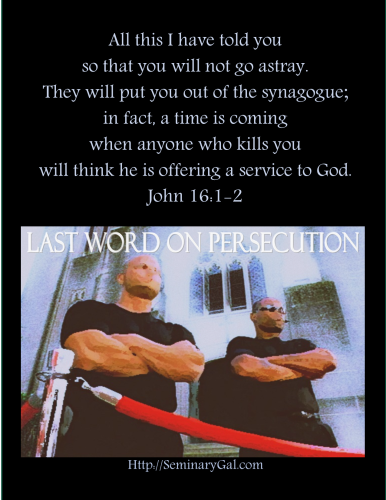
On Persecution-Lent 24, 2015

John 16:1 “All this I have told you so that you will not go astray. 2 They will put you out of the synagogue; in fact, a time is coming when anyone who kills you will think he is offering a service to God. 3 They will do such things because they have not known the Father or me. 4 I have told you this, so that when the time comes you will remember that I warned you. I did not tell you this at first because I was with you.

Jesus hasn’t really done a bait and switch in verse 4.  He’s just clarified what following is…and what following means.

Jesus has known that He’s not a popular guy with the religious hoity-toities of His day.  He has spoken of this to the disciples, but they didn’t understand.  It didn’t fit with what they were expecting!

Here’s why it wasn’t a bait and switch:

Matthew 16:21 From that time on Jesus began to explain to his disciples that he must go to Jerusalem and suffer many things at the hands of the elders, chief priests and teachers of the law, and that he must be killed and on the third day be raised to life. 22 Peter took him aside and began to rebuke him. “Never, Lord!” he said. “This shall never happen to you!” 23 Jesus turned and said to Peter, “Get behind me, Satan! You are a stumbling block to me; you do not have in mind the things of God, but the things of men.” 24 Then Jesus said to his disciples, “If anyone would come after me, he must deny himself and take up his cross and follow me. 25 For whoever wants to save his life will lose it, but whoever loses his life for me will find it.

Today’s passage With Christ in the Upper Room must have sent the disciples reeling.

on persecutionThey’re going to be kicked out of the synagogue.  That’s where they’ve always worshiped!

They’re going to be killed, and be victims in honor killings!  To the disciples, marching to their own deaths probably wasn’t what they had in mind when they began following this Rabbi!  And yet now, it’s being proclaimed as the litmus test of truly following.  Dying to self.  Laying down one’s life for friends.  This is not what they likely had in mind.

Jesus didn’t tell them at first because He was with them!  He was protecting them.  But now, as His final preparation, He’s giving them advance warning so they will not fall away from the faith.  They will view it as prophecy fulfilled instead of nothing but shock value.  Remembering this will keep them from going astray when persecution comes.

* * *

Give it Up for Lent: Expectations that demand being top shelf instead of God’s priorities being there

Put it On for Lent: Humbling denying yourself and picking up your cross for Christ

For further thought:

  • Put yourself in the sandals of the disciples for a moment.  They’re confused.  They don’t understand.  They’re worried.  There’s all this talk of death and persecution.  And still lingering in the background is the recurring idea that Jesus is with them now but is going away.
  • What might be some of the questions rolling around your mind?
  • Reread this:  “in fact, a time is coming when anyone who kills you will think he is offering a service to God. 3 They will do such things because they have not known the Father or me.”
  • We see honor killings all the time in the Islamic world, defending the honor of their god or prophet.  What does this Scripture say about them?

* * *

You can receive these devotional studies in your email (Monday through Saturday during Lent) by entering your email address on the SeminaryGal.com home page in the space provided in the sidebar.  Let’s meet With Christ in the Upper Room.

Continue Reading

Joseph, A “Type of Christ” (sermon text version)

We’re in the Acts of the Holy Spirit and the Apostles and we’re catching up with Stephen.  The first martyr of the Church is in the midst of his speech before the Sanhedrin before he gets stoned to death.  He’s on trial for speaking against the temple (“this holy place”) and against the customs of Moses (the Law).  Of course, the accusations are false, but as is so often (especially these days!), the truth doesn’t seem to matter.  Stephen takes the words of Christ seriously when Jesus said what is recorded in John 15:

John 15: 18 “If the world hates you, keep in mind that it hated me first. 19 If you belonged to the world, it would love you as its own. As it is, you do not belong to the world, but I have chosen you out of the world. That is why the world hates you. 20 Remember the words I spoke to you: ‘No servant is greater than his master.’ If they persecuted me, they will persecute you also. If they obeyed my teaching, they will obey yours also. 21 They will treat you this way because of my name, for they do not know the One who sent me. 22 If I had not come and spoken to them, they would not be guilty of sin. Now, however, they have no excuse for their sin. 23 He who hates me hates my Father as well. 24 If I had not done among them what no one else did, they would not be guilty of sin. But now they have seen these miracles, and yet they have hated both me and my Father. 25 But this is to fulfill what is written in their Law: ‘They hated me without reason.’

Stephen is following Christ.  He’s a true disciple.  So he continues delivering a powerful speech recorded for us in Acts 7 and today, he’s telling the story of one of the favorite sons of the Jews: Joseph.

If you’ll recall, Stephen is artfully leading the Sanhedrin in agreement with him and is delivering a few “ouch” lines along the way.  Ones designed to prick the consciences of his listening audience, even if it will produce no change of heart, just as Jesus said.  Sometimes these things are simply evidence for the trial to beat all trials, the one that comes at the end of time: the one before the White Throne of Judgment in the last day.  Being proclaimed “guilty of sin” will require proof and refusal to obey Christ provides sufficient evidence every time.  Refusal to see that Jesus came as Deliverer has been the latest—and most striking example—of a worldly tradition going way back to the patriarchs.  Rejecting God’s chosen ones has a long pattern.

Joseph_And_The_Amazing_Technicolor_DreamcoatSo Stephen, obeying Christ to the very end, recalls the favorite son of the Jews: Joseph.  He was the favorite son of the patriarch Jacob who was also known as Israel.  If you’ve read or heard his story in Genesis or even seen Joseph and the Amazing Technicolor Dreamcoat, you have a sense for his story.

What may not be clear from the theatrical version often described as a heart-rending tale of reconciliation among brothers, the real lesson is the one that Stephen intends to point out: 

The Jewish religious leaders have chronically rejected the one who will deliver them.

The Jewish religious leaders have chronically rejected the one who will deliver them, such is the case with Christ and such is the case with favorite son Joseph….who might be called a “type of Christ”…a foreshadowing, a prototype, one in the pattern that will be perfectly shown in Jesus Christ, the Son of God.

Keep in mind that this upcoming history of Joseph is all in the context of Stephen answering the accusations that he was speaking against the temple and against the Law.  The false accusations made against Stephen.

Acts 7:9 “Because the patriarchs were jealous of Joseph, they sold him as a slave into Egypt.”

The patriarchs Stephen is referring to are the 11 other tribes of Israel, the sons of Jacob, the brothers of Joseph listed in Genesis 35:22-26. 

These patriarchs sold 17 year old Joseph into slavery because he was kind of a brat, first off tattling on his brothers and then telling his brothers about the dreams he’s been having not due to a spicy falafel.  In his dreams, his brothers will bow to him.  Their sheaves of grain will bow to his sheaf.  Their sun, moon, and 11 stars will bow to him and now it’s not just brothers but mom and dad too!  In the musical about Joseph, the brothers sing,  “Not only is he tactless but he’s also rather dim, for there’s 11 of us and there’s only 1 of him.”

joseph prison rtStephen’s point in bringing up Joseph is that 1 was deliverer, the other 11 tribes were the rest of Israel. 

  • Who was in the holy land?  The 11.
  • Who was sold into slavery?  The one: Joseph.
  • Where did Joseph get sold?  Egypt!  Outside of the holy land that the Sanhedrin are having a fit about, and moreover, the heart of pagan territory!

As our Acts passage continues:  9b But God was with him 10 and rescued him from all his troubles. He gave Joseph wisdom and enabled him to gain the goodwill of Pharaoh king of Egypt; so he made him ruler over Egypt and all his palace.

God was with him.  Yup.  In pagan territory.  God was with him and made Joseph ruler over all the economics of Egypt and Joseph’s wisdom may not have prevented the languishing crops, but it did preserve the Egyptians through it.  Because God was with Joseph.

God was with Joseph in Egypt, but in the Holy Land, God has allowed a devastating famine.  Pagan territory? We’ve got Joseph and grain.  In the Holy Land, nothing but 11 starving brothers and their families.

God was with Joseph and so the 11 brothers, the patriarch Jacob the father and all his extended family head to Egypt to get food, starting with the 11 brothers, the sons of Israel. 

Why is there food?  Because Joseph the dreamer, the rejected deliverer had been sent there ahead. By God.

11 “Then a famine struck all Egypt and Canaan, bringing great suffering, and our fathers could not find food. 12 When Jacob heard that there was grain in Egypt, he sent our fathers on their first visit.

Pause in the action.  Time out.  Pay attention.  The first visit.  Just like Jesus had a first visit.  Joseph recognized his brothers, but they didn’t know him.  On the first visit.  Continuing…

13 On their second visit, Joseph told his brothers who he was, and Pharaoh learned about Joseph’s family. 14 After this, Joseph sent for his father Jacob and his whole family, seventy-five in all. 15 Then Jacob went down to Egypt, where he and our fathers died. 16 Their bodies were brought back to Shechem and placed in the tomb that Abraham had bought from the sons of Hamor at Shechem for a certain sum of money.

Stephen brings up Joseph because he’s a type of Christ.  We haven’t had a second visit from Jesus yet.  That will be what we call the Return of Christ, the Second Coming.  At which point, Scripture tells us that two things are going to happen:

(1) Philippians 2: 8 And being found in appearance as a man, [Jesus] humbled himself and became obedient to death– even death on a cross! 9 Therefore God exalted him to the highest place and gave him the name that is above every name, 10 that at the name of Jesus every knee should bow, in heaven and on earth and under the earth, 11 and every tongue confess that Jesus Christ is Lord, to the glory of God the Father.”  People are going to bow down, just like the brothers did in front of Joseph only this time, it’s for keeps.

(2) Zechariah 12: 10 “And I will pour out on the house of David and the inhabitants of Jerusalem a spirit of grace and supplication. They will look on me, the one they have pierced, and they will mourn for him as one mourns for an only child, and grieve bitterly for him as one grieves for a firstborn son. 11 On that day the weeping in Jerusalem will be great, like the weeping of Hadad Rimmon in the plain of Megiddo. 12 The land will mourn, each clan by itself”…People are going to be mourning, crying unstoppably, grieving as for an only child!  People’s hearts will be broken because they know they have done.  This is a prophecy about Jesus that is yet to be fulfilled.  It will happen at the second visit when He reveals Himself as King of Kings and Lord of Lords!  Prophecy that looks much like the Joseph story…because Joseph is a type of Christ.

At this point in Stephen’s sermon, he knows that the Sanhedrin knows all this history, even what he didn’t state explicitly !  They know their Scriptures!  First visit.  Second visit.  These are details of the Word of God that are not lost on the Sanhedrin!

But Joseph was only a “type of Christ.”  He was not the Christ, only a foreshadowing of the One to come.  Jesus was and is the Christ!

  • Joseph was a type of Christ because he was among the brothers but was singled out and rejected.
  • Joseph was a type of Christ because he suffered unjustly!
  • Joseph was a type of Christ because he was sent as God’s chosen instrument for deliverance of a people who were famished and destitute, and who could not save themselves.
  • Joseph was a type of Christ because he was not recognized by his brothers until…he revealed himself!
  • Joseph was a type of Christ because he did this all—outside of the holy land, outside of the temple, outside of the Law of Moses…because he was …Pharaoh’s #2 guy…long before Moses who would carry Joseph’s bones out of Egypt.

So regarding the accusations of speaking against this holy place and the customs of Moses, God has done some of His greatest work in foreign lands, even pagan lands and before the Law.  Doing things outside of what man would think is wise… is often God’s way.

Joseph whose history the Sanhedrin knows even said as much:

Genesis 50:15 When Joseph’s brothers saw that their father was dead, they said, “What if Joseph holds a grudge against us and pays us back for all the wrongs we did to him?” 16 So they sent word to Joseph, saying, “Your father left these instructions before he died: 17 ‘This is what you are to say to Joseph: I ask you to forgive your brothers the sins and the wrongs they committed in treating you so badly.’ Now please forgive the sins of the servants of the God of your father.” When their message came to him, Joseph wept. 18 His brothers then came and threw themselves down before him. “We are your slaves,” they said. 19 But Joseph said to them, “Don’t be afraid. Am I in the place of God? 20 You intended to harm me, but God intended it for good to accomplish what is now being done, the saving of many lives. 21 So then, don’t be afraid. I will provide for you and your children.” And he reassured them and spoke kindly to them. 22 Joseph stayed in Egypt, along with all his father’s family. He lived a hundred and ten years 23 and saw the third generation of Ephraim’s children. Also the children of Makir son of Manasseh were placed at birth on Joseph’s knees. 24 Then Joseph said to his brothers, “I am about to die. But God will surely come to your aid and take you up out of this land to the land he promised on oath to Abraham, Isaac and Jacob.” 25 And Joseph made the sons of Israel swear an oath and said, “God will surely come to your aid, and then you must carry my bones up from this place.”

God will come to their aid…in Egypt!  God will deliver them out…remember from last week, God told Abraham that his descendants would be enslaved and mistreated for 400 years?  At the end of that 400 years of God will have blessed the Hebrews with great land, flocks, and numbers.  But He also allowed them to be enslaved, Moses will lead these people out in the Great Exodus.  Moses will form another in the line of people who sets a pattern of deliverance, but we’ll leave that for next week.

In the meantime, what are the take home lessons for you and me?

  1. We must be careful not to put too much emphasis on what goes on INSIDE the walls of the church.  Deliverance is primarily done from the outside to bring people in.
  2. We must be on the lookout for God’s ways in saving and be quick to recognize where God is at work, often in places we don’t expect or through unlikely people.
  3. We must remember that God is doing things not only for the benefit of the Church but also for the witness to the entire world!  Pharaoh learned Joseph’s identity was more than just an interpreter of dreams.  Witness in pagan territory is our job right now
  4. And finally, we can see the wisdom of building off of what other people know, teaching them deeply from the Word which turns us from wimps to radicals.  We cannot be ashamed of the Gospel.

Because someday Jesus will make His second visit.  Until then there’s still time to witness, when He comes on the clouds it will be too late.  Let’s not just recognize a type of Christ.  Let’s recognize Him as the real deal.

Continue Reading