On Glory and Going-Lent 8, 2015

on glory and goingJohn 13:31 When [Judas] was gone, Jesus said, “Now is the Son of Man glorified and God is glorified in him. 32 If God is glorified in him, God will glorify the Son in himself, and will glorify him at once. 33 “My children, I will be with you only a little longer. You will look for me, and just as I told the Jews, so I tell you now: Where I am going, you cannot come.”

There was a test Jesus just passed.  There would be a few more before the Crucifixion (even if we don’t usually think of them that way).  But for now, Judas was gone to do quickly the evil work of betrayal of the Son of God and Jesus hadn’t done anything that would interfere with God’s plan.  Jesus was a willing and humble servant of His Father in heaven, having passed a test of self-will by His continuing onward to the Cross.

He now begins the Upper Room Discourse (a farewell address) to His faithful disciples in order to prepare the remaining 11 for what was going to unfold over the next 15 hours or so while they are still With Christ in the Upper Room.

I remember a time I had graduated from Purdue University and was preparing to go down to Texas A&M for further studies.  I said my goodbyes.  And then over a period of the next couple of days, I saw many of those people again and again, each time having more tearful goodbyes, and then finally a few of them said, “Would you get out of here already?  I’m tired of saying goodbye to you only to see you again so soon.”

For the disciples, this was not a tearful goodbye (though later we’re told, they’ll grieve). 

The disciples didn’t understand enough right now to cry.  They didn’t fully comprehend that Jesus would be going away and would not return to them without first experiencing death. 

There is a great irony in that pathway to Jesus’ restored glory was the shame of the Cross.

Now that Judas is gone, the events leading to Jesus’ crucifixion were an inevitable domino effect (so long as Jesus obeyed the Father’s will, that is).  It was a path of no return because it’s the whole reason Jesus came.  No turning back now.  So He looks ahead:

Jesus says, “31…Now is the Son of Man glorified and God is glorified in him. 32 If God is glorified in him, God will glorify the Son in himself, and will glorify him at once.” 

I won’t often ask you to look at verbs because grammar scares the socks off many and bores most of the rest.  But there are some things I want us to see:

  • Now IS” the time and “God IS glorified” in verse 31 (both present verbs).  Now that Judas is gone, the glory is already happening.  It’s a done deal because of the inevitability of the Cross for Jesus.
  • More verb stuff:  the Son of Man and God are “passively” glorified which means that the Son is glorified by the Father.  The Father is glorified by the Son.  Kind of a swap in that they’re glorifying one another.  But it’s more than that: the glory is increasing because Jesus is faithful.  So picture the expanding universe or a puddle expanding because more paint is poured into it.
  • Now take a really deep dive look at the second part of verse 32 (the first part missing in some of the old Greek manuscripts and begins with IF, but carries no doubt that “God is glorified in him”).  The verbs change to a future tense: God WILL and WILL…at once! The glory increases both now and later. You see, after the Cross, God will be actively glorifying Jesus…because of the Cross. Why glory instead of shame? (Stick with me here, I know it seems complicated.) Because the magnitude of the love and the grace of God was displayed for all creation to see in Jesus’ perfect sacrifice.  Jesus was faithful and God received glory from His death for our sins.  I know it sounds kind of bizarre, but it shows how much God loves us (His image bearers)!  If we don’t focus on Jesus’ death itself and how it happened, but rather on the love demonstrated in it, we can see how great the Father’s love for us truly is!  He sees His image in us and as we’re rescued, His glory increases.
  • Therefore, God goes further and restores all of Jesus’ former glory plus some because now, there’s even more glory to go around.

Maybe it seems like a complicated nuance to us, but it wasn’t to Jesus. 

Knowing that God was going to glorify Jesus and be glorified by His actions was actually the driving factor of Jesus’ going to the Cross.

We go really wrong when we think that we’re so amazing that Jesus came to die so that He could save me or you.  Jesus came to die because that was the pathway to God’s increasing glory.  He was sent on a rescue mission to save God’s image from a hell-bound journey for all mankind.  Jesus would do it by the Cross.  There is no worth we bring to the table.  All we bring is sin.  So it’s no nuance that the glory ahead in restoring God’s image bearers propelled Jesus to the Cross.  It’s not at all about us.  It’s all about Him and His glory.

* * *

Give it Up for Lent: A sense that we deserve to be saved

Put it On for Lent: True sense of our worth found only in Christ and His forgiveness

For further thought:

  • Jesus says in John 13:33 (above) that He already told the Jewish leaders, “Where I am going, you cannot come”.  What was their response?    Read John 7:34 You will look for me, but you will not find me; and where I am, you cannot come.” John 8:21 Once more Jesus said to them, “I am going away, and you will look for me, and you will die in your sin. Where I go, you cannot come.” 
  • The full passage in John 7 states that some of the listeners respond by saying “This man is the Prophet” ( v 40) and “He is the Christ” (v 41), or even the temple guards acknowledge “No one ever spoke the way this man does” (v 46).  Notably in verse 50, Nicodemus tries to help Jesus by insisting upon the leaders’ following Jewish law.
  • But by the time we get to John 8:21 and the verses following, the Jewish leaders to whom Jesus is speaking are explicitly told they will die in their sins because of a persistent unbelief regarding who Jesus is.
  • The disciples were told they could not follow now but in a few verses, Peter will be told he will follow later (John 13:36).
  • What is the key difference between the disciples, the listeners who responded, and the people who will die in their sins?

* * *

You can receive these devotional studies in your email (Monday through Saturday during Lent) by entering your email address on the SeminaryGal.com home page in the space provided in the sidebar.  Let’s meet With Christ in the Upper Room.

Continue Reading

Coping with Divisions in the Church-sermon text version

The cycle we’ve seen before continues in the Acts of the Holy Spirit and the Apostles: Pure Church, Powerful Church, Growing Church, then Persecuted Church, repeat.  The enemy on the outside of the Church is always easier to deal with than ones arising as division on the inside of the Church.

a divided churchPersecution and pressure from outside strengthen, build, and purify the Church.  Problems within the church divide us.

So in today’s passage (Acts 6:1-7), as we begin to pick up the pace in our familiar pattern, we see an attack upon the unity and purity of the Church.

It doesn’t always happen as something intentional and insidious.

It can sometimes take the form of being passed over, ignored, marginalized, or having their feelings hurt.

The last time we saw an assault from within the Church, it was Ananias and Sapphira who were exhibiting a lack of integrity, but this time the enemy within is something as ostensibly benign as hurt feelings and a lack of attention to their welfare.  Unequal treatment of widows along ethnic backgrounds was threatening division in the Church .  Today, we’re going to see 6 simple steps for coping with divisions that threaten the Church from within so that united we stand, instead of divided we fall.  Church splits are as common as hurt feelings within the Church and therefore, we’re wise to see how we can avoid division by handing threats properly.

Here’s the problem:  Acts 6:1 In those days when the number of disciples was increasing, the Grecian Jews among them complained against the Hebraic Jews because their widows were being overlooked in the daily distribution of food.

The Church was getting bigger (and that’s good, right?) but the larger an organization gets the more people are there to feel overlooked and the easier it is to lose track of everyone.  There’s greater diversity of background, opinion, and even philosophy of ministry.

Without something unifying us, many groups and churches discover that diversity becomes division.

Not everyone likes the same thing…the same style of worship, color of carpet, type of preacher, or pizza toppings.  It kind of reminds me of that old Groucho Marx line, “I sent the club a wire stating, “Please accept my resignation.  I don’t want to belong to any club that will accept people like me as a member.”

Our first coping strategy for keeping divisions from becoming splits is to listen and correctly identify the problem:

What is the real problem?

  • It was not that the number of disciples was increasing and too many people were joining their exclusive club, people with different tastes and backgrounds.
  • It’s not like the situation of division that one of my Trinity professors spoke about in which the Eastern Orthodox Church doesn’t recognize the Church in the West, the Catholic Church doesn’t recognize the Protestant Church, and 2 Trinity professors don’t recognize each other coming out of a liquor store.
  • It was not that there were Grecian Jews (who spoke Greek) and Hebraic Jews (who spoke Hebrew) and there were language problems.  This Church is at Jerusalem right now and while it might look like favoritism based upon ethnic origin, it could just be a practical issue of the Grecian Jews not having immediate family nearby looking out for their widows the way the Hebraic Jews did.

Acts 6:1 In those days when the number of disciples was increasing, the Grecian Jews among them complained against the Hebraic Jews because their widows were being overlooked in the daily distribution of food.

When looking to identify the problem, we can assume the worst or assume the best in other people.  We can dwell in divisions or dwell in the whole.  We can make a mountain out of a mole hill or try to minimize real mountains by denying their existence or treating them as mole hills, ….or we can create a level path to solve the problem by listening well.

That’s what the apostles did: they listened to the problem being described to find out what might be a level path forward.  Step one in avoiding a Church split was an openness to hearing the problems aired.  Listen. Correctly Identify the Problem.

Step two in coping with division is to identify a prompt and wise solution.

In this case, the solution to the problem of disunity was organization.

Acts 6:2 So the Twelve gathered all the disciples together and said, “It would not be right for us to neglect the ministry of the word of God in order to wait on tables.

Let’s look at how the Church organized…quickly…in order to work smarter and not harder.  The process was pretty simple:

Step 3   Leaders lead.  In case we miss this nuance, let’s notice that the Twelve leaders gathered a meeting of all the disciples, both Greek and Hebraic.  It doesn’t say that all disciples gathered the Twelve.  It doesn’t say that the disciples didn’t need a leader or could operate without one.  They brought the attention to the leaders and then surprise, Leaders lead!  But they don’t leave the congregation out of the discussion.  No one was being overlooked in identifying the problem and identifying a solution.

banyan1The leaders recognized no one person can do it all as a be-all and end-all. 

No one can—or should—do everything in a church.  It’s dangerous on a variety of levels.

Back when I was in seminary, one of my favorite professors—Dr. Hiebert—talked about two types of ministries: a banyan tree and a banana tree.  The banyan tree is filled with pride and builds big arching branches of ministry centered around one person and it spreads and sends out roots along all the branches.  It’s so massive that it kills off everything underneath it.  When that leader dies, leaves, or falls from grace, there’s nothing left to survive since it has killed off everything underneath it.

banana treeThe Twelve were smart because they didn’t build a banyan tree ministry.  They had the other type, a banana tree ministry in which a mother plant sends out daughters and they send out daughters.  The mother plant may eventually die, but having sent new growth out in strength, the movement becomes bigger, stronger, and more diverse.  Why? Because each daughter sends out daughters of their own in health and strength to minister to the local surroundings.

Step 4   Leaders don’t just lead, they delegate.  The Twelve would choose Seven to do the equally important work of “waiting tables.”

There are a lot of churches that totally miss this concept: Waiting on tables is not a lesser ministry of the Word of God than teaching, it’s just another application of ministry.

The Twelve recognized that neglecting one application of ministry in favor of another is dangerous to the health of the Church.  Throwing our whole selves into serving the poor all the while neglecting biblical teaching results in a Church that resembles a philanthropic organization that any group can organize.  Even without faith in Jesus.  But these Twelve were wise.  They also saw that if you take the Spirit of Life, Christ Himself, out of any issue, it’s dead.  It leads nowhere but to satisfy an earthly need for a flash of a moment.  Having Life in the issue begins with going to the source of true Life, John 14:6 Jesus answered, “I am the way and the truth and the life. No one comes to the Father except through me.”  The Church is supposed to know who Jesus is and then share Him with others in both words (teaching) and deeds (acts of service).  So the Twelve delegated, and there’s a good reason why:

When the enemy is outside, we are pressed together and derive strength from one another.  Blessed Be the Tie that Binds.  But when the enemy is on the inside, we fracture and split apart.

Step 5: When the problem is within, the solution must come from within:  Acts 6:3 Brothers, choose seven men from among you who are known to be full of the Spirit and wisdom. We will turn this responsibility over to them 4 and will give our attention to prayer and the ministry of the word.”

log splitSo the ministry of the Word was important and the ministry of practical application was important too.  Not a case of spiritual elitism, of the notion that doing spiritual stuff is better, but only that delegation to each’s gifts and strengths is godly.  Furthermore, by giving the group a say in the matter, they each felt like they had a part in creating a solution.  Involving the whole group in tackling the problem makes it more likely they’ll want to be part of the solution instead of resisting it and dwelling in the division.  Which if you’ve ever put a wedge on the end of a log and applied pressure you know it splits.  Same thing happens in a church if the wedge is not removed.  These widows were just an important symptom of a wedge being present and the Twelve quickly recognized disunity–the true wedge– as the problem and moved to a wise solution.

Therefore, Step 6 is choose the right people to lead the process of implementing the solution in the successful application of the Word by tangible acts of service.  What are the qualifications?  Seniority?  Nope.  Money?  Nope.  Political schmoozing?  .  Aggressive use of force or the ability to be an enforcer?  Nope, nope, nope.  Pouting?  .  Emotional manipulation, salesmanship, random selection, sign-up sheets, or drawing a name out of a hat?  Nope to all that!

It’s not success at the expense of godliness like the old idea that “The secret of success is sincerity.  Once you can fake that you’ve got it made.”

Here are the qualifications:  People are chosen based upon spiritual qualification, not things man looks at, and on spiritual gifts given by God.  Remember our puzzle pieces and where we fit in?  Aside from how God gifts us, there are important character qualifications: full of the Spirit and wisdom. In selecting people to oversee and to lead in practical areas, their qualifications must be the same as that of teachers!  They must be full of faith (reputation), full of Spirit (godly), and full of wisdom (fear of the Lord and knowledge of the Scriptures with practical outworking).  

The Twelve could have overwhelmed and overworked themselves, but they recognized that Pride has no place in ministry.  They chose others.

Acts 6:5 This proposal pleased the whole group. They chose Stephen, a man full of faith and of the Holy Spirit; also Philip, Procorus, Nicanor, Timon, Parmenas, and Nicolas from Antioch, a convert to Judaism.

Let’s look at the wisdom of who they selected among all the godly ministers to the poor.  They chose Greeks like Stephen and Nicolas and put them in positions of authority to be sure it would be viewed as their being advocates for the widows in question, calming their fears of ongoing discrimination.  It might not be something the English does for us, but in the Greek, it’s significant that a Greek is the first name, Stephen, and Nicholas, a Greek convert to Judaism was the last name.  They bracket the Seven.

Acts 6:6 They presented these men to the apostles, who prayed and laid their hands on them.

They were commissioned for this important work by prayer.  The result when we deal with problems without delay is that the Church doesn’t get distracted from its mission by living in the division instead of dwelling in the whole.  And the outcome gets even better:

Acts 6:7 So the word of God spread. The number of disciples in Jerusalem increased rapidly, and a large number of priests became obedient to the faith.

The Jewish priests even began to join with the Christians because of what they witnessed.

In A Tramp Abroad, the author Mark Twain writes,

The church is always trying to get other people to reform; it might not be a bad idea to reform itself a little, by way of example.”

His humor aside, he makes an excellent point.  The Church’s example says much about what it believes.  So, combatting division and organizing ourselves for success is as simple as following these 6 Steps:

    1. Listen and correctly identify the problem
    2. Identify a prompt and wise solution.
    3. Leaders lead.
    4. Leaders don’t just lead, they delegate.
    5. When the problem is within, the solution must come from within
    6. Choose the right people to lead the process of implementing the solution.

Yes organizing for success is a general principle, but here at Plymouth, we can follow these same 6 Steps.  That’s what GROW Plymouth is for.  By being a place where you can share ideas and concerns, we can listen to the collective wisdom of the congregation and identify any potential divisions and problems.  Our leaders can prayerfully develop prompt and wise solutions in which each of us can be part of the solution.  We can do more than talk about ideas.  We can implement them before division gets the better of us.

Arguably the greater enemy of the Church is us.

We, by acting in opposition to one another, by displaying a lack of unity, by imagining, maintaining, fostering, and reinforcing divisions, and by unwillingness to partner together toward a solution, we can cause the Church to be divided against itself.  And it will not stand! Conflict avoidance does no good.  It simply gives time for division that could be resolved to instead corrode away at the very fabric of any church and this will lead, inevitably, to its death if we do not employ helpful coping strategies.

Yet, this is all easily preventable by doing what the Twelve, the Seven, and the rest of the disciples did to benefit the Church and its future.  God blessed their actions by continuing to grow the Church which I propose is exactly what we want too!  Let’s pray.

 

Continue Reading

See Orange

Dear Church, let’s take our cue from our Lord and Savior Jesus Christ.  We must not look at the circumstances of our world through the eyes of evil or ISIS.  Rather we look up to God our Father and we live victorious in life and in death because of Jesus Christ.  I see orange as a warning to evil–their days are numbered– and as encouragement to people of the Cross to press on to certain Victory!  ‪#‎seeorangesee orange

Continue Reading

To Judas, the Betrayer-Lent 7, 2015

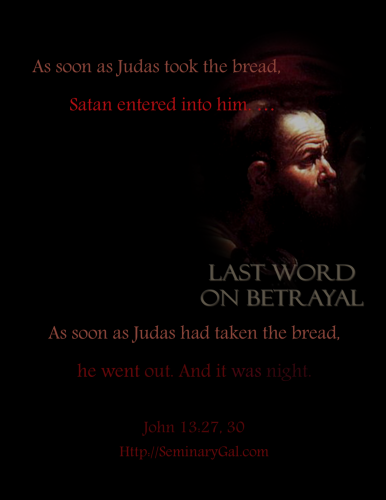
John 13:27 As soon as Judas took the bread, Satan entered into him. “What you are about to do, do quickly,” Jesus told him, 28 but no one at the meal understood why Jesus said this to him. 29 Since Judas had charge of the money, some thought Jesus was telling him to buy what was needed for the Feast, or to give something to the poor. 30 As soon as Judas had taken the bread, he went out. And it was night.

Have you ever marveled that Jesus didn’t try to talk Judas out of it?  Have you ever thought about what you’d do with 11 remaining disciples after your betrayer left?  Especially if they started asking questions or tried to stop him from leaving?

How we handle betrayals says more about us than it does about those who betray us.  Because betrayers are a given in this world.  There’s always someone around to put you down or stab you in the back.  Someone to sell you out to their own advantage.

Jesus offers us some final instruction on handling betrayers by how He dealt with Judas.

Grace is how Jesus dealt with it.

Grace is the same sentiment behind what is often called “The Serenity Prayer.”  The original prayer is attributed to Reinhold Neibuhr and in the better known 1951 version, it includes the word grace.on judaslastword

  • God, give me grace to accept with serenity
  • the things that cannot be changed,
  • Courage to change
  • the things which should be changed,
  • And the Wisdom
  • to distinguish the one from the other.
  • Living one day at a time,
  • Enjoying one moment at a time,
  • Accepting hardship as a pathway to peace,
  • Taking, as Jesus did,
  • This sinful world as it is,
  • Not as I would have it,
  • Trusting that You will make all things right,
  • If I surrender to Your will,
  • So that I may be reasonably happy in this life,
  • And supremely happy
  • with You forever in the next.
  • Amen.

 * * *

Give it Up for Lent: The agony of betrayal

Put it On for Lent: The grace of our Lord Jesus Christ

For further thought on the topic of betrayal and its antidote: grace.

  • God had a will.  Judas had a role.  Was there anything to be gained from Jesus’ getting in the way of either?
  • Why would Jesus want Judas to do this quickly?  How did this show grace?
  • What do you find significant about it being night when Judas left?
  • Read Ephesians 2:1 As for you, you were dead in your transgressions and sins, 2 in which you used to live when you followed the ways of this world and of the ruler of the kingdom of the air, the spirit who is now at work in those who are disobedient. 3 All of us also lived among them at one time, gratifying the cravings of our sinful nature and following its desires and thoughts. Like the rest, we were by nature objects of wrath. 4 But because of his great love for us, God, who is rich in mercy, 5 made us alive with Christ even when we were dead in transgressions– it is by grace you have been saved. 6 And God raised us up with Christ and seated us with him in the heavenly realms in Christ Jesus, 7 in order that in the coming ages he might show the incomparable riches of his grace, expressed in his kindness to us in Christ Jesus. 8 For it is by grace you have been saved, through faith– and this not from yourselves, it is the gift of God– 9 not by works, so that no one can boast. 10 For we are God’s workmanship, created in Christ Jesus to do good works, which God prepared in advance for us to do. 11 Therefore, remember that formerly you who are Gentiles by birth and called “uncircumcised” by those who call themselves “the circumcision” (that done in the body by the hands of men)– 12 remember that at that time you were separate from Christ, excluded from citizenship in Israel and foreigners to the covenants of the promise, without hope and without God in the world. 13 But now in Christ Jesus you who once were far away have been brought near through the blood of Christ. 14 For he himself is our peace.
  • Jesus’ pathway through suffering and Crucifixion became our pathway to peace with God.  How is God’s grace shown to us in Jesus?  What must we do to experience His grace and His peace?

* * *

You can receive these devotional studies in your email (Monday through Saturday during Lent) by entering your email address on the SeminaryGal.com home page in the space provided in the sidebar.  Let’s meet With Christ in the Upper Room.

Continue Reading

On Handling Betrayal–Lent 6, 2015

John 13:18 “I am not referring to all of you; I know those I have chosen. But this is to fulfill the scripture: ‘He who shares my bread has lifted up his heel against me.’ 19 “I am telling you now before it happens, so that when it does happen you will believe that I am He. 20 I tell you the truth, whoever accepts anyone I send accepts me; and whoever accepts me accepts the one who sent me.” 21 After he had said this, Jesus was troubled in spirit and testified, “I tell you the truth, one of you is going to betray me.” 22 His disciples stared at one another, at a loss to know which of them he meant. 23 One of them, the disciple whom Jesus loved, was reclining next to him. 24 Simon Peter motioned to this disciple and said, “Ask him which one he means.” 25 Leaning back against Jesus, he asked him, “Lord, who is it?” 26 Jesus answered, “It is the one to whom I will give this piece of bread when I have dipped it in the dish.” Then, dipping the piece of bread, he gave it to Judas Iscariot, son of Simon. 27 As soon as Judas took the bread, Satan entered into him. “What you are about to do, do quickly,” Jesus told him, 28 but no one at the meal understood why Jesus said this to him.

on betrayalThere are times it’s helpful to rewind and replay something to see the most pertinent scenes again.  Like when watching a favorite movie or some sort of thriller in which there are crucial scenes on which the entire plot turns.  This is one of those scenes With Christ in the Upper Room.

Suddenly Jesus says he’s not referring to all of them and turns to the idea of betrayal.  So let’s back up to the last mention of that:  John 13:10 Jesus answered, “A person who has had a bath needs only to wash his feet; his whole body is clean. And you are clean, though not every one of you.” 11 For he knew who was going to betray him, and that was why he said not every one was clean.

Judas was one of the selected Twelve.  He was a companion–walking along, following Jesus, listening to His teachings as one included in close fellowship, and participating in the sending out of the Twelve (Luke 9).

But there was something missing.  Judas had the heart of a betrayer.

Judas’ individual sins would never be repented and Jesus knew it.  Jesus had given him one last chance knowing full well that it would not result in Judas’ change of heart.  It was only for Scripture to be fulfilled.

Jesus didn’t single out Judas to plead with him to change his mind.  He didn’t engage him in a theological discussion of why Judas was heading down a bad path.  He did not do it to shame him in front of the other disciples.  Instead, He told these disciples beforehand–not so they would grieve for Him–but rather so they’d know later on that Jesus had known exactly what He was getting into.  There wasn’t even a warning at the table for the other disciples about what Judas was about to do and the consequences of such an action so that Judas might have second thoughts.

Judas was already too far gone.  Who knows when Judas crossed the line of no return?

Jesus was troubled in spirit.  He felt what we often feel. 

Pain of betrayal.  A wounded heart.  Grave distress.

But He set an example for us in these final preparations before He’d leave.  Jesus looked betrayal in the face and accepted that sometimes God’s will requires the ugliest aspects of humanity to do quickly what betrayal will do.  Sometimes, in order for God’s greater will to be done in other places, even to bring about the goodness we all need.  God’s salvation for us coming through suffering is a reality of a broken world–a world filled with sinners in need of redemption.  The gift of salvation, amazing and beautiful, could hardly have been predicted through something so difficult and ugly as the Cross.  Crucifixion was as ugly as it gets.  But this should serve to drive home how ugly sin is and how–in a sense–we’re all God’s enemies and betray Him all the time.  What should be our response?  It should give us great gratitude for God’s example to us on handling betrayal and it ought to make us even more thankful for salvation knowing the heavy cost to Jesus: His very life.

* * *

Give it Up for Lent: Any bad path you may be on.

Put it On for Lent: Forgiveness of our enemies.

For further thought, read the following Scriptures and pray about sin and enemies and forgiveness.

  • Romans 5:8 But God demonstrates his own love for us in this: While we were still sinners, Christ died for us.
  • Hebrews 10:26 If we deliberately keep on sinning after we have received the knowledge of the truth, no sacrifice for sins is left, 27 but only a fearful expectation of judgment and of raging fire that will consume the enemies of God. 28 Anyone who rejected the law of Moses died without mercy on the testimony of two or three witnesses. 29 How much more severely do you think a man deserves to be punished who has trampled the Son of God under foot, who has treated as an unholy thing the blood of the covenant that sanctified him, and who has insulted the Spirit of grace? 30 For we know him who said, “It is mine to avenge; I will repay,” and again, “The Lord will judge his people.” 31 It is a dreadful thing to fall into the hands of the living God.
  • Colossians 1: 19 For God was pleased to have all his fullness dwell in him, 20 and through him to reconcile to himself all things, whether things on earth or things in heaven, by making peace through his blood, shed on the cross. 21 Once you were alienated from God and were enemies in your minds because of your evil behavior. 22 But now he has reconciled you by Christ’s physical body through death to present you holy in his sight, without blemish and free from accusation– 23 if you continue in your faith, established and firm, not moved from the hope held out in the gospel. This is the gospel that you heard and that has been proclaimed to every creature under heaven, and of which I, Paul, have become a servant.
  • Pray with thanksgiving that God didn’t require us to clean up our act first since none of us could be saved.  Pray also that we would be preserved from taking for granted God’s forgiveness. Finally pray about what it means to be presented as holy in God’s sight, free from any of the ugliness we bring to the table by our sin.  Thank God for the incredibly high price He paid for this to happen: the shed blood of Christ.

* * *

You can receive these devotional studies in your email (Monday through Saturday during Lent) by entering your email address on the SeminaryGal.com home page in the space provided in the sidebar.  Let’s meet With Christ in the Upper Room.

Continue Reading

On the Power of Example-Lent 5, 2015

John 13:12 When [Jesus] had finished washing their feet, he put on his clothes and returned to his place. “Do you understand what I have done for you?” he asked them. 13 “You call me ‘Teacher’ and ‘Lord,’ and rightly so, for that is what I am. 14 Now that I, your Lord and Teacher, have washed your feet, you also should wash one another’s feet. 15 I have set you an example that you should do as I have done for you. 16 I tell you the truth, no servant is greater than his master, nor is a messenger greater than the one who sent him. 17 Now that you know these things, you will be blessed if you do them.

Judas is still here by the way, With Christ in the Upper Room.  Just thought I’d mention that since it’s easy to forget that Judas, the betrayer, was there during much of the Last Supper and Jesus knew it.  It can be reasonably inferred that Judas was sitting next to Jesus in a place of honor at the table of fellowship during Jesus’ final Passover feast with His disciples.

Jesus, there He was giving final preparations to all His disciples knowing the Crucifixion was around the corner and around the calendar.  And the very one who would set these horrific events in motion–happily from Satan’s perspective—was being served at the table of fellowship by Jesus, the Son of Man and Son of God, whom Judas would willingly betray in only an hour or so.

on exampleAnd yet, what do we see here?  Jesus was setting an example by continuing to give last chances for Judas and opportunities for the rest of the disciples to learn what it means to serve others.  To love the brethren, yes, but also what it means to love our enemies.

Just as the contrast of Peter’s you…my feet in the Greek of verse 6 is no accident of grammar to emphasize how offensive this idea was to Peter, neither is the reversal of Teacher and Lord in verse 13 with what we see in verse 14.

How often do we put the emphasis on Teacher when we should put the emphasis on Lord?

If the Lord could stoop to serve as an example to us, teaching us (i.e. sinners) by His divine authority, is it really that hard for us to stoop to a lesser degree to serve our virtual equals in life compared to what Jesus did?

* * *

Give it Up for Lent: Seeing others as better or as inferior, especially if they have hurt us

Put it On for Lent: Love of our enemies

For further thought:

  • Is there a real difference for you between Jesus being just a teacher or the Teacher?  What about His being a Lord and your Lord?
  • Remembering His lordship, what difference might it make in how you respond to His teachings?
  • Do you think Judas was seeing Jesus as both Lord and Teacher?  Why or why not?
  • Read Luke 6: 27 “But I tell you who hear me: Love your enemies, do good to those who hate you, 28 bless those who curse you, pray for those who mistreat you. 29 If someone strikes you on one cheek, turn to him the other also. If someone takes your cloak, do not stop him from taking your tunic. 30 Give to everyone who asks you, and if anyone takes what belongs to you, do not demand it back. 31 Do to others as you would have them do to you. 32 “If you love those who love you, what credit is that to you? Even ‘sinners’ love those who love them. 33 And if you do good to those who are good to you, what credit is that to you? Even ‘sinners’ do that. 34 And if you lend to those from whom you expect repayment, what credit is that to you? Even ‘sinners’ lend to ‘sinners,’ expecting to be repaid in full. 35 But love your enemies, do good to them, and lend to them without expecting to get anything back. Then your reward will be great, and you will be sons of the Most High, because he is kind to the ungrateful and wicked.”  What does this tell us about enemies and God’s example for us?
  • Read  1 Corinthians 2:8 None of the rulers of this age understood it, for if they had, they would not have crucified the Lord of glory.  Read also Luke 23: 33 When they came to the place called the Skull, there they crucified him, along with the criminals– one on his right, the other on his left. 34 Jesus said, “Father, forgive them, for they do not know what they are doing.”  How would Jesus continue to teach us?

* * *

You can receive these devotional studies in your email (Monday through Saturday during Lent) by entering your email address on the SeminaryGal.com home page in the space provided in the sidebar.  Let’s meet With Christ in the Upper Room.

Continue Reading

On Being Made Clean-Lent 4, 2015

on being made cleanJohn 13: 9 “Then, Lord,” Simon Peter replied, “not just my feet but my hands and my head as well!” 10 Jesus answered, “A person who has had a bath needs only to wash his feet; his whole body is clean. And you are clean, though not every one of you.” 11 For he knew who was going to betray him, and that was why he said not every one was clean.

Peter. Peter. Peter!  Open mouth.  Insert foot.  Didn’t you get it from the verse before this?

Oh dear.  Slow learner.  All heart, no head.  All zeal, no comprehension.  All passion, no perception.

Take a breath, Peter, and know the folk wisdom of God giving us two eyes and two ears so we will be quick to see and hear, two feet for walking well…but only one mouth since if we had two mouths, we’d be down for the count with both feet in mouth instead of walking with Him.

Yup, it’s true.  God wants us to learn before speaking.

The disciples have been made clean—as a whole and as a group–because of their having learned from Jesus about the ways of God.  They’ve seen the Father in Him.  (That’s kind of the picture of those who bathed at home before coming to the table, only their feet would be dusty from the road.)

Individually, however, they would need to have their feet washed as a picture of their individual sins being washed clean.  Jesus says,

Not every one of you is clean. 

Why did He say that? Well, Judas, though he had been part of the group, had lots of passion, but no willingness to serve Jesus by learning from Him.  Judas had no understanding of the future because he didn’t listen long enough before acting.  If he did and if he had a true and loving heart instead of just passion, he wouldn’t have agreed to betray Christ.

Judas’ individual sins would never be washed clean because he would never repent them.  He would go on to betray Christ, then he’d confess to the wrong people, and then he’d kill himself.  The dust was still all over his feet in a figurative sense.  He was not clean.

* * *

Give it up for Lent: Speaking and acting without knowledge.

Put it on for Lent: Being made clean by confessing your sins to God and finding forgiveness in Christ

For further thought:

  • Read Matthew 27:1 Early in the morning, all the chief priests and the elders of the people came to the decision to put Jesus to death. 2 They bound him, led him away and handed him over to Pilate, the governor. 3 When Judas, who had betrayed him, saw that Jesus was condemned, he was seized with remorse and returned the thirty silver coins to the chief priests and the elders. 4 “I have sinned,” he said, “for I have betrayed innocent blood.” “What is that to us?” they replied. “That’s your responsibility.” 5 So Judas threw the money into the temple and left. Then he went away and hanged himself.
  • How is this different than repentance?
  • How does confessing sins to religious leaders never substitute for being washed by Christ?
  • Read 1 John 1:9 “If we confess our sins, He is faithful and righteous to forgive us our sins and to cleanse us from all unrighteousness.” Why can God forgive in ways people–even religious people, priests, pastors, rabbis–can’t?
  • Why must confession be to God first and foremost?  Who defines what sin is?  Who are all sins ultimately against?

 * * *

You can receive these devotional studies in your email (Monday through Saturday during Lent) by entering your email address on the SeminaryGal.com home page in the space provided in the sidebar.  Let’s meet With Christ in the Upper Room.

Continue Reading

Final Instruction on Serving-Lent 3, 2015

John 13:6 [Jesus] came to Simon Peter, who said to him, “Lord, are you going to wash my feet?” 7 Jesus replied, “You do not realize now what I am doing, but later you will understand.” 8 “No,” said Peter, “you shall never wash my feet.” Jesus answered, “Unless I wash you, you have no part with me.”

Even With Christ in the Upper Room, Peter was a rather stubborn guy.  I can appreciate that.  I guess I’m stubborn too, in my own way.

you first cropStubbornness and serving are incompatible.


It sort of reminds me of two people getting ready to go through a doorway and one says, “You first.”  The other says, “No, you first.” And the cycle continues as the stubbornness of each entrenches them to the exact opposite of serving and the die-hard assertions of “You first” instead of selfless generosity and concern, could really be translated, “I want my own way.”

“I want my own way.”  Yikes, that isn’t serving at all!

Instead of Jesus’ deciding to do Peter one better at being stubborn, Jesus teaches about humility and the selfless heart.  He offers two explanations as to why He is, in fact, going to wash Peter’s feet.  Both have to do with Jesus’ final preparations regarding the concept of serving.

on serving black border

  • Jesus says that Peter doesn’t understand the full picture.  Serving God well requires letting Him call the shots.  He knows the full picture.  We don’t.  Since God knows the plan, humility before God is our best attitude.
  • Then Jesus doesn’t argue with Peter.  He simply says, here’s the deal: “Unless I wash you, you have no part with me.” Peter truly does love Jesus and wants to be part of what Jesus is doing.  Jesus appeals to the heart desiring to be selfless and states the simple truth:  Sinners must be made clean by Christ or they simply cannot serve.

The sin of self-will is at the heart of pride and is the opposite of serving others.  Only when we let go of ourselves–and getting our own way–will we see that Jesus offers a better way:  Serving God by serving others.

* * *

Give it up for Lent: Stubbornness

Put it on for Lent: Serving God by serving others.

For further thought:

  • Have you ever been embarrassed by someone serving you?  In the Greek language, there is a contrast in verse 6 (atop this page) of you…my feet with the words you and my side by side to emphasize how much Peter felt this was inappropriate for whatever reason.  What kinds of feelings do you think Peter must have felt by having the Lord stoop to doing slave’s work for him?
  • Read about the baptism of Jesus in Matthew 3:13-17– 13 Then Jesus came from Galilee to the Jordan to be baptized by John. 14 But John tried to deter him, saying, “I need to be baptized by you, and do you come to me?” 15 Jesus replied, “Let it be so now; it is proper for us to do this to fulfill all righteousness.” Then John consented. 16 As soon as Jesus was baptized, he went up out of the water. At that moment heaven was opened, and he saw the Spirit of God descending like a dove and lighting on him. 17 And a voice from heaven said, “This is my Son, whom I love; with him I am well pleased.”  How did John’s initial reaction look like Peter’s?  How did it differ?
  • Now read John 3:25-36, especially verses 27-30:   27 To this John replied, “A man can receive only what is given him from heaven. 28 You yourselves can testify that I said, ‘I am not the Christ but am sent ahead of him.’ 29 The bride belongs to the bridegroom. The friend who attends the bridegroom waits and listens for him, and is full of joy when he hears the bridegroom’s voice. That joy is mine, and it is now complete. 30 He must become greater; I must become less.”  What did John the Baptist (who came to “prepare the way”) know about Jesus that Peter needed to see as the future beyond the moment of foot washing?
  • How does a future view help us to serve God with a whole heart?
  • Finally, read Romans 8:17 “Now if we are children, then we are heirs– heirs of God and co-heirs with Christ, if indeed we share in his sufferings in order that we may also share in his glory.”  Taking part, sharing in what Christ suffered means what?

* * *

You can receive these devotional studies in your email (Monday through Saturday during Lent) by entering your email address on the SeminaryGal.com home page in the space provided in the sidebar.  Let’s meet With Christ in the Upper Room.

Continue Reading

The Last Word on Humility-Lent 2, 2015

on humilityJohn 13:2 The evening meal was being served, and the devil had already prompted Judas Iscariot, son of Simon, to betray Jesus. 3 Jesus knew that the Father had put all things under his power, and that he had come from God and was returning to God; 4 so he got up from the meal, took off his outer clothing, and wrapped a towel around his waist. 5 After that, he poured water into a basin and began to wash his disciples’ feet, drying them with the towel that was wrapped around him.

With Christ in the Upper Room, Jesus offers us the last word on humility. 

It’s an amazing contrast in some important ways: 

God serves man.

Holy serves sinner.

The Savior serves both the Father and sinners. 


The devil had already prompted Judas to betray Christ, yet Jesus washed His disciples’ feet in an act of humble service.   Scripture does not say Jesus washed everyone’s feet but Judas’ because Jesus knew he was a betrayer.  No, Jesus served even the one who would betray Him.  Jesus, the sinless One, served all of us who rebelled and broke the heart of God by our sins.  In a sense, we’ve all betrayed God and rejected Him and yet, Jesus came.  He loved.

He served to show the superiority of love and humility.

The Father had put all things under Jesus’ power and yet this powerful One would show the full extent of His love by serving the Father who sent Him as well as serving those whose station was beneath His own, sinful man.  Scripture says about Jesus, Philippians 2:6 Who, being in very nature God, did not consider equality with God something to be grasped, 7 but made himself nothing, taking the very nature of a servant, being made in human likeness. 8 And being found in appearance as a man, he humbled himself and became obedient to death– even death on a cross! 9 Therefore God exalted him to the highest place and gave him the name that is above every name, 10 that at the name of Jesus every knee should bow, in heaven and on earth and under the earth, 11 and every tongue confess that Jesus Christ is Lord, to the glory of God the Father.

The “condescension of God” in Christ (i.e. the way He stooped down to rescue us) and the humility of Christ to come from God in order to save us is profound.  John 3:16 “For God so loved the world that he gave his one and only Son, that whoever believes in him shall not perish but have eternal life. 17 For God did not send his Son into the world to condemn the world, but to save the world through him.”

* * *

Give it Up for Lent:  Pride

Put it On for Lent: Humility

For further thought:

Read John 12:42 Yet at the same time many even among the leaders believed in him. But because of the Pharisees they would not confess their faith for fear they would be put out of the synagogue; 43 for they loved praise from men more than praise from God. 44 Then Jesus cried out, “When a man believes in me, he does not believe in me only, but in the one who sent me. 45 When he looks at me, he sees the one who sent me. 46 I have come into the world as a light, so that no one who believes in me should stay in darkness. 47 “As for the person who hears my words but does not keep them, I do not judge him. For I did not come to judge the world, but to save it. 48 There is a judge for the one who rejects me and does not accept my words; that very word which I spoke will condemn him at the last day. 49 For I did not speak of my own accord, but the Father who sent me commanded me what to say and how to say it. 50 I know that his command leads to eternal life. So whatever I say is just what the Father has told me to say.”

  • How does your attitude about God get revealed in whose praise you seek?
  • Whose praise did Jesus seek?
  • Comparing Phil 2:9-10 above with this passage in John 12 (esp. v 48-50), ponder the idea of being a servant and obeying commands.  In what ways did Jesus model what being a servant is all about?
  • Does being a servant take away from one’s identity or does it contribute positively toward it?  What makes men bristle at the idea of being a servant?
  • Do you agree with this statement? “We all show humility before God now or end up being humbled later.”  What do our Scriptures say?

* * *

You can receive these devotional studies in your email (Monday through Saturday during Lent) by entering your email address on the SeminaryGal.com home page in the space provided in the sidebar.  Let’s meet With Christ in the Upper Room.

Continue Reading