What follows is the text of the self-guided garden tour from my March-to-November garden in last week’s charity garden walk.
A number of people asked if I could post it for the plant names.

Welcome to my garden! Ready to take a walking tour?
- Mailbox.
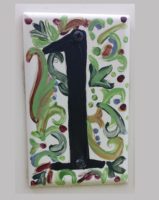 Part of every garden is the first impression. I hand-painted the house numbers on switch plate covers ever since the mailbox bashing game of a few years ago left many of our mailboxes face down in the street. I figured it was at least possible that I could pattern any new ones required off of the old ones. Much of my garden is what I call the “Out of Eden” experience in which I’m dealing with things in a chronic state of imperfection and finding solutions to problems. The daylilies are ‘Happy Returns’ and ‘Stella d’Oro’ (both of which will repeat bloom throughout the season provided I remove the seed pods and fertilize them). Usually, I remove flowers of lamb’s ear but they look rather pretty out here this year.
 - Walkway to front. The ‘Double Delight’ tree rose is new this year and replaces the shorter one I had for nearly a decade before the voles (mice) devoured it down to what looked like a sharpened pencil. The
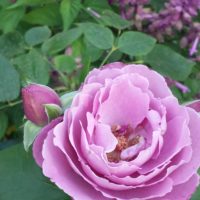 ‘Heirloom’ (hybrid tea, left) and ‘Pinata’ (climbing) roses both made a comeback from growing in pots last summer and overwintering in the garage.
- Also in the front was a stunning group of daffodils which you’ll notice the foliage is still dying back. Decline is a part of the perennial garden which I view as a sequence of fireworks—some new ones come on as others are fading. Daffodil foliage dies back naturally and it produces food for next year’s flowers as it does. But it’s ugly, so pots of annual flowers fill in the blank spot this year that used to be a full display of Black-eyed Susans to hide the dying daffodils. It’s a blank spot because of last year’s black spot (a fungus that thrives in moist conditions with no airflow). I hesitate to treat plants with fungicides when they are a food source for birds, so I have changed the watering from overhead spray to soaker hoses to resolve that disease issue. Even so, the profile of this garden ebbs and flows with the way life goes. Some years, I’ll have more Coneflowers; some years, it’s Black-eyed Susans; and one year, it was mainly Cardinal flower. But this year, they’re all making a march for the sidewalk and I’ll readjust everything this fall (a preferred time for dividing and transplanting). ============================================================================ * My garden demonstrates the truth of Romans 8: 19 “The creation waits in eager expectation for the sons of God to be revealed. 20 For the creation was subjected to frustration, not by its own choice, but by the will of the one who subjected it, in hope 21 that the creation itself will be liberated from its bondage to decay and brought into the glorious freedom of the children of God. 22 We know that the whole creation has been groaning as in the pains of childbirth right up to the present time.” ============================================================================ * Yes, because of man, death comes to the plants of the garden too…outside of Eden. No plant lives forever even if creeping Charlie, garlic mustard, and dandelions make you think they do. But while the garden flowers we love grow and thrive, they bring beauty and food to the rest of nature. Variegated Solomon seal and daffodils are the front yard’s joy of spring. Daylilies, Butterfly Weed (Asclepias tuberosa), Coneflower (Echinacea), Black-eyed Susan (Rudbeckia), and Cardinal flower (Lobelia cardinalis) are the summer’s splendor and the latter four feed both birds and butterflies. Matthew 6:26 “Look at the birds of the air; they do not sow or reap or store away in barns, and yet your heavenly Father feeds them. Are you not much more valuable than they?” When I’m troubled, that’s a Scripture I bring to mind and remember how valuable each person is to our heavenly Father. You are valued and loved by God. Isn’t that a great reassurance against worry? In the fall, the seeds of Coneflower and Black-eyed Susan are a good food source for goldfinches, but the dark seed heads are joined by the lovely white Japanese Anemones which soar to a height of 5 feet and make for an unusual black and white garden.
- Front porch. Ecclesiastes 3:1 “To everything there is a season, A time for every purpose under heaven.” Some plants are late leafers and bloomers.
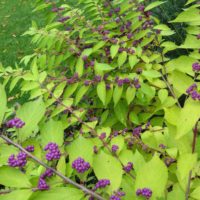 Such is case of the fall beauty called Callicarpa with its lovely magenta berries. It’s under the flag and looks like nothing now, but next month, the little magenta colored flowers will begin to hint that these stunning berries are on their way. The Boston ferns have been part of my family since 1998 and come indoors for the winter or on cold nights. This year, the one in the corner by the garage almost made it inside when I was surprised by a dove flying away as I got ready to bring it in, revealing 3
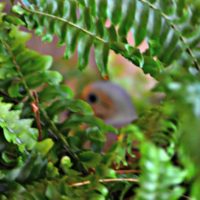 little baby doves, newly hatched in a “nest”. So my fern had to stay outside on a few frosty nights because that mourning dove had decided to make my fern her nesting place. She didn’t actually build a nest. She just smashed down some of the fronds of the fern which was just making a comeback from the winter of its discontent. The hanging baskets are actually 4 window boxes in pairs back-to-back. There’s a tutorial on my blog describing how to make them. Take a sticker from the sticker page to visit the tutorial and see how I turn houseplants and some annuals into beautiful hanging baskets.
  North Face. The north side’s Roseanne Roseannadanna Award Winner (RRAW) of “It’s Always Somethin’” would be the Coneflowers and Coleus, normally a really pretty display that has become the dinner of choice among discriminating bunnies, that is, when they’re not eating the petunias and hollyhocks on the east side.
- Upper East Side. The east side’s RRAW deal was the Japanese maple. Look up and admire its foliage shape and color. It almost didn’t happen this year. The leaf buds that made it through the winter’s ice storm were frosted off by a cold snap. We worried it was dead, but I fertilized and watered and sprayed water on the branches to encourage the adventitious leaf buds to break.
 Plants are amazing! They have the ability to produce new buds or sometimes even roots along stems where no buds existed before, hence the big word adventitious. The Japanese maple is not quite the leafy glory of an average year, but trust me, it’s much better than it had been at the start of the season when we thought it was dead. It’s Always Something. On the Lower East Side is the potted geranium pillar that had been overwintered in the basement. It’s hard to believe it started as a 6-in pot 2 years ago. I’m training it in the way it should go so when it’s older, it will not depart from it. The Japanese Tree Peony
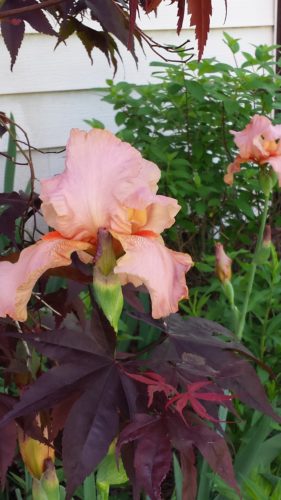
 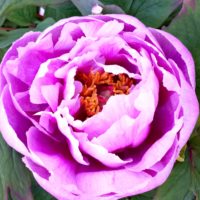 (right) was a going-away gift from a friend of mine who wanted a home for her treasure when she moved. I also have Todd’s Iris from a friend named Todd (amazingly enough) from our time living in Minnesota. He mailed his special iris breeding efforts to us when we first moved into this house as a housewarming gift. I originally thought these were brown until the buds opened up to reveal this lovely shell pink. Take time to notice the colors of the foliage on this side of the house.
 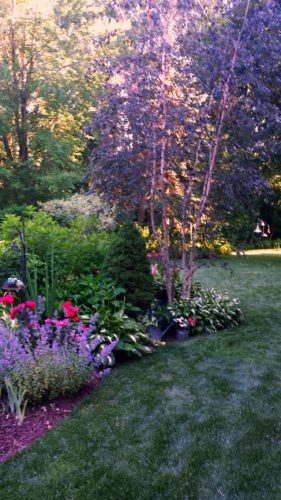 Gardens don’t have to have flowers to have color. All creation is amazing because our Creator is amazing.
- Love Grows Here. This part of my garden originally contained two pretty, but really messy, crabapples that left huge rotting fruit all over the side yard. Worse, the rotting fruit was good at attracting yellow jackets and deer which left behind far more than just trampled fruit. I cut the trees down myself and had a beautiful ‘Royal Frost’ birch planted here instead. From the front yard, the birch visually invites people to visit my back yard (which this year you can actually do!) and to see what hides around the corner. There are ‘Limelight’ hydrangeas, Hostas, Astilbe –all of which are visible now—but the shooting stars were part of its spring glory. Love is beautiful and colorful and this garden interprets 1 Corinthians 13:13 A”nd now these three remain: faith, hope and love. But the greatest of these is love.”
- The Perennial Border. This part of my garden features shrubs and trees as part of the March-to-November beauty. ‘Summer Snowflake’ Viburnum, Lilac, Hakuro-nishiki dappled willow, curly willow and pussy willow (I keep the latter two only to cut them down for container arrangements), and the serviceberry provide seasonal interest whether flowers, foliage, form, or fall color. The bird bath features a solar powered fountain I bought online that my husband laughed at when I was testing it inside back in February. I always wanted one, but he said it was kind of wimpy and likened it to someone in need of medication. Once the intensity of the sun improved its performance, it has become a veritable fountain of youth…so much so, that I’ve had to artificially limit the sun to keep it from draining the bird bath as the wind carries the spray drift. The robins love it. The other birds are kind of scared of it. It was an inexpensive novelty (and birthday gift) that I’m enjoying just because I can.
- Fall Blues.
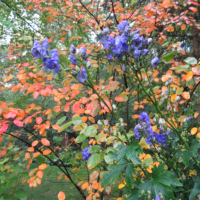 In the back corner of the The Perennial Border is a little tribute to fall. The blue leafed Hostas with lavender flowers, the purple turtlehead, and the towering cobalt blue monkshood all survive shade and the inevitable moisture in the back corner. Together, they make for a long lasting fall display of blues and purples with real pop, contrasted against the scarlet-orange foliage of the serviceberry.
 - South Side. The RRAW winner of the South Side is the redbud tree. The ice storm managed to snap off its leader and required the tree to receive emergency spring pruning. The wrong time of year for such a thing on spring bloomers, but It’s Always Somethin’. You’ll notice that I have some items on the South Side (as well as elsewhere in my garden) that are considered either by ordinance or by experience, invasive plants. Gooseneck loosestrife, wood violets, ostrich fern, Lythrum, and archangel are among those making the invasive list. I would like to make a case for naturally existing invasive plants. They are only as invasive as we allow them to be. I remove the seed heads of the Lythrum so they do not spread, but I can enjoy the flowers while they last and the honey bees love it. If I lived along the lake or closer to the Des Plaines where it would pose a threat, I would feel differently and kill it, but this is a case of something which does no harm in my garden when carefully monitored. Likewise the other invasive plants can spread into the woods where nothing else will grow underneath the trees. It proves that a weed is only a plant growing where you don’t want it to grow.
- The Arbor goes nowhere except to the compost pile and where deer may leave ticks behind in the woods. So, don’t risk that. Instead take a glance at the far-from-my roses Japanese beetle pheromone trap which will be luring the adult beetles (which are sure to emerge shortly) and give them a party of their lifetime in the trap with all the other mating age promiscuous beetles with loose morals. Then they die in the trap far from my ornamentals without my needing chemicals or risking their widespread destruction of my garden. After the distant view, you can turn around since the arbor exists mainly to hide the utility boxes from view from the house and makes people think there’s something far more amazing back there than a compost heap and deer scat.
- Birds. And the places they live and eat. You’ll notice my feeders are an odd amalgam of contraptions to feed the birds which I do like without letting the food go to bully birds and squirrels. Genesis 3:1 “Now the squirrel was more crafty than any beast of the field which the LORD God had made. And he said to the woman, “Indeed, has God said, ‘You shall not eat from any tree of the garden ‘?” OK. It is supposed to say serpent, but I think the squirrel must be a close second in the craftiness category. They are always in search of forbidden food and to usurp man’s place at the top of the food chain.
 Same thing with bully birds like grackles, starlings, and sad to say, redwing blackbirds that I had always partial to because Morning has broken, like the first morning, Blackbird has spoken, like the first bird, Praise for the singing, praise for the morning, Praise for the springing fresh from the world. But then they were eating everything in sight and the bullies were taking over the yard, chasing off the birds I actually wanted to feed. Now, I know all birds and squirrels need to eat, but we will all get along if they know their place. So, a few baffles, cups, sticks, bottles, mirrors, bling, tape, and careful food choices later, I have limited their ability to chow and hog. They can eat in reasonable amounts and leave some for the others. Basically teaching birds and squirrels to play well in groups.
 - Here today. Gone tomorrow. Mockorange is the shrub with the marvelous flower you may still detect as you head back up towards the deck. The yard came with singles and doubles. Only the doubles seemed to bloom this year. They were previously eclipsed in beauty by the ephemeral patch of bluebells which die down and leave bare spots to be filled in with annuals, or on a non-garden-walk year…nothing.
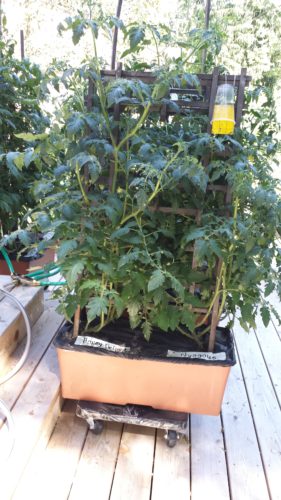
- All Hands on Deck. It is one of the sunniest spots in the yard so that’s where the vegetable garden is. I grow veggies in Earth boxes which are fitted with zip-tied trellises to support the tomatoes as they grow and trolleys to let them follow the sun. The trolleys are one hack I’ve done to provide sturdier support and they roll better compared to any little plastic wheels. Another hack is the “peg leg” wooden push pins on the bottom of the herb pots to give them a minimal footprint since otherwise the pots leave spots on the wood and the bungee cord belts make sure they don’t fall off the railing. The other pots (tomatoes and the peas/peppers/cucumbers) need additional water too, so I have retrofitted a wine bottle with a clay pot as a self-watering system. I have a tutorial for that online as well. Take a sticker for the self-watering planter and view it online. Because we are gluttons for punishment and want to test our status as top of the food chain, we are also growing ‘On Deck’ hybrid corn this year. I’m preparing to fence it off to keep the mice, flying squirrels, chipmunks, regular squirrels, and yes, blackbirds from devouring it so we can have an ear of fresh corn apiece as a reward for all the effort of growing corn in a pot.
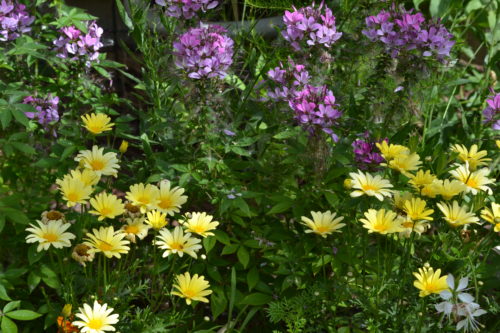 All Around.
- A little cutting garden in a raised bed. Why? Because cable TV and phone lines run underneath too close to the surface for actual planting.
- The wall supports for vines aren’t an indication of wishful thinking. Last year, the morning glories and sweet autumn clematis climbed all the way up and around the corner. Last winter the clematis died so I will buy another one in the fall when the stores carry them.
- The first year for a rose garden
 that used to be on the west side of the garage before the shade did it in and forced its relocation. This year, the bunnies are hungry. Ah, It’s Always Something.
 - The Burgundy Cotton crepe myrtle I brought back on the plane from Texas a decade ago and carefully overwinter each year in the garage. It’s beautiful during all three growing seasons so it’s well worth the effort.
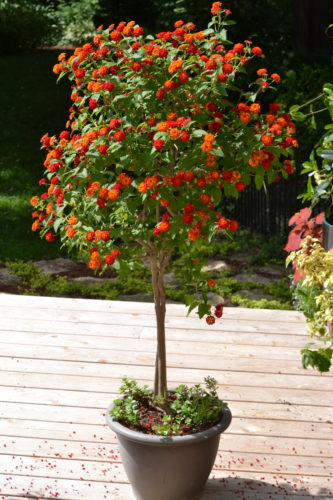
- Houseplants love being outside in the summer…especially since we had new energy efficient (read as any plant’s worst nightmare) windows installed. Great on the energy bills. Terrible for maintaining houseplants indoors. Especially tough for the winter sun lovers like bougainvillea, gardenia, stephanotis, cymbidium orchids, and the hummingbird favorite, a lovely lantana tree that was a hanging basket a few short years ago.
- Woodland Path. Meant mainly as a cut-through for taking items from the back to the front yard without trampling our neighbor’s yard, the flagstone and plants like ostrich fern, Solomon seal, Trillium, lily-of-the-valley, sweet woodruff, spring bulbs like snowdrops, Chinodoxa, and wood violets all add to a woodland appeal. I used to have a ton of pink columbine here too, but they’ve migrated to the north side of the house wanting to escape the natural and invade the cultivated. Yup, it’s always something. There are a few hydrangeas that I had in pots outside of church one year that I brought home when I switched them out for a summer planting. (I hate throwing anything away.) They are marginally hardy and in this little microclimate, my hope is they’ll bloom this year. Like the Nikko Blue I have on the east side, they bloom on old wood and if they die down to the ground, they’ll just be leafy shrubs.
- West Side Story. Fierce rivals—the Suns and the Shades-have been fighting it out for years. I think the Shades are winning. It used to be hotter-n-blazes over here and the fight was intense just to stay alive.
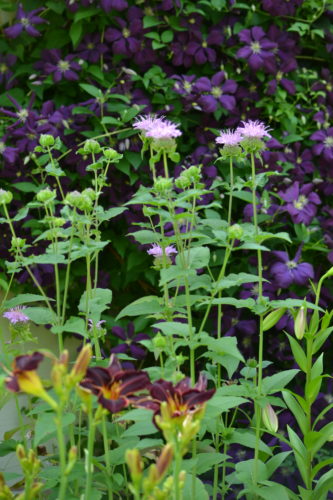 The hybrid tea roses and bee balm were rumbling with the orange daylilies. These days, it’s hard for the Suns to stay alive. The hybrid tea roses moved out to the back and the bee balm and peonies got shifted north as the shade continues to become more pronounced. The bleeding heart obviously love it. The clematis less so. I built these trellises myself and yes, you can read how I did it by taking a sticker for Barbara’s Big Trellis Adventure from the sticker page. There used to be 3 matching clematis and in a normal year, they cover the entire side of the house. Odd thing happened this year, though. They began to bud in the warmth of the sun on the siding before the linden leafed out, but then the cold snap came and frosted them back. Then the linden leafed and the Shades began to fight with the Suns. The clematis which gets the most sun has recovered more quickly and it would say I Feel Pretty. The others, well, Something’s Coming. Eventually, but probably not Tonight or in time for your garden tour. That would be the West Side’s RRAW deal. There are a few other daylily varieties here along with some Asiatic lilies for summer interest. And for year round interest, the paperbark maple has stunning fall color and really interesting peeling bark that is beautiful in its own way. It sure beats the messy crabapple that used to be on this corner, looking good only in the spring of life.
 - Green Green Grass. Normally, we’d let the lawn go dormant in the summer but we decided you’d prefer to see it looking lush and carpet-like. It’s a favorite of dogs too, so we are in a constant state of repairing spots. Oh well. It’s Always Somethin’ outside of Eden.
That concludes the self-guided garden tour.
Please take stickers from the sticker page for any tutorials.
And kindly return the booklet to the greeters so others can enjoy a self-guided garden tour too.
Thank you!
* * *
(Note post-walk: the stickers are now links within the text so you can read the tutorials)
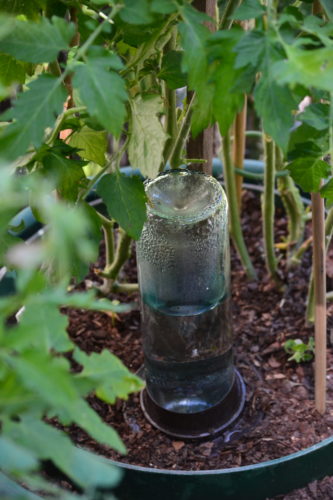 One of the blessings of a lifetime of gardening–even before I was Seminary Gal–has been developing little tricks for keeping my garden looking nice. Enjoy these hacks for a million dollar garden at a budget price. How many of us want self-watering planters, but don’t want the wallet-draining prices that come with them? Today, you can learn to make your own self-watering planters, followed by 4 other quick hacks.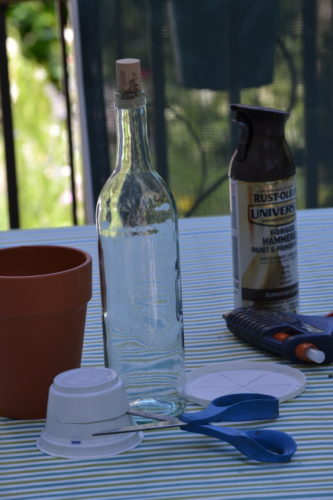
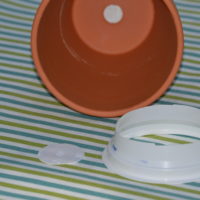 Cut the lid on the asterisk lines and also cut the bottom off the yogurt cup to give it a 1 inch height. It should look like a ring.
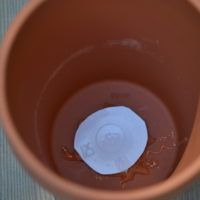 Using the hot glue gun VERY HOT, squirt some glue around the opening of the hole. Gently and carefully press the disk down with the permanent marker so you don’t burn your fingers. Are you paying attention here? Friends don’t let friends get burned. It’s why I’m not just a gardener but an evangelist. I can tell you more if you want…
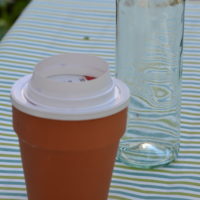 So now you have the two pieces which will fit together. It’s like Garanimals or that card game you played when you were a kid. Match them up by putting the ring lid on the closed hole pot.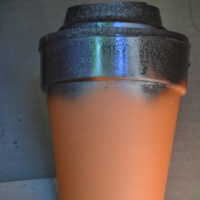
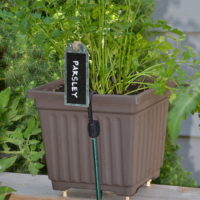 Planter Feet:
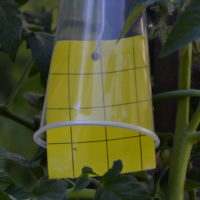 Sticky Bells:
 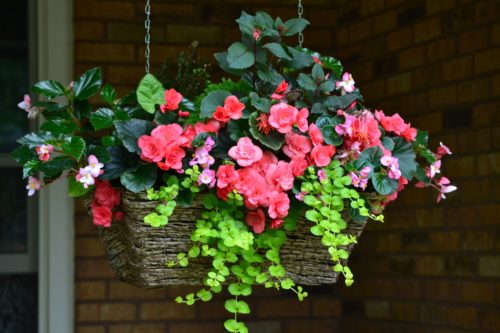 I often get compliments on the beautiful hanging baskets on my front porch. They are large but proportional to the elliptical archway under which they hang. They are not round, but squarish, important so the pair doesn’t look like eyes staring at you. Every year, I do something slightly different, but the result is always spectacular if I may quote friends and neighbors and not sound like I’m boasting.
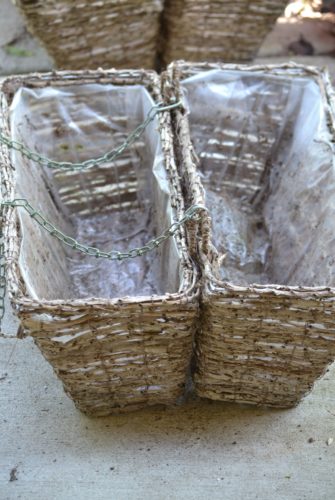 First, they are not hanging baskets at all. They are pairs of window boxes with loops which have been placed back-to-back so they will hang evenly.
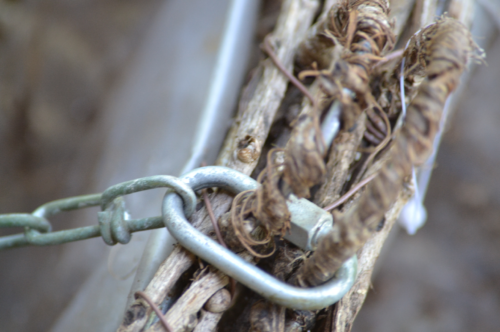 hanging baskets at their proper height. When hanging, the quick link cinches the two baskets tightly to one another and leaves space for the strand to move freely so it doesn’t become uneven. (Here’s a close-up of the link attachment.)
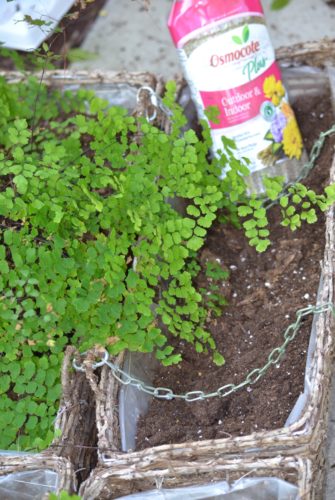 I fill them with potting mix which has been amended with a few water absorbing crystals and slow release fertilizer. I use the water absorbing crystals because the window boxes are shallow, the plants will be numerous (in some cases moisture sensitive), and the location is under the eaves which will limit their receiving natural rainfall. The gel, used in cosmetics, water treatment facilities, and disposable diapers, breaks down along plant roots and underground stems and by the end of the season, it will be decomposed having served its purpose.
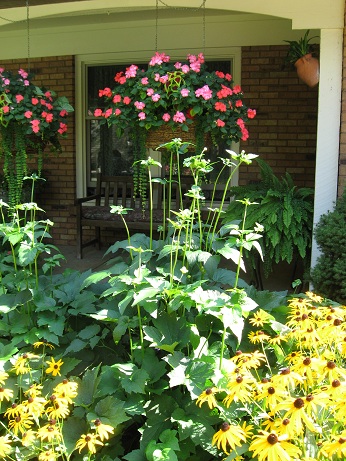 February/March: snow drops, winter aconite, Lenten rose, snow crocus
 Psalm 4:1 For the director of music. With stringed instruments. A psalm of David. Answer me when I call to you, O my righteous God. Give me relief from my distress; be merciful to me and hear my prayer. 2 How long, O men, will you turn my glory into shame? How long will you love delusions and seek false gods? Selah 3 Know that the LORD has set apart the godly for himself; the LORD will hear when I call to him. 4 In your anger do not sin; when you are on your beds, search your hearts and be silent. Selah 5 Offer right sacrifices and trust in the LORD. 6 Many are asking, “Who can show us any good?” Let the light of your face shine upon us, O LORD. 7 You have filled my heart with greater joy than when their grain and new wine abound. 8 I will lie down and sleep in peace, for you alone, O LORD, make me dwell in safety.
 Psalm 3:1 A psalm of David. When he fled from his son Absalom. O LORD, how many are my foes! How many rise up against me! 2 Many are saying of me, “God will not deliver him.” Selah 3 But you are a shield around me, O LORD; you bestow glory on me and lift up my head. 4 To the LORD I cry aloud, and he answers me from his holy hill. Selah 5 I lie down and sleep; I wake again, because the LORD sustains me. 6 I will not fear the tens of thousands drawn up against me on every side. 7 Arise, O LORD! Deliver me, O my God! Strike all my enemies on the jaw; break the teeth of the wicked. 8 From the LORD comes deliverance. May your blessing be on your people. Selah
 Psalm 2:1 Why do the nations conspire and the peoples plot in vain? 2 The kings of the earth take their stand and the rulers gather together against the LORD and against his Anointed One. 3 “Let us break their chains,” they say, “and throw off their fetters.” 4 The One enthroned in heaven laughs; the Lord scoffs at them. 5 Then he rebukes them in his anger and terrifies them in his wrath, saying, 6 “I have installed my King on Zion, my holy hill.” 7 I will proclaim the decree of the LORD: He said to me, “You are my Son; today I have become your Father. 8 Ask of me, and I will make the nations your inheritance, the ends of the earth your possession. 9 You will rule them with an iron scepter; you will dash them to pieces like pottery.” 10 Therefore, you kings, be wise; be warned, you rulers of the earth. 11 Serve the LORD with fear and rejoice with trembling. 12 Kiss the Son, lest he be angry and you be destroyed in your way, for his wrath can flare up in a moment. Blessed are all who take refuge in him.