Category: Articles and Devotionals
A selection of devotionals written by Barbara Shafer.
Making the Theological Understandable
A selection of devotionals written by Barbara Shafer.
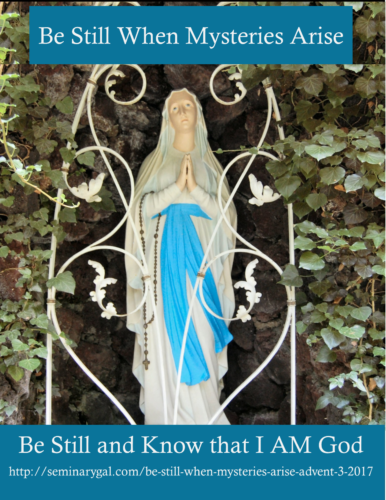 How good are you with incomplete information? When someone tells you only what you need to know—nothing more—and to accept that “nothing more” is all you’re getting? Are you able to Be Still in such an instance or does your mind ramp up, releasing your inner Sherlock Holmes to unlock whatever mysteries exist so they’re no longer mysteries?
Continuing our look into Still Christmas (Advent Devotionals for 2017) and exploring how to Be Still and know that He is God, we can see that sometimes God gives incomplete information and asks us to be cool with it.
Sometimes more information is too much information.
Like Zechariah, Mary’s mind must have been spinning. She’s being told something that is not only way out in left field, it’s never entered her mind as even a possibility.
For Zechariah, the angel’s proclamation was fulfilling a dream long unrealized, but still a realistic dream during his and Elizabeth’s normal child-bearing years. It would have been completely normal had they been younger.
Mary, however, is being asked to believe beyond the outlier and off the bell-shaped curve. She’s being asked to trust in totally uncharted territory.
A total mystery.
Not asking, “How can I be sure?” like Zechariah, Mary just wants to know the obvious:
Luke 1:34 “How will this be,” Mary asked the angel, “since I am a virgin?”
The angel tells her enough to satisfy a need-to-know, but beyond that, to trust that God still does the miraculous. Basically, “Mary, you couldn’t understand even if I were to tell you. I’m asking you to simply trust that you have enough information and let the miraculous remain mysterious.”
35 The angel answered, “The Holy Spirit will come upon you, and the power of the Most High will overshadow you. So the holy one to be born will be called the Son of God. 36 Even Elizabeth your relative is going to have a child in her old age, and she who was said to be barren is in her sixth month. 37 For nothing is impossible with God.”
Mary’s response is powerful: Luke 1:38 “I am the Lord’s servant,” Mary answered. “May it be to me as you have said.” Then the angel left her.
* * *
Be Still, Mary. I know you must have a million questions. Don’t be afraid. I AM your peace.
Be Still. Believe that I AM a God of love and mercy. You trust Me and I’m glorified by your faith.
Be Still and Know that I AM God. I specialize in the miraculous and supernatural. Matthew 19:26 “With man this is impossible, but with God all things are possible.”
Be Still and Know that I AM God. I AM about to reveal what has been among great mysteries in ages past. When the time has come, it will involve the Messiah, the Christ Child you will bear, Mary. “This mystery is that through the gospel the Gentiles are heirs together with Israel, members together of one body, and sharers together in the promise in Christ Jesus.” (Ephesians 3:6)
Questions for Reflection:
===
Still Christmas, Advent 2017 Devotionals began December 3, 2017 and are archived from that date.
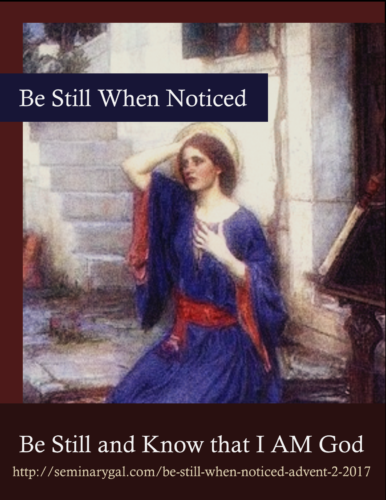 Most of us go through life as a matter of routine. We blend into the backdrop of sunrises and sunsets, each day not all that different from the others. Many of us seek to blend in, not wanting to risk being innovators, vanguards, or even color outside of the lines because standing out invites criticism or judgment or speeding tickets.
Mary was just minding her own business. She was following the usual order of dutiful daughter, betrothal and marriage to a nice guy like Joseph, hopefully to motherhood…like all the other Jewish girls. That’s when God takes notice of her. Not that He couldn’t find her before, even in a nowhere place like Nazareth. It’s just her time had not come to be noticed, singled out, until now.
Luke 1:26 In the sixth month, God sent the angel Gabriel to Nazareth, a town in Galilee, 27 to a virgin pledged to be married to a man named Joseph, a descendant of David. The virgin’s name was Mary. 28 The angel went to her and said, “Greetings, you who are highly favored! The Lord is with you.” 29 Mary was greatly troubled at his words and wondered what kind of greeting this might be. 30 But the angel said to her, “Do not be afraid, Mary, you have found favor with God. 31 You will be with child and give birth to a son, and you are to give him the name Jesus. 32 He will be great and will be called the Son of the Most High. The Lord God will give him the throne of his father David, 33 and he will reign over the house of Jacob forever; his kingdom will never end.”
Mary was a “nobody special” as far as the world could tell. God sees her differently. Like with King David (1 Samuel 16:7), God sees her heart. An angel comes and interrupts her life (just like he did with Zechariah) and turns her normal upside down.
Be Still, Mary. God has taken notice of you. You are highly favored.
(Being noticed upended everything she’d been working toward.)
God assigned a huge responsibility and never really asked if it was in her plans. He didn’t have to. He’d been watching her all her life and knew exactly what her response would be.
* * *
Be Still, Mary. I have been preparing you for this moment since before you were born.
Be Still. I’ve noticed your heart of faith and have set you apart as a beacon for generations as the mother of the Only-Begotten Son of God.
Be Still and Know that I AM God. The promise I made to David “Your house and your kingdom will endure forever before me; your throne will be established forever'” (2 Samuel 7:16) will be fulfilled in the Child you will bear.
Be Still and Know that I AM God. Your faithfulness has not escaped My notice. Now, dear Mary, get ready to marvel: “No eye has seen, no ear has heard, no mind has conceived what God has prepared for those who love him” (1 Corinthians 2:9)
Questions for Reflection:
===
Still Christmas, Advent 2017 Devotionals began December 3, 2017 and are archived from that date.
How well do you handle interruptions? Some are diversions, just brief strays of thought, some are bed rest from illness requiring lifestyle adaptation, some are from your child asking a question and your wanting to respond with love instead of irritation, but some are when God interrupts. His demand a thoughtful response. God’s interruptions are unsettling and can be life-altering. Hold that thought as we begin our journey into Still Christmas, our series for Advent 2017, by looking at how to Be Still When God Interrupts.
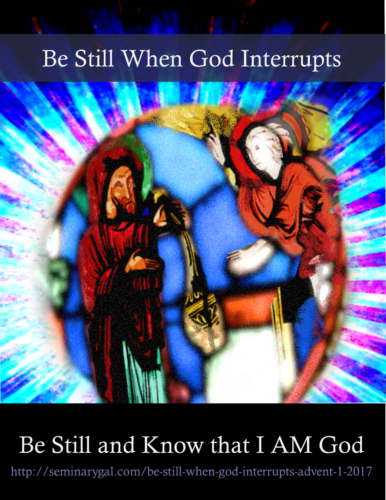 Poor Zechariah was just doing his job as the Christmas narrative from Luke begins (Luke 1:5-25).
He and his wife Elizabeth were ordinary people, holding a sorrow of being childless. Everything is ordinary, typical…full of observance, duty, and custom. But then God sends an angel to interrupt Zechariah as he’s simply doing the routine work of a priest:
Luke 1: 10 And when the time for the burning of incense came, all the assembled worshipers were praying outside. 11 Then an angel of the Lord appeared to him, standing at the right side of the altar of incense. 12 When Zechariah saw him, he was startled and was gripped with fear.
Has God ever scared the living daylights out of you? I totally get why Zechariah would be afraid.
13 But the angel said to him: “Do not be afraid, Zechariah; your prayer has been heard. Your wife Elizabeth will bear you a son, and you are to give him the name John. 14 He will be a joy and delight to you,
To a barren couple, this no doubt longstanding prayer being answered could have elicited many responses. First, maybe “Thank you,” but when you’re gripped with fear you don’t always think of the best answers on the first try. Zechariah’s was a total miss.
18 Zechariah asked the angel, “How can I be sure of this? I am an old man and my wife is well along in years.”
Yeah, wrong answer. Kind of destroys that whole life-of-faith thing that pastors and priests try to uphold. Asking God for probabilities, confidence levels, certainties that He’s not just shining you on, it demonstrates that you have no clue about faith even though you’re a priest.
19 The angel answered, “I am Gabriel. I stand in the presence of God, and I have been sent to speak to you and to tell you this good news. 20 And now you will be silent and not able to speak until the day this happens, because you did not believe my words, which will come true at their proper time.”
* * *
Be Still. I AM in possession of knowledge you don’t have.
Be Still. I AM not asking you to do miracles, only to believe that I can.
Be Still and Know that I AM God. I AM not limited by laws of nature or worldly norms. My ways are not your ways.
Be Still and Know that I AM God. Your heart can find stillness and rest in Me. Isaiah 55:6 Seek the LORD while he may be found; call on him while he is near…”For my thoughts are not your thoughts, neither are your ways my ways,” declares the LORD. 9 “As the heavens are higher than the earth, so are my ways higher than your ways and my thoughts than your thoughts.”
Questions for Reflection:
===
Still Christmas, Advent 2017 Devotionals began December 3, 2017 and are archived from that date.
“Be still, and know that I am God; I will be exalted among the nations, I will be exalted in the earth.” (Psalm 46:10).
“Be Still,” God’s Word says. Do we even know what being still feels like anymore? How can we get to that place of stillness? Especially at Christmas.
 .
.
This year’s Advent Devotional Series, Still Christmas, is the Advent complement to the Lenten series, Be Still and Know that I AM God.
Every day through Advent, we will look at the birth narrative of Christ and find ways to have a Still Christmas, taking time for appreciating what an amazing and transformative event the birth of our Savior was.
We will allow ourselves to take refuge in God’s Word and under His mighty hand.
By doing so, we will learn to relinquish our desire to control our surroundings and in the stillness, find comfort and hope.
Finally, there will be questions for personal reflection designed to carve away all our self-imposed stresses and refocus our pure attention upward.
Be Still and Know that I AM God.
* * *
Advent Devotionals begin December 3, 2017. If you’re already signed up on my Home Page sidebar to receive posts, you’ll get the Advent devotionals automatically. If you haven’t signed up, today is a great day to do so. Advent and Lenten devotionals remain among my most popular offerings. You don’t want to miss this great way to prepare your heart for the true meaning of Christmas! See you in a week!
== ==
Acknowledging inquiries about the entire season’s devotionals for your study group’s planning purposes, Seminary Gal’s prior seasons’ Advent devotionals can be accessed via the archives to the right and are as follows:
 1 Thessalonians 5:14 And we urge you, brothers, warn those who are idle, encourage the timid, help the weak, be patient with everyone. 15 Make sure that nobody pays back wrong for wrong, but always try to be kind to each other and to everyone else. 16 Be joyful always; 17 pray continually; 18 give thanks in all circumstances, for this is God’s will for you in Christ Jesus..
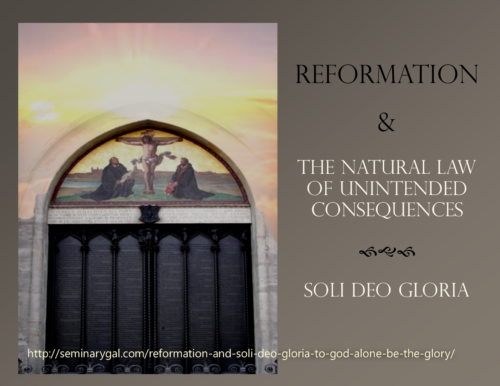
Reformation Day is complicated, even after 500 years of celebrating it. You see, I have many Christian friends who worship in the Roman Catholic Church. For them, it is a familiar worship tradition, a family where they feel at home with Christ, and a place where they learn about our Lord and Savior Jesus Christ. They enjoy community among the faithful and have personal piety as devotion to their Lord. I have many Christian friends who worship in Protestant churches of all denominations. They too enjoy familiar worship traditions, the community of believers, and eagerly learn about Jesus and worship of Christ Alone. For them, the individual decision to follow Jesus moves their hearts to worship, prayer, and obedience. For most of my friends, they believe that Christ Alone is Lord and To God Alone Be Glory, (Soli Deo Gloria), the last of the 5 solas we’ll look at with the Reformation we celebrate today on its 500th anniversary.
As I look back over 5 centuries of church tradition, persecution, and growth, I see a Church constantly wrestling with who it is and who it should be, set apart from a world of sin. That’s what moved Martin Luther to nail “Ninety-five Theses” to the castle door of the church in Wittenberg.
Since the Reformation, the Church wrestles with each other’s purity and identity so much that we seem to forget Christ Alone is our central bond whether Catholic or Protestant. I recall the powerful little book, The Mark of the Christian by Francis A. Schaeffer and what he calls the final apologetic—unity in love for the brethren—that gives glory to God Alone.
In light of pure desire for biblical unity so the world may know Jesus Christ was sent by our Father and for God’s glory, I will admit to an uneasiness, even sadness, when I read nationally-acclaimed pastor John Piper saying about the Reformation,
“I will be celebrating that the finished and complete work of Christ in providing imputed punishment for our sins and imputed perfection for our righteousness was once for all and cannot be reenacted in the Roman Catholic Mass so as to become a necessary point of transfer of that decisive grace purchased once for all for us and given to us through faith in Christ alone…. I have mentioned before in this podcast just last summer’s experience in Europe where a nun was converted at eighty years old and had never read the Gospel of John. So, a Roman Catholic professional religious woman never had read the Gospel of John. That is symptomatic of a deep evil in cutting people off historically and, today, doing things that subtly discourage the personal encounter with God through Christ in his word.”
Right words are there, yes, but also unmistakable zingers hidden like verbal landmines, trip wires, or sniper fire felt intensely by those who worship Christ Alone, just in a different—equally flawed—setting.
The greatest unintended consequence of the Reformation is precisely this kind of division and spiritual pride, and how it robs God. Shouldn’t it be Soli Deo Gloria, (To God Alone Be Glory)?
On this 500th anniversary of the Reformation, let’s leave the zingers behind and focus instead on the 5 solas.
===
The 5 Solas of the Reformation began on October 26, 2017 and can be found in the archives.