God of Wonders Beyond Our Galaxy-Advent 1, 2025   

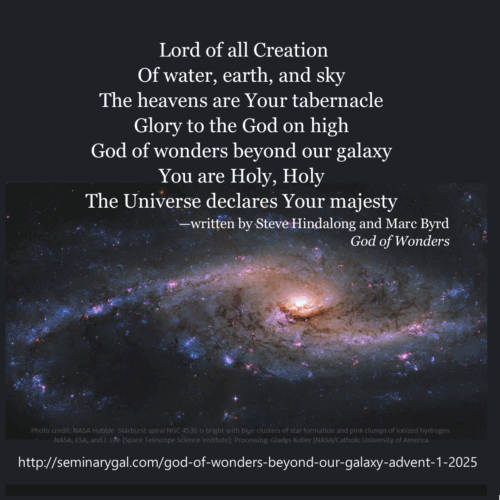
Lord of all Creation,
Of water, earth, and sky
The heavens are Your tabernacle
Glory to the God on high
God of wonders beyond our galaxy
You are Holy, Holy
The Universe declares Your majesty

—written by Steve Hindalong and Marc Byrd
God of Wonders

We live in an age of Mock Omniscience, having the world at our fingertips and the ability to search any question we have for answers on the worldwide web. It’s easy to elevate our own intelligence, artificial or real, but we still need God who alone has all the answers.

Forgive us, Lord, for failing to magnify You, the God who is beyond our galaxy, beyond time, and beyond creation. 

Let’s begin our Advent season by worshiping the God of Wonders who deserves to be exalted as Holy and to receive all glory.
 

Principle: Our God of Wonders is beyond any created thing or being.

Aim: See our God as worthy of being exalted.

At Christmas, a prayer:  Lord God, Your plan is so far above anything we could ever have imagined.  You are loving and holy!  Your justice is true!  Your righteousness is without flaw!  Hallelujah! How amazing that You would look upon our impossible predicament of wickedness and rebellion, yet because of Your character of love, You would implement Your mysterious plan to rescue us anyway.  We acknowledge we are truly unworthy of this mercy on account of sin in our lives.  Even the best of us is a sinner by inheritance from Adam and that from the moment we take our first breath.  We repent of our evil ways and come to You for forgiveness knowing You are merciful.  Oh Hallelujah!  Your wisdom is beyond all searching, and Your plan—mysterious even on the night of the birth of our Lord Jesus Christ—perfectly displays Your love, justice, and mercy.  We praise You!  We lift Your Name above all names!  We give You glory this day in anticipation of celebrating during Advent and beyond, marveling at who You are!  Be magnified in our thoughts, our prayers, and our lives.  You are worthy! Amen.

===
Acknowledging inquiries about an entire season’s devotionals for your study group’s planning purposes, Seminary Gal’s prior seasons’ Advent devotionals can be accessed via the search feature to the right and are as follows:  

  • “Visitation Principles” was the theme of last Advent’s devotional series. It delved into reasons Jesus came as outlined in the Book of Hebrews. They are archived beginning December 1, 2024.
  • From the Jews for the World” was an important devotional exploration of how Jesus’ Jewish heritage was necessary for the salvation of Gentiles, too. It is archived beginning December 3, 2023.
  • Awaken Remnant” was the devotional topic for 2022. It began November 27, 2022, and highlighted the remnant found throughout Scripture as evident in Jesus’ lineage.
  • The multi-faceted Interlude between the promise of a Deliverer and the birth of our Messiah and King was the theme of 2021’s devotional series. It is archived beginning November 28, 2021.
  • 2020’s Devotional Series Divine Intervention began on November 29, 2020 and explored God’s activity on behalf of a hurting world and nations in tumult– Intervention for you and for me when our status as sinners required nothing short of a miracle.
  • God’s Christmas list explored what might be on God’s Christmas list, learning what He wants from us. It began December 1, 2019.
  • Storyteller began December 2, 2018 and entered into the Christmas story through its telling.
  • The 2017 series Still Christmas, began December 3, 2017 and was the Advent complement to the Lenten series, Be Still and Know that I AM God.
  • The 2016 season devotionals were called Timeless: The Message of Christmas for All Ages” and explored how the message of Christmas is timeless truth, for all ages of people, and for all ages at all times.  Timeless hope, encouragement, grace, peace, and love as we looked into the Word, saw the face of our Lord Jesus, and experienced restoration in His presence.  His goodness and His Gospel are truly Timeless. The 2016 devotionals began November 27, 2016.
  • The 2015 season devotionals were titled Incarnation and involved digging deep–and yes, I mean deep– in this important mystery of Christian theology.  They began November 29, 2015.
  • Carol Me, Christmas! remains one of my most popular offerings and tells the Christmas story through our most beloved Christmas hymns and carols.  You can access all of the numbered devotionals from 2014 via the archives.  They began November 30, 2014.
  • The 2013 series was Emmanuel: When LOVE Showed Up in Person and examined the Prologue to the Gospel of John.  It began December 1, 2013.
  • The 2012 series focused on Expecting the Unexpected…the unexpected, unlikely, and uniquely divine qualities of God’s perfect plan outlined in Luke’s account of the Christmas story.  It began December 1, 2012.
Continue Reading

God of Wonders-Advent 2025

“Look it up,” he said. “You have the world at your fingertips.”
“The Age of Wonder is over,” I muttered, almost disgusted at the thought.
Then he said, “Please tell me you’re not going to follow a deep dive of anti-Semitism and ‘just war’ discussions with ‘The Age of Wonder is Over.’  Merry Christmas. Ugh.”

Marriage can be complicated sometimes.

There was a time not so long ago when we’d think about a question and be left wondering. Now we can know almost anything we ask. Yes, even stupid stuff. Did Gene Hackman like doing Hoosiers? What is the meaning behind Gordon Lightfoot’s Rainy-Day People or Ricky Nelson’s Garden Party? Was Churchill’s secretary Miss Layton real?  What’s worse, perhaps, is that other people have clearly asked about the same stupid stuff before we did.

If you’d told me in high school that in the year 2025, I’d have a powerful computer so tiny it would fit in my hand, and that I’d carry it in my pocket or feel lost without it—a computer so powerful it could access all the known knowledge in the universe, I would have been stunned.

Mock Omniscience.
Kind of. That’s a scary thought. 
Among the dangers of AI (for sure!) is the pride of man to think we can know everything. 
“The Age of Wonder is Over.” How sad, I’d even think that!

Then I read a short post from Glenn Beck. 

“The fact that practically the whole world stopped to look up at the Northern Lights is a reminder that wonder still exists outside the algorithm.”

Huh. Wonder still exists …   outside of the known, outside of the knowable.

Please consider joining me for my 2025 Advent Devotional Series “God of Wonders” as we explore the wonder of God in the birth of His Son Jesus Christ. Advent begins on November 30, 2025. You can read the devotionals here or on Facebook. Wonder does exist outside of algorithms, artificial intelligence, and mock omniscience…if you search for it.

Continue Reading

A Fountain Will Be Opened for My People

Zechariah 13:1 “On that day a fountain will be opened to the house of David and the inhabitants of Jerusalem, to cleanse them from sin and impurity.

In the end, My People will be vindicated by God Himself.  This scene, our final installment in My People/Not My People, is fitting as it remains prophecy until the End times.  God has not forsaken the Jewish people. He’s continually working to purify them prior to the Last Day when the last believing Remnant will have their eyes opened, repent, and be saved.

To those who want to believe God has abandoned the Jews, you’re simply wrong.  God opens to the “house of David” and to the “inhabitants of Jerusalem” a fountain of salvation in Christ.  In the end, nations (and people) who take a stand against Jerusalem are the ones who will be destroyed.  God said it: “On that day I will set out to destroy all the nations that attack Jerusalem.”

Do you believe Him?

God has My People (in every instance we’ve seen, they’re His children of FAITH in Christ). Yes, there are Gentile Christians who have NOT replaced the Jews.  And among the Jewish people there are also those of faith (whether predating Christ, His disciples during His lifetime, and those who repented and believed the good news after His death like the men on the Road to Emmaus).

After the full number of Gentile Christians (the Church which is comprised of both Gentile and “Messianic Jewish” people who have repented and believed) has come in, there will be a different Jewish Remnant awakened from a period of hardening. They too repent and believe. Then the final joining of My People will be accomplished.

Do you want to know who My People are? They are from every nation, tribe and tongue with this one belief that ties them together eternally as My People: They are those who have believed in the promise of Messiah, the One who is identified in Scripture alone as the unique Son of God, Son of Man, the Crucified Redeemer, the Risen Savior, the Forgiver of sins, the Way, the Truth, and the Life, and by placing their trust in Him for forgiveness of their sins…they repent and will be saved.

Continue Reading

Man’s Holy War is Never Just

This past week marked 10 years since the attack at the Bataclan Concert Hall in Paris. Many today never heard of it or realized how appalling present chants in that very venue of “Free Palestine” were to those who did remember, or the ones who survived.

It was jihad.  Holy War.  What a misnomer.  Terrorism is anything but holy.

And to be clear, terrorists are Not My People, as we wind down our series of My People/Not My People.

If you want a mental refresher, this individual was still following the developments regarding prosecution and the French government’s role in keeping it out of the headlines; and host and author Jack Posobiec publicly recalled it to international memory. 

A so-called “holy war” is fought by men for the sake of their god. In Islamic jihad, for example, it is a religious duty for a certain faction of Islamists within Islam.  To them, eradication …annihilation … of the Jews is one sign “the Hour” is upon the world: “The Hour will not come until the Muslims fight the Jews, and the Muslims kill them…” — Sahih Muslim 2922.

Promptly after Bataclan, ISIS released a statement calling the attacks “blessed strikes” on the “crusader nation” of France and viewed it as part of a holy war (jihad) against the West.  In all, 130 innocents were killed, 494+ were injured, many critically, and the genuine barbarism of the killings went widely under-reported. 

There is no moral equivalence of terrorists and victims. 
Not at the Bataclan. 
Not at the World Trade Centers. 
Not on October 7, 2023, at the Nova Music Festival in the southern Negev in which 1,200 people were killed and 251 hostages were taken. 
Innocent civilians all. 

In all three of those cases, innocent third parties
who never knew what was coming were slaughtered.

Jean Bethke Elshtain, a longtime Divinity School professor and theological scholar at the University of Chicago wrote about the Just War.  In the memorial on her life from University of Chicago Magazine

As Elshtain wrote in her book (emphasis added),
“although just-war tradition never regards armed conflict as ‘desirable, or as any kind of social ‘good,’ it nevertheless ‘acknowledges that it may be better than the alternative.”’

Just War Against Terror‘ enumerated the complex criteria to determine whether force is justified and to keep its use within necessary limits: a war must prevent harm to innocents and be openly declared by a legitimate authority. It must be a response to unjust aggression against one’s own people or an innocent third party. It must be the last resort after all other options are exhausted. It must be embarked upon only with a reasonable chance of success and conducted in a fashion that protects noncombatants.

Questions for further thought:

Islamic adherents present a polarity: from “mostly peaceful” to engaging in extremist terrorism—all using the Quran to justify their actions…including those whose mission is to annihilate Jews.  

How often does the Muslim “peaceful majority” condemn the extremist elements from among their number committing atrocities like October 7th or the Bataclan concert hall attack?  Why is there not widespread, uniform international outcry from “peaceful majority” Muslims?  Are they afraid of their fringe, fearing wider reprisal, are they in secret handshake agreement, etc.?

Violent jihad with rewards for martyrdom undergird Islam’s “holy war.”  As Islamism grows in formerly Christian nations like the UK and France, what is happening regarding violence? 

Islam is not the only religion to have engaged in a “holy war”—history shows that. 

To our shame, a holy war initiated by Pope Urban II and elite military-affiliated Catholics (known as the Crusades–10th to 13th centuries), was similarly condemned–at the time–as unchristian only by a handful within Christianity. Why do people not speak up about atrocities? Did they not know, did they fall prey to propaganda at the time, did they turn a blind eye to the unthinkable, etc.?

Eventually, Catholicism’s conquest was abandoned entirely in favor of evangelistic missions.  What is the end goal of missions versus a “holy war”?   What means are used to justify each’s ends?

Which religion(s) still use the concept of “holy war” to justify adherents’ actions?

According to the Just War theory outlined above, could Israel’s actions post-October 7th be considered Just?

Continue Reading

My People and the Just War

Last time in our study of My People/Not My People, we asked, “What is the difference between the wars to claim the promise of God through conquest, little by little, as opposed to ethnic cleansing or genocide?”  Is there such a thing as a Just War?  For that matter, “Why does God use war?”

Let’s take these one at a time.  In a 2013 post called Just War, I wrote,

So, why does God use war?  As a moral instrument.  When God made the covenant (regarding all the promises, not just the Land), Scripture says,

The Amorites.  Who are they and where were they located?  The Amorites were one of the major Canaanite ethnic groups, according to the Table of Nations (Genesis 10:6-19), descended from Canaan son of Ham and known for their goliath power and size. As such, they controlled important hill-country territories of Canaan on both sides of the Jordan.  They also were big-time sinners and idolaters, enough that God would single them out.  Notice the “full measure” God spoke about wasn’t the number of Amorites, but the sin of the Amorites.

Questions for further thought:

How does God’s use of war as a moral instrument require men to have a deep, prior understanding of God and His definition of morality?

How does God’s “Just War” require that war be done God’s way?  Why did God require circumcision of the Israelites before going to conquer Canaan (See Joshua 5)?

How did the siege of Jericho display conquest as God’s moral instrument, done God’s way (Joshua 6:1-16)?

Is it actually genocide when God spared an Amorite Remnant by faith (see Rahab, Joshua 6:17 and Matthew 1:5)?  How did that make the siege of Jericho a moral victory in a Just War?

Continue Reading

Nation-State in Formation

Integral to any discussion of the modern state of Israel as My People/Not My People, we must ask, “How do nation-states form?”  There are several ways:

Theologically, the Land of importance to the modern nation-state of Israel is grounded in a forever promise given by God to Abraham many thousands of years ago.  It remains as the only example of Promised Land of God… ever known to be given as an inheritance …or recorded to exist.  The only one.  If you believe in the God of the Bible, this promise endures. There is no expiration date on an eternal God’s forever promises.

No one authoritatively promised (or could!) the US, Germany, Russia, or Venezuela, etc. their lands.  But, when God gave the Land as a promise to Israel, He was specific.  The boundaries were identified, and it was promised as an inheritance forever. (see Genesis 13:15; 15).  The Ottoman conquests from the 1500s did not invalidate that land grant because it was God’s land to give and to promise.

Historically, some other nations like the US, Germany, etc. got (or lost) their lands because wars were fought, and the winner takes all or makes treaties.  Those boundaries are subject to ongoing wars, agreements, invasions, and national defense. National boundaries are subject to these things because wars of man and manmade boundaries are limited by human nature.

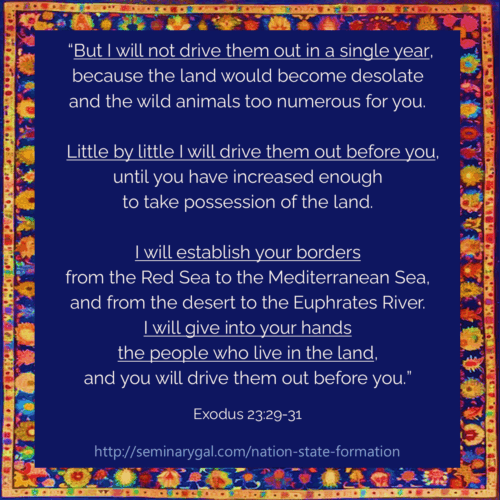
The Promised Land was promised by God, dependent upon His eternal nature and His forever promise and yet, wars had to be fought. In our study of My People/Not My People as history proclaims them, this is where we are. 

Moses has died and Joshua (one of two faithful spies) takes over leadership.  Joshua 1:10 “So Joshua ordered the officers of the people:  11 ‘Go through the camp and tell the people, ‘Get your provisions ready. Three days from now you will cross the Jordan here to go in and take possession of the land the LORD your God is giving you for your own.'”

There were two and a half tribes which weren’t inheriting west of the Jordan.  Those east of the Jordan were still bound under the command of Moses.

Questions for further thought:

Do you think the Reubenites, Gadites, and the half-tribe of Manasseh, might have wanted to avoid helping since they were already living in their own land east of the Jordan?

What is it about God’s mandate made them obey the command of Moses which originated with God?  What does their obedience say about their being My People?

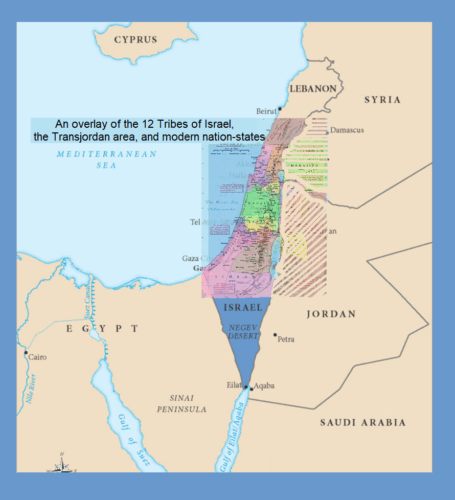
Today the land east of the Jordan River that had belonged to the Reubenites, the Gadites and the half-tribe of Manasseh is under the sovereign ownership of Jordan and Syria.

In fact, the full land outlined in Genesis 15:18-21 includes areas currently part of Egypt, Sudan, Syria, Turkey, and Iraq.  In Joshua chapters 15-19, there are allotments by tribe, the My People of Scripture.  They largely correspond to the area of the modern nation-state of Israel.

What is the difference between the wars to claim the promise of God through My People’s conquest of land inhabited by Canaanites (Not My People), little by little, as opposed to ethnic cleansing or genocide? We will address this subject more in the next installment.

Continue Reading

Sifted in the Wilderness

After the Passover, God gave the faithful Israelites safe passage out of Egypt …  through the Red Sea.  You’d think this “miracle beyond all miracles” they’d ever witnessed would have stuck with the travelers, but humanity is an ungrateful lot with short memories.

Israel is no exception.
It’s why they were commanded to observe the Passover every year.

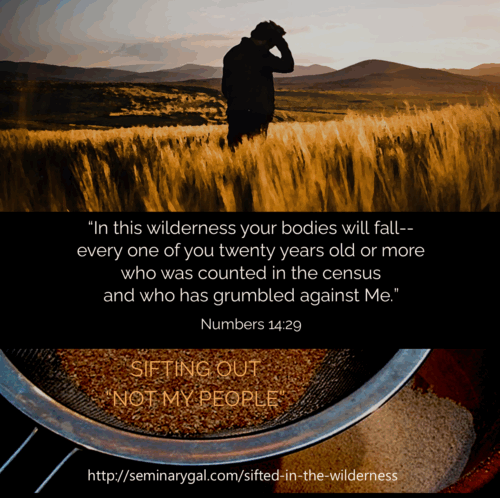
The pack of grumbling ingrates complained non-stop and even wished to go back under slavery.  So, God used 40 years to sift them in the wilderness.

Questions for further thought:

These were all Israelites. Every last one of them. All of them survived the Passover of the destroying angel. All walked safely on dry land through the Red Sea and arrived on the far shore, then witnessing (with their own eyes!) the complete annihilation of the Egyptian oppressors who pursued them. These Israelites had it all! They’d seen it all! How on earth did they forget within the first 2 years, enough that God would sift them?

The forgetters’ children plus Joshua’s and Caleb’s families would be the only My People from among all those hundreds of thousands from the Exodus from Egypt.  All the other Israelites, the grumbling grown-ups, were Not My People. 

Does that seem like Chosen People to you when the faithless so outnumbered the faithful? After all that grumbling, did God still consider the Remnant entering the Promised Land to be His Chosen People?

Does that numerical proportion negate the existence of My People or the Chosen People? What does Jesus say about that principle? (Matthew 7:13-14

Are you beginning to see the pattern that it’s obedience to God which forms the distinction between My People and Not My People?  That it’s not a simple matter of heritage or majority rule? And that numerically speaking, Not My People will always far outnumber My People?

What is the distinction between obedient Chosen People and obedient My People from other nations? What did Jesus mean when He said, “I have other sheep that are not of this sheep pen. I must bring them also. They too will listen to my voice, and there shall be one flock and one shepherd” (John 10:16, emphasis added)?

Continue Reading

The Night of the Destroyer

There are a few instances in the Bible where God makes a powerful statement about My People as distinct from Not My People by personally permitting “the destroyer” (an angel whose job is killing) to do his thing.  The Passover is one.

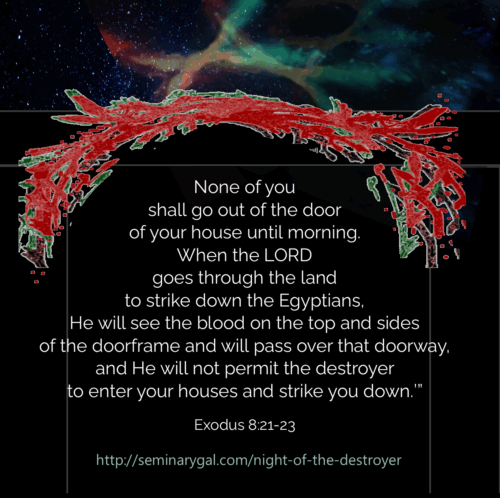
The Lord and His destroyer went through Egypt at midnight.  Only My People (who obeyed the Word of the Lord and stayed inside) were spared.  They were not spared by half measures, location changes, or philanthropic good works, but only by trusting and obeying the full Word of God.

Questions for further thought:

There’s a pattern.  Read Ezekiel 9.  Who were those whom the six destroyers/executioners permitted to strike? Who were those sealed to be spared? Who did the sealing?

We will revisit this passage again in our study. For now, look: Jerusalem. The house of Israel and Judah.  Are these not all Jews? 

Who is the man clothed in linen with the writing case?

In the Passover, if God’s instructions were not followed completely regarding the blood or staying inside, what was the destroyer permitted to do?  Would their heritage have mattered?

Continue Reading

Making a Distinction with My People

Within a family line, there are My People and Not My People.  This understanding will help us as we answer the issue of who are the “real Jews” especially as it relates to the nation-state of Israel and the Israel of the Bible. There is much debate in Christian circles about how to reconcile this.  This series is working toward illuminating that question.

For now, and for continuity’s sake, God also distinguishes between My People and people of other nations who are Not My People.  This is helpful for addressing why God has been the historical deliverer of His Chosen People over and again in history.

Perhaps you remember the story of the plagues in Egypt (that land we saw last time where the Israelites would be enslaved and mistreated for 400 years).  When it was time to go, it was time to go.  To get Pharaoh to release them, God sent ten plagues, with the fourth one being the start of God declaring that He’s making a distinction between My People and Not My People.

And it was so.
By the seventh plague, it becomes clear:
it’s about who believes God (My People) and who doesn’t (“your people”).

The officials of Pharaoh who heeded God’s order might be called “God-fearers” and the others learned a valuable lesson.

Questions for further thought:

Why was it important to distinguish My People before the Plague of the Firstborn (the tenth plague)?  To whom did it reinforce God’s commands?

Was four hundred years long enough for My People living amongst other religions to forget God’s promises?  Why didn’t they?  How were the plagues of distinction a good reminder?

What is God’s ultimate interest in preserving the Jewish people as it relates to Jesus?

Continue Reading

Never in Their Lifetimes

Last time, we looked at Genesis 22 where God ended up preserving the line of Isaac by supplying a ram for the sacrifice instead of Abraham’s beloved son.  As we keep investigating My People/Not My People as portrayed in the Bible, we’d think all should be going well! Passed that test! Promised Land, here we come for My People! 

Wait.  Let’s go back to Genesis 15 and take another look at what happens before the Promised Land.  There’s a significant detour, planned by God.

That “country not their own” would be the nation of Egypt.  Why would God plan such a delay, such a detour?

Four hundred years is a long time to wait, an even longer time to be enslaved and mistreated, and that means that Abraham’s immediate descendants, even among the Chosen People, would never in their lifetimes see the land that their future generations would inherit someday. Only enslavement and misery. Does that look like Chosen to you?

Hebrews 11:1 Now faith is confidence in what we hope for and assurance about what we do not see. 2 This is what the ancients were commended for.

Questions for further thought:

The fourth generation would mean that only those alive (who had been enslaved for 400 years) would begin to know the journey back.  It would happen after the time of Joseph (Jacob/Israel’s son and Abraham’s great-grandson) whose bones were brought back by Moses.  Do you think their national identity as descendants of Abraham and their faith in God were integral to their successfully remembering after 400 years of suffering?

For context, America is about to celebrate 250 years. What risk does America run in forgetting our founding principles and documents, including the part of our rights coming from God? Did our God-given rights play any part in ending America’s slavery issue? How does growing biblical illiteracy (unknown to our founders) jeopardize America’s future? About the Judeo-Christian religious underpinnings, Josh Hammer writes,

Why does it take faith in and believing God (credited as righteousness) to accept that the promise given you would begin to find fruition well after you died? That you’d never live to see it?

How do you think Abraham might have felt about knowing that his descendants, the My People of the Covenant, would be slaves?  Would it be reassuring enough to know that after that, God promised to bring them out to the Promised Land?

Jesus told the men on the Road to Emmaus, “Did not the Messiah have to suffer these things and then enter His glory?” And beginning with Moses and all the Prophets, He explained to them what was said in all the Scriptures concerning Himself (Luke 24:26-27). How does the pattern of suffering before glory show itself in the Covenant to Abraham? How might it express itself in the Chosen People today?

Continue Reading