Forever Incarnated-Advent 5 (2015)

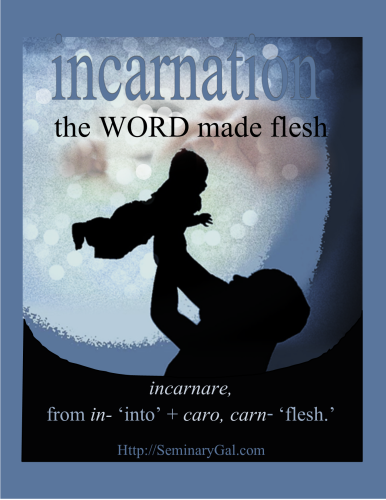
Strange, isn’t it, to think that Jesus still has a body? Once incarnated, He would have a body forever. No return to being some sort of spirit minus a body like the Father or the Holy Spirit. No return to being uncontained, as it were.

My first thought as I was pondering this was a song by the Talking Heads titled “And She Was”—a rock tune written by David Byrne. In talking about his inspiration for this song, he wrote, “I used to know a blissed-out hippie-chick in Baltimore…She once told me that she used to do acid (the drug, not music) and lay down on the field by the Yoo-hoo chocolate soda factory. Flying out of her body, etc., etc. It seemed like such a tacky kind of transcendence… but it was real! A new kind of religion being born out of heaps of rusted cars and fast food joints. And this girl was flying above it all, but in it too.”

word made flesh foreverOkay, that’s pretty weird.

Jesus didn’t have an out-of-body or rather in-the-body experience as some sort of drug-induced trip from which He’d return to reality. Nope. For Him, He existed before all time and then, in God’s perfect timing, He added full humanity to His full divinity and it would be a forever thing.

The Infinite would gain—through the Son’s Incarnation—the experience of being finite. (Aw go ahead and say, “Whoaaaaa”)

The experience of death. (Whoaaaa.) The experience of knowing what created beings feel and know…even if Jesus was never created.

Jesus was Incarnated—in part—to experience full humanity. (Whoaaaa…)

Thought for the day: Once Jesus was Incarnated, He would be the Word made Flesh. There would be no Flesh going back and returning as simply the Word.

Questions for reflection:

  1. When Jesus returns, what does the Bible say? Read Luke 21: 27 At that time they will see the Son of Man coming in a cloud with power and great glory. 28 When these things begin to take place, stand up and lift up your heads, because your redemption is drawing near.” Will Jesus have a body?
  2. Read Luke 24:13-31 about Jesus walking with the two men on the road to Emmaus. Did Jesus have a body? Was it a regular human body? In what ways was it different?
  3. Why is it important that Jesus’ resurrection wasn’t just His spirit but also His body? What if His body was still in the tomb…what could anyone prove?
  4. Does Jesus’ body still serve some function, and if yes, what functions does His humanity serve? For thinking about “in Him”, read 2 Corinthians 5:21 “God made him who had no sin to be sin for us, so that in him we might become the righteousness of God.” (Consider also Eph 1:4-14, Eph 2:21, Eph 3:12, Eph 4:21, and Col 2:6-7)

======

Incarnation (2015 Advent Devotional Series) began November 29th.  By way of reminder, if you haven’t signed up yet, you can receive these devotional studies in your email throughout Advent 2015 by entering your email address on the SeminaryGal.com home page in the space provided in the sidebar.  Or “Like” the SeminaryGal Facebook page to access them there.  If you like these devotionals, I’d really appreciate your letting others know so I can continue to spread the Good News far and wide.  Blessings to you, in Christ always, Barbara <><

Continue Reading

Mysterious Incarnation-Advent 4 (2015)

We cannot get into the mind of God to know why He does things, but the good news is He tells us all that we need to know. The Incarnation is mysterious. He doesn’t expect us to know how He did it.

mysterious incarnationHow can God simultaneously be the Son of God and the Son of Man? Isn’t it a contradiction?

No, it’s a mystery.

God even tells us so.

Isaiah 9:6 For to us a child is born, to us a son is given, and the government will be on his shoulders. And he will be called Wonderful Counselor, Mighty God, Everlasting Father, Prince of Peace.

A finite human child is born who is the everlasting Father.

To us a son is given (the Son of Man) and yet He’s also called Mighty God (the Son of God).

How can a child be the Father or how can the Son of Man be God Himself?

Jesus’ mother Mary even asked how God was going to do it.  God didn’t tell her specifics.

He only had an angel reassure her.

Luke 1:30 But the angel said to her, “Do not be afraid, Mary, you have found favor with God. 31 You will be with child and give birth to a son, and you are to give him the name Jesus. 32 He will be great and will be called the Son of the Most High. The Lord God will give him the throne of his father David, 33 and he will reign over the house of Jacob forever; his kingdom will never end.” 34 “How will this be,” Mary asked the angel, “since I am a virgin?” 35 The angel answered, “The Holy Spirit will come upon you, and the power of the Most High will overshadow you. So the holy one to be born will be called the Son of God. 36 Even Elizabeth your relative is going to have a child in her old age, and she who was said to be barren is in her sixth month. 37 For nothing is impossible with God.

This is the mystery of the Incarnation. Fully God. Fully human. Full of logical inconsistencies from a human rational perspective and yet, to God it is no conundrum, no riddle, and no inconsistency. It’s a mystery to us, but not to Him.

1 Timothy 3:16 Beyond all question, the mystery of godliness is great: He appeared in a body, was vindicated by the Spirit, was seen by angels, was preached among the nations, was believed on in the world, was taken up in glory.

Thought for the day. The mystery of the Incarnation is a wedge of faith. It divides those willing to let it be a mysterious truth from those who refuse to accept anything unless it can be understood.

Questions for reflection:

  1. How are we helped in our faith by knowing that nothing is impossible with God?
  2. In what ways is the Incarnation a wedge of faith?
  3. What would we have to know in order to have a mind expansive enough to understand this mystery completely?
  4. Read Hebrews 1:1 In the past God spoke to our forefathers through the prophets at many times and in various ways, 2 but in these last days he has spoken to us by his Son, whom he appointed heir of all things, and through whom he made the universe. 3 The Son is the radiance of God’s glory and the exact representation of his being, sustaining all things by his powerful word. After he had provided purification for sins, he sat down at the right hand of the Majesty in heaven.” Identify the mysterious elements in this passage.
  5. Is it enough just to have Jesus reveal God to us? Read John 14:9 Jesus answered: “Don’t you know me, Philip, even after I have been among you such a long time? Anyone who has seen me has seen the Father. How can you say, ‘Show us the Father’? 10 Don’t you believe that I am in the Father, and that the Father is in me? The words I say to you are not just my own. Rather, it is the Father, living in me, who is doing his work. 11 Believe me when I say that I am in the Father and the Father is in me; or at least believe on the evidence of the miracles themselves.”

======

Incarnation (2015 Advent Devotional Series) began November 29th.  By way of reminder, if you haven’t signed up yet, you can receive these devotional studies in your email throughout Advent 2015 by entering your email address on the SeminaryGal.com home page in the space provided in the sidebar.  Or “Like” the SeminaryGal Facebook page to access them there.  If you like these devotionals, I’d really appreciate your letting others know so I can continue to spread the Good News far and wide.  Blessings to you, in Christ always, Barbara <><

Continue Reading

Incarnation Pre-existing–Advent 3 (2015)

pre-existing incarnationSo, was the Incarnation God’s “Plan B” after Adam and Eve went AWOL and became rogue humans?

Nope. It was the plan all along.

Even before He created Adam and Eve. 

It was pre-existing.

Perhaps it seems rather odd to you that God would plan to send Jesus to die before He created the ones who would bring death into the picture. Yeah. It is rather strange. Especially since God is all about life.

John 1:4 In him was life, and that life was the light of men.

And yet, He contemplated human mortality and prepared His solution to it. He knew we’d rebel and yet He created us anyway.

In the Godhead (Father, Eternal Word, Holy Spirit), there was no death, only life and life-giving. Yet Scripture says,

Ephesians 1:4 For he chose us in him before the creation of the world to be holy and blameless in his sight. In love 5 he predestined us to be adopted as his sons through Jesus Christ, in accordance with his pleasure and will– 6 to the praise of his glorious grace, which he has freely given us in the One he loves.

God’s choice to redeem us as holy and blameless—rebels though we have been—was a choice God made even before Creation. It was pre-existing. And our God who is all about life would bring about eternal life for us through His Son’s Incarnation and death for us.

Thought for the day: The very same God who is all about life and gave us life at Creation—even knowing that we’d bring death into the picture–would give us the Incarnation as His solution to human mortality. In doing so, He amplified the beauty of eternal life through the ugliness of death.

Questions for reflection:

  1. How did God know that death existed if He’s all about life? Read Genesis 3:22 And the LORD God said, “The man has now become like one of us, knowing good and evil. He must not be allowed to reach out his hand and take also from the tree of life and eat, and live forever.”
  2. Genesis 3:23 “So the LORD God banished him from the Garden of Eden to work the ground from which he had been taken. 24 After he drove the man out, he placed on the east side of the Garden of Eden cherubim and a flaming sword flashing back and forth to guard the way to the tree of life.” How did God keep us from taking matters into our own hands? Would living forever in a sinful state be eternal life or more like a forever death sentence?
  3. How does death make eternal life all the more glorious?

======

Incarnation (2015 Advent Devotional Series) began November 29th.  By way of reminder, if you haven’t signed up yet, you can receive these devotional studies in your email throughout Advent 2015 by entering your email address on the SeminaryGal.com home page in the space provided in the sidebar.  Or “Like” the SeminaryGal Facebook page to access them there.  If you like these devotionals, I’d really appreciate your letting others know so I can continue to spread the Good News far and wide.  Blessings to you, in Christ always, Barbara <><

Continue Reading

Shipwrecked–sermon text version

The last of the sermons from the Book of Acts at Plymouth Congregational Church of Racine, WI, will be included along with the Advent Devotionals for the next 2 weeks.

===

We’re nearly finished with the Book of Acts of the Holy Spirit and the Apostles. Interestingly the only apostle we’ve really been seeing much of lately has been Paul. Luke, our narrator, now rejoins Paul as we can see from the “we” passage we resume today. Luke takes us on a personal journey—a sea-faring journey—that will take Paul from prison in Caesarea to prison in Rome. Because it’s such a good story and like that lady in Forrest Gump might say, “You tell it so well…” we’re going to let Luke tell us this story as an eye-witness.

The Bible doesn’t need to be boring or a dull read. And we can see today how it applies to life–to your life and mine! Some things are timeless. Mark Knopfler of Dire Straits and Mary Chapin Carpenter both sing about a timeless truth.

Sometimes you’re the windshield and sometimes you’re the bug. Yes, life is like that.

Sometimes the wind is at your back. Sometimes it’s in your face. Sometimes the wind and circumstances are with you and make your journey an absolute breeze. And sometimes in life, frankly, the winds are all against you and your life is a shipwreck waiting to happen. Such it is today with Paul.

Acts 27:1 When it was decided that we would sail for Italy, Paul and some other prisoners were handed over to a centurion named Julius, who belonged to the Imperial Regiment. 2 We boarded a ship from Adramyttium about to sail for ports along the coast of the province of Asia, and we put out to sea. Aristarchus, a Macedonian from Thessalonica, was with us. 3 The next day we landed at Sidon; and Julius, in kindness to Paul, allowed him to go to his friends so they might provide for his needs.

This is one of those instances in which we see that even though Paul was a really smart guy his great learning did not make him insane despite what Festus said last week. Paul’s intellect did not keep him from having a great many friends who loved him. Everywhere Paul went, he made friends. The Gospel does that.

4 From there we put out to sea again and passed to the lee of Cyprus because the winds were against us. 5 When we had sailed across the open sea off the coast of Cilicia and Pamphylia, we landed at Myra in Lycia. 6 There the centurion found an Alexandrian ship sailing for Italy and put us on board. 7 We made slow headway for many days and had difficulty arriving off Cnidus. When the wind did not allow us to hold our course, we sailed to the lee of Crete, opposite Salmone. 8 We moved along the coast with difficulty and came to a place called Fair Havens, near the town of Lasea.

If you knew the wind was against you, wouldn’t you want to stop in a place called Fair Havens? Sounds like a good place to take a rest stop and wait out the bad weather. But it’s not a good place to do that. It cannot live up to its name and well, Luke wasn’t in charge. Neither was Paul. Things can go from bad to worse. And they often will.

9 Much time had been lost, and sailing had already become dangerous because by now it was after the Fast. So Paul warned them, 10 “Men, I can see that our voyage is going to be disastrous and bring great loss to ship and cargo, and to our own lives also.”

Paul, being a prisoner, didn’t have much authority even if he was right about most of it, apart from an act of God. No one listened.

11 But the centurion, instead of listening to what Paul said, followed the advice of the pilot and of the owner of the ship.

After all, who was Paul compared to the owner and pilot of the ship? One can only wonder if their experience was clouded by their desire to be paid. Sometimes people make riskier decisions when it’s not their cargo aboard.

12 Since the harbor was unsuitable to winter in, the majority decided that we should sail on, hoping to reach Phoenix and winter there. This was a harbor in Crete, facing both southwest and northwest. 13 When a gentle south wind began to blow, they thought they had obtained what they wanted; so they weighed anchor and sailed along the shore of Crete. 14 Before very long, a wind of hurricane force, called the “northeaster,” swept down from the island. 15 The ship was caught by the storm and could not head into the wind; so we gave way to it and were driven along.

When the wind is against you there is sometimes little you can do but accept that it will carry you where you do not wish to go.

16 As we passed to the lee of a small island called Cauda, we were hardly able to make the lifeboat secure. 17 When the men had hoisted it aboard, they passed ropes under the ship itself to hold it together. Fearing that they would run aground on the sandbars of Syrtis, they lowered the sea anchor and let the ship be driven along.

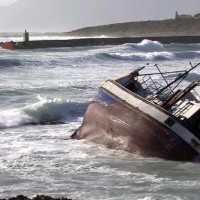
shipwreckSounds like the Wreck of the Edmond Fitzgerald on Nov 10, 1975. Gordon Lightfoot was every bit the story teller that Luke is.

  • The wind in the wires made a tattle-tale sound
  • as a wave broke over the railing
  • And every man knew, as the captain did too,
  • T’was the witch of November come stealin’
  • The dawn came late and the breakfast had to wait
  • When the gales of November came slashin’
  • When afternoon came it was freezin’ rain
  • In the face of a hurricane west wind
  • When suppertime came, the old cook came on deck
  • sayin’ Fellas, it’s too rough to feed ya
  • At seven pm a main hatchway caved in,
  • he said Fellas, it’s been good t’know ya
  • The captain wired in he had water comin’ in
  • And the good ship and crew was in peril
  • And later that night when his lights went outta sight
  • Came the wreck of the Edmund Fitzgerald
  • Does anyone know where the love of God goes
  • When the waves turn the minutes to hours?
  • The searchers all say they’d have made Whitefish Bay
  • If they’d put fifteen more miles behind her
  • They might have split up or they might have capsized
  • They may have broke deep and took water
  • And all that remains is the faces and the names
  • Of the wives and the sons and the daughters

Here’s Luke telling of their journey, not with the sad ending of the Edmund Fitzgerald because why??? Paul was on board. And unlike the story of Jonah we heard in our Scripture reading this morning, Paul is not at fault. He’s not running from the Lord. He’s trusting. Oh, is he trusting!

18 We took such a violent battering from the storm that the next day they began to throw the cargo overboard. 19 On the third day, they threw the ship’s tackle overboard with their own hands. 20 When neither sun nor stars appeared for many days and the storm continued raging, we finally gave up all hope of being saved.

But here is Paul. Trusting! Not so much saying I told you so. But with encouragement and practical solutions.  Paul believed God and God would get them through it…together. Maybe not with their ship, but with the lives that mattered.

21 After the men had gone a long time without food, Paul stood up before them and said: “Men, you should have taken my advice not to sail from Crete; then you would have spared yourselves this damage and loss. 22 But now I urge you to keep up your courage, because not one of you will be lost; only the ship will be destroyed. 23 Last night an angel of the God whose I am and whom I serve stood beside me 24 and said, ‘Do not be afraid, Paul. You must stand trial before Caesar; and God has graciously given you the lives of all who sail with you.’

The lives of everyone mattered to God just as they had in the Jonah story. And how beautiful is it that God shares this encouragement with men who are scared out of their wits and fearing their end. Because Paul loves God and God loves Paul, here’s God’s encouragement spoken through an angel: God has graciously given you the lives of all who sail with you.

25 So keep up your courage, men, for I have faith in God that it will happen just as he told me. 26 Nevertheless, we must run aground on some island.” 27 On the fourteenth night we were still being driven across the Adriatic Sea, when about midnight the sailors sensed they were approaching land. 28 They took soundings and found that the water was a hundred and twenty feet deep. A short time later they took soundings again and found it was ninety feet deep. 29 Fearing that we would be dashed against the rocks, they dropped four anchors from the stern and prayed for daylight.

Do you ever feel that way? You don’t know what to do, where to turn, or what to think? Drop some anchors and pray for daylight? Praying that even though it’s darkest before the dawn somehow that you can have enough faith the dawn will come and it’ll be a new day?

Not everyone responds favorably to the encouragement. Some try to save themselves anyway…in spite of God’s gracious promise. Not that much different than the gift of salvation itself. Everyone with Paul would be spared, but some didn’t want to depend on someone else. It’s how, frankly, a lot of people will be regarding Jesus. They’ll want their own way, their own lifeboat, their own control, and to command their own destiny….all the way to their demise. If ya’ aren’t with Jesus, you aren’t saved. And in our passage today, if you’re not with Paul, you’re going down.

30 In an attempt to escape from the ship, the sailors let the lifeboat down into the sea, pretending they were going to lower some anchors from the bow. 31 Then Paul said to the centurion and the soldiers, “Unless these men stay with the ship, you cannot be saved.”

There ya’ go. What a great pattern of deliverance! No one saves himself. It takes doing things God’s way. And God’s way was going to be deliverance through the stormy seas. “Unless these men stay with the ship, you cannot be saved.”

32 So the soldiers cut the ropes that held the lifeboat and let it fall away. 33 Just before dawn Paul urged them all to eat. “For the last fourteen days,” he said, “you have been in constant suspense and have gone without food– you haven’t eaten anything. 34 Now I urge you to take some food. You need it to survive. Not one of you will lose a single hair from his head.” 35 After he said this, he took some bread and gave thanks to God in front of them all. Then he broke it and began to eat. 36 They were all encouraged and ate some food themselves. 37 Altogether there were 276 of us on board. 38 When they had eaten as much as they wanted, they lightened the ship by throwing the grain into the sea.

I’ve gotta believe that Paul’s encouragement, the angel’s words of encouragement, and ultimately God’s encouragement might have prompted a few to believe in God…to want to know this God whom Paul trusted with his very life. Testimony often happens best in the test.

39 When daylight came, they did not recognize the land, but they saw a bay with a sandy beach, where they decided to run the ship aground if they could. 40 Cutting loose the anchors, they left them in the sea and at the same time untied the ropes that held the rudders. Then they hoisted the foresail to the wind and made for the beach. 41 But the ship struck a sandbar and ran aground. The bow stuck fast and would not move, and the stern was broken to pieces by the pounding of the surf. 42 The soldiers planned to kill the prisoners to prevent any of them from swimming away and escaping. 43 But the centurion wanted to spare Paul’s life and kept them from carrying out their plan. He ordered those who could swim to jump overboard first and get to land. 44 The rest were to get there on planks or on pieces of the ship. In this way everyone reached land in safety.

Sometimes, it doesn’t matter how you get there. Jumping overboard, swimming and being the first to get to land. Some will be grasping planks, pieces of the ship, and being carried ashore by wind and wave. Everyone reached land in safety…because they did things God’s way.

So, today is the first Sunday of Advent. The world is in a world of trouble…not all that different from the turmoil that existed when Jesus arrived as a baby in a manger. For 33 years, He’d live among us, face the same world of trouble that we’d know, and yet, He knew the Cross was why He was sent. Apart from Jesus, we’re a shipwrecked people trying to lower our own lifeboats which would capsize and crash. But with Jesus, we may still be a shipwrecked people, but ones who can all reach the other side in safety. Because we’re with Him and God is faithful.

As you spend the next 4 weeks of Advent preparing your heart for the coming of the Christ Child, remind yourself that Jesus doesn’t care whether you come to Him by swimming or barely holding onto His Word in prayer with white knuckles and trembling knees. Just stick with Him. He’ll get you there. It’s why He came. Let’s pray.


Continue Reading

Shipwrecked–audio version

The last of the sermons from the Book of Acts at Plymouth Congregational Church of Racine, WI, will be included along with the Advent Devotionals for the next 2 weeks.

Our narrator Luke tells us of the shipwreck as the Apostle Paul was being transferred from prison in Caesarea to Rome.  It’s a great story that Luke tells in gripping detail.  This message was first preached at Plymouth Congregational Church of Racine, WI on November 29, 2015 by Barbara Shafer.

Continue Reading

Prophesied Incarnation-Advent 2 (2015)

Why Incarnation? Why not some other way?

Well, the truth is, there was no other way possible.

Today, we’ll look at the first of the reasons why it was the only possibility. The first hint of the Incarnation—the first occurrence of the Gospel in the Bible—was proclaimed, prophesied to mankind.  But it was also a shot across the bow to the serpent all the way back in Genesis 3:15 “And I will put enmity between you and the woman, and between your offspring and hers; he will crush your head, and you will strike his heel.”

Prophesied IncarnationAdam and Eve used to be in the Garden of Eden, naked as the day they were created. But then they disobeyed God, they rebelled against Him and they reaped the consequences that God told them ahead of time were going to happen.

Boom. Mortality.

Genesis 2:16 And the LORD God commanded the man, “You are free to eat from any tree in the garden; 17 but you must not eat from the tree of the knowledge of good and evil, for when you eat of it you will surely die.”

Once mortality happens, there’s no going back. Not even for God. There’s no rewind, do over, replay, or sending the video up to a booth for an official review. Why? Because God saw the play, the promised consequences happened (cause and effect!), and now Adam and Eve are mortals with a sin nature and they die. They surely die. While it may mean the end of their lives, it’s surely not the end of our story.

Hope is as sure as God’s promise…which is as sure as it gets. Why?

Boom. Love.

God enters the picture with a promise—a prophecy—telling humanity that there’s hope for their mortality. Sure, we aren’t going to like death—most people hate and fear the very idea at least of our own death—but eventually God will send a seed, an offspring of humanity, but not through Adam. Through Eve. This promised Messiah will defeat death.

Romans 5: 8 But God demonstrates his own love for us in this: While we were still sinners, Christ died for us. ..12 Therefore, just as sin entered the world through one man, and death through sin, and in this way death came to all men, because all sinned– 13 for before the law was given, sin was in the world. But sin is not taken into account when there is no law. 14 Nevertheless, death reigned from the time of Adam to the time of Moses, even over those who did not sin by breaking a command, as did Adam, who was a pattern of the one to come. 15 But the gift is not like the trespass. For if the many died by the trespass of the one man, how much more did God’s grace and the gift that came by the grace of the one man, Jesus Christ, overflow to the many!

Thought for the day: Jesus, the prophesied seed of the woman, needed to become incarnated (God with us!) as the only way to overcome human mortality.

Questions for reflection:

  1. Read all of Romans 5. Why is God’s action more than enough to overcome the action of one man named Adam? Both had lasting consequences. Why are the actions of Messiah eternal whereas Adam’s consequences only last until death?
  2. Why was the seed prophesied to be from the woman Eve and not Adam?
  3. In Romans 5, why does the Apostle Paul say the law was useful but not effective in saving anyone?

======

Incarnation (2015 Advent Devotional Series) began November 29th.  By way of reminder, if you haven’t signed up yet, you can receive these devotional studies in your email throughout Advent 2015 by entering your email address on the SeminaryGal.com home page in the space provided in the sidebar.  Or “Like” the SeminaryGal Facebook page to access them there.  If you like these devotionals, I’d really appreciate your letting others know so I can continue to spread the Good News far and wide.  Blessings to you, in Christ always, Barbara <><

Continue Reading

Incarnation Defined-Advent 1 (2015)

In the musical The Sound of Music Fraulein Maria sings Do Re Mi which starts with “Let’s start at the very beginning. A very good place to start.” Which is really kind of a no-brainer even if it does make for a cute song with 7 children dressed in drapes.

Incarnation definedLet us start at the very beginning:

What is the Incarnation?

The word itself is derived from the late Middle English: from ecclesiastical Latin incarnat– ‘made flesh,’ from the verb incarnare, from in– ‘into’ + caro, carn– ‘flesh.’ “Embody or represent (a deity or spirit) in human form.” That’s what the Oxford dictionary says which hardly does the concept justice!

If that was the case, the sea witch in Disney’s The Little Mermaid movie would have been “incarnated” as Ursula the adversary of Ariel—a witch who first bargains for Ariel’s voice and then sends her speechless to the prince before Ursula’s becoming human herself as she competes against Ariel to be the prince’s bride.

Incarnation? This is not just a spirit taking human form…a witch or a mermaid getting some legs.

Some people refer to the Incarnation as “God with flesh on”…which also misses the point to some extent with respect to the miraculous nature of it. Jesus was incarnated as more than God’s coat, skin deep.

Throughout the centuries, the church fathers have tried to nail down what the Incarnation was and how that whole Triune Godhead-thing works. They had an easier time identifying what it was NOT.

  • They concluded that Jesus did not go into a different phase like H20 can be steam, water, and ice depending on the environment and circumstances.
  • They concluded that Jesus did not simply enter a different season (i.e. pre-flesh, flesh, and post-flesh) on a timeline where He ceased to be God during that flesh season when He was somehow a created being and not God.
  • They concluded that Jesus didn’t morph like an egg becomes a caterpillar, makes a chrysalis, and becomes a butterfly. His divinity never developed. He didn’t become God as a function of maturation.
  • They concluded the Incarnation wasn’t a mirage, a magic trick, a hologram, or other masquerade of just pretending to be a real man.

Theologian Robert Reymond describes the Incarnation this way: Without ceasing to be all that he was and is as the Second Person of the Holy Trinity, the eternal Son of God took into union with himself in the one divine Person that which he had not possessed before—even a full complex of human attributes—and became fully and truly man for us men and for our salvation. Jesus of Nazareth was and is that God-man.

Yeah. Theologians write that way. All this to say: Jesus is, was, will be, and always has been God. During the time frame of His earthly ministry, He added (to His already full divinity) a full humanity —a perfect humanity by which He would save us and a perfect humanity that He would retain after His death and resurrection. All the while being fully God.

If you’re like “Wow! That’s amazing!” yes, it is. And we’re just getting started. For now, ponder this thought and reflect on the questions below.

Thought for the day: The Gospel writer John says it this way: John 1:1 In the beginning was the Word, and the Word was with God, and the Word was God. 2 He was with God in the beginning.

Questions for reflection:

  1. Consider each part of John 1:1-2. Why is each phrase important?
  2. Look back over what the Incarnation is NOT and ponder why it’s an important distinction.
Continue Reading

Looking Back-sermon text version

Looking as God calls meThis is the season of Thanksgiving—a natural time for reflecting and remembering with gratitude all the blessings in your recent history.

What do you see when you look back over the past year or years? Is your heart filled with gratitude or do you have other thoughts about your life?

Today, we’ll see some looking back in the life of Paul who you will remember was falsely imprisoned these last 2 years. The last thing one would expect when Paul looks back would be gratitude…but I get ahead of myself.

Acts 25:13 A few days later King Agrippa and Bernice arrived at Caesarea to pay their respects to Festus. 14 Since they were spending many days there, Festus discussed Paul’s case with the king. He said: “There is a man here whom Felix left as a prisoner. 15 When I went to Jerusalem, the chief priests and elders of the Jews brought charges against him and asked that he be condemned. 16 “I told them that it is not the Roman custom to hand over any man before he has faced his accusers and has had an opportunity to defend himself against their charges. 17 When they came here with me, I did not delay the case, but convened the court the next day and ordered the man to be brought in. 18 When his accusers got up to speak, they did not charge him with any of the crimes I had expected. 19 Instead, they had some points of dispute with him about their own religion and about a dead man named Jesus who Paul claimed was alive.

Looking back over the situation, Festus sees unfinished business from 2 years ago. Governor Felix had left him with a loose end—a falsely imprisoned Paul. And looking back over it, Festus totally gets it that Paul is under arrest because of his belief in Jesus Christ and the Resurrection.

20 I was at a loss how to investigate such matters; so I asked if he would be willing to go to Jerusalem and stand trial there on these charges. 21 When Paul made his appeal to be held over for the Emperor’s decision, I ordered him held until I could send him to Caesar.”

Festus places his own actions in the best light possible and acknowledges to King Agrippa that Festus is not well equipped to think about Jewish stuff. Instead of saying that Roman law didn’t really address Jewish law and freeing Paul, (and risk getting the Jewish faction in Caesarea all riled up for more of the same kind of revolt that undid Felix before him) Festus looks back and explains away his role in perpetuating this injustice. He didn’t know what to do…or have the moral courage to do it if he did…so what do you do when you don’t know what to do? Delay, do nothing, and hope the situation goes away. Festus was no doubt relieved that Paul appealed to Caesar.

What a stroke of luck to be able to pass the buck! It reminds me of the scene in White Christmas where Wallace and Davis and the Haynes sisters are singing “Gee, I wish I was back in the army… to encourage General Waverly who was also looking back at the glory days of military life.

  • When I was mustered out
  • I thought without a doubt
  • That I was through with all my care and strife
  • I thought that I was then
  • The happiest of men
  • But after months of tough civilian life
  •  
  • Gee, I wish I was back in the Army
  • The Army wasn’t really bad at all
  • Three meals a day
  • For which you didn’t pay
  • Uniforms for winter, spring and fall
  •  
  • There’s a lot to be said for the Army
  • The life without responsibility
  • A soldier out of luck
  • Was really never stuck
  • There’s always someone higher up where you can pass the buck
  • Oh, gee, I wish I was back in the Army

Festus was looking back and not so much grateful as relieved. He was off the hook. He passed the buck on up to the next level.

22 Then Agrippa said to Festus, “I would like to hear this man myself.” He replied, “Tomorrow you will hear him.”

23 The next day Agrippa and Bernice came with great pomp and entered the audience room with the high ranking officers and the leading men of the city. At the command of Festus, Paul was brought in. 24 Festus said: “King Agrippa, and all who are present with us, you see this man! The whole Jewish community has petitioned me about him in Jerusalem and here in Caesarea, shouting that he ought not to live any longer. 25 I found he had done nothing deserving of death, but because he made his appeal to the Emperor I decided to send him to Rome. 26 But I have nothing definite to write to His Majesty about him. Therefore I have brought him before all of you, and especially before you, King Agrippa, so that as a result of this investigation I may have something to write. 27 For I think it is unreasonable to send on a prisoner without specifying the charges against him.”

Passing the buck had just one little problem. What to state on the governmental form regarding the charges. I wonder what Paul thought of this. Looking back, Festus even declares to Agrippa, his sister Bernice–the whole pomp and circumstance crowd—that Festus found he had nothing to put on the form. Paul, after all, was innocent.

In light of Festus’ statement, did Paul suddenly look back and wish he hadn’t appealed to Caesar? No. Because promised Rome was ahead. “As you have testified before the Jews, so also you must testify in Rome.” Looking back for Paul was not for the purpose of justification or regret. Looking back was only to remember with gratitude.

What about you? What do you think about at Thanksgiving? Or on any other day really? What do you see when you look back? I hope it’s gratitude.

Acts 26:1 Then Agrippa said to Paul, “You have permission to speak for yourself.” So Paul motioned with his hand and began his defense: 2 “King Agrippa, I consider myself fortunate to stand before you today as I make my defense against all the accusations of the Jews, 3 and especially so because you are well acquainted with all the Jewish customs and controversies. Therefore, I beg you to listen to me patiently.

“I consider myself fortunate,” Paul says. Wow! He’s been a prisoner for 2 years and counting. He’s outlasted one governor and stymied a second one. What does Paul see when he looks back? Gratitude for all of life’s circumstances—both good and difficult—given by the hand of the same God. And it reminds us that God who is good…is all about redemption. And no one is redeemed out of paradise. Cutting short the vacation at the beach is not the same as being delivered out of hardship. Paul was grateful for it all.

He looks back and remembers where he’d been and what he was. Paul was grateful to be able to share his testimony once again (the 3rd time in Acts):

4 “The Jews all know the way I have lived ever since I was a child, from the beginning of my life in my own country, and also in Jerusalem. 5 They have known me for a long time and can testify, if they are willing, that according to the strictest sect of our religion, I lived as a Pharisee. 6 And now it is because of my hope in what God has promised our fathers that I am on trial today. 7 This is the promise our twelve tribes are hoping to see fulfilled as they earnestly serve God day and night. O king, it is because of this hope that the Jews are accusing me. 8 Why should any of you consider it incredible that God raises the dead? 9 “I too was convinced that I ought to do all that was possible to oppose the name of Jesus of Nazareth. 10 And that is just what I did in Jerusalem. On the authority of the chief priests I put many of the saints in prison, and when they were put to death, I cast my vote against them. 11 Many a time I went from one synagogue to another to have them punished, and I tried to force them to blaspheme. In my obsession against them, I even went to foreign cities to persecute them. 12 “On one of these journeys I was going to Damascus with the authority and commission of the chief priests. road sun13 About noon, O king, as I was on the road, I saw a light from heaven, brighter than the sun, blazing around me and my companions. 14 We all fell to the ground, and I heard a voice saying to me in Aramaic, ‘Saul, Saul, why do you persecute me? It is hard for you to kick against the goads.’ 15 “Then I asked, ‘Who are you, Lord?’ “‘I am Jesus, whom you are persecuting,’ the Lord replied. 16 ‘Now get up and stand on your feet. I have appeared to you to appoint you as a servant and as a witness of what you have seen of me and what I will show you. 17 I will rescue you from your own people and from the Gentiles. I am sending you to them 18 to open their eyes and turn them from darkness to light, and from the power of Satan to God, so that they may receive forgiveness of sins and a place among those who are sanctified by faith in me.’ 19 “So then, King Agrippa, I was not disobedient to the vision from heaven. 20 First to those in Damascus, then to those in Jerusalem and in all Judea, and to the Gentiles also, I preached that they should repent and turn to God and prove their repentance by their deeds. 21 That is why the Jews seized me in the temple courts and tried to kill me. 22 But I have had God’s help to this very day, and so I stand here and testify to small and great alike. I am saying nothing beyond what the prophets and Moses said would happen– 23 that the Christ would suffer and, as the first to rise from the dead, would proclaim light to his own people and to the Gentiles.”

Paul has looked back over his childhood, his upbringing, his early career and this life-changing encounter with Jesus—a life-giving, life-changing event! And I love Paul’s attitude. “I have had God’s help to this very day, and so I stand here and testify to small and great alike.” It’s looking back with gratitude at all the right things. He wasn’t grateful for his pedigree or his zealous persecution of Christians. He was grateful that in spite of all that, Jesus rescued him and had mercy upon him. And grace beyond that! Instead of punishment for all that persecuting, Jesus gave him the most fruitful missionary work of any human being to walk the planet apart from Jesus Himself.

If the definition of justice is getting what we deserve, and mercy is not getting what we deserve, then grace—that unmerited favor—is getting what we do not deserve in place of what we should have gotten. Paul understood grace because it had changed his life in radical ways.

It’s interesting that Paul states before King Agrippa who was familiar with Jewish sects in a Roman world that Jews and Gentiles alike (who BTW were grumbling against each other in Caesarea) were to be united in receiving this grace of God. You want healing of the races, of communities, demographics, or of ethnic groups? Give them the Gospel! The Gospel unites what Satan tears apart.

Festus might not have known the details of theology and argument, but he already knew that this whole Jew-Gentile thing got his predecessor in trouble so:

24 At this point Festus interrupted Paul’s defense. “You are out of your mind, Paul!” he shouted. “Your great learning is driving you insane.”

25 “I am not insane, most excellent Festus,” Paul replied. “What I am saying is true and reasonable. 26 The king is familiar with these things, and I can speak freely to him. I am convinced that none of this has escaped his notice, because it was not done in a corner. 27 King Agrippa, do you believe the prophets? I know you do.”

Paul goes for the spiritual jugular. Do you believe the prophets? There is more contained in that question than just a yes or no answer. Do you believe the prophets? If you do and I know you do, then do you believe what the prophets said would happen? Sure you do! Then take the next step: I want you see that Jesus is the foretold Messiah.

28 Then Agrippa said to Paul, “Do you think that in such a short time you can persuade me to be a Christian?”

He evaded answering the question and responded with a question of his own. He could see exactly what Paul was asking. Agrippa probably had a very uneasy spirit knowing what Paul said was true and the finger of Jesus was pressing in on Agrippa’s heart with the invitation to receive Him.

Revelation 3:20 Here I am! I stand at the door and knock. If anyone hears my voice and opens the door, I will come in and eat with him, and he with me.

Jesus was knocking. Agrippa needed to open the door. Paul even says so.

29 Paul replied, “Short time or long– I pray God that not only you but all who are listening to me today may become what I am, except for these chains.”

All who are listening today is not just referring to Agrippa and Bernice and Festus and a few court officials. Paul’s testimony is told 3 times in Acts so that you will listen. I will listen. We will hear Jesus knocking and open the door. That we would be Christians and become what Paul was…except, hopefully, for the chains of prison.

30 The king rose, and with him the governor and Bernice and those sitting with them. 31 They left the room, and while talking with one another, they said, “This man is not doing anything that deserves death or imprisonment.” 32 Agrippa said to Festus, “This man could have been set free if he had not appealed to Caesar.”

They all knew Paul wasn’t doing anything deserving of death…deserving of imprisonment. To them Paul could have been set free. But it wasn’t a guarantee even if Paul hadn’t appealed to Caesar. Could have. Not would have. But looking back, they experienced a bit of conviction at the imprisonment of an innocent man. The knocking on the door by Jesus and at this point, at least, they only look back and see that Paul ought to regret his decision to go to Rome. Hindsight, looking back as 20/20 vision, the choices from Agrippa’s and Festus’ perspective would have been Paul could appeal to Caesar or be free. But that assumes a lot. Not the least of which is that the government would have the moral courage to do what was right.

To them, Paul’s 20/20 hindsight ought to bring regret. Paul, however, looks back with gratitude. He knows he’s a sinner saved by grace.

He knows what he deserved in terms of wrath and justice from God. He knows that Jesus is real and alive and not only delivered him from that wrath, but Jesus paid it Himself with His very own blood at the cross. And then Jesus gave Paul a ministry second only to His own. Amazing! Looking back, how can there be regrets? Paul is grateful for grace and purpose.

There’s a lesson here for you and me as well. Do you have a problem? Paul did. But like Paul we can find some gratitude in it. Praising and thanking God will go much farther to solving it than regrets, grudges, bitterness, resentment, or taking revenge.

And gratitude needs to be more than a once a year deal accessorized by a turkey and accompanied by football. Looking ahead, Thanksgiving ought to be our daily heart condition as we reflect upon all that God has done for us.

Looking ahead, Paul sees Rome in the distance and it’s assured because God promised it. And there’s purpose for him in going to Rome. More testimony before small and great alike!   Looking back, Paul sees no regrets. Only gratitude for deliverance, mercy and purpose…as God’s amazing grace.

Let’s pray.

 

Continue Reading

Advent Devotionals Begin November 29, 2015

incarnation announcement* * *
We’re counting down 10 days until
the 2015 Advent Devotional Series
entitled Incarnation begins. 
* * *

If you haven’t signed up yet, you can receive these devotional studies in your email throughout Advent 2015 by entering your email address on the SeminaryGal.com home page in the space provided in the sidebar.  Or “Like” the SeminaryGal Facebook page to access them there.

The devotionals will come automatically along with the remaining sermons from Plymouth Church in Racine and perhaps an occasional gardening post.

 * * *

carol me christmasIt has come to my attention that some of you are still excited about last year’s devotionals entitled Carol Me, Christmas!  Yes, it was a fun series!  If you’d prefer those devotionals, you’ll find them in the sidebar archives beginning November 2014.  The announcement was http://seminarygal.com/carol-me-christmas-advent-2014-devotional-series/.  It will require a bit more work to access them, but I know you hymn-folks don’t mind a bit of work.  It put a song in the heart of many of us all through Advent last year!  🙂


As long as I was going down memory lane, I located the first one in the 2013 series When Love Showed Up In-Person. It can be found in the archives beginning December 2013  http://seminarygal.com/advent-begins-2013/ .

The Advent season as told through the Gospel of Luke began back in December 2012 with this one http://seminarygal.com/advent-1-2012-expecting-the-unexpected/ and is contained in the archives as well.

I love writing these devotionals for both Advent and Lent.  I hope this year’s Incarnation series blesses you with a deeper and more meaningful Advent season to make your Christmas truly merry!  In His grace, Barbara <><

Continue Reading