Seminary Gal’s Local Update

Dear friends, as my time as preaching pastor at Plymouth Congregational Church of Racine (WI) winds down, God is moving me into a new volunteer ministry based on Romans 13:10:

Romans 13:10 Love does no harm to its neighbor. Therefore love is the fulfillment of the law.

As I ponder why God would have me assist my neighbors with storm water management concerns, I am reminded that if pastors cannot take Biblical principles and have them apply to civic duty and daily life, then they ought not to stand at a pulpit to preach.

You can visit the Facebook page for the Des Plaines Watershed efforts in Libertyville at https://www.facebook.com/MyNeighborInLibertyville/

I have decided to take Jesus’ discussion of the Good Samaritan to heart.  The expert in the law asks, “And who is my neighbor?” Jesus responds with a question: “Which of these three do you think was a neighbor to the man who fell into the hands of robbers?”  Then the expert replied, “The one who had mercy on him.”

Jesus told him, “Go and do likewise.”

So I am.  Being a neighbor to others sometimes takes on a very practical side and a servant of God does not despise servant’s work…even if it involves sewers.

I’ll still be here writing devotionals even if Sunday will be my last sermon for a while.

in His grace and for His glory,

Barbara <><

Continue Reading

Incarnation-Jesus’ Humility on Display-Advent 12 (2015)

humility on displayImagine for a moment that you created something.
You designed it. You planned it.

You gave this perfect thing to someone else and they broke it. And they considered it worthless, broken, and nothing but junk to be discarded. Or maybe they decided to worship it.

It was a created thing not a god and yet, people are worshiping this broken idol when you’re the brains behind it.

And they don’t care a whit for you.

* * *

Jesus was the Creator of this world, the Giver of the Law, the author and perfecter of our faith and what do we do?

  • Many people deny God’s creative power shown in Jesus Christ. They put legs on a fish symbol and put Darwin’s name in the middle. They believe this marvelous universe just happened by good luck or random chance.
  • Many people deny the Bible as God’s Word. They pick and choose what they want to believe. As self-appointed gods, they put their own spin on verses they don’t like or that don’t fit with the modern era as they see it. They are gods, judges, and juries over what laws to obey and which to ignore.
  • Many people deny that Jesus is God and instead worship other so-called gods, idols, the environment or created things. Or worship themselves since there are no other gods they’re willing to worship.

How humiliating for Jesus Christ to be born under the Law He’d given to us! The Word made flesh! How humiliating that the Creator of all and the Giver of the Law would set that glory aside and suddenly be subject to it just as we are! That’s what happened in the Incarnation.  It was Jesus’ humility on display.

Galatians 4: 4 But when the time had fully come, God sent his Son, born of a woman, born under law, 5 to redeem those under law, that we might receive the full rights of sons. 6 Because you are sons, God sent the Spirit of his Son into our hearts, the Spirit who calls out, “Abba, Father.” 7 So you are no longer a slave, but a son; and since you are a son, God has made you also an heir.

Thought for the day: Jesus came, born under the very Law He gave us—and lived it in perfect humility—so that we’d be able to inherit eternal life as true children of our Father in heaven.

Questions for reflection:

  1. What might be some reasons people deny the Incarnation—that Jesus came as God with us, Emmanuel?
  2. Thinking about Jesus as the Creator of the heavens and earth and also as the One who blessed Adam and Eve. How should we let this knowledge shape our view of the environment and our care for it?
  3. What is the distinction between caring for creation and worshiping it?
  4. What separates being law-abiding from law worshiping?
  5. Ponder those questions regarding issues of trust, pride, control, and idolatry.

======

Incarnation (2015 Advent Devotional Series) began November 29th.  By way of reminder, if you haven’t signed up yet, you can receive these devotional studies in your email throughout Advent 2015 by entering your email address on the SeminaryGal.com home page in the space provided in the sidebar.  Or “Like” the SeminaryGal Facebook page to access them there.  If you like these devotionals, I’d really appreciate your letting others know so I can continue to spread the Good News far and wide.  Blessings to you, in Christ always, Barbara <><

Continue Reading

Setting the Record Straight-sermon text version

For those of you signed up for devotionals, there will be one more sermon from Plymouth Church after this one on Acts 28:1-10 titled, “Setting the Record Straight” even while the daily devotionals continue for Advent.

* * *

Misunderstanding might be our national pastime. We misunderstand each other, our circumstances, our identities, affiliations, and priorities. Sometimes the misunderstandings seem to be intentional like with the killers in San Bernardino and a stubborn official refusal to believe that a terrorist ideology was behind it—that what was in their heads and hearts had anything to do with what they had in their hands and the carnage they committed with it. Sometimes the misunderstandings are unintentional and sometimes they just happen because we get sloppy with our facts and figures…or our Scriptures.

crosscollageToday’s passage of Scripture combined with a few others in the Bible, can lead us to places we don’t want to go, if we get sloppy.
So, let’s spend some time today setting the record straight.

Paul and his companions last week you’ll remember were having a rough sea journey and ended up with all 276 aboard becoming castaways on an island. The Alexandrian grain ship being used for transporting the passengers, including prisoners like Paul, ended up hitting a sandbar and the pounding surf broke the ship apart. All 276 made it to shore safely whether by swimming or clinging to debris from the ship.

The island, we find out today, is called Malta. The island of Malta is actually one of 3 islands in the Maltese archipelago in the Mediterranean. If you think of Italy as a boot and Sicily as being kicked by the boot, Malta is about 1/ 4 of the way from the bottom of Sicily to Libya. They were far south of their target of Rome because of that nor’easter driving them off their planned course.

Fortunately, the islanders were not only friendly, but went above and beyond with kindness.

Acts 28:1 Once safely on shore, we found out that the island was called Malta. 2 The islanders showed us unusual kindness. They built a fire and welcomed us all because it was raining and cold.

The islanders, literally barbarians, didn’t speak Greek which is why they were considered barbarians. Let’s set the record straight: just because someone doesn’t speak your language or is a stranger to you doesn’t mean they don’t know how to be kind. These barbarians were immensely practical as well. They built a fire—the winter season of cool rainy weather (think November or March for us)—was upon them and they’d need warmth to survive and to dry out from having come ashore.

Paul, we’ve mentioned before, was the kind of person who made friends wherever he went. And we know he was smart, but let’s set the record straight: he was also a hard-working man. You can’t say that about all theologians and pastors.

Paul was a tent-maker and used to working with his hands. He wasn’t just some smart guy who spent his time in a book and refused to get his hands dirty. Paul knows that without firewood the fire wouldn’t last so he pitched right in. He’s not like on Gilligan’s Island where the Skipper and Ginger and the Howells never seem to do much. The professor is often doing brainy things with gadgets instead of working on, say, a life raft and all the work is left to Mary Ann and Gilligan who was a notorious goof ball and screw-up. No wonder they weren’t rescued for 98 episodes over 3 years. Poor Mary Ann was doing just about everything, but that’s ok because she was a farm girl and was used to it. Paul was used to hard work too.

3 Paul gathered a pile of brushwood and, as he put it on the fire, a viper, driven out by the heat, fastened itself on his hand.

And now we begin the items that people misunderstand.

First, there was a “viper” and there are still vipers on Malta, but none of them are poisonous. Some people misunderstand thinking this proves the Bible isn’t true. Maybe there used to be poisonous ones but they were eradicated. No one knows. All we can do is take Luke’s word for how the islanders reacted. Luke was thoroughly accurate in his description of the sea journey, why start lying over a snake? Let’s just trust that there’s a good answer for this misunderstanding.

4 When the islanders saw the snake hanging from his hand, they said to each other, “This man must be a murderer; for though he escaped from the sea, Justice has not allowed him to live.”

Second misunderstanding. The islanders assume Paul is a murderer. Justice, a Greek goddess named Nemesis, comes around to bite you. What goes around comes around and Paul must be a murderer. Ah, but..

5 But Paul shook the snake off into the fire and suffered no ill effects.

Here’s another misunderstanding. This one is attached to none other than the disciple Mark of Mark’s Gospel…the Mark who deserted Paul way back when and became as a son to Paul in his final days. The disputed final chapter of Mark says,

Mark 16:14 Later Jesus appeared to the Eleven as they were eating; he rebuked them for their lack of faith and their stubborn refusal to believe those who had seen him after he had risen. 15 He said to them, “Go into all the world and preach the good news to all creation. 16 Whoever believes and is baptized will be saved, but whoever does not believe will be condemned. 17 And these signs will accompany those who believe: In my name they will drive out demons; they will speak in new tongues; 18 they will pick up snakes with their hands; and when they drink deadly poison, it will not hurt them at all; they will place their hands on sick people, and they will get well.” 19 After the Lord Jesus had spoken to them, he was taken up into heaven and he sat at the right hand of God. 20 Then the disciples went out and preached everywhere, and the Lord worked with them and confirmed his word by the signs that accompanied it.

This viper and deadly poison thing is not a litmus test for true Christianity. I’d strongly recommend against picking up poisonous snakes (for that matter, any snakes) with your hands or drinking deadly poison just to test out the theory. Maybe Paul did the viper thing, but it was purely unintentional. He thought it was a stick because it was so cold and it wasn’t until being brought closer to the fire that it moved. So yes, Paul had a viper stuck on his hand and he shook it off into the fire and he was fine. But the Holy Spirit is proof that Paul is a Christian, not some snake-on-the-hand-is-worth-two-in-the-fire thing.

But it only made way for more misunderstanding:

6 The people expected him to swell up or suddenly fall dead, but after waiting a long time and seeing nothing unusual happen to him, they changed their minds and said he was a god.

OK, this may be where the Ewoks and C-3PO did a little biblical reenactment. But the Bible is true and Star Wars, even the third in the trilogy, was just a box office success. The islanders think that Paul is a god. While Luke doesn’t tell us explicitly that Paul disputed that notion, Luke has already set the record straight on that one way back in

Acts 14:11 When the crowd saw what Paul had done, they shouted in the Lycaonian language, “The gods have come down to us in human form!”

Paul, as you may remember, stated that he and Barnabas were just men! This is an instance in which silence doesn’t mean that Paul conferred godhood on himself. Paul’s track record was already established (been there, done that) and Luke had something else he wanted to highlight on the island of Malta. Luke wanted to emphasize a healing ministry.

7 There was an estate nearby that belonged to Publius, the chief official of the island. He welcomed us to his home and for three days entertained us hospitably. 8 His father was sick in bed, suffering from fever and dysentery. (you can tell it’s physician Luke writing this) Paul went in to see him and, after prayer, placed his hands on him and healed him. 9 When this had happened, the rest of the sick on the island came and were cured.

There was a whole lot of healing going on…and while Luke was a physician and no doubt had a role in that, it’s important to see that Paul went in. Paul prayed. Paul placed his hands on this islander and God supplied healing through Paul and probably Luke also. Here’s something of Luke’s interests and vocation peeking through the text…kind of like his watermark authenticating these words as being those of a physician…and of the Holy Spirit through a physician.

Moreover, there’s something to be said for practical ministry. So let’s set the record straight. It’s not just about going to church and sitting in a pew. Remember Tabitha, also called Dorcas? A servant lifestyle communicates great things to a watching world in which so many people are watching out for #1 only. They witnessed, they came, and they were cured. It probably led to some conversion as well. Practical ministry has spiritual benefit!

I’ve been praying about what God will have me do when Acts is finished here. God has a strange way of answering prayers. If the past week is any indication, my next “ministry” may be as an unpaid volunteer doing storm water management and watershed conservation advocacy. When Warren and I were walking and talking about this and how ill-equipped I feel about doing it and how I really don’t want to do it, Warren asked, “Does a servant of the Lord do what she wants or what God desires and expects?” I coulda slugged him. God gives us spouses so we can be hit upside the head with truth that hurts and we’ll still love and be loved. Servant work is rarely glamorous or sexy…and oftentimes it’s not particularly satisfying work on its own. It’s who you’re serving—God Himself—that makes the work a joy.

So it was with Paul. Whether he was preaching or teaching or collecting firewood or making tents or healing people with dysentery, let’s set the record straight: Paul had a servant’s heart.

So the barbarians…at the end of all this,

10 They honored us in many ways and when we were ready to sail, they furnished us with the supplies we needed.

The generosity, the welcoming, the caring, were a gift during the winter, but the kindness of the barbarians supplying everything that these 276 people needed to make the journey by sea—including a ship that had overwintered on the island—was honor upon honor. The captain, the crew, Julius and the officials, the prisoners including Paul, Luke and the other passengers would set sail with everything they needed to get from port to port and eventually to Rome.

So what’s our take home from today? I’d like to encourage you in 3 ways:

  1. Be a careful student of the Scriptures and don’t be led to litmus tests for Christianity except the one the Bible says: the indwelling of the Holy Spirit guaranteeing our inheritance, promised to every believer.
  2. Be observant of actions and don’t be led astray by prejudice. Barbarians can be generous hosts instead of being labeled as savages.
  3. Be open to God’s will and don’t despise servant’s work. There is no retirement from serving God. We serve Him here until we die and then we serve Him in heaven. With an openness of heart and a gracious spirit recognizing it is Jesus we serve, our service will be a joy. We don’t outgrow serving God even if our roles change as we age.

Even Jesus said Mark 10:45 “For even the Son of Man did not come to be served, but to serve, and to give His life a ransom for many.” That’s what we’ll remember in a few moments at the Lord’s Table through the ordinance of Communion. So let’s go to the Lord in prayer and thank Him for setting the record straight on Paul and on the spiritual benefit of practical ministry.


 

Continue Reading

Incarnation, God’s Accommodation-Advent 11(2015)

At one point in my life, I worked in the garden department at Home Depot. It was the only work I could get. I would have liked to believe that I might have been hired at some church for a ministry job, after all I was seminary trained and was told in my exit interview from seminary that I had very strong “gift clusters” of leadership and teaching.

The cold, hard reality is that my theology is far too conservative for denominations that welcome women and denominations that might appreciate my perspective on the Scriptures, well, I was far too female.

One day when I was having a pity party for poor old Barb-n-garden and was hoisting heavy pallets onto a stack in the loading dock, I started to cry. It was hard, heavy, and humiliating work…especially when I considered that my peers from seminary, those men, were younger and stronger than I am and here I was, doing manual labor. Humiliating. Humbling. Hoisting. Hauling. Sweeping up dead leaves and dirt when I ought to have been teaching the Bible somewhere.  Such was the pity party.

Now don’t get me wrong, I was valued at the Home Depot. I loved my coworkers and our customers…and they loved me. I loved being with the plants and being useful and so I stayed for quite a few years. Even beyond the mission trip which was the reason for needing paid employment at the time.

accommodationI learned a lot about humiliation, condescension, and accommodation from being there. That pity party I’d had back in the loading dock?

It had revealed I had far too little humility and thought I deserved something better.

The truth is that I had far too much pride and deserved far worse.

*.*.*

Pride is ugly and insidious and the solution is humiliation, humbling, and accommodation.

*.*.*

What does this have to do with the Incarnation?
Everything.

Philippians 2:5 Your attitude should be the same as that of Christ Jesus: 6 Who, being in very nature God, did not consider equality with God something to be grasped, 7 but made himself nothing, taking the very nature of a servant, being made in human likeness. 8 And being found in appearance as a man, he humbled himself and became obedient to death– even death on a cross! 9 Therefore God exalted him to the highest place and gave him the name that is above every name, 10 that at the name of Jesus every knee should bow, in heaven and on earth and under the earth, 11 and every tongue confess that Jesus Christ is Lord, to the glory of God the Father.

Jesus was not arrogant in the tiniest sense though He was God in every sense. And yet, He humbled Himself. The Incarnation was God’s accommodation to mankind who deserved every last bit of wrath. And Jesus came to humbly show us the way of salvation. He was humiliated for our deliverance. He had no insidious pride and yet took upon Himself all that we deserved (wrath) so that we could receive what He would give (grace).

Thought for the day: The path to exaltation is through humiliation. The Incarnation was both God’s accommodation to mankind and the perfect display of love worth exalting.

Questions for reflection:

  1. What types of things stand in the way of your attitude being what is listed in Philippians 2 above?
  2. Have you ever felt like some type of work was beneath you or you were asked to stoop beneath your dignity? What kinds of feelings did it foster?
  3. Re-read Philippians 2 above and also Isaiah 53:5 and highlight what Jesus gave up in the Incarnation as God’s accommodation for what we could not do for ourselves.

======

Incarnation (2015 Advent Devotional Series) began November 29th.  By way of reminder, if you haven’t signed up yet, you can receive these devotional studies in your email throughout Advent 2015 by entering your email address on the SeminaryGal.com home page in the space provided in the sidebar.  Or “Like” the SeminaryGal Facebook page to access them there.  If you like these devotionals, I’d really appreciate your letting others know so I can continue to spread the Good News far and wide.  Blessings to you, in Christ always, Barbara <><

Continue Reading

Incarnation, Altogether Unique-Advent 10 (2015)

Aladdin’s Genie: What would you wish of me? The ever impressive… the long-contained… the often imitated, but never… duplicated… (duplicated… duplicated… duplicated…) Genie of the Lamp! Right here, direct from the lamp. Right here for your very much wish-fulfillment. Thank you.

Jesus is not a genie from a lamp or a genie that was put in a lamp of a human body. What happened in the Incarnation is totally unique! Jesus is always impressive, long-contained starting with about 33 years on earth and continuing into eternity.  He’s often-imitated in good ways (at least we’re supposed to be imitators of Christ), but He is lampooned by those who really have no clue what they’re doing.

One thing’s for sure: Jesus’ Incarnation is never ever duplicated and it certainly did not happen so that He could grant wishes. Why is the Incarnation unique? Because He’s God.

Wikipedia uses this definition of Incarnation:

Incarnation literally means embodied in flesh or taking on flesh. It refers to the conception and birth of a sentient being who is the material manifestation of an entity, god or force whose original nature is immaterial. In its religious context the word is used to mean the descent from Heaven of a god, or divine being in human/animal form on Earth.

altogether uniqueBecause they define it as being basically a temporary form change, a morphing, avatar, or visitation, they are able to suggest that many world religions have gods who have been incarnated. Some suggest that the Pharaohs were incarnations of gods.  All kinds of beings get all kinds of bodies.
The bad side-flip side is that some believe the flesh is bad and therefore the goal of religion is to be free from a body.

Ugh.  Whatever. People believe all kinds of bunk.

The truth is the biblical idea of the Incarnation is a huge stumbling block to all but those who are willing to see that Jesus is totally unique as The Son of God/Son of Man.

Thought for the day: Jesus didn’t just take on a human form and then go back to being an immaterial entity or change into many different bodies like Aladdin’s Genie.

Questions for reflection:

  1. What is the difference between an avatar (a manifestation or visible representation) and the Incarnation?
  2. A theophany is a visible manifestation of God to humankind. Read Gen 18:1-3 and 32:24-25, 28-30. How is this different than the Incarnation?
  3. This list of verses talks about “the Angel of the Lord” whom many believe are references to the pre-Incarnate Christ. Gen. 16:7-11, Gen 22:11-15, Exo 3:2, Num. 22:22-35, Jdg. 2:1-4, Jdg. 5:23, Jdg. 6:11-22, Jdg. 13:3-211 Ki. 19:7, 2 Ki. 1:3-15, 2 Ki. 19:35, 1 Chr. 21:12-30, Ps. 34:7, Ps. 35:5-6, Isa. 37:36, Zech. 1:11-12, Zech. 3:1-6, Zech. 12:8. If “the Angel  of the Lord” is Jesus before He was fully man (in addition to fully God), how is His Incarnation superior to even this?

======

Incarnation (2015 Advent Devotional Series) began November 29th.  By way of reminder, if you haven’t signed up yet, you can receive these devotional studies in your email throughout Advent 2015 by entering your email address on the SeminaryGal.com home page in the space provided in the sidebar.  Or “Like” the SeminaryGal Facebook page to access them there.  If you like these devotionals, I’d really appreciate your letting others know so I can continue to spread the Good News far and wide.  Blessings to you, in Christ always, Barbara <><

Continue Reading

Incarnation’s Limitations-Advent 9 (2015)

  • Captain Hook: Fly! Fly! Fly! You coward!
  • Peter Pan: Coward! Me?
  • Captain Hook: Ha-ha-ha! You wouldn’t dare fight old Hook man-to-man. You’d fly away like a cowardly sparrow!
  • Peter Pan: Nobody calls Pan a coward and lives! I’ll fight you man-to-man, with one hand behind my back.
  • Captain Hook: You mean you won’t fly?
  • Wendy: No, don’t, Peter! It’s a trick!
  • Peter Pan: I give my word, Hook.
  • Captain Hook: Good, then let’s have at it!
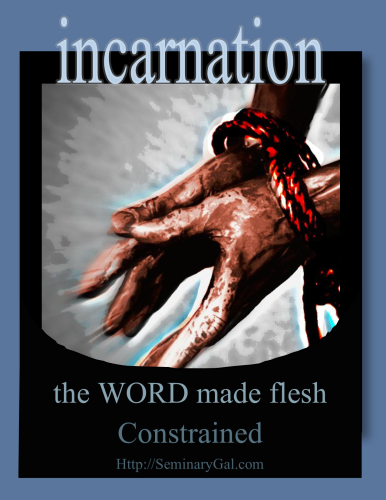
Having the power to do something yet experiencing some level of constraint is a curiosity of the Incarnation. What happened here?

constrained by limitationsIt’s not exactly like Peter Pan fighting man-to-man and refusing to do what was within his power (i.e. flying) to save his own life. It is even more than Pan’s self-decision… for self-restraint. Yet, Jesus had divine power as the Eternal Word. Powerful enough to create the entire universe with it. In the Incarnation, though, His human body had certain limitations without leaving Him powerless.

These limitations are referred to as making Himself “nothing” in Philippians 2: 5 Your attitude should be the same as that of Christ Jesus: 6 Who, being in very nature God, did not consider equality with God something to be grasped, 7 but made himself nothing, taking the very nature of a servant, being made in human likeness. 8 And being found in appearance as a man, he humbled himself and became obedient to death– even death on a cross! 9 Therefore God exalted him to the highest place and gave him the name that is above every name, 10 that at the name of Jesus every knee should bow, in heaven and on earth and under the earth, 11 and every tongue confess that Jesus Christ is Lord, to the glory of God the Father.

This making Himself nothing, sometimes called emptying or kenosis, is a confusing concept. It’s easier to identify what He did not empty Himself of. He did not give up His divinity, His divine attributes, His divine power, His intrinsic equality with the Father or His nature as the Eternal Word of the Godhead.

I’d like to propose that what He emptied Himself of was His independent use of His divine attributes. He depended on the Father, showing the perfect fruit of the Spirit in perfect love and perfect self-control.

How do I arrive at that?

Matthew 26: 39 Going a little farther, he fell with his face to the ground and prayed, “My Father, if it is possible, may this cup be taken from me. Yet not as I will, but as you will.” 40 Then he returned to his disciples and found them sleeping. “Could you men not keep watch with me for one hour?” he asked Peter. 41 “Watch and pray so that you will not fall into temptation. The spirit is willing, but the body is weak.” 42 He went away a second time and prayed, “My Father, if it is not possible for this cup to be taken away unless I drink it, may your will be done.”

Matthew 26:53 Do you think I cannot call on my Father, and he will at once put at my disposal more than twelve legions of angels?

The spirit is willing but the body is weak. Jesus experienced all the weakness of humanity, all the frailty, all the sorrows.  Jesus knew He could call upon His Father to relieve Him of these human limitations and yet, He submitted Himself as a servant would to the will of the Father. He submitted to the full attributes of humanity, including mortality.

Thought for the day: Jesus modeled what a life looks like when a person is fully submitted to God.

Questions for pondering:

  1. In what ways is Jesus the perfect man?
  2. Is the perfect man in perfect control, perfect submission, or both?
  3. In what ways did Jesus’ limitations not act as limitations at all?
  4. Could we, if we were fully submitted to God, rely upon Him and receive full power from the Father as Jesus did?
  5. Why does submission get such a bad rap?

======

Incarnation (2015 Advent Devotional Series) began November 29th.  By way of reminder, if you haven’t signed up yet, you can receive these devotional studies in your email throughout Advent 2015 by entering your email address on the SeminaryGal.com home page in the space provided in the sidebar.  Or “Like” the SeminaryGal Facebook page to access them there.  If you like these devotionals, I’d really appreciate your letting others know so I can continue to spread the Good News far and wide.  Blessings to you, in Christ always, Barbara <><


Continue Reading

Incarnation: A Costly Sacrifice-Advent 8 (2015)

costly sacrificeThe Incarnation was a very costly move.
It was costly for the Father.
It was costly for the Son.
And yet, God did it.

Why?

The Bible tells us that the Incarnation is the perfect expression and revelation of Divine Love. And strange as it seems, love and sacrifice are intimately connected.

John 3:16 “For God so loved the world that he gave his one and only Son, that whoever believes in him shall not perish but have eternal life.

1 John 4:9 This is how God showed his love among us: He sent his one and only Son into the world that we might live through him. 10 This is love: not that we loved God, but that he loved us and sent his Son as an atoning sacrifice for our sins

It’s Christmastime and many people give gifts to those they love. My son, remarking on how many of his friends are getting engaged this Christmas recently wrote, “Engagement Season…because nothing says ‘I Love You!’ like seasonality.”

The truth is that Christmas is a time of Love coming to mankind.

And Easter is when it was shown in its fullness.

Thought for the day: Love gave the gift of the Incarnation. The Incarnation is the gift of perfect Love.

Questions for reflection:

  1. Read Ephesians 2:1 “As for you, you were dead in your transgressions and sins, 2 in which you used to live when you followed the ways of this world and of the ruler of the kingdom of the air, the spirit who is now at work in those who are disobedient. 3 All of us also lived among them at one time, gratifying the cravings of our sinful nature and following its desires and thoughts. Like the rest, we were by nature objects of wrath. 4 But because of his great love for us, God, who is rich in mercy, 5 made us alive with Christ even when we were dead in transgressions– it is by grace you have been saved. 6 And God raised us up with Christ and seated us with him in the heavenly realms in Christ Jesus, 7 in order that in the coming ages he might show the incomparable riches of his grace, expressed in his kindness to us in Christ Jesus. 8 For it is by grace you have been saved, through faith– and this not from yourselves, it is the gift of God– 9 not by works, so that no one can boast. 10 For we are God’s workmanship, created in Christ Jesus to do good works, which God prepared in advance for us to do.” How is God’s love shown to us in the Incarnation?
  2. Read 1 John 4:16 “And so we know and rely on the love God has for us. God is love. Whoever lives in love lives in God, and God in him. 17 In this way, love is made complete among us so that we will have confidence on the day of judgment, because in this world we are like him. 18 There is no fear in love. But perfect love drives out fear, because fear has to do with punishment. The one who fears is not made perfect in love. 19 We love because he first loved us.” How does the gift of Love at Christmas keep on giving even beyond Easter?
  3. How might you give to others this Gift who keeps on giving?

======

Incarnation (2015 Advent Devotional Series) began November 29th.  By way of reminder, if you haven’t signed up yet, you can receive these devotional studies in your email throughout Advent 2015 by entering your email address on the SeminaryGal.com home page in the space provided in the sidebar.  Or “Like” the SeminaryGal Facebook page to access them there.  If you like these devotionals, I’d really appreciate your letting others know so I can continue to spread the Good News far and wide.  Blessings to you, in Christ always, Barbara <><


Continue Reading

Incarnation: Man’s Hope–Advent 7 (2015)

The Incarnation was God’s answer and man’s only hope.  If anything created could have saved us, then God was a fool to do it Himself.

Hope in the IncarnationThink about that statement for a moment.
Now think about all the things we think are going to save us:

  • exercise
  • diet
  • health care
  • concern for the planet
  • jobs and the economy
  • gold
  • elections

Certainly you can add your own ideas to that list.

Unless God is the only point of hope for you, the list contains created things.  Even if some of the created things were done by created beings.  And yet think about it: none of those created things are going to save us.

Death still happens because sin still happens. And why does sin still happen?  Because we have a sin nature.

It takes God to redeem our sin nature.  And here is our hope…not in something created, but in the Eternal Word made flesh.  Our Hope is in Christ Jesus.

In His Incarnation. Nothing created could do it.  So, God did it Himself.

Thought for the day: God’s holiness and our sin are such opposing opposites that God had to save us Himself.

Questions for reflection:

  1. When a person insists on doing something himself, what are some of the reasons?
  2. How is God doing it Himself different?
  3. How is God’s eternal and infinite being sufficient to save all who are willing to be saved by faith?

======

Incarnation (2015 Advent Devotional Series) began November 29th.  By way of reminder, if you haven’t signed up yet, you can receive these devotional studies in your email throughout Advent 2015 by entering your email address on the SeminaryGal.com home page in the space provided in the sidebar.  Or “Like” the SeminaryGal Facebook page to access them there.  If you like these devotionals, I’d really appreciate your letting others know so I can continue to spread the Good News far and wide.  Blessings to you, in Christ always, Barbara <><


Continue Reading

Incarnated as God’s Perfect Image-Advent 6 (2015)

Q: Why did Jesus come as a man and not some other sort of creature?

A: Because only man bears God’s Image.

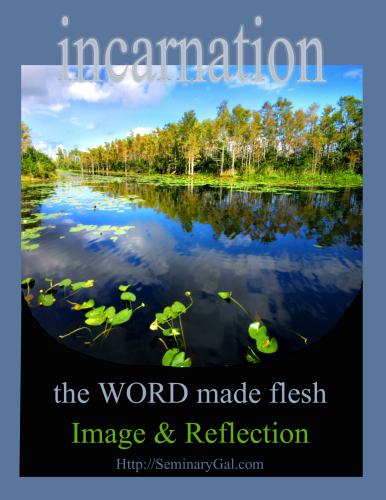
Jesus, as a man, was not only an Image bearer of God, He is the Image of God.

Colossians 1:15 He is the image of the invisible God, the firstborn over all creation. 16 For by him all things were created: things in heaven and on earth, visible and invisible, whether thrones or powers or rulers or authorities; all things were created by him and for him. 17 He is before all things, and in him all things hold together. 18 And he is the head of the body, the church; he is the beginning and the firstborn from among the dead, so that in everything he might have the supremacy. 19 For God was pleased to have all his fullness dwell in him, 20 and through him to reconcile to himself all things, whether things on earth or things in heaven, by making peace through his blood, shed on the cross.

Hebrews 1:3 The Son is the radiance of God’s glory and the exact representation of his being, sustaining all things by his powerful word.

Jesus was Incarnated in human flesh in order to rescue the Image of God from mortality. It was through Jesus’ humanity that God would reconcile man and all the rest of creation groaning under the weight of human sin…and reconcile to Himself these things through Jesus’ blood shed on the cross.

Thought for the day: No other man bears God’s Image the way Jesus did.  Jesus is God’s Perfect Image, His Perfect Reflection, and His Perfect Revelation.

Questions for pondering:

  1. What is the image and reflectionsignificance that Jesus IS the very Image of God?
  2. Read 2 Corinthians 3: 17 “Now the Lord is the Spirit, and where the Spirit of the Lord is, there is freedom. 18 And we, who with unveiled faces all reflect the Lord’s glory, are being transformed into his likeness with ever-increasing glory, which comes from the Lord, who is the Spirit.” When will we reflect God’s Image perfectly? Even so, will we ever BE the very Image of God?  Look at the reflection in the photo and ponder the distinction between an object and its perfect reflection.
  3. How does a perfect and eternal being provide a sufficient and complete sacrifice for all mankind?  Would a near-perfect reflection on account of behavior alone have accomplished the same thing?  Jesus did not earn heaven and achieve godhood by being a well-behaved guy.
  4. What role does our faith accomplish if Jesus paid it all in the death of God’s perfect Image bearer?

======

Incarnation (2015 Advent Devotional Series) began November 29th.  By way of reminder, if you haven’t signed up yet, you can receive these devotional studies in your email throughout Advent 2015 by entering your email address on the SeminaryGal.com home page in the space provided in the sidebar.  Or “Like” the SeminaryGal Facebook page to access them there.  If you like these devotionals, I’d really appreciate your letting others know so I can continue to spread the Good News far and wide.  Blessings to you, in Christ always, Barbara <><

Continue Reading