Reformation and Christ Alone (Solus Christus)

In a big box world of dime-a-dozen gods that we can custom-build to our own specifications, Solus Christus (Christ Alone) remains the stone the builders reject and the capstone (Psalm 118:22) of the Christian faith, even among the 5 Solas of the Reformation.  Gospel Coalition writer Stephen Wellum states it this way in Lose Christ, Lose Christianity

Solus Christus stands at the center of the other four solas, connecting them into a coherent theological system by which the reformers declared the glory of God.” 

Christ Alone is perhaps the greatest reclamation of the Reformation.

Everything about Jesus Christ and His work stands apart.  He is the only True God.  His work—and His work alone—was completely finished when He died.  It was—and is—thoroughly sufficient to give us life.  He did it all.  It is already done.  There is no other way.  Not even one.  And what Christ Alone did, lasts forever … because He lives. 

Hebrews 7:24 But because Jesus lives forever, he has a permanent priesthood. 25 Therefore he is able to save completely those who come to God through him, because he always lives to intercede for them. 26 Such a high priest meets our need– one who is holy, blameless, pure, set apart from sinners, exalted above the heavens. 27 Unlike the other high priests, he does not need to offer sacrifices day after day, first for his own sins, and then for the sins of the people. He sacrificed for their sins once for all when he offered himself.

This truth revealed in Scripture, artfully repeated throughout the Book of Hebrews, reminds us of the supremacy, the sufficiency, and the self-disclosure of the Father in the sacrifice of Christ.
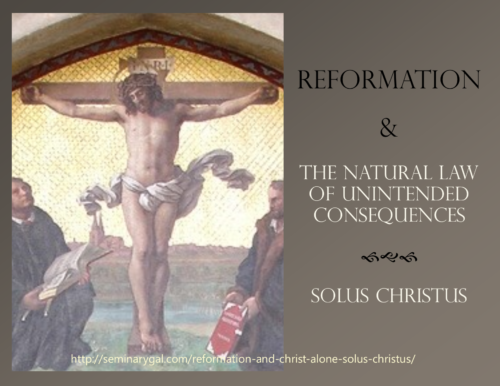
How can this possibly have any unintended consequences?

Well it does because human sin has a way of ruining just about everything. 

Martin Luther and other Reformers looked at the Roman Catholic Church and what it had become: an elaborate system of works and sacraments, hierarchies of pope, bishop, and priest, mediators and indulgences, all of which served to obscure the Person and work of Christ taught in Scripture.

In this regard, what Luther intended—a Reformation of the Roman Catholic Church of his day— was never achieved.  It resulted in no real renewal until centuries later. 

Reformation Day could easily be called Excommunication and Splinter from Catholicism Day which was an actual consequence.  In 1521, Luther was summoned before the Diet of Worms (and no one wants a diet of worms, but even that would be better than showing up at the Imperial Diet for excommunication, which is what happened.)

Then the “priesthood of believers”–a concept both Biblical and beautiful–kind of went their own way, too.  Sin, power, and politics, yup, it’s a nasty trifecta (trying to win, place, and show) and left Christ Alone at the altar.  They established Lutheranism as the state religion throughout much of Germany (also Scandinavia and the Baltics, and unofficially Minnesota).  It was supposed to be Christ Alone, not Luther’s namesake.

This great divorce within the Body of Christ, however, cannot diminish Christ Alone. 

No amount of sinful outcome can undo what Christ did!  His work of sacrifice (Solus Christus) reigns supreme and sufficient through all history and reminds us not to put our faith in any man beyond Christ Alone.  He alone is the capstone of our faith, the hub around Whom all true doctrine revolves, and the central figure of all history, revealing the Father’s love for us.  The Reformation reclaimed a bit of that and we can be grateful.

We can learn to be more faithful, too, whether Catholic or Reformed.  We can learn from the 5 Solas that Jesus belongs neither to Catholicism nor Protestantism.  Salvation is found nowhere else.  Nothing should obscure this fact: Jesus stands above and Jesus stands alone.  Solus Christus

===

The 5 Solas of the Reformation began on October 26, 2017 and can be found in the archives. 

  1. Sola Scriptura (Scripture Alone);
  2. Sola Gratia (Grace Alone);
  3. Sola Fide (Faith Alone);
  4. Solus Christus (Christ Alone); and
  5. Soli Deo Gloria (To God Alone Be Glory).
Continue Reading

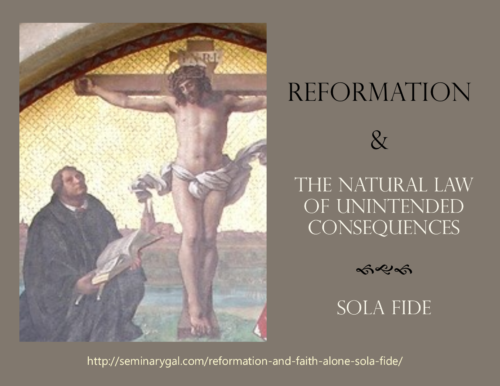
Reformation and Faith Alone: Sola Fide

I remember Misty.  She and I had a public conversation online decades ago and what I loved about engaging in discussion, even argument, with her was that she was thoughtful.  She poked holes in everything, finding flaws in assumptions like nobody I’ve known since.  She made me dig and think, one day particularly about Faith Alone (Sola Fide). 

Misty was from the UK as many of my online friends are.  I wouldn’t say she was a seeker because she was agnostic, admitting no particular inclination toward faith or rejecting it.  She seemed happy, or maybe just content, but didn’t “have faith,” something she saw as a fascinating distinction between us.  One day she asked me,

I don’t have faith.  How do I get it?” 

I replied, “It’s a gift that God will give you if your heart is open to it.” 

Her reply, blunt and emphatic: “Well, He hasn’t given it to me.  What am I supposed to do now?” 

Boom.  Thunderbolt to the heart of an evangelist.

I felt the sucker punch and the wind out of my sails.  What was she supposed to do if God didn’t give her faith?  If God’s grace was a gift and faith itself was a gift and if it was through faith alone that one is saved?

She continued hammering, “How can it be grace alone if it’s faith alone?”

<insert Barbara’s cricket collection>

Greater theologians than I have debated the role of the will, of faith itself, and of the grace of God.  It has inflamed arguments and hostility over big theologian words like justification, sanctification, redemption—unintended consequences—pitting Christian against Christian through history.  Arguably, this issue of Sola Fide, Faith Alone, represents a great chasm in doctrine, seen notably between Roman Catholics and Protestants over the issue of works of faith.  But Scripture is clear:

Ephesians 2:8 For it is by grace you have been saved, through faith– and this not from yourselves, it is the gift of God– 9 not by works, so that no one can boast.

I’ve concluded that God’s grace and my faith are two pillar topics and they can both stand alone in their own right.  God’s grace alone makes salvation possible, no amount of faith will do it, but faith plays a huge role in my experiencing what it truly means.  As Paul writes to Christians, not pagans or seekers in Ephesians 3, “I pray that out of his glorious riches he may strengthen you with power through his Spirit in your inner being, so that Christ may dwell in your hearts through faith. (Ephesians 3:16–17).

Faith (as God’s gift and my willful response to God’s grace) is the means by which Christ dwells, abides, continually interacts with power in my life.  I know Him by experience of my faith.  It’s like the man’s plea for help in Mark 9:22 “But if you can do anything, take pity on us and help us.” 23 “‘If you can’?” said Jesus. “Everything is possible for him who believes.” 24 Immediately the boy’s father exclaimed, “I do believe; help me overcome my unbelief!”

“I do believe,” he says. (Faith Alone reaches out as far as any human can).  “Help me overcome my unbelief” (Grace reaches down and bridges the gap as the gift of Grace Alone can.)  And it is a gift that they meet, both Grace Alone and Faith Alone, allowing a personal experience of the living Christ dwelling in any believer.

Circling back to Misty, I hope she has come to the place of humbly doing her part, holding out her hand to receive this gift God wants to give, salvation possible by Grace Alone.  I pray she has been experiencing the ongoing presence of Christ through Faith Alone (Sola Fide) as Christ helps her to overcome her unbelief.

===

The 5 Solas of the Reformation began on October 26, 2017 and can be found in the archives. 

  1. Sola Scriptura (Scripture Alone);
  2. Sola Gratia (Grace Alone);
  3. Sola Fide (Faith Alone);
  4. Solus Christus (Christ Alone); and
  5. Soli Deo Gloria (To God Alone Be Glory).
Continue Reading

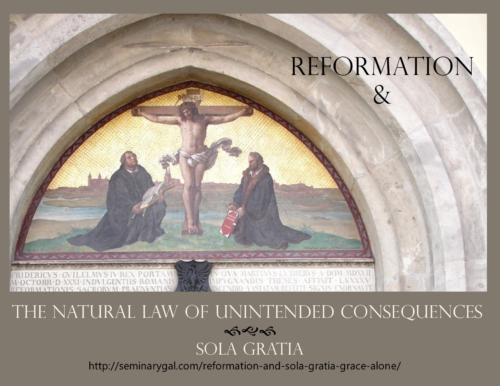
Reformation and Sola Gratia (Grace Alone)

Grace is tough to swallow for many in the modern era, not just Americans even though we, in the States, excel in our desire for control.  Americans are so preoccupied with being masters of our own destiny that National Car Rental has a series of ads making sport of this modern tendency.  We are control freaks (or enthusiasts), makers of our own future, rugged individualists who can make the world our oyster by hard work, turning coal into diamonds with human power and ingenuity.  Somehow the idea that we’re beholden to someone else–God no less–for our eternal future is unsettling for many.  The Biblical truth that had always been there in Scripture, rather forgotten by medieval bishops caught up in their own power structure, was brought back into the spotlight by Augustinian monk Martin Luther in the Reformation.  That truth?  Salvation is by grace alone and it simply cannot be earned.  Sola Gratia (Grace Alone.)

For it is by grace you have been saved, through faith– and this not from yourselves, it is the gift of God–not by works, so that no one can boast.  For we are God’s workmanship, created in Christ Jesus to do good works, which God prepared in advance for us to do. (Ephesians 2:8-10)

The human lust for being in control of one’s own destiny doomed Adam and Eve, ended up mastering Cain, expanded evil to the point of destruction in the Flood, caused the fall of the Tower of Babel, gave birth to Ishmael, and ultimately is why Jesus had to die on the Cross (John 3:14-21Hebrews 9:27-28). 

We want control over our own destiny?  Hell.  There’s our destiny and about all we can accomplish with respect to eternity.

But God gives grace.  And it’s God’s grace alone that saves.  We couldn’t live without it.

  
This emphasis on the beautiful gift of God’s grace alone is pure and holy. 

If there’s nothing we can do to earn it, though, unintended consequences arise when humanity views it through a sinful eye.  Among these are:

  • Laziness regarding charitable works.  Why do it if it’s not gaining me anything? 
  • Despair.  What if God hasn’t chosen to give me grace?  Am I completely out of hope?
  • Pride.  God gave me grace because He loves me, with the emphasis on ME. 
  • Uncertainty.  Am I going to be saved?

The short response to all those unintended consequences is

It’s not about you.  It’s about Him.” 

We do works of love because God created us to do them.  It’s a response to God’s first loving us!  We can trust that our God who loves His Image in humanity so much that He’d send His Son to die (and give us eternal life just for being His Image bearers!) will do so wherever He finds a willing heart to receive this gift.  When we see that it’s actually about His Image and about Him, Jesus didn’t die because you and I are such good people.  Jesus died because He created us … in His Image … and that’s what’s worth eternity, not anything we bring to the table.  It’s out of our control and that’s a good thing.  Sola Gratia. Grace Alone saves.

===

The 5 Solas of the Reformation began on October 26, 2017 and can be found in the archives. 

  1. Sola Scriptura (Scripture Alone);
  2. Sola Gratia (Grace Alone);
  3. Sola Fide (Faith Alone);
  4. Solus Christus (Christ Alone); and
  5. Soli Deo Gloria (To God Alone Be Glory).
Continue Reading

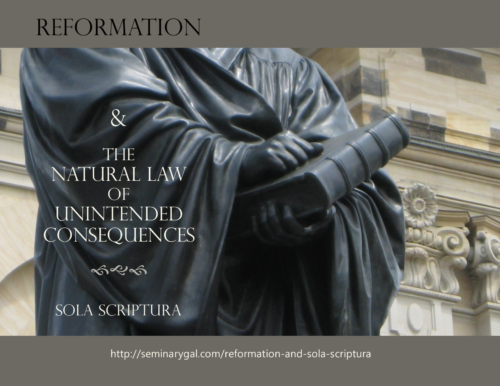
Reformation and Sola Scriptura

The Word.  For Martin Luther it was paramount, Sola Scriptura (Scripture Alone).  And it was imperative that the people of God should have access to it. 

God is present in His Word. To separate the people from the Word of God was to separate people from knowing their God.  God’s divinely inspired Word, Scripture alone, unites Christians with a voice that carries from Judea, Samaria, and to the very ends of the Earth. Just what the Gospel is supposed to do.

For Martin Luther Sola Scriptura didn’t end with a belief in the powerful Word of God, “sharper than a double-edged sword” (Hebrews 4:12) but Luther charged forth with faith in action.  History.com describes it this way:

The key ideas of the Reformation—a call to purify the church and a belief that the Bible, not tradition, should be the sole source of spiritual authority—were not themselves novel. However, Luther and the other reformers became the first to skillfully use the power of the printing press to give their ideas a wide audience.”

God’s timing is always perfect.  All of history belongs to Him. 
So, as a man in God’s perfect timing, Luther became a part of church history.  Luther’s story also was a story of the power of media to influence our lives, to see God’s mighty hand and His Holy Spirit using it for our good and His glory, something we see repeated with every new means of communication.  

When John Piper was asked, “What am I celebrating in [the Reformation]?”  Piper replied in a series of responses, one of which was

“The inspired word of God read and known by every Christian is the decisive means of enjoying peace…The church of the Middle Ages cut people off from the word of God. They had done so intentionally. It was a capital crime in the 1400s in Britain to translate the Scriptures into English so that people could read it. They burned people alive for reading fragments of the English Bible, even children. They believed that God did not offer his fellowship to be enjoyed through a personal encounter with him in his word, but rather through the ministry of priests and sacraments. This was evil.”  

For Luther, the time had come to consider God’s Word as being something to take out of the hands of pros-only and to give God credit for being perfectly able to take His Word directly to the hearts of His people.  The printing press, in the course of history, made that possible.

Of course, all this came with unintended consequences.  Some of those include:

  • Division between Roman Catholics and Reformers on the view of authority and whether people were capable of reading Scripture without having someone explain it to them and tell them what it meant. 
  • The newly acquired ability of people to read Scripture came with a decision to remain true to it or to make Scripture say what they want it to say.  We now know a slide of compromise redefining truth began. 
  • The casual access to the Bible convinced some people that Scripture substitutes for community and a daily Bible study passes for involvement in the Body of Christ. 
  • The power of the written word makes everything seem equally true.  Any written word could pass for having the same authority as God’s.  Consider all the ink in self-help books on every quasi-spiritual topic thought to stand on an equal level with the Word of God.  Which it doesn’t.  Nothing compares to Scripture.  

Sola Scriptura presents every man, woman, and child with decisions.  Will we accept God’s Word as being our spiritual authority, trusting it says what it says, and allow it to change our lives … free from our attempts to change it to suit our lives?  In a tumultuous world of media overload, will we make quiet time for God’s Word, unfiltered and unaltered, to minister His peace?  Will we consider God’s Word a God-breathed document  and treat it as such?

===

The 5 Solas of the Reformation began on October 26, 2017 and can be found in the archives. 

  1. Sola Scriptura (Scripture Alone);
  2. Sola Gratia (Grace Alone);
  3. Sola Fide (Faith Alone);
  4. Solus Christus (Christ Alone); and
  5. Soli Deo Gloria (To God Alone Be Glory).
Continue Reading

Reformation and the Natural Law of Unintended Consequences

While other people are buying costumes to wear and going door-to-door in search of candy for Halloween, I think about other things when October 31st rolls around. For me, Killjoy Barbara, it’s Reformation Day.  (Seriously?)  Yup.  (Zealot.)  Yeah, it’s complicated.

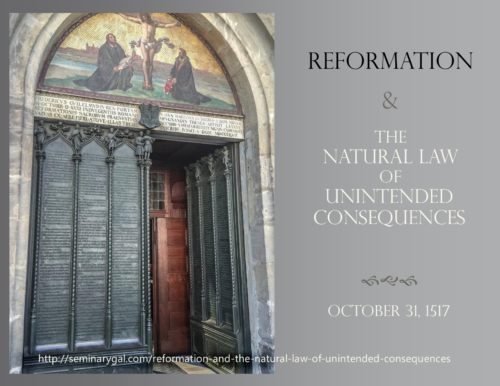
I’m back at the door giving out candy on the outside, but on the door of my heart, I’m thinking about a different door entirely.  I’m thinking about the one on a castle church in Wittenberg, Germany and how on October 31, 1517, a remarkable and remarkably flawed man, Martin Luther was revealed as something of a man for his time.  A man whose life and work demonstrate the power of media and the Natural Law of Unintended Consequences.


It’s amazing how the purifying work of God- when it meets with a world of sin- becomes both a powerful force for good and the double-edged sword of truth which cuts both ways. 

Something Jesus told us:  Matthew 10: 32 “Whoever acknowledges me before men, I will also acknowledge him before my Father in heaven. 33 But whoever disowns me before men, I will disown him before my Father in heaven. 34 “Do not suppose that I have come to bring peace to the earth. I did not come to bring peace, but a sword. 35 For I have come to turn “‘a man against his father, a daughter against her mother, a daughter-in-law against her mother-in-law– 36 a man’s enemies will be the members of his own household.’ 37 “Anyone who loves his father or mother more than me is not worthy of me; anyone who loves his son or daughter more than me is not worthy of me; 38 and anyone who does not take his cross and follow me is not worthy of me“.

Ouch. 

Jesus, that one hurts.  Well, the truth does sometimes.  And it’s worth our understanding exactly what truth does, and precisely who Truth is (John 14:6), and then resolutely decide to let God cut away all that is false in our lives as a response.

Over the next few days, I’d like to take a look at what are called the 5 Solas of the Reformation. 

  1. Sola Scriptura (Scripture Alone);
  2. Sola Gratia (Grace Alone);
  3. Sola Fide (Faith Alone);
  4. Solus Christus (Christ Alone); and
  5. Soli Deo Gloria (To God Alone Be Glory).
From a vertical, eyes-lifted perspective, they’re a beautiful call to true discipleship and uncompromised obedience to One God.  From a horizontal, chained to a sinful humanity perspective, they can present a legion of opportunities to live out the Natural Law of Unintended Consequences as each does what is right in his own eyes (Judges 17:6).  Let’s not let the Reformation divide us.  Let’s choose instead to see that viewed from God’s perspective, the “5 Solas” can help us–Catholics, Orthodox, and Protestants alike–to remain spiritually vertical … in spiritually horizontal world.  To be God’s Church , our unity reflecting our faith in Him to a world that is utterly lost.

Continue Reading

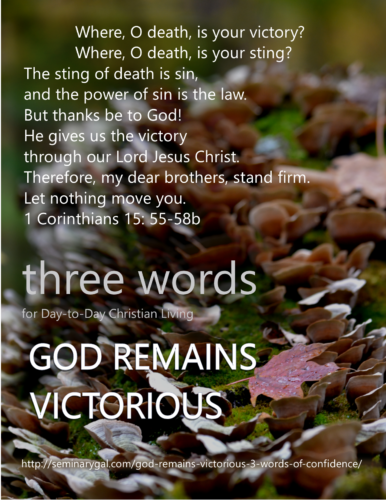
God Remains Victorious-3 Words of Confidence

One of the things I really like about movies based upon books by John Grisham (like The Pelican Brief and The Firm) is the skilled way a compelling hero is uncertain to succeed until the very end.  There’s a suspense that builds until the conclusion finally resolves the conflict and sets one’s heart and confidence at rest. 

The Bible has a different author and our Hero already won. 
There’s no confusion about it whatsoever. No uncertainty. 

God Remains Victorious from beginning to end–all the way through the suspenseful climax of the Cross, from the devastation of the grave to a hope-filled and confident future beyond.  In our series Three Words for Day-to-Day Christian Living, the fact that God Remains Victorious encourages us and gives us confidence today.  Now we’re just waiting for the Resurrection after-party where Jesus arrives– just on time– to reclaim His people!

Most of us, if we’re honest, would believe that the power required to overcome death (which was impossible until Christ) far exceeds any power needed to return to the Earth.  As an analogy, consider the enormous power required to overcome Earth’s gravitational pull, and the propulsion necessary in a rocket’s launch, versus the manned capsule that falls to Earth with parachutes and lands as a splashdown in the ocean.  The pull of gravity makes one exceedingly difficult and the other comparatively easy.

If it was a far greater event for Jesus to overcome death than for Him to return to judge the quick and the dead, then why do so many people live as though He won’t return?

How should believing in His victory and having confidence in His return affect how you live your life? 

1 Corinthians 15: 55 “Where, O death, is your victory? Where, O death, is your sting?” 56 The sting of death is sin, and the power of sin is the law. 57 But thanks be to God! He gives us the victory through our Lord Jesus Christ. 58 Therefore, my dear brothers, stand firm. Let nothing move you.  Always give yourselves fully to the work of the Lord, because you know that your labor in the Lord is not in vain.

=== 

This “three word” series is archived beginning July 22, 2017.  

Continue Reading

Advent Devotional Series 2017-Still Christmas

Here’s your sneak peek at the 2017 Advent Devotional Series: Still Christmas.  Christmas always has its share of hustle-bustle, but this year, it seems more than that.  More of a global angst mixed with frenzied activity like squirrels preparing for a long winter, or yellow jackets stinging everything in sight because the end is near.  To that panicked pace and fear, God would remind us to “Be still, and know that I am God; I will be exalted among the nations, I will be exalted in the earth.” (Psalm 46:10)

This year’s Advent Devotional Series, Still Christmas, is the Advent complement to the Lenten series, Be Still and Know that I AM God
Every day through Advent, we will look at the birth narrative of Christ and find ways to have a Still Christmas, taking time for appreciating what an amazing and transformative event the birth of our Savior was. 

We will allow ourselves to take refuge in God’s Word and under His mighty hand. 

By doing so, we will learn to relinquish our desire to control our surroundings and in the stillness, find comfort and hope. 

Finally, there will be questions for personal reflection designed to carve away all our self-imposed stresses and refocus our pure attention upward. 

Be Still and Know that I AM God.

* * *

Advent Devotionals begin December 3, 2017.  If you’re already signed up on my Home Page sidebar to receive posts, you’ll get the Advent devotionals automatically.  If you haven’t signed up, today is a great day to do so.  Advent and Lenten devotionals remain among my most popular offerings.  You don’t want to miss this great way to prepare your heart for the true meaning of Christmas!  See you in a few weeks!

== ==

Acknowledging inquiries about the entire season’s devotionals for your study group’s planning purposes, Seminary Gal’s prior seasons’ Advent devotionals can be accessed via the archives to the right and are as follows:  

  • The 2016 season devotionals were called Timeless: The Message of Christmas for All Ages” and explored how the message of Christmas is timeless truth, for all ages of people, and for all ages at all times.  Timeless hope, encouragement, grace, peace, and love as we looked into the Word, saw the face of our Lord Jesus, and experienced restoration in His presence.  His goodness and His Gospel are truly Timeless. The 2016 devotionals began November 27, 2016.
  • The 2015 season devotionals were titled Incarnation and involved digging deep–and yes, I mean deep– in this important mystery of Christian theology.  They began November 29, 2015.
  • Carol Me, Christmas! remains one of my most popular offerings and tells the Christmas story through our most beloved Christmas hymns and carols.  You can access all of the numbered devotionals from 2014 via the archives.  They began November 30, 2014.
  • The 2013 series was Emmanuel: When LOVE Showed Up in Person and examined the Prologue to the Gospel of John.  It began December 1, 2013.
  • The 2012 series focused on Expecting the Unexpected…the unexpected, unlikely, and uniquely divine qualities of God’s perfect plan outlined in Luke’s account of the Christmas story.  It began December 1, 2012.
Continue Reading

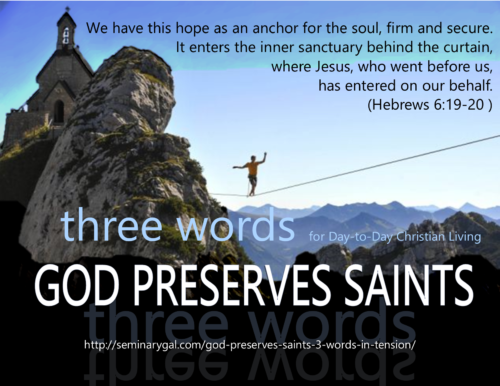
God Preserves Saints-3 Words in Tension

Have you ever heard “Once saved; always saved?”  Have you ever struggled to reconcile that with warnings against falling away?  The Bible is filled—every bit as much—with reassurance as it is with warning.  What is a Christian to make of that tension? 

We all have worries about wayward children, a drifting spouse or parent, siblings or friends who once walked with God who don’t anymore.  As we continue looking at 3 Words for Day-to-Day Christian Living, let us consider God Preserves Saints as 3 Words in Tension.

Imagine a tightrope as an escape plan.  One end is held by God and He’s not letting go.  That’s a given, as Jesus says, John 10: 28 I give them eternal life, and they shall never perish; no one can snatch them out of my hand.

But are we in His hand?  Hmmm. 


Let’s look at the other end.  The other end is held by faith.  Our faith can hold our end of the rope held tightly but we are also free to set it down or reject it entirely.  Only if faith anchors our end, can its tension provide a legitimate escape.

Here’s the harder part.  Our faith anchors our end, but we’re not doing it. 

If you think about it, we cannot hold a tightrope in place and walk across it… at the same time.  Likewise, faith in anything other than God Himself is ineffective.  God alone preserves us by taking our faith in Christ and anchoring it … in Himself. 

God preserves us. 

Faith—always a gift of God to believe—changes the redeemed sinner.  In some mysterious way at a time of His choosing, God’s Holy Spirit comes to dwell in the heart of a forgiven sinner and we become as Scripture says, “marked with a seal.” (Ephesians 1: 13-14).

Think of it like tubes of epoxy glue that once you mix it, or expose it to sunlight, it hardens rock-solid.  Our tube of faith is mere liquid and couldn’t hold a thing, apart from God gifting faith in Him and making it sure.  That’s preservation! The Holy Spirit enters our picture and He solidifies our faith.  The tightrope is held in constant, perfect tension and Christ is our escape when the time comes.  He keeps us from falling when He anchors our escape at both ends.

I offer this picture of a tightrope because, generally speaking, I think people don’t like unresolved items to be held in tension, particularly if we’re not in control of it.  We struggle to understand passages like John 10:25-30 that speak of sheep that are His and ones that aren’t.  Belief yet unbelief, perfect security in tension with falling away. 

Acknowledging this tension helps us to understand how God’s security and preservation are perfectly anchored in a rock-solid faith in Christ.  He is faithful!

Hebrews 6:19 We have this hope as an anchor for the soul, firm and secure. It enters the inner sanctuary behind the curtain, 20 where Jesus, who went before us, has entered on our behalf.

=== 

This “three word” series is archived beginning July 22, 2017.  

Continue Reading

God Told Us-3 Words of Preparation

I have piles of papers on every flat surface in my home, work that I’ve been up to my ears in doing instead of writing devotionals.  Both are God’s calling, so balancing them is a daily art form.  Then suddenly, Las Vegas.  Like many of you, there’s an unspeakable shock, a deep abiding grief, and maybe you’re like me with a desire to understand, an almost insatiable appetite for information and press conferences, a strange and grim interest in motive as what happened to make a person do something so horrible, and an equally morbid desire to know about the victims as if to give them one last moment on the stage of the human drama visible in the afterglow as they depart the stage in dark silence.  Like many of you, I pray and pray some more.  Pray a lot actually, and the repeated thought I have is that God Told Us.  These are 3 Words of Preparation that Christians can use in their Day-to-Day Christian Living.

What difference does it make that God Told Us?

When God tells us what it will be like in the last days, (for example 2 Timothy 3:1-9) He’s not doing it to depress us.  He’s doing it as preparation.  To make us situationally aware so we can respond as Christians, with level heads and helping hands.  To reach out with the Gospel which alone can save our neighbors.

In the last days, some people dig deep into depravity and seemingly snap or worse, plot to do horrific things to their fellow man.  Reality is that mankind, totally apart from God, knows no end to the evil we can conceive and commit.  Just prior to the visiting of God’s judgment in the Flood, Genesis 6:5 The LORD saw how great man’s wickedness on the earth had become, and that every inclination of the thoughts of his heart was only evil all the time.

Because of the rise of wickedness, we’re approaching another Judgment, but not through another flood.  The wise among us live in preparation for that Judgment.

Everyday man’s solutions involve gun control and metal detectors and TSA and withdrawing from gathering.  God’s solutions are different.  God wants us to be situationally aware…to see God’s gracious offer of salvation in the midst of it, and to press on.  Continue.  Rely upon God to rescue us in the near term, if it is His will, but if not near term, the greater rescue into eternity for those who have faith in Jesus Christ.  Situational awareness in both prepares us and comforts us.

The end times bring bad stuff, evil stuff, depraved stuff.  But the man or woman of God pays attention to the preparation God gives us in His Word: 

2 Timothy 3: 10 You, however, know all about my teaching, my way of life, my purpose, faith, patience, love, endurance, 11 persecutions, sufferings– what kinds of things happened to me in Antioch, Iconium and Lystra, the persecutions I endured. Yet the Lord rescued me from all of them. 12 In fact, everyone who wants to live a godly life in Christ Jesus will be persecuted, 13 while evil men and impostors will go from bad to worse, deceiving and being deceived. 14 But as for you, continue in what you have learned and have become convinced of, because you know those from whom you learned it, 15 and how from infancy you have known the holy Scriptures, which are able to make you wise for salvation through faith in Christ Jesus. 16 All Scripture is God-breathed and is useful for teaching, rebuking, correcting and training in righteousness, 17 so that the man of God may be thoroughly equipped for every good work.

Believe.  Know.  Live.  Accept.  Continue.  Teach.  Rebuke. Correct. Train.  Equip. Prepare.

It’s a new normal out there in a depraved world.  You, however, can be situationally aware, prepared for the end times, armed with the Gospel, and shielded by the love of Jesus Christ now and forever. 

Surely I am with you always, to the very end of the age.” (Matthew 28:20b )

=== 

This “three word” series is archived beginning July 22, 2017.  

Continue Reading

God Offers Peace-3 Words to Calm Anxiety

We sure live in anxious times, don’t we?  I know I haven’t been as routine about writing lately and it’s because being “a Neighbor” has meant ministering locally, doing my best to alleviate others’ anxiety through working hard, thinking hard, and yes, praying hard.  How do I keep from letting anxiety get the better of me?  Two pieces of truth:  Sometimes I don’t.  And I always try to keep today’s 3 Words for Day-to-Day Christian Living in mind:  God Offers Peace.

God doesn’t want His people to live in chronic anxiety.  He doesn’t want us worrying over North Korea’s missile tests, Iran’s broken promises in developing nuclear technologies, terrorism, Zika, Ebola, West Nile, hurricanes, tornadoes, or earthquakes.  He doesn’t even want us worrying about what we’re going to wear.  So obviously not anything in between either. 

Matthew 6: 25 “Therefore I tell you, do not worry about your life, what you will eat or drink; or about your body, what you will wear. Is not life more important than food, and the body more important than clothes? 26 Look at the birds of the air; they do not sow or reap or store away in barns, and yet your heavenly Father feeds them. Are you not much more valuable than they? 27 Who of you by worrying can add a single hour to his life? 28 “And why do you worry about clothes? See how the lilies of the field grow. They do not labor or spin. 29 Yet I tell you that not even Solomon in all his splendor was dressed like one of these. 30 If that is how God clothes the grass of the field, which is here today and tomorrow is thrown into the fire, will he not much more clothe you, O you of little faith? 31 So do not worry, saying, ‘What shall we eat?’ or ‘What shall we drink?’ or ‘What shall we wear?’ 32 For the pagans run after all these things, and your heavenly Father knows that you need them. 33 But seek first his kingdom and his righteousness, and all these things will be given to you as well. 34 Therefore do not worry about tomorrow, for tomorrow will worry about itself. Each day has enough trouble of its own.

God’s response to our anxiety is to remind us to seek Him and there find relief from our burdens (Matthew 11:28-30).  To know His peace.

Philippians 4:6 Do not be anxious about anything, but in everything, by prayer and petition, with thanksgiving, present your requests to God. 7 And the peace of God, which transcends all understanding, will guard your hearts and your minds in Christ Jesus. 8 Finally, brothers, whatever is true, whatever is noble, whatever is right, whatever is pure, whatever is lovely, whatever is admirable– if anything is excellent or praiseworthy– think about such things. 9 Whatever you have learned or received or heard from me, or seen in me– put it into practice. And the God of peace will be with you.

God offers peace in place of worry and anxiety. 

We only need to set our minds on God and His Kingdom, delivering in the categories of faith and dependence and God fills in the rest by being with us…which is the safest place to be from an eternal perspective.

=== 

This “three word” series is archived beginning July 22, 2017.  

Continue Reading