O Come O Come Emmanuel (Advent 1-2014)
As we begin Advent 2014 with devotions to Carol Me, Christmas, we start with anticipation! O Come O Come Emmanuel is traditionally sung either at the very beginning of Advent or in the final days just prior to Christmas. Its haunting melody accurately communicates a world in pain, in distress, and dying for need of a Savior. The tune is slow, majestic, and mournful. You wouldn’t probably be surprised to learn that the melody (Veni Emmanuel) is from a Requiem Mass (Mass for the repose of the souls of the dead). It’s a lament for the dead, or a dirge (funeral song) from a 15th century French Franciscan convent of nuns located in Portugal. To a world that’s dying in sin, it’s a perfect melody.
The words are considered an Antiphon (a response chant kind of like a Gregorian chant also known as a “plainsong”). Oftentimes, the original 7 verses were sung out in unison and then the response was chanted back (often in harmony) and rang out “Rejoice! Rejoice! Emmanuel, Shall come to thee, O Israel.”
Greg Sheer (1994) writes,
The text for “O Come, O Come, Emmanuel” comes from a 7 verse poem that dates back to the 8th century. It was used in a call and response fashion during the vespers, or evening, service. The original text created the reverse acrostic “ero cras,” which means “I shall be with you tomorrow,” and is particularly appropriate for the advent season. A metrical version of five of the verses appeared in the 13th century, which was translated into English by J.M. Neale in 1851.
To be sure, most hymnals shortcut the Antiphon’s theological ties by listing it only as “Behold a virgin shall…bear a son, and shall call His name Immanuel (Isa 7:4).” The theological implications and teachings are more profound, however. They are reflected, not only in the many Old Testament names given for the Messiah, but also in their teachings of truths about humanity.
Here are the names in the 5 verses that appeared in the 13th century as pointed out by Sheer.
- “Emmanuel” (Isaiah 7:14, Mt 1:23) means “God with us”
- “Adonai” (Exodus 19:16) is a name for God, the giver of the law (*My note Adonai means Lord and is the way the Jews avoided saying “The Name” represented by YHWH—a tetragrammaton for The Name of God, Yahweh, considered too holy to even speak!)
- “Branch of Jesse” (Isaiah 11:1) refers to Jesus’ lineage
- “Oriens” (Malachi 4:2, Luke 1:78-79) is the morning star or daystar
- “Key of David” (Isaiah 22:22) again refers to Jesus’ lineage
Many of our hymnals, however, will have a different listing of names or varied orders (Emmanuel, Rod of Jesse, Dayspring, Key of David, and Desire of Nations) or even (Wisdom, Emmanuel, The Lord of Might, The Rod of Jesse, Dayspring, and The Key of David). Still that is only six–one short of the 7 verses from the original “Great O Antiphons.” Here you will find a nice chart of how the Catholics use the Antiphons during the final week of Advent including the Latin since you may have noted that the first letters of the English don’t add up to ero cras .
The Anglican Church of the Province of Southern Africa lists the Antiphons this way:
- Antiphon 1 O Emmanuel, our King and Giver of the Law, the people await you, their Savior: Come and save us , O Lord our God!
- Antiphon 2 O Wisdom, you came forth from the lips of God Most High and you reach from one end of the universe to the other, powerfully and gently ordering all things: Come and teach us the way of prudence!
- Antiphon 3 O Adonai and Leader of the house of Israel, you appeared to Moses in the flame of a burning bush and at Sinai you gave him the Law: Come with your outstretched arm to save us!
- Antiphon 4 O Root of Jesse, you stand for a sign to the peoples; before you kings are silent, and Gentiles pray with longing: Come now and set us free!
- Antiphon 5 O Key of David, and Ruler of the House of Israel, you open and none can shut; you shut and no one can open: Come and lead out of the prison house the captives who sit in darkness and in the shadow of death!
- Antiphon 6 O Morning Star, you are the splendor of eternal life; you are the dawning sun, the Sun of justice: Come and enlighten those who sit in darkness and in the shadow of death!
- Antiphon 7 O King of nations and fulfillment of their longing, you are the Cornerstone and you make all one; you formed us from primeval clay: Come, and save us!
No matter which version you use, the theology is the same. Israel as the Chosen People group was prophesied by Isaiah to end up in Babylonian captivity (Isaiah 39:6) in a physical sense forming a fitting metaphor for the spiritual captivity of the entire world due to human sin, idolatry, and rebellion against God. But there would be restoration when the Messiah finally comes. There would be Comfort for God’s people (Isaiah 40:1-5)…but only when Emmanuel comes to ransom all of us who have been held captive to sin. He redeemed us by His death on the Cross. So we anticipate the birth of Messiah—not because He’s a cute baby in a manger—but because of what He would do to save us!
This Messiah is King and Lawgiver. He is the Wisdom that created the entire universe. He is the Lord and Leader promised to Israel. He is the Root of Jesse once razed to the ground by the Assyrians and Babylonians, but when captive Judah returned to the land… from this stump, the Kingdom would again rise. He is the Key of David prophesied in Isaiah 22:22 and shown as fulfilled in Revelation 3:7 when the Spirit says to the churches: “To the angel of the church in Philadelphia write: These are the words of him who is holy and true, who holds the key of David. What he opens no one can shut, and what he shuts no one can open.” He is the Morning Star spoken about in prophecy and fulfilled in Revelation 22:16 “I, Jesus, have sent my angel to give you this testimony for the churches. I am the Root and the Offspring of David, and the bright Morning Star.” And He is the King of Nations, the Cornerstone over which some have stumbled but who has become the Capstone, holding all things together. He is the Desired of all nations. Haggai 2:7 I will shake all nations, and the desired of all nations will come, and I will fill this house with glory,’ says the LORD Almighty.
When we listen to O Come O Come Emmanuel (click link) we should reflect with great anticipation at the deliverance ahead. As Advent 2014 begins, we joyfully remember His birth, yet we mourn…remaining a world in distress, needing the healing touch that only “God with us, Emmanuel,” can provide. Until He returns, all we can do is cry out, “How long, O LORD?” (Psalm 6:3-4; Revelation 6:10) and “Come quickly Lord Jesus” (Revelation 22:20).
O Come O Come Emmanuel….
Thought focus for today’s reflection:
Anticipation at God’s deliverance from an evil world in strife and rebellion. Come, Lord Jesus!
- O come, O come, Emmanuel
- And ransom captive Israel
- That mourns in lonely exile here
- Until the Son of God appear
- Rejoice! Rejoice! Emmanuel
- Shall come to thee, O Israel.
- O come, Thou Rod of Jesse, free
- Thine own from Satan’s tyranny
- From depths of Hell Thy people save
- And give them victory o’er the grave
- Rejoice! Rejoice! Emmanuel
- Shall come to thee, O Israel.
- O come, Thou Day-Spring, come and cheer
- Our spirits by Thine advent here
- Disperse the gloomy clouds of night
- And death’s dark shadows put to flight.
- Rejoice! Rejoice! Emmanuel
- Shall come to thee, O Israel.
- O come, Thou Key of David, come,
- And open wide our heavenly home;
- Make safe the way that leads on high,
- And close the path to misery.
- Rejoice! Rejoice! Emmanuel
- Shall come to thee, O Israel.
- O come, O come, Thou Lord of might,
- Who to Thy tribes, on Sinai’s height,
- In ancient times did’st give the Law,
- In cloud, and majesty and awe.
- Rejoice! Rejoice! Emmanuel
- Shall come to thee, O Israel.
- O, come, Desire of nations, bind
- All people in one heart and mind
- Bid Thou our sad divisions cease,
- And be Thyself our King of Peace.
- Rejoice! Rejoice! Emmanuel
- Shall come to you, O Israel!
====
Carol Me, Christmas (2014 Advent Devotional Series) began November 30th. By way of reminder, if you haven’t signed up yet, you can receive these devotional studies in your email throughout Advent 2014 by entering your email address on the SeminaryGal.com home page in the space provided in the sidebar. Or “Like” the SeminaryGal Facebook page to access them there. If you like these devotionals, I’d really appreciate your letting others know so I can continue to spread the Good News far and wide. Blessings to you, in Christ always, Barbara <><
Advent 2014: Carol Me, Christmas
As we begin to Carol Me, Christmas as our Advent 2014 series and tell the story of Christmas through the Church’s most beloved traditional carols, it would be good to set the stage for why many of these carols have had such an enduring quality. For some, the tune is memorable, is fun to sing, or turns one’s thought to Christmas just by hearing it. For others, it brings back fond recollections of childhood, related more to our lighting candles at the Christmas Eve service, or sugar plums dancing in our heads as we drift off to sleep and wait for Santa to arrive.
But the reason I would like to focus on these hymns is that they have been useful instruction for the Church. It is no mistake that they are in our hymnals, often labeled simply as Jesus Christ: His Advent, or His Birth.
Stop and think about it for a second—Before the invention of the printing press by Johannes Gutenberg (approx. 1439) and with it, the greater availability of reading material or reading instruction, things like oral traditions, memorization, and yes, hymns provided some of the best ways of conveying Scriptural truths. It was one of the easiest ways of communicating theology. Just like we sing ABCs to learn to read, singing could teach us who Jesus is before we could ever hold a Bible in our hands.
The first group of hymns we will look at beginning tomorrow are usually included in a section of a hymnal entitled Advent but they all proclaim an anticipation of His glorious birth. On the first day of Advent, we will explore O Come, O Come, Emmanuel.
Carol Me, Christmas (2014 Advent Devotional Series) will begin November 30th. If you haven’t signed up yet, you can receive these devotional studies in your email throughout Advent 2014 by entering your email address on the SeminaryGal.com home page in the space provided in the sidebar. Or “Like” the SeminaryGal Facebook page to access them there.
===note: You will find all the Carol Me, Christmas items archived beginning in November 2014.

Never Be the Same Again
Acts 4:1 The priests and the captain of the temple guard and the Sadducees came up to Peter and John while they were speaking to the people. 2 They were greatly disturbed because the apostles were teaching the people and proclaiming in Jesus the resurrection of the dead. 3 They seized Peter and John, and because it was evening, they put them in jail until the next day. 4 But many who heard the message believed, and the number of men grew to about five thousand.
5 The next day the rulers, elders and teachers of the law met in Jerusalem. 6 Annas the high priest was there, and so were Caiaphas, John, Alexander and the other men of the high priest’s family. 7 They had Peter and John brought before them and began to question them:
By what power or what name did you do this?”
8 Then Peter, filled with the Holy Spirit, said to them: “Rulers and elders of the people! 9 If we are being called to account today for an act of kindness shown to a cripple and are asked how he was healed, 10 then know this, you and all the people of Israel: It is by the name of Jesus Christ of Nazareth, whom you crucified but whom God raised from the dead, that this man stands before you healed. 11 He is “‘the stone you builders rejected, which has become the capstone.’ 12 Salvation is found in no one else, for there is no other name under heaven given to men by which we must be saved.”
Could this be the same Peter?
The same Annas? The same Caiaphas?
The same “other disciple” John?
John 18:12 Then the detachment of soldiers with its commander and the Jewish officials arrested Jesus. They bound him 13 and brought him first to Annas, who was the father-in-law of Caiaphas, the high priest that year. 14 Caiaphas was the one who had advised the Jews that it would be good if one man died for the people. 15 Simon Peter and another disciple were following Jesus. Because this disciple was known to the high priest, he went with Jesus into the high priest’s courtyard, 16 but Peter had to wait outside at the door. The other disciple, who was known to the high priest, came back, spoke to the girl on duty there and brought Peter in. 17 “You are not one of his disciples, are you?” the girl at the door asked Peter. He replied, “I am not.” 18 It was cold, and the servants and officials stood around a fire they had made to keep warm. Peter also was standing with them, warming himself. 19 Meanwhile, the high priest questioned Jesus about his disciples and his teaching. 20 “I have spoken openly to the world,” Jesus replied. “I always taught in synagogues or at the temple, where all the Jews come together. I said nothing in secret. 21 Why question me? Ask those who heard me. Surely they know what I said.” 22 When Jesus said this, one of the officials nearby struck him in the face. “Is this the way you answer the high priest?” he demanded. 23 “If I said something wrong,” Jesus replied, “testify as to what is wrong. But if I spoke the truth, why did you strike me?” 24 Then Annas sent him, still bound, to Caiaphas the high priest. 25 As Simon Peter stood warming himself, he was asked, “You are not one of his disciples, are you?” He denied it, saying, “I am not.” 26 One of the high priest’s servants, a relative of the man whose ear Peter had cut off, challenged him, “Didn’t I see you with him in the olive grove?” 27 Again Peter denied it, and at that moment a rooster began to crow.
 That rooster crowing was the low point of Peter’s life.
But the grace of God, the forgiveness of Jesus Christ, and the power of the Holy Spirit change people.
This is the very same Peter who’d denied Christ three times and yet, once restored in love, redeemed by his Savior, and filled with the Spirit of God, Peter boldly says what the religious leaders didn’t want to hear. What he should have said the last time. Having been forgiven, Peter would never be the same again.
For some of us, preaching the Good News burns in our bones. We can’t help ourselves. We know what it’s like to be hopeless in sin. We know what it’s like to experience both grace and forgiveness. And so we can’t shut up about it.
When we truly appreciate what it means to be forgiven such a mountain of debt we have no ability to pay, we will know that this Good News is so good that we will want to share it.
Questions for pondering:
- Can you relate more to Peter before his reinstatement by Jesus or the Peter who boldly goes where Jesus leads him? John 21:15 When they had finished eating, Jesus said to Simon Peter, “Simon son of John, do you truly love me more than these?” “Yes, Lord,” he said, “you know that I love you.” Jesus said, “Feed my lambs.” 16 Again Jesus said, “Simon son of John, do you truly love me?” He answered, “Yes, Lord, you know that I love you.” Jesus said, “Take care of my sheep.” 17 The third time he said to him, “Simon son of John, do you love me?” Peter was hurt because Jesus asked him the third time, “Do you love me?” He said, “Lord, you know all things; you know that I love you.” Jesus said, “Feed my sheep. 18 I tell you the truth, when you were younger you dressed yourself and went where you wanted; but when you are old you will stretch out your hands, and someone else will dress you and lead you where you do not want to go.” 19 Jesus said this to indicate the kind of death by which Peter would glorify God. Then he said to him, “Follow me!”
- How does Peter deflect all the glory from himself in the Acts 4:1-12 passage? To whom does he give the credit?
- Why might Annas the high priest, Caiaphas, John, Alexander and the other men of the high priest’s family have asked “By what power or what name did you do this?” If they had been listening to Peter and John’s teachings, do you think they probably already knew the answer? Why then did they ask?
- In Acts 3, a crippled beggar is healed. How does this healing form a turning point for people to believe and other people to get angry at the Gospel? How is faith the hinge, the dividing point, on which the message turns?
Carol Me, Christmas (2014 Advent Devotional Series) will begin November 30th. If you haven’t signed up yet, you can receive these devotional studies in your email throughout Advent 2014 by entering your email address on the SeminaryGal.com home page in the space provided in the sidebar. Or “Like” the SeminaryGal Facebook page to access them there.
Chosen by Grace
This particular series of devotions will end December 7th as I return to the pulpit and post sermons again now that my new grandson is happily situated at home with his parents. We’re praising God for His grace and mercy… and also thank you for understanding this important life event for me personally. But it’s been important to continue our study of Acts of the Holy Spirit and the Apostles. In the flow of Acts, Peter is in midst of giving a sermon about the Messianic expectations.
Acts 3:22 For Moses said, ‘The Lord your God will raise up for you a prophet like me from among your own people; you must listen to everything he tells you. 23 Anyone who does not listen to him will be completely cut off from among his people.’ 24 “Indeed, all the prophets from Samuel on, as many as have spoken, have foretold these days. 25 And you are heirs of the prophets and of the covenant God made with your fathers. He said to Abraham, ‘Through your offspring all peoples on earth will be blessed.’ 26 When God raised up his servant, he sent him first to you to bless you by turning each of you from your wicked ways.”
Genealogy will only take people so far. Good behavior will only take people so far. We can find all kinds of things to rely upon to save us. None of them are sufficient to be our Messiah.
But the Jews are the Chosen People, right? Heirs of the promise, right?
Well, the Chosen People weren’t chosen because they were better, but only because God chose to choose them.
Micah 5:2 “But you, Bethlehem Ephrathah, though you are small among the clans of Judah, out of you will come for me one who will be ruler over Israel, whose origins are from of old, from ancient times.”
The Messiah, Jesus Christ, was to come from the Chosen People. Mary, a devout Jew, bore the Messiah. But entrance into heaven is a function of grace, forgiveness, and faith. Being heirs makes no difference unless we claim that inheritance.
That’s why in verse 26, Peter says,
Acts 3:26 When God raised up his servant, he sent him first to you to bless you by turning each of you from your wicked ways.”
Jesus was sent first to the Jews in accordance with their Chosen status. What was Jesus’ message?
Repent, for the kingdom of heaven is near.”
Repentance is our first step along the path to receiving the inheritance. Everything else was done for us already. Jesus paid for our sins and now all we can do is repent and believe.
Matthew 4:13 Leaving Nazareth, he went and lived in Capernaum, which was by the lake in the area of Zebulun and Naphtali– 14 to fulfill what was said through the prophet Isaiah: 15 “Land of Zebulun and land of Naphtali, the way to the sea, along the Jordan, Galilee of the Gentiles– 16 the people living in darkness have seen a great light; on those living in the land of the shadow of death a light has dawned.” 17 From that time on Jesus began to preach, “Repent, for the kingdom of heaven is near.”
It is through God’s grace that we are chosen. It is by His Son Jesus that we can be forgiven. It is by the gift of faith and the response of repentance that we turn from our wicked ways, whether Chosen as Jews or Chosen as Gentiles. Any of us who wish to claim the inheritance will turn from our wicked ways recognizing that we are all Chosen by Grace.
Questions for pondering:
- In our Acts passage, why do you think God sent Jesus to the Jews first?
- When Scripture (above) says that these Jews ARE heirs of the prophets and of the Covenant, what does that say about Jews today? Are they still heirs of the prophets and the Covenant? What must they do to claim this inheritance?
- Is there a difference between how the Jews are saved and how the rest of us are saved? (I’ll give you the answer on this one: NO).
- Why can there not be many roads to salvation? Why must all of us come through the Savior, Jesus Christ?
Carol Me, Christmas (2014 Advent Devotional Series) will begin November 30th. If you haven’t signed up yet, you can receive these devotional studies in your email throughout Advent 2014 by entering your email address on the SeminaryGal.com home page in the space provided in the sidebar. Or “Like” the SeminaryGal Facebook page to access them there.
Restoration
What do we do with what we know? For Peter’s hearers in Acts 3, there was but one solution. Peter says,
Acts 3:19 Repent, then, and turn to God, so that your sins may be wiped out, that times of refreshing may come from the Lord, 20 and that he may send the Christ, who has been appointed for you– even Jesus. 21 He must remain in heaven until the time comes for God to restore everything, as he promised long ago through his holy prophets.
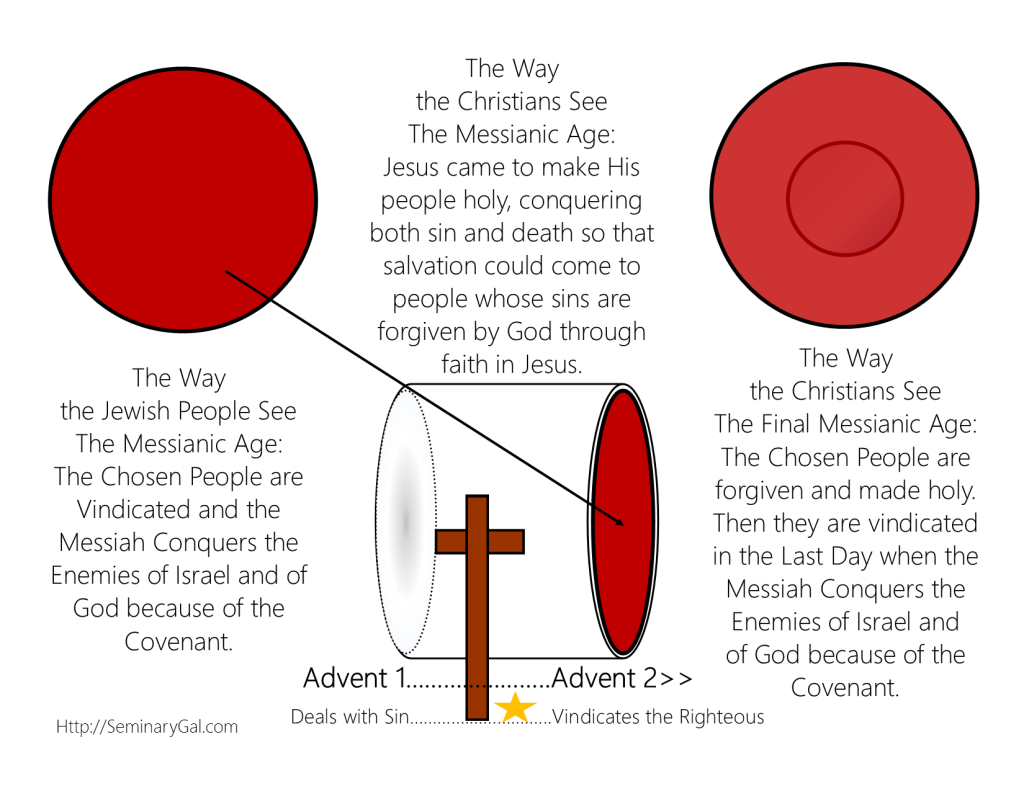
This time of restoration is the Advent which the Jews have eagerly anticipated: the one of refreshing, vindication, and judgment. Christians know this as the Second Advent, the Return of Christ.
The Jews have not been wrong to see that the ultimate coming of the Messianic King will be with a King who does not die. The fault can be found with not seeing—even after the explanation—that sin had to be wiped out in order for the restoration to happen.
Here’s the key though: we cannot wipe out sin on our own.
We need God to eradicate our sin’s consequences. We need Him to pay for the wrath we deserved.
That’s why Jesus had to come first as Perfect Sacrifice (Advent 1) before He could be pronounced by God as Lord and Savior (Ascension).
Interestingly, though, He’s been Lord and King through it all.
Repentance, our turning away from one direction (sin) and turning toward God, is necessary for the refreshing to occur. Jesus made that refreshing a reality in principle and turned sacrifice into Savior, just as God promised in the Scriptures. Whether that refreshing will apply to us depends entirely on what we do with the first Advent.
Questions for pondering:
- Why did I say that that refreshing is a “reality in principle” and not just say it was a reality? What distinguishes grace from universalism?
- What distinguishes what Jesus did on the Cross from what He does in our hearts? How do we get forgiveness applied to us?
- Do you long for refreshing, for restoration, and for forgiveness? What did Peter say is the answer to all that?
- Advent, which begins November 30th this year, offers a time—much as Lent does—for preparing our hearts to receive Him and to take His mission of salvation seriously. What might be some activities you can do to make Advent meaningful and not just a season of holiday shopping?
Carol Me, Christmas (2014 Advent Devotional Series) will begin November 30th. If you haven’t signed up yet, you can receive these devotional studies in your email throughout Advent 2014 by entering your email address on the SeminaryGal.com home page in the space provided in the sidebar. Or “Like” the SeminaryGal Facebook page to access them there.
Fulfilled and Foretold
But Jesus doesn’t look like the Messiah the Jews have been expecting!
In Acts 3, Peter’s sermon continues with an explanation for his Jewish hearers. First, he quickly summarizes the Gospel message and then he explains why Jesus is the long-awaited Messiah, just not the way they were expecting.
The Jews of Jesus’ day were expecting a Messiah who was a conquering King. All of their prophecy pointed to this fact. What they failed to see is that they wouldn’t want a Messiah who conquers kingdoms and vindicates the holy, righteous, and chosen ones as a once-and-done deal.
A once-and-done Eternal Judge isn’t what the Jews or any of us want. Why? Because none of the Jews were holy. None of them would be suitable for the eternal kingdom. None of us are. We need first to be made holy.
This is such an important point and a reason for Christians to continue to treat our Jewish brothers and sisters the way Peter, a Jew, did. Peter had an advantage: he was a Jew himself. Therefore it was easier for him to understand the Jewish perspective. It had been his own story. It’s why he could honestly say,
Acts 3:17 “Now, brothers, I know that you acted in ignorance, as did your leaders.
You see, it isn’t a matter of smart enough or clever enough. They cannot be faulted for “not getting it” before it was explained. With only a lens that showed a conquering King (see diagram below), they cannot be faulted for the eventual understanding that Messiahs don’t die. It’s what Christians expect of the Return of Christ! He won’t die. Been there. Done that.
Therefore, to the Jews who conflated both the first and final Advents, death was the ultimate disqualifier. The Jews had all their prophecies looking toward the very last moment of eternal vindication and a conquering King, not a Messiah who dies. With a view of only a final lens, they are absolutely correct: the Messiah will not die.
Why did Jesus die then?
Peter offers this wise corrective explaining the Crucifixion’s veracity and necessity as only a man who encountered Jesus could.
Acts 3:18 But this is how God fulfilled what he had foretold through all the prophets, saying that his Christ would suffer.
The suffering servant predicted in Isaiah is not just Israel.
The Suffering Servant is the Messiah.
Isaiah 49:1 Listen to me, you islands; hear this, you distant nations: Before I was born the LORD called me; from my birth he has made mention of my name. 2 He made my mouth like a sharpened sword, in the shadow of his hand he hid me; he made me into a polished arrow and concealed me in his quiver. 3 He said to me, “You are my servant, Israel, in whom I will display my splendor.” 4 But I said, “I have labored to no purpose; I have spent my strength in vain and for nothing. Yet what is due me is in the LORD’s hand, and my reward is with my God.” 5 And now the LORD says– he who formed me in the womb to be his servant to bring Jacob back to him and gather Israel to himself, for I am honored in the eyes of the LORD and my God has been my strength– 6 he says: “It is too small a thing for you to be my servant to restore the tribes of Jacob and bring back those of Israel I have kept. I will also make you a light for the Gentiles, that you may bring my salvation to the ends of the earth.” 7 This is what the LORD says– the Redeemer and Holy One of Israel– to him who was despised and abhorred by the nation, to the servant of rulers: “Kings will see you and rise up, princes will see and bow down, because of the LORD, who is faithful, the Holy One of Israel, who has chosen you.”8 This is what the LORD says: “In the time of my favor I will answer you, and in the day of salvation I will help you; I will keep you and will make you to be a covenant for the people, to restore the land and to reassign its desolate inheritances, 9 to say to the captives, ‘Come out,’ and to those in darkness, ‘Be free!’ “They will feed beside the roads and find pasture on every barren hill. 10 They will neither hunger nor thirst, nor will the desert heat or the sun beat upon them. He who has compassion on them will guide them and lead them beside springs of water. 11 I will turn all my mountains into roads, and my highways will be raised up.
All of us, both Jew and non-Jew, have been held captive to sin and death.
This is the real enemy of Jews and non-Jews!
Jesus came and conquered that by entering onto death’s battlefield and He defeated death by doing it and by being resurrected from it. Because of the Cross and the empty tomb, we can all be free to know the day of salvation as fulfilled and foretold.
Questions for pondering:
- What is the root of anti-Semitism among a distinct minority of Christians? Why do they do this when Jesus was Jewish? Most Christians are the Jews’ best friends.
- What is the root of anti-Semitism among Muslims? How is it different?
- How has a politicization of the nation state of Israel in the minds of many Westerners undermined our compassion for Jesus’ brothers and sisters in a Jewish sense?
- If Jesus had not come to deal with sin by dying during His first Advent, where would we all be? Would we still be sinners without salvation?
- The world and all our sinfulness crucified the Messiah. How might this acknowledgement serve to communicate compassion for Jews instead of blame?
- Nationalistic/Religious pride stands between people and their God. How does love break down that barrier?
- How might pointing to the entry to the Promised Land by faithful Jews (while those who failed to trust God died in the desert though they too were Jews by heritage) serve as a parallel to show that salvation is all about faith in God and trusting His means of entry?
Psalm 95:6 Come, let us bow down in worship, let us kneel before the LORD our Maker; 7 for he is our God and we are the people of his pasture, the flock under his care. Today, if you hear his voice, 8 do not harden your hearts as you did at Meribah, as you did that day at Massah in the desert, 9 where your fathers tested and tried me, though they had seen what I did. 10 For forty years I was angry with that generation; I said, “They are a people whose hearts go astray, and they have not known my ways.” 11 So I declared on oath in my anger, “They shall never enter my rest.”
Hebrews 3:15 As has just been said: “Today, if you hear his voice, do not harden your hearts as you did in the rebellion.” 16 Who were they who heard and rebelled? Were they not all those Moses led out of Egypt? 17 And with whom was he angry for forty years? Was it not with those who sinned, whose bodies fell in the desert? 18 And to whom did God swear that they would never enter his rest if not to those who disobeyed? 19 So we see that they were not able to enter, because of their unbelief. 4:1 Therefore, since the promise of entering his rest still stands, let us be careful that none of you be found to have fallen short of it. 2 For we also have had the gospel preached to us, just as they did; but the message they heard was of no value to them, because those who heard did not combine it with faith.
For those of you who would like more information on this subject, please feel free to contact me at seminarygal@gmail.com or read this article I posted in 2011, Top Ten Things I Wish Every Jew Knew.
 Finally, as a reminder, Carol Me, Christmas (2014 Advent Devotional Series) will begin November 30th. If you haven’t signed up yet, you can receive these devotional studies in your email throughout Advent 2014 by entering your email address on the SeminaryGal.com home page in the space provided in the sidebar. Or “Like” the SeminaryGal Facebook page to access them there.
All About Jesus
Acts 3:12 When Peter saw this, he said to them: “Men of Israel, why does this surprise you? Why do you stare at us as if by our own power or godliness we had made this man walk? 13 The God of Abraham, Isaac and Jacob, the God of our fathers, has glorified his servant Jesus. You handed him over to be killed, and you disowned him before Pilate, though he had decided to let him go. 14 You disowned the Holy and Righteous One and asked that a murderer be released to you. 15 You killed the author of life, but God raised him from the dead. We are witnesses of this. 16 By faith in the name of Jesus, this man whom you see and know was made strong. It is Jesus’ name and the faith that comes through him that has given this complete healing to him, as you can all see.
 Remember how we said that Peter and John went to the temple, not only to pray, but also to do evangelistic ministry? After the healing of the crippled man, people came running to see what had happened. It was a 1st century gaper’s delay. Everyone wanted a look to see what had happened.
By the time the crowd had formed, Peter was ready with a sermon. He deflects any credit for this man’s healing and says that really, it’s all about Jesus!
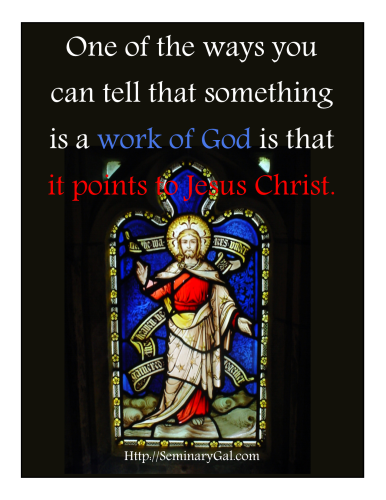
One of the ways you can tell that something is a work of God is that it points to Christ.
Peter gives a short summary of the Gospel message: Jesus was the foretold Messiah; He was crucified; He’s the Son of God who was killed; but God raised Him to life. And we are all witnesses.
Then he closes his message by saying that it’s all about Jesus.
Acts 3:16 By faith in the name of Jesus, this man whom you see and know was made strong. It is Jesus’ name and the faith that comes through him that has given this complete healing to him, as you can all see.
Questions for pondering:
- How often are we tempted to make everything all about us?
- There’s an airline with the slogan right now, “It’s All about You.” What does this appeal to in a human being? Does this glorify God or is it encouraging thoughts and actions that do not bring glory to God? Who receives all the attention and glory in such a slogan?
- If you had the opportunity, how well would you be able to summarize the Gospel message? What is the likelihood that you would share the Gospel with a crowd of people?
As a reminder, Carol Me, Christmas (2014 Advent Devotional Series) will begin November 30th. If you haven’t signed up yet, you can receive these devotional studies in your email throughout Advent 2014 by entering your email address on the SeminaryGal.com home page in the space provided in the sidebar. Or “Like” the SeminaryGal Facebook page to access them there.
Changed Lives Make Great Testimonies
 Acts 3:9 When all the people saw him walking and praising God, 10 they recognized him as the same man who used to sit begging at the temple gate called Beautiful, and they were filled with wonder and amazement at what had happened to him. 11 While the beggar held on to Peter and John, all the people were astonished and came running to them in the place called Solomon’s Colonnade.
Changed lives make great testimonies.
Each of us becomes changed when we encounter Jesus for salvation and He gives us new life. In each and every case, the inward change ought to be manifested outwardly.
Questions for pondering:
- When is the last time you were filled with wonder and amazed at something that happened to you?
- What changes have happened in your life? Do you still see these changes? Do other people see changes in your life?
- The Fruit of the Spirit describe some of the growth areas when a person becomes a follower of Jesus Christ. Galatians 5:22 “But the fruit of the Spirit is love, joy, peace, patience, kindness, goodness, faithfulness, 23 gentleness and self-control. Against such things there is no law.” If this is your measuring tool, are you finding yourself growing or stagnant?
- If you’re at a standstill, what do these Scriptures say about how to grow or resume growing? 2 Timothy 3:16 “All Scripture is God-breathed and is useful for teaching, rebuking, correcting and training in righteousness, 17 so that the man of God may be thoroughly equipped for every good work.” Philippians 4:9 “Whatever you have learned or received or heard from me, or seen in me– put it into practice. And the God of peace will be with you.” Matthew 7:24 “Therefore everyone who hears these words of mine and puts them into practice is like a wise man who built his house on the rock. 25 The rain came down, the streams rose, and the winds blew and beat against that house; yet it did not fall, because it had its foundation on the rock.
As a reminder, Carol Me, Christmas (2014 Advent Devotional Series) will begin November 30th. If you haven’t signed up yet, you can receive these devotional studies in your email throughout Advent 2014 by entering your email address on the SeminaryGal.com home page in the space provided in the sidebar. Or “Like” the SeminaryGal Facebook page to access them there.
Carol Me, Christmas! (Advent 2014 Devotional Series)
Important update: Last year’s devotional series, Carol Me, Christmas! remains a popular offering. You can access all of the numbered devotionals from 2014 via the archives (at the right). They began November 30, 2014. The daily devotionals for the 2015 season are titled Incarnation and involve digging deep in this important point of Christian theology. The email devotionals will be the current year only, but 2014 Carol Me Christmas! devotionals are available to you year-round through the archives! Thank you for your encouragement and I wish you the merriest Christmas ever!
===
Whether you’re someone who loves hymns or prefers popular praise music, chances are good that you still love Christmas carols. Their standing as favorite songs across Christians of all ages testifies to their timeless nature. But something you may not know is that many of them are deeply theological.
Announcing Seminary Gal’s Devotional Series for Advent 2014 entitled Carol Me, Christmas! In this series, we will take a look at how the Christmas story is told from anticipation to proclamation through our most beloved Christmas carols. Advent begins November 30, 2014 and continues to Christmas Day. You can have a song in your heart each day throughout Advent!
If you are already signed up for the email connection, you don’t have to do anything. These devotions of rich theological explanation will arrive in your in-box.
If you haven’t signed up yet, you can receive these devotional studies in your email throughout Advent 2014 by entering your email address on the SeminaryGal.com home page in the space provided in the sidebar. Or “Like” the SeminaryGal Facebook page to access them there.
O Come All Ye Faithful…
===note: You will find all the Carol Me, Christmas items archived beginning in November 2014.
Do You Believe in Miracles?
Acts 3: 2 Now a man crippled from birth was being carried to the temple gate called Beautiful, where he was put every day to beg from those going into the temple courts. 3 When he saw Peter and John about to enter, he asked them for money. 4 Peter looked straight at him, as did John. Then Peter said, “Look at us!” 5 So the man gave them his attention, expecting to get something from them. 6 Then Peter said, “Silver or gold I do not have, but what I have I give you. In the name of Jesus Christ of Nazareth, walk.” 7 Taking him by the right hand, he helped him up, and instantly the man’s feet and ankles became strong. 8 He jumped to his feet and began to walk. Then he went with them into the temple courts, walking and jumping, and praising God.
Sometimes God is so good that He gives us what we need instead of what we want.
Such is the case for the man who had been crippled from birth. Money and begging were temporary solutions to a permanent problem of being unable to work because of the permanent problem of being crippled his whole life.
The man did not get carried to the temple with the idea of his being healed. He was carried there by someone else in order to beg. It’s what people can do in human strength.
Peter and John, having gone to the temple to pray and to do ministry were empowered by the Holy Spirit to heal this man’s physical condition. As disciples of Jesus Christ, they would have witnessed many healing miracles during Jesus’ ministry.
John 14: 11 “Believe me when I say that I am in the Father and the Father is in me; or at least believe on the evidence of the miracles themselves. 12 I tell you the truth, anyone who has faith in me will do what I have been doing. He will do even greater things than these, because I am going to the Father. 13 And I will do whatever you ask in my name, so that the Son may bring glory to the Father. 14 You may ask me for anything in my name, and I will do it.”
Matthew 18:20 “For where two or three come together in my name, there am I with them.”
The point of this healing was not the healing. It was to authenticate the Good News so that the Son may bring glory to the Father.
Questions for pondering:
- What is your reaction to the faith healers you see on TV?
- Do those examples bring glory to the Father and to the Son, or do they more often point to the personality doing the healings?
- Have you ever prayed for healing of some type? How do you reconcile today’s passage with this passage? 2 Corinthians 12:7 “To keep me from becoming conceited because of these surpassingly great revelations, there was given me a thorn in my flesh, a messenger of Satan, to torment me. 8 Three times I pleaded with the Lord to take it away from me. 9 But he said to me, “My grace is sufficient for you, for my power is made perfect in weakness.” Therefore I will boast all the more gladly about my weaknesses, so that Christ’s power may rest on me. 10 That is why, for Christ’s sake, I delight in weaknesses, in insults, in hardships, in persecutions, in difficulties. For when I am weak, then I am strong.”
- Are healings guaranteed to happen and to last?
- Al Michaels has a new book coming out entitled, You Can’t Make This Up: Miracles, Memories, and the Perfect Marriage of Sports and Television but it’s not really about miracles. It’s about Michaels’ career. The miracles reference in the title comes from the final moments of the U.S. – U.S.S.R hockey game (1980), popularly known as the “Miracle on Ice.” Michaels and Ken Dryden were broadcasting the game. As the game wound down to a close in the U.S.’ 4-3 upset, Michaels called out, “Eleven seconds, you’ve got 10 seconds, the countdown going on right now! Morrow up to Silk. Five seconds left in the game. Do you believe in miracles? … Yes!” What is the difference between a happy conclusion of long odds and a genuine miracle?