Once in Royal David’s City (Advent 23-2014)
As we continue our Carol Me, Christmas (2014 Advent Devotional Series), we are in Bethlehem and seeing the Christ Child as the story of Christmas unfolds. Once in Royal David’s City points to that royal city Bethlehem where both Joseph and Mary, both from the line of David, would register for the census. Mary was over 12 years old, the legal age to be taxed. She had to go to Bethlehem too. She had to go personally and couldn’t leave the responsibility to Joseph to whom she was “pledged to be married.”
Luke 2:1 In those days Caesar Augustus issued a decree that a census should be taken of the entire Roman world. 2 (This was the first census that took place while Quirinius was governor of Syria.) 3 And everyone went to his own town to register. 4 So Joseph also went up from the town of Nazareth in Galilee to Judea, to Bethlehem the town of David, because he belonged to the house and line of David. 5 He went there to register with Mary, who was pledged to be married to him and was expecting a child. 6 While they were there, the time came for the baby to be born, 7 and she gave birth to her firstborn, a son. She wrapped him in cloths and placed him in a manger, because there was no room for them in the inn.
Mary and Joseph were legal citizens of the province of Syria, the part of the Roman Empire in which Palestine was located. Mary and Joseph were both from the line of David, as were their parents. One can only assume that since everyone went to his own town to register, both Joseph’s and Mary’s parents and their families would have been participating in the legal census too, especially since they were likely righteous Jews, having raised devout and observant children.
The fact that there was “no room” at the inn suggests that neither Mary nor Joseph were any longer welcomed by their families. After all, what kind of parents would allow their pregnant daughter to sleep in the cold if they had a room at the inn to share?
Righteous and observant doesn’t necessarily mean faithful in the eyes of God. Sometimes people don’t and won’t understand that God does things in ways incomprehensible to us. And that’s because our brains are far too small—even the smartest among us—to fathom the miraculous of God.
Instead, shepherds—the lowest of the pecking order—get it. They hear the news. They believe. Meanwhile we have no record of Mary’s or Joseph’s parents ever coming to see this baby, Mary’s parents’ grandchild and Joseph’s parents’ presumed grandchild. If the silence of Scripture is an indication, the Messiah comes—the One these righteous people would have been waiting for—and they miss it. Completely.
Luke 18:10 “Two men went up to the temple to pray, one a Pharisee and the other a tax collector. 11 The Pharisee stood up and prayed about himself: ‘God, I thank you that I am not like other men– robbers, evildoers, adulterers– or even like this tax collector. 12 I fast twice a week and give a tenth of all I get.’ 13 “But the tax collector stood at a distance. He would not even look up to heaven, but beat his breast and said, ‘God, have mercy on me, a sinner.’ 14 “I tell you that this man, rather than the other, went home justified before God. For everyone who exalts himself will be humbled, and he who humbles himself will be exalted.” 15 People were also bringing babies to Jesus to have him touch them. When the disciples saw this, they rebuked them. 16 But Jesus called the children to him and said, “Let the little children come to me, and do not hinder them, for the kingdom of God belongs to such as these. 17 I tell you the truth, anyone who will not receive the kingdom of God like a little child will never enter it.”
Is it coincidence that Jesus says we need to have a childlike faith immediately after an example of the self-righteous and the self-abased? This childlike faith is what Mrs. Cecil Frances Alexander’s poem Once in Royal David’s City (first published in 1848) talks about.
As you listen to this version by Ecclesium consider the Thought Focus for Today.
Thought Focus for Today: The same God who says, “’Come now, let us reason together,’ says the LORD. ‘Though your sins are like scarlet, they shall be as white as snow; though they are red as crimson, they shall be like wool’” (Isaiah 1:18) also tells us to demonstrate childlike faith that simply and humbly believes. Where are you today? Is it possible to spend so much time attempting to reason out the miraculous that we might miss the Miracle of Christ Jesus?
 Once in royal David’s city,
Stood a lowly cattle shed,
Where a mother laid her Baby,
In a manger for His bed:
Mary was that mother mild,
Jesus Christ, her little Child.
He came down to earth from heaven,
Who is God and Lord of all,
And His shelter was a stable,
And His cradle was a stall:
With the poor, and mean, and lowly,
Lived on earth our Savior holy.
For He is our childhood’s pattern;
Day by day, like us, He grew;
He was little, weak, and helpless,
Tears and smiles, like us He knew;
And He cares when we are sad,
And he shares when we are glad.
And our eyes at last shall see Him,
Through His own redeeming love;
For that Child so dear and gentle,
Is our Lord in heaven above:
And He leads His children on,
To the place where He is gone.
====
Carol Me, Christmas (2014 Advent Devotional Series) began November 30th. By way of reminder, if you haven’t signed up yet, you can receive these devotional studies in your email throughout Advent 2014 by entering your email address on the SeminaryGal.com home page in the space provided in the sidebar. Or “Like” the SeminaryGal Facebook page to access them there. If you like these devotionals, I’d really appreciate your letting others know so I can continue to spread the Good News far and wide. Blessings to you, in Christ always, Barbara <><
O Come All Ye Faithful (Advent 21-2014)
Everything sounds more theological in Latin. Today’s Carol Me, Christmas (2014 Advent Devotional Series) hymn, O Come All Ye Faithful (also known as Adeste Fideles), is no exception. I remember singing it in our high school choir…in Latin. I especially liked singing Venite adoremus Dominum.
O Come All Ye Faithful is attributed to John F. Wade with the English translation by Frederick Oakeley and William T. Brooke among others. The scene depicted in this carol is that of the angels having announced the birth of the Christ to the shepherds,
Luke 2:15 So it was, when the angels had gone away from them into heaven, that the shepherds said to one another, “Let us now go to Bethlehem and see this thing that has come to pass, which the Lord has made known to us.”
Some authors report that this was not designed as a pilgrimage to Bethlehem, but rather a carefully decipherable call to revolt by Wade, a Catholic exiled in France, to fellow faithful Jacobeans in exile to rise up against the English throne which was oppressing Catholics of the day. Personally, I find this fairly incongruous with the plain words of the song. Some people just can’t stand to let Jesus be worshiped without politicizing the whole thing.
The tune itself is regal and almost like a march, suitable for a pilgrimage. It has been attributed to John Wade, or John Reading, as well as to Simao Portogallo which gives rise to another name for this hymn as being The Portuguese Hymn.
All of this said, the lyrics fit with the biblical story, but not for today. Theologically speaking, Christianity is one religion in which pilgrimages no longer happen. God would want it that way. In the flow of Scripture, we don’t have Noah’s ark, the original copies of the Ten Commandments, the budded staff of Aaron, the golden jar of manna, or the Ark of the Covenant. We don’t have Moses’ basket or the bronze snake. We don’t have the stones lifted out of the River Jordan as a memorial. We don’t have a Ripley’s Wax Museum marking the exact spot where the Christ Child was laid in the manger, which is a good thing because that’s kind of creepy.
Why wouldn’t God want us going to Bethlehem in a pilgrimage?
Jesus is Emmanuel, God with us. Christianity is the only religion in which God reached down for us and came to us, Himself, to save us. That’s what Christ, Messiah, means.
Isaiah 9:6 For unto us a Child is born, Unto us a Son is given; And the government will be upon His shoulder. And His name will be called Wonderful, Counselor, Mighty God, Everlasting Father, Prince of Peace. 7 Of the increase of His government and peace There will be no end, Upon the throne of David and over His kingdom, To order it and establish it with judgment and justice From that time forward, even forever. The zeal of the LORD of hosts will perform this.
As you ponder our Thought Focus for Today and listen to the Christmas Eve Service of Eucharist at Westminster Abbey, remind yourself about how wonderful it is that God accomplished for us what no human pilgrimage ever could.
Thought Focus for Today: We don’t need to go on pilgrimages in a physical sense to worship God: Father, Son, and Holy Spirit. How can Christians go on a spiritual pilgrimage without ever leaving home?
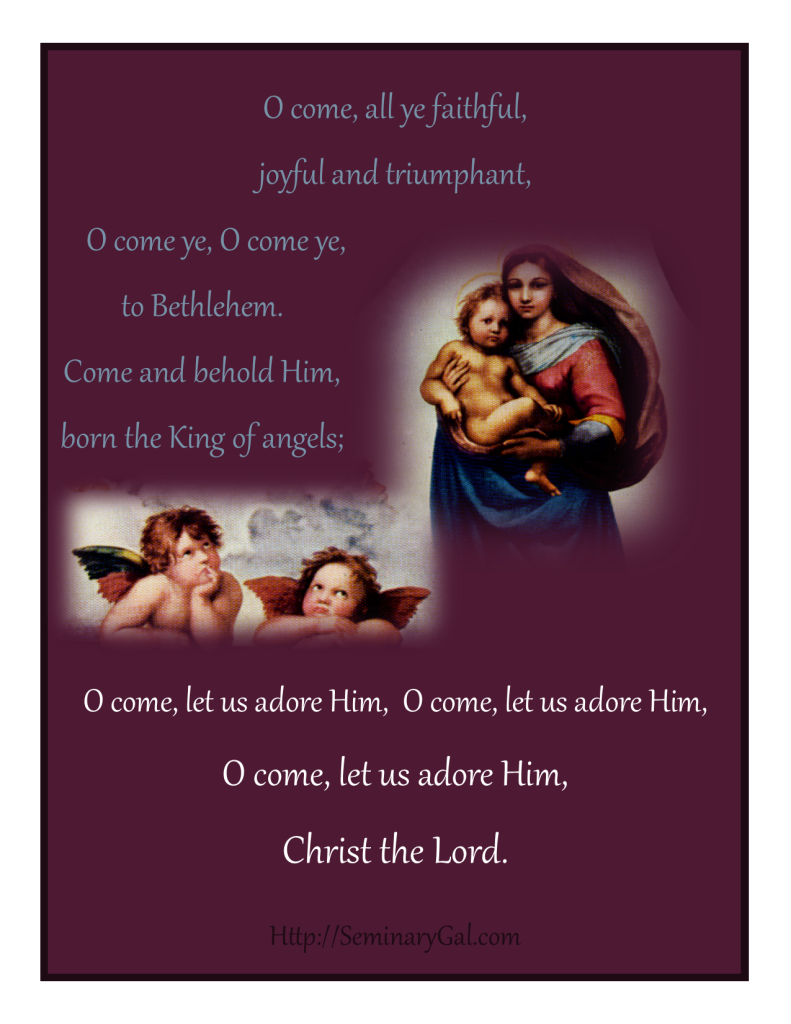 O come, all ye faithful, joyful and triumphant,
O come ye, O come ye, to Bethlehem.
Come and behold Him, born the King of angels;
Refrain
O come, let us adore Him,
O come, let us adore Him,
O come, let us adore Him,
Christ the Lord.
True God of true God, Light from Light Eternal,
Lo, He shuns not the Virgin’s womb;
Son of the Father, begotten, not created;
Refrain
Sing, choirs of angels, sing in exultation;
O sing, all ye citizens of heaven above!
Glory to God, all glory in the highest;
Refrain
See how the shepherds, summoned to His cradle,
Leaving their flocks, draw nigh to gaze;
We too will thither bend our joyful footsteps;
Refrain
Lo! star led chieftains, Magi, Christ adoring,
Offer Him incense, gold, and myrrh;
We to the Christ Child bring our hearts’ oblations.
Refrain
Child, for us sinners poor and in the manger,
We would embrace Thee, with love and awe;
Who would not love Thee, loving us so dearly?
Refrain
Yea, Lord, we greet Thee, born this happy morning;
Jesus, to Thee be glory given;
Word of the Father, now in flesh appearing.
Refrain
=====
Carol Me, Christmas (2014 Advent Devotional Series) began November 30th. By way of reminder, if you haven’t signed up yet, you can receive these devotional studies in your email throughout Advent 2014 by entering your email address on the SeminaryGal.com home page in the space provided in the sidebar. Or “Like” the SeminaryGal Facebook page to access them there. If you like these devotionals, I’d really appreciate your letting others know so I can continue to spread the Good News far and wide. Blessings to you, in Christ always, Barbara <><
Away in a Manger (Advent 19-2014)
Yesterday, in our Carol Me, Christmas (2014 Advent Devotional Series), I suggested that carols could be used as theological education for children. Just don’t use this one.
Away in a Manger is a favorite of adults and children alike (despite its being wrong on two counts):
- Its attributed subtitle as Luther’s Cradle Hymn
- Its theology as a whole
That said, the little lullaby tune combined with sweet baby lyrics makes it a popular choice for children’s programs and Christmas pageants.
Let’s just be blunt: there is no way that Martin Luther–the same guy of 15 verses yesterday of pristine theology–would have written 2-3 verses of something so inaccurate.
Some people have suggested that it was written for the anniversary of Luther’s birth with his name thrown in as a marketing plus, but either way, it was first published as two verses in Evangelical Lutheran Sunday School collection, Little Children’s Book for Schools and Families. The Lutherans love Luther so much that perhaps these wanted to find him everywhere including in the Cradle Hymn. Kind of like how Baptists find Satan under every rock and in the vast majority of US political offices. (Aw, go ahead, insert a wink and a smile here. Christians can laugh at ourselves without going to hell.)
Why do I say that the theology is inaccurate?
The cattle are lowing, the Baby awakes,
But little Lord Jesus, no crying He makes;
Frankly, the little Lord Jesus did not wake up and say to his mother, the virgin Mary, in a calm soothing God-voice
Verily I say unto thee, I have food to eat that you don’t know about.”
Because Lord knows, the Son of God never had a dirty diaper (insert sarcasm here). This is patently ridiculous. Crying is not a sin! Crying is how babies talk and Jesus was as human a baby as any other baby born in the completely natural way. His conception in Mary’s womb by the Spirit of God was the only miracle here.
Luke 1:35 The angel answered, “The Holy Spirit will come upon you, and the power of the Most High will overshadow you. So the holy one to be born will be called the Son of God. 36 Even Elizabeth your relative is going to have a child in her old age, and she who was said to be barren is in her sixth month. 37 For nothing is impossible with God.”
Jesus was not a miracle baby who never cried, always slept through the night, and never had diaper issues. He probably experienced teething pain, coughs, colds and flu during the span of His life. He didn’t spoil His mother Mary by giving her an impossible frame of reference for her other children who would come after Him to fail to achieve. Jesus was not superhuman. He was human. He only added complete humanity to His already complete divinity.
It’s not just a minor theological point. It’s central.
But Away in a Manger is a cute song. It’s cute when kids sing it and they love this one. If you’re on the English side of the pond, the tune is one by William J. Kirkpatrick Cradle Song (1895) which was an adaptation of another known as Sweet Afton, and if you’re on the American side of the pond, the one most commonly used is James R. Murray’s Mueller (1887). Some hymnals are bi-polar and include both variations.
As you read through the lyrics below, enjoy this Kirkpatrick version sung by children dressed in festive red and green with red Santa hats and Santa playing piano, and ponder our Thought Focus for Today.
Thought Focus for Today: Why is it theologically important that Jesus was fully human and yet, not some superhuman being?
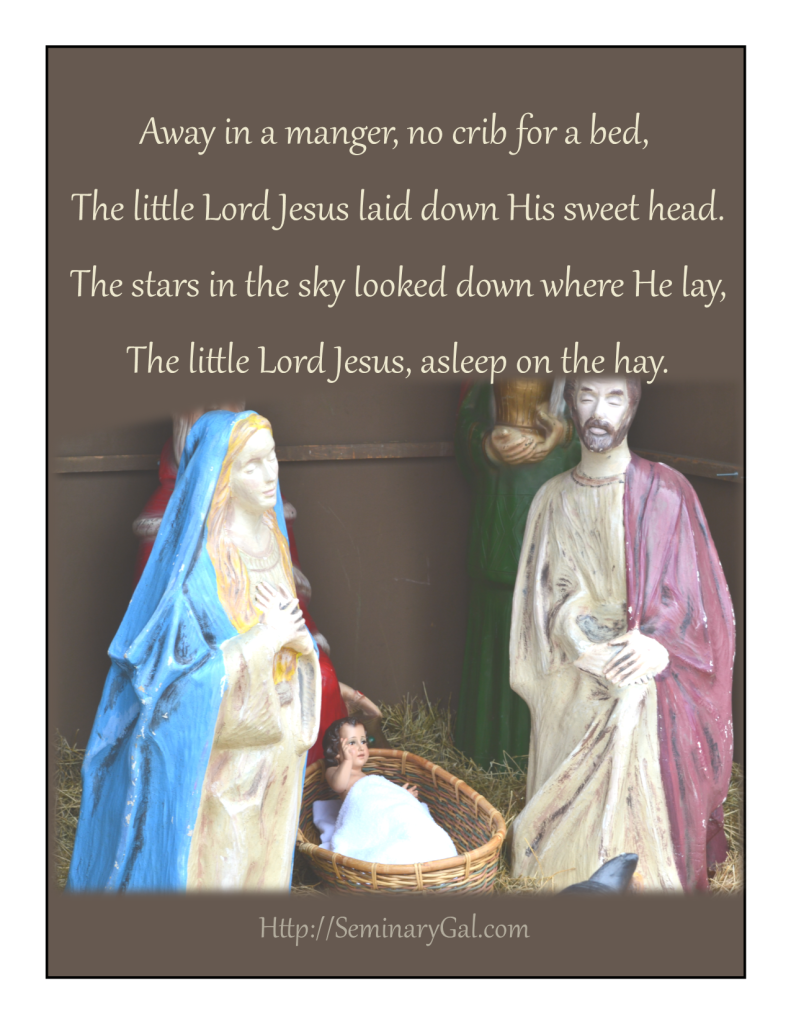 Away in a manger, no crib for a bed,
The little Lord Jesus laid down His sweet head.
The stars in the sky looked down where He lay,
The little Lord Jesus, asleep on the hay.
The cattle are lowing, the Baby awakes,
But little Lord Jesus, no crying He makes;
I love Thee, Lord Jesus, look down from the sky
And stay by my cradle till morning is nigh.
Be near me, Lord Jesus, I ask Thee to stay
Close by me forever, and love me, I pray;
Bless all the dear children in Thy tender care,
And fit us for Heaven to live with Thee there.
=====
Carol Me, Christmas (2014 Advent Devotional Series) began November 30th. By way of reminder, if you haven’t signed up yet, you can receive these devotional studies in your email throughout Advent 2014 by entering your email address on the SeminaryGal.com home page in the space provided in the sidebar. Or “Like” the SeminaryGal Facebook page to access them there. If you like these devotionals, I’d really appreciate your letting others know so I can continue to spread the Good News far and wide. Blessings to you, in Christ always, Barbara <><
From Heaven Above to Earth I Come (Advent 18-2014)
Today’s carol in our Carol Me, Christmas (2014 Advent Devotional Series) is less familiar to me. Perhaps that’s because it was written by Martin Luther and A Mighty Fortress is Our God eclipses his other hymns outside of Lutheran circles.
From Heaven Above to Earth I Come was written by Martin Luther (yes, of Reformation fame) for family devotionals. It is said Luther wrote this carol especially for his five year old son Hans and was performed a man dressed up as an angel (or sung by the parents) pronouncing the opening verses that one would expect would be straight out of Scripture. (After all, this is Martin Luther we’re talking about. Mr. Sola Scriptura—by Scripture alone!)
Luke 2:1 In those days Caesar Augustus issued a decree that a census should be taken of the entire Roman world. 2 (This was the first census that took place while Quirinius was governor of Syria.) 3 And everyone went to his own town to register. 4 So Joseph also went up from the town of Nazareth in Galilee to Judea, to Bethlehem the town of David, because he belonged to the house and line of David. 5 He went there to register with Mary, who was pledged to be married to him and was expecting a child. 6 While they were there, the time came for the baby to be born, 7 and she gave birth to her firstborn, a son. She wrapped him in cloths and placed him in a manger, because there was no room for them in the inn. 8 And there were shepherds living out in the fields nearby, keeping watch over their flocks at night. 9 An angel of the Lord appeared to them, and the glory of the Lord shone around them, and they were terrified. 10 But the angel said to them, “Do not be afraid. I bring you good news of great joy that will be for all the people. 11 Today in the town of David a Savior has been born to you; he is Christ the Lord. 12 This will be a sign to you: You will find a baby wrapped in cloths and lying in a manger.” 13 Suddenly a great company of the heavenly host appeared with the angel, praising God and saying, 14 “Glory to God in the highest, and on earth peace to men on whom his favor rests.” 15 When the angels had left them and gone into heaven, the shepherds said to one another, “Let’s go to Bethlehem and see this thing that has happened, which the Lord has told us about.” 16 So they hurried off and found Mary and Joseph, and the baby, who was lying in the manger. 17 When they had seen him, they spread the word concerning what had been told them about this child, 18 and all who heard it were amazed at what the shepherds said to them.
According to the Virginia Lutherans ELCA,
This Christmas hymn is Luther’s own composition, dated around 1535 when Luther’s own children would have been old enough to sing. The scholarly conjecture is that the hymn originated in Luther’s family devotion, with the part of the angels in verses one to five being sung by the parents, individual children singing the various verses eight through fourteen, and all together singing verse seven and fifteen (LW 53: 267). Luke’s depiction of the angels’ proclamation of the good news to the shepherds structures the first part. Thus the parents lead the children to sing their parts to the Christ‐child by concluding the introductory verses with the exhortation of the shepherds in verse six “to go and see this thing which the Lord has made known.” The hymn concludes with all voices joining the angels in the praise of God.
This carol was sung not only for the annual Christmas Eve festival at the Luther home, but 4 years later would be published to a folk tune and then to the one written by Luther himself, Vom Himmel hoch, da komm’ ich her. Variations on this tune were written by Johann Sebastian Bach and the carol itself was later translated for us into English in 1855 by Catherine Winkworth (who we’ve seen before as a great translator of the German chorale tradition for English audiences).
While present in a few hymnals in all fifteen verses (!), the only hymnals that I have even containing this carol will include only the 4 verses highlighted below.
As you read all 15 verses, listen to this version on double-bass by deaf performer Hector Tirado and ponder our Thought Focus for Today.
Thought Focus for Today: Here we see a prime example of how Christmas carols can teach the Bible. How might you do family devotions (especially for children) using Christmas carols?
 1. “From heaven above to earth I come
To bear good news to every home;
Glad tidings of great joy I bring,
Whereof I now will say and sing:
2. “To you this night is born a child
Of Mary, chosen virgin mild;
This little child, of lowly birth,
Shall be the joy of all the earth.
3. “This is the Christ, our God and Lord,
Who in all need shall aid afford;
He will Himself your Savior be
From all your sins to set you free.
4. “He will on you the gifts bestow
Prepared by God for all below,
That in His kingdom, bright and fair,
You may with us His glory share.
5. “These are the tokens ye shall mark:
The swaddling-clothes and manger dark;
There ye shall find the Infant laid
By whom the heavens and earth were made.”
6. Now let us all with gladsome cheer
Go with the shepherds and draw near
To see the precious gift of God,
Who hath His own dear Son bestowed.
7. Give heed, my heart, lift up thine eyes!
What is it in yon manger lies?
Who is this child, so young and fair?
The blessed Christ-child lieth there.
8. Welcome to earth, Thou noble Guest,
Through whom the sinful world is blest!
Thou com’st to share my misery;
What thanks shall I return to Thee?
9. Ah, Lord, who hast created all,
How weak art Thou, how poor and small,
That Thou dost choose Thine infant bed
Where humble cattle lately fed!
10. Were earth a thousand times as fair,
Beset with gold and jewels rare,
It yet6 were far too poor to be
A narrow cradle, Lord, for Thee.
11. For velvets soft and silken stuff
Thou hast but hay and straw so rough,
Whereon Thou, King, so rich and great,
As ’twere Thy heaven, art throned in state.
12. And thus, dear Lord, it pleaseth Thee
To make this truth quite plain to me,
That all the world’s wealth, honor, might,
Are naught and worthless in Thy sight.
13. Ah, dearest Jesus, holy Child,
Make Thee a bed, soft, undefiled,
Within my heart, that it may be
A quiet chamber kept for Thee.
14. My heart for very joy doth leap,
My lips no more can silence keep;
I, too, must sing with joyful tongue
That sweetest ancient cradle-song:
15. Glory to God in highest heaven,
Who unto us His Son hath given!
While angels sing with pious mirth
A glad new year to all the earth.
=====
Carol Me, Christmas (2014 Advent Devotional Series) began November 30th. By way of reminder, if you haven’t signed up yet, you can receive these devotional studies in your email throughout Advent 2014 by entering your email address on the SeminaryGal.com home page in the space provided in the sidebar. Or “Like” the SeminaryGal Facebook page to access them there. If you like these devotionals, I’d really appreciate your letting others know so I can continue to spread the Good News far and wide. Blessings to you, in Christ always, Barbara <><
O Holy Night (Advent 17-2014)
Continuing our theme of the holy night (with holiness meaning set apart) today’s selection in Carol Me, Christmas (2014 Advent Devotional Series) is O Holy Night, known also as Cantique de Noël. The words in the original French poem by Placide Cappeau would be literally translated as:
Midnight, Christians, it is the solemn hour,
When God as man descended unto us
To erase the stain of original sin
And to end the wrath of His Father.
The entire world thrills with hope
On this night that gives it a Saviour.
People kneel down, wait for your deliverance.
Christmas, Christmas, here is the Redeemer,
Christmas, Christmas, here is the Redeemer!
May the ardent light of our Faith
Guide us all to the cradle of the infant,
As in ancient times a brilliant star
Guided the Oriental kings there.
The King of Kings was born in a humble manger;
O mighty ones of today, proud of your greatness,
It is to your pride that God preaches.
Bow your heads before the Redeemer!
Bow your heads before the Redeemer!
The Redeemer has broken every bond:
The Earth is free, and Heaven is open.
He sees a brother where there was only a slave,
Love unites those that iron had chained.
Who will tell Him of our gratitude
For all of us He is born, He suffers and dies.
People stand up! Sing of your deliverance,
Christmas, Christmas, sing of the Redeemer,
Christmas, Christmas, sing of the Redeemer!
These lyrics are beautiful and yet ironic. Here’s why: Cappeau was invited by a parish priest in Roquemaure to write a poem because Cappeau was a home town favorite as an occasional poet and wine merchant. You’d never know given the beauty of the poem that Cappeau was both anticlerical and an atheist according to published reports. He was also an abolitionist and there is a hint in verse 3 of his passion in that area.
Truly He taught us to love one another;
His law is love and His gospel is peace.
Chains shall He break
for the slave is our brother;
And in His name all oppression shall cease.
To add further intrigue, the musical composer, Adolphe Adam, was kind of a carousing sort and best remembered for Giselle (a ballet dating to 1841). He was considered a rogue because of his lifestyle and his compositions for light and comedic opera. Consequently, many churches shunned this carol as inappropriate due to Adam’s wild living. Nevertheless, the carol premiered in Roquemaure in 1847.
Oh, but we’re not done. The most common translation into English was done by John Sullivan Dwight who was another Unitarian pastor with the resulting lyrics talking about Jesus as the Christ. The Unitarians do not believe that Jesus is God so either Dwight did a translation without believing a word of it, or maybe he didn’t adhere closely to Unitarian teachings.
Here is his translation.
O holy night!
The stars are brightly shining
It is the night of our dear Saviour’s birth
Long lay the world in sin and error pining
‘Til He appear’d and the soul felt its worth
A thrill of hope the weary world rejoices
For yonder breaks a new and glorious morn
Fall on your knees!
O hear the angel voices!
O night divine,
O night when Christ was born;
O night divine, O night,
O night Divine.
Led by the light of Faith serenely beaming
With glowing hearts by His cradle we stand
So led by light of a star sweetly gleaming
Here come the wise men from Orient land.
The King of Kings lay thus in lowly manger;
In all our trials born to be our friend.
He knows our need,
our weakness is no stranger,
Behold your King!
Before Him lowly bend!
Behold your King,
Before Him lowly bend!
Truly He taught us to love one another;
His law is love and His gospel is peace.
Chains shall He break
for the slave is our brother;
And in His name all oppression shall cease.
Sweet hymns of joy in grateful chorus raise we,
Let all within us praise His holy name.
Christ is the Lord!
O praise His Name forever,
His power and glory evermore proclaim
His power and glory evermore proclaim.
This brings us to a really important point for us today. What makes music sacred? Is it the lyrics? Is it the tune? Is it the meter or beat of the music? Must the people writing it be Christians? What kind of litmus test must we place upon their lives in order to judge whether they’re sufficiently Christian in their practice as well as in their theology? Does the spirit of the music still speak, just differently for those who have the Spirit of Christ dwelling in them?
1 Corinthians 2:14 But the natural man does not receive the things of the Spirit of God, for they are foolishness to him; nor can he know them, because they are spiritually discerned.
When I was in seminary, we were required to do a cross-cultural field education experience and I begged to break with traditional field eds and to do my 13 week cross-cultural experience by attending Shabbat services at our local Reform Jewish synagogue. It was a real highlight of my time at seminary. The rabbi’s wife, who was also Jewish, taught the New Testament at a local seminary that was more liberal than where I was being educated. I remember talking with the rabbi and asking him,
How is that possible?
He said she could teach what the words on a page say without believing a word of its veracity in her life. As I began to ponder that, I figured it’s the flip side of my telling you what Unitarians believe without agreeing with them.
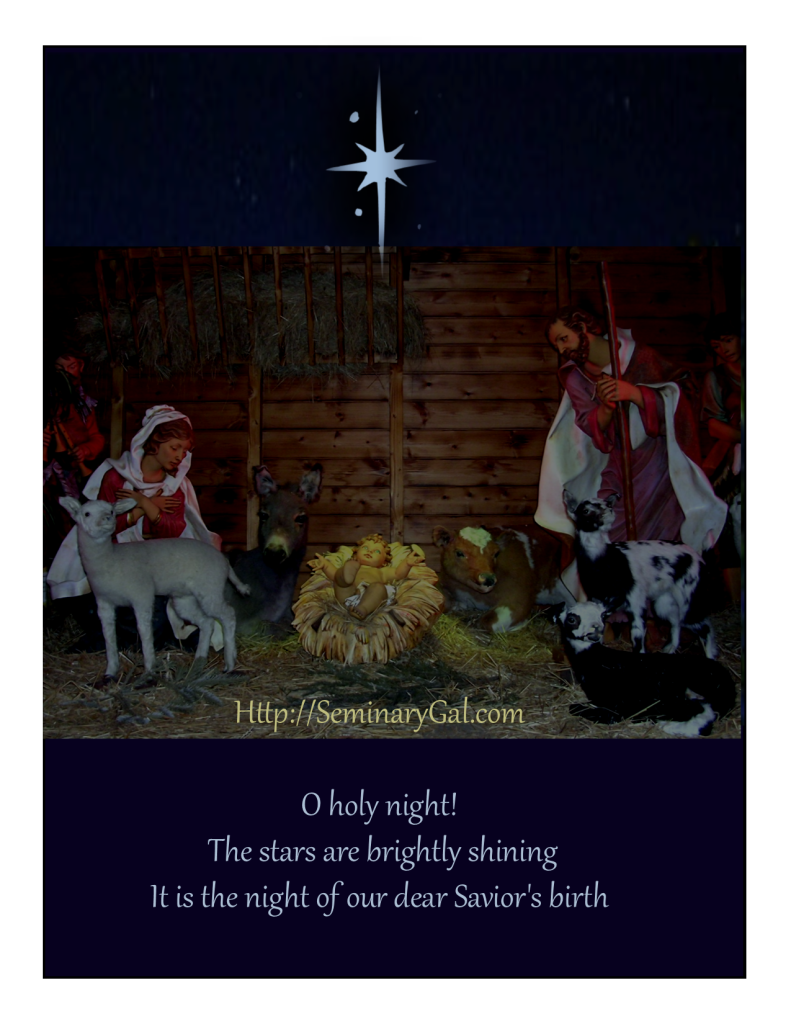 All of this to say that this hymn might not be in many hymnals and the rationale may be varied by the hymnbook editors, but it’s still a lovely poem. It does point to holiness, to the Christ as the Kings of Kings and of His Lordship. To His birth as what we celebrate at Christmas. It’s a night Divine, a holy night. Sure, it’s got the wise men coming to the manger, but it’s not the only hymn that did that and those are hymns that we include without a second thought.
As you listen to Sam Tsui on piano accompanied by Yasmeen Al-Mazeedi on violin, reflect upon our Thought Focus for today and reread the two sets of lyrics above.
Thought Focus for Today:
What makes a carol sufficiently religious for Christmas?
=====
Carol Me, Christmas (2014 Advent Devotional Series) began November 30th. By way of reminder, if you haven’t signed up yet, you can receive these devotional studies in your email throughout Advent 2014 by entering your email address on the SeminaryGal.com home page in the space provided in the sidebar. Or “Like” the SeminaryGal Facebook page to access them there. If you like these devotionals, I’d really appreciate your letting others know so I can continue to spread the Good News far and wide. Blessings to you, in Christ always, Barbara <><
Silent Night Holy Night (Advent 16-2014)
Today’s carol in our Carol Me, Christmas (2014 Advent Devotional Series) is arguably the all-time favorite Christmas carol of many people. It’s often sung as the final song at Christmas Eve services to the glow of handheld candles. It’s beautiful. It’s peaceful. It’s sentimental. It’s Silent Night, Holy Night.
I don’t want to be the one to destroy all the romanticized stories regarding its origin. So I’ll let hymns and carols of Christmas.com break the news.
The traditional story is that Rev. Josef Mohr (1792-1848) and Franz Xaver Gruber (1787-1863) wrote it in Oberndorf, Austria, on Christmas Eve when they discovered the church organ was damaged (different versions say it rusted out, or mice chewed through vital parts3). Charming as those stories are, they are fiction. In fact, in a letter written by Franz Gruber, son of the composer, he noted that “During the time when my father was the organist of the church of St Nikola, there was a very poor almost unusable organ there. This may well explain why the Reverend Mohr preferred to accompany the carol on a well-tuned guitar than on an off-pitch organ.”
An old manuscript has reportedly been discovered that shows Rev. Mohr wrote the lyrics in 1816, and that Franz Gruber wrote the score two years later at Rev. Mohr’s request (the manuscript is now located at the Salzburg Museum, Carolino Augusteum; unfortunately, the English version has disappeared). Mohr never said what his inspiration was. Gruber did not disclose why Mohr made the request to add music to the poem (and you can safely disregard as purest fiction any stories about Mohr walking through the forest on a snowy night, or that invent any dialogue between the two men).
Seriously? Of course, the original song was entitled Stille Nacht, Heilige Nacht (yes, it’s German like many of the other hymns and carols we’ve enjoyed). It all began when Joseph Mohr who was the curate of a church in Oberndorf gave his poem to Franz Gruber requesting a composition for two solo voices, a choir, and accompanied by guitar.
It was first performed in 1818 at the midnight mass on Christmas Eve. Mohr played the guitar and was the tenor solo, Gruber was the bass solo with the church choir singing the refrains.
Every hymnal I have lists the English translation by Rev. John Freeman Young with the dates of translation and publication listed as 1863 though hymns and carols asserts it was published in 1859. Who knows what to believe on the Internet? (OK, I’m still in shock from the mice not chewing the organ. I’d pictured Cinderella’s mice…)
Theologically, I’d like to trust this hymn…even more than the stories of how the carol came about. Although, no one really knows if the night was actually silent. After all, stop and think about it: Bethlehem was buzzing about with a whole crowd of people who had come to register.
Luke 2:1 In those days Caesar Augustus issued a decree that a census should be taken of the entire Roman world. 2 (This was the first census that took place while Quirinius was governor of Syria.) 3 And everyone went to his own town to register. 4 So Joseph also went up from the town of Nazareth in Galilee to Judea, to Bethlehem the town of David, because he belonged to the house and line of David. 5 He went there to register with Mary, who was pledged to be married to him and was expecting a child
Why were they registering? To pay their taxes. The Romans wanted a detailed understanding of who existed for both military service (from which Jews were exempted) and who could fund the government. A census to them wasn’t like the US Census where they’re looking to find out race, education, and household income. Nope. A census then was for the purpose of collecting taxes from both men and women. (Yes, Mary had to go too.) So here is the great irony, the most powerful man on earth, Caesar Augustus, issues a decree with the result that the most powerful man ever to be born would have His humble earthly beginnings in a manger. And Bethlehem as prophesied in Micah 5:2 would be fulfilled.
Micah 5:2 “But you, Bethlehem Ephrathah, though you are small among the clans of Judah, out of you will come for me one who will be ruler over Israel, whose origins are from of old, from ancient times.”
Whether the night was silent, calm, or bright, we will never know. But we do know it was holy because that’s how God would come to be among us. And it was certainly clear enough for a star. Jesus was the Holy Infant, He is our Savior, and He is Lord at His birth. Strange to think that a baby would be Lord, but that’s the truth and we don’t need to take the Internet’s word for it.
I hope I haven’t ruined this hymn for you since I’m still reeling from that whole Cinderella’s mice revelation, but maybe listening to this version will help you like it helped me. Since I’ve spent recent days ripping Europe as in spiritual decline, this group is Dutch and sings Silent Night Holy Night as Stille Nacht.
Thought Focus for Today: Consider how amazing it is that God uses such mundane things as registering both Joseph and Mary, both from the line of David, at Bethlehem to fulfill the prophecy regarding Jesus’ birth. What mundane thing in your life is God looking to use?
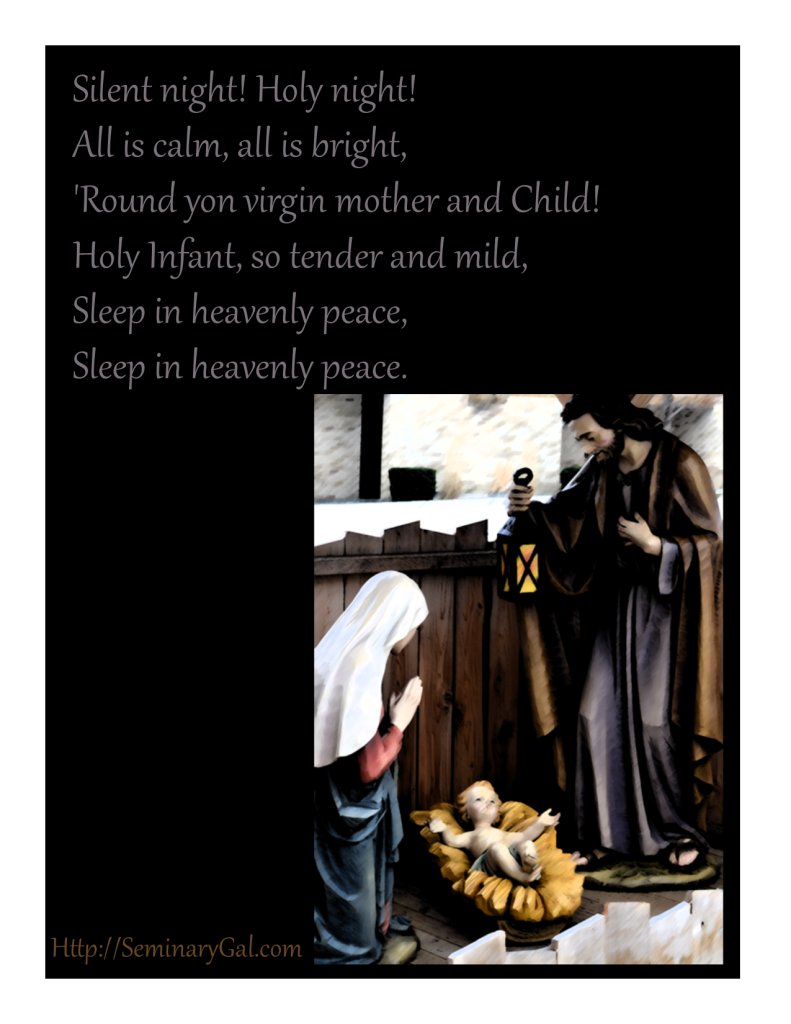 Silent night! Holy night!
All is calm, all is bright
Round yon virgin mother and Child
Holy Infant so tender and mild
Sleep in heavenly peace!
Sleep in heavenly peace
Silent night! Holy night!
Shepherds quake at the sight
Glories stream from heaven afar
Heavenly hosts sing Alleluia
Christ the Savior is born
Christ the Savior is born!
Silent night! Holy night!
Son of God love’s pure light
Radiant beams from Thy holy face
With the dawn of redeeming grace,
Jesus, Lord at Thy birth
Jesus, Lord at Thy birth
======
Carol Me, Christmas (2014 Advent Devotional Series) began November 30th. By way of reminder, if you haven’t signed up yet, you can receive these devotional studies in your email throughout Advent 2014 by entering your email address on the SeminaryGal.com home page in the space provided in the sidebar. Or “Like” the SeminaryGal Facebook page to access them there. If you like these devotionals, I’d really appreciate your letting others know so I can continue to spread the Good News far and wide. Blessings to you, in Christ always, Barbara <><
O Little Town of Bethlehem (Advent 15-2014)
Today’s carol in our Carol Me, Christmas (2014 Advent Devotional Series) is one of the more famous of the Christmas carols, O Little Town of Bethlehem. The words to this carol were written in 1868 by an Episcopal priest by the name of Phillips Brooks who was Rector of the Church of the Holy Trinity, Philadelphia, PA. The inspiration for this hymn was Brooks’ reflection back to a trip he had taken to the town of Bethlehem in 1865. Notes by Louis Redner on this hymn state,
“As Christmas of 1868 approached, Mr. Brooks told me that he had written a simple little carol for the Christmas Sunday-school service, and he asked me to write the tune to it. The simple music was written in great haste and under great pressure. We were to practice it on the following Sunday. Mr. Brooks came to me on Friday, and said, ‘Redner, have you ground out that music yet to “O Little Town of Bethlehem”?’ I replied, ‘No,’ but that he should have it by Sunday. On the Saturday night previous my brain was all confused about the tune. I thought more about my Sunday-school lesson than I did about the music. But I was roused from sleep late in the night hearing an angel-strain whispering in my ear, and seizing a piece of music paper I jotted down the treble of the tune as we now have it, and on Sunday morning before going to church I filled in the harmony. Neither Mr. Brooks nor I ever thought the carol or the music to it would live beyond that Christmas of 1868.
Redner’s composition, which another pastor—Rev. Dr. Huntington—asked to publish in his Sunday-school hymn book called The Church Porch, became titled by Huntington simply as Saint Louis. The music’s simplicity accounts for a good deal of the carol’s ongoing popularity.
The theology is solidly present, although the song itself is addressed to the town of Bethlehem. Odd as that sounds, it’s not without biblical precedent.
Micah 5:1 Marshal your troops, O city of troops, for a siege is laid against us. They will strike Israel’s ruler on the cheek with a rod. 2
But you, Bethlehem Ephrathah, though you are small among the clans of Judah, out of you will come for me one who will be ruler over Israel, whose origins are from of old, from ancient times.”
3 Therefore Israel will be abandoned until the time when she who is in labor gives birth and the rest of his brothers return to join the Israelites. 4 He will stand and shepherd his flock in the strength of the LORD, in the majesty of the name of the LORD his God. And they will live securely, for then his greatness will reach to the ends of the earth. 5 And he will be their peace. When the Assyrian invades our land and marches through our fortresses, we will raise against him seven shepherds, even eight leaders of men. 6 They will rule the land of Assyria with the sword, the land of Nimrod with drawn sword. He will deliver us from the Assyrian when he invades our land and marches into our borders. 7 The remnant of Jacob will be in the midst of many peoples like dew from the LORD, like showers on the grass, which do not wait for man or linger for mankind. 8 The remnant of Jacob will be among the nations, in the midst of many peoples, like a lion among the beasts of the forest, like a young lion among flocks of sheep, which mauls and mangles as it goes, and no one can rescue. 9 Your hand will be lifted up in triumph over your enemies, and all your foes will be destroyed. 10 “In that day,” declares the LORD, “I will destroy your horses from among you and demolish your chariots. 11 I will destroy the cities of your land and tear down all your strongholds. 12 I will destroy your witchcraft and you will no longer cast spells. 13 I will destroy your carved images and your sacred stones from among you; you will no longer bow down to the work of your hands. 14 I will uproot from among you your Asherah poles and demolish your cities. 15 I will take vengeance in anger and wrath upon the nations that have not obeyed me.”
Not exactly the picture of stillness and lullaby sounds. This is the dark side of Christmas. We are in the dark streets but the everlasting Light is shining. At some point, those of us alive will experience the Second Advent, the Return of Christ. It will not be the peaceful quiet Bethlehem of the hymn, but with righteousness as Christ’s banner, He will enter in as victorious.
As you read the poem by Brooks and listen to this version on cello by Nicholas D. Yee, ponder our Thought Focus for Today.
Thought Focus for Today: Sometimes you’ll hear proverbs like “It’s always darkest before the dawn” or “There’s always calm before the storm.” How does O Little Town of Bethlehem remind us of the dark stillness before the Advent and Second Advent of Christ?
1. 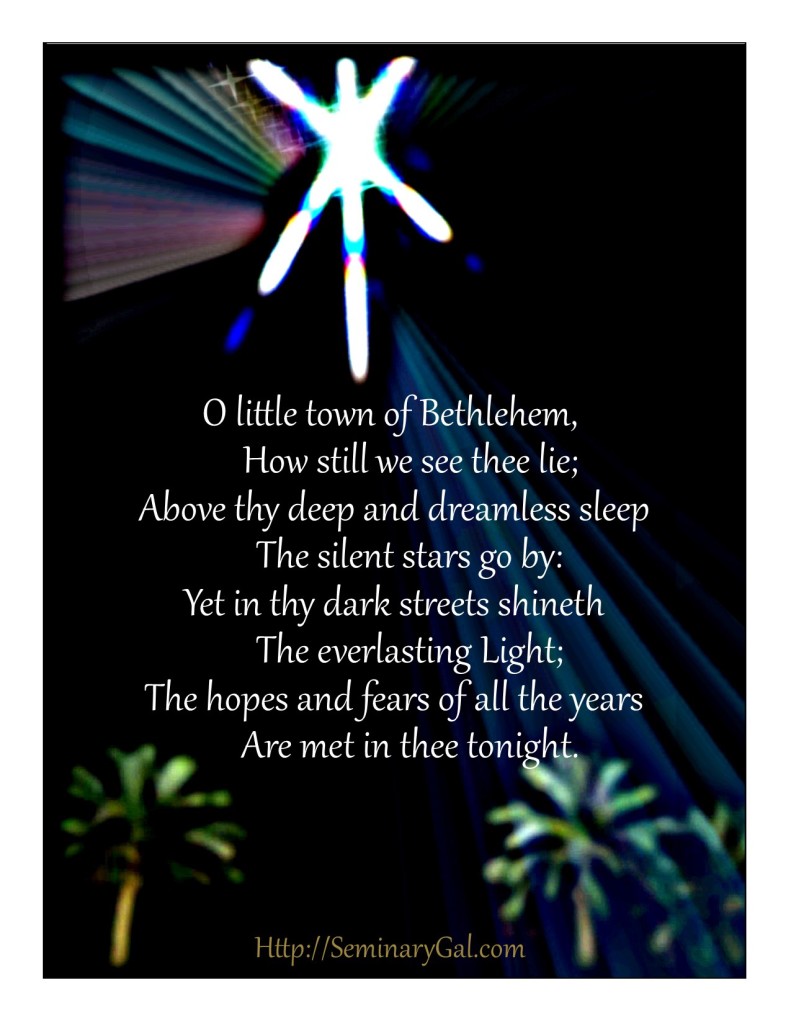 O little town of Bethlehem,
How still we see thee lie;
Above thy deep and dreamless sleep
The silent stars go by:
Yet in thy dark streets shineth
The everlasting Light;
The hopes and fears of all the years
Are met in thee to-night.
2. For Christ is born of Mary;
And gathered all above,
While mortals sleep, the angels keep
Their watch of wondering love.
O morning stars, together
Proclaim the holy birth;
And praises sing to God the King,
And peace to men on earth.
3. How silently, how silently,
The wondrous gift is given!
So God imparts to human hearts
The blessings of His heaven.
No ear may hear His coming,
But in this world of sin,
Where meek souls will receive Him still,
The dear Christ enters in.
4. O holy Child of Bethlehem,
Descend to us, we pray;
Cast out our sin, and enter in,
Be born in us to-day.
We hear the Christmas angels
The great glad tidings tell;
O come to us, abide with us,
Our God Emmanuel.
=====
Carol Me, Christmas (2014 Advent Devotional Series) began November 30th. By way of reminder, if you haven’t signed up yet, you can receive these devotional studies in your email throughout Advent 2014 by entering your email address on the SeminaryGal.com home page in the space provided in the sidebar. Or “Like” the SeminaryGal Facebook page to access them there. If you like these devotionals, I’d really appreciate your letting others know so I can continue to spread the Good News far and wide. Blessings to you, in Christ always, Barbara <><
How Great Our Joy! (Advent 14-2014)
In our Carol Me, Christmas (2014 Advent Devotional Series), we’re still looking at the shepherds in the field hearing the Good News proclaimed by the angels regarding Christ’s birth. These shepherds are never named. They’re just shepherds watching their flocks. They could have been anybody.
Today’s carol goes by four different titles: (1) How Great Our Joy! (2) While by the Sheep, (3) While by My Sheep, and (4) The Echo Carol. Even the author is uncertain.
The words are apparently part of a traditional German carol dating back to the 1600s, but the music arrangement most common in our hymnals is one from 1890 by composer Hugo Jüngst who was born and raised in Dresden, Germany. This is his only hymn of note.
All of this may be uncertain or certainly unspectacular, but this hymn is a great tribute to a spectacular event.
Luke 2:8 And there were shepherds living out in the fields nearby, keeping watch over their flocks at night. 9 An angel of the Lord appeared to them, and the glory of the Lord shone around them, and they were terrified. 10 But the angel said to them, “Do not be afraid. I bring you good news of great joy that will be for all the people. 11 Today in the town of David a Savior has been born to you; he is Christ the Lord. 12 This will be a sign to you: You will find a baby wrapped in cloths and lying in a manger.” 13 Suddenly a great company of the heavenly host appeared with the angel, praising God and saying, 14 “Glory to God in the highest, and on earth peace to men on whom his favor rests.” 15 When the angels had left them and gone into heaven, the shepherds said to one another, “Let’s go to Bethlehem and see this thing that has happened, which the Lord has told us about.” 16 So they hurried off and found Mary and Joseph, and the baby, who was lying in the manger.
I selected this hymn for two reasons. First, it highlights that each of us must respond to the Good News. The shepherds didn’t just hear the Good News and say,
Oh well, so many sheep, so little time. I’m not going to herd all these sheep together to go see this. I don’t have a baby gift, time to shop for one, and really, I don’t even know this couple. I guess I can wait to go to Bethlehem next year when maybe I’ll know the family. When you’ve seen one baby, you’ve seen them all.”
Even the lowest on the social scale among the Jews knew that the birth of the Messiah was a profound event, one that was not to be missed! It was a drop-everything-and-go spectacular that they were privileged to witness. They went and are only recorded in Scripture as shepherds. We don’t even know who they were, but we do know their response. They drop everything and go.
The second reason I chose this hymn is kind of sad, really. It’s about opportunities lost. So many of our hymns have been German, French, and English ones. Those places were at one time the epicenter of the growth of Christ’s Kingdom. Not anymore.
Today, Europe leads the way in moral relativism, secularism, and intellectual opposition to the Gospel. America is rapidly becoming a contender for first place in those same categories. I cannot help but reflect on the Germany that produced some of these great choral traditions and how much of Germany today greets the Gospel with a mighty yawn, if not a sneer. It doesn’t excuse us from trying to echo the past and remind Europe of why the Gospel is Good News. It doesn’t excuse us from trying to save America from the same apostasy and apathy we see overseas.
I like this hymn especially when performed the way the Expressions Choir and orchestra music ministry of Calvary Lutheran Church, Golden Valley, MN does it. It’s full of exuberance and a perfect echo response! This is the kind of joy that we ought to know—just as the shepherds did—that we are blessed with an opportunity to respond to the best news one could ever have: the Savior is born! It’s Good News that we should be joyfully echoing worldwide!
Thought Focus for Today: That the shepherds are not named allows us to place ourselves in their sandals. Can you remember the first time you heard the Good News? How have you responded to it? Do you know the Messiah, the Christ who is born on Christmas Day? Do you know How Great Our Joy?
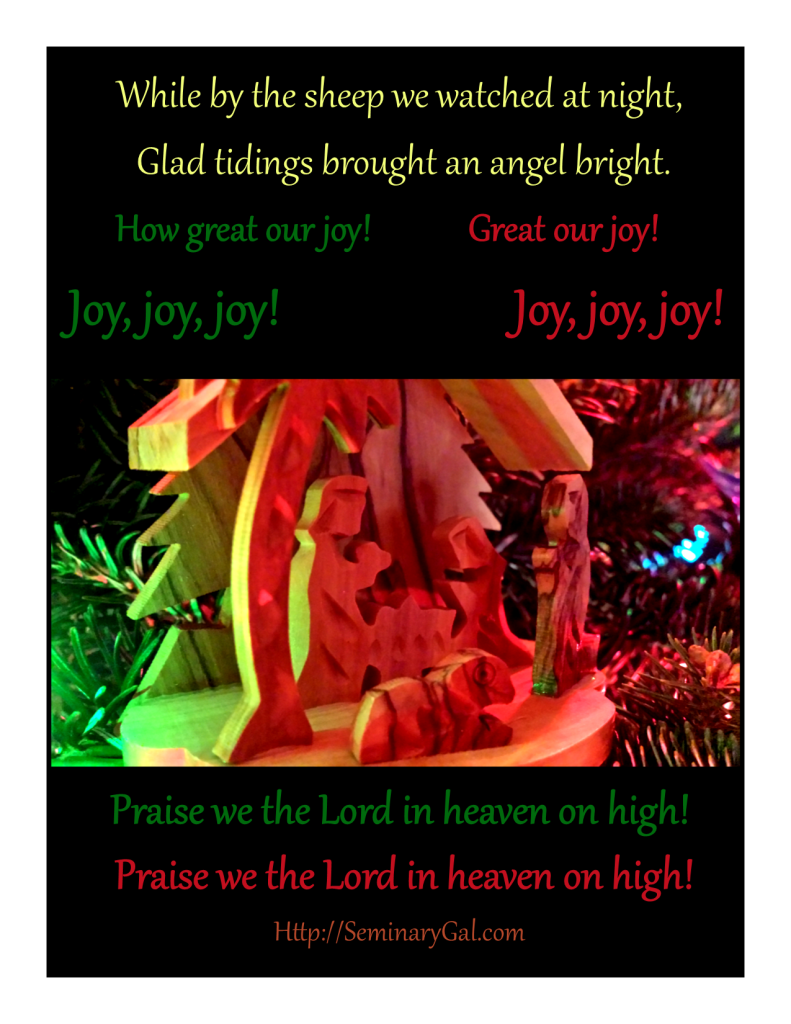 While by the sheep we watched at night,
Glad tidings brought an angel bright.
Refrain
How great our joy! (Great our joy!)
Joy, joy, joy! (Joy, joy, joy!)
Praise we the Lord in heaven on high!
(Praise we the Lord in heaven on high!)
There shall be born, so he did say,
In Bethlehem a Child today.
Refrain
There shall the Child lie in a stall,
This Child who shall redeem us all.
Refrain
This gift of God we’ll cherish well,
That ever joy our hearts shall fill.
Refrain
=====
Carol Me, Christmas (2014 Advent Devotional Series) began November 30th. By way of reminder, if you haven’t signed up yet, you can receive these devotional studies in your email throughout Advent 2014 by entering your email address on the SeminaryGal.com home page in the space provided in the sidebar. Or “Like” the SeminaryGal Facebook page to access them there. If you like these devotionals, I’d really appreciate your letting others know so I can continue to spread the Good News far and wide. Blessings to you, in Christ always, Barbara <><
Lo How a Rose E’er Blooming (Advent 13-2014)
Lo How a Rose E’er Blooming is the next traditional Christmas carol in our Carol Me, Christmas (2014 Advent Devotional Series telling of the birth of Christ. This time the focus is on His being born from the Virgin Mary. Lo How a Rose E’er Blooming is not in all the Protestant hymnals with good reason: there’s debate about whether the Rose is Jesus (as asserted by Protestants) or Mary (as preferred by some Catholics). I cannot explain it any better than in the notes offered here on a web site called Hymns and Carols of Christmas:
Originally published in 1582 (or 1588) in Gebetbuchlein des Frater Conradus, this 19-stanza Catholic hymn’s focus was Mary, who is compared to the mystical rose praised in the Song of Solomon 2:1: “I am a rose of Sharon, a lily of the valleys.” The hymn is believed to have originated in Trier, and once [sic] source stated that on one Christmas Eve, a monk in Trier found a blooming rose while walking in the woods. He placed the rose in a vase, and placed it before the alter [sic] to the Virgin Mary. Some sources indicate the hymn might date back into the 14th Century.
By 1609, however, the Protestants had adopted the hymn, and changed its focus from Mary to Jesus (citing Isaiah 11:1). According to Keyte and Parrott, in medieval iconography, the tree of Jesse is often depicted as a rose plant. They also note that it’s unclear whether Ros’ (rose) or Reis (branch) was the original reading of line 1. The revision first appeared in Michael Praetorius’ Musae Sioniae in 1609. Praetorius is occasionally mistaken as the author.
The words and music of Es ist ein Ros entsprungen (Lo, How a Rose E’er Blooming) first appeared as 23 verses in the Alte Katholische Geistliche Kirchengesäng, (Cologne, 1599). Gradually reduced to nineteen verses and then to six in the Catholic Church, it was translated into English as only verses 1 and 2 by Theodore Baker (1894). A third stanza appears in some hymnals written by Harriet Krauth Spaeth as Behold, a Branch Is Growing.
The music itself has a madrigal sound—the tune appearing in most Protestant hymnals as an arrangement written by the aforementioned German composer Michael Praetorius.
Theologically, this is another weaker hymn in many regards. Much of its focus has been devoted to the Virgin Mary (in the Feast of the Annunciation of the Blessed Virgin Mary) but I include it for a specific reason. The prophecy from Isaiah underpinning this hymn points to something truly important.
Isaiah 11:1 A shoot will come up from the stump of Jesse; from his roots a Branch will bear fruit. 2 The Spirit of the LORD will rest on him– the Spirit of wisdom and of understanding, the Spirit of counsel and of power, the Spirit of knowledge and of the fear of the LORD– 3 and he will delight in the fear of the LORD. He will not judge by what he sees with his eyes, or decide by what he hears with his ears; 4 but with righteousness he will judge the needy, with justice he will give decisions for the poor of the earth. He will strike the earth with the rod of his mouth; with the breath of his lips he will slay the wicked. 5 Righteousness will be his belt and faithfulness the sash around his waist.
This Messianic prophecy goes back to Jesse, King David’s father. That is the stump…and the Holy Seed will be the stump remaining in the land. That comes a few chapters earlier in Isaiah.
Isaiah 6:8 Then I heard the voice of the Lord saying, “Whom shall I send? And who will go for us?” And I said, “Here am I. Send me!” 9 He said, “Go and tell this people: “‘Be ever hearing, but never understanding; be ever seeing, but never perceiving.’ 10 Make the heart of this people calloused; make their ears dull and close their eyes. Otherwise they might see with their eyes, hear with their ears, understand with their hearts, and turn and be healed.” 11 Then I said, “For how long, O Lord?” And he answered: “Until the cities lie ruined and without inhabitant, until the houses are left deserted and the fields ruined and ravaged, 12 until the LORD has sent everyone far away and the land is utterly forsaken. 13 And though a tenth remains in the land, it will again be laid waste. But as the terebinth and oak leave stumps when they are cut down, so the Holy Seed will be the stump in the land.”
At a time when the world is at war, when desolation seems everywhere, when houses are deserted, fields ruined, lives torn up by discord, violence, and hatred, God’s solution is the Holy Seed in the stump. A precious Branch that bears fruit.
This is the Messiah, Jesus Christ, whose birth we celebrate.
He alone is the answer to the discord and chaos of the world then and our world today.
Jesus may be a son of David, but interestingly David isn’t the stump, his father Jesse is. Jesus doesn’t come about as a man of human origin alone whose ancestry can be explained by simple human lineage. He skipped generations spiritually, going back to the stump to prove that God didn’t send a really good regular guy who would grow up to be the Messiah by living a good life. He sent His Son, born as our Savior; born as our Lord, and born as our King–all of which He was even before His birth because He is God. He is Immanuel, God with us. He is the eternal Word made flesh. He is the Holy Seed, born of a virgin whose name was Mary.
As you listen to this version by the Baylor Bronze Hand Bell Choir, ponder the Thought Focus for Today.
Thought Focus for Today: Jesus’ Incarnation was miraculous. He was born of a virgin named Mary. It’s an event that never happened before and will never happen again. God went back to the stump in the land in a spiritual sense and yet the Holy Seed Jesus does have a physical lineage too.
How does veneration of the Virgin Mary risk jumping the gap to becoming worship of a woman who was a really good woman, but not divine like her son Jesus, the unique Son of God?
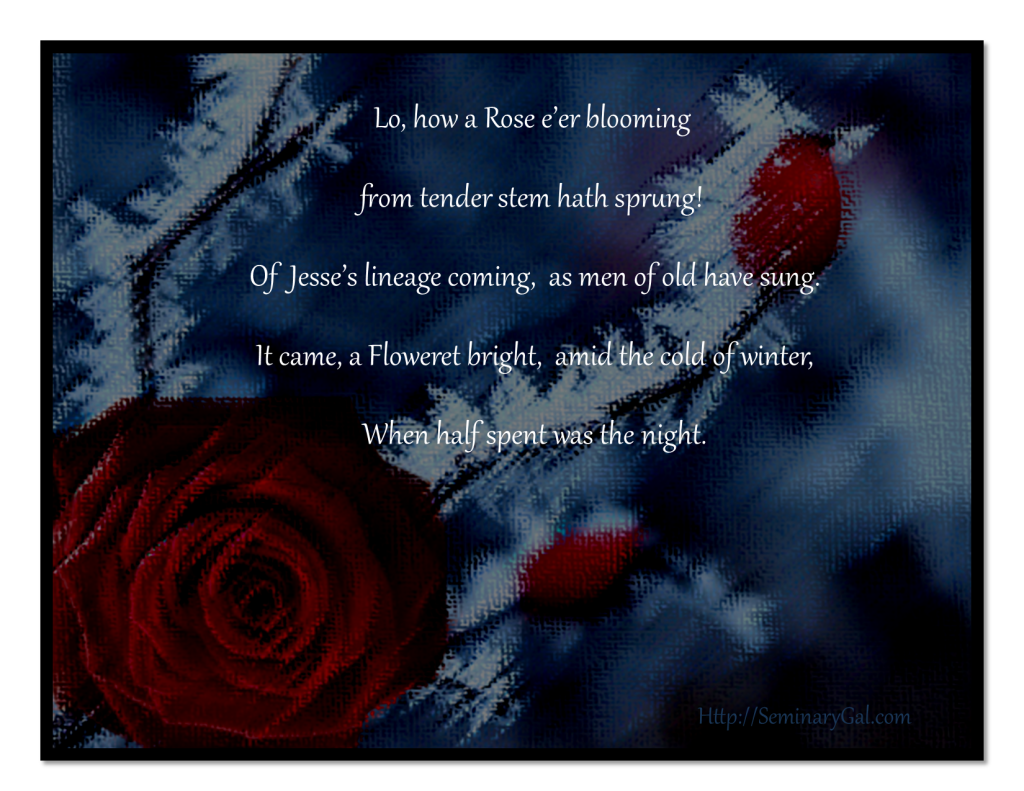 Lo, how a Rose e’er blooming from tender stem hath sprung!
Of Jesse’s lineage coming, as men of old have sung.
It came, a floweret bright, amid the cold of winter,
When half spent was the night.
Isaiah ’twas foretold it, the Rose I have in mind;
With Mary we behold it, the virgin mother kind.
To show God’s love aright, she bore to men a Savior,
When half spent was the night.
This Flower, whose fragrance tender with sweetness fills the air
Dispels with glorious splendor the darkness everywhere
True man, yet very God, from sin and death He saves us
And lightens every load.
====
Carol Me, Christmas (2014 Advent Devotional Series) began November 30th. By way of reminder, if you haven’t signed up yet, you can receive these devotional studies in your email throughout Advent 2014 by entering your email address on the SeminaryGal.com home page in the space provided in the sidebar. Or “Like” the SeminaryGal Facebook page to access them there. If you like these devotionals, I’d really appreciate your letting others know so I can continue to spread the Good News far and wide. Blessings to you, in Christ always, Barbara <><
What Child is This? (Advent 12-2014)
What Child Is This? is proof positive of the old Sunday School joke that the answer to every question is “Jesus.” It’s the next carol in our Carol Me, Christmas (2014 Advent Devotional Series). The lyrics are actually select verses from a poem by William Chatterton Dix entitled The Manger Throne written in 1865.
Born in Bristol, England, Dix was given a middle name that was not a family name, but rather from Dix’ father’s biography of the poet Thomas Chatterton, demonstrating that family names may not always be passed on to the next generation, but avocations and passions often do.
Dix worked as a marine insurance company manager but was, in God’s strange providence, afflicted with a severe illness, leaving him bedridden and depressed, but during which he experienced the saving grace of God. His spiritual rebirth resulted in writing lyrics and poetry to some of the most beloved hymns we know: today’s carol, What Child is This?, Alleluia! Sing to Jesus!, and As with Gladness Men of Old. His near-death experience had brought him through the depths of depression and What Child is This? is one of the most evangelistic carols of Christmas. Dix would carry his passion for Christ through the remainder of his life.
What Child is This? may have been written in England, but its popularity in the United States surpasses that of its country of origin. Perhaps it’s due to the haunting beauty, the soulful sentiment of the tune Greensleeves which was, even at the time, a well-known traditional English folk song.
No one seems to know who associated the lyrics with Greensleeves, but this tune is quite old and this link will take you to an extensive history of the tune with talk of Tudors and disputes dating back to the 1500s regarding ownership rights.
Far more certain than who owned the actual rights to the tune, however, is the carol’s theology. The lyrics discuss the adoration of the shepherds who visited the Christ Child at the manger, and in true Victorian tradition, it suggests the Wise Men come (although less explicitly) to the manger.
The question and response characterizing this carol’s style is what each of us does when we come to meet Jesus. The question is:
What Child is this? (And by association, “Who is Jesus?”)
To this question, each of us individually responds by answering who we believe He is. Ironically, in most hymnals even, the powerful refrain to the second verse of Dix’ poem has been changed to
This This is Christ the King
Whom shepherds guard and angels sing
Hail, hail the Word made flesh,
The Babe, the Son of Mary.
By doing so, many secular artists embrace this as a less religious song of Christmas and many Christian hymnals strip this carol of its most powerful words, removing the Cross, the nails, and the spear—all of which point to the sacrifice of Christ which made Him our Savior. Dix’ words made clear that each of us must come to know Jesus, the babe, the Son of Mary as the unique Son of God, as the perfect Sacrifice for sin, born to be our Savior, and born to be Christ our King.
As you listen to this version by the incomparable Norwegian soprano Sissel Kyrkjebø, ponder the Thought Focus for Today.
Thought Focus for Today: What Child is This? Who is He? Why do we celebrate His birth?
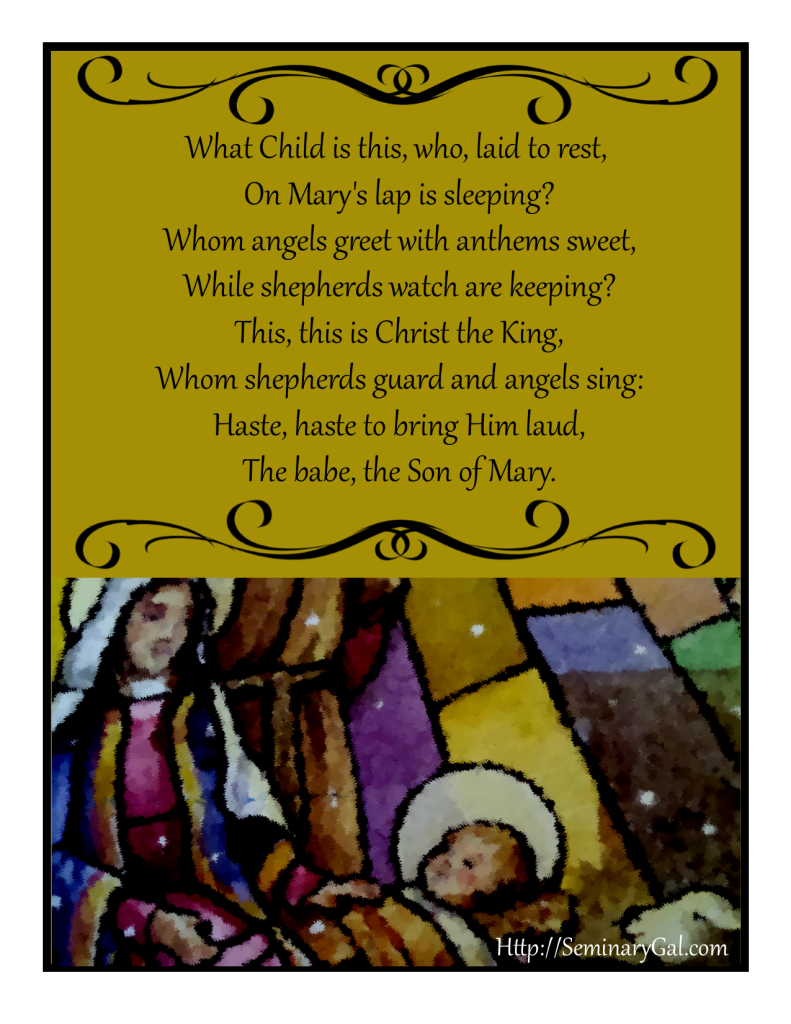 1. What Child is this who, laid to rest
On Mary’s lap is sleeping?
Whom angels greet with anthems sweet,
While shepherds watch are keeping?
This, this is Christ the King,
Whom shepherds guard and angels sing;
Haste, haste, to bring Him laud,
The Babe, the Son of Mary.
2. Why lies He in such mean estate,
Where ox and ass are feeding?
Good Christians, fear, for sinners here
The silent Word is pleading.
Nails, spear shall pierce Him through,
The cross be borne for me, for you.
Hail, hail the Word made flesh,
The Babe, the Son of Mary.
3. So bring Him incense, gold and myrrh,
Come peasant, king to own Him;
The King of Kings salvation brings,
Let loving hearts enthrone Him.
Raise, raise a song on high,
The virgin sings her lullaby.
Joy, joy for Christ is born,
The Babe, the Son of Mary.
====
Carol Me, Christmas (2014 Advent Devotional Series) began November 30th. By way of reminder, if you haven’t signed up yet, you can receive these devotional studies in your email throughout Advent 2014 by entering your email address on the SeminaryGal.com home page in the space provided in the sidebar. Or “Like” the SeminaryGal Facebook page to access them there. If you like these devotionals, I’d really appreciate your letting others know so I can continue to spread the Good News far and wide. Blessings to you, in Christ always, Barbara <><