The First Noel (Advent 11-2014)
I have been wrong a lot in my life. I had always thought that The First Noel was French because Noël sounded French and had the dieresis above the letter ë like the French sometimes do. I guess I was naïve. A lot of carols were French after all, including the Cantique de Noël. But not The First Noël.
The First Noel is a traditional English carol, of Cornish origin apparently. It is well known, having been brought again to public attention in Carols Ancient and Modern (1823) by William Sandys whose book offered the first appearance of traditional English carols such as God Rest Ye Merry Gentlemen, I Saw Three Ships, and yes, The First Noel during the Victorian revival of the Christmas holiday.
Perhaps this is where the confusion arose. Many people have thought that The First Noel is much older, even back to the 13th century. Why? Largely due to writers such as Charles Dickens, for whom the revival of Christmas was steeped in a nostalgia of uncertain origin, even from within the mind of the writer himself. Books like A Christmas Carol (1843), looked back on the past and encouraged child-centric reminiscing in many Christmas traditions. In such an environment, these hymns developed reputations for being sixteenth century or even earlier as Christmases past were romantically rewritten.
In the minds of writers who wanted the dream-like Christmas of the imaginary childhood, the Christmas narrative of England was in need of fixing. You see, they were living in the aftermath of the time Christmas had been publically banned.
According to Time-travel Britain here’s reality:
In January 1645 parliament enlisted the help of a group of ministers to create a Directory of Public Worship establishing a new organisation of the church and new forms of worship that were to be adopted and followed in both England and Wales…
As well as disliking the waste and debauchery that went along with the celebration of Christmas, the Puritans viewed the festival (Christ’s mass) as an unwanted remnant of the Roman Catholic Church and, therefore, a tool of encouragement for the dissentient community that remained in both England and Wales. They argued that nowhere in the Bible had God called upon his people to celebrate the nativity in this manner. They proposed a stricter observance of Sundays, the Lord’s Day, along with banning the immoral celebration of Christmas — as well as Easter, Whitsun and saints’ days. Preferring to call the period Christ-tide, and thus removing the Catholic ‘mass’ element, the Puritans reasoned that it should remain only as a day of fasting and prayer.
The Victorian Web goes on to describe how Christmas had become, for a period of time, a non-holiday:
Christmas, with its apparently timeless customs and traditions, often seems to have been around forever. However, as late as the 1820s, the writer Leigh Hunt labeled it an event “scarcely worth mention,” (Qtd in Pimlott, 85), and it was widely believed that the holiday, both in England and throughout Europe and North America, was destined to die out. Banned under Oliver Cromwell, Christmas in England was restored with the monarchy in 1660, where it appears to have flourished as an increasingly less and less religious event. Nonetheless, by the 1800s, it had shrunk almost beyond recognition. In the 1840s, holidays observed by governmental departments had decreased from roughly a week in 1797 to just Christmas day itself (Pimlott, 77). But in a remarkable turn of events, under the Victorians Christmas flourished to an extent unprecedented in earlier centuries. This reemergence during the nineteenth-century gave birth to many of the traditions that are today indistinguishable from the holiday itself. Christmas trees, cards, dinners, presents, and carols are all either products of, or were revived during, the Victorian period.
Christmas, a less and less religious event. Does that sound like today, or what?
The theology of The First Noel is right out of Scripture and the inclusion of “Born is the King of Israel” and pointing to the Crucifixion are both helpful in filling in the Christmas story.
That said, the timing is inaccurate. Here we have introduced—taught through song—the notion that the Three Wise Men came to our nativity scenes with gold, frankincense, and myrrh. In reality, the un-numbered Magi (aka 3 Wise Men) didn’t show up until later…in the unromanticized version we see in the Bible where Jesus is at home already. Not in the manger.
Matthew 2:1 After Jesus was born in Bethlehem in Judea, during the time of King Herod, Magi from the east came to Jerusalem 2 and asked, “Where is the one who has been born king of the Jews? We saw his star in the east and have come to worship him.” 3 When King Herod heard this he was disturbed, and all Jerusalem with him. 4 When he had called together all the people’s chief priests and teachers of the law, he asked them where the Christ was to be born. 5 “In Bethlehem in Judea,” they replied, “for this is what the prophet has written: 6 “‘But you, Bethlehem, in the land of Judah, are by no means least among the rulers of Judah; for out of you will come a ruler who will be the shepherd of my people Israel.'” 7 Then Herod called the Magi secretly and found out from them the exact time the star had appeared. 8 He sent them to Bethlehem and said, “Go and make a careful search for the child. As soon as you find him, report to me, so that I too may go and worship him.” 9 After they had heard the king, they went on their way, and the star they had seen in the east went ahead of them until it stopped over the place where the child was. 10 When they saw the star, they were overjoyed. 11 On coming to the house, they saw the child with his mother Mary, and they bowed down and worshiped him. Then they opened their treasures and presented him with gifts of gold and of incense and of myrrh. 12 And having been warned in a dream not to go back to Herod, they returned to their country by another route.
The gold, incense, and myrrh would come in very handy to fund the family’s escape to Egypt, demonstrating that where God sends, He also aims to provide. So the timing on God’s part was perfect. Sandys’ was a little off.
Furthermore, in the final verses less commonly included in our hymnals we see perpetuated the belief that our good works contribute to our salvation when they do not. There is also a hint at universal salvation when that doesn’t happen either. So most hymnals leave that verse out.
Still, the carol is among the best known and favorite hymns of Christmas. It’s been performed in many different genres from jazz to choral to pop to gospel to classical. To prove my point, enjoy these versions by
- Victorian carolers at Disney to fill that Victorian caroler idea
- Aretha Franklin from the Christmas Tree Lighting Ceremony
- Sierra Boggess and Lindsay Mendez singing The First Noel as a medley with Still, Still, Still,
- And finally, Ricky Barbas as a One Man A Cappella
Thought Focus for Today: How has the true meaning of Christmas disappeared in favor of traditions? How might we regain the Christmas story from within our traditions?
The first Noel the angel did say
Was to certain poor shepherds in fields as they lay;
In fields where they lay tending their sheep,
 On a cold winter’s night that was so deep.
Refrain
Noel, Noel, Noel, Noel,
Born is the King of Israel.
They lookèd up and saw a star
Shining in the east, beyond them far;
And to the earth it gave great light,
And so it continued both day and night.
Refrain
And by the light of that same star
Three Wise Men came from country far;
To seek for a King was their intent,
And to follow the star wherever it went.
Refrain
This star drew nigh to the northwest,
Over Bethlehem it took its rest;
And there it did both stop and stay,
Right over the place where Jesus lay.
Refrain
Then did they know assuredly
Within that house the King did lie;
One entered it them for to see,
And found the Babe in poverty.
Refrain
Then entered in those Wise Men three,
Full reverently upon the knee,
And offered there, in His presence,
Their gold and myrrh and frankincense.
Refrain
Between an ox stall and an ass,
This Child truly there He was;
For want of clothing they did Him lay
All in a manger, among the hay.
Refrain
Then let us all with one accord
Sing praises to our heavenly Lord;
That hath made Heaven and earth of naught,
And with His blood mankind hath bought.
Refrain
If we in our time shall do well,
We shall be free from death and hell;
For God hath prepared for us all
A resting place in general.
Refrain
====
Carol Me, Christmas (2014 Advent Devotional Series) began November 30th. By way of reminder, if you haven’t signed up yet, you can receive these devotional studies in your email throughout Advent 2014 by entering your email address on the SeminaryGal.com home page in the space provided in the sidebar. Or “Like” the SeminaryGal Facebook page to access them there. If you like these devotionals, I’d really appreciate your letting others know so I can continue to spread the Good News far and wide. Blessings to you, in Christ always, Barbara <><
While Shepherds Watched Their Flocks (Advent 10-2014)
Today in Carol Me, Christmas (2014 Advent Devotional Series) we continue our look at the angels communicating the good news of great joy to the shepherds. One of the great surprises of the Christmas story is that it was announced to shepherds who were considered the dregs of society. Seriously, shepherds? (That might have been the popular reaction at the time.) You’ve got the birth announcement of royalty—the King of Kings—being announced… to shepherds? (Insert hysterical laughter here.)
While Shepherds Watched Their Flocks was versified by Irishman Nahum Tate, a hymn writer and Poet Laureate. Of the many works with which Tate was involved, this time in collaboration with Nicholas Brady, While Shepherds Watched Their Flocks is really the only one to endure and appear in our present-day hymnals at all. Tate, in spite of his continual striving for public favor, ended his years fleeing from his creditors. Perhaps it’s a good time to revisit our own ideas of what it means to be a success. For many of us, our legacy won’t be a hymn or carol; it won’t even be money or property of any kind, but rather our legacy will be in the lives we touched with the Gospel message that the angels proclaimed!
Luke 2:8 Now there were in the same country shepherds living out in the fields, keeping watch over their flock by night. 9 And behold, an angel of the Lord stood before them, and the glory of the Lord shone around them, and they were greatly afraid. 10 Then the angel said to them, “Do not be afraid, for behold, I bring you good tidings of great joy which will be to all people. 11 “For there is born to you this day in the city of David a Savior, who is Christ the Lord. 12 “And this will be the sign to you: You will find a Babe wrapped in swaddling cloths, lying in a manger.” 13 And suddenly there was with the angel a multitude of the heavenly host praising God and saying: 14 “Glory to God in the highest, And on earth peace, goodwill toward men!”
Do you see how the angels pointed to Jesus? They succeeded in the most important way possible: showing the Way, the Truth, and the Life even though at the time, He was but a baby in a manger.
In the Church of England at the time of this carol, only the Psalms of David were permitted to be sung. Therefore, this work was included in a supplement to New Version of the Psalms of David (1696) and became the only Christmas hymn permitted to be sung in addition to the Psalms. The reason for that is many carols (like some of the French ones we’ve seen) had their roots in folk music. Therefore, they were considered commoner’s secular music, insufficiently holy to be used in church services. This persisted until the end of the 18th century as Christianity moved to the wider culture of the unchurched (folk, commoners, seculars and the slave community) in revivals such as those in the Great Awakening.
The carol is most commonly sung to Winchester Old (United Kingdom) and an arrangement of a George F. Handel aria arranged by Lowell Mason (United States). Two other tunes Martyrdom and Shackelford—both from the 1880s—are less commonly associated with While Shepherds Watched Their Flocks.
Theologically, not surprisingly given the Church of England’s tight control over what was sung at the time, While Shepherds Watched Their Flocks is pretty much straight out of the Gospel of Luke. As you enjoy this beautiful version on harp ponder our Thought Focus for Today:
Thought Focus for Today: the angels proclaimed a message that they were compelled to share though they had no stake in its blessing. Yet they rejoice in this Good News and praise God….in the presence of shepherds. If they had any reservations about sharing the Good News with the lowest of society, they certainly did not show it. What is known about angels is that the angelic host of God do exactly what God tells them to do! God says, share the Good News with shepherds. Boom. Done.
How ought we view sharing the Good News, even with those who are from different social circles?
 While shepherds watched their flocks by night,
All seated on the ground,
The angel of the Lord came down,
And glory shone around,
And glory shone around.
“Fear not!” said he, for mighty dread
Had seized their troubled mind.
“Glad tidings of great joy I bring
To you and all mankind
To you and all mankind.
“To you, in David’s town, this day
Is born of David’s line
A Savior, who is Christ the Lord,
And this shall be the sign,
And this shall be the sign.
“The heavenly Babe you there shall find
To human view displayed,
All meanly wrapped in swathing bands,
And in a manger laid,
And in a manger laid.”
Thus spake the seraph and forthwith
Appeared a shining throng
Of angels praising God on high,
Who thus addressed their song,
Who thus addressed their song:
“All glory be to God on high,
And to the Earth be peace;
Good will henceforth from Heaven to men
Begin and never cease,
Begin and never cease!”
====
Carol Me, Christmas (2014 Advent Devotional Series) began November 30th. By way of reminder, if you haven’t signed up yet, you can receive these devotional studies in your email throughout Advent 2014 by entering your email address on the SeminaryGal.com home page in the space provided in the sidebar. Or “Like” the SeminaryGal Facebook page to access them there. If you like these devotionals, I’d really appreciate your letting others know so I can continue to spread the Good News far and wide. Blessings to you, in Christ always, Barbara <><
It Came Upon a Midnight Clear (Advent 9-2014)
It Came Upon a Midnight Clear is the next carol in our Carol Me, Christmas (2014 Advent Devotional Series). This one is a beautiful song of peace written during a time of great strife in the United States. In 1849, we were seeing great westward expansion as “gold fever” was driving people to rush for their share of riches to be found in American soil. The Industrial Revolution—a blessing and yet also a distraction away from our ancient faith to self-reliance in a new industrial material world—was consuming America. We were in the last days of slavery before the Civil War would set the slaves free at the cost of many abolitionists’ lives. With all these dark events drawing America to division and greed, times not unlike today, Edmund Sears would pen this hymn to peace that we’ve come to associate with Christmas because of the message given by the angels to shepherds in the field.
Luke 2:10 But the angel said to them, “Do not be afraid. I bring you good news of great joy that will be for all the people. 11 Today in the town of David a Savior has been born to you; he is Christ the Lord. 12 This will be a sign to you: You will find a baby wrapped in cloths and lying in a manger.” 13 Suddenly a great company of the heavenly host appeared with the angel, praising God and saying, 14 “Glory to God in the highest, and on earth peace to men on whom his favor rests.”
Theologically, however beautiful this hymn to peace is, It Came Upon a Midnight Clear is incredibly weak in its Scriptural underpinnings. The focus is on peace, not the Peace-giver. The focus is on the angels, not on the message they gave of the baby who was the Christ Child and Savior. Sears’ good news was that the angels sing of peace to a world in distress, but the real Good News is that Jesus Christ was born into the world–a world in distress because of human sin–and yet this world could be reconciled to God because of who this Savior is, fully man and fully God.
In case you might think it’s a minor point, part of the backstory of this hymn is that Edmund Sears was a Unitarian pastor and the Unitarians do not believe in the unique divinity of God’s only Son, Jesus Christ. If you read his lyrics carefully, you will note that Jesus isn’t mentioned at all. Peace is exalted. The Prince of Peace is not. The “King of heaven” is the Unitarian idea of God the Father, not the orthodox Christian view of God the Father, Son, and Holy Spirit.
The tune, entitled simply Carol was written by Richard Storrs Willis who was a noted composer and publisher of hymns including his arrangement of Fairest Lord Jesus.
I have included this hymn, not only because it points to the angelic message of our Savior’s birth and telling the Christmas story fully, but because it raises an important point for our faith. No matter how beautiful is peace, no matter how desirous we are of unity as people, no matter how tired we are from the wrongs of this world, and no matter how we might seek other human ways of solving them, peace is not that simple. We cannot forget that peace with God came at a much higher cost to release us as slaves to sin than even the Civil War cost to set American slaves free. Peace with God cost God His Son, our Savior whose shed blood makes our peace possible by bearing the full weight of God’s wrath against sin. Reconciliation with God is of greater worth than gold…even gold of harps, streets, or gold mined from the ground in gold fever. And we must always check everything against the Word of God to understand its truth.
For this reason, many variations of this hymn have arisen to change the fourth verse to the much improved:
For lo! the days are hastening on,
By prophet seen of old,
When with the ever circling years
Shall come the time foretold;
When the new heav’n and earth shall own The Prince of Peace their King
And the whole world send back the song Which now the angels sing.
Enjoy this version by Jana Mashonee from her album American Indian Christmas I cannot understand a word of the Oneida language, but her voice is splendid. I do not know if she’s singing the lyrics below or with the revision above, but the message proclaimed by the angels as it appears in the NKJ version still rings true:
Luke 2:14 “Glory to God in the highest, And on earth peace, goodwill toward men!”
Thought for Today’s Focus: Knowing the rest of the story, read Sears’ original lyrics in light of American culture and his Unitarian background. Revisit the new fourth verse that states Jesus explicitly as the Prince of Peace instead of leaving Him for the hearer to read Him between the lines.
Remember that Christmas celebrates the birth of our Prince of Peace, our King, Lord Jesus. His birth as God’s only Son made peace with God–the only true peace–possible.
 It came upon the midnight clear,
That glorious song of old,
From angels bending near the earth,
To touch their harps of gold;
“Peace on the earth, good will to men,
From Heaven’s all gracious King.”
The world in solemn stillness lay,
To hear the angels sing.
Still through the cloven skies they come
With peaceful wings unfurled,
And still their heavenly music floats
O’er all the weary world;
Above its sad and lowly plains,
They bend on hovering wing,
And ever over its Babel sounds
The blessèd angels sing.
Yet with the woes of sin and strife
The world has suffered long;
Beneath the angel strain have rolled
Two thousand years of wrong;
And man, at war with man, hears not
The love-song which they bring;
O hush the noise, ye men of strife
And hear the angels sing.
And ye, beneath life’s crushing load,
Whose forms are bending low,
Who toil along the climbing way
With painful steps and slow,
Look now! for glad and golden hours
Come swiftly on the wing.
O rest beside the weary road,
And hear the angels sing!
For lo! the days are hastening on,
By prophet-bards foretold,
When with the ever circling years
Comes round the age of gold;
When peace shall over all the earth
Its ancient splendors fling,
And the whole world send back the song
Which now the angels sing.
====
Carol Me, Christmas (2014 Advent Devotional Series) began November 30th. By way of reminder, if you haven’t signed up yet, you can receive these devotional studies in your email throughout Advent 2014 by entering your email address on the SeminaryGal.com home page in the space provided in the sidebar. Or “Like” the SeminaryGal Facebook page to access them there. If you like these devotionals, I’d really appreciate your letting others know so I can continue to spread the Good News far and wide. Blessings to you, in Christ always, Barbara <><
Hark The Herald Angels Sing (Advent 8-2014)
Charles Wesley’s second contribution to our Carol Me, Christmas (2014 Advent Devotional Series) is Hark The Herald Angels Sing which first appeared by a slightly different name (1739) in Wesley’s Hymns and Sacred Poems. Remember how I said that his carols and hymns are often uplifting? Well, apparently that’s not entirely due to Mr. Wesley himself who was a very serious and solemn man.
Wesley’s original version was called Hark, How All the Welkin Rings.
Hark, how all the welkin rings,
“Glory to the King of kings;
Peace on earth, and mercy mild,
God and sinners reconciled!”
Joyful, all ye nations, rise,
Join the triumph of the skies;
Universal nature say,
“Christ the Lord is born to-day!”
OK, I’ll admit I had to look up “welkin” since this day of my writing must be officially International Vocabulary Expansion Day.
Worldwide Words writes:
We don’t use this much nowadays — dictionaries usually tag it as archaic or literary — except in the set phrase make the welkin ring, meaning to make a very loud sound.
What supposedly rings in this situation is the vault of heaven, the bowl of the sky, the firmament. In older cosmology this was thought to be one of a set of real crystal spheres that enclosed the Earth, to which the planets and stars were attached, so it would have been capable of ringing like a bell if you made enough noise.
The word comes from the Old English wolcen, a cloud, related to the Dutch wolk and German Wolke. Very early on, for example in the epic poem Beowulf of about the eighth century AD, the phrase under wolcen meant under the sky or under heaven (the bard used the plural, wolcnum, but it’s the same word). Ever since, it has had a strong literary or poetic connection.
It appears often in Shakespeare and also in Chaucer’s Canterbury Tales: “This day in mirth and revel to dispend, / Till on the welkin shone the starres bright”. In 1739, a book with the title Hymns and Sacred Poems introduced one for Christmas written by Charles Wesley that began: “Hark! how all the welkin rings, / Glory to the King of kings”. If that seems a little familiar, it is because 15 years later it reappeared as “Hark! the herald-angels sing / Glory to the new born king”.
There ya’ go. My problem is that I never read enough Shakespeare or Chaucer. I guess I can be glad that two other famous people had a hand in forming the version of Wesley’s original into what we know today.
- George Whitfield, yes, amazing preacher of the Great Awakening, tweaked the opening couplet to become Hark! The Herald Angels Sing, Glory to the Newborn King!
- Felix Mendelssohn (whose real name is Jakob Ludwig Felix Mendelssohn Bartholdy) you may know from his famous Wedding March was born into a Jewish family, but as his parents later came to faith, he and his siblings were baptized as Reformed Christians. It was Mendelssohn who composed a cantata 100 years after Wesley’s commissioned original tune which had been more somber in tone. This cantata was in commemoration of Johann Gutenberg’s invention of the printing press, and later adapted by one of Mendelssohn’s choristers–an English musician, organist, and tenor named William H. Cummings–to fit the Whitfield-Wesley version of Hark The Herald Angels Sing into what we know and love in most churches today.
All this to say, in the Body of Christ, we are better together! Praise the LORD!
The theology, as one would expect from Charles Wesley, is profound. He goes all the way back to mankind’s sinful start in the Garden of Eden—not at Creation but when Adam and Eve rebelled against God and we needed for the Second Adam (Jesus Christ) to restore us in relationship to God.
Rise, the woman’s conquering seed, Bruise in us the serpent’s head. Goes back to Genesis 3:15 And I will put enmity Between you and the woman, And between your seed and her Seed; He shall bruise your head, And you shall bruise His heel.”
Now display thy saving power, Ruined nature now restore; Now in mystic union join Thine to ours, and ours to thine. Goes back to the whole idea of the Incarnation! Emmanuel, God with us! The Incarnation is the magnitude of God’s love, His grace, His mercy, His wrath, and His unfathomable wisdom and power on full display.
Adam’s likeness, Lord, efface; Stamp Thy image in its place. Second Adam from above, Reinstate us in thy love. Let us Thee, though lost, regain, Thee, the life, the inner Man: O! to all thyself impart, Form’d in each believing heart. This is from Romans 5:6-21 summarized in Romans 5:17 For if by the one man’s offense death reigned through the one, much more those who receive abundance of grace and of the gift of righteousness will reign in life through the One, Jesus Christ.)
It’s a glorious carol, fitting to instruct our hearts as we listen to the lyrics. In this version by the Celtic Women, read through the lyrics of Hark The Herald Angels Sing while it is playing (so all the glitz doesn’t distract you from the powerful words).
Thought for Today’s Focus: Imagine Hark! The Herald Angels Sing as the words proclaim a triumphant victory of Christ—in His birth, in His life, in His death, and in His exaltation as Lord, Savior, and King!
 Hark! The herald angels sing,
“Glory to the newborn King;
Peace on earth, and mercy mild,
God and sinners reconciled!”
Joyful, all ye nations rise,
Join the triumph of the skies;
With th’angelic host proclaim,
“Christ is born in Bethlehem!”
Refrain
Hark! the herald angels sing,
“Glory to the newborn King!”
Christ, by highest Heav’n adored;
Christ the everlasting Lord;
Late in time, behold Him come,
Offspring of a virgin’s womb.
Veiled in flesh the Godhead see;
Hail th’incarnate Deity,
Pleased with us in flesh to dwell,
Jesus our Emmanuel.
Refrain
Hail the heav’nly Prince of Peace!
Hail the Sun of Righteousness!
Light and life to all He brings,
Ris’n with healing in His wings.
Mild He lays His glory by,
Born that man no more may die.
Born to raise the sons of earth,
Born to give them second birth.
Refrain
Come, Desire of nations, come,
Fix in us Thy humble home;
Rise, the woman’s conqu’ring Seed,
Bruise in us the serpent’s head.
Now display Thy saving power,
Ruined nature now restore;
Now in mystic union join
Thine to ours, and ours to Thine.
Refrain
Adam’s likeness, Lord, efface,
Stamp Thine image in its place:
Second Adam from above,
Reinstate us in Thy love.
Let us Thee, though lost, regain,
Thee, the Life, the inner man:
O, to all Thyself impart,
Formed in each believing heart.
Refrain
=======
Carol Me, Christmas (2014 Advent Devotional Series) began November 30th. By way of reminder, if you haven’t signed up yet, you can receive these devotional studies in your email throughout Advent 2014 by entering your email address on the SeminaryGal.com home page in the space provided in the sidebar. Or “Like” the SeminaryGal Facebook page to access them there. If you like these devotionals, I’d really appreciate your letting others know so I can continue to spread the Good News far and wide. Blessings to you, in Christ always, Barbara <><
Angels We Have Heard on High (Advent 7-2014)
You’d think that there was only one hymn about the angels making the A-list since they are so often all lumped together. YouTube has many versions labeled Angels from the Realms of Glory that are actually Angels We Have Heard on High. Oh well, just like Abraham Lincoln once said, “You can’t trust everything you read on the Internet.”
YouTube may seem all mixed up, but fortunately for all of us, the angels themselves were not the least bit confused about titles and the message they needed to communicate from God to the shepherds.
Luke 1:8 And there were shepherds living out in the fields nearby, keeping watch over their flocks at night. 9 An angel of the Lord appeared to them, and the glory of the Lord shone around them, and they were terrified. 10 But the angel said to them, “Do not be afraid. I bring you good news of great joy that will be for all the people. 11 Today in the town of David a Savior has been born to you; he is Christ the Lord. 12 This will be a sign to you: You will find a baby wrapped in cloths and lying in a manger.” 13 Suddenly a great company of the heavenly host appeared with the angel, praising God and saying, 14 “Glory to God in the highest, and on earth peace to men on whom his favor rests.”
Angels We Have Heard on High which is today’s hymn in the Carol Me, Christmas (2014 Advent Devotional Series) tells this story from Luke. The words are a translation by Englishman James Chadwick of a traditional French carol entitled Les Anges dans nos campagnes, (meaning “Angels in Our Countryside”) composed by an unknown author. Of course, God knows who the author is and the angels of heaven probably high-fived the author on his arrival for such a great portrayal of a high point in their angelic lifetimes. The Savior was born. That’s a high point for sure!
1 Peter 1:10 Concerning this salvation, the prophets, who spoke of the grace that was to come to you, searched intently and with the greatest care, 11 trying to find out the time and circumstances to which the Spirit of Christ in them was pointing when he predicted the sufferings of Christ and the glories that would follow. 12 It was revealed to them that they were not serving themselves but you, when they spoke of the things that have now been told you by those who have preached the gospel to you by the Holy Spirit sent from heaven. Even angels long to look into these things.
They may have announced His birth, but regarding the saving, they didn’t know how He was going to do it. They longed to know. Angels We Have Heard on High celebrates that birth announcement sent from God to a bunch of shepherds with the marvelous angelic refrain “Gloria in Excelsis Deo!” (which is Latin for “Glory to God in the highest” from Luke 1:14). It’s appropriate, therefore, that the refrain is not only memorable in words, but the tune to which this carol is sung would have this as a high point. I’m sure it was for the angels.
The French carol tune Gloria, as arranged by American organist Edward Shippen Barnes, is how it is traditionally sung in the US. In England, however, the other A-list angel song James Montgomery’s Angels from the Realms of Glory from yesterday is sung to this tune with a few contour changes including the “Gloria in excelsis Deo” refrain instead of the “Come and worship” refrain. I was fully prepared to blame the Mormon Tabernacle Choir on that error until I discovered that the King’s College Choir did the same thing in their Lessons and Carols…and they were just the two leading the pack! And now I understand: It’s a British thing kind of like putting a bunch of u’s where they don’t belong: colour, armour, favour, etc.. (Just razzing my British friends.)
Anyway, the “Gloria in excelsis Deo” does a beautiful justice to how many of us imagine the angels singing that night of announcing the Savior’s birth.
Tempting as it was to return to the Piano Guys for the sake of making a few friends really happy, do a modern a Capella version by Tonic Sol-fa that I’m not sure communicates that 1st century AD angel voice, or do the amazing tenor Andrea Bocelli singing it in Latin (but due to his viewers’ stupid comments that I can’t bring myself to give voice to that) instead, let’s listen to this version by Libera (a boy’s choir) and ponder our Thought Focus for Today.
Thought Focus for Today: The angels have longed to discover how it is that men and women are saved. They wouldn’t find out until the Ascension of Christ.
This beautiful praise “Glory to God in the Highest” is proclaimed by angels about God’s plan to save mankind, not even angels. Praising God for something good happening to someone else. How does this make sense? Do we often begrudge good things happening to someone we think is undeserving?
 Angels we have heard on high
Sweetly singing o’er the plains,
And the mountains in reply
Echoing their joyous strains.
Refrain
Gloria, in excelsis Deo!
Gloria, in excelsis Deo!
Shepherds, why this jubilee?
Why your joyous strains prolong?
What the gladsome tidings be
Which inspire your heavenly song?
Refrain
Come to Bethlehem and see
Christ Whose birth the angels sing;
Come, adore on bended knee,
Christ the Lord, the newborn King.
Refrain
See Him in a manger laid,
Whom the choirs of angels praise;
Mary, Joseph, lend your aid,
While our hearts in love we raise.
Refrain
====
Carol Me, Christmas (2014 Advent Devotional Series) began November 30th. By way of reminder, if you haven’t signed up yet, you can receive these devotional studies in your email throughout Advent 2014 by entering your email address on the SeminaryGal.com home page in the space provided in the sidebar. Or “Like” the SeminaryGal Facebook page to access them there. If you like these devotionals, I’d really appreciate your letting others know so I can continue to spread the Good News far and wide. Blessings to you, in Christ always, Barbara <><
Angels from the Realms of Glory (Advent 6-2014)
Angels play a significant role in the Christmas story and many hymns point to this fact. An angel, Gabriel, brought good news to Mary about the favor she had with God and how she would be the one—the only one—in all human history to bear the Christ Child. Angels were the host of heaven as a mighty army of singers praising God and announcing the Good News to the shepherds when Jesus was born.
We make a mistake when we view angels as being like Precious Moments figurines. They are mighty warriors of God and it’s why Mary was greatly troubled and why the shepherds were terrified.
Luke 1:26 In the sixth month, God sent the angel Gabriel to Nazareth, a town in Galilee, 27 to a virgin pledged to be married to a man named Joseph, a descendant of David. The virgin’s name was Mary. 28 The angel went to her and said, “Greetings, you who are highly favored! The Lord is with you.” 29 Mary was greatly troubled at his words and wondered what kind of greeting this might be. 30 But the angel said to her, “Do not be afraid, Mary, you have found favor with God. 31 You will be with child and give birth to a son, and you are to give him the name Jesus. 32 He will be great and will be called the Son of the Most High. The Lord God will give him the throne of his father David, 33 and he will reign over the house of Jacob forever; his kingdom will never end.
Today’s hymn in Carol Me, Christmas (2014 Advent Devotional Series) is Angels from the Realms of Glory. What a classic! It was written by a Scottish poet and newspaper editor by the name of James Montgomery. On Christmas Eve in 1816, Montgomery’s poem was published in his Sheffield newspaper called The Iris though it didn’t receive much notice until it was republished in the Christian Psalmist nine years later.
Montgomery, aside from his editorial work, was deeply devoted to humanitarian causes such as the efforts to abolish slavery and to end the exploitation of child labor. He is most noted, however, for his hymn writing and this Christmas carol is one of his best.
The tune from the majority of my hymnals is called Regent Square and was written by composer Henry Smart. He wrote Regent Square during the part of his life when he had lost his sight and composed his music by dictation to his daughter Ellen. Regent Square is one of his best known hymn tunes and has been called “splendid…with lots of lift”—most fitting for angelic worship of God Almighty.
Theologically, this poem is superb, except perhaps for this verse (being picky that I am):
-
Sinners, wrung with true repentance,
-
Doomed for guilt to endless pains,
-
Justice now revokes the sentence,
-
Mercy calls you; break your chains.
Justice didn’t “revoke the sentence” except that it was paid by another: God’s Christ. We could not break our own chains, but God could! And that’s why the Gospel is such Good News for those of us doomed for guilt but who place our faith in this Messiah celebrated at Christmas.
As you listen to this version on organ, ponder our Thought for Today’s Focus.
Thought for Today’s Focus:
We do not worship angels, but they are powerful heralds of God. Jesus didn’t die to save any of the angels who have fallen, but in God’s mercy He sent Jesus, the Christ, the Messiah, to save us.
Angels from the realms of glory,
 Wing your flight o’er all the earth;
Ye who sang creation’s story
Now proclaim Messiah’s birth.
Refrain
Come and worship, come and worship,
Worship Christ, the newborn King.
Shepherds, in the field abiding,
Watching o’er your flocks by night,
God with us is now residing;
Yonder shines the infant light:
Refrain
Sages, leave your contemplations,
Brighter visions beam afar;
Seek the great Desire of nations;
Ye have seen His natal star.
Refrain
Saints, before the altar bending,
Watching long in hope and fear;
Suddenly the Lord, descending,
In His temple shall appear.
Refrain
Sinners, wrung with true repentance,
Doomed for guilt to endless pains,
Justice now revokes the sentence,
Mercy calls you; break your chains.
Refrain
Though an Infant now we view Him,
He shall fill His Father’s throne,
Gather all the nations to Him;
Every knee shall then bow down:
Refrain
All creation, join in praising
God, the Father, Spirit, Son,
Evermore your voices raising
To th’eternal Three in One.
====
Carol Me, Christmas (2014 Advent Devotional Series) began November 30th. By way of reminder, if you haven’t signed up yet, you can receive these devotional studies in your email throughout Advent 2014 by entering your email address on the SeminaryGal.com home page in the space provided in the sidebar. Or “Like” the SeminaryGal Facebook page to access them there. If you like these devotionals, I’d really appreciate your letting others know so I can continue to spread the Good News far and wide. Blessings to you, in Christ always, Barbara <><
Lift Up Your Heads O Mighty Gates (Advent 5-2014)
As we continue to Carol Me, Christmas, we’ll look at one which is a bit lesser known. Lift Up Your Heads O Mighty Gates may be used for Advent and is present in a few hymnals for that purpose, but it’s not as well known as many other Advent hymns. It’s another one from the Germanic chorale tradition, yes, translated by Catherine Winkworth. Georg Weissel (1590-1635) wrote this as Macht hoch die Tür, originally to be performed on the first Sunday of Advent. Of the twenty or so hymns written by Weissel—a pastor of a church at Königsberg—this is his only hymn to endure.
The hymn music is the anonymously written Truro as recorded in Psalmodia Evangelica, a hymnal published by Thomas Williams and intended for use by churches that had broken away from the Church of England.
Some verses of Lift Up Your Heads O Mighty Gates have fallen by the wayside in many hymnals. Of the six verses, verse two is often omitted which may be due to its being less theologically grounded. The final two verses are often rewritten as
4 Redeemer, come! I open wide
my heart to Thee, here, Lord, abide!
Let me Thy inner presence feel:
Thy grace and love in me reveal
5 So come, my Sovereign, enter in!
Let new and nobler life begin!
Thy Holy Spirit guide us on,
until the glorious crown be won.
Although they may have been rewritten as a greater reflection of the “personal Lord and Savior” idea, shown in the particular use of first person pronouns. (Me oh my! Maybe not an improvement). Here are the original six verses from the German, including the second verse. As you read these words of Psalm 24, listen to this version by West Side Presbyterian Church of Ridgewood NJ’s choir singing verses 1, 4, and 5 as part of their 2010 Lessons & Carols tradition, then ponder our Thought for Today’s Focus.
Psalm 24:1 Of David. A psalm. The earth is the LORD’s, and everything in it, the world, and all who live in it; 2 for he founded it upon the seas and established it upon the waters. 3 Who may ascend the hill of the LORD? Who may stand in his holy place? 4 He who has clean hands and a pure heart, who does not lift up his soul to an idol or swear by what is false. 5 He will receive blessing from the LORD and vindication from God his Savior. 6 Such is the generation of those who seek him, who seek your face, O God of Jacob. Selah 7 Lift up your heads, O you gates; be lifted up, you ancient doors, that the King of glory may come in. 8 Who is this King of glory? The LORD strong and mighty, the LORD mighty in battle. 9 Lift up your heads, O you gates; lift them up, you ancient doors, that the King of glory may come in. 10 Who is he, this King of glory? The LORD Almighty– he is the King of glory. Selah
Thought for Today’s Focus: Jesus is King of Glory and Lord from before His birth. Ponder the majesty He deserves as the King of Glory and the kind of reverence one would show to such a Sovereign.
How might your heart become a more suitable temple for Him to enter?
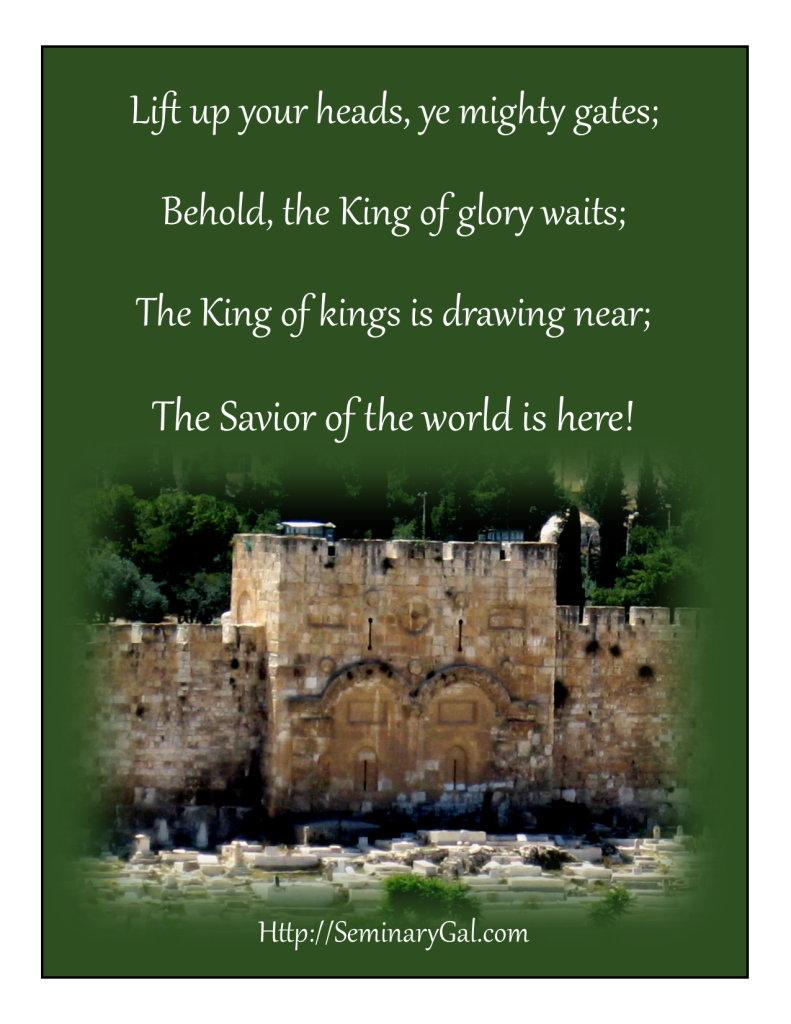 Lift up your heads O mighty gates;
Behold, the King of glory waits;
The King of kings is drawing near;
The Savior of the world is here!
A Helper just He comes to thee,
His chariot is humility,
His kingly crown is holiness,
His scepter, pity in distress.
O blest the land, the city blest,
Where Christ the Ruler is confessed!
O happy hearts and happy homes
To whom this King in triumph comes!
Fling wide the portals of your heart;
Make it a temple, set apart
From earthly use for heaven’s employ,
Adorned with prayer and love and joy.
Redeemer, come, with us abide;
Our hearts to Thee we open wide;
Let us Thy inner presence feel;
Thy grace and love in us reveal.
Thy Holy Spirit lead us on
Until our glorious goal is won;
Eternal praise, eternal fame
Be offered, Savior, to Thy Name!
====
Carol Me, Christmas (2014 Advent Devotional Series) began November 30th. By way of reminder, if you haven’t signed up yet, you can receive these devotional studies in your email throughout Advent 2014 by entering your email address on the SeminaryGal.com home page in the space provided in the sidebar. Or “Like” the SeminaryGal Facebook page to access them there. If you like these devotionals, I’d really appreciate your letting others know so I can continue to spread the Good News far and wide. Blessings to you, in Christ always, Barbara <><
Come Thou Long Expected Jesus (Advent 4-2014)
You gotta hand it to Charles Wesley. He has written the lyrics of so many songs of hope. In the course of his career, he wrote the words to over 6,000 hymns, including many of our favorites. Today, we’ll look at the first of the ones he wrote which are often used at Christmas: Come Thou Long Expected Jesus.
I told you today’s would be more uplifting and it’s not just the way the words are written. In most of the hymnals I have at home (a collection of sorts) the melody is known as Hyfrydol which in Welsh means “cheerful.” See? Even the tune is uplifting.
This hymn tune was written by Rowland Prichard and was originally published in a handbook accompanying Cyfaill y Cantorion (The Singers’ Friend) which was a children’s song book. This hymn was reported to have been written before Prichard was even 20 years old.
The arrangement was done by Ralph Vaughan Williams who also did yesterday’s Let All Mortal Flesh Keep Silence, demonstrating that he was a pretty versatile arranger of musical scores.
Come Thou Long Expected Jesus is used at Advent to describe what happened when the Christ Child was born and yet, Wesley intended that it would also be seen as anticipatory of Christ’s return. Because of that perspective, this traditional carol transcends Christmas and is used year-round as a reminder of the importance of keeping our eyes on the heavens, awaiting the return of our Lord, King, and Savior Jesus Christ.
Though only two verses, the theology is impeccable!
He is our strength. Psalm 28:8 The LORD is the strength of his people, a fortress of salvation for his anointed one.
He is our consolation as God’s people throughout the ages have looked to the comfort our Savior would bring. One such person was Simeon who was promised he’d see the Christ before he died. Luke 2:25 And behold, there was a man in Jerusalem whose name was Simeon, and this man was just and devout, waiting for the Consolation of Israel, and the Holy Spirit was upon him. Again this theology points back to Isaiah 40:1-2 of God comforting His people–He is the Consolation of Israel!
He is the desire of every nation like we saw in Haggai 2:7 I will shake all nations, and the desired of all nations will come, and I will fill this house with glory,’ says the LORD Almighty.
Charles Wesley also shows his preacher side when his words in verse 2 ring with the truth of God’s mercy and grace, that apart from God we can do nothing to save ourselves. God is so good! While we were yet sinners, the Christ Child is born to deliver us!
I love this hymn! Click link to listen to a version by Jody Cross with a modern chorus
Thought focus for today: Having set the stage previously with the mournful words of other hymns of anticipation, reflect on how good the Good News really is!
Come thou long expected Jesus,
born to set thy people free;
from our fears and sins release us,
let us find our rest in thee.
Israel’s strength and consolation,
hope of all the earth thou art;
dear desire of every nation,
joy of every longing heart.
Born thy people to deliver,
born a child and yet a King,
born to reign in us forever,
now thy gracious kingdom bring.
By thine own eternal spirit
rule in all our hearts alone;
by thine all sufficient merit,
raise us to thy glorious throne.
====
Carol Me, Christmas (2014 Advent Devotional Series) began November 30th. By way of reminder, if you haven’t signed up yet, you can receive these devotional studies in your email throughout Advent 2014 by entering your email address on the SeminaryGal.com home page in the space provided in the sidebar. Or “Like” the SeminaryGal Facebook page to access them there. If you like these devotionals, I’d really appreciate your letting others know so I can continue to spread the Good News far and wide. Blessings to you, in Christ always, Barbara <><
Let All Mortal Flesh Keep Silence (Advent 3-2014)
Let’s Carol Me, Christmas–telling the true Christmas story—with another historic hymn. Let All Mortal Flesh Keep Silence is an ancient chant, a Cherubic Hymn and devotion based on words from Habakkuk 2:20, “Let all the earth keep silence before him”.
Tomorrow’s carol will be uplifting, but today’s is another hymn written in a minor key which ought to give us pause about all this Merry Christmas stuff: candy canes, hot cocoa, Santa, reindeer, joy, and happiness; partying, drinking toasts and going to cocktail parties in festive finery. Like Charlie Brown, we can find ourselves getting depressed, finding that we’re not happy, and end up thinking that we don’t know what Christmas is all about.
Contrast the words of Let All Mortal Flesh Keep Silence with the lyrics to pop music like It’s the Most Wonderful Time of the Year! Let me be clear: There’s nothing wrong with celebrating. Let’s make sure we’re celebrating the right things.
Why are all these Christmas carols, these hymns of anticipation, so mournful sounding?
This past month, I’ve had the privilege of our family experiencing births of sons. I have a grandson –a first grandchild, and I am now also a great aunt of a brand new baby boy. Babies are to be celebrated, for sure!
But why is Jesus’ birth notable?
Because He was born healthy and alive—just another miracle of God in that sense?
No. Jesus’ birth is notable because it is beyond the miracle of who He was as a baby (God’s Son).
It’s notable because of what He’d do as an adult and these anticipation hymns sounding mournful remind us that this was no trivial sacrifice of God.
We needed a Savior so badly that God knew there was no other way.
Let All Mortal Flesh Keep Silence is a traditional carol, a chant, a hymn that powerfully points this out. The chant itself probably dates back to around 275 AD with arrangements in Syriac. The hymn as we know it was translated from the Greek by Gerard Moultrie and then Ralph Vaughan Williams gave it a melodic arrangement to the tune of Picardy which was a French medieval folk melody.
The message Let All Mortal Flesh Keep Silence is quite holy and might be modernized and made rather vulgar by saying that it’s like God is saying to us,
Let all the earth shut up!”
Habakkuk records a response of God to the pride, greed, arrogance, plundering, destruction, and bloodshed of a world He created to exist in peace and love. Mankind ruined it all. Violence and idolatry form man’s actions since the fall of man. To a world such as this, God says the end is coming and the end of what we have done to this earth will come with it. Wrath is on its way.
And yet, hidden in this passage of Habakkuk, we read “the righteous will live by his faith” (Habakkuk 2:4).
Habakkuk 2: 2 Then the LORD replied: “Write down the revelation and make it plain on tablets so that a herald may run with it. 3 For the revelation awaits an appointed time; it speaks of the end and will not prove false. Though it linger, wait for it; it will certainly come and will not delay.
4 “See, he is puffed up; his desires are not upright– but the righteous will live by his faith—
5 indeed, wine betrays him; he is arrogant and never at rest. Because he is as greedy as the grave and like death is never satisfied, he gathers to himself all the nations and takes captive all the peoples. 6 “Will not all of them taunt him with ridicule and scorn, saying, “‘Woe to him who piles up stolen goods and makes himself wealthy by extortion! How long must this go on?’ 7 Will not your debtors suddenly arise? Will they not wake up and make you tremble? Then you will become their victim. 8 Because you have plundered many nations, the peoples who are left will plunder you. For you have shed man’s blood; you have destroyed lands and cities and everyone in them. 9 “Woe to him who builds his realm by unjust gain to set his nest on high, to escape the clutches of ruin! 10 You have plotted the ruin of many peoples, shaming your own house and forfeiting your life. 11 The stones of the wall will cry out, and the beams of the woodwork will echo it. 12 “Woe to him who builds a city with bloodshed and establishes a town by crime!
13 Has not the LORD Almighty determined that the people’s labor is only fuel for the fire, that the nations exhaust themselves for nothing? 14 For the earth will be filled with the knowledge of the glory of the LORD, as the waters cover the sea.
15 “Woe to him who gives drink to his neighbors, pouring it from the wineskin till they are drunk, so that he can gaze on their naked bodies. 16 You will be filled with shame instead of glory. Now it is your turn! Drink and be exposed! The cup from the LORD’s right hand is coming around to you, and disgrace will cover your glory. 17 The violence you have done to Lebanon will overwhelm you, and your destruction of animals will terrify you. For you have shed man’s blood; you have destroyed lands and cities and everyone in them. 18 “Of what value is an idol, since a man has carved it? Or an image that teaches lies? For he who makes it trusts in his own creation; he makes idols that cannot speak. 19 Woe to him who says to wood, ‘Come to life!’ Or to lifeless stone, ‘Wake up!’ Can it give guidance? It is covered with gold and silver; there is no breath in it.
20 But the LORD is in his holy temple; let all the earth be silent before him.”
As we listen to musical interpretations of this old carol by the Millennium Youth Choir and another version by Fernando Ortega, read through the words below. All the while, remember how idolatry is commonplace in our day. People exalt money, race, vengeance, pride, and intellectual prowess. Where are the headlines in our newspapers of God’s Good News? Ironic, is it not, that Black Friday, Cyber Monday, greed and materialism mark our culture’s celebration of His Christ? Newspapers report what kind of “good news” retailers might expect and what it means for our economy. God’s answer to that is pointed in the face of sinners: Let all the earth be silent. (Shut your mouth. Don’t you get what this season is all about? You don’t need stuff! You need a Savior.)
Thought focus for today: Consider the difference between Christmas Joy found in an Eternal Savior and the fleeting happiness of stuff.
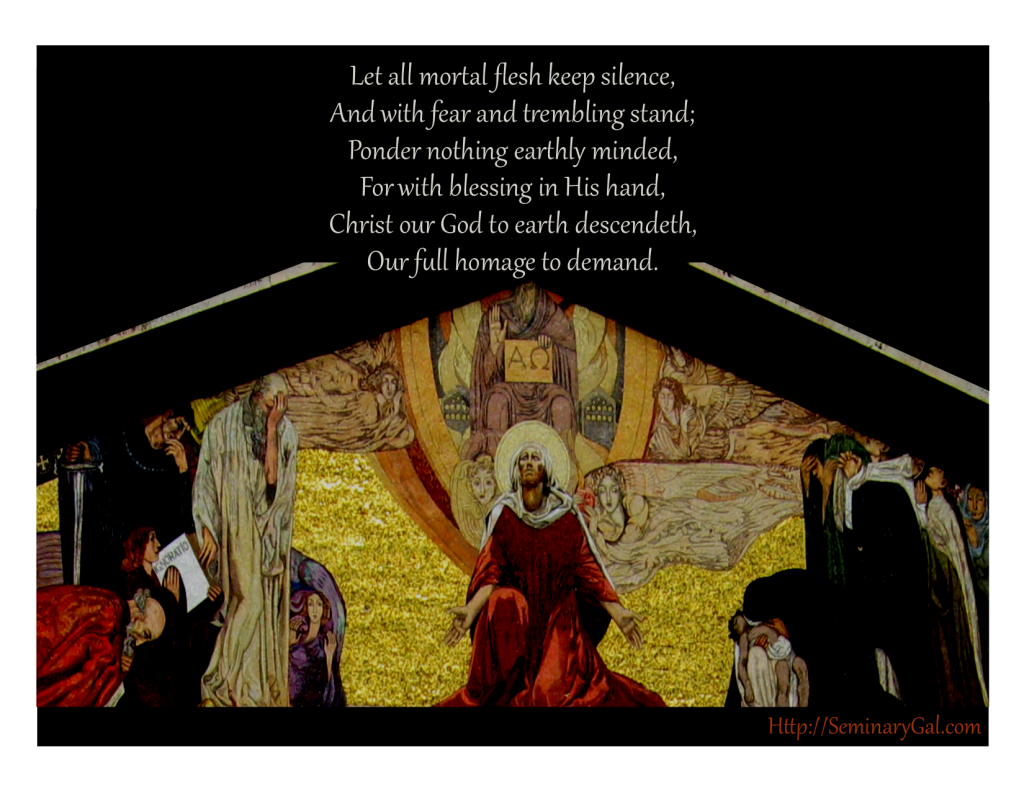 Let all mortal flesh keep silence,
And with fear and trembling stand;
Ponder nothing earthly minded,
For with blessing in His hand,
Christ our God to earth descendeth,
Our full homage to demand.
King of kings, yet born of Mary,
As of old on earth He stood,
Lord of lords, in human vesture,
In the body and the blood;
He will give to all the faithful
His own self for heavenly food.
Rank on rank the host of heaven
Spreads its vanguard on the way,
As the Light of light descendeth
From the realms of endless day,
That the powers of hell may vanish
As the darkness clears away.
At His feet the six wingèd seraph,
Cherubim with sleepless eye,
Veil their faces to the presence, As with ceaseless voice they cry
Alleluia, Alleluia
Alleluia, Lord Most High!
====
Carol Me, Christmas (2014 Advent Devotional Series) began November 30th. By way of reminder, if you haven’t signed up yet, you can receive these devotional studies in your email throughout Advent 2014 by entering your email address on the SeminaryGal.com home page in the space provided in the sidebar. Or “Like” the SeminaryGal Facebook page to access them there. If you like these devotionals, I’d really appreciate your letting others know so I can continue to spread the Good News far and wide. Blessings to you, in Christ always, Barbara <><
Comfort Comfort O My People (Advent 2-2014)
As we continue to Carol Me, Christmas in our 2014 Advent season, the words of today’s traditional Christmas carol, Comfort Comfort O My People, come straight out of the Bible. It’s a passage of Scripture that has also been used in Handel’s Messiah for Comfort Ye My People (Isaiah 40:1-10). These same verses are also used at Easter and speak of preparing the way for the LORD. But this call to repentance didn’t begin at Lent. It begins with preparing our hearts now—for with His coming, you see, the Kingdom is now here.
But why comfort? How does that really relate to Advent?
Without knowledge of our sin and taking it seriously, we have no real need for a Savior. No sin. No Savior. Without realizing our hopeless state of salvation on our own merits, we can delude ourselves into thinking that Christmas is about other things than our pitiful situation. Apart from God’s action on our behalf in the Incarnation, we’re doomed even though we’re Ho-Ho-Hoing our way through the holidays. The mere fact that the Savior had to come is evidence that we needed Him and without Him, we’re toast.
So the words of this hymn and of Isaiah 40:1-10 are profoundly comforting. Speaking Peace. Comforting those who sit in darkness (of bondage to sin, of exile, of exclusion from God’s favor). They’d been rebellious, as have we all. They were mourning their bondage, burdened with sorrow, and tired of fighting the inevitable.
Do you ever feel that way?
So God gives His people comfort and tells us that our sins will be covered. The warfare will end. The payment—though double from the Lord’s hand—will be paid by another. By His Christ.
Make ye straight what long was crooked,
Make the rougher places plain:
Let your hearts be true and humble,
As befits His holy reign,
For the glory of the Lord
Now o’er the earth is shed abroad,
And all flesh shall see the token
That His Word is never broken.
Luke 2:10 But the angel said to them, “Do not be afraid. I bring you good news of great joy that will be for all the people. 11 Today in the town of David a Savior has been born to you; he is Christ the Lord.”
It’s good news of great joy because our situation apart from God’s grace was nothing short of hopeless. Jesus didn’t come as a baby in a manger because the world needed more boys. The Virgin Birth set Him apart. Only He could address our dire straits.
You see, the Good News is that the Savior didn’t begin with the Cross. He is before all time. He is the Living Word. His Incarnation is the radiance of God’s glory and this news of salvation, of purification for sins…is Good News indeed and great Comfort to God’s people.
As you listen to Comfort Comfort O My People, the 1671 German hymn written by Johannes G. Olearius, theologian, writer of biblical commentary, and composer, let the words of comfort given by Isaiah minister to you. Translated into English by London native Catherine Winkworth, this carol appeared in The Chorale Book for England (published in 1863). We can benefit from the great German chorale tradition brought to us today. As you listen to this modernized version (click link), remember the words of old and this theological truth that is our Thought Focus for Today.
Thought focus for today’s reflection: We celebrate the Incarnation as it showed we needed a Savior. God’s lovingkindness to forgive our sins is demonstrated in His Son Jesus who would come not just as a baby in a manger, but as our Savior and God’s Christ. This is Comfort indeed!
 Comfort, comfort ye My people,
Speak ye peace, thus saith our God;
Comfort those who sit in darkness, Mourning ’neath their sorrow’s load;
Speak ye to Jerusalem
Of the peace that waits for them;
Tell her that her sins I cover,
And her warfare now is over.
For the herald’s voice is crying
In the desert far and near,
Bidding all men to repentance,
Since the kingdom now is here.
O that warning cry obey!
Now prepare for God a way!
Let the valleys rise to meet Him,
And the hills bow down to greet Him.
Yea, her sins our God will pardon,
Blotting out each dark misdeed;
All that well deserved His anger
He will no more see nor heed.
She has suffered many a day,
Now her griefs have passed away,
God will change her pining sadness
Into ever springing gladness.
Make ye straight what long was crooked,
Make the rougher places plain:
Let your hearts be true and humble,
As befits His holy reign,
For the glory of the Lord
Now o’er the earth is shed abroad,
And all flesh shall see the token
That His Word is never broken.
====
Carol Me, Christmas (2014 Advent Devotional Series) began November 30th. By way of reminder, if you haven’t signed up yet, you can receive these devotional studies in your email throughout Advent 2014 by entering your email address on the SeminaryGal.com home page in the space provided in the sidebar. Or “Like” the SeminaryGal Facebook page to access them there. If you like these devotionals, I’d really appreciate your letting others know so I can continue to spread the Good News far and wide. Blessings to you, in Christ always, Barbara <><