Begging for a High Traffic Zone
Acts 3:1 One day Peter and John were going up to the temple at the time of prayer– at three in the afternoon.
So why did Peter and John go to the temple to pray if the Holy Spirit was already present and they could pray wherever and whenever they wanted?
Scripture doesn’t say whether the newness was still settling in or whether it was something else, but the fact they went together suggests that they were planning on doing prayer and evangelistic ministry.
Going two by two says much about ministry life. Jesus sent the disciples out to do ministry two by two (Luke 10:1-12). They went as pairs because ministry is discouraging work. We need each other for encouragement and as accountability.
In the flow of the book of Acts, Peter and John’s going to the temple allowed the Holy Spirit to work at a time of day when other people would be going to pray as well. The disciples were seeking to interact with the maximum number people for the purpose of sharing the Good News widely. Peter and John weren’t the only ones who placed themselves in a “high traffic zone” where they could interact with others.
Acts 3:2 Now a man crippled from birth was being carried to the temple gate called Beautiful, where he was put every day to beg from those going into the temple courts. 3 When he saw Peter and John about to enter, he asked them for money.
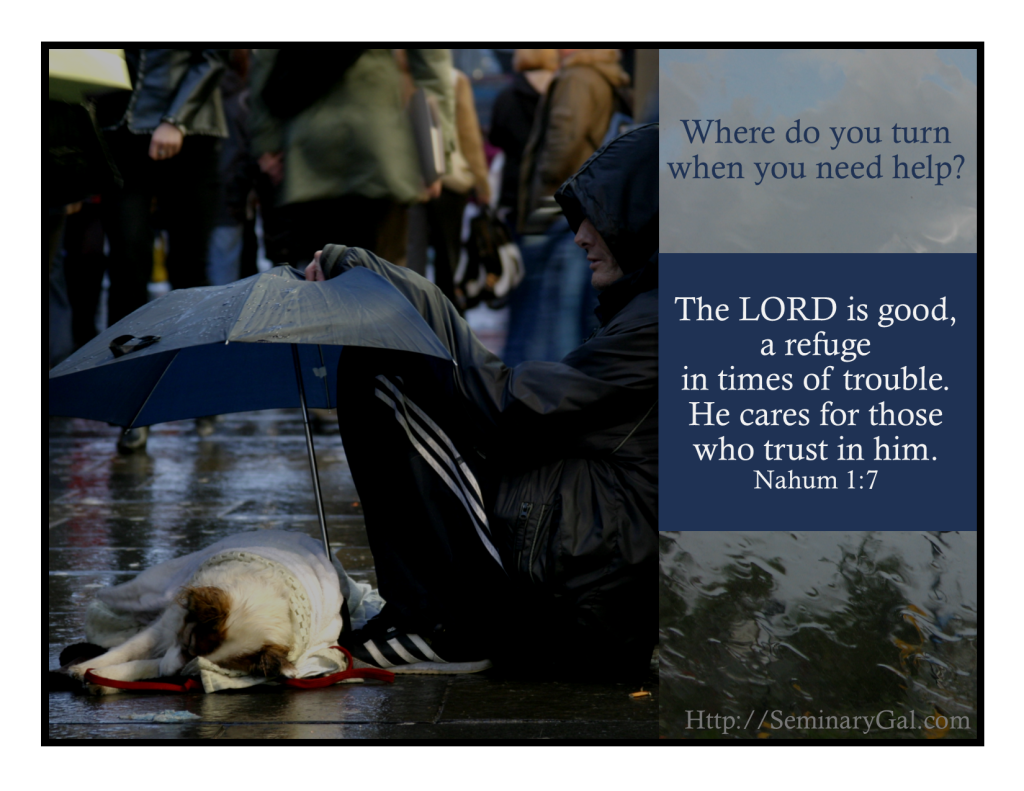
The other day while I was visiting my daughter in the hospital after she gave birth to my first grandson, there was a man stationed at a picnic table outside the hospital. He called out to me as I was exiting the parking garage for the hospital entrance. He was in a “high traffic zone” much like the man crippled from birth was at the temple courts. This man asked me for money, telling me he hadn’t eaten in 3 days. I reached into my bag and gave him 3 protein bars that I’d brought as my own lunches while I was visiting from out of town. I think he was disappointed. He wanted money.
Questions for pondering:
- What kinds of reactions do you have to people who are begging?
- The crippled man begging outside of the temple courts would have had a real disadvantage in a culture that depended heavily on manual labor (e.g. fishing, carpentry/stone mason work, farming) and a community that held strongly negative views of those with physical imperfections to where even work as tax collectors, for example, would have been unavailable to him. With a genuine lack of opportunity, depending upon the generosity of others is a humbling existence. How does asking for money give the person begging some level of autonomy?
- How does that autonomy act as a double-edged instrument, providing the greatest freedom to make choices both good and bad, and providing the best reasons for others not to give money?
- How do you decide whether/how to give to someone begging, especially when the city streets can have dozens of people begging on every sidewalk?
Pray Anywhere and Anytime
One day Peter and John were going up to the temple at the time of prayer– at three in the afternoon. (Acts 3:1)
Most people don’t think of 3:00 in the afternoon as the time of prayer. But it was one of three times of prayer common to observant Jews (the other two being 9 am and noon). Do we often set aside specific times of day to pray?
For some of us, we pray before getting out of bed in the morning. Others of us pray before going to sleep at night.
But, prayer can be enough of a challenge that many people turn the dinner time into the hour of prayer while the food gets cold. Or maybe they fall into the Cut-to-the-Chase-Crowd and simply say “Thank you, God, for this food. Amen.” And then that’s the extent of prayer and worship for the day.
It’s hard to imagine going to church 3 times a day for prayer. In fact, the mere idea of going to church 3 times a day all by itself is a bit much for too many people. But the truth is that worship is something that we don’t have to go to a place to do anymore (beyond a corporate time on the Lord’s Day however you celebrate it). Prayer, because of the Holy Spirit, is something we can do in the shower, in the car, in the grocery store parking lot, on our walks, or while exercising. It doesn’t diminish God by our inviting Him into our everyday tasks. He likes being included. Prayer can be a 24/7 thing. That’s what it means when we talk about praying without ceasing.
Questions for thought:
- When is your favorite time to pray and why?
- When you pray, what types of things do you pray about? Where does praising God fall on your list?

Secret to Church Growth
Acts 2:46 Every day they continued to meet together in the temple courts. They broke bread in their homes and ate together with glad and sincere hearts, 47 praising God and enjoying the favor of all the people. And the Lord added to their number daily those who were being saved.
If we’re looking for the secret of church growth, it’s simply this: Partake together in daily biblical praise of God and cultivate consistent gratitude. That’s contagious because it is so different than the rest of the world.
 The world talks on cell phones and retreats into self-centered individualism
The world selfishly keeps everything, each to his own. Sharing, when done, often has selfish motives.
The world lives with angst and anger. There is a joyless existence and a constant striving to impress others with a fear of being found out.
The world praises man and rejects God.
No wonder that Christians who are living well stand out. And no wonder God rewards this faithfulness with growth.
Questions to ponder:
- Devotion to Scripture, fellowship, identity in Christ and prayer—all of this results in praising God and being grateful. Where in this process do many churches fail?
- Do you think it’s easy to live the way the early Church lived as shown in Acts 2:46-47? What might be some of today’s obstacles?
- What might be some reasons God withholds His blessing of growth from today’s churches in the US?
Redistribution, Charity, and Changed Hearts
Acts 2:45 Selling their possessions and goods, they gave to anyone as he had need.
Sure sounds like redistribution, doesn’t it? I’d like to assure you that it is…but not in the way you might think.
This is not a situation like when Donald Sterling was forced to sell the LA Clippers as punishment for racially insensitive remarks. He was banned from the NBA and his wife went about selling the team to Steve Ballmer, the former CEO of Microsoft, for a record $2 billion. Even at the end of it, however, there was something to gain (money) in exchange for ownership of the team (control).
The issue at stake in our Scripture today is not whether “those who had” ended up giving up something so that the have-nots could have a better life. They did give something up. But, it wasn’t a forced sale. It was completely voluntary…out of a changed heart.
 *
*
Redistribution is only as good as the ones doing the redistribution and the motives they had for doing it. If redistribution is charity—something that is beautiful and honorable and brings pleasure to God—then the voluntary nature is what makes it glorifying to Him.
Why? Because it’s clear we value God more than Money.
If the redistribution is coerced, however, then God is not honored at all.
Why? Because it says we value Money more than God who gave where He wanted so that we’d learn how to love and give like He does.
So why do some Christians jump on the redistribution bandwagon as if it’s biblical?
I’d argue that they fail to see how anyone’s having control over someone else’s choices is slavery. Charity leaves the choice and the beauty in the hands of the giver. And God loves a cheerful giver! Simply taking things from those who have for the purpose of giving to those who do not have is placing the control and the choice in the hands of the ones doing the taking. When they give to those they want to have receive it, then they took away from God’s choice and acted as their own gods.
That type of control (coercion) over other people is to use power and fear to be another’s master. It takes the beauty of cheerful giving as Image bearing of God and morphs it into the evil of slavery. And finally, it often turns the act of receiving charity from grace and thankfulness to God…to something less. Often, it becomes greed and envy cloaked as fairness.
When Redistribution arises voluntarily out of Charity and Changed Hearts, God gets all the glory! Let’s bring glory to Him in our acts of charity, bearing God’s Image as graceful givers and thankful recipients.
Questions for pondering:
- If you are one who has been blessed by God with an abundance of possessions, what does this Scripture say to you? Matthew 6: 19″Do not store up for yourselves treasures on earth, where moth and rust destroy, and where thieves break in and steal. 20 But store up for yourselves treasures in heaven, where moth and rust do not destroy, and where thieves do not break in and steal. 21 For where your treasure is, there your heart will be also.”
- Matthew 6:28 “And why do you worry about clothes? See how the lilies of the field grow. They do not labor or spin. 29 Yet I tell you that not even Solomon in all his splendor was dressed like one of these. 30 If that is how God clothes the grass of the field, which is here today and tomorrow is thrown into the fire, will he not much more clothe you, O you of little faith? 31 So do not worry, saying, ‘What shall we eat?’ or ‘What shall we drink?’ or ‘What shall we wear?’ 32 For the pagans run after all these things, and your heavenly Father knows that you need them. 33 But seek first his kingdom and his righteousness, and all these things will be given to you as well. 34 Therefore do not worry about tomorrow, for tomorrow will worry about itself. Each day has enough trouble of its own.” What does God want for us to have as a priority?
- What light does this Scripture shed on how we use resources and how money enslaves? Luke 16:9 “I tell you, use worldly wealth to gain friends for yourselves, so that when it is gone, you will be welcomed into eternal dwellings. 10 Whoever can be trusted with very little can also be trusted with much, and whoever is dishonest with very little will also be dishonest with much. 11 So if you have not been trustworthy in handling worldly wealth, who will trust you with true riches? 12 And if you have not been trustworthy with someone else’s property, who will give you property of your own? 13 “No servant can serve two masters. Either he will hate the one and love the other, or he will be devoted to the one and despise the other. You cannot serve both God and Money.” 14 The Pharisees, who loved money, heard all this and were sneering at Jesus. 15 He said to them, “You are the ones who justify yourselves in the eyes of men, but God knows your hearts. What is highly valued among men is detestable in God’s sight.
All Together Now
In 1966, the Beatles released a song entitled Yellow Submarine which was a rather successful song, and was later made into a movie/soundtrack by the same name. In part the song’s lyrics read:
-
As we live a life of ease (life of ease)
-
Every one of us has all we need
-
(Every one of us has all we need)
-
Sky of blue and sea of green
-
(Sky of blue, sea of green)
-
In our yellow submarine
-
(In our yellow submarine, aha)
-
We all live in a yellow submarine,
-
A yellow submarine, yellow submarine.
-
We all live in a yellow submarine,
-
A yellow submarine, yellow submarine.
* * *
It has been variously viewed as a sing-along for children with nonsense lyrics, but like another song from the Yellow Submarine film soundtrack, All Together Now, the lyrics have prompted social and political interpretations–ones that allow each person to read into it one’s own ideas of the deeper hidden meaning. After all, the Beatles wouldn’t possibly be that nonsensical or prosaic. Therefore, there must be hidden meaning and it’s whatever you think it means because one thing’s for sure: it can’t be as simplistic as it sounds.
Some people treat this verse of Scripture that way: Acts 2:44 All the believers were together and had everything in common.
Unlike popular lyrics of fantasy-bordering-psychedelic music, Scripture cannot mean whatever we want it to mean. It means what God says it means. And God is not advocating in Acts 2:44 that Christians adopt communism or socialism. What God would have us to know is that our priorities–in the Risen Life, the Redeemed Life, the New Life that is ours from being “born again”—our priorities will be changed. We will not value accumulation of material things above fellowship. We will not value individualism above community. We will no longer consider our own interests (which happens by nature) but instead look out for the welfare of others who are likewise made in the Image of God and reborn in the Image of Christ.
Questions for pondering:
- Read Philippians 2:1 If you have any encouragement from being united with Christ, if any comfort from his love, if any fellowship with the Spirit, if any tenderness and compassion, 2 then make my joy complete by being like-minded, having the same love, being one in spirit and purpose. 3 Do nothing out of selfish ambition or vain conceit, but in humility consider others better than yourselves. 4 Each of you should look not only to your own interests, but also to the interests of others. 5 Your attitude should be the same as that of Christ Jesus: 6 Who, being in very nature God, did not consider equality with God something to be grasped, 7 but made himself nothing, taking the very nature of a servant, being made in human likeness. 8 And being found in appearance as a man, he humbled himself and became obedient to death– even death on a cross! 9 Therefore God exalted him to the highest place and gave him the name that is above every name, 10 that at the name of Jesus every knee should bow, in heaven and on earth and under the earth, 11 and every tongue confess that Jesus Christ is Lord, to the glory of God the Father. “ What areas can you see that point to looking out for the interests of others?
- What priorities do you have that God might want to change?
- What does Acts 2:44 mean with respect to sharing with others when our priorities have changed? What should we do regarding the poor, the lonely, and the lost? In what way is humility the key to being All Together Now?
Awesome
As we continue our study of Acts this week, let’s consider what it means to be in awe of something or someone.
Acts 2:43 Everyone was filled with awe, and many wonders and miraculous signs were done by the apostles.
The word awesome is used in way too familiar a way these days. It’s synonymous with cool, alright, great, or even groovy if you lived through the 1960s. That’s not how the Bible views awesome.
Awe, in a biblical sense, is not being wowed or star struck or even giddy in the presence of celebrity. It’s a reverent holy fear. It’s being made speechless by comprehending in a greater way something of the magnitude of God’s holiness and power. It’s a holy fear and a respect for the Almighty. You don’t mess with Texas, you don’t mess with around with Jim or Slim according to Jim Croce, and I’d argue that you don’t mess around with diminishing your Creator and pretend you’re god enough to take Him on.
Seeing the power of God to radically change people’s lives is the kind of thing that renders us speechless. I can’t say I have had many glimmers of God’s greatness and infinite power visible in my life in show-stopping ways. Sure there are indications of God’s greatness in a million little ways—the breath of life, the beating of a human heart, the regularity of the sunrise, the ability to feel love and joy, the human voice being able to both speak and sing—miraculous in their own ways, though we see them too often as mundane. They’ve grown less awesome by their familiarity and dependability. But the truly stop-you-in-your-tracks kind of power and greatness is not so commonly displayed. Yet, I’ve had a few profound enough that it sent the marrow of my bones to quivering like Jell-O. I kind of wish I saw that more often in my life and in our culture. Why? Because that kind of reminder chastises us for belittling God when we try make Him just a buddy or a friend instead of the High and Holy Sovereign Lord who He is.
In Acts 2:43, it says, “Everyone was filled with awe and the apostles did many wonders and miraculous signs.” It doesn’t say that the apostles did many wonders and miraculous signs, and therefore everyone was filled with awe.
People wonder if wonders and miraculous signs are still done today. I wonder if we’d see more of the miraculous, if we feared God more.
Questions for pondering:
- When is the last time you considered God’s greatness?
- Are you more likely to fear an equal or a more powerful and mysterious being?
- How might your 4 goals of Effective Christians (being devoted to the Word, fellowship, the Lord’s Supper, and prayer) serve to cultivate a more worshipful outlook, treating God with greater reverence?

4 Goals of Effective Christians
 Many of us wonder how to live a more Christian life and how to know God’s will. God’s will—in our lives at least–is rarely a destination point, but often more of a journey that gets confirmed by the Holy Spirit as we pursue 4 goals that ensure our effectiveness as Christians.
In one verse of Scripture (Acts 2:42), Luke lays out Four Goals of Effective Christians:
Acts 2:42 They devoted themselves to the apostles’ teaching and to the fellowship, to the breaking of bread and to prayer.
So here are the Four Goals.
- Be Devoted to the Scriptures
- Be Devoted to fellowship
- Be Devoted to remembering Christ’s sacrifice, which in turn reminds us of our identity in Him.
- Be Devoted to prayer
Devoting ourselves to Scripture is more than just committing to read our way through the Bible in a year or flipping through a Scripture-a-Day calendar, one day at a time. Devotion implies a heartfelt desire to learn and moreover, a desire to put it into action. Anyone can read the Bible for 15 minutes, close the cover and keep the contents safely lodged in there for the next 24 hours. It is far harder to read the Scriptures with an eye to letting them change us by the Holy Spirit. To letting God’s Word find its application in our lives.
Devoting ourselves to fellowship doesn’t mean that we make plans for coffee and donuts after the service or even a pot-luck every other week. It means genuine koinonia which is a reflection of the kind of fellowship that we have with God. We can enjoy that same bond of love with God’s Image Bearers who are also our brothers and sisters in Christ.
Devoting ourselves to the Lord’s Supper means remembering our identity in Christ because Jesus came to save us. That’s what the Eucharist is: a remembrance of what Jesus did for us. For Christians that takes on a special meaning. It is what made us a family of faith. Apart from Jesus’ sacrifice we’re all a bunch of loners, but because of what Jesus did, we’re a family. Jesus is our perfect brother and God the Father is our Father in heaven. We have been given the right to be called children of God. That is our new identity and we remember this each time we observe Communion.
And finally, devoting ourselves to prayer doesn’t mean a lick and a prayer before shooting baskets or taking tests or before a meal. It involves asking God’s input into every activity of our lives. We respond to His prompting by getting rid of sin, repenting the ones we’ve already done and asking for forgiveness, and we respond with obedience to His command to get up and go!
How many of us are devoted like that? Most of us probably can find significant room to grow. What about you? Do your goals match those of Highly Effective Christians?
Questions for pondering:
- Read Psalm 119:11 “I have hidden your word in my heart that I might not sin against you.” Psalm 119:105 “Your word is a lamp to my feet and a light for my path.” What do these say are benefits to being devoted to the Word?
- Is fellowship always fun? Or as with any family situation, what might be some of the functions of fellowship? Read Matthew 18:15-22, 1 Corinthians 1:10-17, and 2 Thessalonians 3:6-15 for insights.
- Read Ephesians 4:1-5:2. What does this say about how we are related within the Body? And what does it say about our identity as Christ followers and how we are to treat one another?
- Read Philippians 4:6-9 and James 4:1-3, 5:13-18. What does this teach us about persevering in prayer, the benefits of praying, and the power of prayer?
Reformation Transformation
Today is October 31st. It’s Halloween. It’s also Reformation Day, the day in 1517 that a monk named Martin Luther nailed 95 theses (or proposals) to the door of the castle church located in Wittenberg, Germany. The Protestant Reformation—that Luther’s actions brought about—included a return to the teachings of the Bible above and beyond the traditions that had long usurped a primary role in the lives of Christians in Europe.
Martin Luther was a vastly imperfect man, but one whose actions were completely suited for the times—needed for the spiritual transformation of people. Sometimes things have been accepted for so long that we simply assume they’re true. Luther’s theses challenged some long-held views and pointed to the Scriptures as the basis for all Truth. It’s often referred to as Sola Scriptura, Latin for “Scripture alone.”
While Scripture alone is our basis for Truth, Martin Luther has also been credited with a return to the understanding that we are saved by God’s grace alone (sola gratia). There is nothing we can do to bring about our own salvation by working hard, being “good people,” better than average on a scale of 0 to 10, or by accumulating enough random acts of kindness to tip the balance.
Our faith is a gift of God and should result in changes in how we approach life. By God’s grace, a spiritual transformation occurs and becomes outwardly reflected in our lives, visible evidence of the inward event of being “born-again.”
Ephesians 2:8 For it is by grace you have been saved, through faith– and this not from yourselves, it is the gift of God– 9 not by works, so that no one can boast. 10 For we are God’s workmanship, created in Christ Jesus to do good works, which God prepared in advance for us to do.
The Church can be Reformed by going back to the Scriptures to find Truth. Believers can be transformed by the Holy Spirit as the Truth contained in the Word of God find its outworking in our lives. We are changed by the Truth…it’s an ongoing transformation!
Truth is hard to come by in our culture, particularly at the time of national elections in the US. In America, in the year 2014, we’d be wise to return to Wittenberg in 1517 and hear the hammer ring: The only place where we can find Truth is Sola Scriptura.

(For those of you who regularly read my writings, you’ll notice I am not posting full-length sermons this month. I have been permitted time off to enjoy the upcoming birth of our first grandchild and therefore, my sermons will instead appear as a series of shorter devotionals for the month of November.)
N…is for Nazarene
 Friends, I have been so grieved at what is going on in the world. Christians are being persecuted around the globe in ways large and small. I’m feeling the sadness of so few tangible ways of directly helping, but I believe in the power of prayer. Here is a Scripture I’m praying and a prayer I’m praying, too.
Father God in heaven, we lift our eyes to You. We feel helpless to address the many persecutions of your people around this world. We are weak but You are powerful! You are the God who cares deeply about the sufferings of those in your Church. You are the God who considers us your children by faith in Jesus Christ. You are our Father and we come to You not on our own merit, but because of what your Son Jesus Christ has done for us.
We do not know what to do, but our eyes are on You. We pray, LORD, for deliverance for your people in every area of this world, and specifically today our hearts are heavy for the Nazarenes in Iraq. Father, we ask for You to spare their lives. We ask that they would cling to your Word and would know they are rich in You. Let them leave in peace to go to a place You will show them. While they may be stripped of the things of this world, we ask LORD that You would mobilize your people to care for them on the other side of this danger. We intercede for them and ask that You would repay the years the locusts are taking away and that they would be blessed for their perseverance in the face of times of great trial. We pray that the Church would step forward in mercy and faith and to provide for their needs.
We are mindful that we do not pray enough. We confess we pay too much attention to things that do not matter. We ask for You to forgive us for not loving others as we should. We confess the ways we have hated our enemies instead of loving them as You have taught us.
We ask for your protection for those suffering around the world, that they would not be ashamed of the Gospel, but would stand firm and that we would stand resolutely in solidarity with them and with You. May your Church stand strong in these dark days! May we join hands together and witness to You, the God of love and justice, the King of Kings and the LORD of Lords whom we proudly serve.
Be glorified in this moment. Be glorified in the actions of your saints. Be glorified in the way the Gospel goes forth. Be glorified in the witness in this world that Christianity isn’t just “a religion, one among many.” Be glorified as we proclaim that Jesus is THE Way, THE Truth, and THE Life! Be glorified as we live it. Be glorified as your people step out in faith and as You demonstrate the eternal power behind the Church. Summon, LORD, your Holy Spirit to act, to protect and shield, to empower and encourage, to remind and to keep their faith strong. Indeed for all of us who claim the Name of Christ, may we know your goodness, your love, and your powerful actions to save those who call upon your Name. We praise You, LORD, for what You have already done. We praise You, LORD, for Jesus and His sacrifice so we can be in your presence to offer prayers. We praise You, LORD, for your mercy. We praise You for being the God we are not ashamed to worship. May we all proudly wear an N, circumscribed by the Holy Spirit on our hearts to testify to our belonging to You our Father and to Jesus the Nazarene. It is in His powerful Name we pray. Amen.
Suffering by Comparison–Part 2: Enter the Pain
Yesterday we saw that we cannot offer compassion and comfort while simultaneously denying, enabling, or competing with someone else’s suffering. None of those will allow us to enter into the pain of another person in order to offer hope.
Yet, without entering into another’s pain, we cannot adequately care. It’s why Scripture admonishes us,
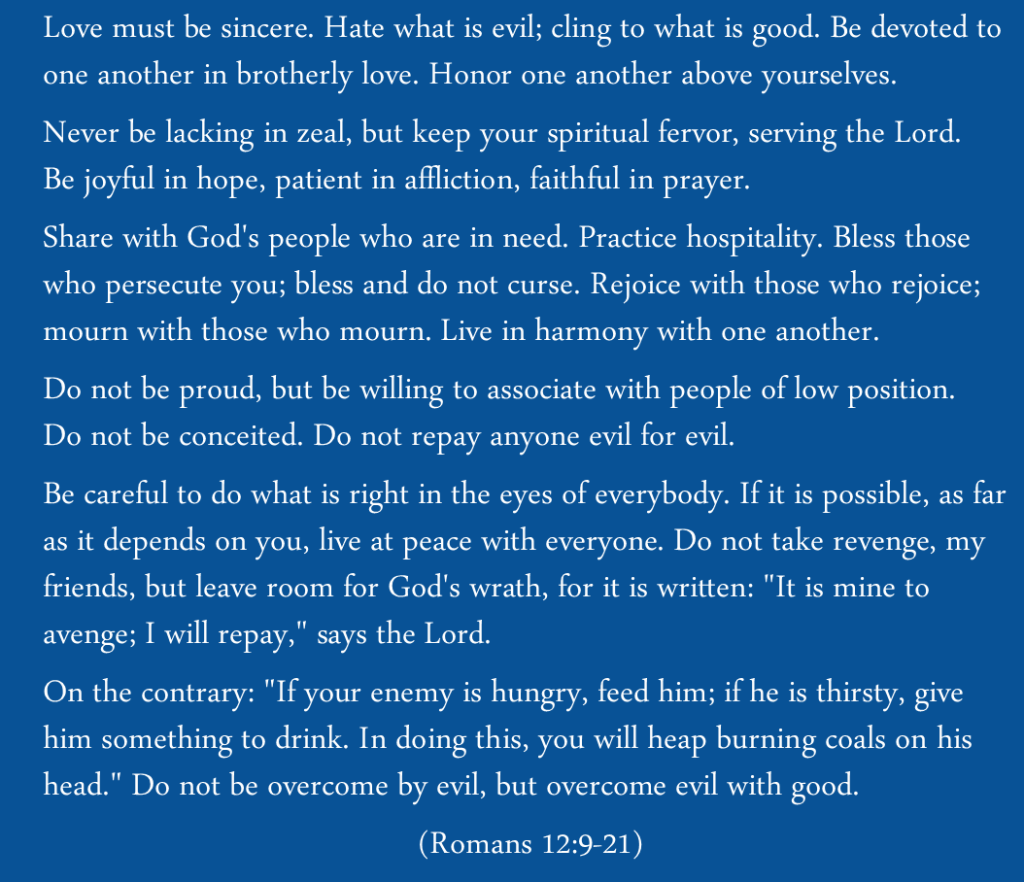
 Romans 12:10 Be devoted to one another in brotherly love. Honor one another above yourselves. 11 Never be lacking in zeal, but keep your spiritual fervor, serving the Lord. 12 Be joyful in hope, patient in affliction, faithful in prayer. 13 Share with God’s people who are in need. Practice hospitality. 14 Bless those who persecute you; bless and do not curse. 15 Rejoice with those who rejoice; mourn with those who mourn.
Yesterday we saw that Scripture calls those of us who have suffered and been comforted to pass the comfort along to someone who needs it.
Additionally we are commanded this:
Carry each other’s burdens, and in this way you will fulfill the law of Christ. (Galatians 6:2)
Did you catch the result?
We fulfill the law of Christ (to truly love one another) when we enter into another person’s pain.
True, this verse in Galatians is referring to the burden of moral sin, but I will tell you from personal experience that the burdens of grief and depression are profoundly spiritual things. To keep these burdens to ourselves, to wallow in them, to depend on our own resources all the while excluding the love of Christian family, to fail to have our eyes lifted to Christ who is our help in times of need, is to say that we are not looking to God for an answer to our situations.
 Does a refusal to look to God cheat Him out of what help is rightfully His to give?
Does rejecting God’s help look like rebellion to you? It should.
We need a broader view of the spiritual ramifications of suffering and greater willingness to carry another’s burden.
Entering someone else’s pain is an uncomfortable place. Most of us have enough pain of our own that we don’t really want to take on more. We stand there with the command to care and to love. What should we do? We follow Jesus when we love someone else the way Christ loved us, and Who, in fact, entered into our pain.
Just when we convince ourselves to love and comfort a brother or sister, IT happens. What is IT? IT is a pair of inevitable and inter-related questions:
(1) Do I have any right to try to enter into another person’s pain and to bring them biblical hope? I find myself thinking, for example,”So-and-so’s daughter died. I have a daughter who died. I can bring them comfort and hope by showing that God got me through the tough times and I can encourage them from personal experience that God knows their sorrow, feels their grief, hears their cries, and will carry them through the valley. In time, they can emerge with a new hope. God is faithful! Just keep the faith, even in the tough times. I’m praying for you!” But then the other shoe drops regarding entering another person’s pain.
Our adversary hits me with the second question:
(2) Does my suffering really match up enough to enter into that pain? I find myself wondering if I’m Suffering by Comparison. Then I start pondering, “So-and-so’s daughter was a teenager. Mine was a newborn. How can you really enter into another person’s pain when they had their daughter for 16+ years and all the memories and all the interactions and all the investment of love and time?” My adversary chides, “Barbara, you never knew your daughter alive. It’s not the same and therefore, you cannot possibly know the grief of a person like that. You’re just being arrogant thinking that you can minister to someone who has suffered far more than you.”
If you’ve been reading my writings over the years, you’ve probably detected something: Satan hangs around me like he’s my designated traveling buddy. I want to dump this traveling buddy, but he seems to want to stop me at every opportunity, hold my hand, and lead me away from doing the comfort ministry we’ve all been called to do.
So I read my Bible and I pray to send our adversary into a herd of pigs and down a cliff. It takes an act of God to free me from all the worry about whether I’m arrogantly Suffering by Comparison; it takes the Holy Spirit to teach me step out in faith and obedience; and it takes my will to submit to the Word that God has already spoken and to simply do what Christians are supposed to do by offering comfort.
The number of reasons we can concoct to get out of entering someone else’s pain are legion. But the command stands firm: to be the good neighbor and to offer comfort because in doing so, we fulfill the law of Christ to love others deeply.
What about you? What do you do when someone is suffering?
Questions for reflection:
1. What are your top 3 reasons for not wanting to get involved in someone else’s suffering?
2. What lies does the adversary tell you? How do those relate to question #1 above?
3. How would life be different for us if Jesus had never entered into our pain?