Being Still in Service (Lent 38-2014)
Some of us struggle with letting other people serve us. True, there are many people out there who love having everyone serve them. But for some of us—whether on account of pride or competence or self-esteem or being in a position of being powerful and needed, or just greatly disliking inconveniencing anyone—we would rather struggle through and even do without than have someone serve us.
I don’t know why I do this.
I remember after my daughter died, one of the teaching leaders from Community Bible Study came over and admonished me to let people serve me as I take time to grieve. She said, “People in this world who enjoy serving others can find it difficult to let others have the joy of serving too. Right now, people will want to do things for you because you’ve always been there for them. It’s your turn to receive grace.”
John 13:1 It was just before the Passover Feast. Jesus knew that the time had come for him to leave this world and go to the Father. Having loved his own who were in the world, he now showed them the full extent of his love. 2 The evening meal was being served, and the devil had already prompted Judas Iscariot, son of Simon, to betray Jesus. 3 Jesus knew that the Father had put all things under his power, and that he had come from God and was returning to God; 4 so he got up from the meal, took off his outer clothing, and wrapped a towel around his waist. 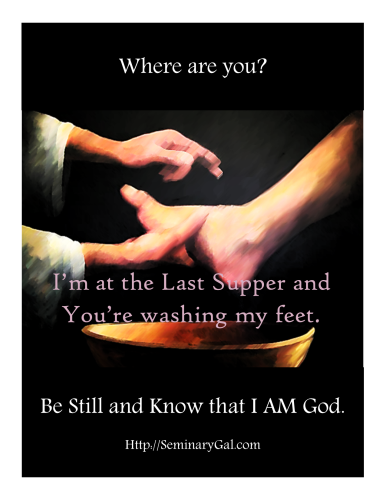 5 After that, he poured water into a basin and began to wash his disciples’ feet, drying them with the towel that was wrapped around him. 6 He came to Simon Peter, who said to him, “Lord, are you going to wash my feet?” 7 Jesus replied, “You do not realize now what I am doing, but later you will understand.” 8 “No,” said Peter, “you shall never wash my feet.” Jesus answered, “Unless I wash you, you have no part with me.” 9 “Then, Lord,” Simon Peter replied, “not just my feet but my hands and my head as well!” 10 Jesus answered, “A person who has had a bath needs only to wash his feet; his whole body is clean. And you are clean, though not every one of you.” 11 For he knew who was going to betray him, and that was why he said not every one was clean. 12 When he had finished washing their feet, he put on his clothes and returned to his place. “Do you understand what I have done for you?” he asked them. 13 “You call me ‘Teacher’ and ‘Lord,’ and rightly so, for that is what I am. 14 Now that I, your Lord and Teacher, have washed your feet, you also should wash one another’s feet. 15 I have set you an example that you should do as I have done for you. 16 I tell you the truth, no servant is greater than his master, nor is a messenger greater than the one who sent him. 17 Now that you know these things, you will be blessed if you do them.
It’d be easy to project myself onto Peter…full of pride, fearful of not being in control, and opinionated. Why did Peter respond in verse 9, “Then, Lord…not just my feet but my hands and my head as well!”? Read back over verses 6-8. I wonder if Peter had a sense of dread in him as he watched Jesus start with other disciples. Dreading having Jesus do something for him. Dreading the humiliation of what Jesus was doing. Maybe even judging it to be inappropriate. Verse 8 is an emphatic statement.
You shall never wash my feet.”
What was rising up in Peter? There was something not still in him. After Jesus explains why He is going to wash Peter’s feet, then Peter continues by telling Jesus what to do and how to do it. It is the pendulum swing from not wanting to be served at all to commanding how it ought to be done. Peter was having a rough time with being still about service.
Be Still. John 13: 16 I tell you the truth, no servant is greater than his master, nor is a messenger greater than the one who sent him. 17 Now that you know these things, you will be blessed if you do them.
Be Still. Let go of the pride that mimics humility. Genuine humility is expressed in no-strings-attached service. In serving for the sake of love.
Be Still and Know that I AM God. This is what Scripture says about Me: Philippians 2:8 And being found in appearance as a man, he humbled himself and became obedient to death– even death on a cross!
Be Still and Know that I AM God. See all the ways I’ve condescended to have a relationship with you. There is no power play in what I do. I do what I do because I AM Love. Get to know Me and you’ll know how to serve others rightly.
Questions for reflection:
- Do you like it when people serve you? What kinds of feelings does it engender? Is a feeling of guilt among those emotions? Why do some of us feel guilty?
- Can you remember a time when you were forced by the circumstances of life to be a grace recipient?
- Most of us have been in a classroom environment when the teacher starts going around the room and asking each person a question or to say something. Think of some strategies for how can you be still in times like that.
Being Still and Satisfied by Little (Lent 37-2014)

John 6: 3 Then Jesus went up on a mountainside and sat down with his disciples. 4 The Jewish Passover Feast was near. 5 When Jesus looked up and saw a great crowd coming toward him, he said to Philip, “Where shall we buy bread for these people to eat?” 6 He asked this only to test him, for he already had in mind what he was going to do. 7 Philip answered him, “Eight months’ wages would not buy enough bread for each one to have a bite!” 8 Another of his disciples, Andrew, Simon Peter’s brother, spoke up, 9 “Here is a boy with five small barley loaves and two small fish, but how far will they go among so many?” 10 Jesus said, “Have the people sit down.” There was plenty of grass in that place, and the men sat down, about five thousand of them. 11 Jesus then took the loaves, gave thanks, and distributed to those who were seated as much as they wanted. He did the same with the fish. 12 When they had all had enough to eat, he said to his disciples, “Gather the pieces that are left over. Let nothing be wasted.” 13 So they gathered them and filled twelve baskets with the pieces of the five barley loaves left over by those who had eaten. 14 After the people saw the miraculous sign that Jesus did, they began to say, “Surely this is the Prophet who is to come into the world.”
What was Andrew thinking? Jesus sees thousands of people coming, points them out to the disciples and inquires about feeding them. Andrew offers “Here is a boy with five small barley loaves and two small fish.” Was the boy selling food or was that his lunch that Andrew was commandeering?
Philip (who came from nearby Bethsaida) saw what they didn’t have: enough food to feed everyone or even the resources to buy it. Andrew saw what they did have: food, but not enough for more than a handful of people.
[Jesus] asked this only to test him, for he already had in mind what he was going to do. (John 6:6)
Feeding that many people would be nothing short of a miracle. Jesus saw that “With man this is impossible, but with God all things are possible.” (Matthew 19:26).
Five thousand men were sitting in the green grass on the hillside and Jesus—the Good Shepherd–was going to provide for the flock and satisfy them. Little is much when God is in it, as the hymn says.
Where are you when you’re at the end of your resources? What do you do when your ministry or your life’s work seems insignificant? Where do you turn when all you have is a little?
Be Still. Here’s what to do: Psalm 107: 8 Let them give thanks to the LORD for his unfailing love and his wonderful deeds for men, 9 for he satisfies the thirsty and fills the hungry with good things.
Be Still. God can multiply whatever is in your hands and make it sufficient and more than enough.
Be Still and Know that I AM God. I who called you will say of your faith, Matthew 25:23 ‘Well done, good and faithful servant! You have been faithful with a few things; I will put you in charge of many things. Come and share your master’s happiness!’
Be Still and Know that I AM God. Deuteronomy 8:1 Be careful to follow every command I am giving you today, so that you may live and increase and may enter and possess the land that the LORD promised on oath to your forefathers. 2 Remember how the LORD your God led you all the way in the desert these forty years, to humble you and to test you in order to know what was in your heart, whether or not you would keep his commands. 3 He humbled you, causing you to hunger and then feeding you with manna, which neither you nor your fathers had known, to teach you that man does not live on bread alone but on every word that comes from the mouth of the LORD. 4 Your clothes did not wear out and your feet did not swell during these forty years. 5 Know then in your heart that as a man disciplines his son, so the LORD your God disciplines you. 6 Observe the commands of the LORD your God, walking in his ways and revering him. 7 For the LORD your God is bringing you into a good land– a land with streams and pools of water, with springs flowing in the valleys and hills; 8 a land with wheat and barley, vines and fig trees, pomegranates, olive oil and honey; 9 a land where bread will not be scarce and you will lack nothing; a land where the rocks are iron and you can dig copper out of the hills. 10 When you have eaten and are satisfied, praise the LORD your God for the good land he has given you.
Questions for reflection:
- If we could satisfy every problem on our own, feeding the multitudes in our own strength, would we see God’s faithfulness as well? If the Israelites always had plenty of bread, would manna have been as meaningful?
- Sometimes God wants us to bring what we have that is too little (e.g.time, money, food, energy, patience, hope, etc.) and by bringing it to Him, see that He doesn’t waste anything in our life experiences. He can multiply what is small and bring enough out of nothing. What do you have that you could offer to Him today for His multiplication and use?
- The lyrics to the hymn Little is Much when God is in It follow. Let these words minister to you today.
Little is Much when God is in It
In the harvest field now ripened
There’s a work for all to do;
Hark! the voice of God is calling
To the harvest calling you.
Refrain
Little is much when God is in it!
Labor not for wealth or fame.
There’s a crown—and you can win it,
If you go in Jesus’ Name.
In the mad rush of the broad way,
In the hurry and the strife,
Tell of Jesus’ love and mercy,
Give to them the Word of Life.
Refrain
Does the place you’re called to labor
Seem too small and little known?
It is great if God is in it,
And He’ll not forget His own.
Refrain
Are you laid aside from service,
Body worn from toil and care?
You can still be in the battle,
In the sacred place of prayer.
Refrain
When the conflict here is ended
And our race on earth is run,
He will say, if we are faithful,
“Welcome home, My child—well done!”
Refrain
Be Still in the Boat with Jesus (Lent 36-2014)
 Luke 8: 22 One day Jesus said to his disciples, “Let’s go over to the other side of the lake.” So they got into a boat and set out. 23 As they sailed, he fell asleep. A squall came down on the lake, so that the boat was being swamped, and they were in great danger. 24 The disciples went and woke him, saying, “Master, Master, we’re going to drown!” He got up and rebuked the wind and the raging waters; the storm subsided, and all was calm. 25 “Where is your faith?” he asked his disciples. In fear and amazement they asked one another, “Who is this? He commands even the winds and the water, and they obey him.
There are few places in which it ought to be easier to Be Still than when we’re in the boat with Jesus. But oftentimes, we really don’t feel all that still. We feel the motion of the boat as it is being tossed about on the rough seas of an average life. Jesus’ simple command seems so friendly, “Let’s go over to the other side of the lake.” Yet, the boat ride was going to be anything but smooth sailing.
Where are you when you’re passing through a rough patch of life
and it’s anything but smooth sailing for you?
If you’re in the boat with Jesus, you can Be Still. Truth be told for most of us, we’re more like the disciples and Jesus might inquire of us,
Where is your faith?”
Back when I was in seminary, our family was going through a really rough time. Employment was in upheaval. We were going to have to uproot our family and move. Family life was shaken as we grieved our youngest daughter’s death and tried to decide whether it was unloving as parents to leave her grave behind and just move…or to treat her casket like a suitcase and pack her up to where we were going so that we could still visit her grave. Classes were difficult and I was struggling with learning Greek. Waves were tossing us to and fro and in my panic, I did what the disciples did: I cried out in fear that I was drowning in the rough seas we were sailing. I thought Jesus said we were just sailing across to the other side but I realized my life was taking on water.
I could relate to the passage from Mark 4:38 “Jesus was in the stern, sleeping on a cushion. The disciples woke him and said to him, ‘Teacher, don’t you care if we drown?’” One day as I was crying out to God and well, crying period, I told God I couldn’t handle anything more. I was drowning. He gave me a vision (for the lack of a better word, think what you will) of myself standing on His hand with my mouth barely above the water and He said, “Does this look like drowning to you?” It occurred to me that if I spent more time with my mouth shut, no water would get in. Ouch.
It’s easy to have faith when life is smooth sailing, but when the seas are rough, we can still Be Still when we’re in the boat with Jesus.
Be Still. Do you really think you’re going to drown if your Savior is in the boat?
Be Still. As long as your head is above water and your mouth isn’t open all the time voicing doubts and fears, you’re not drowning, are you?
Be Still and Know that I AM God. “Who is this? He commands even the winds and the water, and they obey him.” I’ll tell you who I AM. I’m God. Get to know Me and you won’t be so afraid.
Be Still and Know that I AM God. Job 40:2 “Will the one who contends with the Almighty correct him? Let him who accuses God answer him!” Do you know who I AM?
Questions for reflection:
- Read Job 42:1 “Then Job replied to the LORD: 2 “I know that you can do all things; no plan of yours can be thwarted. 3 You asked, ‘Who is this that obscures my counsel without knowledge?’ Surely I spoke of things I did not understand, things too wonderful for me to know. 4 “You said, ‘Listen now, and I will speak; I will question you, and you shall answer me.’ 5 My ears had heard of you but now my eyes have seen you. 6 Therefore I despise myself and repent in dust and ashes.” How do we see God best in the storms of life?
- Is Jesus truly sleeping up in heaven? Did He doze off while waiting for His enemies to be made His footstool?
- How can knowing God better help us to Be Still when life is rough sailing?
Be Still at the Point of Your Sin (Lent 35-2014)
I’m so glad today’s passage of Scripture is in the Bible. It stands as clear proof that Jesus was not afraid of women—He was not afraid to talk to women, to associate with women, to deal with women on an intellectual level, to reason with women, to listen to women, or to risk how others would think of Him by speaking with a woman…alone.
Many modern-day pastors could take a few notes on what it means to be the kind of man that Jesus wants them to be. The reasons why these pastors fear women are Legion. Much of it has to do with the fact that we’re women and they associate sin with women.
Jesus, in today’s passage, was confronted with a woman He knew was a sinner. Worse, she was a sexual sinner—most modern male pastors’ worst nightmare. Instead of insisting that there be another disciple there to protect Him or vouch for Him, what did Jesus do? He engaged her in conversation. Shocking!
 Read John 4: 4-30 4 Now [Jesus] had to go through Samaria. 5 So he came to a town in Samaria called Sychar, near the plot of ground Jacob had given to his son Joseph. 6 Jacob’s well was there, and Jesus, tired as he was from the journey, sat down by the well. It was about the sixth hour. 7 When a Samaritan woman came to draw water, Jesus said to her, “Will you give me a drink?” 8 (His disciples had gone into the town to buy food.) 9 The Samaritan woman said to him, “You are a Jew and I am a Samaritan woman. How can you ask me for a drink?”) (For Jews do not associate with Samaritans. 10 Jesus answered her, “If you knew the gift of God and who it is that asks you for a drink, you would have asked him and he would have given you living water” … 28 Then, leaving her water jar, the woman went back to the town and said to the people, 29 “Come, see a man who told me everything I ever did. Could this be the Christ?” 30 They came out of the town and made their way toward him.
Talking with a woman wasn’t any more acceptable then than it is now. At the 6th hour (the heat of the day), when all the disciples had gone to get food, Jesus would have been quite alone. When the woman came to draw water, did Jesus look at His hands or suddenly be preoccupied with the straps on His sandals or gaze into the distant scenery so He could ignore her existence? Nope. Jesus was a real man. Real men aren’t afraid of women, even ones with a checkered past.
Jesus asked this woman a question to get the conversation going. He was intent upon turning her from a Samaritan woman of ill-repute into the first woman evangelist (maybe even the first one period, since John the Baptist was a prophet not an evangelist).
Did Jesus wish the opportunity away? No, He did not.
He delved into the sin issue deeply: “Go and call your husband,” He says. It had nothing to do with drawing water but everything to do with her being an outcast getting water in the heat of the day.
Maybe it takes a man like Jesus to point a woman to her sin and point her to the Messiah and to explain that the two points can become a line of forgiveness.
Be Still, woman. I had something beautiful in mind when I created you. I didn’t create you or man to be sinners, but to be holy.
Be Still, man. You’ve blamed woman long enough. I created woman and called her “good” and “very good.”
Be Still and Know that I AM God. I want to see both men and women come to the point of their sin, repent, and find forgiveness in Me. Galatians 3:28 There is neither Jew nor Greek, slave nor free, male nor female, for you are all one in Christ Jesus.
Be Still and Know that I AM God. 2 Corinthians 6:18 “I will be a Father to you, and you will be my sons and daughters, says the Lord Almighty.”
Questions for reflection:
- What difference would it make in the church if men viewed women as relational categories: mother, wife, sisters, and daughters? In God’s family, what is happening when men and women take sex outside of marriage?
- How do men and women relate to Jesus in heaven? Therefore, how will women relate to men in heaven? Read Matthew 22:29 Jesus replied, “You are in error because you do not know the Scriptures or the power of God. 30 At the resurrection people will neither marry nor be given in marriage; they will be like the angels in heaven.
- Are you willing to meet a person at the point of sin and draw the line of forgiveness by showing him/her the point of salvation in Christ?
Palm Sunday Devotional 2014
Palm Sunday is the beginning of Holy Week and so our regular Lenten devotional series, Be Still and Know that I AM God, will continue tomorrow.
Palm Sunday merits a devotional day all on its own, however, because it’s a high point of the church known as the Triumphal Entry (a day in earthly time remembering celebration of the arrival of the long-awaited Messiah). From that point during the week, it’s all downhill from a human perspective.

On Palm Sunday, people are waving palms and cheering “Hosanna,” celebrating Christ Jesus as King. A mere 5 days later, they’re demanding His death. During the next 5 days of earthly time,
- People will fall away.
- The crowd will brood with unmet expectations.
- They will conclude it’s just another false Messianic hope.
- The Pharisees, scribes, and teachers of the Law will conspire against Jesus who is seen as a blasphemer, or at least someone stealing their thunder.
- The onlookers and believers—once a crowd of countless people pressing in on Jesus—will be gradually peeled off until all that’s left are the 12 disciples, Jesus, and a handful of women.
- The Last Supper will be shared and the disciples will still be fighting amongst each other, not understanding what’s happening.
- Of the 12 disciples, Judas will betray Jesus and the other 11 will all deny Him, even Peter who promised Jesus that he wouldn’t.
- An insurrectionist will be freed and the Innocent One will be sentenced to die on the Cross.
- Friday will come and Jesus will be dead.
Why do I dwell on all this sudden change?
Because in the Church, it is far too easy to go from pinnacle to pinnacle without descending into the valley of the shadow of death. We want to run straight from singing Hosanna to Christ the Lord is Risen Today. All that stuff in between is unpleasant for us to think about. We don’t want to consider what had to happen to Jesus and our role in it. So we blip from peak to peak without peeking into the valley where the battle was fought and the victory won.
But it’s the steps down into death and the rising from it that form the true meaning of what it means to be a follower of Jesus Christ.
Ephesians 4: 8 This is why it says: “When he ascended on high, he led captives in his train and gave gifts to men.” 9 (What does “he ascended” mean except that he also descended to the lower, earthly regions? 10 He who descended is the very one who ascended higher than all the heavens, in order to fill the whole universe.)
Jesus never said that He would go to Jerusalem hailed as an earthly king and remain that way, gathering armies of warriors, fighting earthly battles, and doing things earthly ways. He said He was going to His death.
Permit yourself as the week unfolds to remember that the valley of the shadow of death was where Jesus descended in order to deal with human sin so that Easter would have real meaning. So the empty tomb would have real meaning. Without dying, there would be no victory.
So it is with us, we need to die to ourselves and to seeing our lives as not really needing redemption. Die to seeing ourselves as not really requiring salvation. As if we were maybe good enough on our own to be saved without Him.
Today and for the next 6 days, step into the valley and see the work Jesus did in a new light. The shadow of death may be blackest black, but Jesus is the Light of the World.
Be Still When You’re Disillusioned (Lent 34-2014)
As we prepare to enter Holy Week in our devotional series Be Still and Know that I AM God, I find today’s verses of Scripture one of the most reassuring passages. It isn’t located in the Gospel accounts of Passion Week, but the same concept is there very clearly, just as it is present in our lives today. Be Still When You’re Disillusioned.
Matthew 11:1 After Jesus had finished instructing his twelve disciples, he went on from there to teach and preach in the towns of Galilee. 2 When John heard in prison what Christ was doing, he sent his disciples 3 to ask him, “Are you the one who was to come, or should we expect someone else?” 4 Jesus replied, “Go back and report to John what you hear and see: 5 The blind receive sight, the lame walk, those who have leprosy are cured, the deaf hear, the dead are raised, and the good news is preached to the poor. 6 Blessed is the man who does not fall away on account of me.” 7 As John’s disciples were leaving, Jesus began to speak to the crowd about John: “What did you go out into the desert to see? A reed swayed by the wind? 8 If not, what did you go out to see? A man dressed in fine clothes? No, those who wear fine clothes are in kings’ palaces. 9 Then what did you go out to see? A prophet? Yes, I tell you, and more than a prophet. 10 This is the one about whom it is written: “‘I will send my messenger ahead of you, who will prepare your way before you.’ 11 I tell you the truth: Among those born of women there has not risen anyone greater than John the Baptist; yet he who is least in the kingdom of heaven is greater than he. 12 From the days of John the Baptist until now, the kingdom of heaven has been forcefully advancing, and forceful men lay hold of it. 13 For all the Prophets and the Law prophesied until John. 14 And if you are willing to accept it, he is the Elijah who was to come.
Here’s why I find it reassuring: Even among the greatest of the faithful believers, doubts can happen. But doubts can be overcome.
Holy Week is all about that. John the Baptist was the greatest of those born of women, by Jesus’ own words. He was the one to prepare the way for the Christ. And yet, sometimes when things don’t make sense, even the best among us can find ourselves questioning. We can find ourselves becoming disillusioned.
Jesus says, “Be Still” to your doubts. He gives evidence to buck up the imprisoned prophet. “Blessed is the man who does not fall away on account of me,” He says.
Tomorrow is Palm Sunday. Everyone is cheering. The crowd loves the Jesus on a donkey riding into Jerusalem (just as royalty would). He’s going to become our Messiah. He’s going to overthrow Rome and vindicate the Jewish people. Jerusalem will be the world capital and we’ll all be delivered! Then there will be shalom, true peace!
Well, not yet. And not like that.
The expectations of a world might be asking as Holy Week unfolds, “Are you the one who was to come, or should we expect someone else?” The reassurance that leads to Easter’s empty tomb is found in Jesus’ encouragement to look at the evidence and in His words, “Blessed is the man who does not fall away on account of me.”
The crowd, as Holy Week progresses, goes from celebration to doubt to disdain to demanding crucifixion. The way God saved us is totally different than what was expected, even though Jesus told the disciples over and over again that this was precisely what was going to happen. Every bit of evidence foretold was fulfilled. Jesus’ empty tomb on Easter Sunday ought to put an end to all doubts. If we accept any of that as evidence…
So where are you during Lent? Are you cheering Jesus’ triumphal entry or doubting whether He’s really the Messiah? Are you expecting God to do things your way or are you looking at the evidence God has provided showing His Son as The Way?
Be Still When You’re Disillusioned. The evidence is there.
Be Still. When I AM not meeting your expectations, the problem isn’t with Me.
Be Still. Come to My Word and see the evidence of who I AM.
Be Still and Know that I AM God. “Blessed is the man who does not fall away on account of Me.”
Be Still and Know that I AM God. Joel 3: 17 “’Then you will know that I, the LORD your God, dwell in Zion, my holy hill. Jerusalem will be holy; never again will foreigners invade her. 18 ‘In that day the mountains will drip new wine, and the hills will flow with milk; all the ravines of Judah will run with water. A fountain will flow out of the LORD’s house and will water the valley of acacias. 19 But Egypt will be desolate, Edom a desert waste, because of violence done to the people of Judah, in whose land they shed innocent blood. 20 Judah will be inhabited forever and Jerusalem through all generations.”
Questions for reflection:
- Do your expectations ever get in the way of your progress?
- How do you feel when your expectations aren’t met? What do you do as a response to unmet expectations?
- Read the story of Jesus cleansing an evil spirit from a boy in Mark 9:20 “So they brought him. When the spirit saw Jesus, it immediately threw the boy into a convulsion. He fell to the ground and rolled around, foaming at the mouth. 21 Jesus asked the boy’s father, ‘How long has he been like this?’ ‘From childhood,’ he answered. 22 ‘It has often thrown him into fire or water to kill him. But if you can do anything, take pity on us and help us.’ 23 ‘”If you can?”’ said Jesus. ‘Everything is possible for him who believes.’ 24 Immediately the boy’s father exclaimed, ‘I do believe; help me overcome my unbelief!’” What did Jesus do when others were doubting? What did the boy’s father ask?

Still in Flight (Lent 33-2014)
Matthew 2:11 On coming to the house, [the Magi] saw the child with his mother Mary, and they bowed down and worshiped him. Then they opened their treasures and presented him with gifts of gold and of incense and of myrrh. 12 And having been warned in a dream not to go back to Herod, they returned to their country by another route.
 The boy Jesus, around 2 years old now, is presented with gifts from the Magi. Gold, incense, and myrrh—not your typical baby presents–would come in very handy as going-away-gifts.
Gold, incense, and myrrh would have value no matter where they went and that’s a good thing because Joseph and Mary and Jesus were soon to be running for their lives.
Matthew 2:13 When [the Magi] had gone, an angel of the Lord appeared to Joseph in a dream. “Get up,” he said, “take the child and his mother and escape to Egypt. Stay there until I tell you, for Herod is going to search for the child to kill him.” 14 So he got up, took the child and his mother during the night and left for Egypt, 15 where he stayed until the death of Herod. And so was fulfilled what the Lord had said through the prophet: “Out of Egypt I called my son.”
When we’re afraid, it’s hard to be still. We want to scramble and be ready as the fight-or-flight response of adrenaline kicks in. But God revealed His next steps for Joseph through a dream. Joseph and Mary and Jesus were to go to Egypt. Fight was not an option. Flight was God’s design.
Matthew 2:19 After Herod died, an angel of the Lord appeared in a dream to Joseph in Egypt 20 and said, “Get up, take the child and his mother and go to the land of Israel, for those who were trying to take the child’s life are dead.” 21 So he got up, took the child and his mother and went to the land of Israel. 22 But when he heard that Archelaus was reigning in Judea in place of his father Herod, he was afraid to go there. Having been warned in a dream, he withdrew to the district of Galilee, 23 and he went and lived in a town called Nazareth. So was fulfilled what was said through the prophets: “He will be called a Nazarene.”
One hardly ever hears sermons about the importance of Joseph’s clarity in perceiving revelatory dreams or his obedience to them, but Joseph doesn’t need to be treated as the third wheel in the early childhood of Christ Jesus. Joseph was a righteous and obedient man. He was Still in Flight.
Joseph was still. Scripture doesn’t say he pondered the dreams for a week or two before acting. It doesn’t say he discussed them with Mary and asked her what she thought of that as if his dreams were no different than dreaming your boss is the Cheshire cat, your desk is a swimming pool, and your office is Planet of the Apes. Oh, and you’re wearing a chicken suit. Nope. Joseph immediately caught on that this is how God communicates with him. He was still, even in flight.
Dream the command about going to Egypt. Get up and do it. Dream the command about coming home. Get up and do it. Still in Flight. Still in Flight home. Still smart in the flight home because Joseph discerned that Archelaus might be a problem and Joseph was afraid to go there. Another dream. Get up and go to Nazareth.
Joseph was the head of his household, protecting his wife Mary and the young boy Jesus. Joseph discerned carefully. And he obeyed God as a righteous man would do.
No second guessing. No foot dragging. No indecision. Dream it. Do it. Be Still in Flight.
Be Still. I know where I AM taking you and the reasons I AM taking you where I AM taking you.
Be Still. Just listen and obey and I will protect you from both indecision and regret.
Be Still and Know that I AM God. Isaiah 42:16 “I will bring the blind by a way they did not know; I will lead them in paths they have not known. I will make darkness light before them, and crooked places straight. These things I will do for them, and not forsake them.”
Be Still and Know that I AM God. Jeremiah 31: 8 “See, I will bring [the remnant of Israel] from the land of the north and gather them from the ends of the earth. Among them will be the blind and the lame, expectant mothers and women in labor; a great throng will return. 9 They will come with weeping; they will pray as I bring them back. I will lead them beside streams of water on a level path where they will not stumble, because I am Israel’s father, and Ephraim is my firstborn son.”
Questions for reflection:
- Have you ever been afraid for your life or the lives of those in your care? How does it feel?
- How do you know what to do when the fight-or-flight adrenaline response comes?
- To what degree can instinct be trained by spending time with God and practicing obedience to Him in the mundane?
- Do you trust God to watch over you? Offer a prayer of thanksgiving if the answer is “Yes.” Ask for His help to trust Him more, if your answer was “Not enough.”
Being Still in Confrontation (Lent 32-2014)
Changing the status of the status quo requires no mere tweaking. Especially when it’s the religious status quo. No simplistic tinkering will do: It’s overhaul time!
Jeremiah 20:1 When the priest Pashhur son of Immer, the chief officer in the temple of the LORD, heard Jeremiah prophesying these things, 2 he had Jeremiah the prophet beaten and put in the stocks at the Upper Gate of Benjamin at the LORD’s temple. 3 The next day, when Pashhur released him from the stocks, Jeremiah said to him, “The LORD’s name for you is not Pashhur, but Magor-Missabib. 4 For this is what the LORD says: ‘I will make you a terror to yourself and to all your friends; with your own eyes you will see them fall by the sword of their enemies. I will hand all Judah over to the king of Babylon, who will carry them away to Babylon or put them to the sword. 5 I will hand over to their enemies all the wealth of this city– all its products, all its valuables and all the treasures of the kings of Judah. They will take it away as plunder and carry it off to Babylon. 6 And you, Pashhur, and all who live in your house will go into exile to Babylon. There you will die and be buried, you and all your friends to whom you have prophesied lies.'”
 Ouch. Not exactly the way to make friends. But prophets must accept they will be unpopular dudes. God cares more about our obedience than our popularity and Jeremiah knew that better than many.
It doesn’t mean it didn’t matter to him. Sometimes being an unpopular man with an unpopular job can get under your skin. This instance broke Jeremiah’s spirit and silence. So he continues with a lament to God,
Jeremiah 20:7 O LORD, you deceived me, and I was deceived; you overpowered me and prevailed. I am ridiculed all day long; everyone mocks me. 8 Whenever I speak, I cry out proclaiming violence and destruction. So the word of the LORD has brought me insult and reproach all day long. 9 But if I say, “I will not mention him or speak any more in his name,” his word is in my heart like a fire, a fire shut up in my bones. I am weary of holding it in; indeed, I cannot. 10 I hear many whispering, “Terror on every side! Report him! Let’s report him!” All my friends are waiting for me to slip, saying, “Perhaps he will be deceived; then we will prevail over him and take our revenge on him.” 11 But the LORD is with me like a mighty warrior; so my persecutors will stumble and not prevail. They will fail and be thoroughly disgraced; their dishonor will never be forgotten. 12 O LORD Almighty, you who examine the righteous and probe the heart and mind, let me see your vengeance upon them, for to you I have committed my cause. 13 Sing to the LORD! Give praise to the LORD! He rescues the life of the needy from the hands of the wicked. 14 Cursed be the day I was born! May the day my mother bore me not be blessed! 15 Cursed be the man who brought my father the news, who made him very glad, saying, “A child is born to you– a son!” 16 May that man be like the towns the LORD overthrew without pity. May he hear wailing in the morning, a battle cry at noon. 17 For he did not kill me in the womb, with my mother as my grave, her womb enlarged forever. 18 Why did I ever come out of the womb to see trouble and sorrow and to end my days in shame?
I’m unpopular with an unpopular job. I wish I’d never been born.
This stinks. I hate confrontation.
Have you ever felt that way?
Be Still. I know I didn’t give you a choice in calling, but I do reward the obedient.
Be Still. Popularity is less important than faithfulness. Keep your eyes on Me.
Be Still and Know that I AM God. Revelation 2:9 “I know your afflictions and your poverty– yet you are rich! I know the slander of those who say they are Jews and are not, but are a synagogue of Satan. 10 Do not be afraid of what you are about to suffer. I tell you, the devil will put some of you in prison to test you, and you will suffer persecution for ten days. Be faithful, even to the point of death, and I will give you the crown of life. 11 He who has an ear, let him hear what the Spirit says to the churches. He who overcomes will not be hurt at all by the second death.”
Be Still and Know that I AM God. Revelation 3: 7 “These are the words of him who is holy and true, who holds the key of David. What he opens no one can shut, and what he shuts no one can open. 8 I know your deeds. See, I have placed before you an open door that no one can shut. I know that you have little strength, yet you have kept my word and have not denied my name. 9 I will make those who are of the synagogue of Satan, who claim to be Jews though they are not, but are liars– I will make them come and fall down at your feet and acknowledge that I have loved you. 10 Since you have kept my command to endure patiently, I will also keep you from the hour of trial that is going to come upon the whole world to test those who live on the earth. 11 I am coming soon. Hold on to what you have, so that no one will take your crown. 12 Him who overcomes I will make a pillar in the temple of my God. Never again will he leave it. I will write on him the name of my God and the name of the city of my God, the new Jerusalem, which is coming down out of heaven from my God; and I will also write on him my new name.”
Questions for reflection:
- How good are you at dealing with confrontation? What kinds of feelings accompany confrontation and conflict for you?
- Have you ever wallowed in self-pity? Read back over Jeremiah’s complaint (Jeremiah 20:7-13) and notice what initially turned the tide for Jeremiah.
- How can remembering God’s faithfulness call us out of fearing confrontation and indulging self-pity…and into praise?
- Even Jeremiah, the great prophet who saw God’s work throughout his life, returned to pity after praising God (Jeremiah 20:14-18). What does that say about the tenacity of negative thinking?
Being Still When Spiritually Exhausted (Lent 31-2014)

Exhaustion. Have you ever experienced it?
Many of us know what it’s like to be physically exhausted after doing strenuous activity for an extended period of time. Our legs can feel like rubber and our arms may ache. We may be out of breath and want to collapse in a chair or a bed and just sleep.
Spiritual exhaustion can happen easily to those of us exercising powerful faith on a regular basis. It can even happen to those who are simply holding on, standing still, and facing the storm for a bit too long.
Spiritual exhaustion ought not to be underestimated. In many regards, it is more difficult to endure, can only be spiritually resolved, and can take longer to heal.
Elijah was spiritually exhausted. Having faced the years of drought, then finally the rain, and his killing of Jezebel’s prophets, now Elijah had Jezebel on his heels trying to take his life.
Elijah was spiritually and emotionally spent. He wished he was dead.
1 Kings 19:1 Now Ahab told Jezebel everything Elijah had done and how he had killed all the prophets with the sword. 2 So Jezebel sent a messenger to Elijah to say, “May the gods deal with me, be it ever so severely, if by this time tomorrow I do not make your life like that of one of them.” 3 Elijah was afraid and ran for his life. When he came to Beersheba in Judah, he left his servant there, 4 while he himself went a day’s journey into the desert. He came to a broom tree, sat down under it and prayed that he might die. “I have had enough, LORD,” he said. “Take my life; I am no better than my ancestors.”
There’s no shame in admitting that we feel this way from time to time. Elijah, among the greatest of the OT prophets who was taken up into a whirlwind alive, wasn’t ashamed to admit to God, “I’ve had enough, LORD.”
Depression and exhaustion go hand in hand.
Those of us who know spiritual exhaustion well also know that depression is the shadow that follows behind exhaustion.
It isn’t a loud boisterous killer of the spirit, but it’s there—insidiously so. It tags along, leeching off the life of the godly man or woman who is weakened by fighting the fight. Depression is parasitic and it sucks the life and the joy and the peace out of a person. Elijah felt that painfully.
What happened then? God provided help in a variety of ways (1 Kings 19:5-21):
- Rest (1 Kings 19:5)
- Sustenance (1 Kings 19:5-6)
- Compassion in the form of acknowledging that the journey is hard (1 Kings 19:7)
- Strength to forge ahead (1 Kings 19:8)
- God’s reassuring presence (1 Kings 19:11-13)
- Information that God only knew–information that would encourage Elijah
- Direction (1 Kings 19:15)
- Succession plan (1 Kings 19:16-17)
- Divine perspective (1 Kings 19:18)
Strengthened by God’s provision, Elijah was able to pass the baton to Elisha, whom God provided to be Elijah’s attendant and successor with the mantle of prophet (1 Kings 19:-21)
Be Still. I know you are weary. I AM here to help you.
Be Still. I know that the human spirit can withstand only so much. I will refresh you.
Be Still and Know that I AM God. Matthew 11:29 “Take My yoke upon you, and learn from Me, for I am gentle and humble in heart; and you shall find rest for your souls.”
Be Still and Know that I AM God. Remind yourself of who I AM. Psalm 23:1 “A psalm of David. The LORD is my shepherd, I shall not be in want. 2 He makes me lie down in green pastures, he leads me beside quiet waters, 3 he restores my soul. He guides me in paths of righteousness for his name’s sake. 4 Even though I walk through the valley of the shadow of death, I will fear no evil, for you are with me; your rod and your staff, they comfort me. 5 You prepare a table before me in the presence of my enemies. You anoint my head with oil; my cup overflows. 6 Surely goodness and love will follow me all the days of my life, and I will dwell in the house of the LORD forever.”
Questions for reflection:
- How often have you thought it was a sign of weakness to admit that you’ve had enough? Does it seem unchristian or like a lack of faith?
- Where do you turn when depression hits?
- In the stillness, remind yourself of who God is and then look for how He provides for you.
- Elijah reached his limit and wanted to die. What did God do, give Elijah the death he wanted as relief or something better? Read 2 Kings 2:11 As they were walking along and talking together, suddenly a chariot of fire and horses of fire appeared and separated the two of them, and Elijah went up to heaven in a whirlwind.
SG 32 Where are you? I’m unpopular with an unpopular job. Jeremiah.
SG 33 Where are you? Running for our lives. Joseph, Mary, and Jesus.
SG 34 Where are you? Preparing the way and getting disillusioned. John the Baptist
PALM SUNDAY Where are you? I’m celebrating the Messiah and getting my hopes up.
SG 35 Where are you? I’m at the well and I’m an outcast among women.
SG 36 Where are you? I’m in Your boat on a stormy sea. The discples.
SG 37 Where are you? I’m on the hillside and I have nothing to share but my lunch. Little boy.
SG 38 Where are you? I’m at the Last Supper and You’re washing my feet. Peter.
SG 39 Where are you? I’m at the foot of the Cross and I don’t understand. Mary.
SG 40 Where are you? I’m hiding because I was a disciple of Jesus.
EASTER SUNDAY Where are you? I’m at the empty tomb. Mary Magdalene.
Still Humiliated (Lent 30-2014)
Do you ever feel alone in this world? Like everything is stacked against you? Elijah had just royally ticked off King Ahab and his wife—the evil Queen Jezebel—by predicting a drought that would last for years.
Go hide, God says.
1 Kings 17:1 Now Elijah the Tishbite, from Tishbe in Gilead, said to Ahab, “As the LORD, the God of Israel, lives, whom I serve, there will be neither dew nor rain in the next few years except at my word.” 2 Then the word of the LORD came to Elijah: 3 “Leave here, turn eastward and hide in the Kerith Ravine, east of the Jordan. 4 You will drink from the brook, and I have ordered the ravens to feed you there.” 5 So he did what the LORD had told him. He went to the Kerith Ravine, east of the Jordan, and stayed there. 6 The ravens brought him bread and meat in the morning and bread and meat in the evening, and he drank from the brook. 7 Some time later the brook dried up because there had been no rain in the land.
How humiliating. Running for cover. Drinking from a brook that was about to dry up. Being fed meat and bread by ravens. (Yikes! You didn’t know where they’d been or where they got the meat and bread from—ugh!) But God told them to feed you, so there you go. Being fed by ravens. Then God adds insult to injury from a human perspective:
1 Kings 17:8 Then the word of the LORD came to him: 9 “Go at once to Zarephath of Sidon and stay there. I have commanded a widow in that place to supply you with food.” 10 So he went to Zarephath. When he came to the town gate, a widow was there gathering sticks. He called to her and asked, “Would you bring me a little water in a jar so I may have a drink?” 11 As she was going to get it, he called, “And bring me, please, a piece of bread.” 12 “As surely as the LORD your God lives,” she replied, “I don’t have any bread– only a handful of flour in a jar and a little oil in a jug. I am gathering a few sticks to take home and make a meal for myself and my son, that we may eat it– and die.” 13 Elijah said to her, “Don’t be afraid. Go home and do as you have said. But first make a small cake of bread for me from what you have and bring it to me, and then make something for yourself and your son. 14 For this is what the LORD, the God of Israel, says: ‘The jar of flour will not be used up and the jug of oil will not run dry until the day the LORD gives rain on the land.'” 15 She went away and did as Elijah had told her. So there was food every day for Elijah and for the woman and her family. 16 For the jar of flour was not used up and the jug of oil did not run dry, in keeping with the word of the LORD spoken by Elijah.
Yes, God was faithful! Yet, the way He did it must have felt like a huge humiliation. Elijah, in all your manliness, you will be fed by a woman. Not just any woman! The low social class of a poor widow with no means of providing for herself and on the edge of starvation. Not just any widow. No! This widow was from Zarephath. The heart of pagan territory…a Gentile city of Sidon…and right under Jezebel’s nose. However, God chose a widow who would show great faith. She believed that Elijah was a man of God and she acted accordingly. Therefore, God blessed all of them every day with food in keeping with God’s faithfulness and goodness.
Be Still. When I call you to the brook and send you to time alone in the secret place, it’s because I AM prepared to provide for you there. You need time to Be Still in order to be useful.
Be Still. When I call you to exercise faith by obedience, even in humiliating things, I AM prepared to sustain you and to give life to you.
Be Still and Know that I AM God. John 10:10 “The thief comes only to steal and kill and destroy; I have come that they may have life, and have it to the full.”
Be Still and Know that I AM God. John 14:6 “I am the way and the truth and the life. No one comes to the Father except through me.”
Questions for reflection:
- Read 1 Corinthians 1:27 “But God chose the foolish things of the world to shame the wise; God chose the weak things of the world to shame the strong.” Jezebel and Ahab were the so-called strong. Who were the weak things in 1 Kings 17 whom God used to show that His wisdom is greater?
- There were probably all kinds of widows in Israel. Consider that King Ahab was the Israelite king at the time. His wife Jezebel, born a Phoenician princess, was queen over Israel. Together they were political strong and worshipped false gods. Therefore, what might be some reasons God chose to send Elijah to a widow outside the community of Israel?
- Jezebel has become an archetype of the evil woman. Why is it helpful, therefore, that God chose to keep Elijah alive by the faith of a woman?