Stillness When Your Heart is Racing (Lent 19-2014)
Have you ever been minding your own business, then “BOOM!” –God shows up? Or maybe you’ve been going about your daily routine and you have a “God Moment” when all of a sudden you’re powerfully aware that He’s really real? Or perhaps you’ve had a growing sense that some big event is ahead, you turn a corner, see it, and it scares the socks off of you?
That’s the kind of place Moses was in (Exodus 3). One moment he’s tending sheep. The next moment—theophany: A visible manifestation of God’s holiness, presence, and glory!
Note Moses’ reactions and how they progress from simple curiosity (Exodus 3:3)…to a servant’s acknowledgement (Exodus 3:4)…to fear (Exodus 3:6)…to self-doubt (Exodus 3:11)…to begrudging obedience (Exodus 4:10-14).
How is it possible to Be Still when you’re scared stiff?
When your heart is racing and you feel like you’re in a near panic?
Do not come any closer,” God said. “Take off your sandals, for the place where you are standing is holy ground.” (Exodus 3:5)
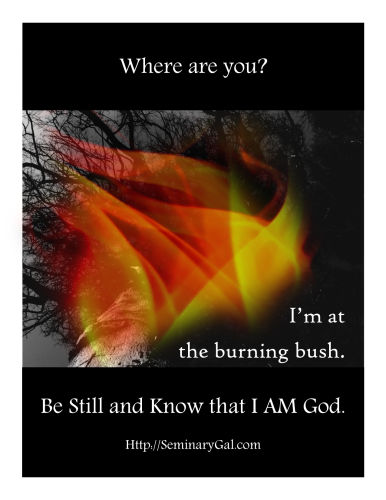 Be Still. I know you’re panicking, but I AM loving as well as holy. You’re near enough to Be Still so you don’t need to come any closer. Stay calm. I AM your place of stillness.
Be Still. I will guide you through what it means to be My servant. I AM only asking you to respect that I AM God, there is no other. Listen to My instructions. Follow them, and you’ll find yourself experiencing stillness.
Be Still and Know that I AM God. Respect My boundaries and My holiness. The distance between us is not a sign of My disinterest, but of My love for you and protection of you. My boundaries are not to keep you from Me, but to bring you as close as you can get while keeping you alive in My presence.
Be Still and Know that I AM God. I AM not the bush and I AM not the flames. Let your curiosity draw you close. Listen to Me and learn from Me. I want you to know Me as I reveal My character, My ways, and My will to you.
Questions for reflection:
- How close are you willing to come to God in order to hear Him speaking to you?
- How willing are you to obey what He tells you?
- What are some strategies you can take to acknowledge His holiness and your willingness to serve Him?
- How might understanding God’s holiness and love keep you still when your heart is racing? Imagine yourself resting in His hand…
The Vulnerability of Stillness (Lent 18-2014)
As we continue in our series Be Still and Know that I AM God, we look today at protection and vulnerability. Most of us prefer a place of obvious protection to clearly being vulnerable.
 Moses was in a basket floating among the reeds. If the basket had a leak, he could have drowned. A fish, a bird, or an Egyptian could have tipped it over and the vulnerable baby Moses could have died. Had a crocodile had been swimming near, Moses easily could have been the happy meal in a picnic basket.
Dangers abound. Death is just a ripple of water away. Moses was hidden there by brave women, including his mother, to protect him from the Pharaoh who was the most powerful man around. Also a man who wanted Moses dead.
God wasn’t about to let that happen.
He had big plans for Moses.
But sometimes big plans have their genesis in humble beginnings.
Vulnerability, that sense of human frailty, can turn someone into a worrywart who sees the world out of control. Or it can be powerful instrument in the hand of God to build trust in Him. Vulnerability is the kind of environment in which humility is born. Scripture tells us that Moses was a humble man–Numbers 12:3 “(Now the man Moses was very humble, more than any man who was on the face of the earth.)”–and a helpless infant in a basket qualifies as humble beginnings.
Vulnerability says you have nothing with which to protect yourself.
Depending on God is your only real option.
Have you ever been in a place of being vulnerable? What did it feel like?
Be Still. I’ve got the situation under control
Be Still. Your life is always in My hands whether you’re feeling vulnerable or not.
Be Still and Know that I AM God. Jeremiah 29:11 “For I know the plans I have for you,” declares the LORD, “plans to prosper you and not to harm you, plans to give you hope and a future.”
Be Still and Know that I AM God. Know what My Word says about Me. Psalm 72:12 For he will deliver the needy who cry out, the afflicted who have no one to help. 13 He will take pity on the weak and the needy and save the needy from death. 14 He will rescue them from oppression and violence, for precious is their blood in his sight.”
Questions for reflection:
- What types of things make you feel vulnerable?
- What is your reaction to that vulnerability?
- What strategies can you take to Be Still and Know that He is God? In Psalm 72 :12-14, there is only one thing we do. In Psalm 71, we see this in action. Read Psalm 71 and note the different ways we can cry out.
A Jewel of the Heart Cut in Stillness (Lent 17-2014)
There are a few scenes from the movie Les Miserables that are firmly planted in my mind. Jean Valjean, the ex-convict who had served hard labor for stealing bread, has been arrested for breaking parole and stealing silver from the Bishop of Digne. Brought before the Bishop, he expects retribution and to pay the price once again for stealing. Instead, the Bishop shows him grace. Fast-forward a few scenes, we see this same grace played out as Valjean begins to live as a man who knows he had been redeemed from the power of evil. Over and over again, Valjean exhibits grace to others even while he is confronted with the law in the person of Inspector Javert whose obsession with the law simply cannot understand grace. It’s a powerful movie and an even more powerful book. The book’s author, Victor Hugo, wrote this about Les Miserables:
The book which the reader has under his eye at this moment is, from one end to the other, as a whole and in detail, whatever may be its intermittences, exceptions and faults, the march from evil to good, from the unjust to the just, from night to day, from appetite to conscience, from rottenness to life, from hell to heaven, from nothingness to God. Point of departure: matter; point of arrival: the soul. The hydra at the beginning, the angel at the end.
Grace is hard to understand. Most of us expect retribution.
Such is the case with Joseph’s brothers. Genesis 37:2 This is the account of Jacob. Joseph, a young man of seventeen, was tending the flocks with his brothers, the sons of Bilhah and the sons of Zilpah, his father’s wives, and he brought their father a bad report about them.
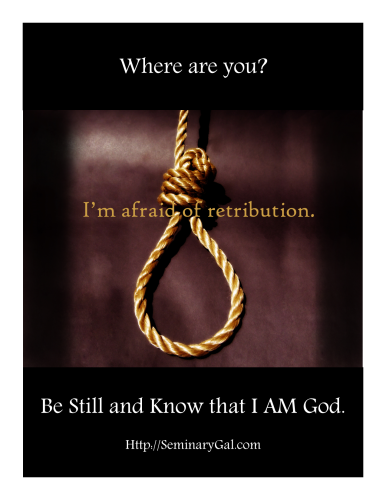 The brothers knew they had sold Joseph into slavery after hating him for giving their father Jacob a bad report. They thought Joseph deserved it though. After all, he was a snitch, an arrogant dreamer, and their daddy’s favorite son. Where are you, sons of Jacob? Selling your own brother, because of what? Jealousy?
Fast-forward a few chapters (Genesis 45) and Joseph is powerful in Egypt. He recognizes his brothers right away. Eventually Joseph reveals himself to his brothers. Where are you now, sons of Jacob?
The 10 brothers feared retribution.
Joseph taught them grace.
Had Joseph not had the prison time, success and power could have gone to his head, and retribution would have been all too easy.
After all, Law is always easier than Grace.
But grace is a jewel of the heart, cut in stillness. It is formed in the fire of time alone with God when human desires for retribution and self-vindication are purged and what’s left at the end is the kind of love God has for His enemies.
Where are you? Are you still fearing retribution and punishment? Or do you know this jewel of the heart called grace?
Be Still. I AM with you.
Be Still. I will avenge and restore.
Be Still and Know that I AM God. I AM known by My love and I AM known for My grace.
Be Still and Know that I AM God. I AM bringing you by the hand, through the valley of the shadow of retribution’s death and into the light and life of grace.
Questions for reflection:
- Read Romans 5:8 “But God demonstrates His own love toward us, in that while we were yet sinners, Christ died for us.” How does this show grace?
- Do you agree with the statement, “Law is always easier than Grace?” Why or why not?
- Have you ever been in the painful place of stillness as God cuts the jewel of grace in your heart so that you will be able to truly love your enemies? If yes, what has that been like? If no, would you want to enter that painful place in order to learn grace? Why or why not?
Success in the Midst of Stillness (Lent 16-2014)
Genesis 42:1 When Jacob learned that there was grain in Egypt, he said to his sons, “Why do you just keep looking at each other?” 2 He continued, “I have heard that there is grain in Egypt. Go down there and buy some for us, so that we may live and not die.” 3 Then ten of Joseph’s brothers went down to buy grain from Egypt. 4 But Jacob did not send Benjamin, Joseph’s brother, with the others, because he was afraid that harm might come to him. 5 So Israel’s sons were among those who went to buy grain, for the famine was in the land of Canaan also. 6 Now Joseph was the governor of the land, the one who sold grain to all its people. So when Joseph’s brothers arrived, they bowed down to him with their faces to the ground. 7 As soon as Joseph saw his brothers, he recognized them, but he pretended to be a stranger and spoke harshly to them. “Where do you come from?” he asked. “From the land of Canaan,” they replied, “to buy food.” 8 Although Joseph recognized his brothers, they did not recognize him. 9 Then he remembered his dreams about them…
Well, well, well. A mighty interesting predicament you’re in. You’re starving. I have grain. You’re here on a mission because you’re in want. I’m here in charge of everything you need and are looking to gain from me.
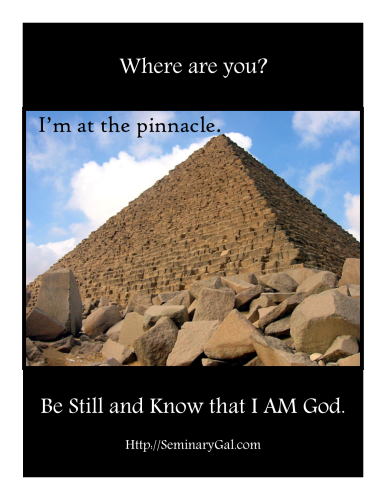 Where are you, Joseph? I’m in a position of great power over my brothers…and with great power, period. I’m at the pinnacle of success and among men, only Pharaoh is greater than I.
Had Joseph not spent plenty of time in prison, a chip may have remained on his shoulder. But the loneliness and forgotten years of prison had been fruitful. Tears and time had softened his heart, eroded his pride, and made him malleable in the hand of the God who never left him. He was truly at the pinnacle of earthly success because he had power and wealth and wisdom, too. He was wise enough to know the God who had been with him in the pit, who was with him in Potiphar’s house, who was with him in prison, and who was the same God who put him at the pinnacle for a while.
Fame, success, power, wealth—all these things are ones the world treasures as signs of a great life. One quick look at all the child stars who end up really mixed up, athletes who make awful and unlawful decisions and act as though they can’t be touched, rock stars who overdose on drugs, as well as politicians who break laws they have written and face just punishment—all of this testifies to how success can really, truly ruin a person.
Or as Lord Acton once said, “Power tends to corrupt, and absolute power corrupts absolutely. Great men are almost always bad men.”
Not Joseph. He valued his relationship with God over all this power. What poses a stumbling block to stillness in so many people’s lives—success—was for Joseph the high point from which a life of faith can shine. That pinnacle can be a place of stillness, but only if one meets God there and humbly remembers that God is still higher.
Be Still. Value your relationship with Me above all else and you will be rewarded.
Be Still. I want for your faith to shine from the highest places.
Be Still and Know that I AM God. I raise up and I will keep you humble. Trust in Me. Matthew 11:29 “Take My yoke upon you, and learn from Me, for I am gentle and humble in heart; and you shall find rest for your souls.”
Questions for reflection:
- What successes have been your proudest achievements? To whom did you give the credit? What have these done to your relationship with God?
- Read Paul’s words. Philippians 4:11 “I am not saying this because I am in need, for I have learned to be content whatever the circumstances. 12 I know what it is to be in need, and I know what it is to have plenty. I have learned the secret of being content in any and every situation, whether well fed or hungry, whether living in plenty or in want. 13 I can do everything through him who gives me strength.” How does his perspective show he understood stillness before God?
- What are some positive steps you can take today to put achievement in perspective and be still at the pinnacle of success?
The Formation Power of Stillness (Lent 15-2014)
Loneliness is pervasive in much of the modern world. Ironically, the more technology that we have with social media, we may simultaneously have an abundance of real and virtual friendships and yet experience a profound loneliness in the midst of it all.
Do you ever feel like no one cares? That you could drop off the planet and no one would notice? Maybe you’ve felt like other people have tons of friends and activities that they’re posting all over Facebook and Twitter…and no one ever invites you? Perhaps you’ve been a good friend to others and they fail time and again to reciprocate? It’s like for them, friendship is a one-way street.
You feel forgotten. Like you’re nowhere to everybody. You’re all alone. It happens.
Acts 7:9 “Because the patriarchs were jealous of Joseph, they sold him as a slave into Egypt. But God was with him 10 and rescued him from all his troubles.”
Where are you, Joseph? I’m nowhere. Actually, I’m nowhere even here in prison, exactly where I’ve been for years.
For two long years after Joseph helped the Pharaoh’s cupbearer, Joseph sat alone and forgotten. But God was with him. God knew the formation power of stillness.
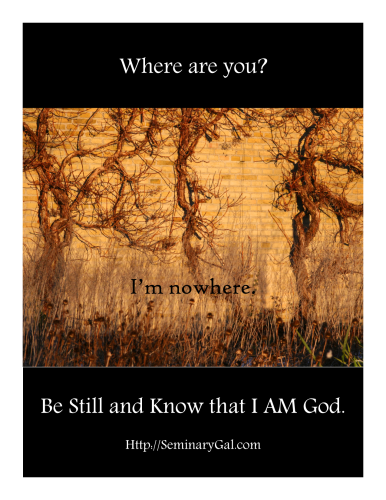 Be Still. I have not forgotten you. I know where the prisons are and how to reach you in them.
Be Still. I am forming your character in the quietness of lonely times. Your character is important to me, enough so that I don’t want you to be distracted during this time of formation.
Be Still. I know the sadness and the loneliness you feel, but know this: I AM with you.
Be Still and Know that I AM God. I am faithful to everything I’ve promised. I restore what is good by purification times. The lonely times are when I’m removing any offenses that might stand between us.
Be Still and Know that I AM God. Deuteronomy 31:6 “Be strong and courageous. Do not be afraid or terrified because of them, for the LORD your God goes with you; he will never leave you nor forsake you.” As it was with Moses and Joshua, I AM here with all those whose eyes are looking for Me, even from the nowhere places.
Questions for reflection:
- Read Isaiah 44:21 “Remember these things, O Jacob, for you are my servant, O Israel. I have made you, you are my servant; O Israel, I will not forget you. 22 I have swept away your offenses like a cloud, your sins like the morning mist. Return to me, for I have redeemed you.” 23 Sing for joy, O heavens, for the LORD has done this; shout aloud, O earth beneath. Burst into song, you mountains, you forests and all your trees, for the LORD has redeemed Jacob, he displays his glory in Israel. 24 “This is what the LORD says– your Redeemer, who formed you in the womb: I am the LORD, who has made all things, who alone stretched out the heavens, who spread out the earth by myself, 25 who foils the signs of false prophets and makes fools of diviners, who overthrows the learning of the wise and turns it into nonsense, 26 who carries out the words of his servants and fulfills the predictions of his messengers, who says of Jerusalem, ‘It shall be inhabited,’ of the towns of Judah, ‘They shall be built,’ and of their ruins, ‘I will restore them,’ 27 who says to the watery deep, ‘Be dry, and I will dry up your streams,’ 28 who says of Cyrus, ‘He is my shepherd and will accomplish all that I please; he will say of Jerusalem, “Let it be rebuilt,” and of the temple, “Let its foundations be laid.”‘
- What does it mean to you that God tears down and restores?
- What hope can we hold onto when we’re feeling lonely?
- How does loneliness purify where our hope resides? Is it human relationship you desire or a relationship with God?
Still in Prison (Lent 14-2014)
Have you ever been mistreated? Had your character maligned? Had gossip spread about you? If yes, then you probably have an idea of how Joseph must have felt. One day he was the favorite son and then suddenly it’s all gone.
Joseph was in prison unfairly (Genesis 39-40). He’d tried to do everything right and his brothers sold him to Ishmaelite slave traders. He’d tried to behave and Potiphar’s wife falsely accused him. Joseph is sitting there in prison and must have been thinking, “What gives?”
How many of us, trying to do what’s right, have bad stuff happen and are left wondering if this downward spiral is the reward for a life of faith?
To make matters worse, Joseph still tries to be faithful in prison and then the guy he helps gets freed from prison promptly and conveniently forgets about Joseph, leaving Joseph feeling quite alone. But here in the dungeon, Joseph gives us a human model of worship that honors God, showing what it means to Be Still and Know that I AM God. He was living 1 Peter 2:18-23 before it was written about Christ.
1 Peter 2:18 Slaves, submit yourselves to your masters with all respect, not only to those who are good and considerate, but also to those who are harsh. 19 For it is commendable if a man bears up under the pain of unjust suffering because he is conscious of God. 20 But how is it to your credit if you receive a beating for doing wrong and endure it? But if you suffer for doing good and you endure it, this is commendable before God. 21 To this you were called, because Christ suffered for you, leaving you an example, that you should follow in his steps. 22 “He committed no sin, and no deceit was found in his mouth.” 23 When they hurled their insults at him, he did not retaliate; when he suffered, he made no threats. Instead, he entrusted himself to him who judges justly.
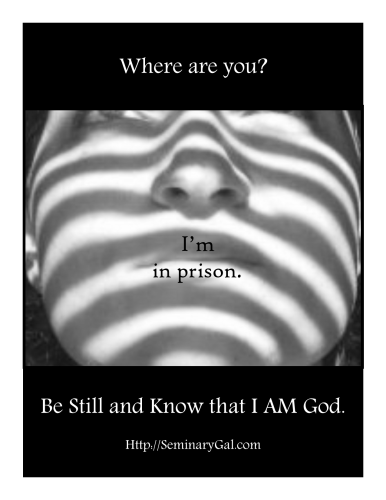 Be Still. Your faithfulness isn’t being tested in any way I AM not prepared to reward
Be Still. This is to your credit. I see everything and know all about your suffering.
Be Still. I need those who will continue to glorify Me even in the prisons of life—in the disappointments, in the rejections, in the false accusations and in the long lonely waits.
Be Still and Know that I AM God. I walked that road ahead of you for a purpose. Nothing witnesses like unjust suffering.
Be Still and Know that I AM God. It’s counterintuitive, but I receive glory when you follow Me. Your faith—in the realm of the unseen–is earning an eternal weight of glory. 2 Corinthians 4:17 For our light and momentary troubles are achieving for us an eternal glory that far outweighs them all.
Questions for reflection:
- What is your default response to suffering?
- When suffering comes your way that is undeserved, how does that make you feel?
- What might be some of the prisons of your life? What kind of thoughts hold you hostage?
- What kind of changes do you need to make to Be Still and Know that I AM God in the midst of unjust suffering?
Stillness in the Favored Place (Lent 13-2014)
 It’s not just bad stuff that can get in the way of our experiencing stillness before God.
Sometimes our biggest obstacles are things that are going so right or are so good that you can’t stop thinking about them.
Where are you?
Being consumed with thinking about social status or riches you already have accumulated? Happy with how swimmingly everything is going?
This was the case with Joseph, Jacob’s favorite son (Genesis 37). We cannot scrub him of his humanity by overlooking that he was even dreaming about his place of favor.
For us, our place of favor may be the job we have or the place of being the favorite child. Maybe our place of favor is with our friends or neighbors or in the community.
- Are you the corporate whiz-kid and rising star?
- Or in the community, are you a household name?
- Are you the child your parents can’t stop talking about?
- Have you become the person in whom your family has invested all their hopes because you’ll be the college-educated one, the doctor, the lawyer, the NBA player, the singer, or the movie star?
Riches of this world, fame, popularity, favor, talent, and celebrity get in the way of stillness. This is what Jesus basically said to the rich young ruler.
Mark 10: 17 As Jesus started on his way, a man ran up to him and fell on his knees before him. “Good teacher,” he asked, “what must I do to inherit eternal life?” 18 “Why do you call me good?” Jesus answered. “No one is good– except God alone. 19 You know the commandments: ‘Do not murder, do not commit adultery, do not steal, do not give false testimony, do not defraud, honor your father and mother.'” 20 “Teacher,” he declared, “all these I have kept since I was a boy.” 21 Jesus looked at him and loved him. “One thing you lack,” he said. “Go, sell everything you have and give to the poor, and you will have treasure in heaven. Then come, follow me.” 22 At this the man’s face fell. He went away sad, because he had great wealth. 23 Jesus looked around and said to his disciples, “How hard it is for the rich to enter the kingdom of God!”
It’s not hard for the rich to enter the Kingdom because they’re rich…but because of what being rich does to our stillness before God.
God doesn’t hate rich people or favor poor people. But rich people, being in an earthly place of favor, can either assume that this is a sign God is pleased with them (when that might not be the case) or lead them to self-worship, believing that they got to that place of favor all by themselves.
Be Still. You can’t serve both Money and Me.
Be Still. You can’t bring it with you when you die, which you will some day because you’re human.
Be Still. Riches come and riches go, and so do you. But I AM eternal.
Be Still. There are better uses for riches than serving yourself. Serve Me instead by serving people. It’s what Jesus did.
Be Still and Know that I AM God. I AM the source of every good thing and behind every favored place.
Be Still and Know that I AM God. Eternal riches (found in a relationship with Me) make earthly riches look like nothing.
Be Still and Know that I AM God. Step out of the spotlight and let’s be honest about who you are and who I AM. Know that I AM God.
Questions for reflection:
- What are you placing your trust in?
- What happens when people trust in themselves or their riches and later, they fall from favor or lose their riches?
- Read 2 Corinthians 8:1-15. Note particularly verses 14 and 15 (14 At the present time your plenty will supply what they need, so that in turn their plenty will supply what you need. Then there will be equality, 15 as it is written: “He who gathered much did not have too much, and he who gathered little did not have too little.”). Equality is a buzzword these days. In reading this entire passage and looking at the rich young ruler, is this equality mandated (compelled by external forces) or impelled (compelled from within)? What is the difference, especially as it relates to worship?
- 2 Corinthians 8:9 reads “For you know the grace of our Lord Jesus Christ, that though he was rich, yet for your sakes he became poor, so that you through his poverty might become rich.” How does generosity in giving to those less fortunate demonstrate your love for God? How was this shown in the dialogue between the rich young ruler and Jesus (above)?
Wrestling with Being Still (Lent 12-2014)
 Where are you? And why are you wrestling with Me? You do realize how pointless trying to overpower Me is, don’t you?
NAS Genesis 32:24 Then Jacob was left alone, and a man wrestled with him until daybreak. 25 And when he saw that he had not prevailed against him, he touched the socket of his thigh; so the socket of Jacob’s thigh was dislocated while he wrestled with him.
What I find really interesting about the passage above is that it says Jacob was left alone (i.e. there was no one else there). Yet there was Someone Else there. This is one case in which I really do not like the NIV translation and will opt for another. It’s not theologically correct that God “could not overpower him” (as if God and man are power equals) but theologically speaking, the words used form a strong statement about the free will that God gives us to wrestle with Him and to engage with Him as His image bearers.
We are not gods. We are God’s image bearers and yet we wrestle with what it means to bear His image. He tangles with us so that we will wrestle with our identity and our faith.
God might look at Jacob and look at us and ask us all,
What does wrestling with God say about your trust in your own capabilities versus your faith in God?”
Are you trusting in your strength? In your flesh? In the things you can do to remedy what problems are ahead?
There’s a difference between wrestling to hold tight and wrestling to get away.
What can wrestling with God do to build your faith? To give you confidence in your Creator? To give you strength to press onward? Jacob ends up with a dislocated hip as evidence that His Creator knew how to disable him and had plenty of power remaining at His disposal. God could have destroyed him. Even so, Jacob wouldn’t let go.
NAS Genesis 32:26 Then he said, “Let me go, for the dawn is breaking.” But he said, “I will not let you go unless you bless me.” 27 So he said to him, “What is your name?” And he said, “Jacob.” 28 And he said, “Your name shall no longer be Jacob, but Israel; for you have striven with God and with men and have prevailed.” 29 Then Jacob asked him and said, “Please tell me your name.” But he said, “Why is it that you ask my name?” And he blessed him there. 30 So Jacob named the place Peniel, for he said, “I have seen God face to face, yet my life has been preserved.”
Jacob’s free will holds onto God and will not let go until God blesses him. When is the last time you held onto God like that? Where are you?
Be Still. Holding tight to Me is exactly where I want you.
Be Still. All that wrestling is wasted energy if you’re trying to get away from Me or trying to beat Me at the power game.
Be Still and Know that I AM God. NAS Genesis 32:28b “for you have striven with God and with men and have prevailed.” Here’s a huge confidence builder: You have prevailed…even before you head to meet your brother whom you fear. You have already won. You did it by clinging to Me. Know that I AM God and have the power to spare your life now and always.
Questions for reflection:
- When is the last time you wrestled with God… or with His will for your life?
- Imagine holding onto a dog or a cat that didn’t want to be picked up. It squirms and whines and sometimes bites in an attempt to get away. The last time you wrestled with God, did you wrestle to cling to Him or to try to get away from Him? Why?
- How can you Be Still even when wrestling?
The Fear that Robs Us of Stillness (Lent 11-2014)
 Where are you? I’m genuinely afraid for my life and the lives of those I love, Jacob might say.
Have you ever felt that way? Afraid for your own life or the life and safety of your loved ones?
Genesis 32:9 Then Jacob prayed, “O God of my father Abraham, God of my father Isaac, O LORD, who said to me, ‘Go back to your country and your relatives, and I will make you prosper,’ 10 I am unworthy of all the kindness and faithfulness you have shown your servant. I had only my staff when I crossed this Jordan, but now I have become two groups. 11 Save me, I pray, from the hand of my brother Esau, for I am afraid he will come and attack me, and also the mothers with their children. 12 But you have said, ‘I will surely make you prosper and will make your descendants like the sand of the sea, which cannot be counted.'”
Fear is a formidable enemy of stillness. It can keep us up at night with worry. It is unfortunately a most committed companion. We can go to bed with fear on our minds and wake up with it in the morning. It can cling to us throughout the day and consume our every spare thought. It can infiltrate even moments of contentment as a dart to a target or a dagger to the heart.
Fear is not an unreasonable thing. Fear is a perfectly understandable reaction to threats against your physical person or your emotional well-being. We don’t see it, but it is often most active in the unseen world of our spiritual lives. For that reason, fear will always get in the way of stillness.
Jacob was afraid, but look what he did: Jacob became still and prayed. And then he remembered who God is.
Be Still. In spite of fear, be still and pray. I’m listening.
Be Still. No enemy has seized you that I, the LORD, have not already conquered.
Be Still and Know that I AM God. John 14:27 “Peace I leave with you; my peace I give you. I do not give to you as the world gives. Do not let your hearts be troubled and do not be afraid.”
Be Still and Know that I AM God. Deuteronomy 31:8 “The LORD himself goes before you and will be with you; he will never leave you nor forsake you. Do not be afraid; do not be discouraged.”
Questions for reflection:
- Did Jesus give in to fear? Why not?
- What does fear suggest about faith?
- Why does God command us so often in Scripture not to be afraid? What role does our trust in Him play?
Depression: A Great Killer of Stillness (Lent 10-2014)
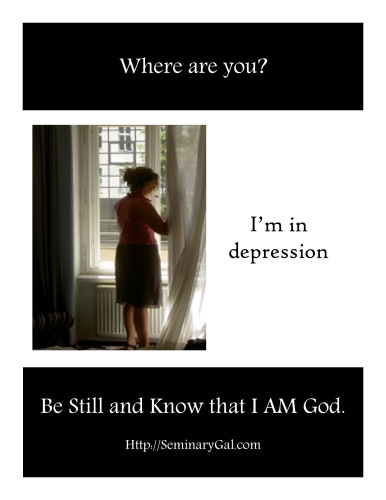 Yesterday in our 2014 Lenten Devotional series entitled Be Still and Know that I AM God, we saw that Leah, Rachel’s sister, wanted a gold medal in the Most Competitive Fertile Woman in the World games. Rachel wasn’t going to let her have it without a fight.
Where are you, Rachel?
I’m in depression, God.
I’m jealous of my sister’s ability to have babies. I’m competitive and coming up short. I’m striving every way I can and still have no child to call my own. I am barren and I’m brokenhearted about it. I’m even blaming my husband.
Genesis 30: 1 When Rachel saw that she was not bearing Jacob any children, she became jealous of her sister. So she said to Jacob, “Give me children, or I’ll die!” 2 Jacob became angry with her and said, “Am I in the place of God, who has kept you from having children?”
When we are competitive for the wrong reasons, we don’t rejoice with others and their successes. We envy them and resent their joy. We see only winners and losers. No one wants to be the loser. Being a loser is depressing.
Depression is a great killer of stillness. It churns the mind.
It’s a powerful force that refuses to be still.
It can be centrifugal, forcing us into the outer world to deal with it in relation to others. In a positive sense, it can become compassion for others who are suffering. But more often, perhaps, negatively as striving, scheming, or spreading our woes to others.
- Weighing others down with our problems that we’d rather coddle than cure.
- Anger that we take out on those we love and those we don’t.
- Bitterness that turns relationships into dumping grounds and creates a graveyard of loneliness in a garden of friendship that used to sustain life and joy.
Depression can also be centripetal, spinning and spinning, forcing all our emotions inward into one consolidated lump buried deep in our core. Depression sits there and weighs on us. It ferments and grows, refusing to be comforted. It becomes the friend we never wanted and the house guest that refuses to leave.
Where are you? Are you like Rachel, trying and trying and spinning and spinning and getting nowhere?
Be Still. Are you spinning inward? I need your decision to stop before I can change your direction. I’m not a puppeteer and I love you too much to override your will. You must decide to stop and look to Me.
Be Still. Are you spinning outward, but in a negative way? Some things need more than human effort. That’s why you particularly need My touch to show you how to live with joy even in difficult circumstances.
Be Still and Know that I AM God. When you are still in My presence, when you seek Me, the desires of your heart will be conformed to look more like mine. Sometimes human desires and effort get in the way of what you really need.
Be Still and Know that I AM God. I don’t ask you to approve of My plans for you. But when you reach the other side, the place I alone can see at present, you will know that I AM God and will have done right by you all along, even if it’s not what you wanted right now because you couldn’t see the better things I had planned for all eternity.
Questions for reflection:
- Everyone experiences depressing circumstances from time to time. It’s part of living in a broken world. What direction do you spin when depression hits?
- Do you know someone who is depressed, perhaps like Rachel because of infertility, or perhaps feeling like there is no hope? How might you help that person to have hope?
- The desire for babies is strong among women and infertility is a sorrow of immense proportions. What might be some ways for infertile women to spin their sorrow outward to helping others and having that nurturing relationship they desire?