From before you were born—from the day you were made,
God knew who you were CREATED TO BE.
 You were not created to be static—like a rock which is acted upon by its environment of rain and ice and the winds of time.
You were not created merely to be alive—like the trees or the flowers of the field, growing but living at the mercy of the weather.
You were not created simply to be alive and thinking –like dogs or horses or dolphins or doves.
You were created to BE.
To be is a linking verb, but can also be used existentially. It also has dynamic and stative uses. One grammar web site writes:
The verb “To be” is said to be the most protean of the English language, constantly changing form, sometimes without much of a discernible pattern. Considering that we use it so often, it is really too bad that the verb “To be” has to be the most irregular, slippery verb in the language.
I like to think of “To be” as organic and intrinsically part of the human condition–our state of existence and life itself. Organic has a punctiliar sense to it—a point in time, an origin. But organic also implies a living quality–movement, progression, dynamism—that shows we were not meant to be victims of the elements. Rather, we are to engage life. We are created to BE.
- To be—as a point of origin.
- To be—as an ongoing linking verb.
We are created in the image of God, our Creator.
Our Creator—without beginning or end—calls Himself “I AM.”
Exodus 3:14 God said to Moses, “I AM WHO I AM. This is what you are to say to the Israelites: ‘I AM has sent me to you.'”
Given that we are made in I AM’s image, what action verbs will you choose to link with your BE?
Let’s ponder today what stewardship of this life entails and what it means that we are CREATED TO BE .
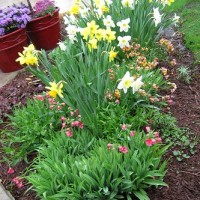 Real world gardening involves everything being beautiful its time (Ecclesiastes 3:11).
 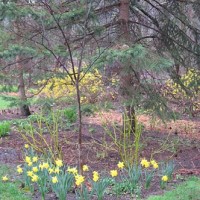 Even in the midst of dreary days, perennial features such as the cheerful yellow forsythia, “Cardinal” red-twig dogwood, and King Alfred daffodils lift one’s spirits.
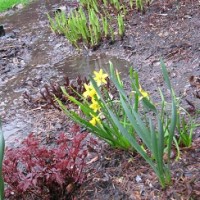 And look at the beautiful range of colors of emerging growth of turtlehead (Chelone obliqua), Astilbe ‘Fanal’, and hostas—all of which tolerate standing water for short periods. Good thing, since in every real world garden a little rain must fall. This particular garden is always among the last to be worked because it is a low spot in our yard. I find that working our higher front yard to the lowest back is always helpful since that’s how things aren’t worked when it’s too wet. Working the soil when it’s wet ruins the structure. Mulching when it’s raining causes the ground to retain the soggy conditions longer. It’s important with conditions like these to research carefully what plants will survive in such Out of Eden locations.
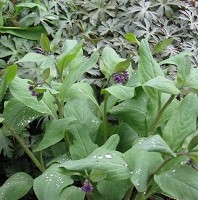 My bluebells (Mertensia virginica) are budding and my native cranesbill geranium (Geranium maculatum) won’t be outdone. Also in my woodland garden are lily-of-the-valley (Convallaria majalis) and sweet woodruff (Galium odoratum) which are not native but escaped cultivation and are real showstoppers. I like that phrase: escaped cultivation. Makes them seem like garden rebels…or too beautiful to be held captive.
 O’Reilly, this means you. While in the camera’s eye, you have the ability to persuade many people and convince them that “the spin stops here.” When you enter the realm of theology, we no longer call it spin. To the extent you are misinformed and try to play pastor-prophet-priest in your bully pulpit, you need to know the consequences of displaying such ignorance: it’s called deception. Lies. Dangerous. Infectious.
 Top Ten Things I Wish Every Jew Knew About Christians (Summary Version)
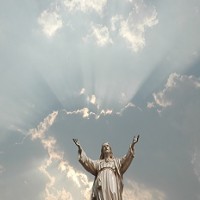 With the tomb empty—as Jesus foretold—the sacrifice was accepted. Forgiveness of our sins was made possible, once for all. Now what is left for us is to give thanks to the Lord, saying “He is good; his love endures forever.” To kneel before our Maker in humble worship. To know that He is God in heaven and that the Risen Christ is God’s glory revealed.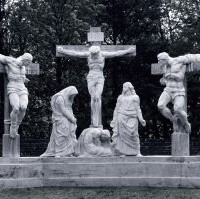
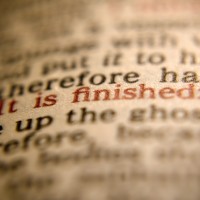 The encouragement that we get from this is that there is nothing we can do to save ourselves. There is nothing we can do to right our wrongs. There is nothing we can do about our imperfections. There is no way we can be perfectly obedient. There is no way we’ll resist every temptation. There is no way that we will speak truthfully all the time no matter how hard we try. And there is no opposition we will face that compares to what Jesus experienced. For us, it is impossible to lay our lives down for our fellow man as Jesus did. So we can stand with hearts of gratitude knowing it is for our benefit that Jesus did it all and could say, “It is finished.” It was all for our benefit. Now what remains is for us to recieve the gift of grace that He made possible by finishing the work of God.
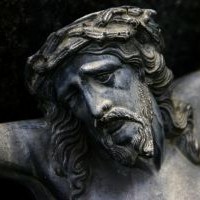 One of the common human sensations is thirst. When Jesus quotes Psalm 69:21 as being fulfilled, there is a sense that He was reassuring us of His humanity. He was identifying with our humanity through a very human need: thirst.
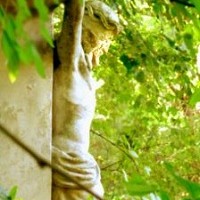 About the ninth hour Jesus cried out in a loud voice, “Eloi, Eloi, lama sabachthani?”– which means, “My God, my God, why have you forsaken me?” Matthew 27:46
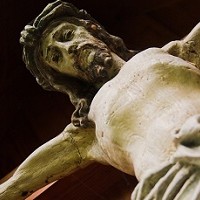 Mary had known since Jesus’ birth that something would happen to pierce her soul (Luke 2:29-35). It is unlikely she’d ever have imagined crucifixion of her son. So Jesus, upon the Cross, gazes down at His mother and His beloved disciple John. While separating Himself from both family and friend as He faces death, He gives them both a new vision and new relationship.