How do I control Japanese Beetles?
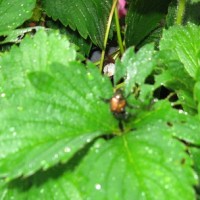 Japanese Beetles (right) are veritable eating machines, able to decimate entire plants, crops, and gardens. We’re in the height of Japanese Beetle season at present and there are ways of keeping them under control.
Keeping Japanese Beetles under control is a good thing, too, because they’re not just eating machines. They are also breeding machines with every female capable of laying 40-60 eggs, reproducing herself and her boyfriend 20-30 times over. Worse yet, and part of what make Japanese Beetles such a nasty pest is that the eggs hatch and form really gross white grubs that will kill your lawn and the root systems of other plants. Disgusting though they may be to humans, they are a favorite food of skunks, raccoons, opossums, and starlings. Skunks, raccoons, and opossums will tear up your lawn, peeling back or scratching through whole sections of the slightly brown lawn to find them. With forty to sixty beetle grubs per female, animals don’t have to work that hard to find them, but your lawn will look like it had a close and prolonged encounter with a rototiller anyway.
A wonderful fact sheet is available from The Ohio State University Cooperative Extension Service outlining the control of Japanese Beetles. It is a detailed article which I used in developing my approach (below). Controlling Japanese Beetles involves knowing their life cycle and how they behave, or misbehave as the case may be.
Some plants are Japanese Beetle magnets, the beetles leaving behind a scent on the plants (called pheromones) that tell males and females where to come for sex. It turns many favorite plants into a brothel as the beetles prostitute themselves anywhere they can to make their forty-sixty eggs. They make me mad. Roses, Purple Leaf Plum, Roses, Echinacea (Purple Coneflower), Roses, Strawberries, Roses, and Lindens are among their favorites to destroy. Did I mention roses? Roses seem to be among their very favorite.
The thief comes only to steal and kill and destroy (John 10:10).
Japanese Beetles are agents of Satan, evil insects if there ever were any, which only a few insects are true friends. Any approach I use wants to save my friends and kill as many Japanese Beetles as possible.
I use Bayer All-in-One for my roses early in the season (before Japanese Beetle adults emerge) and at regular intervals to turn my roses—their favorite food—into something that will kill any who try to feed there. It also prevents diseases so basically I’m eliminating two sprays with one treatment. Friendly insects (honey bees, lady bugs, dragonflies, etc) will not be harmed and don’t favor roses as their food hangouts. It prevents spray drift from killing friendly insects even while protecting my roses from Japanese Beetles. Because this particular Bayer product is systemic, meaning it gets sent throughout the entire plant internally, you must NEVER use it on anything you’re planning on ever eating.
I keep my eyes open early in the season (early June) to kill any adult beetle scouts that may want to establish their brothel in my neighborhood. Killing the scouts and any followers on food crops like strawberries will be done using an organic approach—an Entomological Neighborhood Watch in action. When I see a scout, I tap his little body into my plastic cup of soapy water which becomes his cup of death. Couldn’t happen to a nicer bug. By killing the scouts, very little pheromone will get left behind to shout, “The party’s over here! Come’on and let’s get it on!” Less pheromone, fewer Japanese Beetles to kill in other ways.
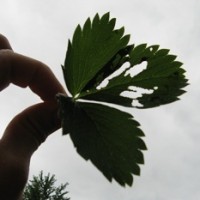 I do spray, but only when truly necessary—when things have gotten totally out of hand as they did one year that a bazillion of them were hanging out in a nearby linden tree, skeletonizing all the leaves (see damage to strawberry leaf at left). I’m not a big fan of spraying chemicals because they’re generally indiscriminate, killing friend and foe with equal force. Anything I can do to be more selective and less harmful, the better.
This type of combination approach is referred to as Integrated Pest Management and includes one final component, remembering the important life cycle of the Japanese Beetle.
Finally, we apply a grub killer to the lawn in the spring and as a “rescue” treatment in the fall. Today’s disgusting, root eating, lawn destroying grub, is tomorrow’s or next season’s eating machine of an adult beetle. Every grub you kill today won’t live tomorrow to chow away.
As with any chemical alternative, the goal is to use only what may be necessary to do the management with as minimal side effect as possible. Each person will want to check with their local ordinances and regulations with respect to using any chemical alternative, as these regulations and restrictions are locally and state-mandated.
 Of the frequently asked questions I received on the sales floor, people asked how to care for their daylilies. They’d bubble with excitement at seeing a big daylily that looked like this (right).
 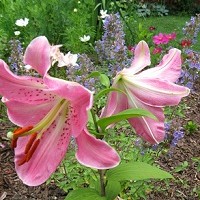 Plants have a legal name, if you will, that consists of a genus (larger group) and species (subgroup). Beyond that, certain cultivated varieties (cultivars for short) will have a name in quotes which makes it even more specific. The Oriental lily Lilium ‘Farolito’ shown here is a cultivar. Lilium x ‘Kiss Me Kate’ would be a hybrid lily denoted by an ‘x’ to show that it is a cross between a longiflorum lily (like an Easter lily) and an Asiatic lily.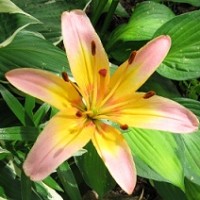
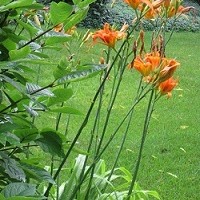 They grow differently in form—lilies (pictured on the left) are flowers emerging atop leafy stalks, daylilies (right) form clumps. They originate from different structures—lilies arise from bulbs, daylilies grow from fibrous root systems that will enlarge into spindle-like roots resembling tubers. Lily flowers are long lasting and open from the lower buds to the upper buds. When the buds have all opened, the flowering is completed for the year. Daylilies, on the other hand, have a short bloom—each lasting only a day, hence daylily, however the season of bloom may be quite extensive. Lily bulbs must be planted at a sufficient depth to protect them from the harsh winters, but not so deep that the plant must struggle through an endless stretch to reach the soil surface. Daylilies are planted so the crown is at the soil level with the fibrous roots and tuberous spindles are stretched out just below the soil surface. Lilies will grow larger clumps by growing increasing bulb sizes as well as by dropping bulbils (present after bloom in the leaf axils) off the stem onto the ground. Daylilies, depending on variety, can be downright invasive…emerging anywhere there’s an opportunity within the range of the mother plant.