Category: Articles and Devotionals
A selection of devotionals written by Barbara Shafer.
Making the Theological Understandable
A selection of devotionals written by Barbara Shafer.
He was heading to Jerusalem and already had plenty of disciples. He’d gain and lose quite a few more before it’s all said and done. He had the Twelve, that more-or-less faithful band (individually and as a group) who stuck by His side over many miles of the journey. Even when they were arguing about who was the greatest, Jesus loved them. They didn’t get it that He was the greatest. (After all, He was leading and they were following.) But Jesus just chalked it up to “simply human” and let it go.
There were so many people–all of whom were simply human. They were sometimes hangers-on, wannabes, gapers or yes, critics. He knew He was a tough act to follow.
And it would get tougher. Some people would hate Him and His disciples simply because they were Jews (religious hatred). Some would hate Him because He was headed for Jerusalem (hatred for a place). Others would find His teachings too controversial (hating what He stands for). And then there were the people jumping on Jesus’ demon-driving-bandwagon. They wanted to be part of good things, but for all the wrong reasons. His disciples pointing out that some are “of us” and some of them “are not” didn’t contribute to unity. In fact, it undermined the cause of discipleship. To that “you’re not part of our club” mentality, Jesus said to them firmly,
“Don’t stop him, for whoever is not against you is for you.”
They’d need to remember that advice because going to Jerusalem meant that following would get even harder to do. Discipleship would have enough obstacles there without creating them. Crowds come, some maybe wanting to be a part of the next big thing, but crowds also go. And serving the King of Heaven is always easier desired than accomplished.

52 And he sent messengers on ahead, who went into a Samaritan village to get things ready for him; 53 but the people there did not welcome him, because he was heading for Jerusalem. 54 When the disciples James and John saw this, they asked, “Lord, do you want us to call fire down from heaven to destroy them?” 55 But Jesus turned and rebuked them. 56 Then he and his disciples went to another village. 57 As they were walking along the road, a man said to him, “I will follow you wherever you go.” 58 Jesus replied, “Foxes have dens and birds have nests, but the Son of Man has no place to lay his head.”
59 He said to another man, “Follow me.” But he replied, “Lord, first let me go and bury my father.” 60 Jesus said to him, “Let the dead bury their own dead, but you go and proclaim the kingdom of God.” 61 Still another said, “I will follow you, Lord; but first let me go back and say goodbye to my family.” 62 Jesus replied, “No one who puts a hand to the plow and looks back is fit for service in the kingdom of God.”
Think about it:
Father God, please grant us the courage for these last days, that we might bring glory to You by our faithful endurance. Lord Jesus, thank You for being the author and perfecter of our faith and for paving the way ahead of us, showing us by Your example what overcoming looks like. Holy Spirit, embolden us with Your truth and Your righteousness so we may bear fruit for the Kingdom. Make us fit for service to the King of Kings and the Lord of Lords. Amen.
= = =
Beginning with the time that Jesus set out resolutely for Jerusalem until the empty tomb, there’s so much more to Jesus’ story at the time we call Easter, for Him the Passover. Let’s listen in His own words from the Gospel of Luke (with a few of mine for painting the scene) to let His Word shine.
If you’re already signed up on my Home Page sidebar to receive posts, you’ll get the 2019 Lent Devotionals automatically. Or you can “Like” Seminary Gal on Facebook and they’ll be delivered to your Facebook news feed. If you haven’t signed up, today is a great day to do so. Advent and Lenten devotionals remain among my most popular offerings. You don’t want to miss this great look at the Easter story to prepare your heart for Easter!
===
Acknowledging that former years’ devotional series remain popular:
How He’d looked forward to this so many times! Going home! He thought back to just a few days earlier when He’d had a mountaintop moment in the presence of His disciples Peter, John, and James (Luke 9:28-36). It refreshed Him endlessly to have been speaking with Moses and Elijah about His departure which He was about to bring to fulfillment in Jerusalem. Sure, He’d been at this work since before He was born, but now 30 years into the Incarnation, He was overjoyed at the prospect of being reunified … in the eternal realm … with His Father. He missed dwelling there away from the earthly realm with all the problems caused by human sin. But that was the reason He was sent and the reason He came.

Luke 9:51 As the time approached for him to be taken up to heaven, Jesus resolutely set out for Jerusalem. 52 And he sent messengers on ahead, who went into a Samaritan village to get things ready for him; 53 but the people there did not welcome him, because he was heading for Jerusalem.
Jerusalem! It is there He’d find the one last and pivotal piece of work to finish: The Cross. It loomed ahead of Him like a glorious and grim finish line. Glorious, because the moment of reunification in the heavenly realm …but grim also, because there was plenty of rejection between here and there and the battle to be won in His death.
Think about it:
Lord Jesus, we praise You and thank You for being sent to earth to teach us and redeem us. Thank You, Father, for the sacrifice You also made to show us what love truly looks like. Thank You, Holy Spirit, for teaching us by taking from what belongs to Christ Jesus and making it known to us. Help us, Lord, to anticipate Your return and our homecoming with great joy and watchful obedience. Amen.
= = =
Beginning with the time that Jesus set out resolutely for Jerusalem until the empty tomb, there’s so much more to Jesus’ story at the time we call Easter, for Him the Passover. Let’s listen in His own words from the Gospel of Luke (with a few of mine for painting the scene) to let His Word shine.
If you’re already signed up on my Home Page sidebar to receive posts, you’ll get the 2019 Lent Devotionals automatically. Or you can “Like” Seminary Gal on Facebook and they’ll be delivered to your Facebook news feed. If you haven’t signed up, today is a great day to do so. Advent and Lenten devotionals remain among my most popular offerings. You don’t want to miss this great look at the Easter story to prepare your heart for Easter! Understanding that prior years’ devotionals remain popular,
===
Acknowledging that former years’ devotional series remain popular:

Lent begins on Ash Wednesday, March 6th and will continue for 40 days plus the Sabbath rests. This year, the Lent Devotional Series is entitled “More to the Easter Story” and applies the admonition from Advent (“Just tell My story”) to the Easter story because there’s always more than meets the eye.
Given the retail store displays appearing right after any Valentine’s love for chocolate has grown cold–and gets set up in the Clearance Aisle at 70% off– you’d think that Easter was really all about chicks and bunnies, eggs and candies of varying kinds. But there’s more to the Easter story than a superficial commercialization. You won’t find chicks, bunnies, or candies in this Easter story. There’s an egg, but not for hunting.
Beginning with the time that Jesus set out resolutely for Jerusalem until the empty tomb, there’s so much more to Jesus’ story at the time we call Easter, for Him the Passover. Let’s listen in His own words from the Gospel of Luke (with a few of mine for painting the scene) to let His Word shine.
If you’re already signed up on my Home Page sidebar to receive posts, you’ll get the 2019 Lent Devotionals automatically. Or you can “Like” Seminary Gal on Facebook and they’ll be delivered to your Facebook news feed. If you haven’t signed up, today is a great day to do so. Advent and Lenten devotionals remain among my most popular offerings. You don’t want to miss this great look at the Easter story to prepare your heart for Easter!
===
Acknowledging that former years’ devotional series remain popular:
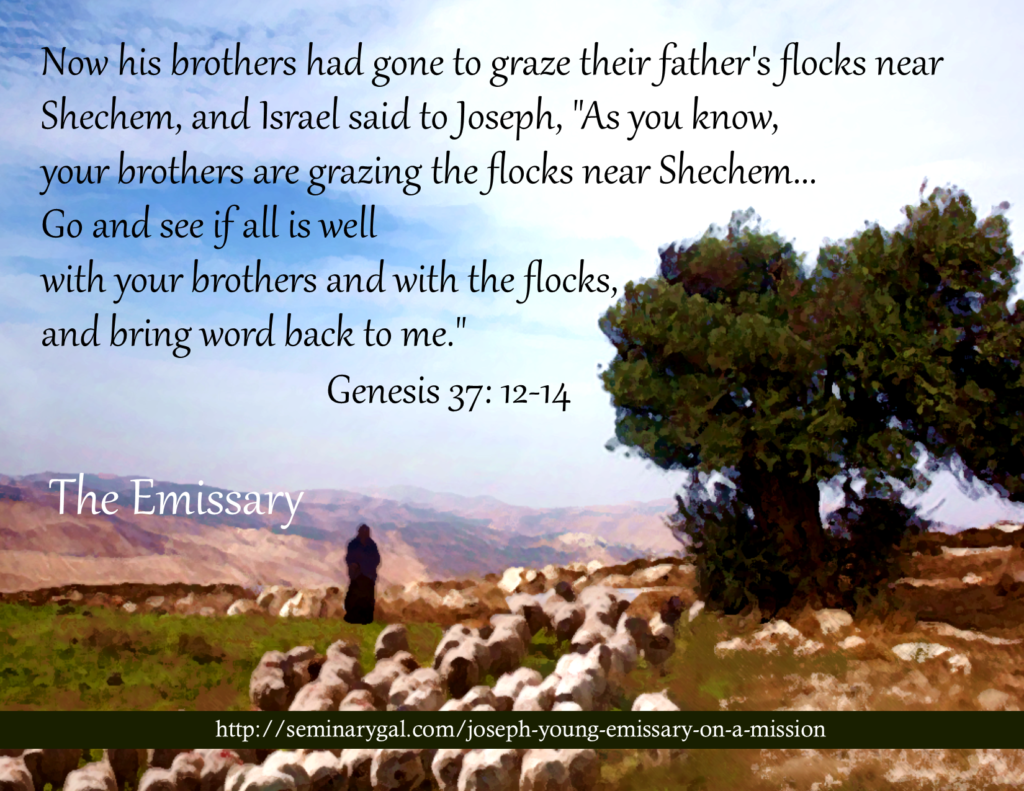
Genesis 37: 12 Now his brothers had gone to graze their father’s flocks near Shechem, 13 and Israel said to Joseph, “As you know, your brothers are grazing the flocks near Shechem. Come, I am going to send you to them.” “Very well,” he replied. 14 So he said to him, “Go and see if all is well with your brothers and with the flocks, and bring word back to me.” Then he sent him off from the Valley of Hebron.
All of Joseph’s brothers except probably 10-year-old Benjamin were out working with the sheep. Only Joseph and Benjamin (sons of favorite wife Rachel) would have been at home. Let that sink in. How must the other brothers have felt about this? They’re slaving away near Shechem with their lesser pedigrees in the hot sun with a bunch of stinkin’ sheep. But Joseph—seventeen and old enough to dream of authority with his famous coat–is hanging out with baby brother and dear old Dad in the shade of a tent in the Valley of Hebron.
Then it’s like he’s Agent 007 getting sent on a mission. Jacob says, “As you know” … and then sends him to investigate the brothers and report back.
Only Jacob didn’t know it was a dangerous mission or that Joseph as emissary wouldn’t return as planned.
But let’s not jump ahead of ourselves. Joseph is sent on a mission to Shechem which was a good four or five-day journey. He no doubt had a lot to think about as he traveled in the now famous coat. Pondering dreams? Fear of the wilderness? The Ancient Near East equivalent of being afraid to wear Canada Goose jackets or Air Jordans for fear of being killed for what you’re wearing because it’s a prestige item and an invitation for robbers? Who knows?
 .
.
One wonders if Joseph saw anyone earlier along the journey and whether they thought he might be a dignitary or a rich guy or wanted to get his autograph or kill him and take his coat. Scripture doesn’t say, hinting that those details are unimportant for the story’s progression.
What is important is that Joseph obeyed a direct command from Dad to go look in on his brothers and to issue another report. Since it went so well the last time. Not.
Think about it:
As we continue our look at Joseph: A Life With Many Colors, we see the dreamer keeps on dreaming. And talking about it. This time, not just to his brothers who are more than tired of this dreamer. Now he’s telling his father too.
Genesis 37:9 Then he had another dream, and he told it to his brothers. “Listen,” he said, “I had another dream, and this time the sun and moon and eleven stars were bowing down to me.” 10 When he told his father as well as his brothers, his father rebuked him and said, “What is this dream you had? Will your mother and I and your brothers actually come and bow down to the ground before you?”
 .
.
Two dreams, two reactions.
His brothers were jealous of him, but his father kept the matter in mind. (Genesis 37:11)
What does it mean that Jacob would keep the matter in mind?
By this point in Joseph’s life (age 17ish), his mother Rachel has already been dead 7 years (which may have created the favoritism to begin with, a transfer of his affections from wife to son). Rachel died giving birth to Benjamin, Joseph’s only full brother.
In the dream, who is this “mother” … is she Rachel from beyond the grave? Leah as adoptive mother? One of the concubines (Jewish tradition has Bilhah as Jacob’s favorite after Rachel died)? It’s hard to say. What isn’t hard to say is that it was tough for the brothers to choke back their total indignation and extreme envy. What isn’t hard to say is that it’s one thing to give a bad report about siblings, receive and wear a coat of authority given by your father, and to dream about brother-sheaves bowing, but it’s another thing entirely to suggest to your dad and “mom” that your authority will extend over them, too.
(Pausing from the storyline for a moment, we begin to see in the progression in Scripture of the idea of kingship and ruling. It’s emerging from within the Chosen People, the tribes of Israel. Maybe that’s why Jacob pondered the significance and whether there was something spiritual, beyond-the-grave-ish about the whole thing. Maybe he was sensing a dawning of God’s work in fulfilling the covenant he’d heard from God. Maybe that’s just wishful thinking on my part, wanting to imagine he’s like Mary, the mother of Jesus, treasuring these things up in her heart because there’s a sense of significance even if one can’t put a finger on exactly what it is. Understanding that what was happening was powerful and real, yet confusing, mysterious, and intriguing all wrapped up into one.)
But it could be Jacob was brooding over having given that stupid coat since it appeared to be a factor causing all this big-headed audacity. Maybe he was just annoyed because this kid is giving evidence of bucking a long-held tradition of respecting your elders. It’s hard to say why Jacob kept the matter in mind.
Think about it:
Genesis 37:5 Joseph had a dream, and when he told it to his brothers, they hated him all the more.
As if they needed a reason to hate him more.
Normally a person wears a coat on his back, covering his shoulders, arms, and part of his torso. In Joseph’s case as we continue our look at Joseph: A Life With Many Colors, we can guess his coat went to his head. At least that’s what the half-brothers thought and soon we’ll see that his father, too, was wondering if he’d created a monster with that coat. And it’s all because of two dreams that Joseph could have kept to himself, but he didn’t.
(Stepping out of the story for a moment, I’m glad he told the dreams and it made it into Scripture, because it would be proof in the future that what happened was foreseen and foreordained by God. It adds to the narrative and the proof. You see, before the Holy Spirit’s indwelling, dreams held a special place as evidence of divine revelation. These dreams are no exception so it’s good that Joseph shared them, and it made it into Scripture).
These are two dreams hinting not only at God’s sovereignty, but also at the importance of dreams for Joseph’s future. Here’s the first dream, in Genesis 37:6 He said to them, “Listen to this dream I had: 7 We were binding sheaves of grain out in the field when suddenly my sheaf rose and stood upright, while your sheaves gathered around mine and bowed down to it.”
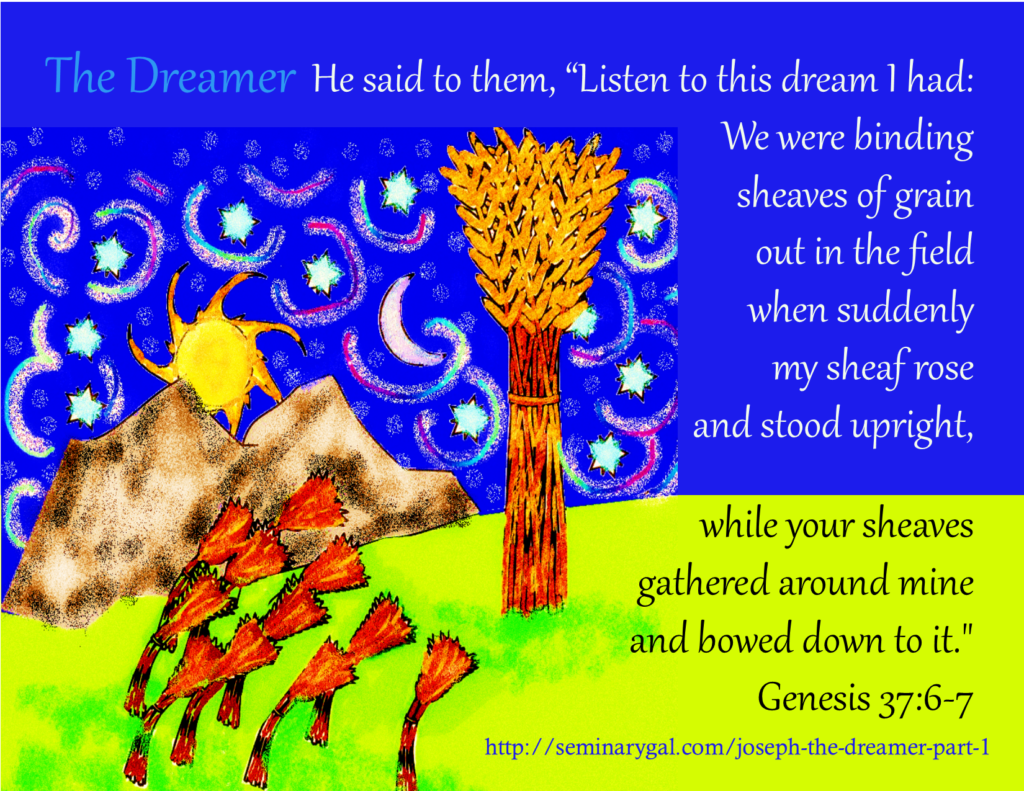
Do you see it’s the issue of authority, same as with the coat?
That’s certainly how the brothers interpreted it. Genesis 37:8 His brothers said to him, “Do you intend to reign over us? Will you actually rule us?” And they hated him all the more because of his dream and what he had said.
As if they needed a reason.
Think about it:
In “A Charlie Brown Christmas,” Charlie Brown goes to the mailbox and it’s empty. “Rats,” he says, “Nobody sent me a Christmas card today. I almost wish there weren’t a holiday season. I know nobody likes me. Why do we have to have a holiday season to emphasize it?”
There’s nothing like evidence of affection elsewhere (or lack thereof to yourself) to send a message straight to the heart. When it happens, it’s painful whether it’s a shock out of the blue or like proof in your face of what you’ve already known deep in your gut.
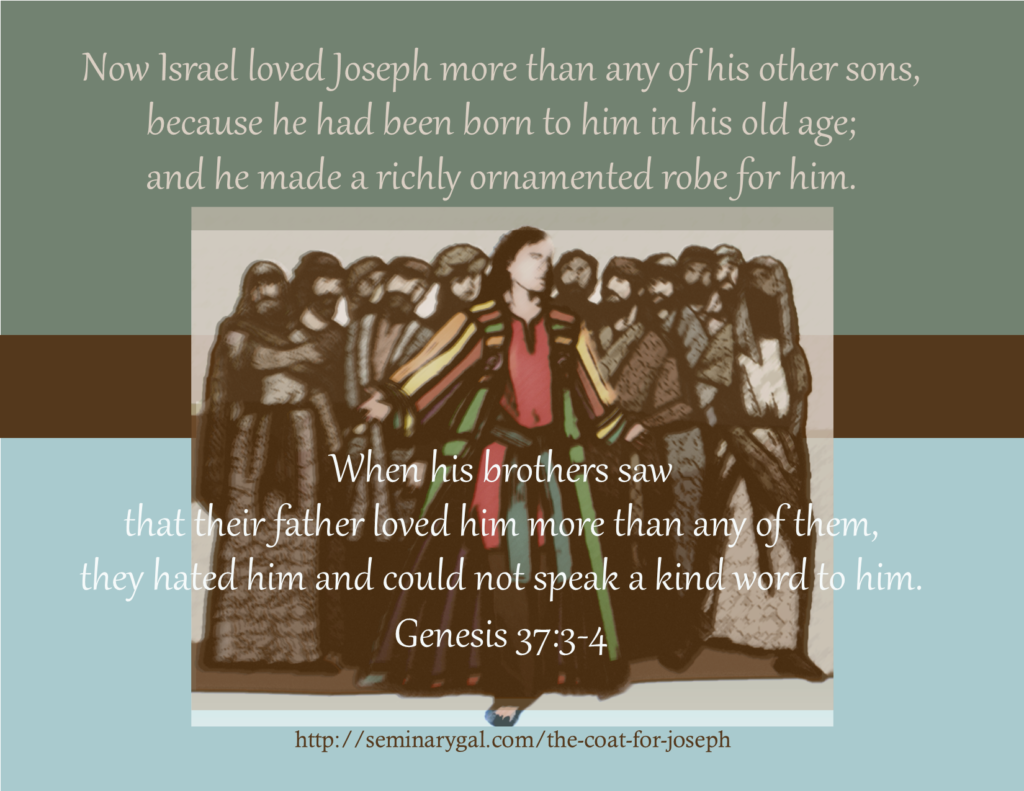
Genesis 37:3 Now Israel loved Joseph more than any of his other sons, because he had been born to him in his old age; and he made a richly ornamented robe for him. 4 When his brothers saw that their father loved him more than any of them, they hated him and could not speak a kind word to him.
Enter the coat, probably one of the most famous things about Joseph, especially thanks to a catchy tune by Andrew Lloyd Webber and Sunday School coloring pages to enjoy with the Crayola 64s, 96, or 120- pack. In fact, so much attention is paid to the coat that you’d think it is the greatly anticipated unveiling of the Ancient Near East collection from the House of Dior, launching the modeling career of Joseph, son of Jacob. But that would be to misunderstand the coat.
No one exactly knows what the coat looked like, the same wording of “richly ornamented” being used in 2 Samuel 13:19 to refer to the robe that beautiful and desirable Tamar (virgin daughter of the king) tore after being raped by her half-brother Amnon. (Half-brothers. Aargh!)
The visual appearance of the coat is far less clear than the meaning of it.
 .
.
It was a status symbol saying in effect, “You know that management potential you saw displayed in the shepherding field? It’s now an official title. He’s headed for management not left to labor like you.” As we continue our look at Joseph: A Life With Many Colors, make no mistake: It’s all about authority, and undeniable evidence of the special love Jacob had for his son Joseph.
No wonder the half-brothers were ticked off.
They already knew he preferred Joseph.
They didn’t need a coat to emphasize it.
Think about it:
In the Bible there are only a few people whose lives we know about in some degree of detail from their origin/birth to their death: Adam, Abel, Noah, Isaac, Jacob, Joseph, Moses, Samuel, Samson, Solomon, John the Baptist, and Jesus Christ. That’s my list so far. There may be others and certainly, if you have additions, I’m all ears.
As we pick up our story of Joseph: A Life With Many Colors, the truth is that Joseph’s brothers (half-brothers, actually) hated him well before the famous coat. It had been a long time coming, probably from shortly after Joseph was born as the cherished child and pushed them out of favor. Finally, at seventeen he’d get that coat, but before the coat, he’d gotten the brothers’ goat with an event that became pivotal in turning their anger into future action against him. It’s what made the coat significant and why it’s a prelude that made it into the biblical coat narrative.
What event was that? The report. The bad report.
.
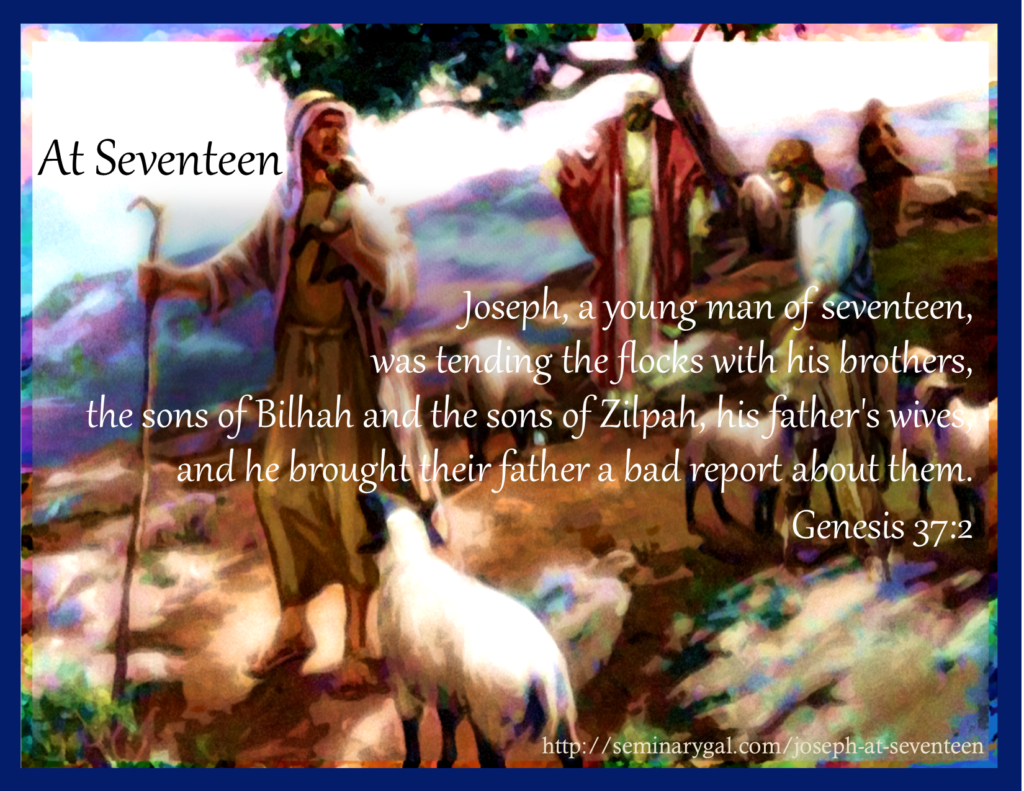
Genesis 37:1 Jacob lived in the land where his father had stayed, the land of Canaan. 2 This is the account of Jacob. Joseph, a young man of seventeen, was tending the flocks with his brothers, the sons of Bilhah [Dan and Naphtali] and the sons of Zilpah [Gad and Asher], his father’s wives, and he brought their father a bad report about them.
The children of Bilhah and Zilpah are depicted on a human scale as third-rate kids legally adopted by Rachel and Leah, but born to pagan maidservants (concubines), who became Jacob’s “standby wives” doing the fertility bidding of Leah and Rachel in an Old Testament custom for barren women.
But as Jacob’s actions had shown by preserving Joseph and Rachel (and probably many times before and after), what chance did Leah’s sons (Reuben the firstborn of Jacob, Simeon, Levi, Judah, Issachar and Zebulun), or children of concubines (Dan, Naphtali, Gad, and Asher) stand when faced with a kid who walked on water as far as their dad was concerned?
When we read Joseph was “tending flocks with his [half-]brothers,” read that as a supervisory role. At seventeen, Joseph was a combination dad-ordained-overseer and snitch. His father saw him as the former. His half-brothers saw him as the latter.
It’d be easy to pass off Joseph as just a bratty kid…but at seventeen in the Ancient Near East, girls were married with babies and young men were gainfully employed, some even married. All of those brothers being older, their anger was evident at this upstart who was giving them a bad performance review. After all, from their perspective, he’s seventeen and full of himself. Who does he think he is?
Think about it:
We all try to protect what we love or what is valuable to us. It explains the rise of “spider wraps” and other anti-theft protections on expensive products, home security camera systems, and smart homes that alert us when there’s been a breach. It also explains everything from child-safety car seats to tamper-evident technology for electronics, containers for foods, medicines, and baby formula. Safety and protection are important to us.
Such is the case today with Jacob and the way he was reunited with his brother Esau after many years. Jacob clearly remembered how he deceived his brother into receiving Isaac’s blessing as a birthright and to see him after all these years would be awkward at best. So, he sends a message to Esau clearly implying “Don’t worry.” He hasn’t been sneaking or hiding, he’s not coming to take anything that belongs to Esau, and he wants to let the past be forgiven.
Why that? Well, he imagined—without too much difficulty—that Esau may hold a grudge, long ago turning into bitterness, and then there’s the confusing message brought back that caused Jacob to be alarmed. Genesis 32:6 When the messengers returned to Jacob, they said, “We went to your brother Esau, and now he is coming to meet you, and four hundred men are with him.”
Four. Hundred. Men. An army! Jacob feared the worst and put a plan in action. Genesis 32:7 In great fear and distress Jacob divided the people who were with him into two groups, and the flocks and herds and camels as well. 8 He thought, “If Esau comes and attacks one group, the group that is left may escape.”
He knew who he wanted to ensure would escape: Rachel and their son Joseph. Above all, Joseph was the protected child.
Jacob begins to schmooze Esau to win his favor…all kinds of animals as a gift! Yet Esau and his army still came!
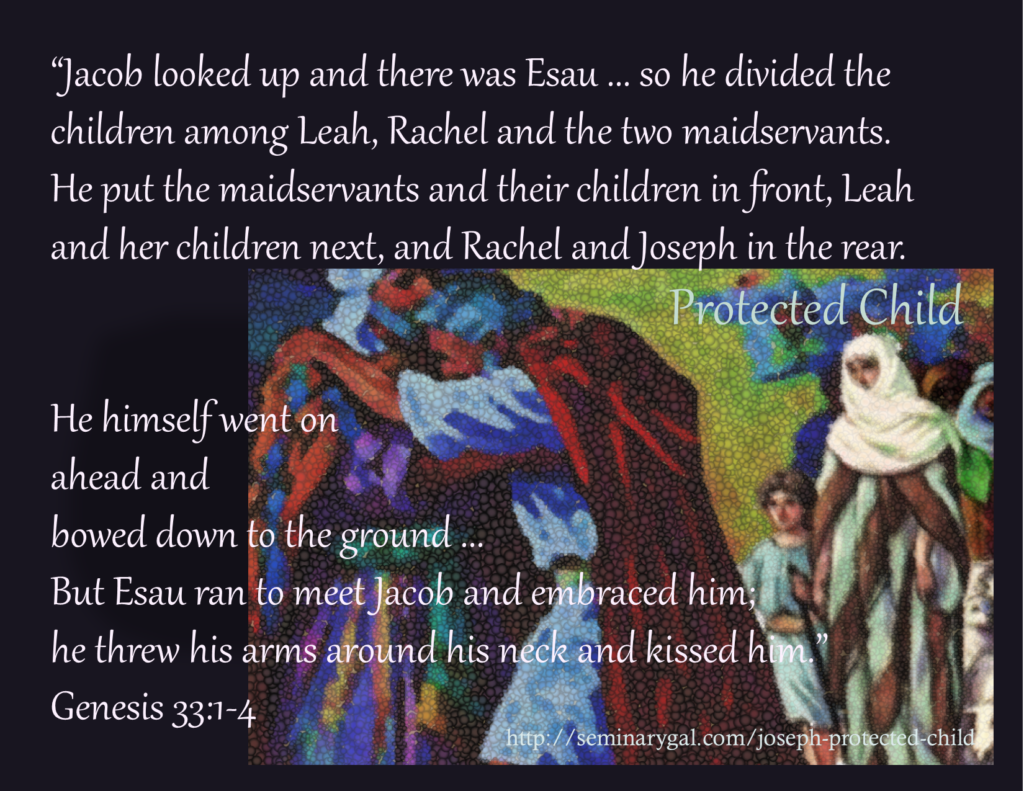
Genesis 33:1 Jacob looked up and there was Esau, coming with his four hundred men; so he divided the children among Leah, Rachel and the two maidservants. 2 He put the maidservants and their children in front, Leah and her children next, and Rachel and Joseph in the rear.
 .
.
And that tells you everything you need to know about Jacob’s special relationship with Rachel and their son Joseph. His children with maidservants, valued, yes, but expendable. His children with Leah including the one who’d be in the lineage of Christ (Judah)…valued, but not so much as the child with Rachel.
Jacob stands between himself and all his offspring. And after a quick quasi-prayer (which is about all we ever get with Jacob), Genesis 33:3 He himself went on ahead and bowed down to the ground seven times as he approached his brother. 4 But Esau ran to meet Jacob and embraced him; he threw his arms around his neck and kissed him. And they wept. 5 Then Esau looked up and saw the women and children. “Who are these with you?” he asked. Jacob answered, “They are the children God has graciously given your servant.” 6 Then the maidservants and their children approached and bowed down. 7 Next, Leah and her children came and bowed down. Last of all came Joseph and Rachel, and they too bowed down.
A lot to think about today:
We’re a couple of weeks into the New Year, yet it seems Christmas 2018 is far behind us. The birth of Christ gets shelved along with the Nativity scene for many of us. But today, we have reason to think of another special birth in our new study, “Joseph: A Life With Many Colors”.
First, let’s be clear because the name Joseph is just as confusing as the name John with respect to the Bible. (Let’s face it: not everyone was lucky enough be named Tychicus or Onesiphorus.) We’re looking at Joseph–not the one with Mary and the manger and no room at the inn—we’re looking at the one born in Genesis 30 and we can see this birth was a special moment too.
Why was it special? Cherished?
Joseph was born to Jacob (also known as Israel) and his wife Rachel. They had tough start in marriage since Jacob—deceiver extraordinaire—reaped what he had sown over that whole “sell me your birthright” stuff with his brother Esau. What goes around, comes around. I’d say karma, but I don’t actually believe in that.
Jacob had been working for a guy named Laban—a relative who made Jacob’s deception look like child’s play. Laban had two daughters: Leah and Rachel. Leah was older and headed for Old Maidsville. Rachel was the girl Jacob wanted. Laban (Deceiver Dad) pulls a grand switch and hides Leah under a veil and after the vows are said and the act is done…it’s morning and Bride Surprise.
Jacob naturally protested this situation, an Ancient Near East version of WTH? You can read the whole multiple wives thing yourself. It’s all right there in Genesis 29. (Betcha Jacob peeked under the second veil to make sure it wasn’t someone else. Fool me once, shame on you. Fool me twice, shame on me.)
Two wives, double trouble, and the birth wars began. Frankly, if the wedding situation was a mess, this sibling rivalry between Leah and Rachel was worse. These two women plus their maidservants and garnished with some fertility mandrake plants populated the official Tribes of Israel in a very messy way. Genesis 30:15 But [Leah] said to [Rachel], “Wasn’t it enough that you took away my husband? Will you take my son’s mandrakes too?” “Very well,” Rachel said, “he can sleep with you tonight in return for your son’s mandrakes.”
.
Sisters. Hmmm. Just as an aside, don’t you find it interesting that the Chosen People of Israel would be like this and how into the total mess of human life, God sends a deliverer? Not “the deliverer” who will come much later, but one named Joseph whose many-colored life would in fact provide a pattern anticipating the Christ to come.
And it all began with a cherished birth: Genesis 30:22 Then God remembered Rachel; he listened to her and opened her womb. 23 She became pregnant and gave birth to a son and said, “God has taken away my disgrace.” 24 She named him Joseph.”
Think about it: