Now That’s Security! (Lent 24-2013)

What, then, shall we say in response to this? If God is for us, who can be against us? He who did not spare his own Son, but gave him up for us all– how will he not also, along with him, graciously give us all things? Who will bring any charge against those whom God has chosen? It is God who justifies. Who is he that condemns? Christ Jesus, who died– more than that, who was raised to life– is at the right hand of God and is also interceding for us. Who shall separate us from the love of Christ? Shall trouble or hardship or persecution or famine or nakedness or danger or sword? As it is written: “For your sake we face death all day long; we are considered as sheep to be slaughtered.” No, in all these things we are more than conquerors through him who loved us. For I am convinced that neither death nor life, neither angels nor demons, neither the present nor the future, nor any powers, neither height nor depth, nor anything else in all creation, will be able to separate us from the love of God that is in Christ Jesus our Lord.  (Romans 8:31-39, NIV)

from http://www.tsa.gov/Recently, I traveled on a domestic flight out of Chicago O’Hare airport.  With “the sequester” in progress in the US, we thought we’d be standing in long lines for airport security.  Surprisingly, there was hardly any wait at all.

Of course there was the usual process: identification check, ticket check, shoes off, computer out, no belt, no metal, no weapons, quart-sized zippered plastic bag of miniscule amounts of liquids, gels, etc., and the inevitable luggage x-ray.  Then there’s the full body scanner and a possible pat down…all in the name of security.

Yes, it’s inconvenient, and a lot to go through, but it’s nice having a sense of security.

Even so, when we got to our destination, we heard news reports of the failures of the safety protocol and people getting through airport security with bombs in their pants.  Good grief, I don’t even want to think about what comes next for the law-abiding among us.

I was thinking about security because today’s passage (Romans 8:31-39  also above) talks about it.  You see, we’re all under a death sentence because of sin.  We’re not faced with mere terrorism—humanity is faced with total annihilation.

And yet, we can have security from this enemy.  It doesn’t require quart sized bags and scanners.

Our greatest security measure is nothing less than God Himself.

Look at the laundry list of enemies in the verses above!

Yet God’s security measure is His love shown to us in Jesus Christ. 

He took our sins. 

He conquered death. 

In Him, we have the same victory.  Now that’s security!

* * *

Give it up for Lent: Fear that something will separate you from God

* * *

For further study:

  1. In 65 verses of the Bible (in the NIV translation), it reads “Do not be afraid.”  Why do you think God takes such pains to remind us…indeed He commands us…not to fear? 
  2. What does fear suggest about our view of God’s security?
  3. Read 1 Peter 3:8-22.  Does freedom from fear equal freedom from persecution or trouble?  What does Jesus say about that in John 16:33?

Continue Reading

The Sustaining Power of the Unseen (Lent 23-2013)

What can you have but never hold?  
What can you possess while it is invisible, but once you see it, it’s gone?
It sounds like a riddle, but it’s hope.

The hope of salvation is something we can possess but we do not see it, except by faith.  rainbow croppedHope sustains us between our first believing until we possess it fully.  Paul tells us that we do not hope for what we already hold in our hands.  Once hope has been realized, it’s no longer hope.

Hope is the hidden faith bridge between possession and realization.

Likewise, our passage today (Romans 8:24-30) teaches that the Holy Spirit provides a similar kind of sustaining power of the unseen.  We cannot see the Holy Spirit, but He testifies to our salvation and He is powerfully at work on our behalf behind the scenes. He bridges for us between saving faith and final redemption.

Romans 8:26 In the same way, the Spirit helps us in our weakness. We do not know what we ought to pray for, but the Spirit himself intercedes for us with groans that words cannot express. 27 And he who searches our hearts knows the mind of the Spirit, because the Spirit intercedes for the saints in accordance with God’s will. 28 And we know that in all things God works for the good of those who love him, who have been called according to his purpose. 29 For those God foreknew he also predestined to be conformed to the likeness of his Son, that he might be the firstborn among many brothers. 30 And those he predestined, he also called; those he called, he also justified; those he justified, he also glorified (NIV).

We try to pray and the Holy Spirit takes the believers’ prayers and prays for us in accordance with God’s will.  It’s reassuring to know that when God’s will isn’t exactly clear to me, yet I can pray the will of God because the Holy Spirit is the sustaining power of the unseen, hard at work, all the time on behalf of believers!

I’d prefer to finish with that encouraging word, but in good conscience, I cannot leave this passage of Scripture without pointing out that theologians try to use verses 28-30 to force the visible upon the unseen on two theological points.  They try to take what we clearly have and try to make it something we can hold.  I will address the issues of (1) God’s working things for good and (2) the idea of predestination in a separate article.  They’re important topics even if they generate far more heat than light in theological discussions.

We can be encouraged that sometimes things can simply remain a mystery and stay hidden to our eyes.  Mystery is a beautiful thing because when we force the visible upon the unseen, we lose something valuable.  We lose hope and the sustaining power of the unseen.

* * *

Give it up for Lent: My need to resolve all mysteries

* * *

For further study:

  1. Take a moment to ponder the unseen.  Rainbows’ ends, gravity, wind, love, hope…why do you think people desire to hold onto what is unseen?  Why are we tempted to harness it?  What are we doing when we harness something?
  2. Why might humans want to quantify salvation?  What would we gain if we know who is saved and who isn’t?  What would we lose?
  3. Read John 3:1-18How does this apply to the idea of the unseen?  Is it unseen to Jesus if it is to our eyes?  What is required of us if Jesus can see it and we cannot?
Continue Reading

Chapel Worship Guide 3.10.2013

Chapel Worship Guide for Sunday 9 AM—March 10, 2013
The Nemmers Family Chapel at Advocate Condell

Prelude

Welcome—Barbara Shafer, Christ Church Highland Park

Worship in Song:

Scripture Reading (Old Testament): Isaiah 6:8-13
8 Then I heard the voice of the Lord saying, “Whom shall I send? And who will go for us?”

And I said, “Here am I. Send me!”

9 He said, “Go and tell this people:

“‘Be ever hearing, but never understanding;
be ever seeing, but never perceiving.’
10 Make the heart of this people calloused;
make their ears dull
and close their eyes.[a]
Otherwise they might see with their eyes,
hear with their ears,
understand with their hearts,
and turn and be healed.”

11 Then I said, “For how long, Lord?”

And he answered:

“Until the cities lie ruined
and without inhabitant,
until the houses are left deserted
and the fields ruined and ravaged,
12 until the Lord has sent everyone far away
and the land is utterly forsaken.
13 And though a tenth remains in the land,
it will again be laid waste.
But as the terebinth and oak
leave stumps when they are cut down,
so the holy seed will be the stump in the land.”

Prayer

Scripture Reading (New Testament): Matthew 13:1-30
The Parable of the Sower

13 That same day Jesus went out of the house and sat by the lake. 2 Such large crowds gathered around him that he got into a boat and sat in it, while all the people stood on the shore. 3 Then he told them many things in parables, saying: “A farmer went out to sow his seed. 4 As he was scattering the seed, some fell along the path, and the birds came and ate it up. 5 Some fell on rocky places, where it did not have much soil. It sprang up quickly, because the soil was shallow. 6 But when the sun came up, the plants were scorched, and they withered because they had no root. 7 Other seed fell among thorns, which grew up and choked the plants. 8 Still other seed fell on good soil, where it produced a crop—a hundred, sixty or thirty times what was sown. 9 Whoever has ears, let them hear.”

10 The disciples came to him and asked, “Why do you speak to the people in parables?”

11 He replied, “Because the knowledge of the secrets of the kingdom of heaven has been given to you, but not to them. 12 Whoever has will be given more, and they will have an abundance. Whoever does not have, even what they have will be taken from them. 13 This is why I speak to them in parables:

“Though seeing, they do not see;
though hearing, they do not hear or understand.

14 In them is fulfilled the prophecy of Isaiah:

“‘You will be ever hearing but never understanding;
you will be ever seeing but never perceiving.
15 For this people’s heart has become calloused;
they hardly hear with their ears,
and they have closed their eyes.
Otherwise they might see with their eyes,
hear with their ears,
understand with their hearts
and turn, and I would heal them.’[a]

16 But blessed are your eyes because they see, and your ears because they hear. 17 For truly I tell you, many prophets and righteous people longed to see what you see but did not see it, and to hear what you hear but did not hear it.

18 “Listen then to what the parable of the sower means: 19 When anyone hears the message about the kingdom and does not understand it, the evil one comes and snatches away what was sown in their heart. This is the seed sown along the path. 20 The seed falling on rocky ground refers to someone who hears the word and at once receives it with joy. 21 But since they have no root, they last only a short time. When trouble or persecution comes because of the word, they quickly fall away. 22 The seed falling among the thorns refers to someone who hears the word, but the worries of this life and the deceitfulness of wealth choke the word, making it unfruitful. 23 But the seed falling on good soil refers to someone who hears the word and understands it. This is the one who produces a crop, yielding a hundred, sixty or thirty times what was sown.”

The Parable of the Weeds

24 Jesus told them another parable: “The kingdom of heaven is like a man who sowed good seed in his field. 25 But while everyone was sleeping, his enemy came and sowed weeds among the wheat, and went away. 26 When the wheat sprouted and formed heads, then the weeds also appeared.

27 “The owner’s servants came to him and said, ‘Sir, didn’t you sow good seed in your field? Where then did the weeds come from?’

28 “‘An enemy did this,’ he replied.

“The servants asked him, ‘Do you want us to go and pull them up?’

29 “‘No,’ he answered, ‘because while you are pulling the weeds, you may uproot the wheat with them. 30 Let both grow together until the harvest. At that time I will tell the harvesters: First collect the weeds and tie them in bundles to be burned; then gather the wheat and bring it into my barn.’”

Message: “Why Parables?” by Barbara Shafer

Song of Response:

Continue Reading

Groaning Pains (Lent 22-2013)

heart-earthOK, I’ll admit it: I struggle with “the environmentalist movement.” On one hand, I try to be a good steward of the environment, have been a frugal consumer and was a cautious recycler long before it was fashionable. I am a trained horticulturist and have a deep and abiding love of nature. On the other hand, I don’t want to lead people to believe that we can “save the planet.” Heck, we can’t even save ourselves!

Creation got the bad end of the deal, frankly. Adam and Eve were made rulers over and then boom! Sin. Fall. Mortality. Decay.  You take a nice little planet and put it under the control of generations of sinners and the motto stands true: Life stinks and then you die. Poor planet Earth!

In today’s passage Romans 8:18-23, we see that mortality didn’t just happen for mankind where the planet will endure for eternity and only men will come and go. Nope! The whole planet is struggling under the weight of death. Earth is groaning—it too is unable to be liberated until Jesus returns.

We’re all stuck in the middle zone of the “already” but “not yet” of salvation history. Act 2 has come and gone– our Redeemer Jesus came, lived, DIED, and conquered death. We await Act 3 when Jesus returns with a new heaven and a new earth and there will be no more death (Revelation 21:4) and the old order of mortality is gone forever!

This is where “the environmentalists” have it wrong. There is no human way around mortality.

I love the Chicago Botanic Garden, but sadly, they’re wrong in saying, “Plant Science Will Save the Planet.” No, it won’t. The planet persists in a state of groaning and struggle until the glorious freedom of redemption. Freedom from death. Freedom from decay. Freedom from abuse. Freedom from pollution. Freedom from sin’s self-interests reigning poorly over a sad, abused, and subjected creation. When mankind is finally liberated beyond the Great White Throne of Judgment; when death and Hades are destroyed, only then will creation, too, be liberated from the same specter of death that has haunted mankind since the curse upon the ground.

Jesus’ return will save the planet. Until that time, we’re all in the throes of groaning pains.

 * * *

Give it up for Lent: Belief that sinful human stewards can save the planet

* * *

For further study:

  1. Read Jonah 4:11. What does God think about creatures? Do they have value in His eyes?
  2. Read Genesis 1, noting the blessings and goodness of what God created.
  3. Read Job chapters 38-41 and meditate on the majesty of God’s creation and His investment in it.
Continue Reading

Spirit-led (Lent 21-2013)

holding_hands3The Holy Spirit is, in my view, the best kept secret of evangelical Christianity. Whether it’s out of our fear of being perceived as too charismatic, or that He goes by the name Holy Ghost and this seems remarkably unscientific, or maybe just that we can’t see the spiritual, we treat the Holy Spirit like the member of the Trinity who truly embarrasses us. Not me! I love the Holy Spirit and today’s passage (Romans 8:12-17) outlines why.
The Holy Spirit leads us from slavery to sonship, from the uncertainty surrounding death to the assurance of eternal life, and from fearful outcasts to adopted children of God, heirs of eternal blessings as part of God’s family!

How many of us long for relationship that is stable and reliable! How many of us wish for the security of true love that never leaves, to feel safe, or to feel like we are part of a truly loving family! The Holy Spirit’s indwelling believers testifies to all of this.

He leads us by His presence from slavery to sin and from fighting the impossible fight to keep the law. Then, He leads us through conviction, repentance, and faith to His dwelling in our hearts as a guarantee that we are, in fact, God’s children. He brings the law to life in us rather than keeping us as outcasts afraid of the impossible standard and the death our failures to meet it entail.

Do you have the Holy Spirit? How do you respond to the way He leads you from slavery, fear, and uncertainty to the assurance of sonship, hope, and eternity in the glorious presence of God the Father?

* * *

Give it up for Lent: Contentment with slavery when you can have sonship

* * *

For further study:

  1. Read 2 Cor 1:21-22 and Ephesians 1:13-14.What kind of assurance does the Holy Spirit give us?
  2. What is the Holy Spirit’s role in leading us? Read John 16: 7-15.
  3. Read John 1: 12 “Yet to all who received him, to those who believed in his name, he gave the right to become children of God– 13 children born not of natural descent, nor of human decision or a husband’s will, but born of God.” What does this passage say about adoption into the family of God?
  4. How does the Holy Spirit testify that Jesus was the Son of God and that believers have hope of sonship?
Continue Reading

Justice Served. Love Triumphs. (Lent 20-2013)

Condemnation is not anything we want to experience.   The word conveys judgment and we’re on the wrong end of it.  We’d rather be found not guilty, but the truth is that each of us is guilty before God.  We’re guilty so long as we’re standing there as our own defense team with our life’s works as Exhibits A-Z.

Paul has just finished his great exposition of why the law—while good—was insufficient to save us and why sin is too much for humans to conquer on our own.  If this is where redemption history ended, we’d all be hell-bound.  We’d all face condemnation—and rightly so—because we aren’t able to save ourselves.

Here’s the dilemma that God faced: all humans bear God’s Image, and yet do all sorts of things with it that make for human sin.  For God to condemn sin would mean condemning His Image stamped on every human being, consigning it to hell.

What was God’s solution?  Jesus.

For what the law was powerless to do in that it was weakened by the sinful nature, God did by sending his own Son in the likeness of sinful man to be a sin offering.   And so he condemned sin in sinful man,  in order that the righteous requirements of the law might be fully met in us, who do not live according to the sinful nature but according to the Spirit. (Romans 8:3-4, NIV)

Because of our inherited sin nature, we cannot keep the law no matter how good it is at circumscribing holiness.  We are the limiting factor.

So God sent His Perfect Image (His Son Jesus).  Jesus is not a created being and therefore He is not just an Image bearer, but the perfect one.  Jesus lived a perfect life, always doing what God would do with His Image. Jesus did this as the fullness of God, yet in human likeness.

As an unlimited being, Jesus (the Son of God) carried (as the Son of Man) the sin of all mankind to the Cross.  God resolved the dilemma by fully condemning sin, punishing it with ubiquity (because Jesus is uniquely unlimited and lived perfectly).

2 Corinthians 5: 19 that God was reconciling the world to himself in Christ, not counting men’s sins against them. … 21 God made him who had no sin to be sin for us, so that in him we might become the righteousness of God.

Jesus became sin to be punished because He had none of His own.  He was our sin offering as our passage for today  (Romans 8:1-11) says.

It really is remarkable (although, I suppose not surprising) how perfect His resolution to the dilemma was. 

  • God punished sin (demonstrating His perfect justice).
  • God brought us back into relationship with Him (demonstrating His mercy).
  • God showed us what His Image looks like (demonstrating His holiness, wisdom, and compassion).
  • God acted in every way loving toward us, His Image bearers (demonstrating His love).

Justice Served.  Love Triumphs.

* * *

Give it up for Lent: Denying the power of Christ’s deity

* * *

For further study:

  1. Romans 8:1-11 contains a number of blessings for the Christian.  See how many you can identify.
  2. In what ways do we limit Christ and treat Him as a mere man?
  3. Could Jesus have paid it all and been a sin offering if He was not also God?  Think about all the ramifications of Jesus’ being fully God.
Continue Reading

Uphill Battle (Lent 19-2013)

“I’m facing an uphill battle,” I said. He replied, “All battles are uphill. Downhill, it’s called a slide, a cake-walk, inevitable, or gravity.”

He was a WWII vet and I think he knew what he was talking about. It’s also a good picture of what today’s Scriptures (Romans 7:13-25) are saying.

I personally find today’s Scriptures among the most encouraging passages in the whole Bible. For those of us who fight perfectionism at every turn and who desire to live impeccable lives, we hate the inevitable slide or gravity pulling us down from our desire to do what is right. Paul knew what it was like and had that same “Aaargh!” sentiment that many of us feel when we fall short of our desires. It’s a relief that I’m not alone in my struggle to fight the uphill battle and the frustration at failures that come with it.

If I died with Christ and am born again to live a life of holiness, then why is it so hard?  There’s a war going on until we go home to Jesus or He returns to us. The warring factions, ironically, are both me!

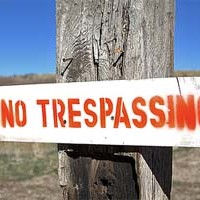
no trespassingOn the spiritual side, this is the person I want to be, and the opposing side is sinful person I am by nature. Like gravity, the sinful nature constantly pulls me downhill. It’s easy to slip, to slide, to take the cake-walk rather than the hard road. Unchecked, I inevitably careen toward chaos.

For Paul, as a Jew, as for us today, the uphill battle to live a righteous life still leads to defeat. Yes, it’s hard work to fight the uphill battle. And for those of us who try and fail again and again, it could be cause for despair. This would remain the case if Act 1 of redemption history (the giving of the law) was all we had; if the sacred space was simply cordoned off as No Trespassing so that we were prevented from accessing it.

Romans 7:24 What a wretched man I am! Who will rescue me from this body of death? 25 Thanks be to God– through Jesus Christ our Lord!

But it’s good to know that we have someone who has rescued us from this body of death: Jesus. He fought the uphill battle and won the decisive victory over sin and death. For those of us who try, but fail time and again, Jesus reassures us that–for Jew and Gentile—He died once for all of us. We can know that our fighting the uphill battle is worth it, and He offers forgiveness for the times we fail. That’s good news indeed!

* * *

Give it up for Lent: Despair at surrendering to our sinful selves

* * *

For further study:

1. To what extent was it even more frustrating for the Jews who had been given the Law?

2. Do you ever picture yourself as walking around in a body of death? How might it change your view of the condition of humanity and the promise of eternal life?

3. How does the picture of slavery to sin and slavery to God’s law leave the Jew with a “Catch-22” (they have been given the Law, but cannot keep it)? What is the way out for Jews and Gentiles alike? Give thanks to God that Jesus rescues us from impossible, uphill battles.


Continue Reading

The Impossibly High Standard (Lent 18-2013)

If you’ve ever been to a theme park, you’ve likely encountered rides marked with a sign that reads, “You must be this tall to ride.” 

I always wondered about that.  Let’s say someone was very tall for their age…or very short.  It’d be a disqualifier that you couldn’t do anything about.  One could hope that with age, we will grow in height.

But what if the sign was so tall that no one could reach it no matter how old they were or how tall they got?

That’s a picture of what today’s passage (Romans 7:1-13) is saying about the Mosaic Law.

The law is an impossibly high standard.  No matter how long we have been alive or how long we have been Christians or Jews, we will never be able to live up to that high standard.  We’re not up to the level needed to ride.  So we stand there looking at the sign and are acutely aware of being too small, falling too short.

What might be some of the reactions to the requirements?

  • Cry because you couldn’t ride?
  • Become angry at the requirement being impossible to attain?
  • Feel frustration that no matter how hard you worked, it wasn’t good enough?
  • Would you pass judgment on the ride, the standard, or the whole theme park as being worthless?
  • Would you experience denial, insisting you are tall enough?
  • Or maybe would it release your inner schemer: I’ll find a way around it?

I found that the very commandment that was intended to bring life actually brought death. For sin, seizing the opportunity afforded by the commandment, deceived me, and through the commandment put me to death.  So then, the law is holy, and the commandment is holy, righteous and good. (Romans 7: 10-12)

Considering the ride at the theme park, the sign is there as a positive to permit me to ride, but instead it is negative in that it points out that I am deficient and unable.  If the sign wasn’t there, I wouldn’t know I couldn’t ride until boarding time when I’d be passed over for not measuring up because the standard is the standard.  Likewise, the law is there to show me what it takes to live with holiness, and what do I see?  My deficiency and inability to live with holiness.  It’s not the law’s fault.  It’s the way things are.

I am deficient not because there was a sign pointing it out, but the sign clearly shows the impossibly high standard that I am unable on my own to satisfy.  For the Jews of Paul’s day, they wanted to believe that they received the law as a positive to give them a ticket to heaven.  But the law stood as a reminder that they could never measure up.  It is an Impossibly High Standard.

 * * *

Give it up for Lent: Striving for the impossible and resisting God’s solution

* * *

For further study:

  1. What is your reaction to the impossibly high standard of the law?
  2. Consider Romans 5:8 “But God demonstrates his own love for us in this: While we were still sinners, Christ died for us.”  Unlike the theme park where the sign prevents you from riding, what did Jesus do to allow us to experience eternal life?
  3. Read Colossians 2:13-15.  What did Jesus do with the impossibly high standard?
  4. If we died with Christ, how is our relationship to the law like Paul’s example from marriage in Romans 7:1-3?
Continue Reading

God is Your New Boss (Lent 17-2013)

Have you ever resigned from one job and taken another?  If so, you will understand today’s analogy.

Let’s say the new job offered you better pay, a nicer boss, and greater job security, would you even consider going back to work for the bad boss who stressed you out, threatened to fire you all the time—all for a job in which you were constantly abused?  Even after you started your new job, if your old bad boss called you on the phone and threatened to make your life miserable if you didn’t come back, would you leave the good job and go back to the bad one?

This is the argument that the Apostle Paul is making in today’s passage (Romans 6:12-23).

He says you previously had a bad job.  Your boss was Satan.  Your cubicle was a filthy, foul place.  Your job description included sinning, doing all kinds of bad things to yourself and others, and at the end of the end of your work week, you had a paycheck that was nothing but death.   Your coworkers were the Grim Reaper, Satan’s henchmen, and probably a few evil clowns.  Clowns can be creepy.

But now, look!  You resigned from that job. 

You’re never going back.  Good for you! 

Your new boss is God.  Your office is clean. Your job description is to serve Him; do good stuff; and obey His wise instructions.  He cares about you and your welfare.  It’s Friday and you and all your coworkers get paid for the random and planned acts of kindness that God paved the way for you to do.

 Your paycheck? Wow! Righteousness and holiness!

But then in your envelope, you see it: God gave you a wonderful bonus that you didn’t (and couldn’t) earn.  It’s eternal life and it starts right now and continues forever.   

So would you really take the gift of God’s presence and favor and trade it for being Satan’s whipping boy all over again? (I didn’t think so).  You might hear Satan calling like the telemarketer from Hell trying to sell you on his brand of relationship saying, “Come back, I’ll make you a deal.”  But you can say like the Dave Edmunds song,

“You better get back to your use-to-be
‘Cause your kind of love ain’t good for me
I hear you knockin’
But you can’t come in
I hear you knockin’
Go back where you’ve been

Romans 6:23 For the wages of sin is death, but the gift of God is eternal life in Christ Jesus our Lord.

* * *

Give it up for Lent: Looking back, longing for the sinful days to return

* * *

For further study:

  1. How is it that you resign from the bad job of sinning?
  2. What does God’s job application process entail?  Is this job something you deserve or earn?
  3. Read James 4:1-10.  What does this say about how to get rid of the old boss?
Continue Reading

Chapel Worship Guide 3.3.2013

Service Order for 9:00 AM Sunday, March 3, 2013

Nemmers Family Chapel at Advocate Condell

This week’s worship service is brought to you by The First Presbyterian Church of Libertyville

Piano Prelude (Leann Malecha)

Welcome–Barbara Shafer, Christ Church Highland Park

Opening Prayer (Dan Brame)

Hymn: “We Walk by Faith” (LeAnn Malecha)

Scripture Reading: Matthew 12:9-15 (Dan Brame)  9 He left that place and entered their synagogue; 10 a man was there with a withered hand, and they asked him, ‘Is it lawful to cure on the sabbath?’ so that they might accuse him. 11 He said to them, ‘Suppose one of you has only one sheep and it falls into a pit on the sabbath; will you not lay hold of it and lift it out? 12 How much more valuable is a human being than a sheep! So it is lawful to do good on the sabbath.’ 13 Then he said to the man, ‘Stretch out your hand.’ He stretched it out, and it was restored, as sound as the other. 14 But the Pharisees went out and conspired against him, how to destroy him. 15 When Jesus became aware of this, he departed. Many crowds followed him, and he cured all of them (NRSV)

Hymn 137: “What Wondrous Love” (LeAnn Malecha)

Meditation (Gary Holland)

Pastoral Prayer (Dan Brame)

Hymn 67: “Fairest Lord Jesus” (LeAnn Malecha)

Benediction (Gary Holland)

Piano Postlude (LeAnn Malecha)

Continue Reading