
Grave Trampling (Lent 40–2013)

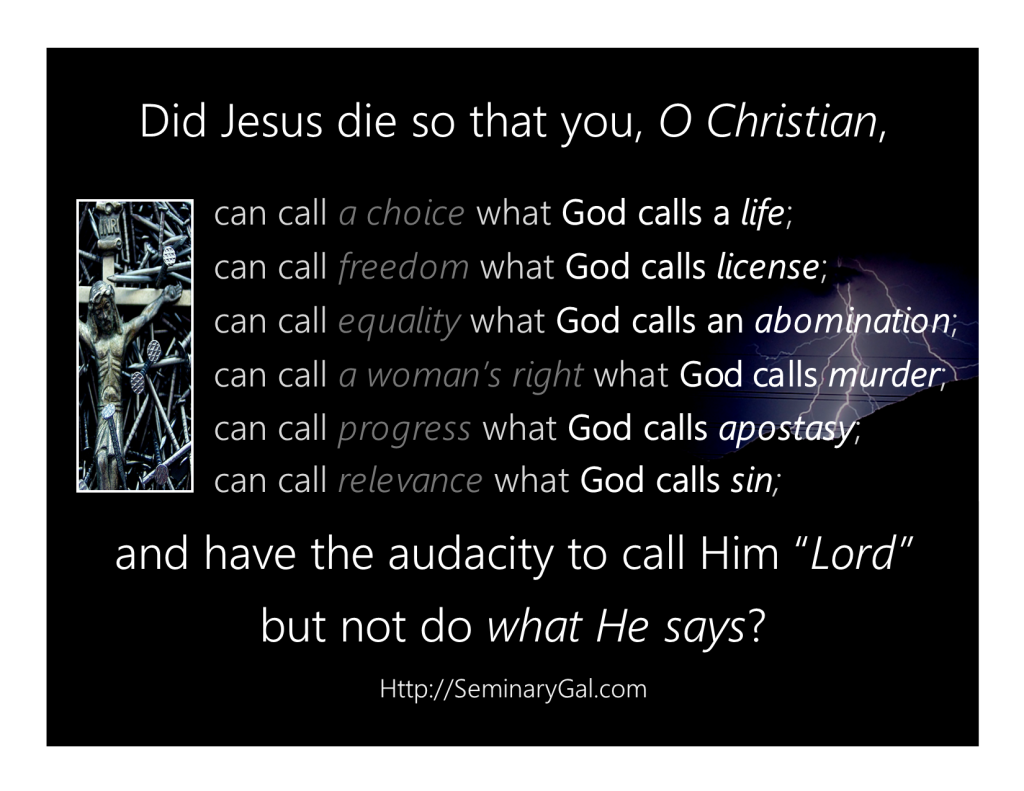
The grave contains Jesus’ cold, dead body on Holy Saturday.  I am grieved at how much grave trampling is going on by those who call themselves Christian.

We’re concluding our Lenten devotional series on The Letter to the Romans: Paul’s Masterpiece in which Paul has been proclaiming,

“I am not ashamed of the gospel, because it is the power of God for the salvation of everyone who believes: first for the Jew, then for the Gentile.  For in the gospel a righteousness from God is revealed, a righteousness that is by faith from first to last, just as it is written: “The righteous will live by faith.” (Romans 1:16-17)

The foundation of the Gospel is nothing less than the proclamation of Jesus Christ (Romans 16:25).  Paul builds carefully on this foundation: Jesus Christ, crucified for our sake.  On Holy Saturday the light of Christ is extinguished in the grave so that on Resurrection Sunday and beyond, we can call Him Lord over death, Lord over life, and King of Kings and Lord of Lords.

Yet, too many of us want Jesus as our Savior and call ourselves Christian–all the time denying belief in God’s Word (Genesis to Revelation) and refusing to obey Him.  Too few of us want to call Jesus “Lord” and mean it.

Where are you today?  Are you acquiescing to the culture, afraid to take a stand for the Gospel, too young to know wisdom, too old to want to stand firm, too concerned with what your fellow man thinks and unconcerned about what Jesus thinks?  Are you trampling on the grave of Christ? Jesus asked in Luke 6:46:

“Why do you call me, ‘Lord, Lord,’ and do not do what I say?”

Did Jesus Die for This?

Continue Reading

Good Friday Insults (Lent 39—2013)

forsakenIt’s Good Friday –a day to remember the way Jesus Christ suffered and died.  To remember how He bore our sins through His death on the Cross. 

Think about all His sufferings and how the insults we have issued to brothers and sisters (in humanity and even now in Christ) fell upon Him.  Insults to each other in addition to all of our collective insults to God Almighty directly!

It’s amazing how many ways we can inflict wounds upon our fellow believers and how often those conflicts are over theologically insignificant matters that we should learn to accept under the umbrella of diversity.  We insult God when we harbor ill will toward others instead of acting as we are instructed by today’s passage:

For the kingdom of God is not a matter of eating and drinking, but of righteousness, peace and joy in the Holy Spirit,  because anyone who serves Christ in this way is pleasing to God and approved by men. (Romans 14: 17-18, NIV)

Someone must pay for all these insults (both personal and collective) in order for God to be a righteous Judge.

 For even Christ did not please himself but, as it is written: “The insults of those who insult you have fallen on me.” (Romans 15:3, NIV)

David, the author of the Psalm quoted in Romans 15:3 had guilt, but Jesus Christ–the Son of David, the Son of Man, the Son of God–did not.  In order for Good Friday’s insults to be dealt with completely, Jesus had to be numbered among the transgressors.

Read the account of the last hours of Jesus’ life in Luke 22:63-23:46.  See the insults He endured and how it was fulfilled,

For even the Son of Man did not come to be served, but to serve, and to give his life as a ransom for many.” (Mark 10:45)

* * *

Give it up for Lent: Heaping insults upon Jesus by mistreating each other

 * * *

For further study,

  1. Read Psalm 69, how does it speak of the ocean of insults?
  2. Read Isaiah 53, the passage about the Suffering Servant.  How did this apply to Jesus?
  3. When Jesus says in Luke 23:34 “Father, forgive them, for they do not know what they are doing,” how does this apply to us today?  Does it apply to non-Christians as well as to believers when we insult others? 
  4. Do we realize that, as Christians, we heap insults upon God in whose Image all humans are made when we insult our neighbors?  Think about Jesus’ call to love our enemies.  Why would He have told us to do that?
Continue Reading

Final Accounting (Lent 38—2013)

ashamedImagine that today, you’re standing before God, the Judge:

  • Having to give an account of your life.
  • Having to own up to all your sins. 
  • Having to acknowledge the many ways you violated God’s commands. 
  • Having to confess all the ways you capitulated to the culture.
  • Having to explain why you took the wide, easy road of personal comfort and convenience instead of the way of holiness.

And then having your fellow man stand as a witness to how you judged him and placed obstacles–through your example, your acquiescence, your judgments by human standards, or your wrong-headed teachings–to his finding mercy in God.  Worse, for the person living in sin that you refused to point to the truth of Jesus Christ, he will face an eternity of torment apart from the mercy of God.

That day is coming. 

As surely as Jesus was heading to the Cross during Passion Week, He heads to the Great White Throne of Judgment and before Him, we will each give an account.

Romans 14:10 You, then, why do you judge your brother?  Or why do you look down on your brother? For we will all stand before God’s judgment seat. 11 It is written: “‘As surely as I live,’ says the Lord, ‘every knee will bow before me; every tongue will confess to God.'” 12 So then, each of us will give an account of himself to God. 13 Therefore let us stop passing judgment on one another. Instead, make up your mind not to put any stumbling block or obstacle in your brother’s way. (NIV)

So, the question you and I face is:

How are we doing with our final accounting?

* * *

Give it up for Lent: Living for comfort and convenience instead of holiness

* * *

For further study:

  1.  Read Revelation 20:11-15.  How ought that influence how you live today?
  2. The accountability for our actions is articulated elsewhere in Scripture.  Read Psalm 62:12, Jeremiah 17:7-10, and 1 Peter 1:17.  What does it mean to live our lives here in “reverential fear”?
  3. How is enabling people to live in sin nothing short of placing a stumbling block to their coming to faith?  How is the truth spoken in love necessary? 


Continue Reading

Life and Death Matters (Lent 37–2013)

emo philipsYears ago, comedian Emo Philips performed “Once I was in San Francisco,” a routine that included a joke that has been voted the best religious joke ever (watch here):

Once I saw this guy on a bridge about to jump. I said, “Don’t do it!”   He said, “Nobody loves me.”  I said, “God loves you. Do you believe in God?”

He said, “Yes.” I said, “Are you a Christian or a Jew?” He said, “A Christian.” I said, “Me, too! Protestant or Catholic?” He said, “Protestant.” I said, “Me, too! What franchise?” He said, “Baptist.” I said, “Me, too! Northern Baptist or Southern Baptist?” He said, “Northern Baptist.” I said, “Me, too! Northern Conservative Baptist or Northern Liberal Baptist?”

He said, “Northern Conservative Baptist.” I said, “Me, too! Northern Conservative Baptist Great Lakes Region, or Northern Conservative Baptist Eastern Region?” He said, “Northern Conservative Baptist Great Lakes Region.” I said, “Me, too!”

Northern Conservative Baptist Great Lakes Region Council of 1879, or Northern Conservative Baptist Great Lakes Region Council of 1912?” He said, “Northern Conservative Baptist Great Lakes Region Council of 1912.” I said, “Die, heretic!” And I pushed him over.

The “Die, heretic!” conclusion of the joke was unexpected and makes it appropriate for today’s devotional on Romans 14:1-9.

We’re rapidly approaching the end of our look into The Letter to the Romans: Paul’s Masterpiece.    Paul has asserted that the Gospel is for all, that we’re all sinners and we’re all in need of salvation.  As he brings his letter to a close, he drives home this point:  Christ united believers through His death on the Cross, therefore, let us not divide ourselves over small things.

For none of us lives to himself alone and none of us dies to himself alone.  If we live, we live to the Lord; and if we die, we die to the Lord. So, whether we live or die, we belong to the Lord.  For this very reason, Christ died and returned to life so that he might be the Lord of both the dead and the living. (Romans 14:7-9)

We belong to the Lord as believers, so let’s leave the judging to Him as Lord of life and death matters and every small matter in between.

 * * *

Give it up for Lent: Looking down on Christians who don’t believe exactly like you

* * *

For further study, read Titus 3:1-10, noting all the ways this echoes Paul’s admonitions in Romans regarding how to live in community.

Titus 3:1 Remind the people to be subject to rulers and authorities, to be obedient, to be ready to do whatever is good, 2 to slander no one, to be peaceable and considerate, and to show true humility toward all men. 3 At one time we too were foolish, disobedient, deceived and enslaved by all kinds of passions and pleasures. We lived in malice and envy, being hated and hating one another. 4 But when the kindness and love of God our Savior appeared, 5 he saved us, not because of righteous things we had done, but because of his mercy. He saved us through the washing of rebirth and renewal by the Holy Spirit, 6 whom he poured out on us generously through Jesus Christ our Savior, 7 so that, having been justified by his grace, we might become heirs having the hope of eternal life. 8 This is a trustworthy saying. And I want you to stress these things, so that those who have trusted in God may be careful to devote themselves to doing what is good. These things are excellent and profitable for everyone. 9 But avoid foolish controversies and genealogies and arguments and quarrels about the law, because these are unprofitable and useless.


Continue Reading

Government: God’s Servant (Lent 36–2013)

from http://www.worldjewishdaily.com/non-denial-denial.php

Submission to the government is easy!  Not…

Many days go by in which I wonder how Presidential spokesperson Jay Carney can look at himself in the mirror without cringing.  Speaking for the government as he does…with God watching?

In the days prior to President Nixon, I’m sure the White House lied. It’s human nature to lie.  But something happened.  When Nixon was caught lying to the American people, it shocked the nation, severing the bond of trust many of us had in our elected officials.

Today, lying seems to be the official job description of elected leaders and for them, abusing the trust of the American public is just another day at the office.  Yet, this is our government and what do we do with a passage like today’s (Romans 13:1-14)? It is well worth the read.

The million dollar question is,

How do we submit to a government we cannot trust to do what is right with the truth?”

The priceless answer is,

The same way Jesus did.”

“When they hurled their insults at him, he did not retaliate; when he suffered, he made no threats. Instead, he entrusted himself to him who judges justly.” 1 Peter 2:23

When you get a chance, read the story of Jesus’ arrest, trial, sentencing to crucifixion, and burial in John 18:1-19:42.  Submission to authorities means entrusting the outcome of matters to God Himself.

We treat leaders, officials, and other authorities as God’s chosen ones for the purpose He has in mind.  Pilate wouldn’t have been God’s choice for Messiah, but was God’s choice to crucify Him.  Annas may have been chosen by God for Jesus’ interrogation, and Caiaphas for High Priest in order to fulfill Scripture, but neither of them dealt honestly with the Messiah. And neither of them were chosen to be disciples.  They served God’s purpose even in their wickedness.

The sovereignty of God and the grand sweep of redemption history is beyond our understanding.  God’s use of powerbrokers to accomplish His will has a long-established history–whether the hardening of Pharaoh’s heart or the dishonesty of religious leaders who led the call to crucify Jesus.

So, when we have cause to disagree with our government, become appalled at rampant corruption, grieve over the lack of personal integrity and honesty, we must remember that submission to authorities is what Jesus did and what we are called to do until He returns as our Righteous King.

 * * *

Give it up for Lent: Using Biblical counterculturism to cloak a rebellious heart

 * * *

For further study:

  1. Read Exodus 9:16, 1 Kings 14:7-11, and Jeremiah 32:1-5 (fulfilled in Jeremiah 52:7-14).  What do these passages say about God’s raising up leaders for judging nations and individuals?
  2. What does it mean for a leader to be “God’s servant” in verse 4 of today’s passage?  Does this mean the leader is good or just that the leader is God’s instrument of reward and/or judgment?
  3. How does today’s passage affect your thinking about your current political system?
  4. In reading the account of Jesus’ final days during Passion Week, where did Jesus draw the line with regard to the truth and personal integrity?
Continue Reading

The Cheese Stands Alone (Lent 35–2013)

The Cheese Stands AloneThe cheese stands alone, the Christian does not.

It’s easy to be countercultural and come across as holier-than-thou.  Taking a stand on your principles sometimes means you need to stand alone (and is the result, but it should not be the goal).

Unlike the child’s game, “The Farmer in the Dell,” it’s not the goal to finish the game with the cheese standing alone.  Christians stand in community.

There’s a way to be biblically countercultural and a way not to do it.  Today’s passage talks about both.  These are instructions for wise community living:

Romans 12: 14 Bless those who persecute you; bless and do not curse. 15 Rejoice with those who rejoice; mourn with those who mourn.  16 Live in harmony with one another. Do not be proud, but be willing to associate with people of low position. Do not be conceited. 17 Do not repay anyone evil for evil. Be careful to do what is right in the eyes of everybody. 18 If it is possible, as far as it depends on you, live at peace with everyone. 19 Do not take revenge, my friends, but leave room for God’s wrath, for it is written: “It is mine to avenge; I will repay,” says the Lord. 20 On the contrary: “If your enemy is hungry, feed him; if he is thirsty, give him something to drink. In doing this, you will heap burning coals on his head.” 21 Do not be overcome by evil, but overcome evil with good.  (NIV)

We aspire to live by principles, love our neighbors and therefore rejoice and mourn right alongside them.  We turn the other cheek.  We are blessed peacemakers.  We love our enemies.  We leave the judging to God and invest ourselves in doing what is right. That is how to be countercultural in a world that doesn’t value it.

* * *

Give it up for Lent: Holier-than-thou attitudes

* * *

For further study:

  1. This is Passion Week (also known as Holy Week) in the Church.  Jesus was, in fact, holier than any of us.  Yet, how did Jesus act during the days prior to His crucifixion?  Read the account of Jesus in Luke 22:47-23:43.  How did He model what He expects of us?
  2. Look at how many times in our passage today, it talks about our attitudes toward others and our view of ourselves.  To what extent are you willing to associate with people who are not like you?
  3. In what ways can standing on principles lead to judging others?  What advice does our passage give to counter that?
  4. What does it mean to heap burning coals on someone’s head?  The Message paraphrase records Romans 12:20-21 as saying, “Our Scriptures tell us that if you see your enemy hungry, go buy that person lunch, or if he’s thirsty, get him a drink. Your generosity will surprise him with goodness. Don’t let evil get the best of you; get the best of evil by doing good.”  How might a guilty conscience also play a role?
Continue Reading

Palm Sunday Message from Advocate Condell 2013

Palm SundayA King Who Understands the Valley

by Barbara Shafer, Seminary Gal

Palm Sunday represents a unique challenge to a Sunday morning hospital ministry.  Tempting as it may be to stay cheerful and go from the mountaintop of Palm Sunday’s Triumphal Entry to the mountaintop of Easter Sunday’s Resurrection, doing so by-passes the valley.  Sunday-to-Sunday bypasses the Cross.  It bypasses the tomb of Jesus before He was resurrected. And it strips the Gospel of its power to minister to us in our deepest needs.

I submit to you that we cannot have just a king of the mountaintops who says he feels our pain.  We need a King who lived it.

We need a King who understands the valley.

Any king that has only experienced mountaintops cannot minister to us in the valleys of life.  Chances are good that unless you’re happily in the maternity ward, you’re probably feeling like you’re in a valley right now.

Today’s encouragement is that Jesus is a King who understands the valley.

In our sermon series on the Gospel according to Matthew, we’ve reached Holy Week, also called Passion Week—the week beginning with Palm Sunday and concluding with Easter Sunday.  So today we will see our King descend from the Mount of Olives into the valley of suffering—into the valley of the shadow of death.

The people didn’t know.  They celebrated because they thought he was heading to a coronation as their long-awaited King at the Temple Mount.  From the Mount of Olives to Jerusalem and Mount Zion, but Jesus wasn’t going from mountaintop to mountaintop without knowing the valley.
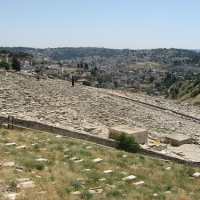
Tombs on the Western Slope 1If you’ve ever been to Jerusalem you know that there is huge Jewish cemetery on the western slope of the Mount of Olives, facing Jerusalem.  That cemetery is the traditional burial place of many notable Jews dating back to King David’s son Absalom and the prophet Zechariah.  Today there are more than 150,000 Jews buried there anticipating the Messiah and the grand resurrection to come.

Jesus went from the mountaintop of the Mount of Olives, past the tombs and crossed the Kidron Valley before entering Jerusalem.  What were the Jews of His day expecting?  Why the celebration?  They thought they were seeing Scripture finally fulfilled in the Messiah:

  • Joel 2:32 And everyone who calls on the name of the LORD will be saved; for on Mount Zion and in Jerusalem there will be deliverance, as the LORD has said, among the survivors whom the LORD calls.
  • Obadiah 1:17 But on Mount Zion will be deliverance; it will be holy, and the house of Jacob will possess its inheritance.
  • Zechariah 14:4 On that day his feet will stand on the Mount of Olives, east of Jerusalem, and the Mount of Olives will be split in two from east to west, forming a great valley, with half of the mountain moving north and half moving south.
  • Zechariah 9:9 Rejoice greatly, O Daughter of Zion! Shout, Daughter of Jerusalem! See, your king comes to you, righteous and having salvation, gentle and riding on a donkey, on a colt, the foal of a donkey. 10 I will take away the chariots from Ephraim and the war-horses from Jerusalem, and the battle bow will be broken. He will proclaim peace to the nations. His rule will extend from sea to sea and from the River to the ends of the earth. 11 As for you, because of the blood of my covenant with you, I will free your prisoners from the waterless pit. 12 Return to your fortress, O prisoners of hope; even now I announce that I will restore twice as much to you. 13 I will bend Judah as I bend my bow and fill it with Ephraim. I will rouse your sons, O Zion, against your sons, O Greece, and make you like a warrior’s sword. 14 Then the LORD will appear over them; his arrow will flash like lightning. The Sovereign LORD will sound the trumpet; he will march in the storms of the south, 15 and the LORD Almighty will shield them. They will destroy and overcome with slingstones. They will drink and roar as with wine; they will be full like a bowl used for sprinkling the corners of the altar. 16 The LORD their God will save them on that day as the flock of his people. They will sparkle in his land like jewels in a crown.

The mountaintop of the Lord’s coming is a day of rejoicing, preceded by battle in a great valley the Lord knows.  Their victory awaits.  It is why they shout Hosanna!  It’s praise and salvation all wrapped up in one!  But Jesus doesn’t go to the Temple for a coronation.

Instead His Passion week unfolds with crossing the valley of human suffering:

  • He heads to the temple but not for the reason they thought.  He was cleansing the temple to point out that the valley must be a place of purification.
  • He cursed the fig tree and it withered, pointing out that the valley must be a place of authenticity, truth and faith.
  • His authority is questioned, but Jesus points out that the valley must be a place where God’s authority is shown and accepted.
  • The valley is a place of holiness—and as holy, it requires repentance and atonement for sin
  • The valley is a place to encounter God (for us through His Son and Suffering Servant, Jesus Christ)
  • The valley is a place to respond to the greatest commandment to love the Lord and to love those who bear His image—the Cross being the supreme example of this!
Jesus on the crossThe Jews of Jesus’ day did not understand that Jesus is not a political king who goes from mountaintop to mountaintop, ruling over a nation without dealing with the spiritual valley as the Suffering Servant.

* * *

But Jesus is a King who understands the valley.

In dealing with the valley as a place of battle, a place of purification, a place of truth and faith, a place of God’s authority over the events of this world, a place of atonement for sin and a place to show God’s greatest love…dealing with the valley meant this King…

The King who understands the valley of humanity’s condition…endures the Cross.

Followers of Jesus, too, must deal with the valley…but not through a crucifixion we have to endure.  Rather,

  • We deal with the valley by coming to the King who endured the Cross for us.
  • We deal with the valley in the battles of life and in Jesus, finding purification and truth and love.
  • We deal with the valley by saying “No” to the things of sin and saying “Yes and Amen” to Christ our King!
  • We deal with the valley by worshiping the One who gave His only Son, Jesus Christ so that we do not have to bear the consequences of our sins or dwell in the valley of the shadow of death forever.

What happened during Passion Week?  Why did the crowds turn on Him?  Jesus was not conforming to the image of a mountaintop king the crowds expected.  He first had to deal with our valley of sin and death.  The Jews of His day didn’t understand that.  Jerusalem didn’t recognize their king when He came the first time and Jesus wept over Jerusalem because of it (Luke 19:41-44).
Jesus coming with the cloudsYou see, someday, our King will return…not to deal with the valley again, but looking exactly like the Messiah the Jews of His day expected.  A King to reign over the mountaintop as King of Kings and Lord of Lords.

Jesus did not need to prove He was King.  He knew who He was.  He understood the valley, and endured the valley, but He would not remain in it.

Jesus said, “But I say to all of you: In the future you will see the Son of Man sitting at the right hand of the Mighty One and coming on the clouds of heaven” (Matthew 26:64).

Just prior to His crucifixion, when Pilate asked Jesus, “Are you the king of the Jews?” Jesus replied, “Yes, it is as you say.”  He knew He was King.

But this King of Kings would not go from mountaintop to mountaintop without knowing the valley.  He is both Priest and King and as such He is able to save.  The Letter to the Hebrews states it this way.  Hebrews 7:23 Now there have been many of those priests, since death prevented them from continuing in office; 24 but because Jesus lives forever, he has a permanent priesthood. 25 Therefore he is able to save completely those who come to God through him, because he always lives to intercede for them. 26 Such a high priest meets our need– one who is holy, blameless, pure, set apart from sinners, exalted above the heavens. 27 Unlike the other high priests, he does not need to offer sacrifices day after day, first for his own sins, and then for the sins of the people. He sacrificed for their sins once for all when he offered himself.

Jesus did this when He died on the Cross.  We have a King who understands the valley!

No matter where today finds you: broken, convicted in your heart of sin, lonely, depressed, or hurting.  No matter what today’s valley brings: sadness, grief, pain, fear of death, needing an encouraging word, or a hand of friendship and love.  Jesus is the King who understands the valley you’re in.  Come to Him.  Find forgiveness in Him.  Find love and friendship in Him.  Find rest for your soul in Him.  Find peace with God in Him.  He dealt with the ultimate valley so you don’t have to do it alone.  Come to Him.  Though we are in the valley, through Him we can have hope of the mountaintop in the future.  Philippians 2 states this about Jesus’ knowing our valley and His ultimate mountaintop coronation: Jesus,

Philippians 2:6 Who, being in very nature God, did not consider equality with God something to be grasped, 7 but made himself nothing, taking the very nature of a servant, being made in human likeness. 8 And being found in appearance as a man, he humbled himself and became obedient to death– even death on a cross! 9 Therefore God exalted him to the highest place and gave him the name that is above every name, 10 that at the name of Jesus every knee should bow, in heaven and on earth and under the earth, 11 and every tongue confess that Jesus Christ is Lord, to the glory of God the Father.

Amen!


Continue Reading

Chapel Worship Guide 3.24.2013

Chapel Worship Guide for Sunday 9 AM—March 24, 2013

The Nemmers Family Chapel at Advocate Condell

Prelude—Blessed Be the Name of the Lord

Welcome—Barbara Shafer, Christ Church Highland Park

Worship in Song:

Hymn 131–All Glory, Laud and Honor

Hymn 248–And Can It Be That I Should Gain (v 1,3)

Hymn 232–I Hear the Savior Say (v 1,3,4)

Scripture Reading (Old Testament):

Zechariah 9:9 Rejoice greatly, O Daughter of Zion! Shout, Daughter of Jerusalem! See, your king comes to you, righteous and having salvation, gentle and riding on a donkey, on a colt, the foal of a donkey. 10 I will take away the chariots from Ephraim and the war-horses from Jerusalem, and the battle bow will be broken. He will proclaim peace to the nations. His rule will extend from sea to sea and from the River to the ends of the earth. 11 As for you, because of the blood of my covenant with you, I will free your prisoners from the waterless pit. 12 Return to your fortress, O prisoners of hope; even now I announce that I will restore twice as much to you. 13 I will bend Judah as I bend my bow and fill it with Ephraim. I will rouse your sons, O Zion, against your sons, O Greece, and make you like a warrior’s sword. 14 Then the LORD will appear over them; his arrow will flash like lightning. The Sovereign LORD will sound the trumpet; he will march in the storms of the south, 15 and the LORD Almighty will shield them. They will destroy and overcome with slingstones. They will drink and roar as with wine; they will be full like a bowl used for sprinkling the corners of the altar. 16 The LORD their God will save them on that day as the flock of his people. They will sparkle in his land like jewels in a crown.

Prayer

Scripture Reading (New Testament):

Hebrews 7:23 Now there have been many of those priests, since death prevented them from continuing in office; 24 but because Jesus lives forever, he has a permanent priesthood. 25 Therefore he is able to save completely those who come to God through him, because he always  lives to intercede for them. 26 Such a high priest meets our need– one who is holy, blameless, pure, set apart from sinners, exalted above the heavens. 27  Unlike the other high priests, he does not need to offer sacrifices day after day, first for his own sins, and then for the sins of the people. He sacrificed for their sins once for all when he offered himself.

Message:   “A King Who Understands the Valley” by Barbara Shafer

Song of Response: Oh How He Loves You and Me

Benediction

Continue Reading

Same Tune, Different Drummer (Lent 34–2013)

snareWhen God calls the Church to be biblically countercultural, He doesn’t overlook that we are individuals. 

In fact, everything about our individuality matters to God.

* * * 

And while we might march to the beat of a different drummer, we’re all marching to the same Gospel tune.

* * *

This intricate balance between the individual and the community is beautifully articulated in today’s passage:

Romans 12:4 Just as each of us has one body with many members, and these members do not all have the same function, 5 so in Christ we who are many form one body, and each member belongs to all the others. 6 We have different gifts, according to the grace given us. If a man’s gift is prophesying, let him use it in proportion to his faith. 7 If it is serving, let him serve; if it is teaching, let him teach; 8 if it is encouraging, let him encourage; if it is contributing to the needs of others, let him give generously; if it is leadership, let him govern diligently; if it is showing mercy, let him do it cheerfully. 9 Love must be sincere. Hate what is evil; cling to what is good. 10 Be devoted to one another in brotherly love. Honor one another above yourselves. 11 Never be lacking in zeal, but keep your spiritual fervor, serving the Lord. 12 Be joyful in hope, patient in affliction, faithful in prayer. 13 Share with God’s people who are in need. Practice hospitality. (NIV)

Just as a band or an orchestra needs all the instruments, a ballet company choreographs all the dancers, and a theatrical production requires all the actors, so a Church displaying diversity can yet march to the same Gospel tune.

* * *

Give it up for Lent: Wishing you were gifted differently

* * *

For further study:

  1. Identify the areas in our passage above where Scripture points to the diversity of the individuals.
  2. Now identify the areas in which the community is held together.
  3. Why do you suppose it’s so hard in the Church for people to serve in the way they are gifted?  What types of things stand in the way? 
  4. To what degree is the responsibility an individual responsibility and to what degree is it a community success or failure?  How do the commands beginning in verse 9 show us how to succeed as a Church? 
Continue Reading

Biblical Counterculturist (Lent 33–2013)

Pope Francis is a counterculturist and that’s a good thing.  Given the dank depths to which the so-called mainstream culture has sunk, being countercultural is a breath of fresh air. 

* * *

Pope Francis greets people after celebrating Mass at St. Anne's Parish within the Vatican March 17. The new pope greeted every person leaving the small church and then walked over to meet people waiting around St. Anne's Gate. (CNS photo/Paul Haring) from http://www.catholicworldreport.com/Item/2093/pope_francis_and_secularist_stereotypes.aspx#.UUsEQsUo7rc
Pope Francis greets people after celebrating Mass at St. Anne’s Parish within the Vatican March 17. The new pope greeted every person leaving the small church and then walked over to meet people waiting around St. Anne’s Gate. (CNS photo/Paul Haring)

* * *

Be a Biblical Counterculturist–that’s the message the Apostle Paul tells us in today’s passage:

Romans 12:1 Therefore, I urge you, brothers, in view of God’s mercy, to offer your bodies as living sacrifices, holy and pleasing to God– this is your spiritual act of worship. 2 Do not conform any longer to the pattern of this world, but be transformed by the renewing of your mind. Then you will be able to test and approve what God’s will is– his good, pleasing and perfect will. 3 For by the grace given me I say to every one of you: Do not think of yourself more highly than you ought, but rather think of yourself with sober judgment, in accordance with the measure of faith God has given you.

In a culture that exalts hedonism, excess, self-gratification, sexual aberrance, license, tolerance–indeed celebration–of what God calls sin, and a selfish, godless human existence with few to no moral limits, Scripture tells us to be countercultural.

Don’t conform to that culture! 

Take a stand against all that!

Well done, Pope Francis!  Well done, Christian counterculturist!

By way of contrast to our modern culture, Biblical Counterculturalism calls us to self-sacrifice, holiness, worship of God, thanksgiving for His mercy, spiritual renewal, reformation of our minds and our churches, and by the power of the Gospel, it calls us to humility.

How are you doing with being a Biblical Counterculturist?

* * *

Give it up for Lent: Conformity with an immoral world

* * *

For further study:

  1. In what ways was Jesus countercultural?  Read the Sermon on the Mount (Matthew 5-7) and identify ways in which Jesus preached a countercultural life for His disciples.
  2. What pressures are placed against Pope Francis and other Christians to conform to what the world wants?
  3. From where does a Christian derive his strength to stand tall and to resist conformity?  Name a few ways Christians can find encouragement.


Continue Reading