Necessary Time (sermon text version)

Time is one of those things we never get back.  Once it has passed us by, it’s gone forever.  We’re living in the flow of it, we’re changed by it, we can try to resist it, but it keeps on rolling along.  It’s like a river pressing against both banks, moving ever downstream, its currents changing so that no one ever steps into the same river twice.

Time is relative—at least that’s what Einstein talked about when he said, “When you are courting a nice girl an hour seems like a second. When you sit on a red-hot cinder a second seems like an hour. That’s relativity.”

It didn’t take Einstein to say what we can actually know from the Bible.  Psalm 90:4 For a thousand years in your sight are like a day that has just gone by, or like a watch in the night.

Einstein talked about time a lot.  And I’m not sure Einstein was being completely serious when he said that “The only reason for time is so that everything doesn’t happen at once.”  If there was no time, how could you even tell?  Could you tell time?  How could you tell what time anything was happening?  Like the man who was getting sleepy while driving, so he pulled over into a parking lot to take a quick afternoon nap.  His car was parked dangerously close to a jogging path and a runner came up to the car, woke the man up and asked what time it was.  He said 2:15, the jogger said, “Thanks,” and ran off.  The man began to doze off when another runner came up, tapped on the window and asked what time it was.  The man said, 2:25.  The runner said “Thanks” and ran off.  The man looked out his window and saw a whole bunch of runners in an endless stream so he made a sign and put it in his window, saying “I don’t know what time it is!”  He began to doze off contentedly when suddenly a tapping on the window woke him up and the runner smiled and said, “I do.  It’s 2:35.”

Time.  Who can understand it?

clock handsScholars write volumes and researchers write dissertations on the relationship of God and time.  Suffice it for our purposes today to say that Time means nothing to an eternal God who exists outside of time, over time, and beyond time…except that He gave us the sun moon, and stars for marking time.  And He did it, not for Himself, but for our benefit.  Because for mortal man, we see our lives as days ticking away.  Or like that old soap opera tag line “Like sands through the hour glass, so are the days of our lives.”  Yes, from the moment we’re conceived, we’re terminal.  At game over, we will all die.  Time is what we have.

Or as the Psalmist says,

Psalm 90:12 Teach us to number our days aright, that we may gain a heart of wisdom.

Whether we’re talking about Central Time, Daylight Savings Time, Greenwich Time; whether we’re living on Tulsa Time, Military Time, Civilian Time, Island Time; whether we’re focused on Work Time, Play Time, or Summertime, there is a kind of time that is important to God for our sakes.  Let’s call it “Necessary Time.”

What is “Necessary Time?”  If time is like a river, Necessary Time form the tributaries of circumstances and individual preparation meet together to form a mighty river, coursing toward the end of days.  Necessary Time is the relative time played out as the days of our lives, and how we choose to spend them.

Today’s passage of Scripture tells us about Necessary Time, specifically as it applied to replacing Judas as an eyewitness of Jesus Christ. But Necessary Time also applies to us as generations of witnesses, far downstream from where we’re at in the book of Acts.

I know it seems like we’re going painstakingly slowly through the book of Acts.  It will only be this way through Chapters 1 and 2, although we may spend more time on a few others along the way because of the wisdom contained in it and its importance for the Church.  Chapters 1 and 2 lay the groundwork for the entire era of the Church, the complete book of Acts, the New Testament as a whole, and therefore, it’s worth our time to take our time.

Today we’ll look at qualities of “Necessary Time” as it relates to people.  Specifically I want to look at past, present, and future that we might call the Necessary Time of History, Maturity, Synergy.

In our passage Acts 1:20-22, Peter recognizes the flow of time going all the way back to the OT, saying Acts 1:20 “For,” said Peter, “it is written in the book of Psalms, “‘May his place be deserted; let there be no one to dwell in it,’ and, “‘May another take his place of leadership.’ 21 Therefore it is necessary to choose one of the men who have been with us the whole time the Lord Jesus went in and out among us, 22 beginning from John’s baptism to the time when Jesus was taken up from us. For one of these must become a witness with us of his resurrection.”

In our passage, Peter recites the Necessary Time in the past, History (foretold in the Psalms), and connects them with the events of the present moment.  It is necessary, he says, to replace Judas.  Scripture doesn’t tell us why it was necessary, only that Peter appealed to Scripture and concluded it was necessary:

  • Could it be that 11 disciples didn’t match with the original 12 and therefore everyone would be focused on the one who got away instead of focusing on the mission of the Church or worship of Jesus?  In other words, he didn’t want the numbers to be a distraction?
  • Could it be that he saw the 12 apostles and the 12 tribes of Israel in history and how they reappear in heaven and maybe Peter remembered that Jesus taught that there was a connection?  One example is in Matthew 19:28 Jesus said to them, “I tell you the truth, at the renewal of all things, when the Son of Man sits on his glorious throne, you who have followed me will also sit on twelve thrones, judging the twelve tribes of Israel.”  Maybe it’s continuity.
  • Could it be that Peter felt the void in incomplete numbers and knew from God’s word that God likes fullness, completeness?

All of those are possibilities, but what I want for us to see is that Peter appealed to the Scriptures telling us past history…that in the flow of time…it is necessary.  Necessary time God used forming the circumstances of history that Peter used to reach such a conclusion in the present moment.

Have you ever been waiting for something to happen?  Maybe you felt like you were twiddling your thumbs or killing time waiting to be recognized for the talents you have.  Maybe you were waiting to be employed again and it seemed like unemployment was going on forever!  Maybe as you look back on your life, you see a time that you waited and waited and only when the prayer was answered did you see all the orchestration that went into things coming together perfectly.  Hindsight is 20/20 and History displays necessary time.

After all, it’s His Story and the time we spend waiting is time God is spending working, bringing all things together so the circumstances are ready for forward movement.

That’s what was happening in our passage.  In the flow of time, Judas was gone and void was left.  How does one go about filling such a spot?  Well, again the focus is on time.  Among those who had been with Jesus the whole time of His ministry—from baptism to ascension—one of those would have had the necessary time for forming a testimony.

Baptism to Ascension—the whole time of Jesus’ public ministry–it was time Jesus spent coming and going and teaching.  In order to replace one of the 12, this person needed preparation time.  Necessary time with Jesus.

Are we spending this Necessary Time with Jesus?  Where does it rank in your day’s priorities?  Not only is the history leading all circumstances through necessary time, but the time required for someone to be useful to God is also necessary.

However, this is not a fixed time frame, but a relative one.  Length of time is only one measure of Necessary Time.  People are individuals and our learning and experiences reflect that.  Some people can be Christians for 20 years and go to church every week like it was their religion.  They sit in the pews and they listen, or at least they look like they do.  But length of time is not enough, as the Apostle Paul tells us in 1 Corinthians 3:1 Brothers, I could not address you as spiritual but as worldly– mere infants in Christ. 2 I gave you milk, not solid food, for you were not yet ready for it. Indeed, you are still not ready. 3 You are still worldly. For since there is jealousy and quarreling among you, are you not worldly? Are you not acting like mere men?

Or as the author of Hebrews says, Hebrews 5: 11 We have much to say about this, but it is hard to explain because you are slow to learn. 12 In fact, though by this time you ought to be teachers, you need someone to teach you the elementary truths of God’s word all over again. You need milk, not solid food! 13 Anyone who lives on milk, being still an infant, is not acquainted with the teaching about righteousness. 14 But solid food is for the mature, who by constant use have trained themselves to distinguish good from evil.

love the lord your god deutNecessary Time isn’t just a quantity of time (which we all experience the same 24 hours in a day).  No, it’s what we do with that 24 hours.  Necessary Time is a quality of time.  It’s the amplitude of the time wave.  It’s how high your sights are and how deep your roots go and you progress through the flow of time.  Necessary Time is a maturity thing.

For Peter, he was looking for someone who had been part of the ministry the whole time, from the baptism under the water to the ascension into the clouds.  Amplitude.  Maturity.  Time spent, yes.  But more than that, it was how the time was spent.

Notice in verse 22: For one of these must become a witness with us of his resurrection.”

It doesn’t say a witness of the Crucifixion, but of the Resurrection.  The word “must” tells us that this is necessary.  It is necessary that someone who has familiarity and maturity in the course of time become something new.  No longer a bystander seeing the same history as everyone else, this person has the personal maturity coming together and becoming something even more powerful:  a witness.

Now is a good time to say that Peter is talking about someone who had been an eye-witness of Christ to be an apostle-type-of-witness, something none of us would qualify to do.  None of us have seen Jesus in His lifetime.

But the same principles of History and Maturity come together in our lives, too.  They can apply to us just as they did in filling the spot of Judas.  In order to be witnesses, we need to acknowledge the History shown in the Bible.  We need to have the preparation of reading the Word and praying and being like the Bereans who we will discover later in Acts 17:11 “Now the Bereans were of more noble character than the Thessalonians, for they received the message with great eagerness and examined the Scriptures every day to see if what Paul said was true.”  This Paul is the same one who wrote the vast majority of the New Testament and yet, the Bereans were examining the Word to make sure Paul was telling them the truth!

Necessary Time of History.  Necessary Time for Maturity.  But there’s also Synergy—that coming together for the purpose of forward movement.  This person being chosen to replace Judas must become a witness WITH US of His resurrection.

Synergy is when the whole is more than just the sum of its parts.  The disciples as the Church will be far greater than just an adding up the disciples.  Because there’s synergy.  They’re all working together to be a witness.

Interestingly, the Body of Christ doesn’t look like me.  It doesn’t look like you.  It looks like us, working together to be far better together than any of us alone.  But it requires Necessary Time.

Necessary time for all of us!  Working together!  But it doesn’t just happen without Necessary Time of History and Necessary Time of Maturity, the two tributaries that join together to be the mighty river.

So the questions each of us must answer are:  How am I doing at knowing God’s Word, History, His Story?

How am I doing at growing in Christian maturity?  Knowing Jesus and living it out as mature followers of Christ who can move on to solid food?

How am I doing at synergy so that the parts of the Body all work together toward the goal of witness?

Important questions about what we’re doing with the time we’ve got.  It’s necessary time, a relative notion of flow and amplitude.  History… Maturity…Synergy.

Take those thoughts as your homework assignment for this week as you look at how you spend your time.  Once there was a professor who came into class with an empty jar.  When the class assembled, he put golf balls into the jar and asked if it was full.  No more golf balls would fit, so the class said “Yes.”  He brought out and added a bag of pebbles that fell in between the golf balls and asked “Is it full?”  The class said “Yes.”  Then he produced sand that fell in between the pebbles and asked, “Is it full?”  The class was silent, not wanting to be wrong again.  Then he produced water which filled up the areas between the grains of sand.  Lastly, he produced a pitcher of water that filled up the last of the space.  Finally, it was full.  But here’s the lesson: if you added the sand first, focusing on small and less important things, you’d have insufficient room for the golf balls in your life, those things that are big and important.

I’d argue that there is no better use of time than to devote it to learning the history in God’s word, growing in Christian maturity and devoting yourself to working together alongside others in the Church in which we’re better together.  Synergy –the Church—all of us together is greater than the sum of you and me working at odds or independently.  History.  Maturity.  Synergy–  You could even write those three words down in the section for Notes we added into your bulletin this week.  Write them down.  History.  Maturity.  Synergy.

And then write down this passage of Scripture:  2 Peter 3:4-12.  2 Peter 3:4 They will say, “Where is this ‘coming’ he promised? Ever since our fathers died, everything goes on as it has since the beginning of creation.” 5 But they deliberately forget that long ago by God’s word the heavens existed and the earth was formed out of water and by water. 6 By these waters also the world of that time was deluged and destroyed. 7 By the same word the present heavens and earth are reserved for fire, being kept for the day of judgment and destruction of ungodly men. 8 But do not forget this one thing, dear friends: With the Lord a day is like a thousand years, and a thousand years are like a day. 9 The Lord is not slow in keeping his promise, as some understand slowness. He is patient with you, not wanting anyone to perish, but everyone to come to repentance. 10 But the day of the Lord will come like a thief. The heavens will disappear with a roar; the elements will be destroyed by fire, and the earth and everything in it will be laid bare. 11 Since everything will be destroyed in this way, what kind of people ought you to be? You ought to live holy and godly lives 12 as you look forward to the day of God and speed its coming.

This same Peter who wrote about History, Maturity, and Synergy in filling the void in the group of 12, is the same Peter who talked about the day of God and said that we can speed its coming by living holy and godly lives.  Sounds like Necessary Time of maturity and witness, does it not?  We can hasten or speed the day of Jesus’ return.  By making the most of the Necessary Time.  Knowing that history is leading the point of Jesus’ Return.  Our maturity in Christ and our working in powerful synergy will make for effective witness as we complete the numbers of those who will be saved before Jesus comes back.  In the fullness of time He will return.  Until then, we have 24 hours a day of Necessary Time for History, for Maturity and in Synergy.  The Bible encourages us to make the most of time.

What will you do with your 24 hours?

===

This message was first preached at Plymouth Congregational Church in Racine, WI on September 7, 2014 by Barbara Shafer.

Continue Reading

Necessary Time (audio version)

clock handsWhat are you doing with your time on earth?

This is the audio version of last Sunday’s sermon from Plymouth Congregational Church entitled “Necessary Time” as we look at qualities of time (History, Maturity, and Synergy) and how they relate to the 24 hours each of us has for witness.

Please click the link to listen to the message, first preached at Plymouth Congregational Church of Racine, WI on September 7, 2014 by Barbara Shafer.

https://www.youtube.com/watch?v=_JmFNaiRM8M&feature=youtu.be


Continue Reading

Fall in Love with your Garden (FREE workshop in Racine)

fall in love with your garden poster png


I will be in Racine on Saturday, September 20th to be part of this community outreach.  If you know of people in the vicinity of Racine, WI, please let them know about this special FREE event.  Lots of great free information and a plant give-away, too!  Share with your Facebook friends, on Twitter, and Pinterest so that we can bless as many people as possible.  Details are available on the Http://PlymouthChurchRacine.com web site, or you may contact me here for details as well.  Thanks!


Continue Reading

Handling Betrayals with Grace (semon text version)

handling betrayals with graceEver been betrayed?

We don’t need to see a show of hands, but I would imagine that most of us can think of a time we’ve been betrayed.  Maybe it was someone you trusted as a good friend or a valued coworker who stabbed you in the back.  Maybe it was a boyfriend or girlfriend who cheated on you.  Maybe it was a family member who took the opportunity to knock you down, tried to control you, maybe abused you, or lied about you to others.

Maybe you’ve felt betrayed by your politicians, your leaders, and let’s face it: the present national landscape is littered by pastors who betray us by their moral failings as spiritual leaders.  Maybe that betrayer is yourself:  your own body.  When I had cancer, I felt that way…like my body had rebelled against me and all I’d tried to do with a healthy lifestyle.  Eat well.  Get exercise.  What did I get for my efforts?  Cancer, surgery and a long recovery.  It’s pretty safe to say that I felt betrayed….by myself.

Maybe you have felt like God has betrayed you.  You tried, you prayed, you read the Bible, you worshiped, you gave to the ministry, you worked hard, you poured your heart and soul into serving Him and then Wham!  Bad stuff happened.  It can feel like betrayal.

What should be our response to such betrayals?  How can we handle betrayals to be more Christlike and better people…instead of sinking into bitterness, resentment, anger and gloom of doubt? 

You see, if faith, hope, grace, and love are 4 great Christian virtues, then bitterness, resentment, anger, and doubt stand as wicked options that will happen if we don’t learn to Handle Betrayals with Grace.

Today, let’s aim for the virtuous life by looking at Acts 1:12-20 and see how the early church dealt with betrayal.

In the flow of Acts that we’ve been looking at over the past several weeks, the disciples had been overjoyed at the Resurrection appearances of Christ, they’d been instructed to wait for the Holy Spirit, and then Jesus left them.  Alone.  Staring into the clouds.  Wondering, now what?

Kind of like that scene from Forrest Gump where all the runners are running along behind Forrest Gump who had been running back and forth across the country.  Suddenly he stops and says, “I’m tired.  I think I’ll go home now” and then all the people are like “What are we supposed to do now?”

The disciples—who we must remember were real people with real emotions–probably felt that way.  Jesus went away.  They didn’t understand.  The disciples are informed that Jesus will come back in the same way that He left.  They aren’t told when.

When faced with uncertainty and confusion, they could have felt betrayed by Jesus, or begun to reflect in total bitterness about how this all came to pass.  They were once a happy group of 13.  Jesus was their leader.  They were 12 happy disciples who were chosen by the Son of God Himself!  Everything was great…until Judas betrayed Jesus.  With a kiss, no less.

They could have sunk into gloom at betrayal, but instead, our Scriptures today give us a 4 good reminders at how to handle betrayals with grace.  Let’s look at how the disciples of Christ did it:

  1. Productive activities can help us to handle betrayals (such as prayer, fellowship, and worship)
  2. Knowing God’s Word reminds us of God’s sovereignty.  Nothing escapes His attention–even human betrayals can work for His glory
  3. Separating the facts from our feelings about them.  We see the “rest of the story” regarding Judas who is kind of the poster boy of betrayal.  Judas’ example reminds us of how God can take even bad stuff the world dishes out for His glory.
  4. Forgiveness.  There is a divine necessity of putting betrayals behind us and learning to forgive.
First, there are activities that can help us to handle betrayals: 

Acts 1:12 Then they returned to Jerusalem from the hill called the Mount of Olives, a Sabbath day’s walk from the city. 13 When they arrived, they went upstairs to the room where they were staying. Those present were Peter, John, James and Andrew; Philip and Thomas, Bartholomew and Matthew; James son of Alphaeus and Simon the Zealot, and Judas son of James. [Note: all 11] 14 They all joined together constantly in prayer, along with the women and Mary the mother of Jesus, and with his brothers.

The first activity we can see is that they didn’t give up on the fellowship of believers.  They circled the wagons and stuck together as the 11 remaining disciples, the followers of Christ.  They stayed together.  They joined constantly in prayer along with the other disciples.

They remained in fellowship.  They constantly prayed together as of one mind.  Why is this important?  Because when we’re alone, we’re more likely to sink into a “woe is me” mindset and get depressed, resentful, and bitter.  When I’m in the context of others, I can see I’m not the center of the universe with the world revolving around me and my pain.  It forces me outward, to see a world in which we are better together and can support one another.

If you’ve ever seen a brick arch, you’ve probably noted that all the bricks can be the same size and shape.  Remove any one of them and the arch collapses.  Some arches have a capstone (one that is wedge-shaped) that gives even greater stability.  Scripture tells us that Jesus is our capstone, and when the Body is together, He is still with us as our capstone, not a brick is missing, and we are a stable strong group of disciples.  Sticking together is really important.

But more than that, they prayed together as of one mind.  Total unity!  They joined together constantly in prayer, which is an act of worship.  Why is that important?  Well, Scripture tells us that agreeing with Jesus through prayer and worship set the stage for handling betrayals:

Matthew 18:15 “If your brother sins against you, go and show him his fault, just between the two of you. If he listens to you, you have won your brother over. 16 But if he will not listen, take one or two others along, so that ‘every matter may be established by the testimony of two or three witnesses.’ 17 If he refuses to listen to them, tell it to the church; and if he refuses to listen even to the church, treat him as you would a pagan or a tax collector. 18 “I tell you the truth, whatever you bind on earth will be bound in heaven, and whatever you loose on earth will be loosed in heaven. 19 “Again, I tell you that if two of you on earth agree about anything you ask for, it will be done for you by my Father in heaven. 20 For where two or three come together in my name, there am I with them.” 21 Then Peter came to Jesus and asked, “Lord, how many times shall I forgive my brother when he sins against me? Up to seven times?” 22 Jesus answered, “I tell you, not seven times, but seventy-seven times.”

Ok, “Time out!  Problem,” you say!  “Judas was dead.  There was no confronting him about his sin.”  You’re right.  But Jesus still says, that if two or three witnesses come together in His Name, He is there among us.  Even before the Holy Spirit came.  Jesus is interceding for us, and on this side of Pentecost, we have the Holy Spirit to be Jesus’ ongoing presence among us.  The Body of Christ, that arch of support, will not falter as long as we stick together in fellowship and prayer, for worship of God alone.  We prayerfully seek God’s presence among us to teach us how to forgive…yes, seventy-seven times, which is a number not to be counted but one showing forgiveness is an ongoing necessity.

I know, learning to forgive sounds easier than it actually is for many of us, but we’ll get to that in a moment.

Point 2:  Knowing God’s Word reminds us of God’s sovereignty.  Nothing escapes His attention—and even human betrayals can work for His glory

Acts 1:15 In those days Peter stood up among the believers (a group numbering about a hundred and twenty) 16 and said, “Brothers, the Scripture had to be fulfilled which the Holy Spirit spoke long ago through the mouth of David…”

Scripture tells us that this betrayal by Judas was a divine necessity.  Scripture HAD TO BE fulfilled.  This betrayal and Crucifixion were foretold and not an example of God’s being gone on a summer vacation in the North Woods and Satan sneaking something past Him.

To be sure, I struggle with the idea that bad things happen to people while God is watching.  It seems as though the old notion ought to be true that IF God watches bad stuff happen THEN He’s a bad God.  And it would be…IF God did one of two things: (1) passed over the bad stuff and just said, “OK.  Works for me!”…or (2) if He watched, allowing it to happen because He was powerless to do anything about it.

But here’s the key: the Crucifixion WAS God’s doing something about bad stuff in this world.

Again, the key is that the Crucifixion WAS God’s doing something about bad stuff in this world.

Ever since the fall of man, we’ve had sin ruling humanity’s world.  We wouldn’t want a God who said, “You know, Barb is a pretty nice person. She tries really hard.  She has her faults, but she’s really trying to obey and her sin? Well, it’s an acceptable level so let’s just call it a clean slate.”  That God would not be good!  There is no “acceptable level of sin” for a holy God.  Nor would we want a God who was constantly scanning our lives for hidden faults like divine antivirus software and bingo!  Found it!  And then He obliterates us because we’re a malware blight on the surface of the earth.  Destroying us because of sin we inherited from Adam wouldn’t make for a good God either.

God has never—Never!—whitewashed my sin or given me a pass on the consequences of mortality–all the sicknesses and worries of this world that are the direct consequences of the fall of man.  Sin does not “work for Him” and He wasn’t powerless to do anything about it!

God did something BETTER:  He sent Jesus. 

He punished my sin by taking it on Himself.  He freed me from the eternal consequences, but while I’m here on earth, you know what?  Bad stuff still happens.  It happens to me and it happens to you.  Sometimes it happens in the form of betrayals by our bodies and betrayals by others.  We’re living in the tension of redemption already secured in the heavenly realms even while we’re still stuck here on earth.

What’s my point?  Just this: the eternal scope is something we cannot comprehend.  God’s knowing everything and being all powerful and over all means that even when bad stuff happens to us, it’s not without redemptive value.  Job could tell us that!   God—and we can take this to the bank—God will use what has been bad in our lives for some kind of eternal good.  Maybe ours.  Maybe someone else’s.  Maybe to remind us that all humanity is broken and there’s a reason why the Gospel is such incredibly good news.

So it follows, Point #3:  Separating fact from feelings, we can see that even human betrayals can work for God’s glory.  It did with Jesus and He was betrayed by the modern poster boy of betrayal: Judas.

If you stop to think about it, the original poster boy of betrayal was Adam, the poster girl was Eve…who together had everything perfect and wonderful and God’s presence and the whole 9 yards, but then betrayal!  By listening to the adversary, they gave up on God in the fall of man.  But maybe part of our problem is that we’ve fictionalized that.  Oh, it was a long time ago so we seem to forget how bad that really was.  So we now have Judas—whose name is pretty synonymous with betrayal.  Worse than Benedict Arnold who was a mere traitor.

So, Peter stands up among all these disciples and recounts the facts of what happened to Judas (note he’s recounting facts instead of dwelling in his feelings):  Acts 1:16 concerning Judas, who served as guide for those who arrested Jesus—17 he was one of our number and shared in this ministry.” 18 (With the reward he got for his wickedness, Judas bought a field; there he fell headlong, his body burst open and all his intestines spilled out. 19 Everyone in Jerusalem heard about this, so they called that field in their language Akeldama, that is, Field of Blood.) 20 “For,” said Peter, “it is written in the book of Psalms, “’May his place be deserted; let there be no one to dwell in it,’ and, “’May another take his place of leadership.’

Do you see how this is a focus on the facts and not how Peter felt about it?  Peter was a real person and I tell you, if I’d been one of the 12, which I’m not nearly that old, I’d have been royally ticked at Judas.  I would have thought, “He was one of us!  How could he do this?  How could someone be so evil as to betray Jesus, the perfect Son of God??”  I would have been angry and probably wanted to kill Judas if he wasn’t already dead.  “He was one of our number and shared in this ministry.”

Judas didn’t just betray Jesus.  In a sense, he betrayed them all.  (Not that much different than Adam when you stop to think about it.  Betray God with earthly consequences, all over again!).

Yet without the Crucifixion, we’d have no Jesus dying for our sins and we’d be in a world of hurt until we died and then we’d have an eternity of hurt.  But God used even this betrayal by Judas, and the one of Adam, for His glory.  God showed us in this profound moment of horrid betrayal, the incredible magnitude of love He has for each and every person displaying the Image of God…which is all of us.  Scripture says in Romans 5:8 But God demonstrates his own love for us in this: While we were still sinners, Christ died for us.

God receives glory for the magnitude of His love, for the greatness of His mercy, for the power of forgiveness, which brings us to the 4th point.

Point #4:  Forgiveness is really important.  We have a divine necessity of putting betrayals behind us and learning to forgive.

Peter, in our passage today quotes from 2 Imprecatory Psalms that describe the devastation of betrayal with application to Judas, but it’s worth noting that both of these Imprecatory Psalms (Psalm 69 and Psalm 109) have elements that foreshadow the sufferings of Christ.    Maybe you recognize these verses repeated in Jesus’ life:

Psalm 69:9 for zeal for your house consumes me, and the insults of those who insult you fall on me.  (John 2:17 His disciples remembered that it is written: “Zeal for your house will consume me.”)

Psalm 69:21 They put gall in my food and gave me vinegar for my thirst.  (both seen in Matthew 27:34,48)

Psalm 109:25 I am an object of scorn to my accusers; when they see me, they shake their heads.  (Matthew 27:39 Those who passed by hurled insults at him, shaking their heads.)

If God could be betrayed twice (once by Adam and once by Judas) each with lasting consequences…

And if Jesus could yet come in-the-flesh to offer forgiveness to betrayers and sinners like us…

And if He could do that out of the greatness of His unfathomable love and mercy…

…to those who have failed Him and know it!  Betrayed Him!  Time and again…

… and if only we’ll welcome His forgiveness that is freely offered by God—the very One we betrayed,

can’t we do the lesser thing of forgiving those who betray us? 

This is the point of Judas.  We don’t know what God did with him.  Lots of theories are out there, but the offer of forgiveness had been there because that’s what’s common to all sinners.  God’s Image was just as present in broken form in Judas just as it is in other disciples, including you and me.  The point of Judas is that we can trust that God did what was right in an eternal frame and receives glory for doing what is good and loving and right!  Therefore, can’t we do the lesser thing of forgiving others whose sins are alongside ours being dealt with in Jesus’ body at the Cross?

Can’t we do the lesser thing of understanding that even things that seem like times God has betrayed us, really aren’t?

Look at the Cross.  It does not shout that God is focused on betrayal—in fact it does just the opposite! The Cross points only to love and mercy, grace and God’s willingness to forgive us…while we were still sinners.

Can’t we do the lesser thing of responding with love for others in light of the enormity of God’s love for us?  God loved us so much that He’d pay for sins He did not commit to save the very ones who had betrayed Him, sinners who’d denied that He’s God.  If we can we understand that He has forgiven us, isn’t our only right response to handle betrayals with a tiny token of the same kind of extravagant grace He has shown to us?

For some of us, quite frankly, this will mean forgiving ourselves for betraying others and humbly asking for forgiveness.  Self-flagellation, beating ourselves up over our pasts, holding grudges against ourselves when God has forgiven us—even if others have not been willing to forgive—is a lesser thing to give up, especially in light of the greatness of God’s redemption in our lives.

We must Handle Betrayals with Grace.

So here’s your homework assignment for this week: I’d like for you to read through the Parable of the Wicked Servant found in Matthew 18:21-35.  Pray through your feelings of betrayal.  Friends who betray, coworkers who betray, politicians who betray, lovers who betray, bodies that betray us, and feelings that sometimes even God has let us down.  Then, stop.  Look at the facts.  Take a look at the Cross.  Remember the fact that Jesus Christ, the perfect and sinless Son of God, died there for you and for me—betrayers of God not at all unlike Adam and Judas.

  1. Then remember the activities that help us to handle betrayals with grace.  Things like unity and fellowship, prayer and worship, getting us out of a focus on ourselves.
  2. Remember God’s awareness of every betrayal and the amazing goodness of His intervention in it by sending Jesus.
  3. Remember Judas and Adam, as betrayers—and look at ourselves as betrayers too–and know for a fact that God can take even bad stuff the world dishes out for His glory.
  4. And remember the divine necessity of putting betrayals behind us and learning to forgive.  That’s what the Cross shows.

I won’t say it’s always easy to Handle Betrayals with Grace, but it’s absolutely necessary that we learn to forgive as we’ve been forgiven.  Let’s pray the Lord’s Prayer together SLOWLY as we close our message for today, thinking about every line…

The Lord’s Prayer

“Our Father who art in heaven,

Hallowed be Thy name.

Thy kingdom come.

Thy will be done on earth, as it is in heaven.

Give us this day our daily bread.

And forgive us our debts, as we forgive our debtors.

And lead us not into temptation, but deliver us from evil;

For Thine is the kingdom, and the power,

and the glory, forever.”

Amen.

 ===

This message was first preached at Plymouth Congregational Church of Racine, WI on August 31, 2014 by Barbara Shafer

Continue Reading

Handling Betrayals with Grace (audio version)

handling betrayals with graceIf you’ve ever felt betrayed by someone, you know how hurtful it can be.  Yet, the Bible gives us many good reminders on why it’s important to handle betrayals with grace.  Listen to this message, first preached at Plymouth Congregational Church in Racine, WI (8.31.2014) and learn four ways the early church dealt with this.  The Scripture passage referred to is Acts 1:12-20 and the homework (Parable of the Wicked Servant) is located in Matthew 18:21-35.

Link to the message Handling Betrayals with Grace


Continue Reading

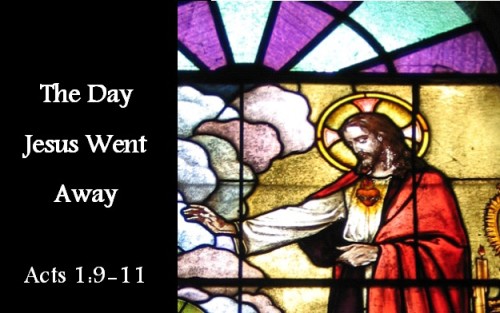
The Day Jesus Went Away (sermon text version)

Have you ever had a good friend who moved away?  Yet you had hope of seeing them again, even if that hope was pretty remote because the distance was significant.  What about when a good friend or a family member dies?  You hope of seeing them again—and it’s a heavenly hope!!  But you’d never expect to see them walking the earth again.   The disciples had seen both, in a sense.  Jesus died and they thought they said final goodbyes before the Crucifixion, but then came the Resurrection and the empty tomb and they didn’t understand.  But then Jesus started His Resurrection appearances and as the Risen Lord, He continued His teachings so they would understand what was hoped for—resurrection–was now being realized.

The Resurrection meant that Jesus was among the disciples.  And just as real as He had been before the Last Supper.  It was like old times.  The disciples—as we continue in our series of Acts—have been experiencing both the strange hope of a friend who went away and came back and one who died but was resurrected.  But now, they’re about to be confused again.  Their friend who died and came back is about to go away and not walk this earth again just like old times.

I want to share with you today about “The Day Jesus Went Away.”

The Day that Jesus Went Away is an actual remembered/celebrated date on the Christian calendar.  Ascension Sunday is normally celebrated on the first Sunday beyond 40 days after Easter Sunday.  Most evangelical and Protestant Churches let it pass by with very little recognition.  Maybe there will be a celebration on the Sunday six weeks after Easter, this year June 1, 2014.  In the early church there was a feast on Ascension Day or Ascension Thursday which is technically 40 days which recalls the date of Jesus’ Ascension.

day jesus went away jpgMany Protestant Churches skip over the Ascension because the Crucifixion and the Resurrection eclipse it.  For certain, the Crucifixion and the Resurrection are important.  Last week I described them as the pivot point of all human history, yet without the 40 days of time post-Resurrection and the Ascension—the rising of Jesus Christ into the clouds before their very eyes—we’d discover that even the Resurrection would be diminished.  We’ll get to that in a moment.
Many people don’t like the Ascension in the Church because to them, it’s kind of strange to go proclaiming that Jesus went away, rising into the clouds and they try to imagine what that must have been like.  Was it:

  • “Beam me up, Scotty!” from Star Trek where He turned into a bunch of sparkles?
  • Or is it like Iron Man with rocket things on Jesus’ feet?
  • Or maybe did He just float up into the clouds like a balloon, getting smaller and smaller until they couldn’t see Him anymore?
  • Or did He disappear like the baseball players in the movie Field of Dreams who walked into the corn field and slowly disappeared?

Scripture doesn’t exactly say, just that He “was taken up before their very eyes, and a cloud hid him from their sight.”  Frankly, it doesn’t really matter how it looked, although I would have liked to have been there to see it.  Curiosity wants to know.  In any case, the Ascension requires a suspension of the natural world’s reliance upon the physical and conversely requires a willingness to believe the supernatural.

If you stop to think about it, why would the day Jesus left be any less miraculous than His arrival as a fertilized egg in the womb of a virgin named Mary?  Doesn’t it follow that the time from conception to baptism to ministry to death to resurrection to ascension would all be a time that the Son of God—Emmanuel (God with Us)—that it would ALL be miraculous?  This walking Miracle walked the very earth He created as God?  If we look at it that way, the Ascension of Christ is actually a fitting close to His Incarnational ministry and completes the proof of His Lordship confirmed anew in His Resurrection.

Together, Jesus’ Resurrection and Ascension are considered His exaltation.  The early Church viewed them as two different ends of the same rope, two perspectives on the same event.  As it says in the early church hymn found in

Philippians 2:8 And being found in appearance as a man, he humbled himself and became obedient to death– even death on a cross! 9 Therefore God exalted him to the highest place and gave him the name that is above every name, 10 that at the name of Jesus every knee should bow, in heaven and on earth and under the earth, 11 and every tongue confess that Jesus Christ is Lord, to the glory of God the Father.

The Resurrection and the Ascension.  Two points on the continuous movement of exaltation.  Remember the scene from outside the empty tomb?

John 20:15 Jesus said to her, “Woman, why are you weeping? Whom are you seeking?” Supposing Him to be the gardener, she said to Him, “Sir, if you have carried Him away, tell me where you have laid Him, and I will take Him away.” 16 Jesus said to her, “Mary!” She turned and said to Him in Hebrew, “Rabboni!” (which means, Teacher). 17 Jesus said to her, “Stop clinging to Me, for I have not yet ascended to the Father; but go to My brethren, and say to them, ‘I ascend to My Father and your Father, and My God and your God.'”

Don’t try to hold Me to this earth, Jesus says.  The physical world has no hold on Me.  The NAS Bible uses the word ascended which is from the Greek word  Ἀναβαίνω which means “go up, ascend” and is referred to by our NIV as “returned” only because God the Father was already up there.

Very briefly, then, I’d like to explore 6 reasons why the Ascension—the Day Jesus Went Away—was critically important for the disciples then…and is critically important for us as disciples today.  6 reasons.  I’ve already alluded to the first

1.  It is a fitting closure to the days of the Miraculous walking among us.  The Incarnation and the Ascension form the two bookends of God with Us in the person of Jesus Christ.  He came.  He left.

2.  Second, it was a clear closure, unlike the empty tomb which is “open ended” in a sense.  Frankly the empty tomb could have been explained by a million natural reasons.  Had the Resurrection occurred without 40 days of proving that He was still alive, we’d probably have more questions than answers.  It’d be the difference for a Vietnam Vet between a fellow solider coming home to his family and one who is still Missing in Action.  Alive, perhaps, but not visible and all the questions surrounding where he is. Uncertainty!  If there wasn’t a 40 day period of Jesus walking and teaching, we’d have nothing hard and fast onto which to pin our faith—just an empty tomb and a bunch of theories as to how it happened.  But the post-Resurrection appearances of Christ proved that He was alive again.  That death didn’t have a hold on Him.  The supernatural had superseded the natural.  The post-Resurrection appearances of Christ were a condescension of God so that we’d believe in the supernatural of God.  But, those appearances couldn’t continue if we were to have faith in what we know from His Word and not only in what we see with our eyes.  Those post-Resurrection appearances of Christ had to end and His visible ascension provided the statement “The End” at the end of His earthly ministry as the person of Jesus on earth.  It was clear closure.  Fitting closure.  Clear closure.

3.  Next, the Ascension was important because it ushered in what was new:  the coming of the Holy Spirit.  Remember this?  John 14: 15 “If you love me, you will obey what I command. 16 And I will ask the Father, and he will give you another Counselor to be with you forever– 17 the Spirit of truth. The world cannot accept him, because it neither sees him nor knows him. But you know him, for he lives with you and will be in you. 18 I will not leave you as orphans; I will come to you. 19 Before long, the world will not see me anymore, but you will see me. Because I live, you also will live. …25 “All this I have spoken while still with you. 26 But the Counselor, the Holy Spirit, whom the Father will send in my name, will teach you all things and will remind you of everything I have said to you. 27 Peace I leave with you; my peace I give you. I do not give to you as the world gives. Do not let your hearts be troubled and do not be afraid. 28 “You heard me say, ‘I am going away and I am coming back to you.’ If you loved me, you would be glad that I am going to the Father, for the Father is greater than I. 29 I have told you now before it happens, so that when it does happen you will believe.”  Jesus ascended so that the Holy Spirit could come.

Now, let me tell you a little story.  When I was on a mission trip to South Africa in 2005, there were a bunch of doctors and nurses on the trip.  We stayed with a partner church and with members of their congregation.  One morning at breakfast, I made the comment that the Holy Spirit couldn’t come until the Father pronounced the acceptability of Jesus’ sacrifice.  The Holy Spirit couldn’t come to indwell us until the temple of our hearts was clean.  At that point, one of the nurses said, I always thought it was like the 1/3-2/3 rule where 2/3 of God always had to be in heaven and the Holy Spirit couldn’t be here on earth while Jesus was still here because that would have meant that 2/3 of God would be on earth.  We got into a protracted discussion of how God isn’t divisible by 3, that the Godhead is One (Father, Son, and Holy Spirit), but suffice it to say for our purposes today that the Ascension was proof of acceptable sacrifice and the reason God would send the Holy Spirit since we were now in a position to be able to receive Him IN us as the indwelling Holy Spirit by faith in Jesus Christ.  A deposit guaranteeing our inheritance as saints.  The Ascension as a point of exaltation ushered in something new!

4.  But the Day Jesus went away is also important because of the preparation work Jesus is doing even now!  From John 14:1 “Do not let your hearts be troubled. Trust in God; trust also in me. 2 In my Father’s house are many rooms; if it were not so, I would have told you. I am going there to prepare a place for you. 3 And if I go and prepare a place for you, I will come back and take you to be with me that you also may be where I am.”  When we hear that Jesus is seated at the right hand of the Father in heaven and is waiting for His enemies to be made His footstool, it’s not like He’s lounging around in the heavenly version of a Lazy-Boy.  He’s actually finished with the work on earth, but He’s busy preparing a place for us.  How?  By interceding for us and by continuing to draw people to Himself!  Romans 8:34 Who is he that condemns? Christ Jesus, who died– more than that, who was raised to life– is at the right hand of God and is also interceding for us.”  The author of the letter to the Hebrews says it this way:  Hebrews 7: 22 …, Jesus has become the guarantee of a better covenant. 23 Now there have been many of those priests, since death prevented them from continuing in office; 24 but because Jesus lives forever, he has a permanent priesthood. 25 Therefore he is able to save completely those who come to God through him, because he always lives to intercede for them. 26 Such a high priest meets our need– one who is holy, blameless, pure, set apart from sinners, exalted above the heavens.” 

He’s exalted in heaven and is interceding for you and for me—right now—and in every moment.  I don’t know about you, but I find this hugely comforting as I ponder the fate of the Christians in Iraq and journalists being beheaded and Ferguson, MO, and Gaza and Racine and struggles I face in my own life.  Jesus isn’t taking an extended nap in a Stratolounger!  He’s actively interceding and I don’t know what transpired in the moments before James Foley was beheaded, but I want to believe that Jesus showered His grace upon Mr. Foley and Jesus intervened in an eternally powerful way.  That not even death by beheading could separate James Foley from the love of God because of what Jesus did…preparing, I hope and trust, a place for him.  No one knows the answer to that one but God, but if we believe that Jesus’ sacrifice was sufficient to cover our sins, if we have faith that He’s preparing a place for us, He won’t let us down.  That’s what the Day Jesus Went Away proves: His sacrifice was accepted by the Father as being sufficient and nothing we can do could ever add or take away from that work of God since Jesus Himself is preparing the place for us.

Fitting closure.  Clear closure.  Ushering in something new by Jesus’ acceptable sacrifice.  Going to prepare a place for us where Jesus is still lovingly working on our behalf.  But I’m not done. 

5.  There’s more that the Ascension proves:  It also tells us that we’re not through.  Jesus will come back in the same way He left.  In verse 11 “Men of Galilee,” they said, “why do you stand here looking into the sky? This same Jesus, who has been taken from you into heaven, will come back in the same way you have seen him go into heaven.” 

Now that doesn’t necessarily mean in a tunic circa 33 AD with OT sandals and looking like those portraits people imagine of the beautifully coiffed wavy light brown hair and blue eyes holding a little lamb and that it will be like a rewind of how Jesus looked leaving.  Like we’re just watching it play backward, but it does mean that in the same miraculous and supernatural way He left, His return will be nothing less than supernatural too.  He told us in John, remember?  John 14:3 And if I go and prepare a place for you, I will come back and take you to be with me that you also may be where I am.” 

The Ascension was witnessed history—people saw it, men of Galilee saw it—and it proves that the Day Jesus Went Away is also our guarantee that Jesus will be returning.  People can scoff all they want—and they do, but the truth is that when He returns there will be eternal joy and presence of God for those who believe …and eternal separation from God for those who scoffed at witnessed history.

Yes, all those rocket scientists who made up their own versions of matters of creation, who rejected the supernatural as being nothing but fantasy.  Hell will have its share of people who were “too smart” to believe the supernatural.  When Jesus comes back, Scripture tells us every knee will bow and every tongue confess that Jesus Christ is Lord to the glory of God the Father.  Yes, EVERY.  That means even those who refused to believe it while it would have done them some eternal good.  But they didn’t take it for truth when they were alive.  Live by the physical world.  Die by the physical world…dust to dust for their bodies, but they ignored that their souls are supernatural and at the point of Jesus’ return, supernaturally separated from God forever.   Yup.  The Day Jesus Returns, supernaturally, we’ll see who the truly smart ones are.

6. There’s one last thing that I want to mention about the Ascension among the many good reasons to be thankful for the Ascension and not ignore it:  We’re supposed to do the work of witness until He returns.  I love what today’s passage says:  Acts 1:9 After he said this, [said what?   Back to verse  8 But you will receive power when the Holy Spirit comes on you; and you will be my witnesses in Jerusalem, and in all Judea and Samaria, and to the ends of the earth.”]  After he said this, he was taken up before their very eyes, and a cloud hid him from their sight. 10 They were looking intently up into the sky as he was going, when suddenly two men dressed in white stood beside them. 11 “Men of Galilee,” they said, “why do you stand here looking into the sky? This same Jesus, who has been taken from you into heaven, will come back in the same way you have seen him go into heaven.” 

A good principle for walking with God in our daily lives is this: Do the last thing He told you to do until He tells you what the next thing is.

Our entire job now is to witness to who He is, walk with the Holy Spirit, learn about God and His ways through His Word and to teach it to others so that when He returns we’ll be found faithful—working hard at what He told us to do.

So here’s your homework assignment.  Browse through the Gospel of Luke and think about the 6 reasons we identified today that the Ascension is important.  That the Ascension is

(1) a fitting closure—Jesus’ incarnational ministry was miraculous from beginning to end,

(2) that it is clear closure—no missing in action doubts whether it’s true, or expectations that He’s going to pop out periodically from behind the clouds.

(3) ushering in something new because Jesus’  sacrifice was accepted.  The Ascension as a point of exaltation proves that.

(4) changing the scope of Jesus’ work from completed incarnation on earth to ongoing ministry of preparation and intercession in heaven.

(5) proof that He will be returning.  In the same supernatural way He left, He’s a-coming, comin’ for to carry me home.  And not just me, everyone who believes upon the Name of Jesus for forgiveness, for remission of sin, and for our salvation.

(6) transforming our work from disciples just watching and learning …to becoming disciples who are doing as well.  The work of witness, the work of Kingdom growth—this amazing partnership God has privileged us to share is possible because the Holy Spirit is now here.  For the disciples staring into the clouds, they were still waiting for this gift worth waiting for, the Holy Spirit who would lift them out of their ruts and expectations, who would empower them to stand as witnesses!  And the Ascension as one point on the exaltation of Christ proves that He will be returning!  Just as Jesus said Luke 18:7 And will not God bring about justice for his chosen ones, who cry out to him day and night? Will he keep putting them off? 8 I tell you, he will see that they get justice, and quickly. However, when the Son of Man comes, will he find faith on the earth?”

The Ascension—The Day Jesus Went Away—is supernatural.  His coming was supernatural.  His return will be no less supernatural.  So the question we’re left with is, Will we believe?  Or as Jesus stated it,

When the Son of Man comes, will He find faith on earth?

Let’s pray.

===

This message was first preached at Plymouth Congregational Church in Racine, WI on August 24, 2014 by Barbara Shafer


Continue Reading

Racine Revival Prayer-Week 3

Gracious Father in Heaven, You are our greatest treasure and we value You above everything else.  We honor You as God.  We marvel at Your awesome power.  We praise You for Your goodness and love.

Revival in RacineWe acknowledge, Lord, that we fail to give You all the glory You deserve, for You deserve it all, infinitely more than we know how to give as finite human beings.  We thank You, Lord Jesus, for the sacrifice of Your life for our sins, though our sins are many.  We know that apart from You, we can do nothing.  We thank You for Your faithfulness to endure the Cross for our sakes.  We thank You for Your grace and mercy.  Holy Spirit, we thank You for Your guidance, for pointing us to Christ, for inspiring every good thought and every good deed.  Lord God, You alone are good.

Today we ask that You would make us bold witnesses for Yourself so that we might take a stand in a world that does not know You.  We thank You for the power of the Holy Spirit and the way He gives us words when we don’t have any.  We thank You for friends and family, for coworkers and neighbors, as well as for our leaders—in our local communities and in our nation.  May Your people be bold witnesses, standing up for Jesus and proclaiming the powerful truth that Jesus Christ is THE Way, THE Truth, and THE Life.

We thank You that because of the power of the Cross, nothing—not even death—can separate those who believe in You from the love of God shown to us in Christ Jesus.  We praise You for Your mercy and grace that we can only know because of Jesus Christ in Whose Name we pray.

Amen.


Continue Reading

Michael Brown, James Foley, & Humanity’s Values

Every once in a while, God gives us a profound spiritual lesson in the form of juxtaposition, events of eerie similarity yet contrasting spiritual points by their very nature.

It happened when Mother Teresa died (5 September 1997) at around the same time as Princess Diana (31 August 1997).  The world grieved more at the loss of a beautiful princess and young mother of two who worked for the benefit of many secular charities than at the death of the spiritually beautiful Mother Teresa whose work among the lepers in India will be revealed by God someday as a lasting spiritual legacy of divine beauty.  The love of God in Christ Jesus had been shown in Mother Teresa’s daily actions of humility and service.  Were we right to grieve both?  Absolutely! 

The manner in which we grieved, however, spoke more about us and what humanity values than it did about them.

The same type of juxtaposition happened quite recently with the death of 18-year old Michael Brown in Ferguson, MO.  The facts of the story are still emerging, but he was technically unarmed (i.e. not in possession of his own gun), he was leaving a convenience store which he had just robbed of cigarillos commonly used for making blunts, he had marijuana in his system, and he was a towering 6’4” and weighed around 290 lbs.  He was shot 6 times by a uniformed policeman, Officer Darren Wilson, who happens to be white.  The grand jury will begin listening to the facts of Brown’s death and will make a determination whether this use of force merits an indictment and criminal charges against Wilson or whether it was justifiable in light of all the facts, many of which are still unknown to the public.

Brown’s death sparked riots and looting and venting of rage and charges of racism despite few facts being known.  Michael’s parents, Lesley McSpadden and Michael Brown, Sr., appeared on television with the Trayvon Martin attorney Benjamin Crump.   “We don’t want no violence,” Brown Sr. said. “Michael would have wanted no violence. We need justice for our son.”  http://www.ksdk.com/story/news/local/2014/08/11/michael-brown-parents-ben-crump-press-conference/13923007/

McSpadden pointed out that Michael was her firstborn son and then Crump, the family attorney said this:  “Their baby was executed in broad daylight,” he said. “Executed before he was a man. We will not be silent. We will stand up.”  Then, Crump asked if anyone has “any video evidence to please turn it over to law enforcement.”

Here’s the juxtaposition: 

James Foley, age 40, photojournalist, was in fact executed in broad daylight by ISIS militants.   He was the firstborn son of his parents, John and Diane Foley.  They appeared on television, too.  Their tribute for their son spoke powerfully about their son’s passion in life, saying “love and compassion had drawn her son to cover the plight of the people in Syria, which has been embroiled in a violent conflict for the past several years.” http://www.chicagotribune.com/news/nationworld/chi-james-foley-parents-pope-20140822-story.html

John and Diane Foley share the same last name and have 2 other children, Michael and Katie, also with the same last name.  No one has looted anything.  No charges of racial hatred toward Arabs, or even Islam, have boiled over into riots in the US.  The Tribune also reported that Pope Francis called family and expressed his condolences.  The Pope “said this week that Western countries would be justified in acting to stop the “unjust” aggression.”

The family continued to applaud the virtues of their son’s attitudes and behaviors in life saying,

Pope Francis, like Jesus, loves, like Jim. He understood Jim’s heart,” Diane Foley said of her son, who “was able to draw strength from prayer” during his capture….We must stand together,” Diane Foley said. “Good and love and all that is free in the world must be together to fight the evil and the hatred.”

 Two young men, one 18 and one 40.  Neither to see the fullness of days.  They both died too young.

Two families with siblings, but both the deceased were their family’s firstborn sons.

That’s what’s common.

What’s the juxtaposition?

One was black.  One was white.  But that’s not the point.

One had just committed a robbery.  One was engaging in his life’s work and was kidnapped twice in the process.

One, we’re told, had justifiable reason to have rage and a deep mistrust of authority because of American institutional racism.  The other had justifiable reason to be afraid and mistrustful because he was singled out for beatings and mock executions because he was an American, but chose to continue with his moral imperative to help others by communicating to the world their plight.

One family showed up on TV with a lawyer demanding “justice” though they do not know the facts.  One family showed up on TV praising their son’s devotion to doing good and pleading for good and love and freedom to fight evil and hatred.

One family had Rev. Al Sharpton come to the scene and even to participate in Monday’s funeral as the racial divide became more pronounced.  Articles surfaced everywhere about white privilege and white abuse of power and how racist whites are, even so far as to refer to racism as genocide, posing for photos on Time Magazine’s cover as re-enacting the killing, “hands up don’t shoot” and stand up and don’t be silent.  One thing the Rev. Al Sharpton did not do among all his fundraising and voter registration is to preach Jesus, unity in Christ, or His peace that passes all understanding.   One family stood tall and talked of the beautiful person their son was, pleaded for the national community to stand together, drawing their personal strength from prayer.

One family sunk to sensationalism with a lawyer who is out to make a name for himself, calling Michael Brown’s killing an execution to enflame emotions.  One family rose to the occasion and preached love.  Understandably they are reticent about referring to how their son died (which was in fact and in every sense of the word an execution) and instead they pray for the international community to come together so that others still held for ransom do not suffer the same fate as their son, Jim.

One family demands a video and their supporters want all police to be wearing video cameras at all times.  One family probably wants to put out of their minds that a video of their son’s beheading ever surfaced on the Internet, and that others have seen it probably weighs heavy on their hearts.  A video is no consolation for them.

no bitter rootWhy do I bring up this juxtaposition?  Because one family was black and one was white?  No.  Because it tells a lot about us as Americans.  Perhaps we’d all be wise to ask ourselves about these things:

  1. In what ways does white privilege or black rage communicate a judgment about others and what their lives must be like?
  2. If I were to have white guilt (yes, I am white), or if I were to either regret or revel in white privilege, what does that communicate about my view of my Creator?  What about my view of Who owns everything and only asks that we be wise and loving stewards of what He has given us and asks us to seek ways to bless others?
  3. Why do Christians happily stand in a corner with Rev. Al Sharpton (who does not preach Jesus only justice), or go to march in protests even when they don’t know the facts?  Does doing some “hands up don’t shoot” for 15 minutes of fame on camera make it true, and if it’s a lie, does either personal fame or falsehood honor Christ?  Or rather, does fanning flames of hatred dishonor His Name?  What do you think God’s view is of pastors, and yes Christians, who do this kind of thing?
  4. What is the root cause of unhappiness in the black community?  What about the root cause of unhappiness in the white community?
  5. Which will serve a person better when problems happen: the strength of faith in Christ, or faith in the political process?
  6. What role does the truth serve?  What about love?  How do we know Truth and Love?
  7. If faith, hope, and love are three prominent Christian virtues, what are bitterness, rage, and resentment?
  8. Why are so many people willing to believe that our law enforcement (servants of the public interest) are evil and yet many are still not willing to call ISIS evil?  Can evil actually be subdued or contained or must it be defeated?  What did Jesus say?  What did Jesus do?  What’s He going to do when He returns?
  9. Letting angry people loot innocent people’s stores (repeat, innocent people’s stores) happened.  Does giving angry people room to vent their rage against innocent people encourage lawless personally self-indulgent behavior, or does it bring glory to God?
  10. Why has race become political at all–especially for Christians–when the Bible doesn’t make it that way?

I could think of a million more questions about race, mistrust, love, faith, frauds, saints, etc.  Because when God gives us such a powerful contrast, we’re wise to ponder why.  Take these life events and look deep beneath the surface for root values that the Bible calls us to develop in the Christian life…and then, take a really good look at what the Bible says about perpetuating divisions, anger, and any bitter root.  The world cannot be expected to appreciate this, but Christians beware, every minute of your walk with God is being recorded, not with a video, but in the book of Life.

Hebrews 12:15 See to it that no one comes short of the grace of God; that no root of bitterness springing up causes trouble, and by it many be defiled.


Continue Reading