Is my boxwood dead or does it just look like it? Well, that depends. In Chicagoland, we had a rough winter. That polar vortex descended rapidly, froze the ground, stayed for way too long, and leafy evergreens paid a price. Perhaps your boxwood looks like this:
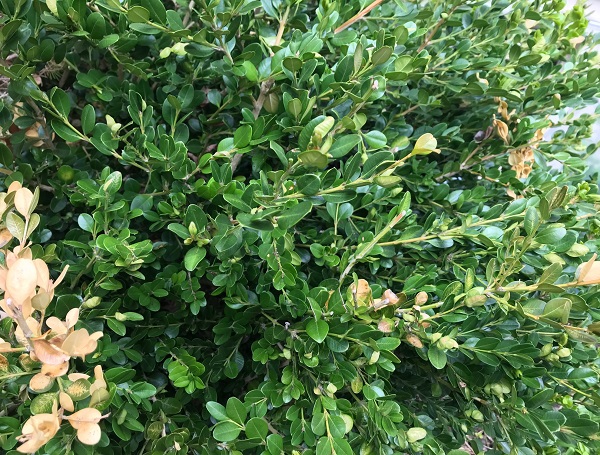
Or this:
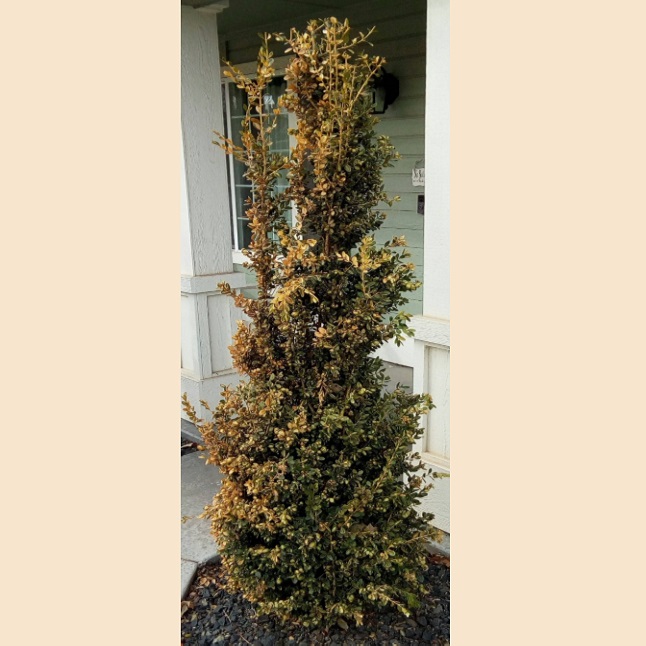
Or even this.
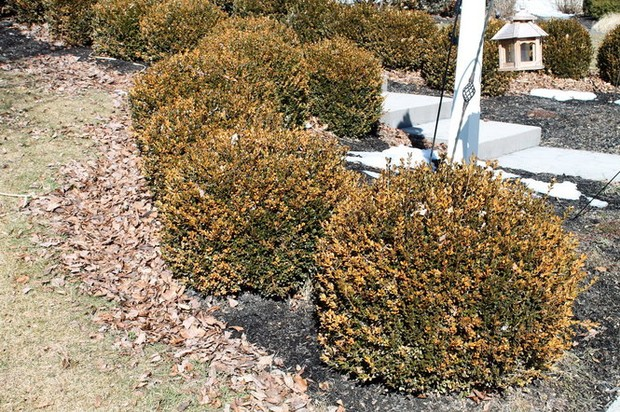
Tell-tale symptoms of (1) brown outer branches with green interior, (2) ground-level green but top-level brown, or (3) only brown on the south to west to north “hemisphere” of growth indicates it’s probably winterburn.
What exactly is winterburn?
It’s a condition in which the leaves have desiccated (dried out) due to the leafy portion still transpiring (exhaling) moisture but the ground is frozen preventing water uptake. Add to that howling windy conditions and brutally cold sunny days, and it’s a perfect recipe for all the transpiring with no ability to replace the moisture from a frozen root zone. Basically, it’s like freeze-drying, and boxwoods are particularly susceptible to it because their leaf structure.
So, what do I do? If your boxwood was only marginally hardy (and different varieties have different hardiness levels), it may be dead because our winter was extreme. A quick way to tell is to scratch through the bark of a stem to see if there is green underneath indicating it’s still alive.
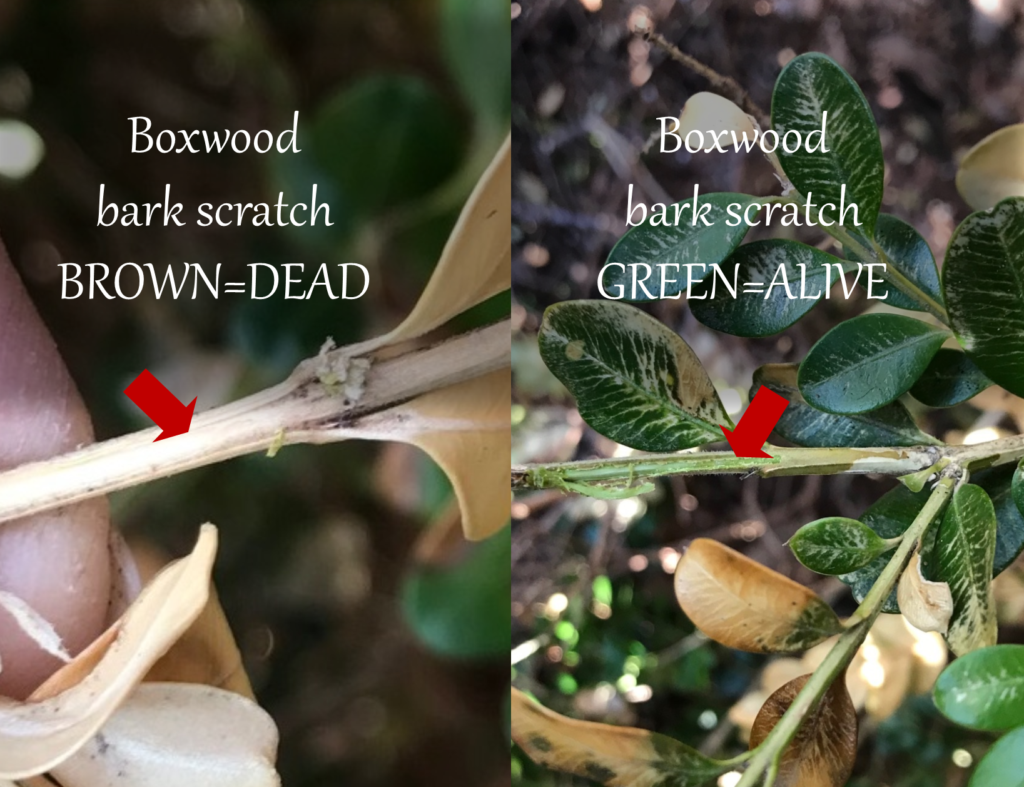
If your boxwood is only marginally brown, still alive and could withstand a bit of pruning, make your cut just above a green leaf. If your boxwood has a whole chunk affected or a whole top, give it a while if the scratch test proved green. You will be amazed at the resiliency of plants as their brown leaves get pushed off by emerging green buds. Even into June this can happen, particularly if you’re having a cold, cloudy spring as we have had in Chicagoland.
Be sure to keep the root zone moist (but not wet) as that will help with emerging leaves. A balanced fertilizer or one designed for trees and shrubs is also helpful as your boxwood tries to recover. If your boxwood is dead, no amount of moisture or fertilizer will bring it back from the dead. One last reason for browning is disease, but that’s far less common than winterburn.
With a little detective work, you can figure out if your boxwood is actually dead or just a little winter weary as are the rest of us. For more information, check out the Chicago Botanic Garden’s website: https://www.chicagobotanic.org/plantinfo/winterburn

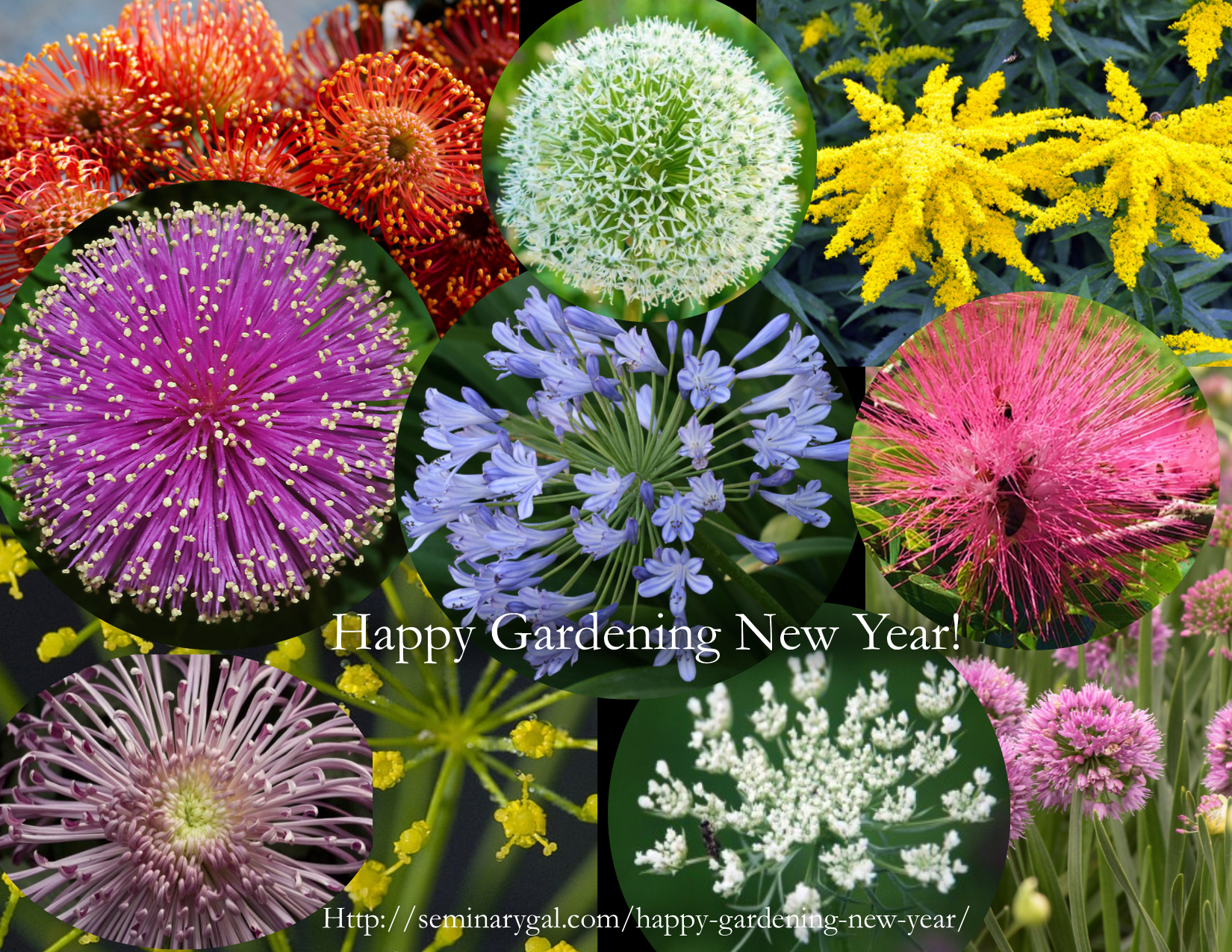 As I do every year, my New Year’s begins by thanking God for all this beauty and reflecting on last year’s garden and last year’s living. I am reminded that every year it’s the same thing: my garden had show-stoppers and total flops. Just like my life in 2017.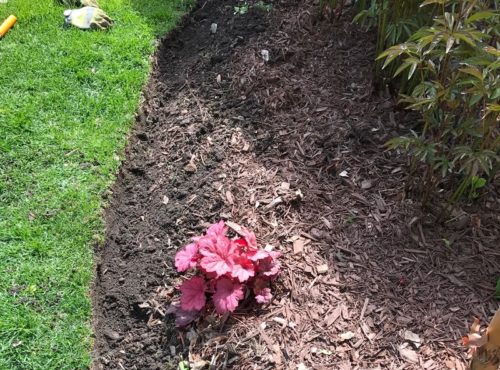
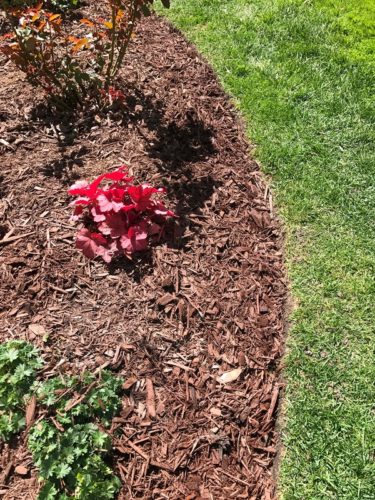 Repeat until the full edge is complete and then use the grass clippers to shear the very edge to a scalping level. While a weed whacker could do it, the result will be less precise.
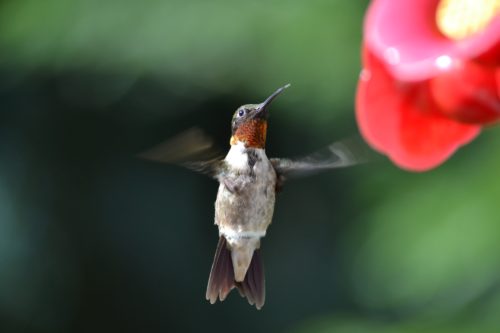 Nectar feeders: To greet their arrival, I put out the oriole and hummingbird feeders with a room temperature sugar-water mixture (1 cup granulated sugar to 4 cups hot water for ease of dissolving).
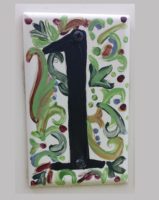 Part of every garden is the first impression. I hand-painted the house numbers on switch plate covers ever since the mailbox bashing game of a few years ago left many of our mailboxes face down in the street. I figured it was at least possible that I could pattern any new ones required off of the old ones. Much of my garden is what I call the “Out of Eden” experience in which I’m dealing with things in a chronic state of imperfection and finding solutions to problems.
 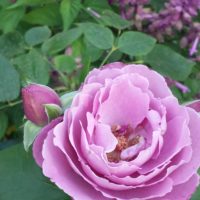 ‘Heirloom’ (hybrid tea, left) and ‘Pinata’ (climbing) roses both made a comeback from growing in pots last summer and overwintering in the garage.
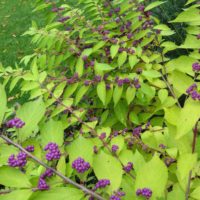 Such is case of the fall beauty called Callicarpa with its lovely magenta berries. It’s under the flag and looks like nothing now, but next month, the little magenta colored flowers will begin to hint that these stunning berries are on their way. The Boston ferns have been part of my family since 1998 and come indoors for the winter or on cold nights. This year, the one in the corner by the garage almost made it inside when I was surprised by a dove flying away as I got ready to bring it in, revealing 3
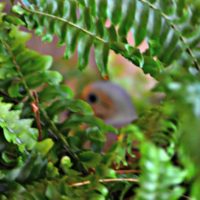 little baby doves, newly hatched in a “nest”. So my fern had to stay outside on a few frosty nights because that mourning dove had decided to make my fern her nesting place. She didn’t actually build a nest. She just smashed down some of the fronds of the fern which was just making a comeback from the winter of its discontent.
 North Face. The north side’s Roseanne Roseannadanna Award Winner (RRAW) of “It’s Always Somethin’” would be the Coneflowers and Coleus, normally a really pretty display that has become the dinner of choice among discriminating bunnies, that is, when they’re not eating the petunias and hollyhocks on the east side.
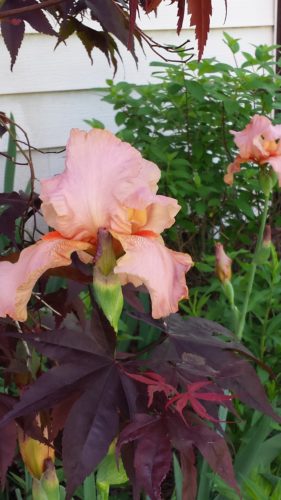 Plants are amazing! They have the ability to produce new buds or sometimes even roots along stems where no buds existed before, hence the big word adventitious. The Japanese maple is not quite the leafy glory of an average year, but trust me, it’s much better than it had been at the start of the season when we thought it was dead. It’s Always Something. On the Lower East Side is the potted geranium pillar that had been overwintered in the basement. It’s hard to believe it started as a 6-in pot 2 years ago.
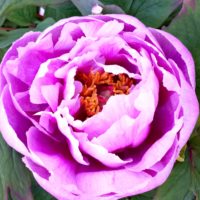 (right) was a going-away gift from a friend of mine who wanted a home for her treasure when she moved. I also have Todd’s Iris from a friend named Todd (amazingly enough) from our time living in Minnesota. He mailed his special iris breeding efforts to us when we first moved into this house as a housewarming gift. I originally thought these were brown until the buds opened up to reveal this lovely shell pink. Take time to notice the colors of the foliage on this side of the house.
 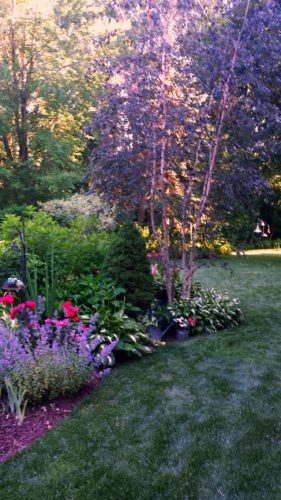 Gardens don’t have to have flowers to have color. All creation is amazing because our Creator is amazing.
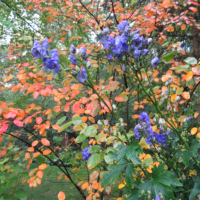 In the back corner of the The Perennial Border is a little tribute to fall. The blue leafed Hostas with lavender flowers, the purple turtlehead, and the towering cobalt blue monkshood all survive shade and the inevitable moisture in the back corner. Together, they make for a long lasting fall display of blues and purples with real pop, contrasted against the scarlet-orange foliage of the serviceberry.
 Same thing with bully birds like grackles, starlings, and sad to say, redwing blackbirds that I had always partial to because Morning has broken, like the first morning, Blackbird has spoken, like the first bird, Praise for the singing, praise for the morning, Praise for the springing fresh from the world. But then they were eating everything in sight and the bullies were taking over the yard, chasing off the birds I actually wanted to feed. Now, I know all birds and squirrels need to eat, but we will all get along if they know their place. So, a few baffles, cups, sticks, bottles, mirrors, bling, tape, and careful food choices later, I have limited their ability to chow and hog. They can eat in reasonable amounts and leave some for the others. Basically teaching birds and squirrels to play well in groups.
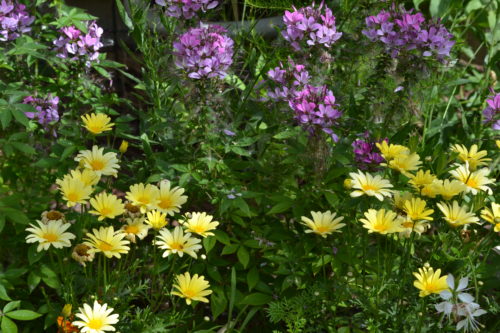 All Around.
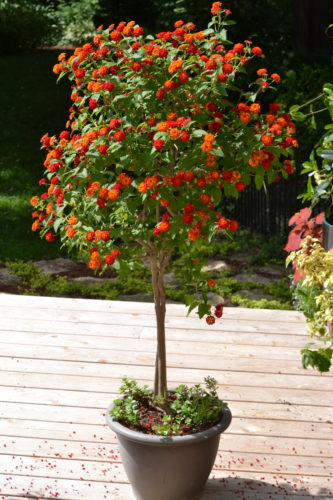
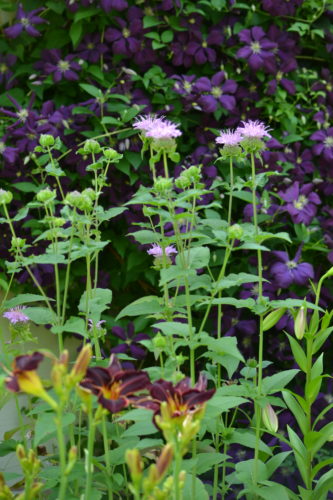 The hybrid tea roses and bee balm were rumbling with the orange daylilies. These days, it’s hard for the Suns to stay alive. The hybrid tea roses moved out to the back and the bee balm and peonies got shifted north as the shade continues to become more pronounced. The bleeding heart obviously love it. The clematis less so.
 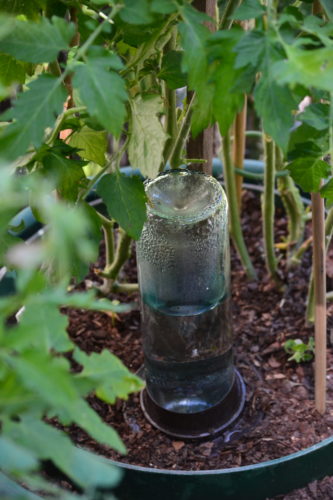 One of the blessings of a lifetime of gardening–even before I was Seminary Gal–has been developing little tricks for keeping my garden looking nice. Enjoy these hacks for a million dollar garden at a budget price. How many of us want self-watering planters, but don’t want the wallet-draining prices that come with them? Today, you can learn to make your own self-watering planters, followed by 4 other quick hacks.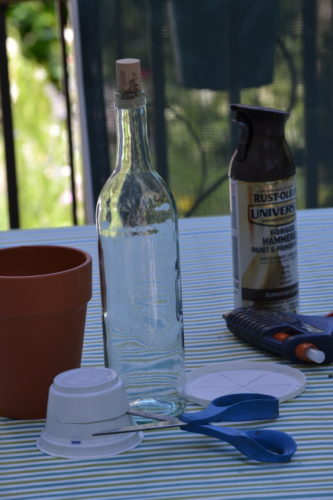
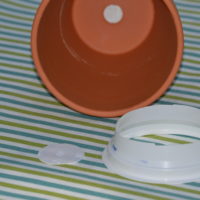 Cut the lid on the asterisk lines and also cut the bottom off the yogurt cup to give it a 1 inch height. It should look like a ring.
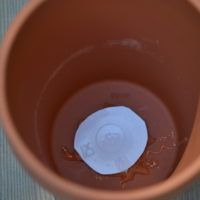 Using the hot glue gun VERY HOT, squirt some glue around the opening of the hole. Gently and carefully press the disk down with the permanent marker so you don’t burn your fingers. Are you paying attention here? Friends don’t let friends get burned. It’s why I’m not just a gardener but an evangelist. I can tell you more if you want…
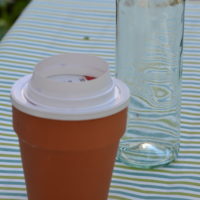 So now you have the two pieces which will fit together. It’s like Garanimals or that card game you played when you were a kid. Match them up by putting the ring lid on the closed hole pot.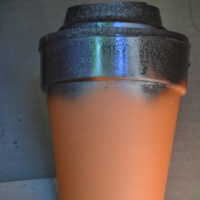
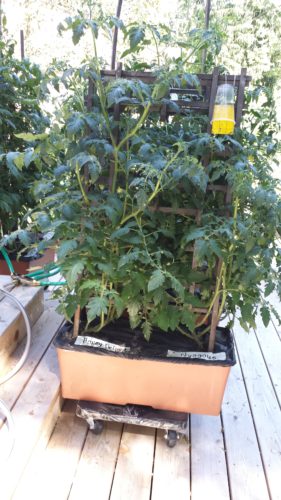
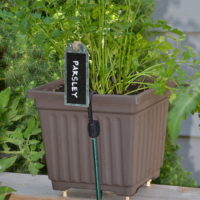 Planter Feet:
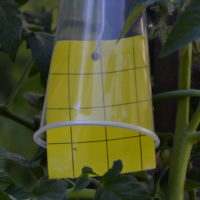 Sticky Bells:
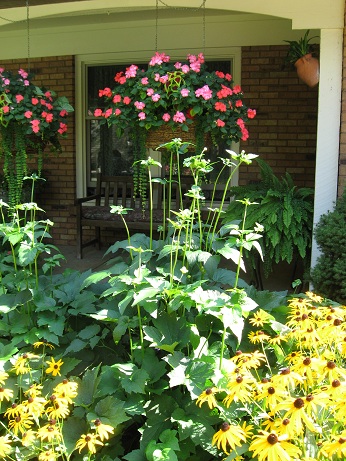
 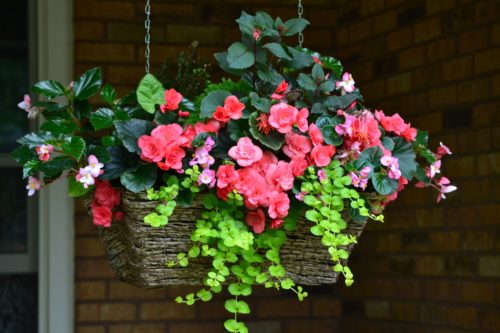 I often get compliments on the beautiful hanging baskets on my front porch. They are large but proportional to the elliptical archway under which they hang. They are not round, but squarish, important so the pair doesn’t look like eyes staring at you. Every year, I do something slightly different, but the result is always spectacular if I may quote friends and neighbors and not sound like I’m boasting.
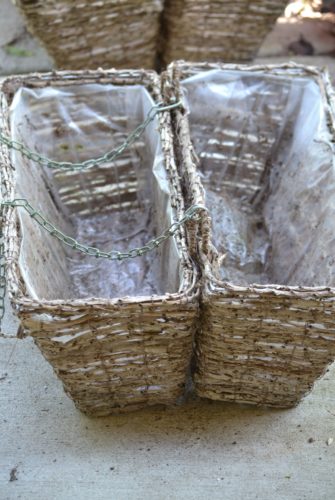 First, they are not hanging baskets at all. They are pairs of window boxes with loops which have been placed back-to-back so they will hang evenly.
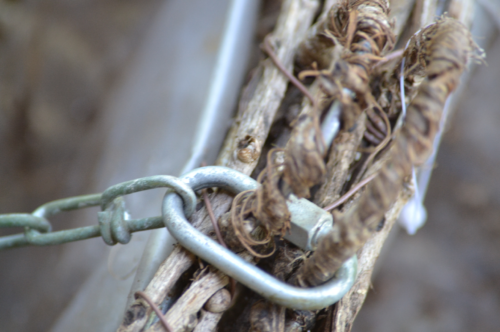 hanging baskets at their proper height. When hanging, the quick link cinches the two baskets tightly to one another and leaves space for the strand to move freely so it doesn’t become uneven. (Here’s a close-up of the link attachment.)
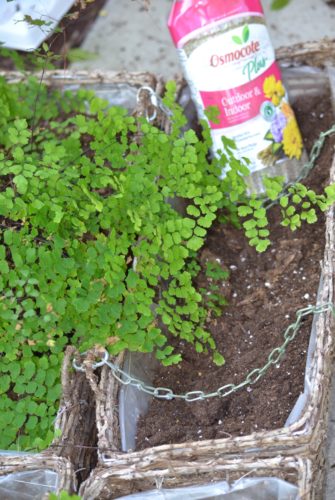 I fill them with potting mix which has been amended with a few water absorbing crystals and slow release fertilizer. I use the water absorbing crystals because the window boxes are shallow, the plants will be numerous (in some cases moisture sensitive), and the location is under the eaves which will limit their receiving natural rainfall. The gel, used in cosmetics, water treatment facilities, and disposable diapers, breaks down along plant roots and underground stems and by the end of the season, it will be decomposed having served its purpose.
 February/March: snow drops, winter aconite, Lenten rose, snow crocus