Lent 2018–Pi and Chi: Asking and Answering Questions Why

Soon Lent begins.  An annual rhythm, a cycle, a circle, a question repeated:

Why?”

Every year I pray through what to do for Lent (not so much what to give up, although this year Lent begins on Ash Wednesday otherwise known as February 14th, Valentine’s Day much to the chagrin of vendors of chocolate, a favored sacrificial item).  Nope, I pray about what God wants to speak to me, to you, and to those in our lives during this special and sacred 40 day season of Lent that comes and goes each year with the regularity of waves on the beach.
I cannot escape what goes on in my life as I pray. 

Two movies have made me think lately. 

One I’ve seen, “Life of Pi,” and the other, “I, Tonya,” I will not see. 

There’s a question that arises from both, particularly as it relates to suffering. 

In real life, Nancy Kerrigan, the figure skater whose life was changed the day of the assault upon her, recently has been shown in video reliving the moment of her injury as pundits discuss the morality of glorifying Tonya Harding in a movie.  The news clip shown over and over again displays Nancy grimacing in pain, crying out, “Why, why, why?” 

“Why?” is a hard question.  It’s among the questions Pi asks in the “Life of Pi” movie script.

  • Why would a god do that?
  • Why would he send his own son to suffer for the sins of ordinary people?
  • If God is so perfect and we’re not, why would He want to create all this?
  • Why does He need us at all?  
  • Sacrificing the innocent to atone for the sins of the guilty? What kind of love is that? (In other words, why?)

Lots of questions “Why?” in the movie, but there’s another repeated phrase that cycles like a rhythm and strikes the heart like a thunderbolt, a repetition each of us could utter:

I’m sorry!” 

Yes, the movie blurs the lines of world religions and that’s worth addressing!  It’s been making me think about the uniqueness of Christ.  After all, not all world religions are the same.  Thinking about Pi and his writing the digits of the number pi in class to change his name, and how it’s an utterly unique number. 

In his New Yorker article, “Why Pi Matters,” Steven Strogatz, professor of mathematics at Cornell, writes, “The beauty of pi, in part, is that it puts infinity within reach. Even young children get this. The digits of pi never end and never show a pattern. They go on forever, seemingly at random—except that they can’t possibly be random, because they embody the order inherent in a perfect circle. This tension between order and randomness is one of the most tantalizing aspects of pi.”

Jesus puts infinity within reach

…but a reach bridged only by faith. 

Why?  Yeah, it’s a hard question but a good one.

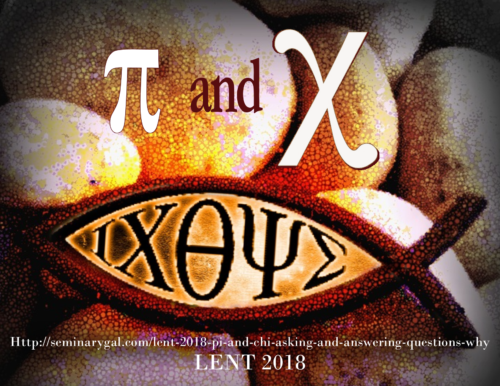
So, for Lent 2018, we’ll explore the questions of Pi and Chi (the Greek letter beginning the word Christos, which means Christ, Messiah, the Anointed One). We’ll ask and answer the question “Why?” as we discover the uniqueness of Jesus Christ.  Join me for the 40 days of Lent beginning February 14, 2018 by liking Seminary Gal on Facebook or having these devotionals sent to your email box which you can do via the sign-up on my Home page.  Thank you for blessing me with this opportunity to study together the Word of God.

===

Acknowledging that former years’ devotional series remain popular:

Continue Reading

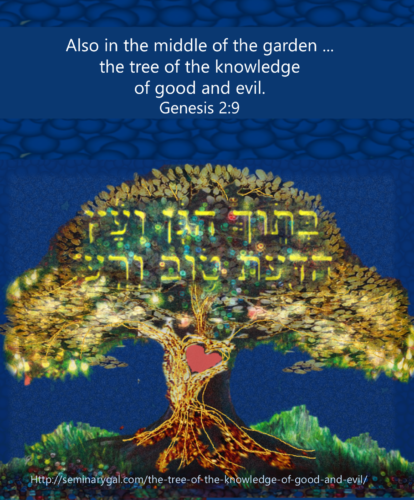
The Tree of the Knowledge of Good and Evil

Why, oh why didn’t God warn Adam about that tree? 
(He did.) 

***

Why, oh why did God put that tree there in the first place?

(Because the tree was good, even if the fruit of it was not ripe for mankind’s consumption yet.) 

***

Why, oh why didn’t God tell Adam what would happen? 

(He did. 

He said Adam would “surely die.”)

***

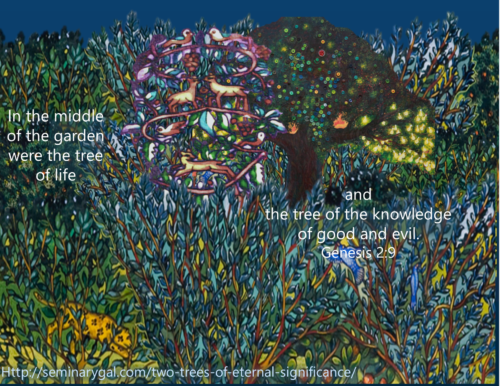
In Genesis 2:9, we see all kinds of trees: “And the LORD God made all kinds of trees grow out of the ground– trees that were pleasing to the eye and good for food. In the middle of the garden were the tree of life and the tree of the knowledge of good and evil.”  About the one tree of knowledge, the LORD God commands, Genesis 2:16 “You are free to eat from any tree in the garden; 17 but you must not eat from the tree of the knowledge of good and evil, for when you eat of it you will surely die.”

A couple of quick points:

  • The tree of the knowledge of good and evil was not an evil tree.  (God created it good and put it there which was also good because God only does good). 
  • The consequence of certain death was not an evil consequence, but a natural one that would arise within the possibilities from the good and wonderful gift of freedom.  (Just as wrath is not evil but God’s appropriate action against our freely chosen sin which was never–of course–God’s choice for us.)   
  • “Surely die” does not equal instantaneous death like a lightning bolt or execution.  (Death–and not just spiritual death–is what happens naturally when do things our own way.)

Food for thought: 

  • Verse 16 says that Adam is free to eat from any tree.  Would it really be freedom if there was no actual choice available?  If you went into an ice cream parlor and there were only many containers of vanilla, would there really be freedom of choice? 
  • There were many different kinds of trees in the Garden, so there was a type of choice available.  How much choice and what kinds of choice are necessary for true freedom? 
  • What value do limitations serve? How is the tree of the knowledge of good and evil both imagery and analogy? 
  • If the tree of knowledge of good and evil was not put there as a test, which theologians insist is the case, what good things might have resulted from the tree of the knowledge of good and evil if Adam and Eve had waited until God gave them permission instead of giving in to temptation?   

===

From the series Agricultural Imagery and Analogy in the Bible 

Continue Reading

Two Trees of Eternal Significance

Two trees have had more ink spilled on their accounts than any other.  In Genesis 2:9, we see all kinds of trees: “And the LORD God made all kinds of trees grow out of the ground– trees that were pleasing to the eye and good for food. In the middle of the garden were the tree of life and the tree of the knowledge of good and evil.”

***

Two trees singled out. 

A tale of two trees identified, hinting at the eternal difference they would make. 

Two trees in the middle of everything. 

Two trees of eternal significance, yet of the two trees, only one endures to the end of the Bible: the tree of life.

What are these two trees and why were they even there?  I’ve been assured by greater theological minds than mine that they weren’t put there as a test.  God isn’t frivolous, so they served some purpose and had value.  If that’s the case, then why (Genesis 2:16-17) was the tree of knowledge of good and evil (a merism like bookends for all things and an indication of self-discernment) forbidden? 

As we continue our look at Agricultural Imagery and Analogy in the Bible, I’d like to let these questions remain for a bit because imagery and analogy linger.  Life and Knowledge, the two named trees, were both at the middle and hint at relationship and importance.  

Food for thought:

  • Read the connection God outlines between blessed life and true knowledge (wisdom) on our side of Eden. 

Proverbs 2:2 “Make your ear attentive to wisdom, Incline your heart to understanding; 3 For if you cry for discernment, Lift your voice for understanding; 4 If you seek her as silver, And search for her as for hidden treasures; 5 Then you will discern the fear of the LORD, And discover the knowledge of God. 6 For the LORD gives wisdom; From His mouth come knowledge and understanding.” (NAS)

Proverbs 3:13 How blessed is the man who finds wisdom, And the man who gains understanding. 14 For its profit is better than the profit of silver, And its gain than fine gold. 15 She is more precious than jewels; And nothing you desire compares with her. 16 Long life is in her right hand; In her left hand are riches and honor. 17 Her ways are pleasant ways, And all her paths are peace. 18 She is a tree of life to those who take hold of her, And happy are all who hold her fast. 19 The LORD by wisdom founded the earth; By understanding He established the heavens. 20 By His knowledge the deeps were broken up, And the skies drip with dew. 21 My son, let them not depart from your sight; Keep sound wisdom and discretion, 22 So they will be life to your soul, And adornment to your neck. 23 Then you will walk in your way securely, And your foot will not stumble. 24 When you lie down, you will not be afraid; When you lie down, your sleep will be sweet. 25 Do not be afraid of sudden fear, Nor of the onslaught of the wicked when it comes; 26 For the LORD will be your confidence, And will keep your foot from being caught. (NAS).

  • In what ways does our culture challenge sound biblical judgment and godly discernment? 
  • Does all knowledge lead to life?
Continue Reading

Adam in the Garden

“In a selfish act of laziness, God created Adam for slavery and shoved him into Eden’s trenches to work as a landscaper and even put him on a hyper-restrictive diet, laying down the law about what he could eat.”  Unfortunately, that is precisely the meaning that way too many people believe when they read Genesis 2:15 “The LORD God took the man and put him in the Garden of Eden to work it and take care of it.”  Of course, they wouldn’t come out and say it as bluntly as I just did, but their attitudes reveal that they believe it nonetheless.

That kind of statement is wrong, wrong, wrong. 

Shocking and wrong.  Did I say that? 

Yeah, it’s SO wrong.

Not selfish, not laziness, not slavery, not shoving, not trenches, not landscaping, and not restrictive.  Glad I got that off my chest.

Ok, Barb ol’pal, what do you think it means then? 

I’m glad you asked.  My meaning expansions are in the [parentheses]:  Genesis 2:15 “The LORD God [in a divine act of joy and generous delegation] took the man [His cherished and prized pinnacle of Creation] and put him in the Garden of Eden [God’s sanctuary and palace garden, a place of lush beauty, yielding fruit by command of God Himself] to work it [rule it, have responsibility for lovingly keeping it every bit the sanctuary it was from the start] and take care of it [by maintaining communion with God and keeping the order and beauty with which this sanctuary was created.  In effect, God was giving the man the highest honor possible: to maintain—by man’s God-given abilities and intellect—what God had established in creating man in God’s own Image and creating a sanctuary for joy, communion with God, and as worship of Him as our Creator.]”   

As we continue looking at Agricultural Imagery and Analogy in the Bible, the first occupation for man is a combination gardener and priest.  The image conveys everything from cultivation, nurturing, and stewardship of what God has given us… as an act of worship.

Food for thought:

  • In general, is your unspoken expectation that God is out to bless you or mess with you?  In a situation where things could go wrong through no fault of your own, do you expect that they will or that God will preserve you from it? 
  • When you think of Adam’s working in the Garden of Eden do you think of digging dirt and planting rows of corn or beans in the hot sun, or do you think of priestly duties? 
  • How might changing your assumptions about work in the Garden change your attitudes about God and about the work He has you doing? 
  • In Creation, God established order over chaos, light into darkness, form into the formless, and life into what He’d already created as a material world.  Even before the fall of man, God’s sanctuary needed to be maintained to keep chaos, darkness, and material forces from pressing in, disrupting the order.  Read Colossians 1:15-17 and Hebrews 1:3  Who really holds it all together?  How might Adam’s working in the Garden be both gardening and priestly as God’s Image-bearer?
Continue Reading

Created for Biodiversity

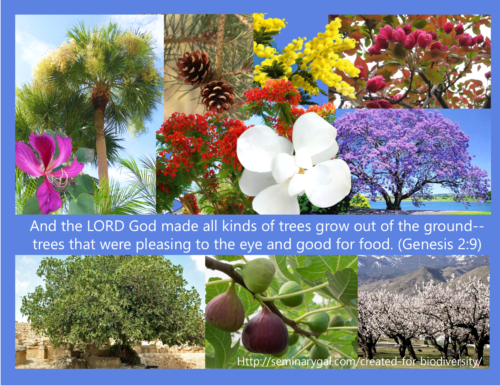
Genesis 2:8 Now the LORD God had planted a garden in the east, in Eden; and there he put the man he had formed. 9 And the LORD God made all kinds of trees grow out of the ground– trees that were pleasing to the eye and good for food.

We can all agree that the Bible is not a science textbook or a research biologist’s journal.  But when you consider the Pentateuch (the first 5 books of the Bible) was recorded thousands of years before the modern era—even more than a thousand years before Christ—it’s genuinely remarkable what is written. 
Man was formed out the dust of the earth as were the other land animals (Genesis 1:20-25).  Those happened on “Days” 5 and 6.  God made all kinds of trees grow out of the ground as part of Third Day gardening.

Biodiversity, a crasis of the words biological and diversity, basically points to the variety of living organisms on Earth and their inherent and amazing variability.   

If you take the Bible as true, as I do, this diversity was designed from the start. 

All kinds of trees.  Pretty trees.  Trees for food.  Some are both. 

All display God’s wisdom, His appreciation for beauty, His preference of diversity over monotony, and His awesome creativity.

And yet, built into the DNA from the very beginning was future biodiversity.  Pretty trees could become varied and more beautiful, even without the help of geneticists and breeders.  Trees for food would develop greater efficiency and production because what was already built into the genetic code made it possible.  It is this pre-programming for functionality and future diversity in DNA that breeders use to feed the world.  God created for biodiversity and future productivity, giving us a clear picture of God’s existence, His wisdom, and His open invitation for mankind to rejoice in his Creator and to use the opportunity for wise stewardship.

Food for thought:

Consider the miracle of the genetic code and how DNA not only governs reproduction but also contributes to biodiversity.

When mankind decided to sin and fell from grace, what happened to the genetic code?  What does that mean for mankind?

Consider Adam and Eve.  One couple chose sin.  From one couple, many nations.  Many nations, One Redeemer, the Lamb (that is, Jesus Christ).   Revelation 5:9 And [the four living creatures and twenty-four elders] sang a new song: “You are worthy to take the scroll and to open its seals, because you were slain, and with your blood you purchased men for God from every tribe and language and people and nation. 10 You have made them to be a kingdom and priests to serve our God, and they will reign on the earth.” 

In what way do we see diversity of people (united by human DNA) affirmed in redemption as an expression of open invitation, even as the means of redemption remains only one Way?

Continue Reading

The Abundance of Eden

The Garden of Eden—even the name suggests abundance, everything lush and beautiful.  The romantic view is that the Garden was a tropical paradise, replete with flowering plants and with jungle-like, untamed greenery both wild and wonderful.  Kind of like Costa Rica, only better. 

Sorry to pop your bubble, but Costa Rica and even Hawaii aren’t anywhere close to what the Garden of Eden was in Genesis.  Technically, it’s not even the Garden of  Eden, as if it was the sole garden of a proper noun place called Eden like Longwood Gardens of Kennett Square, Pennsylvania.  The very word Eden is in the semantic range of enrich or make abundant resulting in the Garden of Eden conveying meaning as Garden of Abundance. 

What was so abundant?  The streams arising from within the earth—Eden, the very source of water for sustaining life—made God’s Garden well-watered and the perfect place for perfect life to be perfectly introduced.

Genesis 2:4 This is the account of the heavens and the earth when they were created. When the LORD God made the earth and the heavens– 5 and no shrub of the field had yet appeared on the earth and no plant of the field had yet sprung up, for the LORD God had not sent rain on the earth and there was no man to work the ground, 6 but streams came up from the earth and watered the whole surface of the ground”

God had not sent rain and even when no man was yet to work the ground, the water was so abundant in Eden, it could not be contained.  It didn’t pool deeply in the Garden, but was meant to water entire areas outside of the Garden (Genesis 2:10-14). 

This was not rain water—a gift of the sky.  It emerged up from Eden, from within God’s abundance.

I wonder if Jesus had this life-giving, life-sustaining, arising from God’s abundance idea in mind when Scripture records this imagery, John 7: 37 “On the last and greatest day of the Feast, Jesus stood and said in a loud voice, ‘If anyone is thirsty, let him come to me and drink. 38 Whoever believes in me, as the Scripture has said, streams of living water will flow from within him.’ 39 By this he meant the Spirit, whom those who believed in him were later to receive. Up to that time the Spirit had not been given, since Jesus had not yet been glorified.”

Food for thought:

Read Jeremiah 2:12-13 about God’s people having rejected the spring of living water.  In what ways do we dig our own cisterns instead of trusting God in current culture?

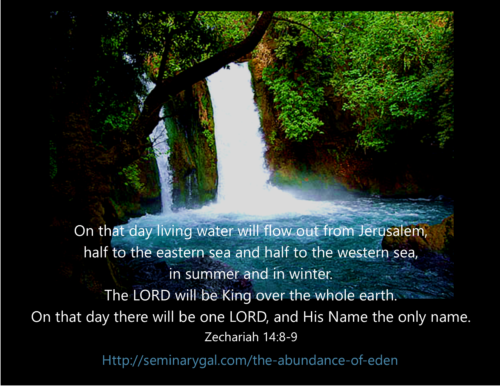
About the day of reckoning, again we see living water.  Zechariah 14:8 “On that day living water will flow out from Jerusalem, half to the eastern sea and half to the western sea, in summer and in winter. 9 The LORD will be King over the whole earth. On that day there will be one LORD, and His Name the only name.”

In John 4:4-14, Jesus talks to a Samaritan woman about living water saying, John 4:10 Jesus answered her, “If you knew the gift of God and who it is that asks you for a drink, you would have asked him and he would have given you living water.” 11 “Sir,” the woman said, “you have nothing to draw with and the well is deep. Where can you get this living water? 12 Are you greater than our father Jacob, who gave us the well and drank from it himself, as did also his sons and his flocks and herds?” 13 Jesus answered, “Everyone who drinks this water will be thirsty again, 14 but whoever drinks the water I give him will never thirst. Indeed, the water I give him will become in him a spring of water welling up to eternal life.”.

In what ways might these be connected as imagery, recalling Eden, God’s abundance—living water—giving and sustaining life?  In what ways is water necessary for life?

Continue Reading

Third Day Gardening

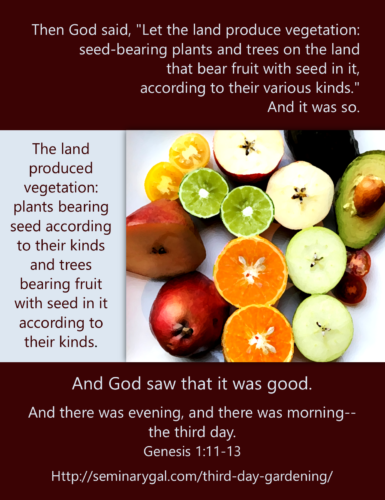
Genesis 1:9 And God said, “Let the water under the sky be gathered to one place, and let dry ground appear.” And it was so. 10 God called the dry ground “land,” and the gathered waters he called “seas.” And God saw that it was good. 11 Then God said, “Let the land produce vegetation: seed-bearing plants and trees on the land that bear fruit with seed in it, according to their various kinds.” And it was so. 12 The land produced vegetation: plants bearing seed according to their kinds and trees bearing fruit with seed in it according to their kinds. And God saw that it was good. 13 And there was evening, and there was morning– the third day.

The Third Day is when gardening began.  And God proclaimed it was good. 

No flops in God’s garden. 

It was all perfect, as perfect should be.

Don’t you find it interesting that people always try to poke holes in the Bible, that it’s nothing but a bunch of fairy tales and myths?  And yet, here it is, as true today as it was then. 
Plants have seed that reproduce themselves.  Trees bear fruit and do so according to their kind.

Sure, there’s some genetic variability on this side of expulsion from Eden in which some offspring from seed produce genetic show-stoppers that today’s breeders work hard to attain, but in every bunch, there are some genetic flops, failing to grow or producing no fruit.  But the variability never results in apples producing sheep or alligators or even different kinds of trees.  Apples don’t become elms or maples or buckthorn.  Their seeds produce apples.

The words of Christ still ring true: Matthew 7: 15 “Watch out for false prophets. They come to you in sheep’s clothing, but inwardly they are ferocious wolves. 16 By their fruit you will recognize them. Do people pick grapes from thornbushes, or figs from thistles? 17 Likewise every good tree bears good fruit, but a bad tree bears bad fruit. 18 A good tree cannot bear bad fruit, and a bad tree cannot bear good fruit. 19 Every tree that does not bear good fruit is cut down and thrown into the fire. 20 Thus, by their fruit you will recognize them.”

Jesus, always one to have a good horticultural analogy in His arsenal, is talking about people, their hearts, and their fruit, but consider the consistency which He likens to plants.  For millennia no thornbush bears grapes.  Grapes bear grapes.  And it’s been that way since the Third Day.

Food for thought:

What kind of spiritual fruit do you bear?  How do you feel about others noticing the fruit you produce and whether it’s good or bad?  Does Jesus tell us to condemn them or just recognize them?

Continue Reading

Agricultural Imagery and Analogy in the Bible

God loves a good garden.  God loves farming. 

And God loves using horticultural and agricultural imagery and analogy. 

From the very beginning of the Bible (Genesis) to the final chapter of Revelation, there are gardens and agricultural imagery which God uses to teach us about Himself and about the world in which we live. 

Mankind began as caretakers of the perfect world called Eden from which we were expelled on account of sin.  Now we take care of an imperfect world by the sweat of our brow.  But someday, we will experience a new and perfect world which we sometimes call Heaven, but is really a New Heaven and a New Earth (Revelation 21:1-5). 

We’re going to be living on the New Earth after Jesus returns.  None of this floating on clouds playing harps nonsense and having to earn our wings like Clarence helping George Bailey

There will be productive and enjoyable work to do which makes some of us cringe at the thought of working for eternity.  But work won’t seem like work does here.  I’ve gotta believe at least some of it will be agricultural with all the blessing and joy and none of the disease and drought and risk of losing the farm.

Food for thought:

What words would you use to describe work?  What makes work hard outside of Eden? Would you welcome or despise agricultural work? 

Continue Reading

Happy Gardening New Year!

Wishing all my gardening and theology friends a Happy New Year!  Isn’t it amazing how many flowers look like fireworks?  I was thinking about that this morning as I was watching the westward setting of the biggest, most beautiful full moon I can ever remember on a New Year’s Day.  Looking eastward over Lake Michigan with the air so cold that lake-effect clouds hug the coastline, I watched as the sun bravely rose into an otherwise clear sky.  A frigid January 1, 2018.  But beauty everywhere!

As I do every year, my New Year’s begins by thanking God for all this beauty and reflecting on last year’s garden and last year’s living.  I am reminded that every year it’s the same thing: my garden had show-stoppers and total flops.  Just like my life in 2017.
But it’s a New Year and while it’s really just a calendar turn, it does mean planning for this year’s show-stoppers and knowing I’ll also have my share of flops. 

New Year’s self-improvement resolutions aren’t my thing anymore because I know the disappointment of planning for show-stoppers, but living in the real world where there are flops I try to avoid and those beyond my control.  Rain.  Drought.  Heat.  Cold.  It’s life outside of Eden.

My main resolutions, therefore, are positive and my hope of a beautiful garden of fruit for God’s glory includes sowing these things:  

  • Resolving to be faithful and pray before speaking. 
  • Resolving to forgive readily. 
  • Resolving to be brave when boldness is needed. 
  • Resolving to be patient when patience is required.
  • Resolving to thank God for so many wonderful blessings and the beauty of this earth. 
  • Resolving to be found hard at work when Jesus returns.

What about you?  If your life is a garden, what will you plant this year?  


Continue Reading

2018-A New Year of Promise, A Year of Hope

Another year gone by.  A 2018 ahead as a year of promise, a year of hope.  Why do I say that?  Well, I prefer optimism to pessimism and I think it’s more biblical.  God emphasizes not fearing the future.  He reminds us He’s still God.

God’s focus is always on hope, faith, trust, and giving us ample reasons to believe God has good in store for us.

A while back, I was trying to earn money for a mission trip to South Africa with a group of nurses and doctors ministering to those who were HIV-positive and dying from AIDS.  One of the jobs I held temporarily to earn my way was doing telemarketing for a well-known charity before the negativity and rejection became too much for me. 

I discovered something profound though: discouragement is spiritual. 

It gets in your flesh. You can’t wash it off at the end of a day.  Nothing other than prayer and time in God’s Word could extinguish it…but even then, it lingered as an echo, a shadow, a placeholder, even a hook like Velcro waiting for a weak moment for discouragement to return and resume discouraging.  Spiritual things are like that.

For this reason, optimism and trusting in God go hand-in-hand, offering a better future.  God never sends a spirit of discouragement, depression, purposelessness, or futility.

As we conclude 2017, Americans (and others globally) can acknowledge that far too many of us have spent the year being negative, pessimistic, depressed, stressed, and discouraged people. 

Looking for bad news in our brothers instead of looking for what is good.  Going on witch-hunts, as if we were hoping to discover the worst in our fellow Christians!  And it’s no one’s fault but our own for partnering with evil and reaping the personal consequences in our own attitudes.

We have Scripture’s clear admonition to agree with each other in the Lord because it’s a genuine key to joy (Philippians 4:1-9).

As we look ahead to 2018, let’s consider it a year of promise, a year of hope.  Let us no longer succumb to a lack of faith, uncharitable actions and words, grieving the Holy Spirit by listening to our adversary’s lies and joining that work of the devil.  Instead may we find ourselves submitting to God, acknowledging that God’s plan is to bring good, perhaps in ways we cannot even fathom.  Yes, even good out of what man intends as harm (Genesis 50:20).

My New Year’s wish for you is a 2018 as a year of promise, a year of hope.  May your 2018 include seeing God’s actions in surprising ways, God’s faithfulness to you in every circumstance, an eternal perspective that melts the stresses and waters your faith, and a year in which you experience more of Jesus, day by day and become like Him.

Closing the year with something good and ringing in this year of promise, year of hope, here is my prayer for you:

Lord God, how wonderful to call you “Lord!” How marvelous to acknowledge all your faithfulness to us during the past year and the many years prior!  How awesome are your deeds and amazing is your sovereignty! How beautiful is your mercy!  How desperately we need your grace and forgiveness!  Your wisdom is so far beyond our understanding, Lord. Teach us to fear you daily and to honor you as Lord throughout 2018.

We ask, Lord, that you would be glorified this coming year.  May our submission to you testify to your goodness and may we display that beautiful virtue of humility.  Remind us daily of your love.  Keep us in safety and health according to your will.  Give us hearts of gratitude for your provision and spirits of contentment no matter our circumstances.  May we have enthusiasm and zeal for what is good and honorable in your sight.  May we grow in love for one another and have grace to show our fellow man.  Let us hate only what is evil and love fully what is good.  May we bring joy to your heart in our daily actions and receive joy in return to bless our days.  Let this be a year of promise, Lord, of witnessing many more of your promises kept, and a year of hope as hope in you never disappoints.  Strengthen us for the days ahead so that we might bring glory to you as we bring your Gospel of peace to a world in need.  We ask for your blessings upon our families and friends.  Most of all, we ask for you to be with us.  Thank you, Jesus, for all these good gifts.  Amen.

Continue Reading