Fifth Sabbath of Lent (2018)

Matthew 5:43 “You have heard that it was said, ‘Love your neighbor and hate your enemy.’ 44 But I tell you: Love your enemies and pray for those who persecute you, 45 that you may be sons of your Father in heaven. He causes his sun to rise on the evil and the good, and sends rain on the righteous and the unrighteous. 46 If you love those who love you, what reward will you get? Are not even the tax collectors doing that? 47 And if you greet only your brothers, what are you doing more than others? Do not even pagans do that? 48 Be perfect, therefore, as your heavenly Father is perfect.”
===
Devotionals for Lent 2018, Pi and Chi (the Greek letter beginning the word Christos, which means Christ, Messiah, the Anointed One) continue tomorrow in which we’ll ask and answer the question “Why?” and discover the uniqueness of Jesus Christ. Join me for the 40 days of Lent which began February 14, 2018 by liking Seminary Gal on Facebook or having these devotionals sent to your email box which you can do via the sign-up on my Home page. Thank you for blessing me with this opportunity to study together the Word of God.
===
Acknowledging that former years’ devotional series remain popular:
- Lent 2013 looked at The Letter to the Romans: Paul’s Masterpiece to reclaim foundations of our Christian heritage and began February 13, 2013.
- A very special and ever popular offering was Lent 2014’s Be Still and Know that I AM God which can be obtained through the archives beginning in March 2014.
- Lent 2015 began on February 18, 2015 with a series entitled With Christ in the Upper Room: Final Preparations. We explored what is often called “The Upper Room Discourse” found in John chapters 13-17.
- ReKindle, the Lent 2016 series, began on February 10, 2016 and encouraged us to rekindle our spiritual lives.
- .Light: There’s Nothing Like It was the 2017 Lent series and explored this metaphor often used to portray Christ. It is archived beginning March 1, 2017.
Why Does Pressure Reveal the Inner Man? (Lent 28-2018)
It’s often said that what’s in a man gets revealed when he is squeezed under pressure. What’s truly in a man comes out. Why is that?
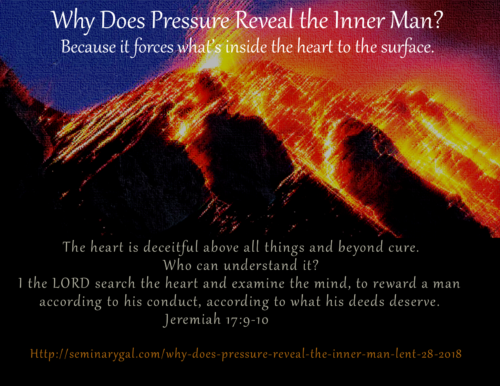
Why Does Pressure Reveal the Inner Man? Because it forces what’s inside the heart to the surface.
 ***
***
In the Life of Pi, the movie we’ve been using to launch our Lenten devotional series, Pi ends up on a raft with Richard Parker the Bengal tiger who brings out who Pi is beneath the surface. The pressures and stresses of survival 227 days alone on a raft. Attempting to tame the predator within the boat.
Towards the end of the movie, as Pi recounts his story to investigators who are wanting to know why the Japanese cargo ship sank in the Pacific. His story of survival with Richard Parker the tiger still doesn’t answer why the ship sink. Why did he alone survive? All the animals–the zebra, the orangutan, the rat, and hyena–it’s all too unreal. So, they ask him to tell them a believable story, one without all the animals. Pi says, “I told him another story. ‘Four of us survived…'” and he recounts the four: the injured sailor called the happy Buddhist, Pi’s mother, a ruthless cook, and himself. After the cook kills the sailor and Pi’s mother, Pi recalls watching his mother’s dead body being thrown to the sharks and his resultant encounter with the cook, “The next day I killed him. He didn’t even fight back. He knew he had gone too far, even by his standards. He’d left the knife out on the bench. And I did to him what he did to the sailor. He was such an evil man, but worse still, he brought the evil out in me…I have to live with that. I was alone in a lifeboat, drifting across the Pacific Ocean. And I survived.”
The inner man, in a quest for self and survival, is capable of all kinds of evil.
It all begins in the heart.
Jesus talks about it, saying, Mark 7: 21 “For from within, out of men’s hearts, come evil thoughts, sexual immorality, theft, murder, adultery, 22 greed, malice, deceit, lewdness, envy, slander, arrogance and folly. 23 All these evils come from inside and make a man ‘unclean.’”
Food for thought:
- Read Jeremiah 17:7 “But blessed is the man who trusts in the LORD, whose confidence is in him. 8 He will be like a tree planted by the water that sends out its roots by the stream. It does not fear when heat comes; its leaves are always green. It has no worries in a year of drought and never fails to bear fruit.” 9 The heart is deceitful above all things and beyond cure. Who can understand it? 10 “I the LORD search the heart and examine the mind, to reward a man according to his conduct, according to what his deeds deserve.” How does pressure reveal both good and bad in people?
- Matthew 12:34 reminds us that “out of the abundance of the heart the mouth speaks.” Have you ever had the experience of saying something you wish you hadn’t and wondered where that came from? What is the best response when that happens?
- In the final scene of the movie Life of Pi, the writer to whom he’s sharing his story connects the stories and concludes Pi was the predatory Richard Parker. Is there any part of your character hiding beneath the surface you’d find helpful to address with God who has already searched your heart and knows about?
==
For Lent 2018, we’ll explore the questions of Pi and Chi (the Greek letter beginning the word Christos, which means Christ, Messiah, the Anointed One). We’ll ask and answer the question “Why?” as we discover the uniqueness of Jesus Christ. Join me for the 40 days of Lent which began February 14, 2018 by liking Seminary Gal on Facebook or having these devotionals sent to your email box which you can do via the sign-up on my Home page. Thank you for blessing me with this opportunity to study together the Word of God.
===
Acknowledging that former years’ devotional series remain popular:
- Lent 2013 looked at The Letter to the Romans: Paul’s Masterpiece to reclaim foundations of our Christian heritage and began February 13, 2013.
- A very special and ever popular offering was Lent 2014’s Be Still and Know that I AM God which can be obtained through the archives beginning in March 2014.
- Lent 2015 began on February 18, 2015 with a series entitled With Christ in the Upper Room: Final Preparations. We explored what is often called “The Upper Room Discourse” found in John chapters 13-17.
- ReKindle, the Lent 2016 series, began on February 10, 2016 and encouraged us to rekindle our spiritual lives.
- Light: There’s Nothing Like It was the 2017 Lent series and explored this metaphor often used to portray Christ. It is archived beginning March 1, 2017.
Why Won’t God Just Make Me Believe? (Lent 27-2018)
Who knows what happens in the nanosecond before the brain waves cease? Does Jesus make a final appeal, offering one last opportunity before an eternity in hell? Yes, but it’s still an invitation to come, to follow Him, and a choice we have. It’s not like grabbing the hand of the toddler melting down and demanding, “Enough! You’re coming with me, buddy!”
God wants all men to be saved, right? (1 Timothy 2:4)
Why Won’t God Just Make Me Believe? Well, because faith is a matter of the heart, not works, and not history, even for the chosen people. And each man follows his heart.
Heaven wouldn’t be heaven with those who are there completely against their will. They’d soon resent being there with those whose hearts chose to follow.
 ***
***
In the movie Life of Pi that we’ve been using for our Lent 2018 devotional series, faith is presented as an issue of the heart.
- Mother: He’s young, Santosh – he’s still finding his way.
- Father: And how can he find his way if he does not choose a path? (To Pi) Listen: instead of leaping from one religion to the next, why not start with reason? In a few hundred years, science has taken us farther in understanding the universe than religion has in ten thousand.
- Mother: That is true. Your father is right. Science can teach us more about what’s out there-(With a hand to her heart:) but not what is in here. Art, music, literature they all spring from our faith.
Science. Hmmmm. Stephen Hawking. Brilliant physicist. Crumpled and confined to a wheelchair. Communicating his genius thoughts through voice assistance. He relied on science. Who knows if he died as the atheist he once asserted? I grieve for him and for his family. If Jesus made one last appeal, would Hawking have said, “My Lord and my God! I was wrong! Forgive me!” Or would he have said, “No thank you?” The Independent UK offers this insight
Professor Hawking has long been a critic of ideas of the afterlife or an all-powerful god. He said it was natural to believe in the divine before we understand science – but that science had now provided a better explanation.”
I hope he rethought that answer. To be so brilliant and so clueless…and leading others to cluelessness is a tragedy far worse than an earthly lifetime of disability.
Food for thought:
- Why might science not provide the ultimate answer? What is the key to having a heart of faith?
- The Apostle Paul spoke of grief at the hardening of his brethren, the Israelites, so the Gentiles could be grafted in as children of faith. He grieved yet he fully believed that the Israel of faith would arise, having their faith rekindled. Read Romans 9. In it, Paul asserts this about the seeming rejection of the chosen people, “32 Because they pursued it not by faith but as if it were by works. They stumbled over the “stumbling stone.” 33 As it is written: “See, I lay in Zion a stone that causes men to stumble and a rock that makes them fall, and the one who trusts in him will never be put to shame.” How are historical entitlements and science stumbling blocks to faith?
Join me tomorrow for Why Does Pressure Reveal the Inner Man?
==
For Lent 2018, we’ll explore the questions of Pi and Chi (the Greek letter beginning the word Christos, which means Christ, Messiah, the Anointed One). We’ll ask and answer the question “Why?” as we discover the uniqueness of Jesus Christ. Join me for the 40 days of Lent which began February 14, 2018 by liking Seminary Gal on Facebook or having these devotionals sent to your email box which you can do via the sign-up on my Home page. Thank you for blessing me with this opportunity to study together the Word of God.
===
Acknowledging that former years’ devotional series remain popular:
- Lent 2013 looked at The Letter to the Romans: Paul’s Masterpiece to reclaim foundations of our Christian heritage and began February 13, 2013.
- A very special and ever popular offering was Lent 2014’s Be Still and Know that I AM God which can be obtained through the archives beginning in March 2014.
- Lent 2015 began on February 18, 2015 with a series entitled With Christ in the Upper Room: Final Preparations. We explored what is often called “The Upper Room Discourse” found in John chapters 13-17.
- ReKindle, the Lent 2016 series, began on February 10, 2016 and encouraged us to rekindle our spiritual lives.
- Light: There’s Nothing Like It was the 2017 Lent series and explored this metaphor often used to portray Christ. It is archived beginning March 1, 2017.
Why Does God Ignore Merit? (Lent 26-2018)
If we can’t earn our salvation by our good works, frankly, why bother doing them? Why not just eat, drink, and be merry? Let Jesus be your insurance plan and open your Bible now and then to remind yourself that it’s God’s gift to you as you go on with your life? Seems simple enough.
But then one day, something happens, and you ask yourself about meaning in life, about merit and things larger than yourself. In our Lent 2018 devotional series Pi and Chi, asking 40 questions why, Pi speaks as a voice-over,
The world had lost some of its enchantment. School was a bore – nothing but facts, fractions and French. Words and patterns that went on and on. I grew restless, searching for something that would bring meaning into my life.”
Pi’s something was a girlfriend. But I’ve been thinking about deeper meaning and merit, and I’ve been struck by one (now two) celebrity deaths. There is the death of the Reverend Billy Graham who reached many millions of people with the Gospel. I find myself feeling rather jealous on a visible merit basis. He preached worldwide to millions of people. I blog and deal with my hometown’s sewers. On a merit-basis alone, I know I don’t measure up, like I’m eternally insignificant. But hope rises as I think about Edward Kimball and the truth of the saying,
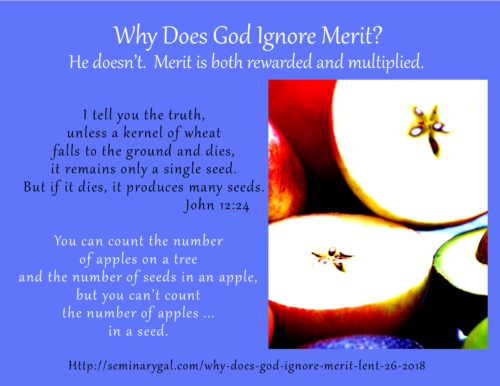
You can count the number of apples on a tree and the number of seeds in an apple, but you can’t count the number of apples in a seed.
 ***
***
Had Edward Kimball not found meaning in his life by teaching the Gospel in Sunday school, who might have preached to the millions way down the line? Merit is a funny thing–visible and hidden–it’s earthly but for the Christian, it’s eternal.
Then as I rewrite portions of my messages for you each day, I learned this morning that Stephen Hawking, renowned physicist and intellectual died. He dismissed a need for God and asserted that “conventional afterlife is a fairy tale for people afraid of the dark.” In the end, his children praised him saying, “He was a great scientist and an extraordinary man whose work and legacy will live on for many years.” True, he beat the odds of his diagnosis and was a respected intellectual, but that’s not the same as the person living on. Fairy tale or sad reality: you can’t take it with you and living on for many years isn’t the same as eternity.
But then there’s Billy Graham whose work carried on until his death and now what he said earlier makes us smile, “Someday you will read or hear that Billy Graham is dead. Don’t you believe a word of it. I shall be more alive than I am now. I will just have changed my address. I will have gone into the presence of God.” And I’m certain an obscure Edward Kimball was there in the huge crowd in heaven to greet him even as Graham’s earthly work and legacy live on.
Why Does God Ignore Merit? He doesn’t. Merit is both rewarded and multiplied by God like a seed. Given only in service to this world, any merit just doesn’t seem to have the same significance, does it?
Food for thought:
- Compare and contrast the legacy and hope in the juxtaposed deaths of Graham and Hawking. Read Mark 8:36 “What good is it for a man to gain the whole world, yet forfeit his soul?” How does merit belong to the earth in a different way than its meaning in the hands of God?
- Read John 12:24 “I tell you the truth, unless a kernel of wheat falls to the ground and dies, it remains only a single seed. But if it dies, it produces many seeds.” How does God reward self-sacrifice and multiply merit?
- Do you ever feel like you’re insignificant? How does God’s multiplication and reward of merit help you to persevere in doing good (Galatians 6:9)?
Join me tomorrow for Why Won’t God Just Make Me Believe?
==
For Lent 2018, we’ll explore the questions of Pi and Chi (the Greek letter beginning the word Christos, which means Christ, Messiah, the Anointed One). We’ll ask and answer the question “Why?” as we discover the uniqueness of Jesus Christ. Join me for the 40 days of Lent which began February 14, 2018 by liking Seminary Gal on Facebook or having these devotionals sent to your email box which you can do via the sign-up on my Home page. Thank you for blessing me with this opportunity to study together the Word of God.
===
Acknowledging that former years’ devotional series remain popular:
- Lent 2013 looked at The Letter to the Romans: Paul’s Masterpiece to reclaim foundations of our Christian heritage and began February 13, 2013.
- A very special and ever popular offering was Lent 2014’s Be Still and Know that I AM God which can be obtained through the archives beginning in March 2014.
- Lent 2015 began on February 18, 2015 with a series entitled With Christ in the Upper Room: Final Preparations. We explored what is often called “The Upper Room Discourse” found in John chapters 13-17.
- ReKindle, the Lent 2016 series, began on February 10, 2016 and encouraged us to rekindle our spiritual lives.
- Light: There’s Nothing Like It was the 2017 Lent series and explored this metaphor often used to portray Christ. It is archived beginning March 1, 2017.
Why Couldn’t We Do It? (Lent 25-2018)
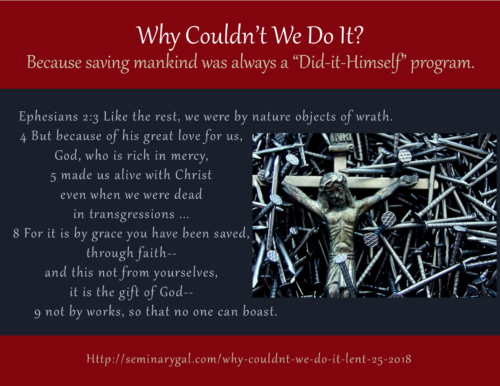
Salvation is not a do-it-yourself program because—even back when it was found only in the mind of God—saving mankind was always a “Did-it-Himself” program.
If there’s one distinguishing feature of Christianity in contrast to all the other world religions, it’s this fact: we cannot earn salvation. We must accept it as a gift of God’s grace.
Whether it’s our piling up good works as philanthropy, doing acts of purging the world of infidels, climbing through levels to inner peace, offering appeasements to placate the angry gods, or even atheism which says it’s a do-it-yourself program of “life stinks and then you die” before becoming food for worms…all of these involve human effort. And each person thinking he’s saving himself, primarily looking out for number 1, yet completely unable to save anyone whether self or others.
The idea of receiving salvation as a gift of grace through faith is a uniquely Christian idea.
Ephesians 2:3 Like the rest, we were by nature objects of wrath. 4 But because of his great love for us, God, who is rich in mercy, 5 made us alive with Christ even when we were dead in transgressions … 8 For it is by grace you have been saved, through faith– and this not from yourselves, it is the gift of God– 9 not by works, so that no one can boast.
 ***
***
In all other religions, men reach up for their god. In Christianity, God reached down and gave us the gift of Jesus and salvation through His sacrifice for our sins on the Cross. Note, however, this was not some gruesome, nasty act of Father God killing his kid, but Jesus—fully God Himself—willingly, lovingly, graciously coming as One sent…not to live…but to die. To intentionally die because it can never be a do-it-yourself program no matter how hard we try.
For further thought:
- At the risk of offending my friends who are Mormon, believing that Jesus was a mere man who was exalted to godhood, this is different than Jesus coming from the Father, His already being fully God. How does God make that truth clear in the Did-it-Himself program of Christ’s perfect sacrifice? Read Hebrews 10:1-18 for insight.
- Is 99% perfect good enough or does it take 100% to be holy?
- On this side of heaven can man alone ever be 100% holy? What made Jesus holy and 100% perfect?
Join me tomorrow for “Why Does God Ignore Merit?”
==
For Lent 2018, we’ll explore the questions of Pi and Chi (the Greek letter beginning the word Christos, which means Christ, Messiah, the Anointed One). We’ll ask and answer the question “Why?” as we discover the uniqueness of Jesus Christ. Join me for the 40 days of Lent which began February 14, 2018 by liking Seminary Gal on Facebook or having these devotionals sent to your email box which you can do via the sign-up on my Home page. Thank you for blessing me with this opportunity to study together the Word of God.
===
Acknowledging that former years’ devotional series remain popular:
- Lent 2013 looked at The Letter to the Romans: Paul’s Masterpiece to reclaim foundations of our Christian heritage and began February 13, 2013.
- A very special and ever popular offering was Lent 2014’s Be Still and Know that I AM God which can be obtained through the archives beginning in March 2014.
- Lent 2015 began on February 18, 2015 with a series entitled With Christ in the Upper Room: Final Preparations. We explored what is often called “The Upper Room Discourse” found in John chapters 13-17.
- ReKindle, the Lent 2016 series, began on February 10, 2016 and encouraged us to rekindle our spiritual lives.
- Light: There’s Nothing Like It was the 2017 Lent series and explored this metaphor often used to portray Christ. It is archived beginning March 1, 2017.
Why Does God Insist on Exclusivity? (Lent 24-2018)
In the Life of Pi that we’ve been using to dig into the Scriptures to answer 40 questions “Why?” Pi responds to his father’s claim that believing in all things is like believing in nothing by saying he wants to be baptized as a Christian.
In case we might be tempted to cheer along with all the angels at the salvation of one who was lost, Pi later on is still crediting Lord Vishnu for providing fish and saving him. For the boy Pi, Jesus was an add-on, not a sole occupant of a heart of worship.
This whole idea of exclusivity and exceptionalism has gotten a bad rap in modern culture. It has morphed into a holier-than-thou-ism which says
I’m better than you.”
It’s a total misunderstanding. It’s not that at all. It’s “I’m a sinner completely unable to save myself. But I follow Christ who can save me.”
Let’s say you accidently drank poison. You didn’t know it at first, but when the symptoms began to show, you and a bunch of other people took notice that unless help arrived, it was going to kill you. Paramedics immediately show up on the scene and want to administer the only known antidote. You say that you don’t like the exclusive claims of antidote. You’d rather try positive thinking and suggestions you found on an Internet search. Most people would think that’s stupid with a capital S. “Take the antidote, you fool!” would be chanted by everyone watching.
There is one (and only one) antidote to sin’s death sentence: Jesus.

***
1 Timothy 2: 3 This is good, and pleases God our Savior, 4 who wants all men to be saved and to come to a knowledge of the truth. 5 For there is one God and one mediator between God and men, the man Christ Jesus, 6 who gave himself as a ransom for all men.
The only question that remains is whether you’re willing to accept the antidote or want to keep looking on the Internet for ways to try.
Food for thought:
- Are you like Pi with Jesus as an add-on to your collection of gods?
- Or are you willing to look beyond culture’s mislabeling of exclusivity as a problem rather than as a known solution?
- Should Christians feel guilty about telling other people about Jesus as the cure?
- In what ways do we value knowing a sure solution in other areas of life and welcome hearing them? Do others get offended when we offer “life hacks” or solutions that work?
Join me tomorrow for “Why Couldn’t We Do It?” and a discussion of DIY salvation programs offered by all other religions.
==
For Lent 2018, we’ll explore the questions of Pi and Chi (the Greek letter beginning the word Christos, which means Christ, Messiah, the Anointed One). We’ll ask and answer the question “Why?” as we discover the uniqueness of Jesus Christ. Join me for the 40 days of Lent which began February 14, 2018 by liking Seminary Gal on Facebook or having these devotionals sent to your email box which you can do via the sign-up on my Home page. Thank you for blessing me with this opportunity to study together the Word of God.
===
Acknowledging that former years’ devotional series remain popular:
- Lent 2013 looked at The Letter to the Romans: Paul’s Masterpiece to reclaim foundations of our Christian heritage and began February 13, 2013.
- A very special and ever popular offering was Lent 2014’s Be Still and Know that I AM God which can be obtained through the archives beginning in March 2014.
- Lent 2015 began on February 18, 2015 with a series entitled With Christ in the Upper Room: Final Preparations. We explored what is often called “The Upper Room Discourse” found in John chapters 13-17.
- ReKindle, the Lent 2016 series, began on February 10, 2016 and encouraged us to rekindle our spiritual lives.
- Light: There’s Nothing Like It was the 2017 Lent series and explored this metaphor often used to portray Christ. It is archived beginning March 1, 2017.
Why Can’t All Religions Lead to God? (Lent 23-2018)
If there was one thing that I found troubling about Life of Pi that we’ve been using to launch our 40 days of asking “Why?” it’s that the movie often feels like a cinematic COEXIST bumper sticker. A religious mumbo jumbo that makes all religions seem equally valid, effective, and here’s a word for you: salvific.
 ***
***
You might think it rests solely with movies. Nope. It’s being combatted at the Vatican too apparently. I recently read a column entitled “In New Document, Vatican Proclaims Jesus As The ‘Only Savior’ of Humanity.” Before all the Christians do a face-palm and utter a collective, “Duh…” it’s apparently not such a no-brainer elsewhere. The article’s author elaborates,
“According to Catholic teaching, this does not mean that only Christians are saved or that all Christians are saved. What it does teach is that no one is saved without Christ.”
A deep apology for my Catholic friends, but wow…this is such an unnecessary complication of matters…all in the name of not being offensive. Oh, and it’s wrong. (ouch)
What is a Christian but an actual Christ-follower? One who displays that best-attempt-at-following Christ Jesus in word and deed? One who displays sorrow and repentance when one fails to live by God’s holiness standard?
John 10:25 Jesus answered, “I did tell you, but you do not believe. The miracles I do in my Father’s name speak for me, 26 but you do not believe because you are not my sheep. 27 My sheep listen to my voice; I know them, and they follow me. 28 I give them eternal life, and they shall never perish; no one can snatch them out of my hand.”
What about that passage gives anyone freedom to say any sheep of Christ’s are not saved? What gives anyone the right to say those who do not believe are also saved through Christ though they do not follow?
The article makes it clear that there’s a reason people complicate what is a very simple issue of following:
“This text received enormous pushback from secularists as well as from a number of Catholics, who claimed the Christian Church’s claim of uniqueness was offensive to followers of other religions. Writing for the LA Times, Richard Boudreaux said that proclaiming Jesus as ‘the sole redeemer’ was ‘expected to stir unease in Asia and other places where Catholics are a tiny minority’ noting that such ‘exclusive language about salvation’ is offensive to Asia’s dominant religions—Buddhism, Hinduism and Islam.”
The world. Getting in the way of following God since Genesis 3.
Food for thought:
- What does it do to the claims of Christ if He can save only some of His true followers with God condemning the rest?
- What does it say about the love of God if only some of Christ’s followers win the salvation lottery?
- What does it say about the power of God if He can’t protect His followers all the way to the end?
We’ll explore this a bit tomorrow with “Why Does God Insist on Exclusivity?”
==
For Lent 2018, we’ll explore the questions of Pi and Chi (the Greek letter beginning the word Christos, which means Christ, Messiah, the Anointed One). We’ll ask and answer the question “Why?” as we discover the uniqueness of Jesus Christ. Join me for the 40 days of Lent which began February 14, 2018 by liking Seminary Gal on Facebook or having these devotionals sent to your email box which you can do via the sign-up on my Home page. Thank you for blessing me with this opportunity to study together the Word of God.
===
Acknowledging that former years’ devotional series remain popular:
- Lent 2013 looked at The Letter to the Romans: Paul’s Masterpiece to reclaim foundations of our Christian heritage and began February 13, 2013.
- A very special and ever popular offering was Lent 2014’s Be Still and Know that I AM God which can be obtained through the archives beginning in March 2014.
- Lent 2015 began on February 18, 2015 with a series entitled With Christ in the Upper Room: Final Preparations. We explored what is often called “The Upper Room Discourse” found in John chapters 13-17.
- ReKindle, the Lent 2016 series, began on February 10, 2016 and encouraged us to rekindle our spiritual lives.
- Light: There’s Nothing Like It was the 2017 Lent series and explored this metaphor often used to portray Christ. It is archived beginning March 1, 2017.
Fourth Sabbath of Lent (2018)
 ***
***
Isaiah 44:3 For I will pour water on the thirsty land, and streams on the dry ground; I will pour out my Spirit on your offspring, and my blessing on your descendants. 4 They will spring up like grass in a meadow, like poplar trees by flowing streams. 5 One will say, ‘I belong to the LORD’; another will call himself by the name of Jacob; still another will write on his hand, ‘The LORD’s,’ and will take the name Israel. 6 “This is what the LORD says– Israel’s King and Redeemer, the LORD Almighty: I am the first and I am the last; apart from me there is no God. 7 Who then is like me? Let him proclaim it. Let him declare and lay out before me what has happened since I established my ancient people, and what is yet to come– yes, let him foretell what will come. 8 Do not tremble, do not be afraid. Did I not proclaim this and foretell it long ago? You are my witnesses. Is there any God besides me? No, there is no other Rock; I know not one.”
===
Devotionals for Lent 2018, Pi and Chi (the Greek letter beginning the word Christos, which means Christ, Messiah, the Anointed One) continue tomorrow in which we’ll ask and answer the question “Why?” and discover the uniqueness of Jesus Christ. Join me for the 40 days of Lent which began February 14, 2018 by liking Seminary Gal on Facebook or having these devotionals sent to your email box which you can do via the sign-up on my Home page. Thank you for blessing me with this opportunity to study together the Word of God.
===
Acknowledging that former years’ devotional series remain popular:
- Lent 2013 looked at The Letter to the Romans: Paul’s Masterpiece to reclaim foundations of our Christian heritage and began February 13, 2013.
- A very special and ever popular offering was Lent 2014’s Be Still and Know that I AM God which can be obtained through the archives beginning in March 2014.
- Lent 2015 began on February 18, 2015 with a series entitled With Christ in the Upper Room: Final Preparations. We explored what is often called “The Upper Room Discourse” found in John chapters 13-17.
- ReKindle, the Lent 2016 series, began on February 10, 2016 and encouraged us to rekindle our spiritual lives.
- .Light: There’s Nothing Like It was the 2017 Lent series and explored this metaphor often used to portray Christ. It is archived beginning March 1, 2017.
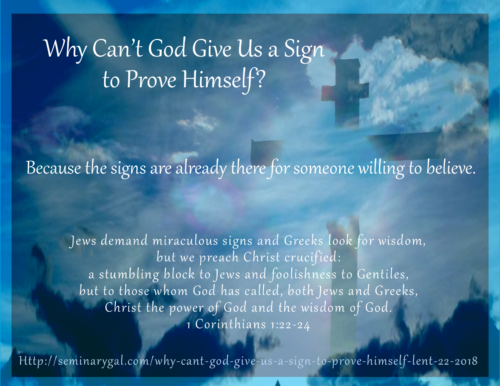
Why Can’t God Give Us a Sign to Prove Himself? (Lent 22-2018)
How often have we heard it?
I’d believe if God gave me a sign or wrote something across the sky so I could know He exists.”
We’re not all like Thomas who got a first-hand experience of the Risen Lord. John 20:27 Then [Jesus] said to Thomas, “Put your finger here; see my hands. Reach out your hand and put it into my side. Stop doubting and believe.” 28 Thomas said to him, “My Lord and my God!” 29 Then Jesus told him, “Because you have seen me, you have believed; blessed are those who have not seen and yet have believed.” 30 Jesus did many other miraculous signs in the presence of his disciples, which are not recorded in this book. 31 But these are written that you may believe that Jesus is the Christ, the Son of God, and that by believing you may have life in his name.
Okay, so we have a lot of signs that have been written in the Bible and we’re told they were written so we’d believe (John 20:30-31). So, why do so many people still refuse to repent and believe?
Jesus tells a story of a rich man and a beggar named Lazarus (not the same Lazarus that rose from the dead). In it, the rich man pleads with Abraham across the great chasm between hell and heaven to send Lazarus saying, “’I have five brothers. Let him warn them, so that they will not also come to this place of torment.’ Abraham replied, ‘They have Moses and the Prophets; let them listen to them.’ “‘No, father Abraham,’ he said, ‘but if someone from the dead goes to them, they will repent.’ “He said to him, ‘If they do not listen to Moses and the Prophets, they will not be convinced even if someone rises from the dead.” (Luke 16:28-31)
God isn’t in the habit of performing tricks at our command.
His request is a simple one: Follow Me, Jesus says. Repent and believe.
The signs are already there for someone willing to believe.
 ***
***
Food for thought:
- Why do some people not want to believe?
- What purpose would a sign accomplish at this point? For further insight, read 1 Corinthians 1:22 Jews demand miraculous signs and Greeks look for wisdom, 23 but we preach Christ crucified: a stumbling block to Jews and foolishness to Gentiles, 24 but to those whom God has called, both Jews and Greeks, Christ the power of God and the wisdom of God.
- What does God think of our demands for a sign? Matthew 16:1 The Pharisees and Sadducees came to Jesus and tested him by asking him to show them a sign from heaven. 2 He replied, “When evening comes, you say, ‘It will be fair weather, for the sky is red,’ 3 and in the morning, ‘Today it will be stormy, for the sky is red and overcast.’ You know how to interpret the appearance of the sky, but you cannot interpret the signs of the times. 4 A wicked and adulterous generation looks for a miraculous sign, but none will be given it except the sign of Jonah.
Join me on Monday for Why Can’t All Religions Lead to God?
==
For Lent 2018, we’ll explore the questions of Pi and Chi (the Greek letter beginning the word Christos, which means Christ, Messiah, the Anointed One). We’ll ask and answer the question “Why?” as we discover the uniqueness of Jesus Christ. Join me for the 40 days of Lent which began February 14, 2018 by liking Seminary Gal on Facebook or having these devotionals sent to your email box which you can do via the sign-up on my Home page. Thank you for blessing me with this opportunity to study together the Word of God.
===
Acknowledging that former years’ devotional series remain popular:
- Lent 2013 looked at The Letter to the Romans: Paul’s Masterpiece to reclaim foundations of our Christian heritage and began February 13, 2013.
- A very special and ever popular offering was Lent 2014’s Be Still and Know that I AM God which can be obtained through the archives beginning in March 2014.
- Lent 2015 began on February 18, 2015 with a series entitled With Christ in the Upper Room: Final Preparations. We explored what is often called “The Upper Room Discourse” found in John chapters 13-17.
- ReKindle, the Lent 2016 series, began on February 10, 2016 and encouraged us to rekindle our spiritual lives.
- Light: There’s Nothing Like It was the 2017 Lent series and explored this metaphor often used to portray Christ. It is archived beginning March 1, 2017.
Why Follow? (Lent 21-2018)
What does following have to do with faith? Well, what is following but one person acting upon a decision to go in the same direction as the leader? A Christian, really, is nothing but a Christ follower in the great tradition of the earliest disciples.
Matthew 4:18 As Jesus was walking beside the Sea of Galilee, he saw two brothers, Simon called Peter and his brother Andrew. They were casting a net into the lake, for they were fishermen. 19 “Come, follow me,” Jesus said, “and I will make you fishers of men.” 20 At once they left their nets and followed him.
Faith. It’s as easy as following.
The movie Life of Pi which we’ve been using for Lent 2018 devotionals shifts today when instead of “Why?” Pi asks, “Why not?” Pi’s father had challenged his mother about Pi’s religious sampling saying, “No Gita, [Pi’s brother] Ravi has a point, no? You cannot follow three different religions at the same time, Piscine.” The young Pi asks, “Why not?” to which his father explains,
Because believing in everything at the same time is the same as not believing in anything at all.”
 ***
***
The action of following makes it abundantly clear: We cannot come to a fork in the road and take it. There’s a point of decision, a choice. To go forward or back, to the left or the right, up or down. To follow one way or another. No one can follow all directions simultaneously. At some point we believe in nothing or all others must fall away, leave one.
Food for thought:
- In what ways do Christians try to follow the world’s ways and Christ’s way at the same time? What causes them to do it?
- Ponder ideas of syncretism and assimilation. If three major monotheistic religions claim the only One True God, how does COEXIST fail every time? Why does it fail?
- This idea of choosing which way to follow goes way back to the early days of the chosen people. Deuteronomy 30:15 See, I set before you today life and prosperity, death and destruction. 16 For I command you today to love the LORD your God, to walk in his ways, and to keep his commands, decrees and laws; then you will live and increase, and the LORD your God will bless you in the land you are entering to possess. 17 But if your heart turns away and you are not obedient, and if you are drawn away to bow down to other gods and worship them, 18 I declare to you this day that you will certainly be destroyed. You will not live long in the land you are crossing the Jordan to enter and possess. 19 This day I call heaven and earth as witnesses against you that I have set before you life and death, blessings and curses. Now choose life, so that you and your children may live 20 and that you may love the LORD your God, listen to his voice, and hold fast to him. For the LORD is your life, and he will give you many years in the land he swore to give to your fathers, Abraham, Isaac and Jacob.
- Joshua 24:15 But if serving the LORD seems undesirable to you, then choose for yourselves this day whom you will serve, whether the gods your forefathers served beyond the River, or the gods of the Amorites, in whose land you are living. But as for me and my household, we will serve the LORD.”
- Who and what do you follow?
Join me next time for “Why Can’t God Give Us a Sign to Prove Himself?”
==
For Lent 2018, we’ll explore the questions of Pi and Chi (the Greek letter beginning the word Christos, which means Christ, Messiah, the Anointed One). We’ll ask and answer the question “Why?” as we discover the uniqueness of Jesus Christ. Join me for the 40 days of Lent which began February 14, 2018 by liking Seminary Gal on Facebook or having these devotionals sent to your email box which you can do via the sign-up on my Home page. Thank you for blessing me with this opportunity to study together the Word of God.
===
Acknowledging that former years’ devotional series remain popular:
- Lent 2013 looked at The Letter to the Romans: Paul’s Masterpiece to reclaim foundations of our Christian heritage and began February 13, 2013.
- A very special and ever popular offering was Lent 2014’s Be Still and Know that I AM God which can be obtained through the archives beginning in March 2014.
- Lent 2015 began on February 18, 2015 with a series entitled With Christ in the Upper Room: Final Preparations. We explored what is often called “The Upper Room Discourse” found in John chapters 13-17.
- ReKindle, the Lent 2016 series, began on February 10, 2016 and encouraged us to rekindle our spiritual lives.
- Light: There’s Nothing Like It was the 2017 Lent series and explored this metaphor often used to portray Christ. It is archived beginning March 1, 2017.