
Attitude Characteristics for Exemplary Christians

tiny-virtues-attitude“I’ve had enough of your attitude!” How many moms can relate to having said that? And it probably isn’t in the context of children being angelic, winsome, agreeable, amenable, or compliant. Attitude probably conveys something more like sass, lip, disrespect, and rebellion. One’s attitude demonstrates the connection of one’s heart and one’s mind in clearer fashion than most attributes.

In its most positive sense, it’s one of the Tiny Virtues for Exemplary Christian Living . Our attitudes display on the outside what our hearts know on the inside. When I think of someone in the Bible whose attitude is virtuous in many ways, Esther is always one who immediately comes to mind. Maybe it’s because I’ve portrayed her character a few times when I’ve done first person narrative preaching (Bible character reenactment). There aren’t a whole lot of women in the Bible for me to do because most don’t come with such a bulk of Scripture to know much about their lives.

The Book of Esther shines with her virtuous attitude.  If you get a chance, read the whole Book of Esther. It doesn’t take long and it tells a great story that encourages both men and women with this heroic exchange as the story’s climax:

Esther 4:9 Hathach [one of Esther’s attendants] went back and reported to Esther what Mordecai [Esther’s cousin] had said. 10 Then she instructed him to say to Mordecai, 11 “All the king’s officials and the people of the royal provinces know that for any man or woman who approaches the king in the inner court without being summoned the king has but one law: that he be put to death. The only exception to this is for the king to extend the gold scepter to him and spare his life. But thirty days have passed since I was called to go to the king.” 12 When Esther’s words were reported to Mordecai, 13 he sent back this answer: “Do not think that because you are in the king’s house you alone of all the Jews will escape. 14 For if you remain silent at this time, relief and deliverance for the Jews will arise from another place, but you and your father’s family will perish.

And who knows but that you have come to royal position for such a time as this?”

15 Then Esther sent this reply to Mordecai: 16 “Go, gather together all the Jews who are in Susa, and fast for me. Do not eat or drink for three days, night or day. I and my maids will fast as you do. When this is done, I will go to the king, even though it is against the law. And if I perish, I perish.” 17 So Mordecai went away and carried out all of Esther’s instructions.

Mordecai had been as a father to the orphaned Esther and he would not have been willing to sacrifice her. His attitude was protective of both his cousin and their people, the Jewish people. But characteristics of Esther’s attitude included her humility, winsomeness, respect, wisdom, bravery, selflessness, and compliance. Her character radiated in her every action and consequently, the king spared her life.  Esther’s actions saved the Jewish people.

Ponder today: How a little bit of good attitude goes a long way in producing positive outcomes.

Bible characters of the day: Esther and her cousin Mordecai
Continue Reading

Authenticity: a Genuine Virtue for Christians

acts 20 transparency authenticityAuthenticity is a most desired virtue.  However desirable, one rarely sees it in the Church no matter how much we talk about it.  All we end up with is the not-so-close facsimile of “too much information.”
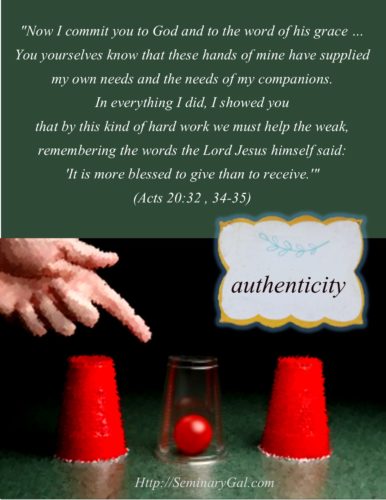
Genuinely authentic people have nothing to hide, but it’s maybe not what you think.

Their lives are transparent because they’ve got a clear conscience and a sure foundation in the grace of God to cover their failures.

Authentic people do not scramble wildly for the nearest excuse. No need to cover their shame.  God already did that.  They know humans are prone to sin, yet forgiveness is possible by God’s grace.  They try to keep from sinning and never parade their flaws as though a display of brokenness is a competitive goal.

In “Has ‘Authenticity’ Trumped Holiness?” the author Brett McCracken asks,

Evangelicalism—both on the individual and institutional level—is trying hard to purge itself of a polished veneer that smacked of hypocrisy. But by focusing on brokenness as proof of our “realness” and “authenticity,” have evangelicals turned “being screwed up” into a badge of honor, its own sort of works righteousness? Has authenticity become a higher calling than, say, holiness?

The Apostle Paul’s final encounter with the Ephesian elders points out how much Paul grasped of a genuine authenticity among the Tiny Virtues for Exemplary Christian Living. He also shows the inescapable connection of transparency to both grace and integrity.

  • Paul authentically displayed his life and character: Acts 20:17 From Miletus, Paul sent to Ephesus for the elders of the church. 18 When they arrived, he said to them: “You know how I lived the whole time I was with you, from the first day I came into the province of Asia. 19 I served the Lord with great humility and with tears, although I was severely tested by the plots of the Jews.
  • He taught fully. Acts 20:20 You know that I have not hesitated to preach anything that would be helpful to you but have taught you publicly and from house to house. 21 I have declared to both Jews and Greeks that they must turn to God in repentance and have faith in our Lord Jesus.
  • He was open about facing hardship. Acts 20:22 “And now, compelled by the Spirit, I am going to Jerusalem, not knowing what will happen to me there. 23 I only know that in every city the Holy Spirit warns me that prison and hardships are facing me. 24 However, I consider my life worth nothing to me, if only I may finish the race and complete the task the Lord Jesus has given me– the task of testifying to the gospel of God’s grace. 25 Now I know that none of you among whom I have gone about preaching the kingdom will ever see me again.
  • His authenticity was on display when he was bold in his preaching and protective in his shepherding. Acts 20:26 Therefore, I declare to you today that I am innocent of the blood of all men. 27 For I have not hesitated to proclaim to you the whole will of God. 28 Keep watch over yourselves and all the flock of which the Holy Spirit has made you overseers. Be shepherds of the church of God, which he bought with his own blood. 29 I know that after I leave, savage wolves will come in among you and will not spare the flock. 30 Even from your own number men will arise and distort the truth in order to draw away disciples after them. 31 So be on your guard! Remember that for three years I never stopped warning each of you night and day with tears.
  • His conscience was clear. Acts 20:32 “Now I commit you to God and to the word of his grace, which can build you up and give you an inheritance among all those who are sanctified. 33 I have not coveted anyone’s silver or gold or clothing. 34 You yourselves know that these hands of mine have supplied my own needs and the needs of my companions. 35 In everything I did, I showed you that by this kind of hard work we must help the weak, remembering the words the Lord Jesus himself said: ‘It is more blessed to give than to receive.'”
  • His authenticity in life and in prayer made him all the more loved. Acts 20:36 When he had said this, he knelt down with all of them and prayed. 37 They all wept as they embraced him and kissed him. 38 What grieved them most was his statement that they would never see his face again. Then they accompanied him to the ship.
What holds you back from genuine authenticity, from knowing true grace, and from displaying integrity in all things?

Ponder today: the interconnection between understanding grace and displaying authenticity

Bible characters of the day: Paul and the Ephesian elders

Continue Reading

Art of Savoring: a Tiny Virtue

I wish I were better at savoring life’s moments. How much of my life would have been different, better even, had I chosen to savor the moment I was in rather than wishing it away or looking perpetually ahead on the calendar of life? If only the babies would grow up and stop needing diaper changes. If only the kids could drive themselves to their activities. If only they would stop asking for homework help, just graduate and get a job. If only my degree was completed and I could do ministry. If only…

Never savoring the moment while I had it. It doesn’t mean I was loveless or totally devoid of gratitude or enjoyment. I just never truly savored…really treasured…that time the way I should.

There’s a scene in The Field of Dreams that I use for a lot of theological illustrations. Dr. Archibald “Moonlight” Graham reflects,

We just don’t recognize life’s most significant moments while they’re happening. Back then I thought, ‘Well, there’ll be other days.’ I didn’t realize that that was the only day.”

tiny-virtues-savoringSavoring Today.  As we continue our look at the Tiny Virtues for Exemplary Christian Living, maybe savoring isn’t so much a lost art as it is the flipside of a human failing. Because we can only see the past and the present, the future is for romantics and dreamers. The past can be romantic, too, like nostalgia in which a lot of the bad melts away and we primarily remember the beauty and the good. But the present? Rather than savoring the moment, we seem to be…in it…only to endure it.  Savoring is a tiny jewel among the virtues for exemplary Christians.  It’s an art form in miniature.

Jesus and His mother Mary both understood savoring.  I’d like to be better at savoring that way. Mary had a string of ponderings, astonishments, and savoring at the time of Jesus’ birth and throughout His early years. (Luke 2:1-51)

Jesus knew how to savor. Luke 22: 14 When the hour came, Jesus and his apostles reclined at the table. 15 And he said to them, “I have eagerly desired to eat this Passover with you before I suffer. 16 For I tell you, I will not eat it again until it finds fulfillment in the kingdom of God.” 17 After taking the cup, he gave thanks and said, “Take this and divide it among you. 18 For I tell you I will not drink again of the fruit of the vine until the kingdom of God comes.”

Ponder today: what you can savor in this moment and how to make savoring a part of your daily experience

Oh, how I love your law! I meditate on it all day long. How sweet are your words to my taste, sweeter than honey to my mouth! Psalm 119:97, 103

Bible characters of the day: Jesus and His mother Mary

Continue Reading

Receiving Criticism Well–a Tiny Virtue

How good are you at receiving criticism? If you’re like me, that question brings a decided “Ouch!” As we transition from the tiny virtues of the heart to the tiny virtues of the mind, we cannot help but see that our hearts and our minds have a certain connection. Our minds do not exist independently from our hearts.

When someone has a critique to offer, what is your default response?

  • tiny-virtues-criticismTo listen carefully and examine your heart to see if it applies?

  • To reciprocate and find fault in the fault-finder?
  • To lash out in anger?
  • Or do you just feel wounded?

Sure, it can depend on who is offering the criticism and the heart (or lack of heart) with which the person offers it. But for some of us, it’s just really hard to accept criticism and let it change us for the better. I submit to you that chronically rejecting criticism is a pride-response.

The proud heart and proud intellect hate to admit that he or she is wrong.

That’s the bad news. But the good news is that we can grow in these Tiny Virtues for Exemplary Christian Living and learn how to receive criticism in a godly way.

* * *

He is on the path of life who heeds instruction, But he who forsakes reproof goes astray.” (Proverbs 10:17)

We could all learn from a man like Apollos about how to receive criticism.

Acts 18:24 Meanwhile a Jew named Apollos, a native of Alexandria, came to Ephesus. He was a learned man, with a thorough knowledge of the Scriptures. 25 He had been instructed in the way of the Lord, and he spoke with great fervor and taught about Jesus accurately, though he knew only the baptism of John. 26 He began to speak boldly in the synagogue. When Priscilla and Aquila heard him, they invited him to their home and explained to him the way of God more adequately. 27 When Apollos wanted to go to Achaia, the brothers encouraged him and wrote to the disciples there to welcome him. On arriving, he was a great help to those who by grace had believed. 28 For he vigorously refuted the Jews in public debate, proving from the Scriptures that Jesus was the Christ.

Apollos had every reason to reject criticism. He was learned with a thorough knowledge. He had been instructed and spoke with great passion and accuracy. But he was missing some details. Perhaps Priscilla and Aquila were gracious beyond words and encouraged him privately in the way of God. The Scriptures say they “explained…more adequately.” They didn’t admonish or correct with a heart of superiority. But they did offer criticism and instruction. And Apollos received it well.

Ponder today: how you can be better at offering and receiving criticism

Bible characters of the day: Apollos, Priscilla, and Aquila.

Continue Reading

Respect: the Earned Virtue for Exemplary Christians

Respect is earned. That’s a tough lesson for many of us. It’s earned by position (e.g. parents, government officials, doctors, pastors, etc.) and it’s earned by people with their actions. Because respect is earned, it can be lost. It can be lost by individuals not acting in accordance with their position, abusing authority as it were. It can be lost by institutions through systemic corruption, chronic failure, or the high-visibility sinning of a prominent leader.

tiny-virtues-respectThere are a lot of people out there thinking that respect is owed no matter what.  They demand it… from others… as if it’s only Romans 13:7 “Give everyone what you owe him: If you owe taxes, pay taxes; if revenue, then revenue; if respect, then respect; if honor, then honor” and has nothing to do with their actions.  They forget the “if” precedes respect and integrity is the glue that holds institutions together when enough corruption has weakened the institution. For that reason, we can remove rogue policemen from the force without condemning all policemen. We can remove false teachers from the pastorate without bulldozing the Church.

Respect is one of the Tiny Virtues for Exemplary Christian Living seen best when we examine our hearts closely. The Bible tells the story of a woman who had been bleeding for twelve years. She’d lost all respect for the institutions that had taken her money but hadn’t given her any relief from her condition.

Mark 5: 26 She had suffered a great deal under the care of many doctors and had spent all she had, yet instead of getting better she grew worse. 27 When she heard about Jesus, she came up behind him in the crowd and touched his cloak, 28 because she thought, “If I just touch his clothes, I will be healed.” 29 Immediately her bleeding stopped and she felt in her body that she was freed from her suffering. 30 At once Jesus realized that power had gone out from him. He turned around in the crowd and asked, “Who touched my clothes?”

Maybe it was her desperation. Maybe she had tremendous faith and respect for Jesus as a healer of people. A respect that was both by His position as Rabbi but also earned by His reputation as Healer. She felt the power of Christ and knew He was worthy of respect.

The passage continues Mark 5: 31 “You see the people crowding against you,” his disciples answered, “and yet you can ask, ‘Who touched me?'” 32 But Jesus kept looking around to see who had done it. 33 Then the woman, knowing what had happened to her, came and fell at his feet and, trembling with fear, told him the whole truth. 34 He said to her, “Daughter, your faith has healed you. Go in peace and be freed from your suffering.”

Jesus wouldn’t let it go without commending her faith and sealing her healing. Jesus wanted to reward the respect she’d shown Him by her publically coming forward in truth, gratitude, and humility.

Ponder today: the foundation of respect and how you demonstrate it.

Bible character of the day: the woman who reached out for Jesus’ healing

Continue Reading

Empathy-a Tiny Virtue to Develop

tiny-virtues-empathy“You don’t know what it’s like because you’re not black,” he chided me angrily. I suggested to him that I could, however, empathize with the pain of discrimination because I have experienced it as a woman. Same sin, different target, I explained. He wasn’t buying it. Empathy is one of the Tiny Virtues for Exemplary Christian Living and it refers to the ability to connect personally with the issue at hand.
We are not born with empathy. We develop it as one of those exemplary heart virtues that we’ve been seeing under the microscope.

Empathy differs from sympathy in a heart location sense. Empathy is being present in the story—in the same pit– as if it were happening to you. Sympathy is looking down from the rim of the pit and having feelings about the pit and the people stuck in it.

Remember the 33 coal miners who were rescued in Chile?

Empathy brought them out. Sympathy was watching it on TV and being captivated by it. But empathy does the miraculous and this article highlights some things you may not know about the efforts to free them.

There’s a great story in the Bible that exemplifies this virtue called empathy and its connection to rescue.

Mark 2:1 A few days later, when Jesus again entered Capernaum, the people heard that he had come home. 2 So many gathered that there was no room left, not even outside the door, and he preached the word to them. 3 Some men came, bringing to him a paralytic, carried by four of them. 4 Since they could not get him to Jesus because of the crowd, they made an opening in the roof above Jesus and, after digging through it, lowered the mat the paralyzed man was lying on. 5 When Jesus saw their faith, he said to the paralytic, “Son, your sins are forgiven.” … 13 Once again Jesus went out beside the lake. A large crowd came to him, and he began to teach them. 14 As he walked along, he saw Levi son of Alphaeus sitting at the tax collector’s booth. “Follow me,” Jesus told him, and Levi got up and followed him. 15 While Jesus was having dinner at Levi’s house, many tax collectors and “sinners” were eating with him and his disciples, for there were many who followed him. 16 When the teachers of the law who were Pharisees saw him eating with the “sinners” and tax collectors, they asked his disciples: “Why does he eat with tax collectors and ‘sinners’?” 17 On hearing this, Jesus said to them, “It is not the healthy who need a doctor, but the sick. I have not come to call the righteous, but sinners.”

The four men who carried the paralytic empathized with his plight. As true friends, they lowered him through the roof in order for him to be healed by Jesus. But in an interesting sense, the passage continues.  It’s connected to what follows with the teachers of the law being disgusted that Jesus would fraternize with people they viewed as beneath them. The Pharisees might have sympathized with the plight of sinners and looked to the Law for ways of dealing with them, but Jesus—the Son of God—came down. Into our pit. He ate with sinners. He called them to Himself. He empathized with our plight as sinners though He never ever sinned. Not even once.  That is how He rescued us.

Praise the LORD, O my soul, and forget not all his benefits–who forgives all your sins and heals all your diseases, who redeems your life from the pit. (Psalm 103:2-4)

Ponder today: how to develop empathy

Bible characters of the day: the friends of the paralytic

Continue Reading

Nurturing-a Hallmark of Exemplary Christians

Nurturing is not a hallmark of wimps—it’s the calling card of the forever dedicated.

tiny-virtues-nurturingI have been thinking a lot about Colin Kaepernick and what he has brought on himself–the sadness and controversy he has thrust upon this nation–by his poor choice of timing. His actions needed nurturing by those around him so Colin would have chosen better– to make a huge difference instead of just a big stink. About his adoptive parents,

“They agree with what I’m standing for,” Colin Kaepernick told USA TODAY Sports Wednesday at the 49ers’ practice facility in Santa Clara, about a two-hour drive from his parents’ house.

“Once again, it’s not a protest against America. It’s a protest against oppression and injustices and the equality that’s not being given to all people.”

Kaepernick’s parents declined to comment, with Teresa Kaepernick saying,

It’s not in our best interest or Colin’s best interest.”

Hmmmm. Nurturing and training go hand in hand. Colin’s birth mother Heidi Russo has commented via Twitter that his desire to press for social justice can be better expressed in other ways and at other times.

Colin is in a position to do something meaningful about oppression, injustice, and inequality. He could take a page from LeBron James’ playbook “Cleveland Hustles”  and be a role model, using his wealth and his celebrity to organize like-minded celebrity individuals to give those oppressed a hand of actual help up instead of a collective knee for the anthem. Protesting isn’t nearly as productive as nurturing. Protesting makes him a goat. Nurturing would turn him back to being a hero in his hometown.

Particularly in an age of absentee fatherhood, genuine nurturing is a biblical trait for men (and women)—it’s one of the Tiny Virtues for Exemplary Christian Living.. And that nurturing doesn’t stop when our children reach adulthood. A hands-off approach only fosters loveless actions but our continued hand up for the downed player coaches the best in our family members and it only makes us all better. It’s the goal of nurturing.

The Apostle Paul knew how to nurture.  He wasn’t a pushover or neglectful.  He was intentional about his nurturing in every way.

I do all this for the sake of the gospel that I may share in its blessings. Do you not know that in a race all the runners run, but only one gets the prize? Run in such a way as to get the prize. Everyone who competes in the games goes into strict training. They do it to get a crown that will not last; but we do it to get a crown that will last forever. (1 Corinthians 9:23-25)

Ponder today: the negativity inherent in protest and the positive impact of nurturing someone’s best interests

Bible character of the day: the Apostle Paul

Continue Reading

Remembering 9/11 with a Tender Heart

tiny-virtues-tender-hearted 9/11 memorial never forgetToday is the 15th anniversary of the terror attack upon the Twin Towers of the World Trade Center. Any of us alive and of an age to remember anything probably remember how we felt, where we were, and the deep, deep sorrow for a world that had-in a span of dark minutes-breached every code of human decency. Remembering this event arouses not only a righteous anger against that kind of evil, but it also stirs the wellspring of love and compassion in the soul and spirit of the tender-hearted. Of the exemplary Christian.

Tender-hearted people never grow stale in their love, their empathy, or their sorrow. The tiny virtue of a tender heart is the evergreen source of the bigger virtues of love and compassion.

A tender heart we cannot see but for its outflow.

And be kind to one another, tender-hearted, forgiving each other, just as God in Christ also has forgiven you. (Ephesians 4:32)

Mary Magdalene had that kind of tender heart. In John 20:1-18, she discovers that the stone has been removed from the entrance to the tomb in which Jesus was buried. She was so distressed, she ran all the way to tell the disciples Peter and John. They came, they saw, they left…confused. Mary didn’t leave. Her tender heart caused her to cry. Moved with love, overcome by sorrow, she just stood there weeping. Her heart reached beyond the fact of death and the reality of the grave. Jesus met her there and spoke the Good News to this beautiful woman that He is risen. Death and the grave couldn’t hold Him down.  Because of His victory over evil, death and the grave can’t hold Christians down either.

As we continue to honor the lives of the men and women who died on 9/11, we will see the phrase #NeverForget. We remember the lives which have been lost, the bravery of those who loved others more than themselves, the people living through the daily hell of remembering that day in which their lives were forever changed, the children who have grown up with this as their family’s story, and the nation with deep wounds carved with a jagged knife of evil but capable of being healed by the powerful hand of God. Day by day, may God bless us with hearts that do not grow weary. Let us not grow cold. Let us not be moved from that powerful tiny place of a tender heart from which flows all kindness, love, compassion, and yes, forgiveness.

Ponder today: how a tender heart is evergreen

Bible character of the day: Mary Magdalene

Continue Reading

Ten Traits of Virtuous Listening

tiny-virtues-listeningI cannot deny that Mary chose better. She chose listening (Luke 10:38-42). Of course way too many people in ministry like to take this story and turn it into the biblical equivalent of “Why can’t you be like your sister?”  Martha was working out her faith while Mary was listening.
Being a task-oriented person myself, I can kind of relate to Martha. It takes effort to be a good listener (and not simply listen in order to problem solve or have an answer to offer). Jesus tenderly gives Martha the encouragement to make that effort. To listen while she has the once-in-a-lifetime opportunity. Martha can serve Christ forever, but listening to Him face-to-face? After He ascends to heaven, those opportunities vanish. Mary chose to listen.  And listening was better.

Listening is one of the Tiny Virtues for Exemplary Christian Living. Most of us don’t listen well, but we would be served well by learning the virtue of listening.

We’re still magnifying the tiny virtue of friendship to see the inner workings of how to be an exemplary friend. Listening is a good friendship skill. Plenty of sources describe good listening as something like

  • Stop talking, relax and come prepared to listen.
  • Make the speaker feel comfortable by removing distractions.
  • Get your attitude right. Empathize. Be patient. Avoid prejudice and judgment.
  • Listen to the tone and ideas, not just words
  • Observe non-verbal communication

Helpful in business or in counseling, perhaps, but it does nothing to help someone distinguish good listening from bad. Good listening is not to be confused with being a “vent-recipient” as someone calls just to spew their spleen and sin over the wireless and you just simply take it in, absorbing what they have to offer. That’s what the scapegoat was for. Good listening isn’t the precursor for good gossip. And good listening isn’t buying lies out of a misguided politeness or lack of discernment.

The Bible gives us some pretty clear instruction on listening…the dos and don’ts from God’s perspective.

  1. Prioritize listening– James 1:19 My dear brothers, take note of this: Everyone should be quick to listen, slow to speak and slow to become angry.
  2. Let go of pride– Philippians 2:3 Do nothing out of selfish ambition or vain conceit, but in humility consider others better than yourselves.
  3. Reject your inner apathy– 1 Corinthians 12:26 “If one part suffers, every part suffers with it; if one part is honored, every part rejoices with it.” Galatians 6:2 “Carry each other’s burdens, and in this way you will fulfill the law of Christ.”
  4. Listen to act– Luke 11:28 Jesus replied, “Blessed rather are those who hear the word of God and obey it.” James 1:22 “Do not merely listen to the word, and so deceive yourselves. Do what it says.”
  5. Listen to learn–Proverbs 16:20 “Whoever gives heed to instruction prospers, and blessed is the one who trusts in the Lord.”
  6. Be cautious with secrets- Luke 12:3 “What you have said in the dark will be heard in the daylight, and what you have whispered in the ear in the inner rooms will be proclaimed from the roofs.”
  7. Don’t gossip– Proverbs 11:13 “A gossip betrays a confidence, but a trustworthy man keeps a secret.” Proverbs 20:19 “A gossip betrays a confidence; so avoid a man who talks too much.”
  8. Distinguish the spirit of what you’re hearing. 1 Peter 3:15 “But in your hearts set apart Christ as Lord. Always be prepared to give an answer to everyone who asks you to give the reason for the hope that you have. But do this with gentleness and respect, 16 keeping a clear conscience, so that those who speak maliciously against your good behavior in Christ may be ashamed of their slander.”
  9. Put a stop to what is being spoken if it is ungodly or untrue. Don’t feed your mind what is evil. Ephesians 4: 21 Surely you heard of him and were taught in him in accordance with the truth that is in Jesus. 22 You were taught, with regard to your former way of life, to put off your old self, which is being corrupted by its deceitful desires; 23 to be made new in the attitude of your minds; 24 and to put on the new self, created to be like God in true righteousness and holiness. 25 Therefore each of you must put off falsehood and speak truthfully to his neighbor, for we are all members of one body. .. 29 Do not let any unwholesome talk come out of your mouths, but only what is helpful for building others up according to their needs, that it may benefit those who listen. 30 And do not grieve the Holy Spirit of God, with whom you were sealed for the day of redemption. 31 Get rid of all bitterness, rage and anger, brawling and slander, along with every form of malice.”
  10. Remember to listen to Jesus and hear what He says. Matthew 13: 13 This is why I speak to them in parables: “Though seeing, they do not see; though hearing, they do not hear or understand. 14 In them is fulfilled the prophecy of Isaiah: … 15 For this people’s heart has become calloused; they hardly hear with their ears, and they have closed their eyes. Otherwise they might see with their eyes, hear with their ears, understand with their hearts and turn, and I would heal them.’ 16 But blessed are your eyes because they see, and your ears because they hear. 17 For I tell you the truth, many prophets and righteous men longed to see what you see but did not see it, and to hear what you hear but did not hear it.

Listening can make or break a friendship.  Sometimes a broken friendship among people must happen for a relationship of purity with God to continue.  One thing’s for sure, if you hear the Master’s voice, listen and obey.

Ponder today: any instance of listening in which you should have stopped and instances where you could have listened better.  Ask God to teach you to listen well.

Bible character of the day: Mary

Continue Reading

Help-a Tiny Christian Virtue in 360 Exemplary Degrees

No one has to teach us how to cry for help. We need to make a concerted effort to offer it. Help is among the Tiny Virtues for Exemplary Christian Living and sometimes we need a little help learning how …to help.

(Cue the Beatles):

  • Help, I need somebody
  • Help, not just anybody
  • Help, you know I need someone, help
  • When I was younger, so much younger than today
  • I never needed anybody’s help in any way
  • But now these days are gone, I’m not so self-assured
  • Now I find I’ve changed my mind and opened up the doors
  • Help me if you can, I’m feeling down
  • And I do appreciate you being ‘round
  • Help me, get my feet back on the ground
  • Won’t you please, please help me
  • And now my life has changed in oh so many ways
  • My independence seems to vanish in the haze
  • But every now and then I feel so insecure
  • I know that I just need you like I’ve never done before
  • Help me if you can, I’m feeling down
  • And I do appreciate you being ‘round
  • Help me, get my feet back on the ground
  • Won’t you please, please help me
  • When I was younger, so much younger than today
  • I never needed anybody’s help in any way
  • But now these days are gone, I’m not so self-assured
  • Now I find I’ve changed my mind and opened up the doors
  • Help me if you can, I’m feeling down
  • And I do appreciate you being ‘round
  • Help me, get my feet back on the ground
  • Won’t you please, please help me, help me, help me

tiny-virtues-helpAccording to the Beatles, we need help when we’re old, when we’re lacking confidence, when we’re lonely, when we’re down, when we have a tendency to rely only upon ourselves but suddenly find that we’re not enough, and when we lose our footing in life.

The exemplary Christian doesn’t need to be asked before offering help. Barnabas was such a man.

In Acts 4:32-37, we read that no one has any needs because these exemplary Christians helped in advance. Barnabas was so outstanding, his nickname is Son of Encouragement. He’s Mr. Joseph Helperson.

Acts 4:36 Joseph, a Levite from Cyprus, whom the apostles called Barnabas (which means Son of Encouragement), 37 sold a field he owned and brought the money and put it at the apostles’ feet.

He shows up repeatedly in the Book of Acts as a person who helps, who encourages, and whose life was extraordinary in this tiny virtue. Looking at help in 360 exemplary degrees, Barnabas lives it out in the fullest sense, helping those who need instruction, warning, encouragement, strength, resources, and patience.

He lives out this verse as an example to us:  1 Thessalonians 5:14 And we urge you, brothers, warn those who are idle, encourage the timid, help the weak, be patient with everyone.

So what about you? Which of those degrees of help is hardest for you to offer?

Ponder today: the 360 degree nature of help

Bible character of the day: Barnabas

Continue Reading