Category: Articles and Devotionals
A selection of devotionals written by Barbara Shafer.
Making the Theological Understandable
A selection of devotionals written by Barbara Shafer.
 The Incarnation was a very costly move.
Why?
The Bible tells us that the Incarnation is the perfect expression and revelation of Divine Love. And strange as it seems, love and sacrifice are intimately connected.
John 3:16 “For God so loved the world that he gave his one and only Son, that whoever believes in him shall not perish but have eternal life.
1 John 4:9 This is how God showed his love among us: He sent his one and only Son into the world that we might live through him. 10 This is love: not that we loved God, but that he loved us and sent his Son as an atoning sacrifice for our sins
It’s Christmastime and many people give gifts to those they love. My son, remarking on how many of his friends are getting engaged this Christmas recently wrote, “Engagement Season…because nothing says ‘I Love You!’ like seasonality.”
The truth is that Christmas is a time of Love coming to mankind.
And Easter is when it was shown in its fullness.
Thought for the day: Love gave the gift of the Incarnation. The Incarnation is the gift of perfect Love.
Questions for reflection:
======
Incarnation (2015 Advent Devotional Series) began November 29th. By way of reminder, if you haven’t signed up yet, you can receive these devotional studies in your email throughout Advent 2015 by entering your email address on the SeminaryGal.com home page in the space provided in the sidebar. Or “Like” the SeminaryGal Facebook page to access them there. If you like these devotionals, I’d really appreciate your letting others know so I can continue to spread the Good News far and wide. Blessings to you, in Christ always, Barbara <><
The Incarnation was God’s answer and man’s only hope. If anything created could have saved us, then God was a fool to do it Himself.
 Think about that statement for a moment.
Now think about all the things we think are going to save us:
Certainly you can add your own ideas to that list.
Unless God is the only point of hope for you, the list contains created things. Even if some of the created things were done by created beings. And yet think about it: none of those created things are going to save us.
Death still happens because sin still happens. And why does sin still happen? Because we have a sin nature.
It takes God to redeem our sin nature. And here is our hope…not in something created, but in the Eternal Word made flesh. Our Hope is in Christ Jesus.
In His Incarnation. Nothing created could do it. So, God did it Himself.
Thought for the day: God’s holiness and our sin are such opposing opposites that God had to save us Himself.
Questions for reflection:
======
Incarnation (2015 Advent Devotional Series) began November 29th. By way of reminder, if you haven’t signed up yet, you can receive these devotional studies in your email throughout Advent 2015 by entering your email address on the SeminaryGal.com home page in the space provided in the sidebar. Or “Like” the SeminaryGal Facebook page to access them there. If you like these devotionals, I’d really appreciate your letting others know so I can continue to spread the Good News far and wide. Blessings to you, in Christ always, Barbara <><
Jesus, as a man, was not only an Image bearer of God, He is the Image of God.
Colossians 1:15 He is the image of the invisible God, the firstborn over all creation. 16 For by him all things were created: things in heaven and on earth, visible and invisible, whether thrones or powers or rulers or authorities; all things were created by him and for him. 17 He is before all things, and in him all things hold together. 18 And he is the head of the body, the church; he is the beginning and the firstborn from among the dead, so that in everything he might have the supremacy. 19 For God was pleased to have all his fullness dwell in him, 20 and through him to reconcile to himself all things, whether things on earth or things in heaven, by making peace through his blood, shed on the cross.
Hebrews 1:3 The Son is the radiance of God’s glory and the exact representation of his being, sustaining all things by his powerful word.
Jesus was Incarnated in human flesh in order to rescue the Image of God from mortality. It was through Jesus’ humanity that God would reconcile man and all the rest of creation groaning under the weight of human sin…and reconcile to Himself these things through Jesus’ blood shed on the cross.
Thought for the day: No other man bears God’s Image the way Jesus did. Jesus is God’s Perfect Image, His Perfect Reflection, and His Perfect Revelation.
Questions for pondering:
 significance that Jesus IS the very Image of God?
======
Incarnation (2015 Advent Devotional Series) began November 29th. By way of reminder, if you haven’t signed up yet, you can receive these devotional studies in your email throughout Advent 2015 by entering your email address on the SeminaryGal.com home page in the space provided in the sidebar. Or “Like” the SeminaryGal Facebook page to access them there. If you like these devotionals, I’d really appreciate your letting others know so I can continue to spread the Good News far and wide. Blessings to you, in Christ always, Barbara <><
Strange, isn’t it, to think that Jesus still has a body? Once incarnated, He would have a body forever. No return to being some sort of spirit minus a body like the Father or the Holy Spirit. No return to being uncontained, as it were.
My first thought as I was pondering this was a song by the Talking Heads titled “And She Was”—a rock tune written by David Byrne. In talking about his inspiration for this song, he wrote, “I used to know a blissed-out hippie-chick in Baltimore…She once told me that she used to do acid (the drug, not music) and lay down on the field by the Yoo-hoo chocolate soda factory. Flying out of her body, etc., etc. It seemed like such a tacky kind of transcendence… but it was real! A new kind of religion being born out of heaps of rusted cars and fast food joints. And this girl was flying above it all, but in it too.”
 Okay, that’s pretty weird.
Jesus didn’t have an out-of-body or rather in-the-body experience as some sort of drug-induced trip from which He’d return to reality. Nope. For Him, He existed before all time and then, in God’s perfect timing, He added full humanity to His full divinity and it would be a forever thing.
The Infinite would gain—through the Son’s Incarnation—the experience of being finite. (Aw go ahead and say, “Whoaaaaa”)
The experience of death. (Whoaaaa.) The experience of knowing what created beings feel and know…even if Jesus was never created.
Jesus was Incarnated—in part—to experience full humanity. (Whoaaaa…)
Thought for the day: Once Jesus was Incarnated, He would be the Word made Flesh. There would be no Flesh going back and returning as simply the Word.
Questions for reflection:
======
Incarnation (2015 Advent Devotional Series) began November 29th. By way of reminder, if you haven’t signed up yet, you can receive these devotional studies in your email throughout Advent 2015 by entering your email address on the SeminaryGal.com home page in the space provided in the sidebar. Or “Like” the SeminaryGal Facebook page to access them there. If you like these devotionals, I’d really appreciate your letting others know so I can continue to spread the Good News far and wide. Blessings to you, in Christ always, Barbara <><
We cannot get into the mind of God to know why He does things, but the good news is He tells us all that we need to know. The Incarnation is mysterious. He doesn’t expect us to know how He did it.
 How can God simultaneously be the Son of God and the Son of Man? Isn’t it a contradiction?
No, it’s a mystery.
God even tells us so.
Isaiah 9:6 For to us a child is born, to us a son is given, and the government will be on his shoulders. And he will be called Wonderful Counselor, Mighty God, Everlasting Father, Prince of Peace.
A finite human child is born who is the everlasting Father.
To us a son is given (the Son of Man) and yet He’s also called Mighty God (the Son of God).
How can a child be the Father or how can the Son of Man be God Himself?
Jesus’ mother Mary even asked how God was going to do it. God didn’t tell her specifics.
He only had an angel reassure her.
Luke 1:30 But the angel said to her, “Do not be afraid, Mary, you have found favor with God. 31 You will be with child and give birth to a son, and you are to give him the name Jesus. 32 He will be great and will be called the Son of the Most High. The Lord God will give him the throne of his father David, 33 and he will reign over the house of Jacob forever; his kingdom will never end.” 34 “How will this be,” Mary asked the angel, “since I am a virgin?” 35 The angel answered, “The Holy Spirit will come upon you, and the power of the Most High will overshadow you. So the holy one to be born will be called the Son of God. 36 Even Elizabeth your relative is going to have a child in her old age, and she who was said to be barren is in her sixth month. 37 For nothing is impossible with God.
This is the mystery of the Incarnation. Fully God. Fully human. Full of logical inconsistencies from a human rational perspective and yet, to God it is no conundrum, no riddle, and no inconsistency. It’s a mystery to us, but not to Him.
1 Timothy 3:16 Beyond all question, the mystery of godliness is great: He appeared in a body, was vindicated by the Spirit, was seen by angels, was preached among the nations, was believed on in the world, was taken up in glory.
Thought for the day. The mystery of the Incarnation is a wedge of faith. It divides those willing to let it be a mysterious truth from those who refuse to accept anything unless it can be understood.
Questions for reflection:
======
Incarnation (2015 Advent Devotional Series) began November 29th. By way of reminder, if you haven’t signed up yet, you can receive these devotional studies in your email throughout Advent 2015 by entering your email address on the SeminaryGal.com home page in the space provided in the sidebar. Or “Like” the SeminaryGal Facebook page to access them there. If you like these devotionals, I’d really appreciate your letting others know so I can continue to spread the Good News far and wide. Blessings to you, in Christ always, Barbara <><
 So, was the Incarnation God’s “Plan B” after Adam and Eve went AWOL and became rogue humans?
Nope. It was the plan all along.
Even before He created Adam and Eve.
It was pre-existing.
Perhaps it seems rather odd to you that God would plan to send Jesus to die before He created the ones who would bring death into the picture. Yeah. It is rather strange. Especially since God is all about life.
John 1:4 In him was life, and that life was the light of men.
And yet, He contemplated human mortality and prepared His solution to it. He knew we’d rebel and yet He created us anyway.
In the Godhead (Father, Eternal Word, Holy Spirit), there was no death, only life and life-giving. Yet Scripture says,
Ephesians 1:4 For he chose us in him before the creation of the world to be holy and blameless in his sight. In love 5 he predestined us to be adopted as his sons through Jesus Christ, in accordance with his pleasure and will– 6 to the praise of his glorious grace, which he has freely given us in the One he loves.
God’s choice to redeem us as holy and blameless—rebels though we have been—was a choice God made even before Creation. It was pre-existing. And our God who is all about life would bring about eternal life for us through His Son’s Incarnation and death for us.
Thought for the day: The very same God who is all about life and gave us life at Creation—even knowing that we’d bring death into the picture–would give us the Incarnation as His solution to human mortality. In doing so, He amplified the beauty of eternal life through the ugliness of death.
Questions for reflection:
======
Incarnation (2015 Advent Devotional Series) began November 29th. By way of reminder, if you haven’t signed up yet, you can receive these devotional studies in your email throughout Advent 2015 by entering your email address on the SeminaryGal.com home page in the space provided in the sidebar. Or “Like” the SeminaryGal Facebook page to access them there. If you like these devotionals, I’d really appreciate your letting others know so I can continue to spread the Good News far and wide. Blessings to you, in Christ always, Barbara <><
Why Incarnation? Why not some other way?
Well, the truth is, there was no other way possible.
Today, we’ll look at the first of the reasons why it was the only possibility. The first hint of the Incarnation—the first occurrence of the Gospel in the Bible—was proclaimed, prophesied to mankind. But it was also a shot across the bow to the serpent all the way back in Genesis 3:15 “And I will put enmity between you and the woman, and between your offspring and hers; he will crush your head, and you will strike his heel.”
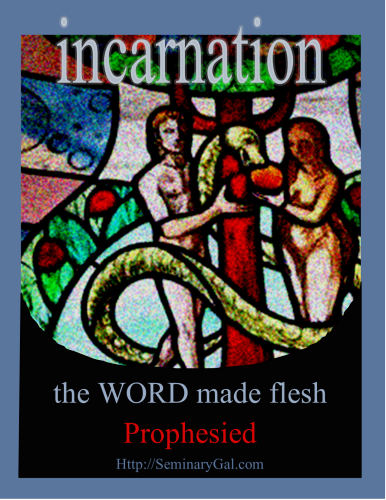 Adam and Eve used to be in the Garden of Eden, naked as the day they were created. But then they disobeyed God, they rebelled against Him and they reaped the consequences that God told them ahead of time were going to happen.
Boom. Mortality.
Genesis 2:16 And the LORD God commanded the man, “You are free to eat from any tree in the garden; 17 but you must not eat from the tree of the knowledge of good and evil, for when you eat of it you will surely die.”
Once mortality happens, there’s no going back. Not even for God. There’s no rewind, do over, replay, or sending the video up to a booth for an official review. Why? Because God saw the play, the promised consequences happened (cause and effect!), and now Adam and Eve are mortals with a sin nature and they die. They surely die. While it may mean the end of their lives, it’s surely not the end of our story.
Hope is as sure as God’s promise…which is as sure as it gets. Why?
Boom. Love.
God enters the picture with a promise—a prophecy—telling humanity that there’s hope for their mortality. Sure, we aren’t going to like death—most people hate and fear the very idea at least of our own death—but eventually God will send a seed, an offspring of humanity, but not through Adam. Through Eve. This promised Messiah will defeat death.
Romans 5: 8 But God demonstrates his own love for us in this: While we were still sinners, Christ died for us. ..12 Therefore, just as sin entered the world through one man, and death through sin, and in this way death came to all men, because all sinned– 13 for before the law was given, sin was in the world. But sin is not taken into account when there is no law. 14 Nevertheless, death reigned from the time of Adam to the time of Moses, even over those who did not sin by breaking a command, as did Adam, who was a pattern of the one to come. 15 But the gift is not like the trespass. For if the many died by the trespass of the one man, how much more did God’s grace and the gift that came by the grace of the one man, Jesus Christ, overflow to the many!
Thought for the day: Jesus, the prophesied seed of the woman, needed to become incarnated (God with us!) as the only way to overcome human mortality.
Questions for reflection:
======
Incarnation (2015 Advent Devotional Series) began November 29th. By way of reminder, if you haven’t signed up yet, you can receive these devotional studies in your email throughout Advent 2015 by entering your email address on the SeminaryGal.com home page in the space provided in the sidebar. Or “Like” the SeminaryGal Facebook page to access them there. If you like these devotionals, I’d really appreciate your letting others know so I can continue to spread the Good News far and wide. Blessings to you, in Christ always, Barbara <><
In the musical The Sound of Music Fraulein Maria sings Do Re Mi which starts with “Let’s start at the very beginning. A very good place to start.” Which is really kind of a no-brainer even if it does make for a cute song with 7 children dressed in drapes.
 Let us start at the very beginning:
What is the Incarnation?
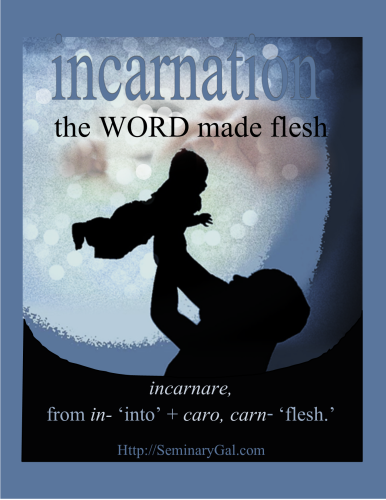
The word itself is derived from the late Middle English: from ecclesiastical Latin incarnat– ‘made flesh,’ from the verb incarnare, from in– ‘into’ + caro, carn– ‘flesh.’ “Embody or represent (a deity or spirit) in human form.” That’s what the Oxford dictionary says which hardly does the concept justice!
If that was the case, the sea witch in Disney’s The Little Mermaid movie would have been “incarnated” as Ursula the adversary of Ariel—a witch who first bargains for Ariel’s voice and then sends her speechless to the prince before Ursula’s becoming human herself as she competes against Ariel to be the prince’s bride.
Incarnation? This is not just a spirit taking human form…a witch or a mermaid getting some legs.
Some people refer to the Incarnation as “God with flesh on”…which also misses the point to some extent with respect to the miraculous nature of it. Jesus was incarnated as more than God’s coat, skin deep.
Throughout the centuries, the church fathers have tried to nail down what the Incarnation was and how that whole Triune Godhead-thing works. They had an easier time identifying what it was NOT.
Theologian Robert Reymond describes the Incarnation this way: Without ceasing to be all that he was and is as the Second Person of the Holy Trinity, the eternal Son of God took into union with himself in the one divine Person that which he had not possessed before—even a full complex of human attributes—and became fully and truly man for us men and for our salvation. Jesus of Nazareth was and is that God-man.
Yeah. Theologians write that way. All this to say: Jesus is, was, will be, and always has been God. During the time frame of His earthly ministry, He added (to His already full divinity) a full humanity —a perfect humanity by which He would save us and a perfect humanity that He would retain after His death and resurrection. All the while being fully God.
If you’re like “Wow! That’s amazing!” yes, it is. And we’re just getting started. For now, ponder this thought and reflect on the questions below.
Thought for the day: The Gospel writer John says it this way: John 1:1 In the beginning was the Word, and the Word was with God, and the Word was God. 2 He was with God in the beginning.
Questions for reflection:
 * * *
* * * If you haven’t signed up yet, you can receive these devotional studies in your email throughout Advent 2015 by entering your email address on the SeminaryGal.com home page in the space provided in the sidebar. Or “Like” the SeminaryGal Facebook page to access them there.
The devotionals will come automatically along with the remaining sermons from Plymouth Church in Racine and perhaps an occasional gardening post.
* * *
 It has come to my attention that some of you are still excited about last year’s devotionals entitled Carol Me, Christmas! Yes, it was a fun series! If you’d prefer those devotionals, you’ll find them in the sidebar archives beginning November 2014. The announcement was http://seminarygal.com/carol-me-christmas-advent-2014-devotional-series/. It will require a bit more work to access them, but I know you hymn-folks don’t mind a bit of work. It put a song in the heart of many of us all through Advent last year! 🙂
As long as I was going down memory lane, I located the first one in the 2013 series When Love Showed Up In-Person. It can be found in the archives beginning December 2013 http://seminarygal.com/advent-begins-2013/ .
The Advent season as told through the Gospel of Luke began back in December 2012 with this one http://seminarygal.com/advent-1-2012-expecting-the-unexpected/ and is contained in the archives as well.
I love writing these devotionals for both Advent and Lent. I hope this year’s Incarnation series blesses you with a deeper and more meaningful Advent season to make your Christmas truly merry! In His grace, Barbara <><
By way of reminder, Advent Devotionals begin November 29th. This reminder of Incarnation is not to be confused with reincarnation which isn’t real and never happens. The Incarnation was real and actually happened, but only once.
Announcing this year’s Seminary Gal Advent devotional series: Incarnation.
Have you ever wondered exactly what the Incarnation is and why God did it?
In a series of 26 lessons, we will explore this most important event in Christian theology. If there are any specific questions you’ve had about the Incarnation, I’m giving some advance notice of this series so that you can send me your questions and I’ll address them. (Go ahead, stump me. Try anyway, it’ll be a new means of holiday cheer for even for those who don’t call the holiday Christmas).
This year, Advent begins November 29, 2015. If you’re already signed up on my Home Page sidebar to receive posts, you’ll get the Advent devotionals automatically. If you haven’t signed up, today is a great day to do so. Advent and Lenten devotionals remain among my most popular offerings. You don’t want to miss this great way to prepare your heart for the true meaning of Christmas!
Join me for Incarnation: The WORD Made Flesh.