Why Didn’t God Just Punish Satan? He Started It. (Lent 6-2018)

Parents see it all the time with kids: an argument ensues and each child passes the blame to the other until it ends up with the pronouncement: “He started it.”  That’s the child’s version of Game Over.  It’s supposed to end all argument and settle the score.  The first to do wrong is at fault for everything that followed.

Even in the Garden of Eden, we see this passing of the buck.  The man blames the wife (and indirectly blames God for giving him this woman Genesis 3:12).  The woman blames the serpent (Genesis 3:13) and the serpent (Satan) is without a leg to stand on.  Serpents don’t have legs.  Plus, he started it.

For God, that doesn’t wash.  The serpent didn’t jam the fruit in Eve’s mouth or Adam’s, nor did he hide it in the applesauce.  He tempted and ensnared, but he didn’t force-feed.  So, all of them get punished, together and separately.  There’s plenty of brokenness to go around.

Have you ever wondered why God didn’t swoop in, kill Eve, spare Adam and give him a new wife?  One younger, maybe a blonde and Swedish or perhaps a Brazilian babe who really knows how to samba?  Have you ever wondered why Eve’s eyes weren’t opened immediately so that she would say, “Uh-oh!  Adam don’t do what I just did!”?  It took both Adam and Eve to launch the consequences.

This introduces two of the most fundamental concepts known to man: temptations will always come (and because of that), representation.

Had God just punished Satan, he’d still be at his old tricks after his time out.  Like the tiger Richard Parker in our series Pi and Chi, his animal soul and animal nature killed because he is a predator.  In 1 Peter 5:8, our enemy (Satan) is likened to a roaring lion “looking for someone to devour.”  As a predator, evil stalks and waits. 

Evil is persistent and insatiable. Temptations would come again and again.  Therefore, punishing Satan would eventually prove pointless.  Adam and Eve, despite their God-given freedom and Image-bearing, would someday choose poorly.  In fact, we are never told how long Adam and Eve behaved themselves before eating that forbidden fruit and how long those temptations had been resisted, maybe 1 day or maybe 1000 years.  To God, it’s all the same.  

Threats and punishment do little in the face of desire and autonomy, two of the worst predators out there when temptation crouches for the kill.  But God had something amazing in mind!

Without the Fall of Man happening as representation (Adam representing Eve and all who followed as future generations), we couldn’t have the beauty of representation in Christ—forgiveness and salvation—for all who follow Him. 

Food for thought: 

  • Have you ever had a temptation that keeps coming around? 
  • Does it become easier to resist over time? 
  • Why is giving in to temptation to break your diet a totally different animal than giving in to temptation to disobey your Creator?

Join me tomorrow for Why Does God Send People to Hell?
Continue Reading

Why Didn’t God Stop Adam and Eve Before They Ate? (Lent 5-2018)

Some may think, “You know, God could have prevented all that.  Why didn’t God stop Adam and Eve before they ate?”  Why didn’t He tape their mouths shut, tie their hands or even put a big fence around that tree if He didn’t want them to eat “the forbidden fruit”?  Probably the shortest answer is that coercion is incompatible with freedom. Love doesn’t coerce.  It frees.

In Paul’s first letter to the Corinthians, he offers this beautiful tribute to the gift of love: 1 Corinthians 13:4 Love is patient, love is kind. It does not envy, it does not boast, it is not proud. 5 It is not rude, it is not self-seeking, it is not easily angered, it keeps no record of wrongs. 6 Love does not delight in evil but rejoices with the truth. 7 It always protects, always trusts, always hopes, always perseveres. 8 Love never fails.

Love invites dependence and obedience.  Jesus’ own words tell us about the freedom God gives, John 8:31 To the Jews who had believed him, Jesus said, “If you hold to my teaching, you are really my disciples. 32 Then you will know the truth, and the truth will set you free.”

This invitation to obey God’s command—in the Garden and today–is grounded in three Image-bearing characteristics: freedom, rational thought, and love.  To each one among us since the days of Adam and Eve, Jesus appeals to our relationship, John 8:34 Jesus replied, “I tell you the truth, everyone who sins is a slave to sin. 35 Now a slave has no permanent place in the family, but a son belongs to it forever. 36 So if the Son sets you free, you will be free indeed.”


To questions “Why?” in our devotional series, the priest in The Life of Pi offers the most pat Sunday School answer: “All you have to know is that He loves us.”  While true, it’s deeper than that.

Go deeper with this food for thought:

  • Do you know the freedom to choose a relationship of love and obedience to God?  What are you doing with your freedom? 
  • If God prevented Adam and Eve from accessing the tree, what would happen to that freedom, day after day?  What would happen to love? 
  • What kind of rational thought and choice would Adam and Eve actually experience? 
  • How was God’s choice to let Adam and Eve experience genuine freedom the most Image-honoring choice God could make even knowing they’d choose poorly? 
  • How did God choose to redeem repentant sinners, showcase forgiveness, and perfectly display His love?

Tomorrow’s question: “Why Didn’t God Just Punish Satan? He Started It.”

===

For Lent 2018, we’ll explore the questions of Pi and Chi (the Greek letter beginning the word Christos, which means Christ, Messiah, the Anointed One). We’ll ask and answer the question “Why?” as we discover the uniqueness of Jesus Christ.  Join me for the 40 days of Lent which began February 14, 2018 by liking Seminary Gal on Facebook or having these devotionals sent to your email box which you can do via the sign-up on my Home page.  Thank you for blessing me with this opportunity to study together the Word of God.

===

Acknowledging that former years’ devotional series remain popular:

Continue Reading

First Sabbath of Lent (2018)

For as the soil makes the sprout come up and a garden causes seeds to grow, so the Sovereign LORD will make righteousness and praise spring up before all nations.” (Isaiah 61:11)

===

Devotionals for Lent 2018, Pi and Chi (the Greek letter beginning the word Christos, which means Christ, Messiah, the Anointed One) continue tomorrow in which we’ll ask and answer the question “Why?” and discover the uniqueness of Jesus Christ.  Join me for the 40 days of Lent which began February 14, 2018 by liking Seminary Gal on Facebook or having these devotionals sent to your email box which you can do via the sign-up on my Home page.  Thank you for blessing me with this opportunity to study together the Word of God.

===

Acknowledging that former years’ devotional series remain popular:

Continue Reading

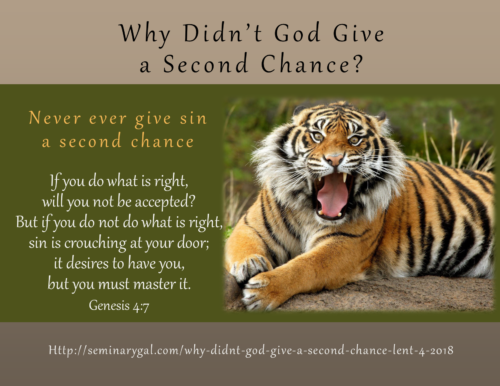
Why Didn’t God Give a Second Chance? (Lent 4-2018)

Americans like second chances.  There’s something romantic and nostalgic about it.  It feels like forgiveness and has the fragrance of hope.  Hope that things will be different next time.  Hope that a change of heart can lead to change of circumstances.  Hope that history being an excellent teacher can prevent our repeating past mistakes.

Was God not powerful enough to turn back time and allow a do-over?  With Adam and Eve, Why Didn’t God Give a Second Chance?

In the movie, The Life of Pi, the young boy Pi, moved by the majesty and beauty of Richard Parker the tiger, and imagining the tiger’s soul, Pi tries to feed him through the bars of the gate when he is caught by his father.  His father is understandably alarmed.

  • Father:  This is between a father and his sons…
  • Mother:  He said he’s sorry. You want to scar them for life?
  • Father:  Scar them? That boy almost lost his arm!
  • Mother:  But he’s still a boy!
  • Father:  He will be a man sooner than you think, and this is a lesson I do not want them ever to forget.

The father knew some lessons are life and death. 

So critical are they that there will never be a do-over. 

Instead, there will be consequences. 

In the movie, the father forces Pi and his brother to watch as an animal’s nature does what a predator does: Richard Parker grabs a living goat through the bars of the gate and kills it.

Sin—which is rebellion against God—is like a roaring lion or the predator Richard Parker.  Always able to kill and destroy.  Sin can never be given a second chance no matter who commits it. 

If you do what is right, will you not be accepted? But if you do not do what is right, sin is crouching at your door; it desires to have you, but you must master it.” (Genesis 4:7)

Sin crouches like a predator.  Its animal nature always wants the kill.  We master it by not giving it a chance.  And God, loving us, did not give sin a second chance at ruining God’s perfect Creation.  Instead, He gave us consequences so death would forever remind us…of a lesson never to forget.

Food for thought:

  1. Many don’t want to believe the story of the Fall of Man.  How is death explained otherwise? 
  2. Once Adam and Eve ate the “forbidden fruit” they were changed in their nature.  Would a second chance have yielded the same result or a different one? 
  3. In what way is being “born again” giving us a new nature and does it represent a second chance that provides a different outcome: instead of death, life?

Tomorrow is the Sabbath rest in our devotional series Pi and Chi.  On Monday we resume with 40 hard questions and investigate “Why Didn’t God Stop Adam and Eve Before They Ate?”

===

For Lent 2018, we’ll explore the questions of Pi and Chi (the Greek letter beginning the word Christos, which means Christ, Messiah, the Anointed One). We’ll ask and answer the question “Why?” as we discover the uniqueness of Jesus Christ.  Join me for the 40 days of Lent which began February 14, 2018 by liking Seminary Gal on Facebook or having these devotionals sent to your email box which you can do via the sign-up on my Home page.  Past devotionals can be accessed via the archives.  Thank you for blessing me with this opportunity to study together the Word of God.

===

Acknowledging that former years’ devotional series remain popular:

Continue Reading

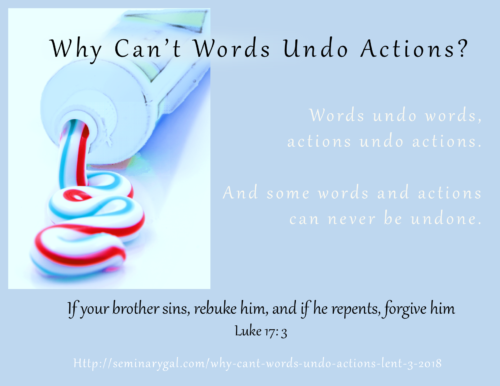
Why Can’t Words Undo Actions? (Lent 3-2018)

Why Can’t Words Undo Actions? For that matter, can words undo words?  Or is it that once spoken can they never be unspoken?

Did you ever think you’d see Al Franken and Harvey Weinstein in a Christian devotional?  (Yeah, me neither.) They apologized in words conveying regret, they expressed their support for the women they hurt, they even committed themselves to making amends by championing women, but in the end, did it change what they did and how it impacted the women they harmed?  

Is there more to an apology than saying you’re sorry?  Get this:   “’Apologies really do work, but you should make sure you hit as many of the six key components as possible,’ said Roy Lewicki, lead author of the study and professor emeritus at The Ohio State University’s Fisher College of Business. The six magic factors are (1) Expression of regret, (2) Explanation of what went wrong, (3) Acknowledgement of responsibility, (4) Declaration of repentance, (5) Offer of repair, and (6) Request for forgiveness.”

I’m sorry, Mr. Lewicki, but I don’t believe in magic.  Seriously, does apology undo the offense?  Why apologize if words cannot undo actions?  Toothpaste just never goes back in the tube. No expressing regret, explanation, accepting responsibility, changing your behavior, offering a sacrifice of restitution, and begging for forgiveness will erase an action committed against another in real time. 

Forgiveness is more important than apology–which helps to keep short accounts–but even then, keep in mind that nothing turns back the clock.  It’s why we need a Savior and not just a scorekeeper. 

Food for thought:

  • Words can’t undo actions, but they can point toward healing.  Are there any relationships that you can try to heal today? 
  • Anyone you’ve hurt, dissed, gossiped about, belittled, abused, or cheated, etc.?  An apology can help toward healing. 
  • Forgiveness is good for your soul, even when no apology has been or can be offered.  It takes more energy to hold a grudge than to hold your tongue and extend an olive branch. 
  • Is there anyone who has harmed you who never apologized?  You can forgive that person–even with silent words–and you can offer peace with your actions.  If the one who has harmed you is dead, how can forgiving him/her be good for your soul? 
  • Need help with how to do that? Here are 3 posts I’ve written on this admittedly difficult subject.  http://seminarygal.com/forgiveness-good-for-your-soul/  http://seminarygal.com/forgiveness/2/  http://seminarygal.com/handling-betrayals-with-grace-semon-text-version/

Luke 17: 3″If your brother sins, rebuke him, and if he repents, forgive him.”

Join me tomorrow for “Why Didn’t God Give a Second Chance?”

===

For Lent 2018, we’ll explore the questions of Pi and Chi (the Greek letter beginning the word Christos, which means Christ, Messiah, the Anointed One). We’ll ask and answer the question “Why?” as we discover the uniqueness of Jesus Christ.  Join me for the 40 days of Lent which began February 14, 2018 by liking Seminary Gal on Facebook or having these devotionals sent to your email box which you can do via the sign-up on my Home page.  Thank you for blessing me with this opportunity to study together the Word of God.

===

Acknowledging that former years’ devotional series remain popular:

Continue Reading

Why Is Sin Against God Any Worse Than Against Man? (Lent 2-2018)

Repentance, it’s one of those words.  Christian jargon that only religious people actually use or try to understand fully.  It’s one of those actions Christians don’t practice as they should.  It’s a change of heart, a change of direction, and a change of behavior.  It’s making up one’s mind to agree with God about sin and determining to live in agreement with Him.  Genuine repentance isn’t easy.

It gets at the heart of why yesterday’s “I’m sorry” really isn’t good enough.  Genuine guilt leaves a stain.  Jeremiah 2:22 “Although you wash yourself with soda and use an abundance of soap, the stain of your guilt is still before me,” declares the Sovereign LORD.”  Yeah, He’s Sovereign and we’re outmatched.  

As we continue Pi and Chi our Lent 2018 devotional series of 40 hard questions, Pi (from the Life of Pi) is talking with a writer who is interviewing him about his life story.  As a Hindu, Pi quips,

We get to feel guilty before hundreds of gods instead of just one.“

But is it a matter of numbers?  Would guilt before a thousand men ever measure up to guilt before One True God?  Is our guilt real, determined by Someone beyond us or does it just come from a tiny voice we can ignore? 

What determines guilt anyway? 

Is it the right of a Sovereign God, or is it just a feeling? 


Why Is Sin Against God Any Worse Than Against Man?

Getting at why any apology from Adam and Eve would have proved insufficient, let’s just acknowledge the issue of consequences.  Apologies don’t take them away.  After all, who are we to quarrel with our Maker?  

God said, “Don’t eat” from the tree of the knowledge of good and evil because He loved us.  He outlined the consequences of disobedience to His command—a forewarning grounded in His love for His Image-bearers.  Yet Adam and Eve persisting in that state of consequences is what the tree of life represented and explains why God, in love, had to banish them.  Actions have consequences.  Actions against an eternal Being have eternal consequences which a finite human can never wash clean.  

Think about it:

  • Dissing your Creator and dissing your fellow man are two different things.  Read Isaiah 45:5-12.  What sin is at the heart of dissing your Creator who has existed from eternity past? 
  • Why did God’s command and the consequences pronounced to Adam become irrevocable?  What would happen to God’s character if He’d just said, “OK, this time I’ll spare you from your choices.  After all, you said you’re sorry.  But next time, I mean it.”? 
  • Why was Jesus’ sacrifice—taking God’s wrath upon Himself—both acceptable and eternal?
  • Is there a difference between punishment and natural consequences?
  • Can natural consequences be forgiven enough so they won’t happen?  Or do you reap what you sow?  Galatians 6:7

Join me tomorrow for “Why Can’t Words Undo Actions?”

===

For Lent 2018, we’ll explore the questions of Pi and Chi (the Greek letter beginning the word Christos, which means Christ, Messiah, the Anointed One). We’ll ask and answer the question “Why?” as we discover the uniqueness of Jesus Christ.  Join me for the 40 days of Lent which began February 14, 2018 by liking Seminary Gal on Facebook or having these devotionals sent to your email box which you can do via the sign-up on my Home page.  Thank you for blessing me with this opportunity to study together the Word of God.

===

Acknowledging that former years’ devotional series remain popular:


Continue Reading

Why Isn’t ‘I’m Sorry’ Good Enough? (Lent 1-2018)

It’s Ash Wednesday, the beginning of Lent and the beginning of Pi and Chi: Asking and Answering Questions Why, our devotional series for Lent 2018.  And what’s the beginning of Lent without a little guilt trip?  Ash Wednesday is a perfect day to feel the deep guilt we daily brush aside. A day also to deal with the lesser guilts.  A day to fess up to all our sins, confessing both to ourselves and to God.  To give sins up, well, for 40 days which becomes a habit, so they say.

So why Pi?  While it’s a number that never repeats, there are some phrases repeated in the Life of Pi, the movie which provides the launch pad for 40 days of hard questions.  The number Pi might not repeat, but the first question the movie raises is due to the number of times Pi says, “I’m sorry!”

I’ll admit, not everyone likes the movie but then again, not everyone is a pastor who ruins movies by thinking deeply about a boy and a tiger named Richard Parker and how it relates to Christianity.  In fact, someone even put together a video entitled Everything Wrong with the Life of Pi in 4 Minutes or Less and calculates 55 cinematic sins the movie commits.  It was a good laugh, even if real sin is no laughing matter.

On this Ash Wednesday, I ask you to adorn yourself with your Christian Thinking Cap (which incidentally is not made of tin foil). 

If God is so loving and so forgiving, then “Why Isn’t ‘I’m Sorry’ Good Enough?”

***

Couldn’t Adam and Eve just say “I’m sorry”

and God would have been loving and forgiving and let it go?

We’ll spend a few days on this topic of apology, but for now, the short answer is that God couldn’t let the words “I’m sorry” cover the guilt of such sin.  If we understand guilt and sin and who we’ve sinned against, it becomes clear:

Apology is only half of it.  Action is required. God acted by giving us Jesus.  “Repent and believe the good news!” (Mark 1:15)  

So, in the meantime, food for thought:

  • Has someone ever hurt you deeply with words or actions that cannot be undone?  
  • What made the situation irreversible?  Was “I’m Sorry” good enough when they said it?  Is irreversible the same as unforgiveable?
  • Have you ever hurt someone—whether a loved one, a friend, or a total stranger—and never uttered an apology to them? 
  • Or have you said “I’m sorry” only to repeat the same offense?

Join me tomorrow for another look at “I’m sorry” with “Why Is Sin Against God Any Worse Than Against Man?”

===

For Lent 2018, we’ll explore the questions of Pi and Chi (the Greek letter beginning the word Christos, which means Christ, Messiah, the Anointed One). We’ll ask and answer the question “Why?” as we discover the uniqueness of Jesus Christ.  Join me for the 40 days of Lent beginning February 14, 2018 by liking Seminary Gal on Facebook or having these devotionals sent to your email box which you can do via the sign-up on my Home page.  Thank you for blessing me with this opportunity to study together the Word of God.

===

Acknowledging that former years’ devotional series remain popular:

Continue Reading

Reminder: Lent 2018 Devotionals Pi and Chi Begin Soon

Reminder: February 14th (Ash Wednesday) is the beginning of Pi and Chi: Asking and Answering Questions Why, our Lent 2018 Devotional Series.  It’ll be 40 days of hard questions and seeking thoughtful answers.  Maybe you always wanted to know.  Maybe you were afraid to ask.  Maybe questions to get you to think outside the box of neatly packaged Christianity.  God’s best work is often displayed outside of our boxes or when He colors outside of the lines we’ve drawn. 

If you were living The Life of Pi, alone on a boat with only your thoughts and a tiger named Richard Parker, maybe these are questions that would keep you awake at night.  Deep things of the Bible and the cosmos.  Pondering the Life of Chi (the Greek letter beginning Christos, meaning Christ, Anointed One, Messiah) and why our thoughts turn toward Him–Jesus Christ–and His death during Lent.

Sneak peek under the tarp in our boat:  Our first question is

Why Isn’t ‘I’m Sorry’ Good Enough?”


===

Curious?  Join me for the 40 days of Lent beginning February 14, 2018 by liking Seminary Gal on Facebook or having these devotionals sent to your email box which you can do via the sign-up on my Home page.  Thank you for blessing me with this opportunity to study together the Word of God.

===

Acknowledging that former years’ devotional series remain popular:

Continue Reading

The Tree of Life Returns as Blessing

What do you think of when you think of the tree of life? 

Do you think of something like a fountain of youth that would make you immortal if you were to take one bite of its fruit? 

Do you think of its fruit magically making your life more fulfilling? 

Or do you think of a tree that was out of reach for sinners?

Genesis 3: 22 And the LORD God said, “The man has now become like one of us, knowing good and evil. He must not be allowed to reach out his hand and take also from the tree of life and eat, and live forever.” 23 So the LORD God banished him from the Garden of Eden to work the ground from which he had been taken. 24 After he drove the man out, he placed on the east side of the Garden of Eden cherubim and a flaming sword flashing back and forth to guard the way to the tree of life.

In Genesis we have a sad picture of self-reliance as its own reward.  Now instead of trees yielding fruit for Adam and Eve, it would take hard work to accomplish it as a do-it-yourself program.  Instead of whatever carefree life existed before sin, it’s now a life with more worries than you can shake a stick at. 

The Fall of Man–instead of true life as it was meant to be, now it would be a life as it was never meant to be.

It would be death constantly nipping at our heels, threatening to steal our joy, and rob us of so much we hold dear. 
Outside of Eden–in the land of thorns and thistles–our lives would be spent in constant conflict between desiring to return to a place of blessing with full dependence upon God and the rubble of a life in perpetual denial of a need for God in a do-it-yourself world.

Fortunately for us, God did not leave it there.  That sword-bearing cherubim may have prevented Adam and Eve from running back in, but that was for their benefit.  Living our days in chronic sin and inner conflict is no life.  So Jesus came to rescue us and give us eternal life.

The tree of life returns in the Bible as a blessing for those who overcome because Jesus died for us.

Revelation 22:1 Then the angel showed me the river of the water of life, as clear as crystal, flowing from the throne of God and of the Lamb 2 down the middle of the great street of the city. On each side of the river stood the tree of life, bearing twelve crops of fruit, yielding its fruit every month. And the leaves of the tree are for the healing of the nations. 3 No longer will there be any curse. The throne of God and of the Lamb will be in the city, and his servants will serve him. 4 They will see his face, and his name will be on their foreheads. 5 There will be no more night. They will not need the light of a lamp or the light of the sun, for the Lord God will give them light. And they will reign for ever and ever. 6 The angel said to me, “These words are trustworthy and true. The Lord, the God of the spirits of the prophets, sent his angel to show his servants the things that must soon take place.” 7 “Behold, I am coming soon! Blessed is he who keeps the words of the prophecy in this book.

I, for one, am glad that the Bible ends with hope and joy and blessing. 

That tree of life returns to be ours.  It will be on both sides of the river, bearing fruit, crop after crop, and there will be healing. 

We need that. 

Revelation 2:7 He who has an ear, let him hear what the Spirit says to the churches. To him who overcomes, I will give the right to eat from the tree of life, which is in the paradise of God.

Continue Reading

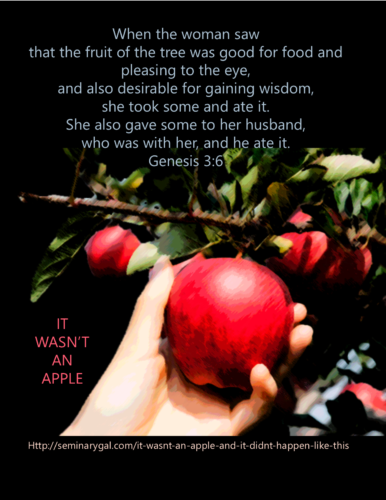
It Wasn’t an Apple and It Didn’t Happen Like This

There are many Fractured Fairytales of the Fall of Man.  In the movie, Walk the Line, Jerry Lee Lewis states, “We’re all going to hell for the songs we sing” as he explains about that “great big apple” and “Don’t touch it.” It reinforces the idea that Eve grabbed an apple from the apple tree God told her was off-limits leading to…

Fractured Fairytale #1:  Eve, being the brainless ditz and immoral woman she was, grabbed a great big apple and she made Adam sin.  It’s always been the fault of the woman alone, women are always on the prowl to seduce men, and women are always to blame.  Just ask any woman in a male-dominated seminary how she feels.  (Go ahead and laugh.  I’m over it now.)  Carried to the extreme it becomes…

Fractured Fairytale #2: Eve colluded with the serpent to seduce and destroy Adam, that stoic bastion of godly righteousness. 

You think I’m joking?  Wish I was.  From early theologian Tertullian (c. 155 – c. 240 AD): “And do you not know that you are (each) an Eve? The sentence of God on this sex of yours lives in this age: the guilt must of necessity live too. You are the devil’s gateway: you are the unsealer of that (forbidden) tree: you are the first deserter of the divine law: you are she who persuaded him whom the devil was not valiant enough to attack. You destroyed so easily God’s image, man. On account of your desert — that is, death — even the Son of God had to die.  (The Apparel of Women, Book I, Chapt. 1

Gotta hand it to those church fathers.  They sure know how to make a woman feel special.

Fractured Fairytale #3

  • The man: “Woman, don’t eat from the trees.  I’m the man.  I know better.  You’d better let me pick the fruit.”
  • The woman: “But I’m hungry.”
  • The man: “You’ll get fat and I don’t want a fat wife.”
  • Snake: “No calories, woman.  Chill.”
  • The man: “Don’t do it!”
  • The woman: “I’ll show you.” (Takes apple, eats big bite, but doesn’t die.)  “See?”
  • The man: “Cool!” (Eats apple).
  • Afterwards the man (adam) gets a name change to Adam which comes from adama, dirt.  Man’s name has been dirt or mud with women ever since.

The truth is the fruit of the tree of the knowledge of good and evil, the “forbidden fruit” was never an apple, didn’t result in instant death, and it didn’t make Adam and Eve future Jeopardy winners with instant recall of all knowledge.  No omniscience from this fruit, but eating it did forever divorce them from childlike dependence upon God and reliance upon His loving guidance. That fruit was real but presents an image of anything we want apart from God.

Genesis 3:1 Now the serpent was more crafty than any of the wild animals the LORD God had made. He said to the woman, “Did God really say, ‘You must not eat from any tree in the garden’?” 2 The woman said to the serpent, “We may eat fruit from the trees in the garden, 3 but God did say, ‘You must not eat fruit from the tree that is in the middle of the garden, and you must not touch it, or you will die.'” 4 “You will not surely die,” the serpent said to the woman. 5 “For God knows that when you eat of it your eyes will be opened, and you will be like God, knowing good and evil.” 6 When the woman saw that the fruit of the tree was good for food and pleasing to the eye, and also desirable for gaining wisdom, she took some and ate it. She also gave some to her husband, who was with her, and he ate it. 7 Then the eyes of both of them were opened, and they realized they were naked.

For further thought:

  • How do these misunderstandings of how the Fall happened contribute to dismissing both Creation and the Fall? 
  • The man was with his wife.  What was his role?  What should have been his role?
  • Do you ever wonder if your actions would have been different?
  • We don’t know what the fruit was, but that it was pretty to look at and good for food.  God wasn’t withholding something good from them for bad reasons.  When’s the last time you felt like God was depriving you of something you wanted? 
  • Are there any hidden ways a distrust of the opposite sex displays itself in your life or thoughts? 
Continue Reading