Incarnation Defined-Advent 1 (2015)
In the musical The Sound of Music Fraulein Maria sings Do Re Mi which starts with “Let’s start at the very beginning. A very good place to start.” Which is really kind of a no-brainer even if it does make for a cute song with 7 children dressed in drapes.
 Let us start at the very beginning:
What is the Incarnation?
The word itself is derived from the late Middle English: from ecclesiastical Latin incarnat– ‘made flesh,’ from the verb incarnare, from in– ‘into’ + caro, carn– ‘flesh.’ “Embody or represent (a deity or spirit) in human form.” That’s what the Oxford dictionary says which hardly does the concept justice!
If that was the case, the sea witch in Disney’s The Little Mermaid movie would have been “incarnated” as Ursula the adversary of Ariel—a witch who first bargains for Ariel’s voice and then sends her speechless to the prince before Ursula’s becoming human herself as she competes against Ariel to be the prince’s bride.
Incarnation? This is not just a spirit taking human form…a witch or a mermaid getting some legs.
Some people refer to the Incarnation as “God with flesh on”…which also misses the point to some extent with respect to the miraculous nature of it. Jesus was incarnated as more than God’s coat, skin deep.
Throughout the centuries, the church fathers have tried to nail down what the Incarnation was and how that whole Triune Godhead-thing works. They had an easier time identifying what it was NOT.
- They concluded that Jesus did not go into a different phase like H20 can be steam, water, and ice depending on the environment and circumstances.
- They concluded that Jesus did not simply enter a different season (i.e. pre-flesh, flesh, and post-flesh) on a timeline where He ceased to be God during that flesh season when He was somehow a created being and not God.
- They concluded that Jesus didn’t morph like an egg becomes a caterpillar, makes a chrysalis, and becomes a butterfly. His divinity never developed. He didn’t become God as a function of maturation.
- They concluded the Incarnation wasn’t a mirage, a magic trick, a hologram, or other masquerade of just pretending to be a real man.
Theologian Robert Reymond describes the Incarnation this way: Without ceasing to be all that he was and is as the Second Person of the Holy Trinity, the eternal Son of God took into union with himself in the one divine Person that which he had not possessed before—even a full complex of human attributes—and became fully and truly man for us men and for our salvation. Jesus of Nazareth was and is that God-man.
Yeah. Theologians write that way. All this to say: Jesus is, was, will be, and always has been God. During the time frame of His earthly ministry, He added (to His already full divinity) a full humanity —a perfect humanity by which He would save us and a perfect humanity that He would retain after His death and resurrection. All the while being fully God.
If you’re like “Wow! That’s amazing!” yes, it is. And we’re just getting started. For now, ponder this thought and reflect on the questions below.
Thought for the day: The Gospel writer John says it this way: John 1:1 In the beginning was the Word, and the Word was with God, and the Word was God. 2 He was with God in the beginning.
Questions for reflection:
- Consider each part of John 1:1-2. Why is each phrase important?
- Look back over what the Incarnation is NOT and ponder why it’s an important distinction.
Advent Devotionals Begin November 29, 2015
 * * *
* * *
We’re counting down 10 days until
the 2015 Advent Devotional Series
entitled Incarnation begins.
* * *
If you haven’t signed up yet, you can receive these devotional studies in your email throughout Advent 2015 by entering your email address on the SeminaryGal.com home page in the space provided in the sidebar. Or “Like” the SeminaryGal Facebook page to access them there.
The devotionals will come automatically along with the remaining sermons from Plymouth Church in Racine and perhaps an occasional gardening post.
* * *
 It has come to my attention that some of you are still excited about last year’s devotionals entitled Carol Me, Christmas! Yes, it was a fun series! If you’d prefer those devotionals, you’ll find them in the sidebar archives beginning November 2014. The announcement was http://seminarygal.com/carol-me-christmas-advent-2014-devotional-series/. It will require a bit more work to access them, but I know you hymn-folks don’t mind a bit of work. It put a song in the heart of many of us all through Advent last year! 🙂
As long as I was going down memory lane, I located the first one in the 2013 series When Love Showed Up In-Person. It can be found in the archives beginning December 2013 http://seminarygal.com/advent-begins-2013/ .
The Advent season as told through the Gospel of Luke began back in December 2012 with this one http://seminarygal.com/advent-1-2012-expecting-the-unexpected/ and is contained in the archives as well.
I love writing these devotionals for both Advent and Lent. I hope this year’s Incarnation series blesses you with a deeper and more meaningful Advent season to make your Christmas truly merry! In His grace, Barbara <><
Reminder Advent Devotionals “Incarnation” Begin Soon
By way of reminder, Advent Devotionals begin November 29th. This reminder of Incarnation is not to be confused with reincarnation which isn’t real and never happens. The Incarnation was real and actually happened, but only once.
Announcing this year’s Seminary Gal Advent devotional series: Incarnation.
Have you ever wondered exactly what the Incarnation is and why God did it?
In a series of 26 lessons, we will explore this most important event in Christian theology. If there are any specific questions you’ve had about the Incarnation, I’m giving some advance notice of this series so that you can send me your questions and I’ll address them. (Go ahead, stump me. Try anyway, it’ll be a new means of holiday cheer for even for those who don’t call the holiday Christmas).
This year, Advent begins November 29, 2015. If you’re already signed up on my Home Page sidebar to receive posts, you’ll get the Advent devotionals automatically. If you haven’t signed up, today is a great day to do so. Advent and Lenten devotionals remain among my most popular offerings. You don’t want to miss this great way to prepare your heart for the true meaning of Christmas!
Join me for Incarnation: The WORD Made Flesh.

Incarnation (2015 Advent Devotional Series)
The entire series is available in the archives (right) beginning November 29, 2015.
Announcing this year’s Seminary Gal Advent devotional series: Incarnation.
Have you ever wondered exactly what the Incarnation is and why God did it?
In a series of 26 lessons, we will explore this most important event in Christian theology. If there are any specific questions you’ve had about the Incarnation, I’m giving some advance notice of this series so that you can send me your questions and I’ll address them. (Go ahead, stump me. Try anyway, it’ll be a new means of holiday cheer for even for those who don’t call the holiday Christmas).
This year, Advent begins November 29, 2015. If you’re already signed up on my Home Page sidebar to receive posts, you’ll get the Advent devotionals automatically. If you haven’t signed up, today is a great day to do so. Advent and Lenten devotionals remain among my most popular offerings. You don’t want to miss this great way to prepare your heart for the true meaning of Christmas!
Join me for Incarnation: The WORD Made Flesh.
Mistaken Identity-text version
Sorry for the repost on this. My web site has been experiencing technical difficulties and I needed to restore to an earlier version that was missing this post.
I’m away from the pulpit again this week as I continue to prepare the good folks in the congregation at Plymouth Church for my departure at the conclusion of the Book of Acts (in December). We have a guest preacher again this week as we pursue an orderly transition and learn Bible truths from other preachers and pastors. I thoroughly enjoyed the message offered this week by our guest.
However, to keep up with the study of Acts of the Holy Spirit and the Apostles online, I offer my own devotional on the topic (and again, there will be no accompanying audio this week).
It’s important that we don’t carry around notions based upon mistaken identity.
The Apostle Paul had his share of misunderstandings, some self-inflicted and others aimed directly at him. God, however, wants us to be seeing life with eyes wide open, being clear minded, knowing our role in our culture, and grounding our identity in Christ. When we see the question is not so much “Who am I?” but “Whose am I?” we will be free from mistaken identity and confident in sharing our Christian identity with others in the form of testimony. Lately people have been using a hashtag #IamAChristian to affirm their identity in Christ. That’s what Paul will be talking about today as he teaches us 5 aspects of mistaken identity in Acts 21-22. Mistaken identity that needed correcting if one will be a Christian.
Last week, the mob was about to kill Paul when he was hauled off to the barracks for questioning. The commander got it wrong, though.
Mistaken Identity #1. He’s not an Egyptian causing trouble. He’s a Jew through and through.
Acts 21: 37 As the soldiers were about to take Paul into the barracks, he asked the commander, “May I say something to you?” “Do you speak Greek?” he replied. 38 “Aren’t you the Egyptian who started a revolt and led four thousand terrorists out into the desert some time ago?” 39 Paul answered, “I am a Jew, from Tarsus in Cilicia, a citizen of no ordinary city. Please let me speak to the people.”
The commander was surprised to see that Paul speaks Greek and further surprised to learn that Paul was not an Egyptian at all but from Tarsus and a Jew, like the rest of the “Men of Israel” mob which was trying to kill Paul. Mistaking him for an Egyptian meant that the commander’s reason for taking Paul to the barracks was thrown into question. Paul was from Tarsus—moreover, he was a citizen of Tarsus which was no ordinary city. The commander didn’t really seem to be all that impressed with Tarsus, but it did alert him to the fact that he wasn’t dealing with the person he thought he was dealing with (an Egyptian insurrectionist and terrorist).
Therefore he lets Paul speak. Perhaps the commander thought that Paul was going to correct the record with the crowd. Maybe the “Men of Israel” thought Paul was an Egyptian too. Letting Paul speak, however, is always a dangerous thing. Not only is he a good speaker, but his logic is impeccable and his rhetorical skill is superb. He’ll give the Gospel full strength at every opportunity. So, Paul retells his conversion story that we first heard about in Acts 9. This time, Paul fills us in on a few more details. The crowd, those “Men of Israel,” may very well be surprised now to learn that Paul isn’t who they thought he was. Paul has some pretty amazing Jewish credentials.
Acts 22:1 “Brothers and fathers, listen now to my defense.” 2 When they heard him speak to them in Aramaic, they became very quiet. Then Paul said: 3 “I am a Jew, born in Tarsus of Cilicia, but brought up in this city. Under Gamaliel I was thoroughly trained in the law of our fathers and was just as zealous for God as any of you are today. 4 I persecuted the followers of this Way to their death, arresting both men and women and throwing them into prison, 5 as also the high priest and all the Council can testify. I even obtained letters from them to their brothers in Damascus, and went there to bring these people as prisoners to Jerusalem to be punished.
Mistaken identity #2. Paul is not some ignorant, mind-numbed cult follower of Jesus, but a highly educated and credentialed Jew of Jews.
He is a Jew and therefore calls them “brothers and fathers.” He spoke in Aramaic because that was their spoken language of choice. He was trained under Gamaliel, the foremost rabbi of their time. He was not just a student who skipped class perpetually, some lazy slacker who squeaked by with a D-minus. Nope. He was thoroughly trained and zealous as any of them. Actually Paul is being modest. He was zealous beyond the point that even they are. In fact, he was downright notorious for his persecution of Christians. He was feared by Christians throughout the region and he was known to the high priest and to the Council, the Sanhedrin, as he got letters from these leaders to hunt down, arrest, and kill Christians. Paul was a persecutor of Christians, and like ISIS today, Paul had that as his primary life’s ambition.
But Paul previously had a mistaken identity. #3 Paul thought that Christians were the infidels and Jesus was falsely worshiped. But then, something changed: Paul saw the Light.
 6 “About noon as I came near Damascus, suddenly a bright light from heaven flashed around me. 7 I fell to the ground and heard a voice say to me, ‘Saul! Saul! Why do you persecute me?’ 8 “‘Who are you, Lord?’ I asked. “‘I am Jesus of Nazareth, whom you are persecuting,’ he replied. 9 My companions saw the light, but they did not understand the voice of him who was speaking to me. 10 “‘What shall I do, Lord?’ I asked. “‘Get up,’ the Lord said, ‘and go into Damascus. There you will be told all that you have been assigned to do.’ 11 My companions led me by the hand into Damascus, because the brilliance of the light had blinded me. 12 “A man named Ananias came to see me. He was a devout observer of the law and highly respected by all the Jews living there. 13 He stood beside me and said, ‘Brother Saul, receive your sight!’ And at that very moment I was able to see him. 14 “Then he said: ‘The God of our fathers has chosen you to know his will and to see the Righteous One and to hear words from his mouth. 15 You will be his witness to all men of what you have seen and heard. 16 And now what are you waiting for? Get up, be baptized and wash your sins away, calling on his name.’
The companions saw the light too, but they were not blinded by it. No scales on their eyes. They didn’t understand the voice that spoke to Paul. Interesting, is it not, that people can see the very same thing…and yet, not understand what has happened? God must open our eyes to see the mistaken identity and we must be willing to take it to heart. Paul did.
Mistaken identity #4. Paul thought he was only persecuting Christians. He had no idea that he was actually persecuting the Christ, the long-awaited Jewish Messiah. The Jews had been waiting for this Messiah since the days of Abraham and now Paul is aware that he has been persecuting the very One he has been waiting for: it’s a case of mistaken identity on steroids.
We aren’t told about the companions. Did they have their eyes opened to the truth, too? Or did the Gospel cut both ways? Did they go away with nothing but a strange story and hard hearts?
From Damascus to Jerusalem, must have been a thinking journey for Paul. Working his way through all those Scriptures he knew by heart. All that training that he’d received. And now the Light of Christ illuminating it all and the Holy Spirit showing Paul the Truth and how much Paul himself was going to suffer for the cause of Christ.
What goes around comes around;
the hunter becomes the hunted;
and the persecutor becomes the persecuted.
17 “When I returned to Jerusalem and was praying at the temple, I fell into a trance 18 and saw the Lord speaking. ‘Quick!’ he said to me. ‘Leave Jerusalem immediately, because they will not accept your testimony about me.’
Mistaken identity #5. The crowd then thought that Paul was a false teacher. But Paul is an extraordinary evangelist to Jews and Gentiles alike. He’s teaching Truth, but now just as before, many will not accept it.
Now, Paul has come full circle, twice. He started in Jerusalem as a persecutor of Stephen (and Christ). On round one, Paul returned to Jerusalem as a Christian with work to do and needing to flee in order to accomplish it. But now, Paul is back in Jerusalem and they still do not accept Paul’s testimony about God’s plan of salvation, but the time has arrived that was bound to happen. The crowd has a mistaken identity just as Paul had at the time of Stephen’s death.
The difference is that now, Paul knows exactly who he is and moreover, he knows Whose he is. He belongs to Christ Jesus.
What about you? Who do you say Jesus is? Who do you think you are? Is your identity in all the credentials and the pedigree…or is your identity as one who has been redeemed? Are you living in a case of mistaken identity… or have you seen the Light? Are you living with your eyes open wide? Are you clear minded, knowing your role in our culture, grounding your identity in Christ, and consequently being confident in sharing your Christian identity with others in the form of testimony? If not, today is a good day to give up that old mistaken identity and to ask God’s forgiveness through Jesus Christ and to clothe yourself with His righteousness so that you, like Paul, might know Whose you are.
For the one who has been redeemed, there’s no more mistaken identity.
The Teachable Spirit
Oftentimes when someone possesses a truly brilliant intellect, pride inevitably follows. Perhaps the person is a braggart making sure everyone knows how smart he is. Perhaps the person feigns humility to be seen in a positive public light when behind closed doors, the sneer of condescension reigns supreme. Perhaps the person adopts the view of “It’s not bragging if you can do it” and one feels like he’s not really braggin’ at all. He’s just swaggin’. All of those are pretty common.
Far rarer is the teachable spirit, particularly with the brightest and most talented among us. The teachable spirit is something truly special and in today’s passage, we see two instances of it. We see it in the Apostle Paul and we see it in Apollos.
When we last left off with Paul, he was ministering in broken Corinth as an incredibly broken man. He’d been chased from town to town, hunted down in some cases, and generally ended up fleeing for his life before he ever got a chance to witness the results of his ministry to others. To task-oriented people, this is a difficult thing to swallow. We want results. We want to check it off the list. We want that external validation that our time was well-spent. Paul got precious little of that on a strictly human level.
But now, we read in Acts 18:18 Paul stayed on in Corinth for some time. Then he left the brothers and sailed for Syria, accompanied by Priscilla and Aquila. Before he sailed, he had his hair cut off at Cenchrea because of a vow he had taken. 19 They arrived at Ephesus, where Paul left Priscilla and Aquila. He himself went into the synagogue and reasoned with the Jews. 20 When they asked him to spend more time with them, he declined. 21 But as he left, he promised, “I will come back if it is God’s will.” Then he set sail from Ephesus. 22 When he landed at Caesarea, he went up and greeted the church and then went down to Antioch. 23 After spending some time in Antioch, Paul set out from there and traveled from place to place throughout the region of Galatia and Phrygia, strengthening all the disciples.
 Paul had learned something very important by virtue of his life experiences.
Do the work.
Plant the seed.
And trust God with the results.
Paul knew what it was like to try to enter Mysia and Bithynia (Acts 16:7) and to desire staying on at length with every church he’d planted.
But instead, he learned to trust God even when things made no sense.
To a brilliant man like Paul, he probably wanted answers. He may have wanted the satisfaction and feedback of a job well done. An attaboy. Assurance. He had probably dispensed with needing accolades back on the road to Damascus when he met the Risen Lord. Yet, human nature wants to have food for faith and the favor of a reply to know how one is doing.
The Jews at the synagogue asked Paul to spend more time. A less teachable spirit might have said, “OK, I like all the attention.” But instead Paul trusted God. He trusted that God would bring him back if Paul was needed back there. He trusted that churches he planted didn’t depend on him. He trusted that these churches wouldn’t curl up and die without him. A few pastors in the US could take a page from the Apostle Paul’s training manual on that one.
Are you in ministry?
Do you ever feel like ministry would fall apart if you stepped aside to let someone else do the work?
* * *
Are you in business?
Do you ever feel like the whole business would fall apart if you didn’t do what you do?
Do you feel indispensable or more importantly, do you want to be?
A teachable spirit is team-minded and goal-centered. For the Apostle Paul, it wasn’t about him. It was about being the best missionary he could be. If God brought him back to do more work there, he’d be there 100%. If God didn’t bring him back to Ephesus, Paul had learned to plant and walk away. God taught him that it would be okay without Paul’s ongoing hands-on involvement. God taught Paul to trust and Paul had a teachable spirit forged through brokenness.
But Paul wasn’t the only example we see in today’s passage. We also see a teachable spirit in Apollos.
24 Meanwhile a Jew named Apollos, a native of Alexandria, came to Ephesus. He was a learned man, with a thorough knowledge of the Scriptures. 25 He had been instructed in the way of the Lord, and he spoke with great fervor and taught about Jesus accurately, though he knew only the baptism of John. 26 He began to speak boldly in the synagogue. When Priscilla and Aquila heard him, they invited him to their home and explained to him the way of God more adequately. 27 When Apollos wanted to go to Achaia, the brothers encouraged him and wrote to the disciples there to welcome him. On arriving, he was a great help to those who by grace had believed. 28 For he vigorously refuted the Jews in public debate, proving from the Scriptures that Jesus was the Christ.
Look at the glowing description of Apollos! Learned man. Thorough knowledge. Instructed in the way of the Lord. Spoke with great fervor. Taught accurately about Jesus. These are amazing attributes of someone whom God can use powerfully.
Priscilla and Aquila heard Apollos teaching and realized his knowledge of Jesus was missing some detail, especially since he knew only of the baptism of John (a baptism of repentance in v 25). So they opened their home to him and in the privacy and safety of genuine friendship, they “explained to him the way of God more adequately.”
Priscilla and Aquila saw that Apollos had a teachable spirit and a powerful gift and knew it was a blessed combination. They “completed” his faith in Christ by supplying detail that they had learned that he didn’t already know. I would like to add that Priscilla was teaching too and Apollos didn’t reject her instruction because she was a woman. Apollos had a teachable spirit.
 Let me offer an illustration to show how it is that Apollos could teach about Jesus accurately but still have an inadequate understanding.
- Let’s say you need reading glasses. If your eyes strain to read the words on the page, you risk misreading something, but with corrective lenses, magnifiers, you can read the words fully and clearly without your risking not seeing what’s actually there. So far, so good, in the life of Apollos. Learned. Thorough knowledge. Instructed. Spoke with great fervor. But missing some detail could place him at risk, so this teachable spirit was supplied with additional detail.
- Let’s say you need glasses for distance vision. The leaves on trees look like a big green blur. But put on your glasses and the detail you can see will take your breath away. Apollos had a slight blur. But with the detail supplied by Priscilla and Aquila, this powerful preacher could be safely unleashed by God on a wider world to do greater good.
I’m always a bit troubled by commentators who want to make Apollos into a pagan, a false teacher, or unregenerate person. The Scriptures don’t say that. They only say that Priscilla and Aquila discovered some deficiency in his teaching, not in his accuracy or in his faith. The truth is that we all start somewhere. The truth is we all have a lot more to learn. We’re all struggling under the weight of our blurry vision and deficient understanding. That’s going to continue until we meet Jesus face to face. As Paul describes it in 1 Corinthians 13:12 Now we see but a poor reflection as in a mirror; then we shall see face to face. Now I know in part; then I shall know fully, even as I am fully known.
Apollos was not so arrogant that he couldn’t accept he didn’t have all the answers. A few theologians I know could take a page from Apollos’ book. Apollos had a teachable spirit and that’s a beautiful thing.
So where are you? Do you have all the answers? Is your knowledge of Jesus complete? Or have you developed the beautiful disposition of the teachable spirit?
The teachable spirit is what makes one winsome and effective in witness, in teaching others, and in loving one’s neighbor as one loves himself. A teachable, humble spirit is what we see in Paul and Apollos. May we blessed that God would give us a teachable spirit so visible to others that they stop and take notice. May God grant us the effective evangelism that this teachable spirit inspires!
On Message, Mobs, and Money from Acts 17
In lieu of a sermon text version or audio message from last Sunday at Plymouth Church, I offer this devotional to keep up with our study on Acts of the Holy Spirit and the Apostles. (I was out of town and we had a guest preacher.)
On Message, Mobs, and Money
In the musical The Sound of Music, Fraulien Maria quotes the Reverend Mother as saying, “When the Lord closes a door, somewhere He opens a window.” I don’t know how biblical that is, but God does send us along by way of closed doors to ones that are open. Such is the case with the Apostle Paul. Having come out of prison in Philippi, he and Silas said goodbye to their new friends and fled for their lives. A door of ministry had closed there but another would open for them a little way down the road that we know as the historic Egnatian Way, if you call 100 miles “a little way”.
Acts 17:1 When they had passed through Amphipolis and Apollonia, they came to Thessalonica, where there was a Jewish synagogue. 2 As his custom was, Paul went into the synagogue, and on three Sabbath days he reasoned with them from the Scriptures, 3 explaining and proving that the Christ had to suffer and rise from the dead. “This Jesus I am proclaiming to you is the Christ,” he said. 4 Some of the Jews were persuaded and joined Paul and Silas, as did a large number of God-fearing Greeks and not a few prominent women.
Paul and Silas passed the 1st century Welcome to Thessalonica sign and they did what they always do: they went to the synagogue.
Isn’t that what you always do when you’re new in town?
When you go on a vacation, isn’t your first stop a place of worship to tell everyone there about Jesus?
Well, it was for Paul and Silas.
Or more than a one-stop, our passage for today says that they spent 3 Sabbaths reasoning with people. That’d be two full weeks of doing evangelism and apologetics and showing people where in the Bible it tells us who Jesus is. The two letters to the Thessalonians in our Bible suggest that Paul stayed there longer than a few Sabbaths, but his welcome at the synagogue probably didn’t go on much beyond 3 weeks. Paul and Silas took their message to the streets. We could learn something from the early disciples about how to witness.
 God-fearers among the Jews and the Gentiles would have had some knowledge of the Scriptures. But there’s nothing like seeing that something has always been there in familiar pages to be convincing. It’s like one of those MC Escher paintings when you see what’s in the drawing. The light bulb blinks on and you can see what had been there all along.
So a large number of Jews and God-fearing Greeks believed and “not a few prominent women” who were often the benefactors of itinerant preachers. These women of means paid for lodging and food and other ministry necessities and were women who deserved notice whether being from the foremost families or due entirely to their own merit. So all these people saw what was in the Bible all along. And they believed.
When you’ve got the message right, it’s easy to be persuasive. And Paul and Silas were.
You may remember way back when we had a cycle we talked about: Pure Church, Powerful Church, Growing Church, & Persecuted Church. It’s happening all over again only sometimes faster because their reputation precedes them. It doesn’t take long for word to get around about Paul and Silas. To some, they are persuasive and powerful teachers. To others, Trouble with a capital T that rhymes with P and stands for Paul.
So their good message gets countered with a violent message.
5 But the Jews were jealous; so they rounded up some bad characters from the marketplace, formed a mob and started a riot in the city. They rushed to Jason’s house in search of Paul and Silas in order to bring them out to the crowd.
Mobs form and violence erupts. Might I point out that things are not so different today?
In our world, there are forces devoted to organized disruption, rent-a-mob activities, community organizing for the purpose of fomenting chaos, and wide-ranging opposition. These forces will oppose godliness, truth, and order. It is most clearly seen wherever Truth—especially God’s Truth in the Gospel—is on the line. Wherever a work of God has begun or can shine. The Jews of Thessalonica didn’t like Paul and Silas horning in on their territory with the message of salvation in Christ, so they went to extreme lengths to silence Paul and Silas.
Just as some in our culture will use the power of authorities to get their way and try to silence the work of God, in Thessalonica, the authorities sought to intimidate–not just our evangelists, but even the friends of Paul and Silas—by targeting them. Divide and conquer. Carve up your opposition and make them easier to intimidate. It’s not unlike the “John Doe” investigations seen recently in Wisconsin or the selective denial of service/prosecution of individuals by the IRS.
A systematic destruction of one’s opposition has a long and sordid history.
6 But when they did not find them, they dragged Jason and some other brothers before the city officials, shouting: “These men who have caused trouble all over the world have now come here, 7 and Jason has welcomed them into his house. They are all defying Caesar’s decrees, saying that there is another king, one called Jesus.”
The opposition now resorted to false accusation and distortion of the Truth. Even Jesus said He was a king, but not like a regular one on this earth. John 18:33 “Pilate then went back inside the palace, summoned Jesus and asked him, “Are you the king of the Jews?” 34 “Is that your own idea,” Jesus asked, “or did others talk to you about me?” 35 “Am I a Jew?” Pilate replied. “It was your people and your chief priests who handed you over to me. What is it you have done?” 36 Jesus said, “My kingdom is not of this world. If it were, my servants would fight to prevent my arrest by the Jews. But now my kingdom is from another place.” 37 “You are a king, then!” said Pilate. Jesus answered, “You are right in saying I am a king. In fact, for this reason I was born, and for this I came into the world, to testify to the truth. Everyone on the side of truth listens to me.” 38 “What is truth?” Pilate asked. With this he went out again to the Jews and said, “I find no basis for a charge against him.” Even Pilate wasn’t convinced he was dealing with an opponent of Caesar …
But it doesn’t stop people from trying to use that against a work of God. Word got around to what our Scriptures call the “city officials”…which, just an interesting historical note: the word politarch appearing twice in chapter 17 of Acts reflects Luke’s accurate record of history. That word is used nowhere else in the NT, but it was discovered in 1835 in an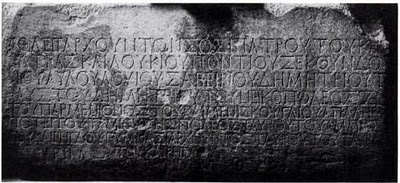 inscription on the Vardar Gate spanning the Egnatian Way barely west from where Paul and Silas were preaching. Though the arch was destroyed in 1867, that inscription was rescued and has its home in London’s British Museum. Just a little more external evidence that what we have in our Bibles is true history.
The city officials were treated to some false accusations and then poor Jason was maligned too! Guilt by association. Guilt by distortion and half-truths. The mob demanded justice. But as is so often the case, that’s nothing that a little extortion won’t fix.
8 When they heard this, the crowd and the city officials were thrown into turmoil. 9 Then they made Jason and the others post bond and let them go.
Money is a competing god. And it will stop at nothing to silence the Gospel. Followers of the Way, the Christians would face economic persecution, fear of the authorities and litigation, and intimidation would force their businesses underground or to close their doors. (Sound at all like America today?) All because of the Gospel. But Jason and the others—simply for knowing Paul and Silas and listening to them and maybe hosting them at Jason’s home as an act of hospitality—would be punished economically.
So what can we take home from today’s lesson?
- Don’t be surprised if God’s open door leads to effective proclamation of the Gospel to those who need to hear it and who will respond.
- Don’t be surprised if the persuasive message of Christ meets with mob opposition.
- Don’t be surprised if economic persecution will crown those mob efforts to counteract the Truth and silence a work of God.
- And don’t be surprised if the door closes so that you will move on to the next open door. Embrace even closed doors and opposition as signs of success for Christ.
My HOPE
The TRUE JUDGE knows the PAST: John 12:37 Even after Jesus had done all these miraculous signs in their presence, they still would not believe in him…43 for they loved praise from men more than praise from God. 44 Then Jesus cried out, “When a man believes in me, he does not believe in me only, but in the one who sent me. 45 When he looks at me, he sees the one who sent me. 46 I have come into the world as a light, so that no one who believes in me should stay in darkness. 47 “As for the person who hears my words but does not keep them, I do not judge him. For I did not come to judge the world, but to save it. 48 There is a judge for the one who rejects me and does not accept my words; that very word which I spoke will condemn him at the last day. 49 For I did not speak of my own accord, but the Father who sent me commanded me what to say and how to say it. 50 I know that his command leads to eternal life. So whatever I say is just what the Father has told me to say.”
The TRUE JUDGE knows the PRESENT: Romans 5:3 Not only so, but we also rejoice in our sufferings, because we know that suffering produces perseverance; 4 perseverance, character; and character, hope. 5 And hope does not disappoint us, because God has poured out his love into our hearts by the Holy Spirit, whom he has given us. 6 You see, at just the right time, when we were still powerless, Christ died for the ungodly. 7 Very rarely will anyone die for a righteous man, though for a good man someone might possibly dare to die. 8 But God demonstrates his own love for us in this: While we were still sinners, Christ died for us.
And the TRUE JUDGE knows the FUTURE: Revelation 19:11 I saw heaven standing open and there before me was a white horse, whose rider is called Faithful and True. With justice he judges and makes war. 12 His eyes are like blazing fire, and on his head are many crowns. He has a name written on him that no one knows but he himself. 13 He is dressed in a robe dipped in blood, and his name is the Word of God. 14 The armies of heaven were following him, riding on white horses and dressed in fine linen, white and clean. 15 Out of his mouth comes a sharp sword with which to strike down the nations. “He will rule them with an iron scepter.” He treads the winepress of the fury of the wrath of God Almighty. 16 On his robe and on his thigh he has this name written: KING OF KINGS AND LORD OF LORDS.
This is the King Eternal, the JUDGE in Whom I place my hope.
The Gospel Cuts Both Ways– 06.14.2015
Last Sunday we had a guest preacher at Plymouth Congregational Church and he continued our series of Acts of the Holy Spirit and the Apostles by doing Acts 13:13-52. To keep us up with our study of Acts online, enjoy this devotional on the same passage.
 The Gospel is the most interesting and most powerful set of words ever spoken.
It cuts both ways.
Paul and Barnabas, after John Mark deserted them, continued on what we’d refer to as Paul’s 1st Missionary Journey. They will arrive in Pisidian Antioch which isn’t the same as the Antioch from which they were sent. It’s kind of like a friend of mine who tells me about his church friends all of whom are named Alan or Barbara…or my old neighborhood where every man was named Mike. (It sure made it easy to remember people’s names.)
Antioch from where they were sent is in Syria and trust me, you wouldn’t want to go there today for safety reasons. Pisidian Antioch is in modern day Turkey and I’m not sure it’s all that much better there. Sacred sites are sometimes dangerous ones.
The Gospel was first preached in the synagogue because the rulers asked Barnabas and Paul to speak. Dangerous thing, letting Paul start talking. He addresses the men of Israel and the Gentiles and begins to tell them that the Gospel is for all. It cuts both ways.
It’s fulfillment for the Jews. It’s light for the Gentiles.
First, the Jewish history,
Acts 13: 16 Standing up, Paul motioned with his hand and said: “Men of Israel and you Gentiles who worship God, listen to me! 17 The God of the people of Israel chose our fathers; he made the people prosper during their stay in Egypt, with mighty power he led them out of that country, 18 he endured their conduct for about forty years in the desert, 19 he overthrew seven nations in Canaan and gave their land to his people as their inheritance. 20 All this took about 450 years. “After this, God gave them judges until the time of Samuel the prophet. 21 Then the people asked for a king, and he gave them Saul son of Kish, of the tribe of Benjamin, who ruled forty years. 22 After removing Saul, he made David their king. He testified concerning him: ‘I have found David son of Jesse a man after my own heart; he will do everything I want him to do.’ 23 “From this man’s descendants God has brought to Israel the Savior Jesus, as he promised.
It cuts both ways: the message of salvation came to the Jews (those brothers, children of Abraham) and also to the God-fearing Gentiles (everyone else who feared God).
26 “Brothers, children of Abraham, and you God-fearing Gentiles, it is to us that this message of salvation has been sent.
But the reaction fell along party lines. The people of Jerusalem, their rulers and even many of the Jews in Pisidian Antioch rejected Jesus. They rejected Paul’s message of their Messiah, their Savior, having come in the person of Jesus of Nazareth.
27 The people of Jerusalem and their rulers did not recognize Jesus, yet in condemning him they fulfilled the words of the prophets that are read every Sabbath.
The Gospel cuts both ways. It cuts to the heart because the Jewish hearers knew their Bibles. They knew their prophets and they knew their history. But they didn’t want Jesus to be the answer.
Proving that Jesus is the answer from their own history—theirs and Paul’s history that he knew very well himself—Paul concludes, 38 “Therefore, my brothers, I want you to know that through Jesus the forgiveness of sins is proclaimed to you. 39 Through him everyone who believes is justified from everything you could not be justified from by the law of Moses. 40 Take care that what the prophets have said does not happen to you: 41 “‘Look, you scoffers, wonder and perish, for I am going to do something in your days that you would never believe, even if someone told you.'” (italics mine for emphasis)
Who would have thought that through Jewish rejection and crucifixion of the Messiah, the light of salvation would come to the Gentiles? The Gospel: It cuts both ways!
45 When the Jews saw the crowds, they were filled with jealousy and talked abusively against what Paul was saying. 46 Then Paul and Barnabas answered them boldly: “We had to speak the word of God to you first. Since you reject it and do not consider yourselves worthy of eternal life, we now turn to the Gentiles. 47 For this is what the Lord has commanded us: “‘I have made you a light for the Gentiles, that you may bring salvation to the ends of the earth.'” 48 When the Gentiles heard this, they were glad and honored the word of the Lord; and all who were appointed for eternal life believed.
Jewish response: They had first dibs and it led to pride and widespread rejection.
Gentile response: They were Johnny-come-latelies and they were glad of it.
This must have been a very memorable and teachable moment for Paul.
He always started at the synagogue and ended up with the Gentiles. It’s his calling, even though in his heart, he remained a Jew of Jews. A completed Jew of Jews. A broken heart for the brethren of his birth became a focal point of Paul’s greatest work: the Letter to the Romans. Chapters 9-11 are basically an explanation of what Paul witnessed here in Pisidian Antioch and his attempting to process what he knew from his own Jewish background and his mission to the Gentiles. His deep desire for his Jewish brothers to come to faith would be a hallmark of Pauline theology of grace. The Gospel, Paul points out, it cuts both ways. The Gentiles once were jealous of Israel’s chosen status. When Israel rejected their Christ, God used this opportunity to extend salvation to the Gentiles who didn’t need to become Jews to be saved. This makes Israel jealous. And regarding that very jealousy, Paul writes in Romans 11:25-32,
Romans 11:25 I do not want you to be ignorant of this mystery, brothers, so that you may not be conceited: Israel has experienced a hardening in part until the full number of the Gentiles has come in. 26 And so all Israel will be saved, as it is written: “The deliverer will come from Zion; he will turn godlessness away from Jacob. 27 And this is my covenant with them when I take away their sins.” 28 As far as the gospel is concerned, they are enemies on your account; but as far as election is concerned, they are loved on account of the patriarchs, 29 for God’s gifts and his call are irrevocable. 30 Just as you who were at one time disobedient to God have now received mercy as a result of their disobedience, 31 so they too have now become disobedient in order that they too may now receive mercy as a result of God’s mercy to you. 32 For God has bound all men over to disobedience so that he may have mercy on them all.
The Gospel. It Cuts Both Ways.
It Happened at Antioch
(I was off from preaching last week, but to keep up with our study from Acts, here is a bit of a devotional on last week’s Scripture passage. Enjoy!)
Acts 11:19 Now those who had been scattered by the persecution in connection with Stephen traveled as far as Phoenicia, Cyprus and Antioch, telling the message only to Jews. 20 Some of them, however, men from Cyprus and Cyrene, went to Antioch and began to speak to Greeks also, telling them the good news about the Lord Jesus. 21 The Lord’s hand was with them, and a great number of people believed and turned to the Lord. 22 News of this reached the ears of the church at Jerusalem, and they sent Barnabas to Antioch. 23 When he arrived and saw the evidence of the grace of God, he was glad and encouraged them all to remain true to the Lord with all their hearts. 24 He was a good man, full of the Holy Spirit and faith, and a great number of people were brought to the Lord. 25 Then Barnabas went to Tarsus to look for Saul, 26 and when he found him, he brought him to Antioch. So for a whole year Barnabas and Saul met with the church and taught great numbers of people. The disciples were called Christians first at Antioch. 27 During this time some prophets came down from Jerusalem to Antioch. 28 One of them, named Agabus, stood up and through the Spirit predicted that a severe famine would spread over the entire Roman world. (This happened during the reign of Claudius.) 29 The disciples, each according to his ability, decided to provide help for the brothers living in Judea. 30 This they did, sending their gift to the elders by Barnabas and Saul.
* * *
The name “Christian” brings up all kinds of thoughts. To those who are Christian, it’s a title proudly embraced because it identifies us with our Savior and encourages us to follow Jesus Christ. To those outside the Christian community, however, it brings up all kinds of other thoughts. For some, the title Christian means we’re hypocrites and Bible-thumpers. To others, we’re the enemy of modern culture. We’re enforcers of rules. The morality police. The gnarled finger-pointers, always out there ruining everyone’s fun…or trying to. We’re the people they avoid at parties because we seem to be God-ordained buzz-kills.
Certainly our culture is presently engaged in an all-out war against Christianity because our God poses the biggest threat. Why? Because deep down, people who hate God all kind of know that our God is the One True God and they resent His existence.
Jesus said, John 15:18 “If the world hates you, keep in mind that it hated me first. 19 If you belonged to the world, it would love you as its own. As it is, you do not belong to the world, but I have chosen you out of the world. That is why the world hates you. 20 Remember the words I spoke to you: ‘No servant is greater than his master.’ If they persecuted me, they will persecute you also. If they obeyed my teaching, they will obey yours also. 21 They will treat you this way because of my name, for they do not know the One who sent me. 22 If I had not come and spoken to them, they would not be guilty of sin. Now, however, they have no excuse for their sin. 23 He who hates me hates my Father as well. 24 If I had not done among them what no one else did, they would not be guilty of sin. But now they have seen these miracles, and yet they have hated both me and my Father. 25 But this is to fulfill what is written in their Law: ‘They hated me without reason.’ 26 “When the Counselor comes, whom I will send to you from the Father, the Spirit of truth who goes out from the Father, he will testify about me. 27 And you also must testify, for you have been with me from the beginning.
No one is out there persecuting followers of Allah/the prophet Muhammad, except perhaps other followers of Allah/the prophet Muhammad (go figure!). No one is out there persecuting Mormons or Jehovah’s Witnesses or Buddhists or Hindus. But say the word Christian (or Jew), and suddenly the world is against you. Jews have been persecuted far longer than Christians, but we ought to belong to the same club, even if many of my Jewish friends don’t yet realize Jesus is their long-awaited Messiah.
But one thing we can say about genuine Christians is that we need to stick together and help each other. That’s how it’s been since Christians were first called Christian. And it happened first at Antioch.
In today’s passage of Scripture, there are a few notable things about that happening place called Antioch.
- Antioch was the place where Jews and Gentiles heard the Gospel preached with equal eagerness. And God grew their numbers for it, particularly among the Gentiles.
- It got the attention of the Church in Jerusalem since they began to see how God was expanding the Gospel to the Gentile world, literally the ends of their known earth. Just as Jesus said.
- Barnabas who had been an instrumental encourager of Paul/Saul was commissioned to check it out and make sure it was legit. And it was.
- Luke records for us that Christians were first called that at Antioch, and notably only after both Jews and Gentiles stood on level ground at the foot of the Cross. Gentiles were not called Christian while Jews were still Jews with a little Jesus accessorizing. They weren’t 2 co-equal but totally separate branches of God-fearers. Jews were not called Christian as a replacement for their Judaism. They were simultaneously fully Jewish by birth and as followers of Jesus, fully Christian, by being born again into a completed faith.
- Christians aren’t Christian in name only. They show their Christianity by what they do. In this case, Christians (having heard that a famine was coming) rallied together to provide for the neediest among them: those back in Judea whose Christianity may have cost them their livelihood or whose sheer numbers of widows and orphans were greatest. The persecution was real and the consequences for those in Judea were dire, especially since the scattering of the believing community left them without safety in numbers. The believers remaining in Judea were at the epicenter of persecution and needed help from the larger body.
Questions for further thought:
- So where are you today? Are you a Christian in name only or do you show your faith by what you do? (James 2:18)
- Divide and conquer is typically a sure-fire strategy for defeating the ones divided. Scattering geographically divided the Body of Christ by space and location.
 Yet, those bold believers found a way to continually preach the Good News and that created new community wherever they went. (Luke 8:16)
 - In our day and age, geography isn’t how we’re scattered. We’re alone in a crowd. Our faith has been driven inward—it has become privatized. How is this more effective at dividing and defeating us? How does individualism (division by space and location) seek to destroy the idea of community (Hebrews 10:25)? How does privatized Christianity disguise our numbers?
- Why do you think that the community of faith wasn’t called Christian until it was both Jews and Gentiles (non-Jews)?