Rekindle a Character of Contentment (Lent 18, 2016)
1 Timothy 6:6 But godliness with contentment is great gain.
Among the things you don’t really care about: I typically use the NIV’s English translation for my work for no reason other than it’s a pretty easy read. Why do I tell you this if you don’t care? Because today, I’ve gone with a different translation: the New American Standard Bible. And why, if they all say basically the same thing? Because it’s fuller in pointing to contentment.
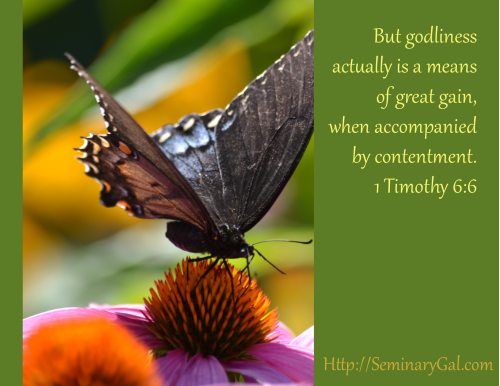
NAS 1 Timothy 6:6 But godliness actually is a means of great gain, when accompanied by contentment.
 The opposite of that statement reminds us that godliness by itself doesn’t necessarily produce great gain. If we’re Bible scholars who are not content with what God has provided along the way, we’re just being holy rollers. Bible thumpers. Christian legal beagles with a crosses for collars.
I’d argue contentment is the litmus test that reveals whether we truly believe God loves us and trust that He provides for us.
So how do we rekindle a character of contentment?
By routinely looking up, letting go and opening our hands to receive what God has to give instead of focusing on this earth and working so hard with our own two hands that we have tight fists regarding our future.
Contentment requires a character of focus and priority on God.
NAS Hebrews 13:5 Let your character be free from the love of money, being content with what you have; for He Himself has said, “I will never desert you, nor will I ever forsake you,” 6 so that we confidently say, “The Lord is my helper, I will not be afraid. What shall man do to me?”
See? Contentment is when we stop striving and worrying and simply trust
- that God loves us,
- He is our helper,
- He is our provider,
- He will never abandon us,
- and He will preserve us even in circumstances that might not be our preferred ones.
It doesn’t mean laziness. Tune in tomorrow for that one, but for now…
Give it up for Lent: A character that begrudges God’s provision
Questions for 1 Tim 6:6 and Hebrews 13:5-6
- For context read all of 1 Timothy 6. It’s pretty amazing. You’ll recognize some familiar lines (NIV this time). 1 Timothy 6: 6 “But godliness with contentment is great gain. 7 For we brought nothing into the world, and we can take nothing out of it. 8 But if we have food and clothing, we will be content with that. 9 People who want to get rich fall into temptation and a trap and into many foolish and harmful desires that plunge men into ruin and destruction. 10 For the love of money is a root of all kinds of evil.” Why is money such a lure?
- In Matthew 6:24 Jesus says, “No one can serve two masters. Either he will hate the one and love the other, or he will be devoted to the one and despise the other. You cannot serve both God and Money.” How does this explain why we need to be content?
- In Hebrews 13:5-6, the contentment we have is by allowing ourselves to be free of the love of money. By analogy, if the love of money is what we actively put into our character like forcing air into a balloon, contentment is externally applied to us like the air pressure around the balloon when we deflate it. A full balloon is at constant pressure with the air around it and waiting to pop. A balloon emptied of air is at rest. Look at what God promises to us and in response, note what we can confidently do when our character is emptied of competing pressures and loves. Why can we do it confidently?
 ReKindle is the 2016 Lenten devotional series from Seminary Gal.
To receive these devotionals to your email inbox throughout Lent, please fill in your email address in the space provided on my Home Page in the sidebar (right) and respond to the verification email. If you already receive devotionals and articles, no need to do anything else. You’ll get them automatically. Thank you! Or log onto the SeminaryGal Facebook page and see them reprinted there.
Acknowledging that former years’ devotional series remain popular, Be Still and Know that I AM God can be obtained through the archives beginning in March 2014 and With Christ in the Upper Room is archived beginning February 18, 2015.
Rekindle My Contentment (Lent 17, 2016)
In the script from the movie Chariots of Fire, Harold M. Abrahams is preparing to run in his final race in the 1924 Paris Olympics. He addresses his fellow athlete, Aubrey Montague saying, “You, Aubrey, are my most complete man. You’re brave, compassionate, kind: a content man. That is your secret, contentment; I am 24 and I’ve never known it. I’m forever in pursuit and I don’t even know what I am chasing.”
Don’t you kind of wish your secret was contentment? It seems so elusive and even contrary to the American pursuit of individual excellence.
Is it possible to experience contentment even while being driven to your personal best?
What about Harold Abrahams made his drive and his passion not contribute to his contentment? I’d argue he lost sight of the goal. He didn’t know what he was chasing, even if he’d ever known it. It became chasing for the sake of chasing. Pursuing for the sake of pursuing. An addiction to a feeling of pursuit not a passion for a goal of eternal significance.
 Eric Liddell, on the other hand, was also on that Olympic team. Did he have passion and drive? Absolutely! Did he want to win? Sure, he did! What made his pursuit different?
When the drive to win was set alongside the goal of bringing glory to God through his life and his pursuits, he didn’t lose sight of the goal.
Even when it meant he couldn’t run the race he’d intended because of the qualifying heats on Sunday, which pitted his excellence and commitment as a runner against his excellence and commitment as a Christian. He had regrets at not participating, but no doubts about it. Therefore, God gave Liddell’s witness extra visibility and he was shown to be excellent both as a runner and as a witness.
What about you? Do you know contentment or are you forever in pursuit of a feeling?
Philippians 4:11 I am not saying this because I am in need, for I have learned to be content whatever the circumstances. 12 I know what it is to be in need, and I know what it is to have plenty. I have learned the secret of being content in any and every situation, whether well fed or hungry, whether living in plenty or in want. 13 I can do everything through him who gives me strength.
Give it up for Lent: An endless chasing after what cannot satisfy
Questions for Phil 4:11-13
- According to Paul, is contentment found in circumstances?
- How ought this to inform our understanding of “giving something up” for Lent?
- In our culture, there are a lot of people who have an insatiable appetite. They chase after many things hoping to find themselves satisfied. Why aren’t they, no matter how much money they accumulate, how attractive their spouses, how quickly they climb the ladder of success or how many friends/followers they have on social media?
- Will the “leap day” today be different for you because it’s one more day? Or will it make no difference if you do the same old same old which won’t satisfy? How can you enter March with a heart for contentment?
 ReKindle is the 2016 Lenten devotional series from Seminary Gal.
To receive these devotionals to your email inbox throughout Lent, please fill in your email address in the space provided on my Home Page in the sidebar (right) and respond to the verification email. If you already receive devotionals and articles, no need to do anything else. You’ll get them automatically. Thank you! Or log onto the SeminaryGal Facebook page and see them reprinted there.
Acknowledging that former years’ devotional series remain popular, Be Still and Know that I AM God can be obtained through the archives beginning in March 2014 and With Christ in the Upper Room is archived beginning February 18, 2015.
Third Sabbath of Lent 2016

Jeremiah 17: 4 “Through your own fault you will lose the inheritance I gave you. I will enslave you to your enemies in a land you do not know, for you have kindled my anger, and it will burn forever.” 5 This is what the LORD says: “Cursed is the one who trusts in man, who depends on flesh for his strength and whose heart turns away from the LORD. 6 He will be like a bush in the wastelands; he will not see prosperity when it comes. He will dwell in the parched places of the desert, in a salt land where no one lives.
7 But blessed is the man who trusts in the LORD, whose confidence is in him. 8 He will be like a tree planted by the water that sends out its roots by the stream. It does not fear when heat comes; its leaves are always green. It has no worries in a year of drought and never fails to bear fruit.”
9 The heart is deceitful above all things and beyond cure. Who can understand it? 10 “I the LORD search the heart and examine the mind, to reward a man according to his conduct, according to what his deeds deserve.” …
13 O LORD, the hope of Israel, all who forsake you will be put to shame. Those who turn away from you will be written in the dust because they have forsaken the LORD, the spring of living water. 14 Heal me, O LORD, and I will be healed; save me and I will be saved, for you are the one I praise… 19 This is what the LORD said to me: “Go and stand at the gate of the people, through which the kings of Judah go in and out; stand also at all the other gates of Jerusalem. 20 Say to them, ‘Hear the word of the LORD, O kings of Judah and all people of Judah and everyone living in Jerusalem who come through these gates. 21 This is what the LORD says: Be careful not to carry a load on the Sabbath day or bring it through the gates of Jerusalem. 22 Do not bring a load out of your houses or do any work on the Sabbath, but keep the Sabbath day holy, as I commanded your forefathers. ‘”
The Sabbath is for our benefit: to rest, to reflect, and to be refreshed as we worship…in our sober acknowledgement of Him. In a spiritual sense, with the loads of life aside, we will keep the Sabbath as a day for the Lord. God reminds us to keep it holy.
Tomorrow we resume ReKindle, the 2016 Lenten devotional series from Seminary Gal.
To receive these devotionals to your email inbox throughout Lent, please fill in your email address in the space provided on my Home Page in the sidebar (right) and respond to the verification email. If you already receive devotionals and articles, no need to do anything else. You’ll get them automatically. Thank you! Or log onto the SeminaryGal Facebook page and see them reprinted there.
Acknowledging that former years’ devotional series remain popular, Be Still and Know that I AM God can be obtained through the archives beginning in March 2014 and With Christ in the Upper Room is archived beginning February 18, 2015.
Sober Self-Control (Lent 16, 2016)
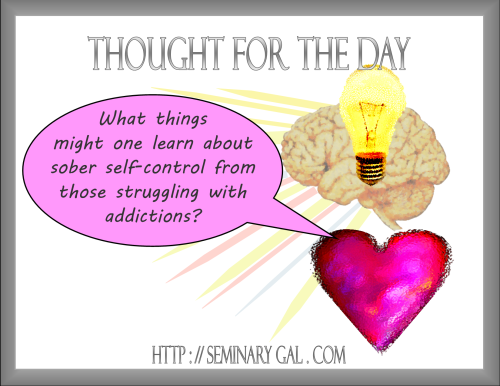 Sober is a word most of us associate with one thing:
substance abuse.
But another word in the Greek often translated as self-control is a word also meaning sober.
Of a right or sound mind.
In Titus, various forms of the word and its synonyms are used frequently. The Apostle Paul has just finished pointing out characteristics of false teachers, ones whose lives lack in self-control and right thinking. About them Paul says, “In fact, both their minds and their consciences are corrupted” (Titus 1:15). To guard his coworker Titus against such an outcome, Paul writes:
Titus 2:1 You must teach what is in accord with sound doctrine. 2 Teach the older men to be temperate, worthy of respect, self-controlled, and sound in faith, in love and in endurance. 3 Likewise, teach the older women to be reverent in the way they live, not to be slanderers or addicted to much wine, but to teach what is good. 4 Then they can train the younger women to love their husbands and children, 5 to be self-controlled and pure, to be busy at home, to be kind, and to be subject to their husbands, so that no one will malign the word of God. 6 Similarly, encourage the young men to be self-controlled.
Clearly it doesn’t matter what age group or gender. A sober self-control is a one-size-fits-all attribute.
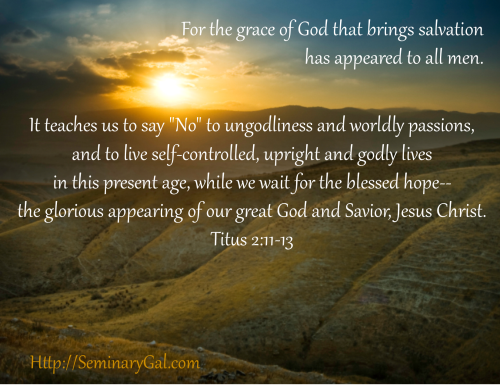
7 In everything set them an example by doing what is good. In your teaching show integrity, seriousness 8 and soundness of speech that cannot be condemned, so that those who oppose you may be ashamed because they have nothing bad to say about us. 9 Teach slaves to be subject to their masters in everything, to try to please them, not to talk back to them, 10 and not to steal from them, but to show that they can be fully trusted, so that in every way they will make the teaching about God our Savior attractive. 11 For the grace of God that brings salvation has appeared to all men. 12 It teaches us to say “No” to ungodliness and worldly passions, and to live self-controlled, upright and godly lives in this present age, 13 while we wait for the blessed hope– the glorious appearing of our great God and Savior, Jesus Christ, 14 who gave himself for us to redeem us from all wickedness and to purify for himself a people that are his very own, eager to do what is good. 15 These, then, are the things you should teach. Encourage and rebuke with all authority. Do not let anyone despise you.
In every case, Scripture is what creates that sound mind and results in sober, right, and self-controlled actions. Rekindle that sober self-control.
Give it up for Lent: Ungodliness and unsound thinking
Questions from Titus 2:1-15.
- Self-control isn’t limited to men or women, young or old. It’s good for us no matter what our generation or line of work. Self-control doesn’t just happen. It must be learned and exercised. How do we learn self-control?
- Imagine self-control and sober thinking as the reins used to control a horse’s movements. How do they work together to keep us moving well instead of just persisting at a standstill? Identify the ways example, sound doctrine, and godly living, etc. work together with saying “No”.
- What happens if everything is just “No” without the positives of grace?
- Is it the law and rules that produce self-control? If not, what does produce it?
 ReKindle is the 2016 Lenten devotional series from Seminary Gal.
To receive these devotionals to your email inbox throughout Lent, please fill in your email address in the space provided on my Home Page in the sidebar (right) and respond to the verification email. If you already receive devotionals and articles, no need to do anything else. You’ll get them automatically. Thank you! Or log onto the SeminaryGal Facebook page and see them reprinted there.
Acknowledging that former years’ devotional series remain popular, Be Still and Know that I AM God can be obtained through the archives beginning in March 2014 and With Christ in the Upper Room is archived beginning February 18, 2015.
Rekindle My Self-Control (Lent 15, 2016)
Repentance is only one side of the coin. The other side is self-control. It’s one thing to repent, do the sin again, and repeat as if it’s a cycle and acceptable to do it over and over.
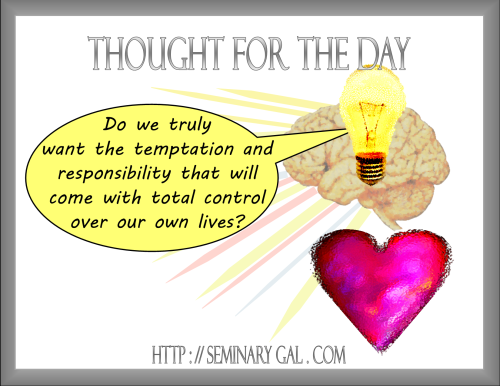
Self-control is one of those things that we want but we don’t. We want all the power and control in the world, especially over our own lives. But do we want the temptation and responsibility that come with it?
 I was thinking about this the other day…a philosophical question.
I am the kind of person whose mind envisions things of beauty that I lack the skills to bring into being. Sculptures that I wish I had equipment and know-how to create. Quilts that would be lovely to behold. Computer graphics and artwork stunning to the eye. Clothing designs I wish I could manufacture. The list goes on and on.
I found myself wondering,
If I could dream-it-do-it in creating things of beauty and cures for diseases presently harming those I love, would I want to have that skill? Would I still want the power of taking my mind and turning it to reality, if that power could be misused? If someone with an evil mind could also dream-it-do-it since I could, or if I could be seduced into using my gift to unwittingly harm others?”
I think of Romans 7:21 “So I find this law at work: When I want to do good, evil is right there with me.” It’s kind of like in Lord of the Rings when Frodo wants to give the ring of power to Gandalf.
- Frodo: [holding out the Ring] Take it Gandalf!
- [Gandalf backs away]
- Frodo: Take it!
- Gandalf: No, Frodo.
- Frodo: You must take it!
- Gandalf: You cannot offer me this ring!
- Frodo: I’m giving it to you!
- Gandalf: Don’t… tempt me Frodo! I dare not take it. Not even to keep it safe. Understand, Frodo. I would use this ring from a desire to do good… But through me, it would wield a power too great and terrible to imagine.
Do we have the kind of self-control to reject even the temptation to sin, understanding that our desire might be good, but our nature is sinful?
Jesus talks about that in Matthew 5: 27 “You have heard that it was said, ‘Do not commit adultery.’ 28 But I tell you that anyone who looks at a woman lustfully has already committed adultery with her in his heart. 29 If your right eye causes you to sin, gouge it out and throw it away. It is better for you to lose one part of your body than for your whole body to be thrown into hell. 30 And if your right hand causes you to sin, cut it off and throw it away. It is better for you to lose one part of your body than for your whole body to go into hell.”
Give it up for Lent: Desire for control
Questions from Romans 7:21 and Matthew 5:27-30:
- Evil can be considered the shadow existing in the darkness behind every good desire. What does Romans 7:21 say about that?
- How can knowledge of this help to rekindle self-control?
- When Jesus tells us to get rid of what causes us to sin, how does this inform a rekindling of self-control?
- What distinguishes self-determination from self-limitation?
 ReKindle is the 2016 Lenten devotional series from Seminary Gal.
To receive these devotionals to your email inbox throughout Lent, please fill in your email address in the space provided on my Home Page in the sidebar (right) and respond to the verification email. If you already receive devotionals and articles, no need to do anything else. You’ll get them automatically. Thank you! Or log onto the SeminaryGal Facebook page and see them reprinted there.
Acknowledging that former years’ devotional series remain popular, Be Still and Know that I AM God can be obtained through the archives beginning in March 2014 and With Christ in the Upper Room is archived beginning February 18, 2015.
Who Needs to Repent? (Lent 14, 2016)
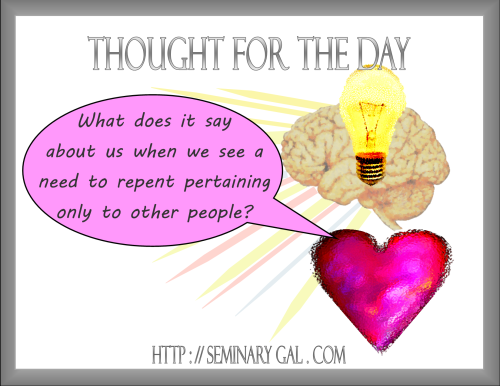
Who needs to repent? It’s easy to point the finger at others instead of looking in the mirror. You see, it’s not just pagans, infidels, and those we decide to label as lost souls who need to repent. It’s all of us.
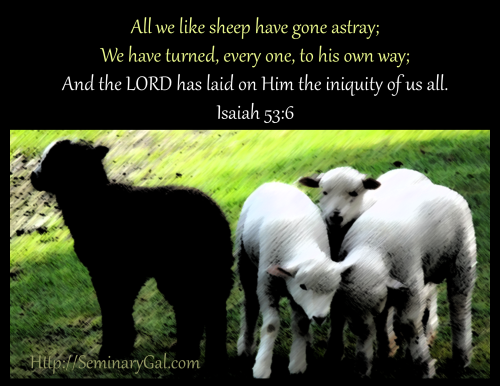
Isaiah 53:6 All we like sheep have gone astray; We have turned, every one, to his own way; And the LORD has laid on Him the iniquity of us all.
 Many of us suffer from the Mary Poppins Effect, measuring ourselves with our own tape measure which proclaims us as “practically perfect in every way.” But close enough (even for a cigar) isn’t really all that close.
You’re either perfect or you’re not… and trust me, you’re not. I’m not either, but you probably already figured that out.
Yeah, even if you’re a Christian. It’s the old “Not Perfect, Just Forgiven” concept.
So, even among the forgiven, repentance is in order. Paul tells Timothy this about those in the community of faith (in case you didn’t catch it, it’s IN the community of faith): 2 Timothy 4:3 For the time will come when men will not put up with sound doctrine. Instead, to suit their own desires, they will gather around them a great number of teachers to say what their itching ears want to hear. 4 They will turn their ears away from the truth and turn aside to myths.
Yes, one look at Christianity in America and you’ll conclude that proclaiming oneself as Christian or forgiven is often claimed as cover so one can rebel with fire of hell insurance. We cannot just point our fingers at others–in and out of the Church– and pick a speck out of their eyes (Matthew 7:1-5). It’s not just Donald Trump or Bernie Sanders or Kim Jong-un or Vladimir Putin or El Chapo Guzman who need to repent.
Who needs to repent?
It’s Billy Graham and the Pope and Dr. James Dobson and the pastor of your church and yes, you and me. We’re as guilty as the rest. Jesus tells the Church at Ephesus this: Revelation 2:5 Remember the height from which you have fallen! Repent and do the things you did at first. If you do not repent, I will come to you and remove your lampstand from its place.
Give it up for Lent: Thinking repentance is only for other people.
Questions for Isaiah 53:6, 2 Tim 4:3-4, and Revelation 2:5:
- In Isaiah 53:6, 21 out of 28 words point to the universal nature of human sin. Identify those and the 7 which point to God’s remedy for that.
- Jesus is not just “practically perfect in every way.” He is perfect period. How does that explain why He is God’s provision for human forgiveness?
- In 2 Tim 4:3-4, who is the center of their universe? How does this warp human understanding of a need to repent?
- In Revelation 2:5, a church that does not love and that does not love the truth fails to be a light to the world. What does Jesus say is the consequence of that?
- In order to rekindle our repentance, what must we do? Who needs to repent?
 ReKindle is the 2016 Lenten devotional series from Seminary Gal.
To receive these devotionals to your email inbox throughout Lent, please fill in your email address in the space provided on my Home Page in the sidebar (right) and respond to the verification email. If you already receive devotionals and articles, no need to do anything else. You’ll get them automatically. Thank you! Or log onto the SeminaryGal Facebook page and see them reprinted there.
Acknowledging that former years’ devotional series remain popular, Be Still and Know that I AM God can be obtained through the archives beginning in March 2014 and With Christ in the Upper Room is archived beginning February 18, 2015.
Repentance Rekindled (Lent 13, 2016)
 One of the casualties of refusing to call a spade “a spade” … or a sin “a sin”…
is that it makes repentance completely unnecessary.
* * *
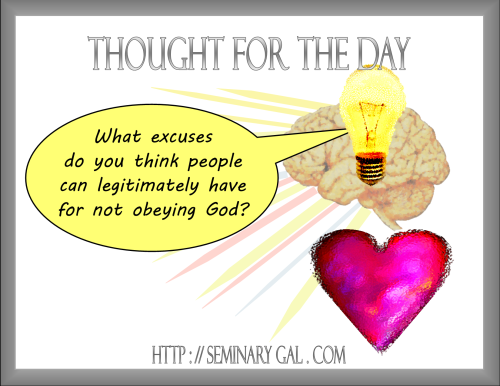
If all truth is relative and no sin is immoral, then no one needs to repent because what they did was right… in their own eyes.
Repentance rekindled would be worse than a waste of time to such people.
The Bible has a few choice words for that kind of dangerous thinking:
Ephesians 4:18 They are darkened in their understanding and separated from the life of God because of the ignorance that is in them due to the hardening of their hearts. 19 Having lost all sensitivity, they have given themselves over to sensuality so as to indulge in every kind of impurity, with a continual lust for more.
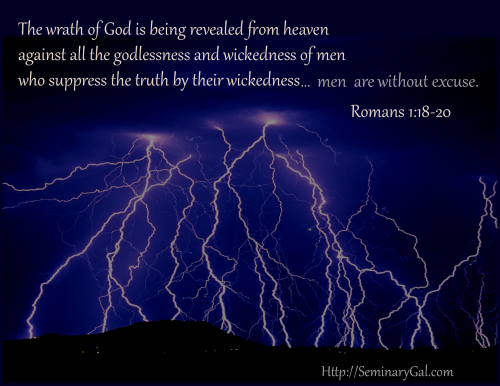
And the outcome isn’t a pretty one: Romans 1:18 The wrath of God is being revealed from heaven against all the godlessness and wickedness of men who suppress the truth by their wickedness, 19 since what may be known about God is plain to them, because God has made it plain to them. 20 For since the creation of the world God’s invisible qualities– his eternal power and divine nature– have been clearly seen, being understood from what has been made, so that men are without excuse. 21 For although they knew God, they neither glorified him as God nor gave thanks to him, but their thinking became futile and their foolish hearts were darkened. 22 Although they claimed to be wise, they became fools 23 and exchanged the glory of the immortal God for images made to look like mortal man and birds and animals and reptiles.
The remedy, however, is remarkably simple: Repentance, a change of mind.
We need repentance rekindled.
The time has come,” Jesus said. “The kingdom of God is near. Repent and believe the good news!” (Mark 1:15)
Give it up for Lent: Fool’s “wisdom”
Questions on Ephesians 4:18-19, Romans 1:18-23, and Mark 1:15:
- How do a darkened understanding and a life apart from God lead to an ongoing hardening of the heart—a downward spiral?
- What comes first, the darkened understanding and rebellion or the hardness of their hearts?
- Once a person enters that downward spiral, what is the only way out?
- What are some ways the world claims to be wise and labels Christians as ignorant?
- How does someone get repentance rekindled? (Mark 1:15)
ReKindle is the 2016 Lenten devotional series from Seminary Gal.
To receive these devotionals to your email inbox throughout Lent, please fill in your email address in the space provided on my Home Page in the sidebar (right) and respond to the verification email. If you already receive devotionals and articles, no need to do anything else. You’ll get them automatically. Thank you! Or log onto the SeminaryGal Facebook page and see them reprinted there.
Acknowledging that former years’ devotional series remain popular, Be Still and Know that I AM God can be obtained through the archives beginning in March 2014 and With Christ in the Upper Room is archived beginning February 18, 2015.
Rekindle My Outrage (Lent 12, 2016)
Uh-oh, you may be thinking. Outrage. There she goes again. But love and understanding are only one part of the equation.
When love and understanding meet injustice and sin, it’s only natural to experience what God does: outrage.
Wrath—the biblical word for outrage—speaks of God’s righteous anger at what harms those He both loves and created. It’s not an uncontrolled anger like rage. It’s not a generalized concept like peeved. It’s not undirected or uninformed like just plain mad. It’s not all heat of action and no light of knowledge like fury.
Wrath is one of those things we know exists (if we’re honest) but no one likes to talk about. Wrath arises out of love and understanding but also the moral consequences of ungodly actions which God sees solely through His moral framework.
Outrage is a moral quality of which we could all use some rekindling in that important moral context.
 We’ve become desensitized.
Murder? Whatever. It’s every day on the news. With dash-cams, we can even watch it happening as if it’s not really real or that the person killed was not actually a fellow human being. The video can go viral and people will watch it over and over again in gruesome prurience. Assault? Smash and grab? Knockout–just a game? Date rape? We’ve lost our sense of outrage because we have stopped caring about the moral consequences of sin.
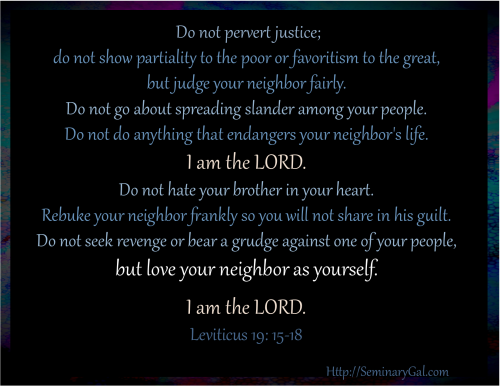
Remember back to Leviticus 19? There are moral consequences to our fellow man and God is outraged by sin. God desires us to care deeply about each other, not just the lower standard of not sinning against them. Leviticus 19: 9 “‘When you reap the harvest of your land, do not reap to the very edges of your field or gather the gleanings of your harvest. 10 Do not go over your vineyard a second time or pick up the grapes that have fallen. Leave them for the poor and the alien. I am the LORD your God. 11 “‘Do not steal. “‘Do not lie. “‘Do not deceive one another. 12 “‘Do not swear falsely by my name and so profane the name of your God. I am the LORD. 13 “‘Do not defraud your neighbor or rob him. “‘Do not hold back the wages of a hired man overnight. 14 “‘Do not curse the deaf or put a stumbling block in front of the blind, but fear your God. I am the LORD. 15 “‘Do not pervert justice; do not show partiality to the poor or favoritism to the great, but judge your neighbor fairly. 16 “‘Do not go about spreading slander among your people. “‘Do not do anything that endangers your neighbor’s life. I am the LORD. 17 “‘Do not hate your brother in your heart. Rebuke your neighbor frankly so you will not share in his guilt. 18 “‘Do not seek revenge or bear a grudge against one of your people, but love your neighbor as yourself. I am the LORD.”
So we rekindle our sense of outrage at what God hates and develop an outrageous grace toward other people. It’s hard to confront sin with a sense of godly outrage and genuine grace but we’re commanded to do it. Ephesians 5:11 Have nothing to do with the fruitless deeds of darkness, but rather expose them. 12 For it is shameful even to mention what the disobedient do in secret.
More than anything for today, take time to pray and ask God to reveal ways in which you’ve become timid and desensitized. Ways in which you’ve developed an unhealthy interest in the gruesome instead of an outrage against it. Ways in which you’ve stopped caring about your neighbors or being concerned for their very real humanity. Taking that to my heart personally, that’s what I’m praying today.
Give it up for Lent: a desensitized complacency
Questions for Leviticus 19:9-18 and Ephesians 5:11-12
- When we harm our brothers, why does God turn the insult heavenward and point out that He is the Lord? (Lev 19:10, 14, 18)
- In Lev 19:17, it speaks of our not hating our brothers, but rebuking our neighbors frankly. What is the distinction between the two? And what is Scripture’s reason for that admonishment?
- Likewise in Eph 5:11, what are we supposed to do with the fruitless deeds of darkness? What constitutes a fruitless deed of darkness? How do we know?
- Why do the disobedient do their fruitless deeds in secret?
- In American culture, how good have we been at exposing fruitless deeds of darkness and rebuking our neighbor frankly? Why do you think that is? What are we losing in confidence and in our culture by no longer seeing sin as sin?
 ReKindle is the 2016 Lenten devotional series from Seminary Gal.
To receive these devotionals to your email inbox throughout Lent, please fill in your email address in the space provided on my Home Page in the sidebar (right) and respond to the verification email. If you already receive devotionals and articles, no need to do anything else. You’ll get them automatically. Thank you! Or log onto the SeminaryGal Facebook page and see them reprinted there.
Acknowledging that former years’ devotional series remain popular, Be Still and Know that I AM God can be obtained through the archives beginning in March 2014 and With Christ in the Upper Room is archived beginning February 18, 2015.
Rekindled Understanding of God’s Truth (Lent 11, 2016)
 Last week, I asserted that compromising of good and evil doesn’t bring glory to God at all. There is no life in that.
For Lent, it’d be good to give up that notion of compromise on moral issues since it’s actually saying that God’s truth is not absolute and God is not God.
It’s time to have a rekindled understanding of God’s truth. By understanding, acknowledging, and accepting God’s ways, we can have peace no matter what the world throws at us.
Where do you turn in distressing times?
Inward–pull yourself up by your bootstraps? Outward–it takes a village while getting by with a little help from my friends? Or do you turn upward and place your trust in God?
We’re in the midst of political overload in the US. Politicians from left to right are wanting your vote by promising to make America great again, to usher in Utopia, to give you everything you ever wanted at someone else’s expense, and to take back our country from the unjust and the powerful. It’s hard to find anyone preaching that strength, true wisdom, courage, and a rekindled understanding can only be found in God. Yup. Even in the Church we’re not preaching it. Yup. Even from the Pope we’re still looking at a man. There are even articles by those who have given up on revival, stating that God has turned His back on America. I’m not ready to throw in the towel, to turn my eyes from trusting God, or to consider placing my hope in any man as the only hope I have left. As for me and my house, we’re still looking up and waiting upon God. What about you?
Will we have a rekindled understanding?
In Isaiah 33, there is a contrast of distress and help and it hinges upon this understanding of God and His truth.
Isaiah 33: 5 The LORD is exalted, for he dwells on high; he will fill Zion with justice and righteousness. 6 He will be the sure foundation for your times, a rich store of salvation and wisdom and knowledge; the fear of the LORD is the key to this treasure. 7 Look, their brave men cry aloud in the streets; the envoys of peace weep bitterly. 8 The highways are deserted, no travelers are on the roads. The treaty is broken, its witnesses are despised, no one is respected. 9 The land mourns and wastes away, Lebanon is ashamed and withers; Sharon is like the Arabah, and Bashan and Carmel drop their leaves. 10 “Now will I arise,” says the LORD. “Now will I be exalted; now will I be lifted up. 11 You conceive chaff, you give birth to straw; your breath is a fire that consumes you. 12 The peoples will be burned as if to lime; like cut thornbushes they will be set ablaze.” 13 You who are far away, hear what I have done; you who are near, acknowledge my power! 14 The sinners in Zion are terrified; trembling grips the godless: “Who of us can dwell with the consuming fire? Who of us can dwell with everlasting burning?” 15 He who walks righteously and speaks what is right, who rejects gain from extortion and keeps his hand from accepting bribes, who stops his ears against plots of murder and shuts his eyes against contemplating evil– 16 this is the man who will dwell on the heights, whose refuge will be the mountain fortress. His bread will be supplied, and water will not fail him. 17 Your eyes will see the king in his beauty and view a land that stretches afar. 18 In your thoughts you will ponder the former terror: “Where is that chief officer? Where is the one who took the revenue? Where is the officer in charge of the towers?” 19 You will see those arrogant people no more, those people of an obscure speech, with their strange, incomprehensible tongue. 20 Look upon Zion, the city of our festivals; your eyes will see Jerusalem, a peaceful abode, a tent that will not be moved; its stakes will never be pulled up, nor any of its ropes broken. 21 There the LORD will be our Mighty One. It will be like a place of broad rivers and streams. No galley with oars will ride them, no mighty ship will sail them. 22 For the LORD is our judge, the LORD is our lawgiver, the LORD is our king; it is he who will save us.
Can I get an Amen?
Give it up for Lent: Trusting in human wisdom
Questions for Isaiah 33:
- What is the key? (v 6)
- Identify the contrasts present in Isaiah 33. A rekindled understanding of God will produce what?
- Is your trust in politicians being able to negotiate treaties or showing bravery or securing peace accords? Ask God to reveal any ways in which your trust is placed upon created things instead of in God.
 ReKindle is the 2016 Lenten devotional series from Seminary Gal.
To receive these devotionals to your email inbox throughout Lent, please fill in your email address in the space provided on my Home Page in the sidebar (right) and respond to the verification email. If you already receive devotionals and articles, no need to do anything else. You’ll get them automatically. Thank you! Or log onto the SeminaryGal Facebook page and see them reprinted there.
Acknowledging that former years’ devotional series remain popular, Be Still and Know that I AM God can be obtained through the archives beginning in March 2014 and With Christ in the Upper Room is archived beginning February 18, 2015.
Second Sabbath of Lent 2016
Job 38:1 Then the LORD answered Job out of the storm. He said: 2 “Who is this that darkens my counsel with words without knowledge? 3 Brace yourself like a man; I will question you, and you shall answer me. 4 “Where were you when I laid the earth’s foundation? Tell me, if you understand. 5 Who marked off its dimensions? Surely you know! Who stretched a measuring line across it? 6 On what were its footings set, or who laid its cornerstone– 7 while the morning stars sang together and all the angels shouted for joy? 8 “Who shut up the sea behind doors when it burst forth from the womb, 9 when I made the clouds its garment and wrapped it in thick darkness, 10 when I fixed limits for it and set its doors and bars in place, 11 when I said, ‘This far you may come and no farther; here is where your proud waves halt’? 12 “Have you ever given orders to the morning, or shown the dawn its place, 13 that it might take the earth by the edges and shake the wicked out of it? 14 The earth takes shape like clay under a seal; its features stand out like those of a garment. 15 The wicked are denied their light, and their upraised arm is broken. 16 “Have you journeyed to the springs of the sea or walked in the recesses of the deep? 17 Have the gates of death been shown to you? Have you seen the gates of the shadow of death? 18 Have you comprehended the vast expanses of the earth? Tell me, if you know all this.
Tomorrow we resume ReKindle, the 2016 Lenten devotional series from Seminary Gal.
To receive these devotionals to your email inbox throughout Lent, please fill in your email address in the space provided on my Home Page in the sidebar (right) and respond to the verification email. If you already receive devotionals and articles, no need to do anything else. You’ll get them automatically. Thank you! Or log onto the SeminaryGal Facebook page and see them reprinted there.
Acknowledging that former years’ devotional series remain popular, Be Still and Know that I AM God can be obtained through the archives beginning in March 2014 and With Christ in the Upper Room is archived beginning February 18, 2015.