Category: Articles and Devotionals
A selection of devotionals written by Barbara Shafer.
Making the Theological Understandable
A selection of devotionals written by Barbara Shafer.
 We’re increasingly accustomed to the concept of followers. Facebook has followers, even subscribers who share, comment, and like. Celebrities have followers. There are even Nabisco Wheat Thins followers and Bronx Zoo Cobra followers on Twitter.
Unlike Facebook, Twitter, fan clubs, paparazzi, groupies, or wannabes, following Jesus costs you something.
Jesus makes it clear that who or what you follow reflects much about the depth of your heart’s commitment and your intellectual agreement.
The Song of Ascents, Psalm 121, is echoing in the background, “I lift my eyes up to the hills—where does my help come from?” The choice of who or what to follow is contained in your answer: the hills of the world’s comforts, or the God who made them.
As they were walking along the road, a man said to him, “I will follow you wherever you go.” Jesus replied, “Foxes have holes and birds of the air have nests, but the Son of Man has no place to lay his head.” He said to another man, “Follow me.” But the man replied, “Lord, first let me go and bury my father.” Jesus said to him, “Let the dead bury their own dead, but you go and proclaim the kingdom of God.” Still another said, “I will follow you, Lord; but first let me go back and say good-by to my family.” Jesus replied, “No one who puts his hand to the plow and looks back is fit for service in the kingdom of God.” (Luke 9:57-62)
Think about it: for Jesus, the purpose of having followers isn’t His personal popularity, increasing His profile of friends, or validation of His ideas.
Jesus isn’t looking for a “follower for a day” like it’s the flavor of the month. He’s looking for committed followers—disciples for an eternal lifetime. He isn’t looking for a crowd of increasing size. He’s looking for disciples of increasing spiritual depth. He isn’t looking for people who will follow Him for what’s in it for them in the earthly sense like a social pyramid scheme. He’s looking for people who follow Him because they see beyond the hills of their kingdoms and castles all the way to God Himself.
Jesus is confident in being the Son of God.
He knows His role is that of revealing the Father and His Kingdom to us.
Outside of the Father’s pleasure with Him, He needs no other affirmation.
Following the Father’s will for Him means enduring the Cross. Following for Jesus is costly indeed.
In the Scripture passage above, Jesus rejects some ideas about what following entails and by doing so, He sets the record straight:
For the disciple listening to Jesus, looking to earthly hills for help isn’t an alternative worth considering. Those fit for service in the Kingdom of God will have their gaze above and beyond mere hills of comfort and convenience. They will follow even when it costs them something now, knowing that what lies ahead (and who they follow) is nothing less than the glory and presence of God Himself—God with us, Jesus, Emmanuel.
Questions for meditation:
A song of ascents. I lift up my eyes to the hills– where does my help come from? My help comes from the LORD, the Maker of heaven and earth. He will not let your foot slip– he who watches over you will not slumber; indeed, he who watches over Israel will neither slumber nor sleep. The LORD watches over you– the LORD is your shade at your right hand; the sun will not harm you by day, nor the moon by night. The LORD will keep you from all harm– he will watch over your life; the LORD will watch over your coming and going both now and forevermore (Psalm 121:1-8).
Have you ever felt worried that God had abandoned you? Or felt vulnerable in your faith? When you’ve experienced difficulties, has it seemed like God is far away? Maybe the pilgrim’s journey has been a long uphill climb and you’re tired?
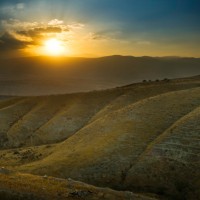 For the disciple experiencing fatigue, rejection, disappointment, or suffering, there is no greater source of encouragement than knowing that God is watching over you and goes with you. He’s watching over your safety and providing for you.
The psalmist writes in this second Song of Ascents, “I lift my eyes to the hills—where does my help come from?” The pilgrims on their journey might see the Judean hill country in the distance, know that Jerusalem is surrounded by hills, and remember that the end point of their journey—beyond mere hills– is the presence of God in His holy city. Discipleship Lesson 2 might be Gaze Beyond the Hills.
“I lift my eyes to the hills”—what a beautiful picture of looking not only to the hills, but above and beyond them to the Creator who made them. The psalmist reminds us that our help comes from “the LORD, the Maker of heaven and earth.” The hills and the heavens above them were set in place by a God such as this! To have the help and watchful eye of “the Maker of heaven and earth” is a great place of security and rest.
Unlike pagan deities that were worshiped on the high places, the psalmist knows that the presence of the God of Israel is beyond the highest heaven. The temple in Jerusalem could not contain God Almighty. It is simply a gathering place of corporate worship and a place to fulfill the obedience expected of a disciple seeking God’s presence in a God-honoring way.
Facing any opposition, the pilgrim remembers what obedience looks like and the certain protection of our God who watches over the pilgrim’s travels. The pilgrimage language speaks of coming and going. In this psalm there is repeated acknowledgement of God’s activites of watching and protecting. The psalmist’s peaceful expressions of trust permeate Psalm 121 as the disciple looks beyond the hills to see his helper is none other than the one true and holy God.
The disciple who completely trusts will not need human assurance of protection or provision beyond the daily bread for he doesn’t look to the hills or the earth for his help, but to God alone.
Questions for meditation:
Listen to Jesus, God reminds us we journey along. Our first pilgrim song reminds us to Expect Opposition. From the moment Jesus resolutely set out for Jerusalem, the opposition was an uninvited guest in the spiritual sidecar.
And he sent messengers on ahead, who went into a Samaritan village to get things ready for him; but the people there did not welcome him, because he was heading for Jerusalem. When the disciples James and John saw this, they asked, “Lord, do you want us to call fire down from heaven to destroy them?” But Jesus turned and rebuked them, and they went to another village (Luke 9:52-56)
 The Samaritans didn’t like the Jews very much. They especially didn’t like them when they were heading to Jerusalem for the feasts. Samaritans believed the presence of God was at Mount Gerizim, not in Jerusalem and the Jewish insistence otherwise by these pilgrims showing up made the Samaritans angry.
Jesus is walking with His disciples and the messengers return with the bad news: the Samaritans have yanked in the welcome mat, shut the windows, and bolted the doors. “No Trespassing” notices adorn every tree and “Keep off the Grass” signs have shown up on everyone’s front lawns. No hero’s welcome or room at the inn in Samaria for the Rabbi on the move.
James and John, the sons of thunder, were quite perturbed. This is Rabbi Jesus, we’re talking about coming through. Indignant, James and John wanted to show those Samaritans a thing or two, just like Elijah did in 2 Kings 1:1-17. Call down fire! Let’em burn. (Samaritan jerks.) Of course, it didn’t take much to stoke the flames of hatred against and by the Samaritans. Any gentle puff of wind will do, blowing any which way.
But Expect Opposition, the first Song of Ascents reminded us. Turn the other cheek. Trust in God. You’re a disciple of Jesus and the presence of God in heaven is your home. In this world, you’re aliens and strangers. So Jesus rebukes James and John. Isn’t this a bit unfair? They were only looking out for Jesus’ best interests and they had biblical precedent with the king of Samaria and Elijah. Why not fire from heaven to consume those Samaritans as a timely reminder?
Jesus knew and taught His disciples this: Expect Opposition. It comes with the territory. So long as it was mere rejection, just brush it off. Expect it. Jesus instructs His disciples to persevere and not to take rejection personally. After all, it’s really Jesus and His Father in heaven that are being rejected.
For the disciple walking with Jesus “Up to Jerusalem,” there will be other villages in which to stay. We’re just passing through. Rejection and discipleship go hand in hand.
Questions for meditation:
A song of ascents. I call on the LORD in my distress, and he answers me. Save me, O LORD, from lying lips and from deceitful tongues. What will he do to you, and what more besides, O deceitful tongue? He will punish you with a warrior’s sharp arrows, with burning coals of the broom tree. Woe to me that I dwell in Meshech, that I live among the tents of Kedar! Too long have I lived among those who hate peace. I am a man of peace; but when I speak, they are for war. (Psalm 120:1-7)
 When I was in elementary school, we had music class and would sing songs. Isn’t it interesting how a song from decades ago can still be memorable? One song popped into my head instantly as I was thinking of pilgrims singing on their journey: The Happy Wanderer. The lyrics went, “I love to go a-wandering, along the mountain track. And as I go, I love to sing. My knapsack on my back.” The chorus was always our favorite: “Val-deri,Val-dera,Val-deri,Val-dera-ha-ha-ha-ha-ha.” We especially liked the ha-ha part and sang it with gusto even if the words were total gibberish.
The pilgrim songs in the Psalter (the Hebrew hymnal) begin with Psalm 120 (above) and are called the Songs of Ascents. Fifteen psalms are listed this way and there is plenty of discussion over why they are called this. Was it because these psalms gradually built upon prior ideas? Or are they related to the fifteen steps up to the sanctuary? Or maybe a description of the pilgrims returning to Israel at the end of the Babylonian exile? Many writers consider that these fifteen psalms reflected the pilgrimage to the three annual festivals: Pesach (Passover), Shavu’ot (Pentecost), and Yom Kippur (The Day of Atonement). Just as we sang new and old songs in elementary school, it is thought that the pilgrims going to the Passover and other feasts would remember God’s Word and sing as they made their journey “Up to Jerusalem.”
 The discipleship lessons taught by these Songs of Ascents were well remembered, too. Psalm 120 is the first Song of Ascents and might be titled, “Discipleship Lesson 1: Expect Opposition.” Not exactly The Happy Wanderer as a subject for Psalm 120. So why start here?
First, the message reminds us that our journey may start in a place that feels like the pits, but as we seek God’s presence, our spirits can soar. After all, doesn’t it feel good to get away from a bad place and head toward a place of joy? Doesn’t it bring you comfort to see how far you’ve come despite feeling like a target of sharp arrows?
Moreover, it prepares us by recalling that opposition happens when you’re on a spiritual journey to the presence of God. Opposition will come in both words and deeds. People who reject God can speak against us in a variety of ways and will often demonstrate their disdain through their actions as well. For American Christians, actions against us are relatively minor in comparison to other areas of this world in which persecution against Christians is commonplace.
For the pilgrims in Israel heading “Up to Jerusalem,” opposition was a familiar experience and hearing this song echoed by other voices would encourage each pilgrim to persevere against opposition. After all, they were on a spiritual journey to the presence of God.
Questions for meditation:
In what ways have you experienced opposition for your faith in Jesus?
Before following Jesus, were there ways in which you took aim against or opposed Christians?
Think of the Apostle Paul’s life. How did he understand the expectation of opposition (Acts 9:1-27)?
Luke 9:51 As the time approached for him to be taken up to heaven, Jesus resolutely set out for Jerusalem.
During the next 40 days of Lent, we will head out on a spiritual journey with Jesus. In many respects, walking with Jesus is our simple path of daily discipleship. At Lent, however, we pause to somberly reflect upon what that journey to the Cross meant for Jesus. This complex fulfillment of prophecy from ages long past had eternal consequences impacting the life of every man, woman, and child.
Jesus’ travel narrative from the Gospel of Luke becomes our journey, too. In the background, we might hear Jesus singing the pilgrim songs called the Songs of Ascents (Psalms 120-134) as He makes His way “Up to Jerusalem” to His final Passover festival. Jesus resolutely set out and Jerusalem was the geographical end point. His travels, however, were not along a straight line predictable path (as the shortest distance between two points). His way was intentional and instructional though, with visits and stays and obstacles along the way. Discipleship is like that. Rarely a beeline or a straight shot.
 God’s ways seem circuitous? You’ve treaded old ground a few times? Yet, it’s never a meaningless meandering. Walking with Jesus is a path of purposeful discipleship for us; and for Him, it was determined destiny—prophetic fulfillment.
Just prior to turning His face resolutely toward Jerusalem, Jesus had appeared glorious at the Mount of Transfiguration (Luke 9:28-36). Scripture records His discussing His departure—literally exodus in Greek—with 2 prophets spanning the earliest and later OT prophetic histories: Moses (prophet of the Law) and Elijah (a prophet whose reappearance would mark the last days). Interestingly, they form the pattern of the two witnesses of the Book of Revelation (Rev. 11:3 -6).
Jesus meets with Moses and Elijah and the voice of God speaks, “This is my Son, whom I have chosen; listen to him.” This calls to mind Moses’ declaration, “The LORD your God will raise up for you a prophet like me from among your own brothers. You must listen to him” (Deuteronomy 18:15).
Jesus was no ordinary prophet, but God’s unique Son; and His exodus would secure a permanent Promised Land for the followers of Jesus. Listen to Jesus, the Son of God, the Messiah—this is what the listeners are all admonished. Jesus speaks: “Listen carefully to what I am about to tell you: The Son of Man is going to be betrayed into the hands of men” (Luke 9:44).
The Cross–this is the destination for Jesus. Let’s take the long and winding road “Up to Jerusalem” as Jesus’ disciples. Though the way rarely seems straightforward to us, God says,
This is my Son…listen to Him.
Questions for meditation:

The forty days of Lent begin on Ash Wednesday, February 22nd and continue until April 8th, Easter Sunday. This year’s devotional series for Lent will prepare your heart as you walk the steps that Jesus walked and sing the songs He would have sung on His pilgrimage to the Passover.
Just as stereo speakers give depth to music, we will let Psalms 120-134, The Songs of Ascents, speak to us and inspire us deeply as we see how they applied during Jesus’ journey “Up to Jerusalem.”
“As the time approached for him to be taken up to heaven,
Jesus resolutely set out for Jerusalem.”
(Luke 9:51)
To sign up, enter your e-mail address on my Home page sidebar and devotionals will be sent to your e-mail during the forty days of Lent.
You don’t have to take my word for it. It’s in the Bible…from the beginning to the end.
In Genesis, Adam and Eve were to work the Garden and take care of it. This is the Lord’s sanctuary; and Adam’s and Eve’s combined act of worship was their serving God by taking care of the place where God met with them. In the Garden of Eden, Adam and Eve were priests.
A stretch, you think? Well, take a look at this one:
Then Moses went up to God, and the LORD called to him from the mountain and said, “This is what you are to say to the house of Jacob and what you are to tell the people of Israel: ‘You yourselves have seen what I did to Egypt, and how I carried you on eagles’ wings and brought you to myself. Now if you obey me fully and keep my covenant, then out of all nations you will be my treasured possession. Although the whole earth is mine, you will be for me a kingdom of priests and a holy nation.’ These are the words you are to speak to the Israelites.” So Moses went back and summoned the elders of the people and set before them all the words the LORD had commanded him to speak. The people all responded together, “We will do everything the LORD has said.” So Moses brought their answer back to the LORD. (Exodus 19:3-8)
When we obey God fully and keep His covenant, we are His treasured possession, a kingdom of priests, and a holy nation. Maybe you’re thinking, “Hmmm. That was the Old Testament and it’s talking about Israel, not Christians.” Alright, how about this next one?
Therefore, I urge you, brothers, in view of God’s mercy, to offer your bodies as living sacrifices, holy and pleasing to God– this is your spiritual act of worship. (Romans 12:1)
 Offering sacrifices to God as a spiritual act of worship: Isn’t that the function of a priest in Old Testament language here in the New Testament? Doesn’t Scripture say that our bodies are the Temple of God (1 Corinthians 3:16)? By His Spirit dwelling in us, aren’t our bodies the place where God meets with us? If yes and Amen and Amen, then doesn’t it follow that when we serve God with our bodies as a spiritual act of worship, we are performing the function of a priest?
Many of us find the concept of BE-ing a priest unsettling. When I was in high school, the last thing anyone—including me—would have thought was that I’d become SeminaryGal. Serving God? Theologically driven? Priest? The chuckle would have blossomed into a full belly laugh from all of us.
 I remember two instances in which the concept of pastor/priest hit home. The first one was when I was speaking with an individual who held a significant administration position in our community. He is Jewish and when he heard that I was in seminary, he asked if when I got out, I’d end up wearing one of those little white collars. We both laughed at the thought and I said that my denomination of church doesn’t do the little white collars…for that matter, women don’t do that kind of service. Then he asked, “Why go through with it then?” I responded, “I really don’t know. I guess, just because God is sending me.” Later on I thought, it doesn’t have to make sense to me. It’s not my role to pass judgment on God’s commission. My role is to do it.
The other time was when I was driving for two days with my daughter, we were going to Florida for a working vacation. When we got there, one of her friends phoned and howling with laughter, asked her, “So how was it going on a road trip with The Paaaaaasterrrrrrrr?” I asked my daughter, “I’m still OK, right? It wasn’t all that bad…was it?”
BE-ing a priest doesn’t mean donning a white color or becoming humanity’s wet blanket, smothering out any semblance of humor or fun. It does mean recognizing that stereotypes will hound the person who is seeking to serve God all the time—our being that living sacrifice. Jokes persist about white collars and being a Holy Roller, Bible thumper, religious Zealot, or right-wing fanatic. But the person—male or female—truly serving God wholeheartedly doesn’t need to be ashamed of BE-ing a priest. It witnesses in wonderful ways a person would never anticipate.
We can withstand the ridicule because all Christians someday will embrace the role—regardless of race or gender. As surely as Jesus stands as King, we will all serve as priests.
And they sang a new song: “You are worthy to take the scroll and to open its seals, because you were slain, and with your blood you purchased men for God from every tribe and language and people and nation. You have made them to be a kingdom and priests to serve our God, and they will reign on the earth.” Revelation 5:9-10
We were Created to BE Priests.
Part of our BE-ing (that extends far beyond our doing) is that we were Created to BE Blessed. I don’t know about you, but I don’t wake up every day thinking that God is looking to bless me from the moment the sun rises until the sun rises the following day. I’m too busy? Too forgetful, too preoccupied? Blessing has been so much a part of my life that it has become mundane? I don’t know. I guess there are ways in which I’m kind of an ingrate.
Blessing has been God’s way since creation. After God created Adam and Eve, He blessed them. Not because Adam and Eve had done anything yet to make God decide to reward them, but because our God is generous and loves to bless.
I saw the evening news about the tornadoes that ripped through Joplin, Missouri. Someone had painted a sign that said, “God is With Us.”
 Someone saw that God was blessing even in the midst of tragedy. This doesn’t come naturally for me. I have to work hard to cultivate that kind of attitude.
Maybe it’s just the flip side of the sovereignty of God, God gets the credit for any blessings that come my way…and God gets the blame for the things that happen that cause me to question, “Where is God in all of this?”
Sounds a lot like the prophet Jeremiah in Lamentations:
I remember my affliction and my wandering, the bitterness and the gall. I well remember them, and my soul is downcast within me. Yet this I call to mind and therefore I have hope: Because of the LORD’s great love we are not consumed, for his compassions never fail. They are new every morning; great is your faithfulness. I say to myself, “The LORD is my portion; therefore I will wait for him.” The LORD is good to those whose hope is in him, to the one who seeks him; it is good to wait quietly for the salvation of the LORD. It is good for a man to bear the yoke while he is young. Let him sit alone in silence, for the LORD has laid it on him. Let him bury his face in the dust– there may yet be hope. Let him offer his cheek to one who would strike him, and let him be filled with disgrace. For men are not cast off by the Lord forever. Though he brings grief, he will show compassion, so great is his unfailing love. (Lamentations 3:19-32)
Look at the blessings of God in this passage: the LORD’s great love, His compassions never fail, His great faithfulness, His goodness, His salvation, His hope!
There are few passages of Scripture that point out God’s vision for Community better than the story of the Good Samaritan.
On one occasion an expert in the law stood up to test Jesus. “Teacher,” he asked, “what must I do to inherit eternal life?” “What is written in the Law?” he replied. “How do you read it?” He answered: “‘Love the Lord your God with all your heart and with all your soul and with all your strength and with all your mind’; and, ‘Love your neighbor as yourself.'” “You have answered correctly,” Jesus replied. “Do this and you will live.” But he wanted to justify himself, so he asked Jesus, “And who is my neighbor?” In reply Jesus said: “A man was going down from Jerusalem to Jericho, when he fell into the hands of robbers. They stripped him of his clothes, beat him and went away, leaving him half dead. A priest happened to be going down the same road, and when he saw the man, he passed by on the other side. So too, a Levite, when he came to the place and saw him, passed by on the other side. But a Samaritan, as he traveled, came where the man was; and when he saw him, he took pity on him. He went to him and bandaged his wounds, pouring on oil and wine. Then he put the man on his own donkey, took him to an inn and took care of him. The next day he took out two silver coins and gave them to the innkeeper. ‘Look after him,’ he said, ‘and when I return, I will reimburse you for any extra expense you may have.’ “Which of these three do you think was a neighbor to the man who fell into the hands of robbers?” The expert in the law replied, “The one who had mercy on him.” Jesus told him, “Go and do likewise.” (Luke 10:25-37)
 Love the Lord your God…and your neighbor as yourself. Being in community and FOR one another may involve risking any of these:
None of us should feel the need to be Messiah. All of us should be concerned to follow Him.
If someone’s situation presents me with the opportunity to have mercy or pass by, it’s probably a good place to “Do likewise.”
How can I do that without being impolite or feeling like a meddler? Probably the simplest answer is to ask, “Is there a special way I can pray for you today?” If they would value the help, they’ll tell you by how they phrase their answer. If the answer is “No, everything’s fine,” then the opportunity isn’t ours.
This is how we know what love is: Jesus Christ laid down his life for us. And we ought to lay down our lives for our brothers. If anyone has material possessions and sees his brother in need but has no pity on him, how can the love of God be in him? Dear children, let us not love with words or tongue but with actions and in truth.” (1 John 3:16-18)
Isn’t it interesting that God said it wasn’t good for the man to be alone (Genesis 2:18) so He made woman?
God was there with Adam, yes? Adam wasn’t truly alone in one sense, but very much alone in a human companionship and community way.
 This was brought home to me in a strange way. My husband and I have a dog named Harley—a smooth haired fox terrier. He attracts a lot of attention, particularly from children. Last evening, Harley was taking us for a walk when a little boy ran up and asked if he could pet our dog. The little boy smiled when I said “Yes” and then he looked at my face with the bandage from my surgery and asked, “What’s that?” I immediately thought of the medical answer and decided that wouldn’t be nearly as informative or age appropriate as the answer I gave him: “I had an owie on my face and so the doctor took it away.” The little boy said “Oh, that’s good.” While he was petting Harley, two little girls came running up to see Harley too, and one of them spoke for the pair and asked “What happened?” and they both pointed to their faces corresponding to where my bandage is. I gave them the same answer and they said, “Oh. OK.” After this episode, I talked with my husband about how I ran into a woman from church while I was at the store earlier and she also asked me “What happened?” I’m sure everyone I encountered was wondering about this prominent bandage, but only she—a friend—asked.
Think of all the ways this never would have happened if I were not in community. No one to see my face or diagnose my cancer. No one to perform the surgery. No one to make the car that I drove home. No bandage manufacturers. No store at which to shop or cashiers to ring my purchase of bandages. No friend. No strangers.
But there was a difference between the strangers at the store and the children. None of them knew me—they had that in common. I’m not a child psychologist, but I thought it was really fascinating that children asked about it whereas the strangers–adults–were silent. Were the children merely curious? I imagine the adults were too. Was it children’s innocence and observation? Unlike adults who also observed, perhaps children had awareness and concern because they have an association with bandages that is different—a “kiss it, make it better” mentality?
Why is it that my friend acted in a similar way to the children? The simple answer is that she cared. She loves me with the love of Christ.
Strangers observed and may have been curious, but what about their concern for another human being? Maybe it was there, but as adults they’d learned not to express it. Then I wondered back to the children. Could their questions evidence a rudimentary community on display before the layers of social mores and taboos would turn their thoughts inward, fear would silence their questions, or responsibilities would dull their concern and transform it into resignation or apathy?
If one part suffers, every part suffers with it; if one part is honored, every part rejoices with it. (1 Corinthians 12:26)
Carry each other’s burdens, and in this way you will fulfill the law of Christ. (Galatians 6:2)
We were made to be in community—to be invested in one another beyond the simple “How are you?” In the United States, most of us have the individualism as standard equipment and community is something we must relearn. There is no better place to relearn community and our concern for others than in the church.