The Long and Winding Road-Lent 1 (2012)

Luke 9:51 As the time approached for him to be taken up to heaven, Jesus resolutely set out for Jerusalem.

During the next 40 days of Lent, we will head out on a spiritual journey with Jesus.  In many respects, walking with Jesus is our simple path of daily discipleship.  At Lent, however, we pause to somberly reflect upon what that journey to the Cross meant for Jesus.  This complex fulfillment of prophecy from ages long past had eternal consequences impacting the life of every man, woman, and child.

Jesus’ travel narrative from the Gospel of Luke becomes our journey, too.  In the background, we might hear Jesus singing the pilgrim songs called the Songs of Ascents (Psalms 120-134) as He makes His way “Up to Jerusalem” to His final Passover festival.  Jesus resolutely set out and Jerusalem was the geographical end point. His travels, however, were not along a straight line predictable path (as the shortest distance between two points). His way was intentional and instructional though, with visits and stays and obstacles along the way.  Discipleship is like that.  Rarely a beeline or a straight shot.

Has your spiritual life been like a long and winding road? 

God’s ways seem circuitous? You’ve treaded old ground a few times? Yet, it’s never a meaningless meandering.  Walking with Jesus is a path of purposeful discipleship for us; and for Him, it was determined destiny—prophetic fulfillment. 

Just prior to turning His face resolutely toward Jerusalem, Jesus had appeared glorious at the Mount of Transfiguration (Luke 9:28-36).  Scripture records His discussing His departure—literally exodus in Greek—with 2 prophets spanning the earliest and later OT prophetic histories: Moses (prophet of the Law) and Elijah (a prophet whose reappearance would mark the last days).  Interestingly, they form the pattern of the two witnesses of the Book of Revelation (Rev. 11:3 -6).

Jesus meets with Moses and Elijah and the voice of God speaks, “This is my Son, whom I have chosen; listen to him.”   This calls to mind Moses’ declaration, “The LORD your God will raise up for you a prophet like me from among your own brothers. You must listen to him”  (Deuteronomy 18:15).

Jesus was no ordinary prophet, but God’s unique Son; and His exodus would secure a permanent Promised Land for the followers of Jesus.  Listen to Jesus, the Son of God, the Messiah—this is what the listeners are all admonished.  Jesus speaks: “Listen carefully to what I am about to tell you: The Son of Man is going to be betrayed into the hands of men” (Luke 9:44).

The Cross–this is the destination for Jesus.  Let’s take the long and winding road “Up to Jerusalem” as Jesus’ disciples.  Though the way rarely seems straightforward to us, God says,

This is my Son…listen to Him.

Questions for meditation:

  • In what ways is Jesus no ordinary prophet?
  • “Listen to Him” is a command statement.  What other voices compete for our listening ear?
  • Think about your spiritual journey: is it a straight line or a long and winding road?

Continue Reading

Lenten Devotionals 2012: “Up to Jerusalem”

Now is the time to sign up for this year’s Lenten Devotionals!


The forty days of Lent begin on Ash Wednesday, February 22nd and continue until April 8th, Easter Sunday.  This year’s devotional series for Lent will prepare your heart as you walk the steps that Jesus walked and sing the songs He would have sung on His pilgrimage to the Passover.


Just as stereo speakers give depth to music, we will let Psalms 120-134, The Songs of Ascents, speak to us and inspire us deeply as we see how they applied during Jesus’ journey “Up to Jerusalem.”  

“As the time approached for him to be taken up to heaven, 
Jesus resolutely set out for Jerusalem.”  

(Luke 9:51)

To sign up, enter your e-mail address on my Home page sidebar and devotionals will be sent to your e-mail during the forty days of Lent.

Continue Reading

Created to BE Priests

Perhaps you’re thinking—basis the title—she’s gone too far this time.  What does she mean we were created to BE Priests?

You don’t have to take my word for it.  It’s in the Bible…from the beginning to the end.

In Genesis, Adam and Eve were to work the Garden and take care of it.  This is the Lord’s sanctuary;  and Adam’s and Eve’s combined act of worship was their serving God by taking care of the place where God met with them.  In the Garden of Eden, Adam and Eve were priests. 

A stretch, you think?  Well, take a look at this one:

Then Moses went up to God, and the LORD called to him from the mountain and said, “This is what you are to say to the house of Jacob and what you are to tell the people of Israel:  ‘You yourselves have seen what I did to Egypt, and how I carried you on eagles’ wings and brought you to myself.  Now if you obey me fully and keep my covenant, then out of all nations you will be my treasured possession. Although the whole earth is mine, you will be for me a kingdom of priests and a holy nation.’ These are the words you are to speak to the Israelites.”  So Moses went back and summoned the elders of the people and set before them all the words the LORD had commanded him to speak.   The people all responded together, “We will do everything the LORD has said.” So Moses brought their answer back to the LORD.  (Exodus 19:3-8)

When we obey God fully and keep His covenant, we are His treasured possession, a kingdom of priests, and a holy nation.  Maybe you’re thinking, “Hmmm.  That was the Old Testament and it’s talking about Israel, not Christians.”  Alright, how about this next one?

Therefore, I urge you, brothers, in view of God’s mercy, to offer your bodies as living sacrifices, holy and pleasing to God– this is your spiritual act of worship. (Romans 12:1)

Offering sacrifices to God as a spiritual act of worship:  Isn’t that the function of a priest in Old Testament language here in the New Testament?  Doesn’t Scripture say that our bodies are the Temple of God  (1 Corinthians 3:16)?  By His Spirit dwelling in us, aren’t our bodies the place where God meets with us?  If yes and Amen and Amen, then doesn’t it follow that when we serve God with our bodies as a spiritual act of worship, we are performing the function of a priest?

Many of us find the concept of BE-ing a priest unsettling.       When I was in high school, the last thing anyone—including me—would have thought was that I’d become SeminaryGal.  Serving God?  Theologically driven?  Priest?  The chuckle would have blossomed into a full belly laugh from all of us.

I remember two instances in which the concept of pastor/priest hit home.  The first one was when I was speaking with an individual who held a significant administration position in our community.  He is Jewish and when he heard that I was in seminary, he asked if when I got out, I’d end up wearing one of those little white collars.  We both laughed at the thought and I said that my denomination of church doesn’t do the little white collars…for that matter, women don’t do that kind of service.  Then he asked, “Why go through with it then?”  I responded, “I really don’t know.  I guess, just because God is sending me.”  Later on I thought, it doesn’t have to make sense to me.  It’s not my role to pass judgment on God’s commission.   My role is to do it.

The other time was when I was driving for two days with my daughter, we were going to Florida for a working vacation.  When we got there, one of her friends phoned and howling with laughter, asked her, “So how was it going on a road trip with The Paaaaaasterrrrrrrr?”  I asked my daughter, “I’m still OK, right?  It wasn’t all that bad…was it?”

BE-ing a priest doesn’t mean donning a white color or becoming humanity’s wet blanket, smothering out any semblance of humor or fun.  It does mean recognizing that stereotypes will hound the person who is seeking to serve God all the time—our being that living sacrifice.  Jokes persist about white collars and being a Holy Roller, Bible thumper, religious Zealot, or right-wing fanatic.  But the person—male or female—truly serving God wholeheartedly doesn’t need to be ashamed of BE-ing a priest.  It witnesses in wonderful ways a person would never anticipate.

We can withstand the ridicule because all Christians someday will embrace the role—regardless of race or gender.  As surely as Jesus stands as King, we will all serve as priests.

And they sang a new song: “You are worthy to take the scroll and to open its seals, because you were slain, and with your blood you purchased men for God from every tribe and language and people and nation.  You have made them to be a kingdom and priests to serve our God, and they will reign on the earth.”  Revelation 5:9-10

We were Created to BE Priests.

Continue Reading

Created to BE Blessed

Part of our BE-ing (that extends far beyond our doing) is that we were Created to BE Blessed.  I don’t know about you, but I don’t wake up every day thinking that God is looking to bless me from the moment the sun rises until the sun rises the following day.  I’m too busy?  Too forgetful, too preoccupied?  Blessing has been so much a part of my life that it has become mundane?  I don’t know.   I guess there are ways in which I’m kind of an ingrate. 

Blessing has been God’s way since creation.  After God created Adam and Eve, He blessed them.  Not because Adam and Eve had done anything yet to make God decide to reward them, but because our God is generous and loves to bless.

I saw the evening news about the tornadoes that ripped through Joplin, Missouri.  Someone had painted a sign that said, “God is With Us.” 

Someone saw that God was blessing even in the midst of tragedy.  This doesn’t come naturally for me.  I have to work hard to cultivate that kind of attitude.

Maybe it’s just the flip side of the sovereignty of God, God gets the credit for any blessings that come my way…and God gets the blame for the things that happen that cause me to question, “Where is God in all of this?”

“God is With Us.” 
Or this photo, “God Saved Us.” 
 
Blessings in tragedy.  
In every tragedy, blessing is still there.
  • Cancer.  Yet God is with us and is blessing us.
  • Tornadoes.  Yet God is with us and is blessing us.
  • Death of loved ones.  Yet God is with us and blessing us.
  • Tsunami in Japan, Earthquake in Haiti, Unrest in the Middle East–we cannot forget these.  Yet God is there…blessing still.

Sounds a lot like the prophet Jeremiah in Lamentations:

I remember my affliction and my wandering, the bitterness and the gall.  I well remember them, and my soul is downcast within me. Yet this I call to mind and therefore I have hope:  Because of the LORD’s great love we are not consumed, for his compassions never fail.  They are new every morning; great is your faithfulness.  I say to myself, “The LORD is my portion; therefore I will wait for him.”  The LORD is good to those whose hope is in him, to the one who seeks him;  it is good to wait quietly for the salvation of the LORD.  It is good for a man to bear the yoke while he is young.  Let him sit alone in silence, for the LORD has laid it on him.  Let him bury his face in the dust– there may yet be hope.  Let him offer his cheek to one who would strike him, and let him be filled with disgrace.  For men are not cast off by the Lord forever.  Though he brings grief, he will show compassion, so great is his unfailing love.  (Lamentations 3:19-32)

Look at the blessings of God in this passage:  the LORD’s great love, His compassions never fail, His great faithfulness, His goodness, His salvation, His hope!

If He is our portion—as He has been since Adam and Eve were first created and before they had ever done a thing—then indeed we have been Created to BE Blessed.
Continue Reading

Created to BE FOR Community

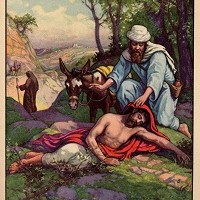
There are few passages of Scripture that point out God’s vision for Community better than the story of the Good Samaritan. 

On one occasion an expert in the law stood up to test Jesus. “Teacher,” he asked, “what must I do to inherit eternal life?” “What is written in the Law?” he replied. “How do you read it?” He answered: “‘Love the Lord your God with all your heart and with all your soul and with all your strength and with all your mind’; and, ‘Love your neighbor as yourself.'”  “You have answered correctly,” Jesus replied. “Do this and you will live.” But he wanted to justify himself, so he asked Jesus, “And who is my neighbor?” In reply Jesus said: “A man was going down from Jerusalem to Jericho, when he fell into the hands of robbers. They stripped him of his clothes, beat him and went away, leaving him half dead.  A priest happened to be going down the same road, and when he saw the man, he passed by on the other side.  So too, a Levite, when he came to the place and saw him, passed by on the other side.  But a Samaritan, as he traveled, came where the man was; and when he saw him, he took pity on him.  He went to him and bandaged his wounds, pouring on oil and wine. Then he put the man on his own donkey, took him to an inn and took care of him.  The next day he took out two silver coins and gave them to the innkeeper. ‘Look after him,’ he said, ‘and when I return, I will reimburse you for any extra expense you may have.’  “Which of these three do you think was a neighbor to the man who fell into the hands of robbers?”  The expert in the law replied, “The one who had mercy on him.” Jesus told him, “Go and do likewise.”  (Luke 10:25-37)

Love the Lord your God…and your neighbor as yourself.  Being in community and FOR one another may involve risking any of these:

  • our being inconvenienced
  • our involvement and concern costing us something
  • our timetable being impacted
  • our image being tainted
  • our being viewed as meddling
  • and our feeling overwhelmed by the needs of others.
How do we discern whether it’s my responsibility or someone else’s?  

None of us should feel the need to be Messiah.  All of us should be concerned to follow Him. 

Jesus said “Go and do likewise.” For many of us, those are hard words.

If someone’s situation presents me with the opportunity to have mercy or pass by, it’s probably a good place to “Do likewise.” 

How can I do that without being impolite or feeling like a meddler?  Probably the simplest answer is to ask, “Is there a special way I can pray for you today?”  If they would value the help, they’ll tell you by how they phrase their answer.  If the answer is “No, everything’s fine,” then the opportunity isn’t ours.

We were Created to BE in Community and we are Created to BE FOR Community.

This is how we know what love is: Jesus Christ laid down his life for us. And we ought to lay down our lives for our brothers.  If anyone has material possessions and sees his brother in need but has no pity on him, how can the love of God be in him?  Dear children, let us not love with words or tongue but with actions and in truth.”  (1 John 3:16-18)

Continue Reading

Created to BE in Community

Isn’t it interesting that God said it wasn’t good for the man to be alone (Genesis 2:18) so He made woman? 

God was there with Adam, yes?  Adam wasn’t truly alone in one sense, but very much alone in a human companionship and community way. 

God created us to be in community.

This was brought home to me in a strange way.  My husband and I have a dog named Harley—a smooth haired fox terrier.  He attracts a lot of attention, particularly from children.  Last evening, Harley was taking us for a walk when a little boy ran up and asked if he could pet our dog.  The little boy smiled when I said “Yes” and then he looked at my face with the bandage from my surgery and asked, “What’s that?”  I immediately thought of the medical answer and decided that wouldn’t be nearly as informative or age appropriate as the answer I gave him: “I had an owie on my face and so the doctor took it away.”  The little boy said “Oh, that’s good.”  While he was petting Harley, two little girls came running up to see Harley too, and one of them spoke for the pair and asked “What happened?” and they both pointed to their faces corresponding to where my bandage is.  I gave them the same answer and they said, “Oh.  OK.”  After this episode, I talked with my husband about how I ran into a woman from church while I was at the store earlier and she also asked me “What happened?”  I’m sure everyone I encountered was wondering about this prominent bandage, but only she—a friend—asked. 

Community:  husband, boy, girls, strangers, friend…

Think of all the ways this never would have happened if I were not in community.  No one to see my face or diagnose my cancer.  No one to perform the surgery.  No one to make the car that I drove home.  No bandage manufacturers.  No store at which to shop or cashiers to ring my purchase of bandages.  No friend.  No strangers.

But there was a difference between the strangers at the store and the children.  None of them knew me—they had that in common.   I’m not a child psychologist, but I thought it was really fascinating that children asked about it whereas the strangers–adults–were silent.  Were the children merely curious?  I imagine the adults were too. Was it children’s innocence and observation?  Unlike adults who also observed, perhaps children had awareness and concern because they have an association with bandages that is different—a “kiss it, make it better” mentality?

Why is it that my friend acted in a similar way to the children?  The simple answer is that she cared.  She loves me with the love of Christ. 

Observation.  Curiosity.  Concern.

Strangers observed and may have been curious, but what about their concern for another human being? Maybe it was there, but as adults they’d learned not to express it.  Then I wondered back to the children.  Could their questions evidence a rudimentary community on display before the layers of social mores and taboos would turn their thoughts inward, fear would silence their questions, or responsibilities would dull their concern and transform it into resignation or apathy?

If one part suffers, every part suffers with it; if one part is honored, every part rejoices with it.  (1 Corinthians 12:26)

Carry each other’s burdens, and in this way you will fulfill the law of Christ. (Galatians 6:2)

We were made to be in community—to be invested in one another beyond the simple “How are you?”  In the United States, most of us have the individualism as standard equipment and community is something we must relearn.  There is no better place to relearn community and our concern for others than in the church.

We were Created to BE in Community, so let’s ask ourselves how can we better show community within the church and in our neighborhoods today?
Continue Reading

Created to BE Individuals

Isn’t it wonderful that when God set out to create human beings, that He made us each to be individuals?  No cookie cutter, mass-produced, dime-a-dozen clones.  Each one of us is handcrafted.

Beyond that, each of us is handcrafted for a purpose.  And while we are each gifted with personalities, talents, and abilities to do the very work we were created to do, we weren’t created as individuals simply to supply a worker-bee role with able bodies.  We were created as individuals–not just to DO but to BE. 

Maybe your voice isn’t like a songbird, but God wants to hear your voice because it is the sound of your BE-ing.  God wants to see your smile—not because it’s dental perfection—but because it’s an outward demonstration of joy in your BE-ing.  God wants for you to pour your tears out before Him when you’re sad because this too is a part of your individual life, your BE-ing.  Even the scars of our lives—the marks on our bodies and emotions—are part of the BE-ing that make each of us unique from every other human on the planet. 

I’ve been thinking about this a lot.  As of this writing, I’m recovering from having a basal cell carcinoma lesion removed from my face.  Once the pain and swelling go away, there will be a scar (hopefully it will not be too noticeable).  But for Christians, these scars are our stigmata—the marks of life—as we pick up our cross and follow Christ on a journey of BE-ing in a fallen world. 

Every scar represents a moment of trust that God is my Savior and He carries me through.

I have already been a Cancer Survivor and these scars from surgeries over the years form something like the fingerprint of God, yet unique to me. 

They are marks reminding me of how my anger at God was transformed by tears and His reassurance into trust.  If this world were the destination, my anger at God would be more enduring.  I would question, “Why me?” and ponder the unfairness of it all.  But instead I trust.  I trust that I have been made with love.

It is written: “I believed; therefore I have spoken.” With that same spirit of faith we also believe and therefore speak,  because we know that the one who raised the Lord Jesus from the dead will also raise us with Jesus and present us with you in his presence.  All this is for your benefit, so that the grace that is reaching more and more people may cause thanksgiving to overflow to the glory of God.  Therefore we do not lose heart. Though outwardly we are wasting away, yet inwardly we are being renewed day by day.  For our light and momentary troubles are achieving for us an eternal glory that far outweighs them all.  So we fix our eyes not on what is seen, but on what is unseen. For what is seen is temporary, but what is unseen is eternal.”        2 Corinthians 4:13-18

The destination is not this earth, this body, this job, or this competition.  The destination—eternity with Jesus—will involve a new earth, a new body, renewed purpose, and a purified spirit.  It will be the endless BE-ing that I was Created to BE.  Unique to me, and perfected in Christ.

Continue Reading

Created to BE Rulers

Then God said, “Let us make man in our image, in our likeness, and let them rule over the fish of the sea and the birds of the air, over the livestock, over all the earth, and over all the creatures that move along the ground.” Genesis 1:26

When God created us, He created us to be stewards, but more than that, our identity is wrapped up in being rulers.  

Do we generally start our day thinking that we’re supposed to be ruling, bringing God’s righteous rule and reign to extend throughout the earth?  Think of it this way:  God did His job of creating, forming, and filling the earth.  But, we were created to be rulers over the fish, birds, livestock, earth, and the creatures—we are regents ruling God’s prefect Kingdom, priests serving in His sanctuary. 

Those of us who live in areas of the world without an active monarchy have a hard time relating to the concept of God as King and our role as regents.  We picture fairytale monarchies and are enamored with royal weddings since we struggle to grasp what a righteous kingdom looks like.  Even in countries where monarchies exist, they are seldom the kind of kingdom that reflects God as King.  That’s because of sin.

Sin makes the earthly Kingdom necessary in a new and different way.  Without a Kingdom of God advancing the truth, how else is a broken world going to hear about the holiness required for heaven?

But sin also makes the earthly Kingdom more difficult because sin has made ruling more about power than about seeing God’s truth and perfection filling the earth.    Don’t you think it’s interesting that Genesis didn’t say we were to rule over each other until sin broke our relationship with God and with one another?  The resulting human kingship is about power, control, and authority; and this is what God had Samuel explain to the people when they rejected God’s Kingship (perfect, holy, and true) and demanded an earthly king (of power, control, and sin).  1 Samuel 8: 5-20

As a society, we have rejected God as King. 
As individuals, we can reinstate God as King over our lives. 

God’s reign and rule can be upon our hearts and spread upon the earth.   We will see His holiness and grace in the giving of the Law and in writing the Law on our hearts.  Our role as regents will involve Law-abiding and Law illuminating/ witnessing in contrast to a world of sin while this earth remains. 

But there is future Kingdom of God in which we will no longer be regents.  We will reign with Christ (because of His humanity) and enjoy the perfection of a Kingdom much like what existed before sin entered the world. 

This is an important distinction:  we will be rulers reigning together with Christ our Lord and Savior. 

Blessed and holy are those who have part in the first resurrection. The second death has no power over them, but they will be priests of God and of Christ and will reign with him for a thousand years. Revelation 20:6

This is not a kingdom of power OVER, but power TO.   The Kingdom of God—more than a Jewish nationalistic hope—is a universal hope because of what Jesus Christ did.  We have power to live righteously–both people of Jewish and Gentile heritages–and can equally access this hope by faith.  In Christ, we will have a righteousness beyond anything the Law and human achievement could give.  And unlike a sin-warped reality of ruling over one another, this future Kingdom involves reigning together with Christ as a vine and we as His branches, enjoying the perfection and holiness of God forever.

 The seventh angel sounded his trumpet, and there were loud voices in heaven, which said: “The kingdom of the world has become the kingdom of our Lord and of his Christ, and he will reign for ever and ever.”  And the twenty-four elders, who were seated on their thrones before God, fell on their faces and worshiped God,  saying: “We give thanks to you, Lord God Almighty, the One who is and who was, because you have taken your great power and have begun to reign.” Revelation 11:15-17

Continue Reading

Created to BE Stewards

Every year at this time, I get asked, “Where do you buy your plants?”  My answer reveals much about what I think of God’s first Commission for man.  We were Created to BE Stewards.

Genesis 2:7 the LORD God formed the man from the dust of the ground and breathed into his nostrils the breath of life, and the man became a living being. 8 Now the LORD God had planted a garden in the east, in Eden; and there he put the man he had formed. 9 And the LORD God made all kinds of trees grow out of the ground– trees that were pleasing to the eye and good for food. In the middle of the garden were the tree of life and the tree of the knowledge of good and evil… 15 The LORD God took the man and put him in the Garden of Eden to work it and take care of it.

It makes me smile that God’s first job for mankind to do was to enjoy gardening within God’s sanctuary.  He didn’t create us to just view the garden.  He created us to work it and take care of it: stewardship!

For us, stewardship is more than just money or time.  Despite the million sermons on stewardship that focus on giving to the Church and the need to scale back our lifestyles to give more by way of a financial tithe, stewardship is far bigger than paid pastors often admit.  Stewardship is not synonymous with stingy or cheap…even if it results in the noble goal of supporting missionaries or the Church.

Big picture stewardship is what we see in the Parable of the Talents: putting God’s resources to work as if God Himself were putting them to work (Matthew 25:14-30).  Do we ever see a penny-pinching God scaling back and being miserly in order to bless someone else?  Or do we see a God with infinite resources looking for faithful stewards on whom to lavish it?  We act sometimes as though Church-supported missionaries are the only people God cares about…or that vocational missionaries are the only ones sent to reach a world in need of God’s love.

Stewardship involves discerning where God wants us to invest what He has given to us.  So, sometimes I try to save money and grow things from seed or buy things at a “big box” store like Home Depot where I worked for several years.  Other times, I will buy plants and other products from smaller independent stores where their livelihoods depend on shoppers willing to spend more for a product to keep them in business.  There are times that I will buy things from places that are little “mom-and-pop” stores where I pay a premium for something truly unusual in order to preserve their niche in the marketplace and put food on their tables.   

Today, I will pick up flowers I ordered from a local food pantry called COOL (Christian Outreach of Lutherans).  Even though I don’t go to a Lutheran church, I love people who do and the people they help through their food pantry.  Yes, I may pay more for the joy of helping their fundraiser, but this is all part of being a steward.  Maybe you have a fundraiser in your area that does something similar.

We can witness to a world in need of God’s love through how we spend money.  When God gives resources into our families, He is using us as His hands and feet to supply the needs of others.  Church supported ministers and missionaries, yes, I don’t want to diminish that.  But people with financial needs work at Home Depot, small independents, premium outlets, and go to food pantries.  God is providing for them through us…just as others are God’s instruments to provide for our needs.  We are not to bury our talent in the local church institution and burden it with caring for every family—everywhere—and to put food on everyone’s tables. 

God commissions us all for fruitful Kingdom work in many places—we were Created to BE Stewards.
Continue Reading

Created to BE God’s Image Bearers

As I’ve pondered the American reaction to the death of Osama Bin Laden, I’ve been trying to decide what word would characterize my reaction. Rejoicing isn’t right. Happy isn’t right. Celebrating isn’t right. Glad. Gratified. Grateful…none of these are exactly what pinpoints what the reaction ought to be because of this:

Like it or not, Bin Laden was made in the image of God.

That’s what the Bible says.

Then God said, “Let us make man in our image, in our likeness, and let them rule over the fish of the sea and the birds of the air, over the livestock, over all the earth, and over all the creatures that move along the ground.” (Genesis 1:26)

 Isn’t it interesting that before God ever made you, He had in mind that you would bear His image?

  • Before His hands picked up the dust and formed you?
  • Before He breathed life into you?

 Before you were born, He created you—and all the rest of mankind—to bear His image.

For us to rejoice in the death of Bin Laden is for us—in a strange way—to rejoice over the destruction of the image of God in another person. Make no mistake: Bin Laden was destructive, dangerous, and had nothing but contempt for his fellow human beings. His actions were wicked, evil, horrific, reprehensible, and brought deep sorrow to thousands of innocent people. Yet, under all Bin Laden’s sin, the image of God was there because he was human and God had created him.

For that reason, we cannot trivialize death of any human being, even in light of Jesus’ mission of destroying the devil’s work.   Jesus destroyed the devil’s work by the power of His love and grace.

Issues like how a Christian should respond to the death of Bin Laden should not divide Christians from one another. We can be satisfied that God used human agency to accomplish His justice. We can honor the bravery of the Navy SEALs and the careful planning. We can be grateful that peace among men has one less enemy today. We can praise God that God alone is righteous and that His grace saves sinners—just like us—who repent. We can ask for hearts that can somehow love our enemies.

We can do these things by remembering that we were CREATED TO BE…God’s Image Bearers.

1 John 3:5 But you know that he appeared so that he might take away our sins. And in him is no sin. 6 No one who lives in him keeps on sinning. No one who continues to sin has either seen him or known him. 7 Dear children, do not let anyone lead you astray. He who does what is right is righteous, just as he is righteous. 8 He who does what is sinful is of the devil, because the devil has been sinning from the beginning. The reason the Son of God appeared was to destroy the devil’s work. 9 No one who is born of God will continue to sin, because God’s seed remains in him; he cannot go on sinning, because he has been born of God. 10 This is how we know who the children of God are and who the children of the devil are: Anyone who does not do what is right is not a child of God; nor is anyone who does not love his brother. 11 This is the message you heard from the beginning: We should love one another. 12 Do not be like Cain, who belonged to the evil one and murdered his brother. And why did he murder him? Because his own actions were evil and his brother’s were righteous.

Continue Reading