Category: Articles and Devotionals
A selection of devotionals written by Barbara Shafer.
Making the Theological Understandable
A selection of devotionals written by Barbara Shafer.
When my daughter was stillborn in 1998, I learned something: Good Theology Must Answer Hard Issues. No glib word, Christian cliché, or reassuring pat on the back can ever put a new frame around what is bad and make it good, make the hard easy, or turn any wrong into a right.
Good theology meets us in the hard places, in the hard issues, and in the cold hard realities of life. And it offers the Gospel as an answer. It offers Compassion in the form of Love. And it offers Truth.
With that in mind, I want to confess up front that my “Wrong Questions” series began in my mind with the one I’m going to answer today, Asking All the Wrong Questions about Homosexuality. Over the past 3 months, a daily series of events has kept this issue in front of my eyes. I know I need to answer it because Good Theology Answers Hard Issues…and it does so with the Gospel’s Truth and Love.
When you’ve been in the waters of deep pain, you are in a unique place to see the pain of others up close and personal. Many people preach from the glassy-walled observation room. I preach the Gospel from the deep waters of the ocean of pain.
From the depth of pain, I know the topic of homosexuality hits people in their hearts much like the women-in-ministry debate hits me in the heart.
For the homosexual reading this, I want you to know that I understand. For you, it’s personal.
Over the course of the past decade, on AllExperts, a few brave souls publicly solicited my view of homosexuality. The questioners have been sincere and kind—as most homosexuals I know are. Note, however, that the vast majority of questions I’ve answered were flagged as private—private, because homosexual thoughts and tendencies are a source of deep confusion. It’s very personal to them. My answers remain between the questioner, myself and God. I bring my thoughts about the topic out of the closet today because I have something to say:
“Who made me this way?” is a question designed to affix blame—on God or on self. But the blame squarely rests with the broken world in which we live. It’s like my asking, “Who killed my daughter?” Do I blame God for why this happened…or me?
Pain looks for someone to blame. The Gospel ministers a response of hope.
I’d like to take this a step deeper as it relates to homosexuality. If you’d like to see how Christians can understand the difference between the wrong question and the right question, please join me on the next page.
 Asking the wrong question “Who can be legally married?” leads us to wrong answers. Instead, we need to remember the original purpose and definition of marriage being one man and one woman becoming “one flesh” to the glory of God. God both established and defined marriage.
Society now circumscribes–through a series of written laws–something like marriage, just without God.
In Part 1 we traced the history of marriage from Bible times to the Middle Ages. Now we will explore six of the watershed events resulting in the legal code that we see today in Europe and America.
Mutual consent can be considered pivotal because marriage shifted from a family-endorsed social structure with dual purpose (religious and social) to an individual decision apart from a religious framework or social benefit. This was not a bad thing since many families arranged marriages for completely political or worldly reasons. But a shift from community to individual paved the way for future changes.
 Mutual consent was an issue because, under Germanic law in the 5th to 9th centuries A.D., marriage didn’t require the bride’s consent at all. The families arranged a Brautkauf or bride-purchase agreement in which the groom consented and the bride was assumed to consent by her family. Originally, a nuptial pretium (a certain amount of property or money) was contracted as the purchase price given to the father or guardian of the bride-to-be. Eventually, to combat the idea of a wife as purchased property, the nuptial pretium became a sum given to the bride as her security should her husband die prematurely.
At this point, we’re in the central and late Middle Ages and the Catholic Church altered Germanic marital practice to insist upon direct, free, and fully mutual consent by both parties in the marriage. To ensure that the union was by mutual consent, the Church established the suggestion that unions be blessed.
A religious blessing became part of the union and occasionally the Catholic Church threatened to excommunicate any persons who married without the blessings of the local priest. Given that the position of women (prior to the Catholic canonists) was extremely low in Frankish tribes, the mutual consent aspect was a good development.
It took significant time for divorce—common in Germanic law—to be abolished by the spread of Catholicism. In the Frankish tribes, legal matters (including marriage related issues such as adultery, divorce, etc.) were typically resolved by ordeal–an ordeal being by fire, water, combat, etc. Eventually a system of compensation—the giving of money to satisfy grievances—was encouraged by the Catholic Church to curb violence and paved the way for the development of the system of indulgences. For those of you who know Reformation history, the system of indulgences eventually became one of Martin Luther’s hot button issues.
Join me on the next page for the next watershed moment, marriage as a sacrament.
A recent Wall Street Journal article entitled “The Divorcé’s Guide to Marriage” opened with, “Want great marriage advice? Ask a divorced person.” I’d say “Ask History.” After 30 years of marriage to my husband, I’m convinced it has much more to do with understanding what marriage is all about.

In American culture, a war has been escalating over the question, “Who is legally allowed to have something called a marriage?” But we’re asking the wrong question.
I’ve been wondering something for a while now. Somewhere down the aisle it seems marriage has changed from a sacred institution of God (Genesis chapter 2) to something that courts decide as they subordinate the original religious ideal beneath an increasingly complicated legal code requiring decisions by the U.S. Supreme Court.
It bubbles up from the oddest of places as even the recent Chick-fil-A vs. gay marriage controversy demonstrates. Why is the definition of marriage so blurred?
In short, sin. To counteract sin, the Bible outlined a few laws. But for the past 250 years, we’ve added new laws upon existing laws to deal with problems with applying prior laws.
But what was the original purpose of marriage?
God blessed them and said to them, “Be fruitful and increase in number; fill the earth and subdue it. Rule over the fish of the sea and the birds of the air and over every living creature that moves on the ground” (Genesis 1:28).
In the beginning, marriage was intended as one man and one woman to be joined as one flesh by God, then blessed by God to be fruitful (literally fertile, hence increase in number); to fill and subdue the earth; and to rule over it all. God’s design was for the image of God present in both man and woman to be multiplied by length of days and production of offspring.
Somewhere, though, we’ve gone off-track. In the pages that follow, I will trace the history of marriage. In Part 2, I will explain how 6 pivotal events have shaped marriage law–for better or for worse. These 6 watershed moments–some of which represented progress at the time–had unintended consequences as they paved the way to a redefinition of marriage:
Would you like to learn more about the history of this important institution called marriage? Join me on the next page.
With the recent Supreme Court’s upholding the constitutionality of the Health Care Law known as Obamacare and the upcoming Independence Day holiday, I’ve been pondering how many pundits are asking and answering the wrong question. Headlines are everywhere about the government upholding every American’s right to, in this case, health care.
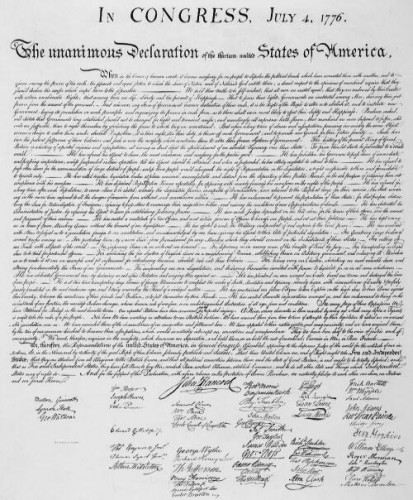 That’s asking and answering the wrong question: “What rights does the government give us?”
Because the truth is the government didn’t come first. The rights we have date back to our Creator.
That’s what the Bible says and for those who don’t like the Bible, it’s also what the Declaration of Independence says.
Significantly drafted by Thomas Jefferson, the same man who took a pair of scissors to his Bible to make a book scrubbed of any supernatural elements, the United States Declaration of Independence was adopted by the Second Continental Congress on July 4, 1776, the anniversary we celebrate as the Fourth of July, Independence Day. The text of the second section of the Declaration of Independence states,
We hold these truths to be self-evident, that all men are created equal, that they are endowed by their Creator with certain unalienable Rights, that among these are Life, Liberty and the pursuit of Happiness. — That to secure these rights, Governments are instituted among Men, deriving their just powers from the consent of the governed.”
If we take the Bible and the Declaration of Independence to be correct, the government doesn’t give us any rights. Our Creator does.
So the right question becomes, “What is the purpose of the rights we have?”
The rights we have are given so that we might freely choose how to live (i.e. whether we will follow God or choose a different way). The government’s role is not to give any rights whatsoever. The role of government is to guard and protect our freedom and to preserve those God-given rights that we already have.
It’s part of what makes the United States of America a beautiful place to live. It is why America is the envy of an oppressed world which yearns for the political freedom to pursue God-given rights.
Would you like to go deeper into the topic of Freedom and Rights? If so, please join me on the page.
This is a trustworthy saying. And I want you to stress these things, so that those who have trusted in God may be careful to devote themselves to doing what is good. These things are excellent and profitable for everyone. But avoid foolish controversies and genealogies and arguments and quarrels about the law, because these are unprofitable and useless (Titus 3:8-9).
Asking all the wrong questions is an unprofitable and useless endeavor. Yet, in every wrong question and its wrong answer,  people find hills to die on. Fight to the death is what too many do and we end up bleeding the Body of Christ with words that hurt, wounds that endure, and worthless controversy that the Bible says is harmful, unprofitable, useless, and completely futile. Why do we do this?
In this first installment of Asking the Wrong Questions, we’ll be considering the wrong question, “Is patriarchy God’s design for women?”
The short answer is Yes and No. Patriarchy is God’s design for all of us, yet not as we practice it in our culture.
If you’d like to go deeper, please join me on the next page.
As we celebrate Easter Sunday and prepare to descend the steps of the temple to resume our life of daily discipleship, let’s review the Songs of Ascents and what they mean for our journey beyond Easter Sunday:
15. It’s All about Praise!
14. The Gift of Unity
13. Desired Dwelling Place
12. Shalom, Simple Shalom
11. Full Redemption
10. Justice Gets Done!
9. The Blessed Fear
* * *
8. Praise God From Whom All Blessings Flow
* * *
7. Harvest of Joy
6. Blessings of Security
5. Remembering God’s Ways
4. Have Mercy!
3. The Habitation of Peace—(Seek God’s Presence and Know His Peace)
2. Gaze Beyond the Hills
1. Listen: Expect Opposition
_______________
Our discipleship journey remains a spiritual one
and the lessons we gained while going Up to Jerusalem we will be ones we carry with us daily.
Until Jesus returns or calls us to the place He has prepared for us,
we will be journeying home with songs in our hearts.
Psalm 134:1 A song of ascents. Praise the LORD, all you servants of the LORD who minister by night in the house of the LORD. 2 Lift up your hands in the sanctuary and praise the LORD. 3 May the LORD, the Maker of heaven and earth, bless you from Zion.
Holy Saturday sometimes seems like kind of a lost day between Good Friday and Easter Sunday. But even though today’s devotional concludes the Lenten Devotional Series entitled Up to Jerusalem, the message of the final Song of Ascents (Psalm 134) isn’t lost on us: It’s All about Praise!
Psalm 134 is the shortest Song of Ascents and in the entire Psalter, only Psalm 117 is shorter; but this final Song of Ascents is also one of the most powerful ones. Plus, it’s a fitting introduction to the remainder of the Psalms which are All about Praise to the God who answers prayers, hears our cry, supplies all our needs, protects us, and knows us.
 Holy Saturday. We don’t quite know what to do about it, but our psalmist gives us an answer on the top step on our spiritual pilgrimage Up to Jerusalem—it’s All about Praise! We have a realization that the spiritual pilgrimage continues.
For the pilgrims of Jesus’ day, worship at the temple was the high point of the year. They returned home confident that those ministering before the Lord would carry on with worship for them. But for our generation, it means there is more to discipleship than an Easter celebration—discipleship lives on and worship continues. Beyond Good Friday, through Holy Saturday and beginning anew at Easter Sunday, we can continually walk in victory. It’s the walk of discipleship.
While Jesus was in the tomb, dead to this world, heaven was already rejoicing! It was All about Praise! You see, the work had already been done. Jesus said, “It is finished” (John 19:30) and “with that, he bowed his head and gave up his spirit.” Jesus cried out in a loud voice, gave up His spirit and then Matthew tells us of a most amazing situation:
At that moment the curtain of the temple was torn in two from top to bottom. The earth shook and the rocks split. The tombs broke open and the bodies of many holy people who had died were raised to life. They came out of the tombs, and after Jesus’ resurrection they went into the holy city and appeared to many people (Matthew 27:51-53).
Look carefully: the victory happened at the moment of Jesus’ giving up His spirit. We make a mistake if we think Jesus ceased to exist during the time His body was in the tomb, that Holy Saturday was some kind of lost day between Good Friday and Easter Sunday.
The victory was done. It was all over but the shouting “He is Risen!”
What was going on in heaven on Holy Saturday? It was no lost day, that’s for sure. The celebration had already begun. Those who ministered all the time in the house of the Lord–in His heavenly dwelling–they were already praising God the Father, Son, and Holy Spirit for the total victory that Jesus accomplished. It was All about Praise!
As spiritual pilgrims, we begin our journey Up to Jerusalem with discipleship, but we end our steps with praise.
So, what should we do about Holy Saturday? We can praise God by walking in Jesus’ victory. We can give Him honor and glory and thanks for enduring the Cross. We can celebrate the Risen Lord and the eternal life He gives all year long. Even before His bodily resurrection, the victory was won! If you stop to think about it, Jesus’ resurrection was simply the proof WE needed. Heaven was already celebrating. Therefore, we can press on with our daily discipleship knowing It’s All about Praise!
***
While this concludes our Up to Jerusalem Lenten series, tomorrow there will be ongoing worship with the weekly Chapel Worship Guide and a recap of all fifteen Songs of Ascents. Beyond Easter, I write periodic articles and devotionals as well as providing inspiration about gardening which you may enjoy as well. I hope you will stay tuned as we continue our pilgrimage of praise.
Today is Maundy Thursday. For those in Chicagoland, I invite you to join me at my home church, Christ Church Highland Park, for a special Maundy Thursday service entitled Christ, Our Passover. I will be presenting an Old Testament view of the Passover during the course of this communion service.
***
Psalm 133:1 A song of ascents. Of David. How good and pleasant it is when brothers live together in unity! 2 It is like precious oil poured on the head, running down on the beard, running down on Aaron’s beard, down upon the collar of his robes. 3 It is as if the dew of Hermon were falling on Mount Zion. For there the LORD bestows his blessing, even life forevermore.
God’s Desired Dwelling Place is among His people. It’s a place of unity and life forevermore. This fourteenth Song of Ascents brings us nearly to the top of our pilgrimage of praise, Up to Jerusalem! Looking out over the horizon, the psalmist reflects upon what it means to be God’s people and writes three lines of poetic beauty.
 Our psalmist writes that it is good and pleasant–just like precious oil–when brothers live in unity. It’s delightful, an eternal blessing and an expression of what true life is all about. Unity is hard to come by in this world and these days, the “brotherhood of man” seems dysfunctional at best.
Why is that? True life can only happen because God has given us The Gift of Unity. Do you ever think of unity as a gift?
Jesus did. He prayed for this gift for us. In John 17:20-24, we read Jesus’ prayer. “My prayer is not for them alone. I pray also for those who will believe in me through their message, that all of them may be one, Father, just as you are in me and I am in you. May they also be in us so that the world may believe that you have sent me. I have given them the glory that you gave me, that they may be one as we are one: I in them and you in me. May they be brought to complete unity to let the world know that you sent me and have loved them even as you have loved me. Father, I want those you have given me to be with me where I am, and to see my glory, the glory you have given me because you loved me before the creation of the world.”
Our psalmist poetically describes The Gift of Unity as God’s heavenly blessing, even life forevermore. Think about how, like Aaron’s anointing, this unity is holy and divinely inspired: God models unity within Himself. He is One God; yet Triune as Father, Son, and Holy Spirit!
Therefore, Jesus spoke of The Gift of Unity as evidence that Jesus was sent from the Father; proof that the Father loves us; and is the greatest witness to the world that Jesus Christ came to give His life as a ransom for many. The Gift of Unity means that we can experience the relational joy of God’s internal oneness. By being one people–a community bound together by faith and in the love of Christ, we can enjoy true life forevermore as God’s gracious gift.
For further thought:
Luke 19:41 As he approached Jerusalem and saw the city, he wept over it 42 and said, “If you, even you, had only known on this day what would bring you peace– but now it is hidden from your eyes. 43 The days will come upon you when your enemies will build an embankment against you and encircle you and hem you in on every side. 44 They will dash you to the ground, you and the children within your walls. They will not leave one stone on another, because you did not recognize the time of God’s coming to you.”
It’s easy to see how if Jerusalem was God’s Desired Dwelling Place among His people, it would break the heart of God to know that His own people didn’t want Him or recognize the time of His coming to them. Our peace with God came at the high price of the crucifixion of Jesus, the Son of God.
How did a crowd shouting “Hosanna” quickly turn to shouting “Crucify him”? They wanted a political solution to a spiritual problem.
They sacrificed what would bring true peace because God’s way didn’t measure up politically. They expected a political revolt and a political conquering king, but they would reap what they had sown. Even in the passage above, Jesus outlines what mere political revolt and overthrow accomplish. The crowd wanted a political solution to a spiritual problem…and Jesus wept because He knew that this approach–on its own–would not achieve what they really wanted. They needed a real Messiah.
In our lives, how often do we look for political solutions to spiritual problems?
I used to be a political junkie. I followed all the talk radio programs, watched all the loud arguing talking heads on panel discussion shows, and lived for the news of the day. I called my congressman regularly, wrote letters to the editor, and voiced my views. Then Jesus grabbed hold of me and things changed.
Oh, don’t get me wrong, I still have clear views of things, I watch news and opinion programs, voice my views, and vote. But I’m looking to Jesus to solve the spiritual problem at the root of every political problem.
 Look at this list of today’s major political hand grenades:
• Abortion
• Energy Policy
• Foreign Policy
• Greed
• Hate
• Jobs
• Judicial Policy
• Military Policy
• Race Relations
• Tax Policy
• Welfare Policy
One passage of Scripture radically changed my thinking on this topic of a political solution to a spiritual problem: Matthew 22:16-22. The answer Jesus gave (v 21) was: “Give to Caesar what is Caesar’s, and to God what is God’s.”
Political solutions belong to political problems. Spiritual problems need a more reliable Messiah. If we let Jesus Christ—and the peace He alone brings—be the lens through which we view the major political ideas of our day, we will stop looking for lesser messiahs in the form of our elected officials. We will move beyond political solutions and recognize the time is now! God has made peace for us through Jesus Christ’s coming to us. He will make us His Desired Dwelling Place as we see Jesus as the only solution to the spiritual problem at the root of every political problem.
For further thought:
In our thirteenth Song of Ascents (the pilgrim songs that travelers would sing on their way Up to Jerusalem), we encounter Psalm 132—the longest of these songs. The title of this discipleship lesson might be Desired Dwelling Place because it highlights God’s desire to dwell among His people.
This song begins: Psalm 132:1 A song of ascents. O LORD, remember David and all the hardships he endured. 2 He swore an oath to the LORD and made a vow to the Mighty One of Jacob: 3 “I will not enter my house or go to my bed– 4 I will allow no sleep to my eyes, no slumber to my eyelids, 5 till I find a place for the LORD, a dwelling for the Mighty One of Jacob.”
David’s desire was to find a dwelling place for God, but God’s desired dwelling place was wherever His people came to worship Him. If we remember back in 1 Chronicles 13-16, King David brought the Ark of the Covenant to Jerusalem. He had found it in Jaar (i.e. Keriath Jearim –1 Samuel 5 tells us the Philistines abandoned it, as it brought nothing but judgment against those who hated God).
Ps 132: 6 We heard it in Ephrathah, we came upon it in the fields of Jaar: 7 “Let us go to his dwelling place; let us worship at his footstool— 8 arise, O LORD, and come to your resting place, you and the ark of your might. 9 May your priests be clothed with righteousness; may your saints sing for joy.”
But even after the Ark was in Jerusalem, Scripture says, “After David was settled in his palace, he said to Nathan the prophet, “Here I am, living in a palace of cedar, while the ark of the covenant of the LORD is under a tent” (1 Chronicles 17:1).
 David’s cedar palace seemed to be a more fitting dwelling place than under a tent. God’s Desired Dwelling Place was among His chosen people. This is what the “Tent of Meeting” represented.
God desires to meet with His people–the ones who love and fear Him–wherever they are.
Here is the beauty of God’s condescension and His great humility. He allowed the Temple to be built not because He needed one, but because He loves us. It would not be built by David, a man of war, but by Solomon, whose name means peace (see the Hebrew consonant similarities with shalom, SLM). Seek God’s Presence and Know His Peace. This is His Desired Dwelling Place.
Ps 132:10 For the sake of David your servant, do not reject your anointed one. 11 The LORD swore an oath to David, a sure oath that he will not revoke: “One of your own descendants I will place on your throne—12 if your sons keep my covenant and the statutes I teach them, then their sons will sit on your throne for ever and ever.”13 For the LORD has chosen Zion, he has desired it for his dwelling: 14 “This is my resting place for ever and ever; here I will sit enthroned, for I have desired it—15 I will bless her with abundant provisions; her poor will I satisfy with food. 16 I will clothe her priests with salvation, and her saints will ever sing for joy. 17 “Here I will make a horn grow for David and set up a lamp for my anointed one. 18 I will clothe his enemies with shame, but the crown on his head will be resplendent.”
God’s resting place–where He is enthroned– is the eternal temple. It was made possible by Jesus Christ—His Anointed One. Where is God’s eternal Desired Dwelling Place?
“And I heard a loud voice from the throne saying,
‘Now the dwelling of God is with men, and he will live with them.
They will be his people, and God himself will be with them and be their God.’”
(Revelation 21:3)