Favor Follows Joseph

Had Potiphar been mad primarily at Joseph, he could have executed him then, there in front of his wife, no questions asked.  But Potiphar had likely seen God’s favor that followed Joseph and noted that his wife seemed awfully comfortable with that trophy cloak as a souvenir.  He probably knew she was a liar from his prior experience with her, and it didn’t help that she started off by blaming Potiphar.  That slave YOU brought us.  (Just can’t win with that woman.)

So instead of execution, Genesis 39:20 “Joseph’s master took him and put him in prison, the place where the king’s prisoners were confined.”

It was an elite sort of prison on (or near) Potiphar’s premises.  This jail also housed Pharaoh’s staff who had failed in their tasks.  Joseph’s sentence was light (but long) because Potiphar’s family honor needed to be upheld even if he expected his wife was nothing but a lying sack of papyrus.

Genesis 39:20 But while Joseph was there in the prison, 21 the LORD was with him; He showed him kindness and granted him favor in the eyes of the prison warden.

Favor followed Joseph and everyone noticed. 

Genesis 39:22 So the warden put Joseph in charge of all those held in the prison, and he was made responsible for all that was done there. 23 The warden paid no attention to anything under Joseph’s care, because the LORD was with Joseph and gave him success in whatever he did.

Think about it:

  • God’s favor found Joseph in prison, as a slave, and as a brother who has now had two cloaks taken from him.  Is God’s favor dependent on our circumstances? Or where in the world we are?  
  • What about our income level?  What about our demographic characteristics of sex, race, creed, and color? 
  • What about our religion?  Stop and think on this last one. 
  • Read James 1:17 “Every good and perfect gift is from above, coming down from the Father of the heavenly lights, who does not change like shifting shadows.” 
  • Now read Matthew 5:44 “But I tell you, love your enemies and pray for those who persecute you, 45 that you may be children of your Father in heaven. He causes his sun to rise on the evil and the good, and sends rain on the righteous and the unrighteous.”
  • How does these inform the previous question?
Continue Reading

Joseph and the Nagging Headache

Joseph was contented.  He was a slave but a privileged one because Potiphar clearly saw the blessing and didn’t want to jeopardize it at all.  Joseph lived in his master’s house and had a very good life, for a slave, that is.  Genesis 39:6 “So Potiphar left everything he had in Joseph’s care; with Joseph in charge, he did not concern himself with anything except the food he ate.”

Genesis 39:6  Now Joseph was well-built and handsome, 7 and after a while his master’s wife took notice of Joseph and said, “Come to bed with me!” 8 But he refused.

Talk about awkward.  He’s a slave.  He couldn’t help it that he was good looking.  Potiphar’s wife had too much time on her hands and turned out to be persistent.  Very persistent.  Avoidance wasn’t working so now Joseph tries diplomacy.

Genesis 39:8  “With me in charge,” he told her, “my master does not concern himself with anything in the house; everything he owns he has entrusted to my care. 9 No one is greater in this house than I am. My master has withheld nothing from me except you, because you are his wife.”

She looked at him blankly and expectantly.  Joseph, seeing that reason was getting nowhere, next tried the religious route.

Genesis 39:9 “How then could I do such a wicked thing and sin against God?”

She neither knew nor cared about some Hebrew God.  She was fixated, the self-appointed queen of the I-want-what-I-can’t-get club, and began pressure tactics.  Maybe he was just playing hard to get.  Indeed, she was nothing short of a nag…and a headache for Joseph.  He couldn’t avoid her because he lived in his master’s house too.  Pretending he didn’t hear her and loudly whistling “The Dreidel Song” probably wouldn’t have worked either.  So, he kept to the same story and hoped she’d stop.

Genesis 39:10 And though she spoke to Joseph day after day, he refused to go to bed with her or even be with her.

Nag, nag, nag.  She didn’t exactly make her case compelling or display an invitation he couldn’t refuse.  Nag, nag, nag.  What a headache!  Finally, one day, he had to do the escape route.

Genesis 39:11 One day he went into the house to attend to his duties, and none of the household servants was inside. 12 She caught him by his cloak and said, “Come to bed with me!” But he left his cloak in her hand and ran out of the house.

Think about it:

  • Joseph was well-built and handsome.  He was full of youthful vigor and hormones.  As a slave, he probably wasn’t getting a lot of action, shall we say?  What supported his integrity? What in our culture undermines our own resolve, particularly where sexual expression is concerned?
  • At this point in history, it would still be 400 years for the Hebrews in Egypt (many of those years as slaves) before Moses would be born, another 80 plus before he’d ascend the mountain and come down with tablets containing the Ten Commandments, outlining the prohibitions against adultery and coveting.  How did Joseph know it’d be a sin against God (verse 9)? 
  • It’d be almost two thousand years before the Apostle Paul would write, 1 Corinthians 3:16 “Don’t you know that you yourselves are God’s temple and that God’s Spirit dwells in your midst?” and 1 Corinthians 6:19 “Do you not know that your bodies are temples of the Holy Spirit, who is in you, whom you have received from God? You are not your own; 20 you were bought at a price. Therefore honor God with your bodies.” The Holy Spirit hadn’t been given yet, so what did Joseph mean when he thought it would be a sin against God?
  • What does it say that Joseph knew this before it was written, yet we refuse to honor it after it’s been made explicit?
Continue Reading

Joseph and God’s Overflowing Blessing

Fast forward through a chapter of Genesis and we catch up with Joseph far from home.  He was formerly Daddy’s favorite with a coat of authority, but resented by his brothers, and now he’s the slave who had been in the Ishmaelite caravan to be sold a second time, first by family and now by strangers.

Genesis 39:1 Now Joseph had been taken down to Egypt. Potiphar, an Egyptian who was one of Pharaoh’s officials, the captain of the guard, bought him from the Ishmaelites who had taken him there.

Potiphar unwittingly won the slave-purchase lottery in buying Joseph because God was preparing to prosper and bless Joseph wherever he went, including Egypt.  All Potiphar probably looked for was an able-bodied honest worker.  Little did he know that God’s hand would be upon Joseph and whatever blessing happened to Joseph would overflow to Potiphar’s benefit.  Cool! Buy one slave who is blessed by God, and it’s all upside. 

Genesis 39:2 The LORD was with Joseph so that he prospered, and he lived in the house of his Egyptian master. 3When his master saw that the LORD was with him and that the LORD gave him success in everything he did, 4 Joseph found favor in his eyes and became his attendant.

Potiphar, a wise man even before the Magi.  It didn’t take a rocket scientist to see that blessing defies gravity and God’s favor upon Joseph could be helpful to Potiphar.  It’s like Potiphar knew this before Malachi.  “Bring the whole tithe into the storehouse, that there may be food in my house. Test me in this,” says the LORD Almighty, “and see if I will not throw open the floodgates of heaven and pour out so much blessing that there will not be room enough to store it.” (Malachi 3:10) 

Genesis 39:4 Potiphar put him in charge of his household, and he entrusted to his care everything he owned. 5 From the time he put him in charge of his household and of all that he owned, the LORD blessed the household of the Egyptian because of Joseph. The blessing of the LORD was on everything Potiphar had, both in the house and in the field.

Think about it:

  • Blessings are not geographical, they are personal.  Joseph was in Egypt, but he was still Joseph.  Egypt was the powerful worship epicenter of foreign gods, but there was Joseph, a faithful Jew, shining brightly because of the dark place.  How often do you look to your change your circumstances to bring about blessing?
  • In what way could your worship of God, obedience to Him, and your trust in Him stand out and become a blessing to others?
  • Read Psalm 67:1 “For the director of music. With stringed instruments. A psalm. A song. May God be gracious to us and bless us and make his face shine on us– 2 so that your ways may be known on earth, your salvation among all nations. 3 May the peoples praise you, God; may all the peoples praise you. 4 May the nations be glad and sing for joy, for you rule the peoples with equity and guide the nations of the earth. 5 May the peoples praise you, God; may all the peoples praise you. 6 The land yields its harvest; God, our God, blesses us. 7 May God bless us still, so that all the ends of the earth will fear him.”  What is God’s purpose in blessing us? 
  • What is God’s purpose in our suffering? 
  • In what way are blessing and suffering two sides of the same instrument God uses to shape character … whether the character of a person or the character of a culture?
  • In what way does that destroy a God-wants-you-happy “prosperity gospel” preached in too many churches? 
Continue Reading

Joseph: When It All Seems Over but It’s Not

A perfectly imperfect plan…ruined!  Reuben had been off somewhere while his brothers were making plans (to foil the plan they didn’t even know existed because Reuben had been keeping it secret). 

Genesis 37:29 When Reuben returned to the cistern and saw that Joseph was not there, he tore his clothes.

The tearing of his own clothes—a response of distress—was probably accompanied by an Ancient Near East expletive or a string of them.  He hadn’t shared his plan with his brothers thinking that Joseph was safe in the cistern.

Genesis 37:30 He went back to his brothers and said, “The boy isn’t there! Where can I turn now?”

Their answer wasn’t, “If you hurry you might be able to catch up to the traders and buy him back. We just happen to have twenty shekels to contribute toward the cause.”  Nope. What did they do?  Cover up the crime.

Genesis 37:31 Then they got Joseph’s robe, slaughtered a goat and dipped the robe in the blood. 32 They took the ornate robe back to their father.

Amazingly enough, they still had the robe.  They’d sold Joseph without it.  The robe, the robe, the robe.  It wasn’t the robe his father would want to see.  Certainly not dipped in blood.

Meanwhile Joseph was walking his way to Egypt, never to be seen again by the brothers…except he would be.  You see, it wasn’t really over for Joseph, it was just a scenery change.

Think about it:

  • Reuben’s plan was secret and imperfect, but whose plan prevailed?
  • Are God’s plans always pleasant and happy?  Who in this story today ended up being truly happy? 
  • “Only in darkness do stars shine the brightest.”  In what way is this playing out in the life of Joseph who will be a star someday for the Jewish people? 
  • Read Stephen’s account in Acts 7:5-13.  How is Joseph’s being sold into slavery part of God’s unfolding plan?
Continue Reading

Traders, Traitors, and a Twenty-Shekel Joseph

Those brothers: traitors and betrayers of the family trust, plotting and planning to defy authority and rip up that stupid coat of Joseph’s that they hated.

Genesis 37:23 So when Joseph came to his brothers, they stripped him of his robe—the ornate robe he was wearing—

Yeah, that robe of his really ticked them off… (and it’s emphasized to make sure we didn’t miss it).

Genesis 37:24 and the brothers took Joseph and threw him into the cistern. The cistern was empty; there was no water in it.

That’s how Reuben planned to rescue him.  He knew Joseph wouldn’t drown because it wasn’t the season for rains and therefore, there was no water.  But Reuben’s plan was not well thought through.  He hadn’t counted on two things.  First, if Joseph were to be rescued, he’d squeal, and the resulting report would be damning for the brothers. All of them.  Beating up Daddy’s favorite but throwing him into a cistern might have saved Joseph, but all the brothers would be in big trouble for the treachery.  The other brothers knew it, so there would be no getting Joseph back to Daddy without Reuben’s plan being foiled.  It’s kind of hard to sneak a young man in a colorful coat back to his father without anyone seeing…for the rest of their lives.

But second, Reuben hadn’t counted on the coincidental timing (read as divine Providence) of Traders … those Ishmaelites and Midianites who were passing through.  Second cousins by heritage, but not really close enough to be considered family and therefore, they were just traders and not traitors like Joseph’s brothers.  Judah did a quick calculation about the consequences now that Joseph was in the pit.  If we let him out and he lives to tell about it, we’re in big trouble.  If he dies, we’re in big trouble unless we lie about it and no one finds out.  Either way we’re in big trouble.  Unless there’s another way.  They were all chewing on well more than food.

 Genesis 37:25 As they sat down to eat their meal, they looked up and saw a caravan of Ishmaelites coming from Gilead. Their camels were loaded with spices, balm and myrrh, and they were on their way to take them down to Egypt. 26 Judah said to his brothers, “What will we gain if we kill our brother and cover up his blood? 27 Come, let’s sell him to the Ishmaelites and not lay our hands on him; after all, he is our brother, our own flesh and blood.” His brothers agreed. 28 So when the Midianite merchants came by, his brothers pulled Joseph up out of the cistern and sold him for twenty shekels of silver to the Ishmaelites, who took him to Egypt.

Think about it: 

  • “Come, let’s sell him … after all, he is our brother, our own flesh and blood.” How is this a major disconnect of thoughts?  How might selling him be no better than killing him? 
  • In what way does it compound their guilt? 
  • The brothers were twenty shekels richer and Joseph was out of sight, out of mind…sort of.  Who had they not taken into consideration regarding traders bringing Joseph to Egypt?  For that reason, would their consciences ever rest easy about what they’d done? 
  • How are the plans of people always subject to the greater plans of God?  Proverbs 19:21 “Many are the plans in a person’s heart, but it is the LORD’s purpose that prevails.”
  • God’s itinerary always leads from bondage to victory. How was this borne out in Joseph’s being sent to Egypt?
Continue Reading

Conscience and a Cistern for Joseph

Joseph’s mission to Shechem was divinely redirected to Dothan but his true destination was an empty cistern.  Only Joseph didn’t know it. He could not predict–as he paraded in with his colorful coat of authority–that he was about to be stripped of that authority and to hit rock bottom.  Of a cistern, that is.

Genesis 37:18 The brothers saw Joseph in the distance, and before he reached them, they plotted to kill him. 19 “Here comes that dreamer!” they said to each other. 20 “Come now, let’s kill him and throw him into one of these cisterns and say that a ferocious animal devoured him. Then we’ll see what comes of his dreams.”

Whether it began as an idle thought of the moment or had been hatched a long time ago as a carefully planned coup, no one knows.  One thing’s for sure: most of the brothers failed to heed their own conscience. 

Conscience is that small voice beckoning integrity to rise in the face of sin and cowardice.  We all have a conscience, but only Reuben stopped to consider his own.

Genesis 37:21 When Reuben heard this, he tried to rescue him from their hands. “Let’s not take his life,” he said. 22 “Don’t shed any blood. Throw him into this cistern here in the wilderness, but don’t lay a hand on him.” Reuben said this to rescue him from them and take him back to his father. 23 So when Joseph came to his brothers, they stripped him of his robe– the ornate robe he was wearing– 24 and they took him and threw him into the cistern.

Think about it: 

  • In Genesis 37:25 Scripture tells us “Then they sat down to eat a meal” (NAS).  What does it say about their conscience that they could carry out a plot like this and then go about life as if they hadn’t done such a horrible thing? 
  • Eating a meal together in Biblical times meant a degree of fellowship.  What might it mean that even Reuben was having a meal with them?
  • We aren’t told why Reuben thought to consider his conscience.  Perhaps it was a function of his responsibility as the eldest. Maybe he wanted to play the hero and get in on some of that colorful coat action.  Or maybe it was an attempt to repair the badly damaged relationship with his father after Reuben’s insolent and indecent behavior recorded in Genesis 35:22.  How does conscience intervene in the process of desire-sin-death referred to in James 1:15
  • Habitually ignoring the conscience tends to silence it.  In what ways do you see our culture ignoring its collective conscience, and individuals rejecting each his own?  What is the likely outcome if we persist?
Continue Reading

Providence and Three Plans for the Dreamer

Joseph was wandering around the fields of Shechem when a chance encounter gave him some direction to locate his brothers.  “’They have moved on from here,’ the man answered. ‘I heard them say, “Let’s go to Dothan. “’ So, Joseph went after his brothers and found them near Dothan.” (Genesis 37:17)

Joseph–that dreamer who gave a bad report on his brothers in the past.  Oh, how they hated him for it!!  But he went on to find his brothers anyway, and report back…again…at least that was his plan.

“But they saw him in the distance, and before he reached them, they plotted to kill him.  “Here comes that dreamer!” they said to each other.  “Come now, let’s kill him and throw him into one of these cisterns and say that a ferocious animal devoured him. Then we’ll see what comes of his dreams.” (Genesis 37:18-20)

The brothers deserved more than a bad report.  They deserved more than a severe reprimand and a lifetime of anger management counseling because they had decided to take matters in their own hands.  They planned to kill him and put an end to all that dreaming.

“God’s Providence:
when future proves the past
and all present plans of man serve God’s purpose.”

Oddly, God’s providence used their hatred of their own brother to accomplish His good and perfect will.  They just didn’t know it. 

Think about it:

  • If Joseph was dead, would his dreams come true? 
  • In what ways were the brothers trying to be architects of their own destiny and thwarting whatever God might be doing with Joseph’s dreams?  Is God’s sovereignty that flimsy? 
  • What do their actions say about their beliefs regarding the origins of Joseph’s dreams? 
  • Joseph had a plan.  The brothers had a plan.  And God had a plan.  Which plan prevailed and how did the other two plans serve to accomplish the best of three?
Continue Reading

Joseph and the Chance Encounter

When we last considered Joseph: A Life with Many Colors in the days leading up to Lent 2019, Joseph (our lead character from this part of the Book of Genesis) was a young emissary sent on a mission to Shechem which was a good four or five-day journey from his father Jacob’s home in the Valley of Hebron.  Jacob sent him to report on his brothers (big mistake) and Joseph, no doubt, had a lot to think about as he traveled in the now famous coat. 

Genesis 37: 14 When Joseph arrived at Shechem, 15 a man found him wandering around in the fields and asked him, “What are you looking for?” 16 He replied, “I’m looking for my brothers. Can you tell me where they are grazing their flocks?” 17 “They have moved on from here,” the man answered. “I heard them say, ‘Let’s go to Dothan.'” So Joseph went after his brothers and found them near Dothan.

Don’t you find this story rather mysterious?  Here’s Joseph desperately seeking siblings in Shechem when he runs into some random guy who just happens to be wandering the same fields (for who knows how long), and knows exactly who Joseph’s brothers are, has overheard them saying where they were going…and amazingly remembers it all.

What a coincidence…such a chance encounter!
Or maybe as Théophile Gautier (1845) says,

“Chance is perhaps the pseudonym of God
when He does not want to sign.”

When God gives us curious details, it’s worth asking ourselves why.  One answer is unmistakable: It’s so we’ll have evidence to believe God’s story is unfolding exactly how God intends.

Think about it:

  1. Why might God want us to know His intention in sending Joseph into harm’s way among his brothers? 
  2. How does direction to Dothan from this chance encounter help us to see God’s foreknowledge of what will transpire? 
  3. Read Genesis 50:20 “You intended to harm me, but God intended it for good to accomplish what is now being done, the saving of many lives.”  In what way does this chance encounter offer evidence of God’s will for a greater purpose? 
  4. What painful circumstances in your life might be chance encounters for a greater purpose?

Continue Reading

Grave Reflections (Lent 40-2019)

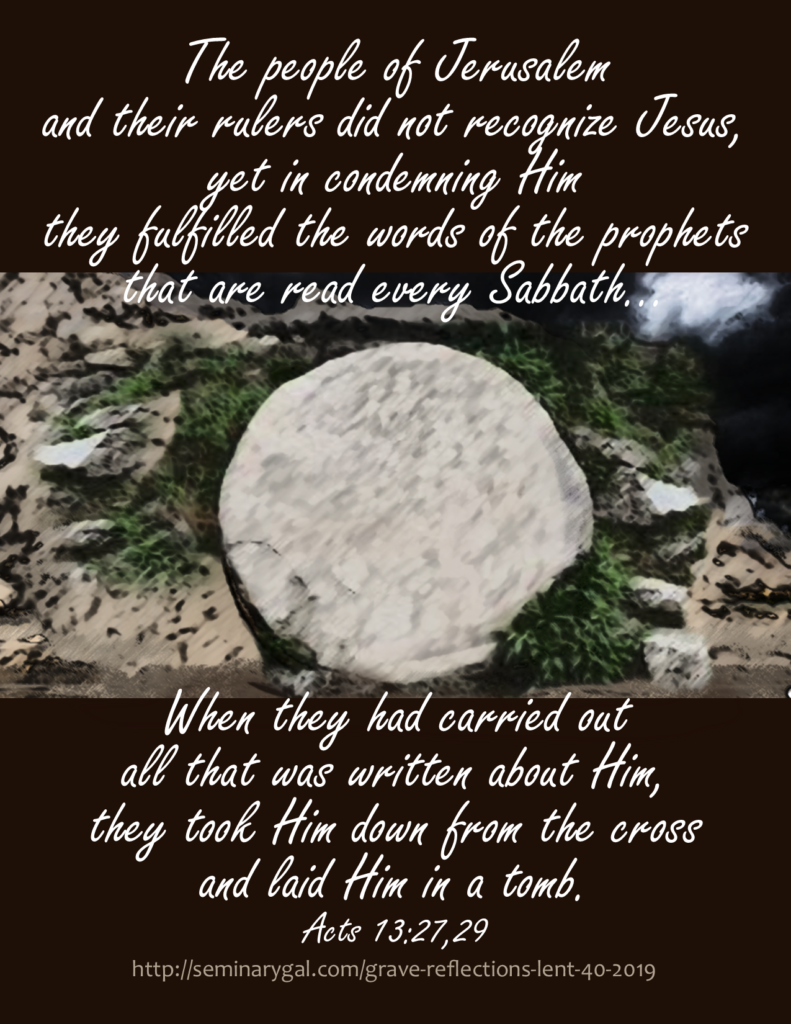
The stone which had been rolled in front of the tomb remained as if frozen in time.  Jesus was dead.  He’d even said, “It is finished.”  The grave was silent and seemingly satisfied.  There is no “More to the Easter Story” for Jesus to tell because He’s dead.  He’s buried.  This stark reality of death gives us sober time to reflect while Jesus is cold, dead, in the grave at this moment on the Church calendar.  “The people of Jerusalem and their rulers did not recognize Jesus, yet in condemning Him they fulfilled the words of the prophets that are read every Sabbath…”

Think about it:

Boiled down to its essence, what is truly Christian faith?  It’s what we do with the actual Person, the real work, the true life, and the importantly unique death of Jesus.  These are the defining measures of a Christian. 

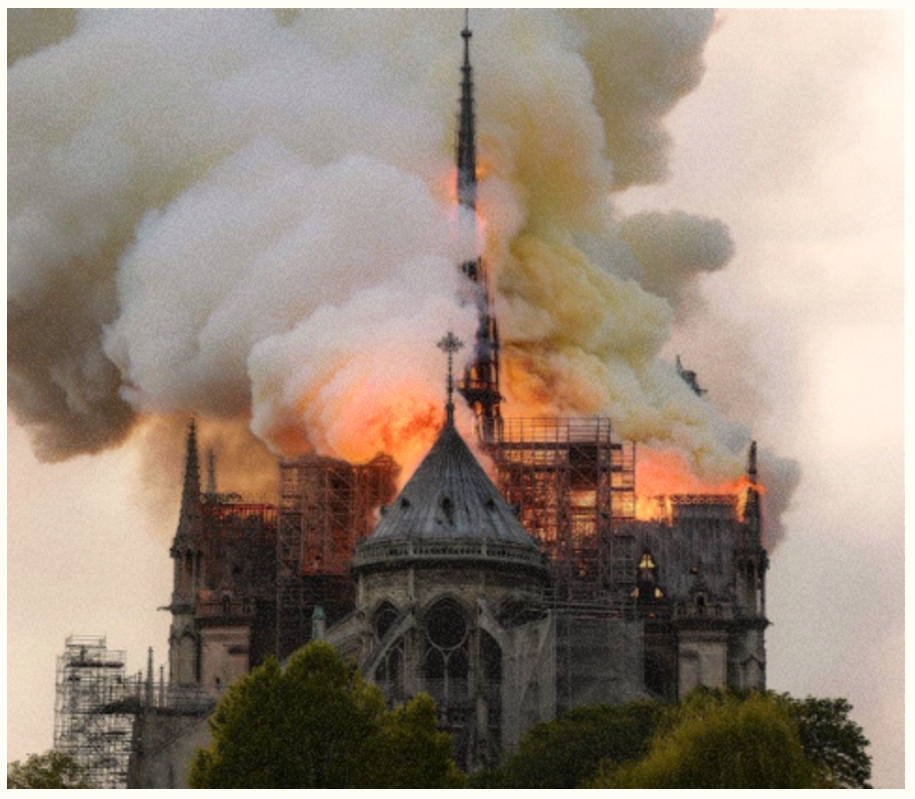
It’s not which Christian church you attend or denomination that church belongs to.  It’s not really about church at all.  As I re-write this day’s devotional in light of the raging fire which consumed much of the Notre Dame Cathedral in Paris, I am mindful that people appreciate–even cherish–relics and artwork, statues and artifacts, and the architecture of the Cathedral which remains a magnificent achievement of human hands in devotion to God.  And yet, these are not what makes a church the Church or a Christian a Christian. 

Relics, art, and architecture are works of the material world.  The living Church (made up of Christians) stands worlds apart–visible in the material world but the real work in us was done in the spiritual world.

In the silence of the grave, we must consider what it means to be a Christian.  I’m rather appalled that so much social media commentary now focuses on assigning certain denominations as having heretical views though they are fully Christian…and other Christians are glossing over heresy to appear open-minded and inclusive. 

Notre Dame, being a Catholic church, has flavored some comments with an anti-Catholic sentiment and others an anti-Protestant (especially anti-Baptist) sentiment as tit-for-tat. 

I have truly Christian friends who worship at their local parish of the Roman Catholic Church and ones who worship at Baptist, Lutheran, Presbyterian, and nondenominational churches.  Maybe it’s time to get back to basics since there are probably frauds in the pews where faithful also attend in most any church.  Wheat and the tares.

Today on the church’s calendar, it’s Holy Saturday and Jesus is entombed.  On tomorrow’s Easter, the tomb will be empty, and death is defeated… forever. 

This happened because Jesus is God, the work He did on the Cross was perfect and is eternal, and His resurrection proves His victory. 

Heresies do exist, but there are essentials missing in each heresy.  Important essentials like:

  • Jesus is Son of Man and fully human.
  • Son of God and fully divine since before Creation.
  • Both God and man at the same time. 
  • God Incarnate.  Word made flesh. 
  • The Way, the Truth, and the Life. 
  • Perfect Sacrifice for Sin because He was sinless. 
  • Lamb of God who takes away the sin of the world. 
  • Promised One.  Risen One.  Messiah.  Savior.  Redeemer. Deliverer. 
  • Now add who He will be at His return:  Bridegroom of the Church.  King of kings. Lord of lords. Judge of the quick and the dead. 

False religions do exist and there are both close pretenders (often very nice people) claiming to be Christian (like Mormonism, Jehovah’s Witnesses, Unitarians, and Universalists) and those that reject Christianity wholesale (Islam being dominant and rising). 

On the Church calendar, Jesus is in the tomb today, but someday in the days to come, He will return as Judge.  Therefore, be careful what you believe about the actual Person, the real work, the true life, and the importantly unique death and resurrection of Jesus. 

Thank You, Jesus, that Your Word tells us, “All Scripture is God-breathed (2 Tim. 3:16), and “The word of God is alive and active. Sharper than any double-edged sword, it penetrates even to dividing soul and spirit, joints and marrow; it judges the thoughts and attitudes of the heart. Nothing in all creation is hidden from God’s sight. Everything is uncovered and laid bare before the eyes of him to whom we must give account. Therefore, since we have a great high priest who has ascended into heaven, Jesus the Son of God, let us hold firmly to the faith we profess”. (Hebrews. 4:12-14)  Keep us in Your Truth and reveal more of Yourself to us each day. Strengthen us for this hour, we pray in Your precious Name.  Thank You, Lord Jesus. Amen.

This is the final offering in our “More to the Easter Story” Lenten Devotionals Series. Tomorrow, there will be an Easter greeting and message. If you received these by logging onto the sidebar of the Seminary Gal Home page or if you have Facebook and you “Liked” my page (Seminary Gal) where they’re always reprinted, I hope you’ll stay on for resuming our Joseph: A Life with Many Colors series which will continue after a short break. I appreciate your encouragement and wish you all a very happy Passover and Easter!

Continue Reading

The Very Long Bad Good Friday (Lent 39-2019)

Jesus set down His cup and His betrayer left.  The remaining disciples tried to move beyond the awkwardness by singing a hymn with Jesus, and then they went out to the Mount of Olives.  Matthew 26:31 Then Jesus told them, “This very night you will all fall away on account of me, for it is written: “‘I will strike the shepherd, and the sheep of the flock will be scattered.’

While the disciples protested that they would stand with Him until the end, Jesus knew better.  The very long bad Good Friday was unfolding, and He said to His disciples,

Yes, what is written about me is reaching its fulfillment.” (Luke 23:37)

They arrived at the Mount of Olives and Jesus needed to take some time to pray alone to His Father since He was now facing the battle of His life. 

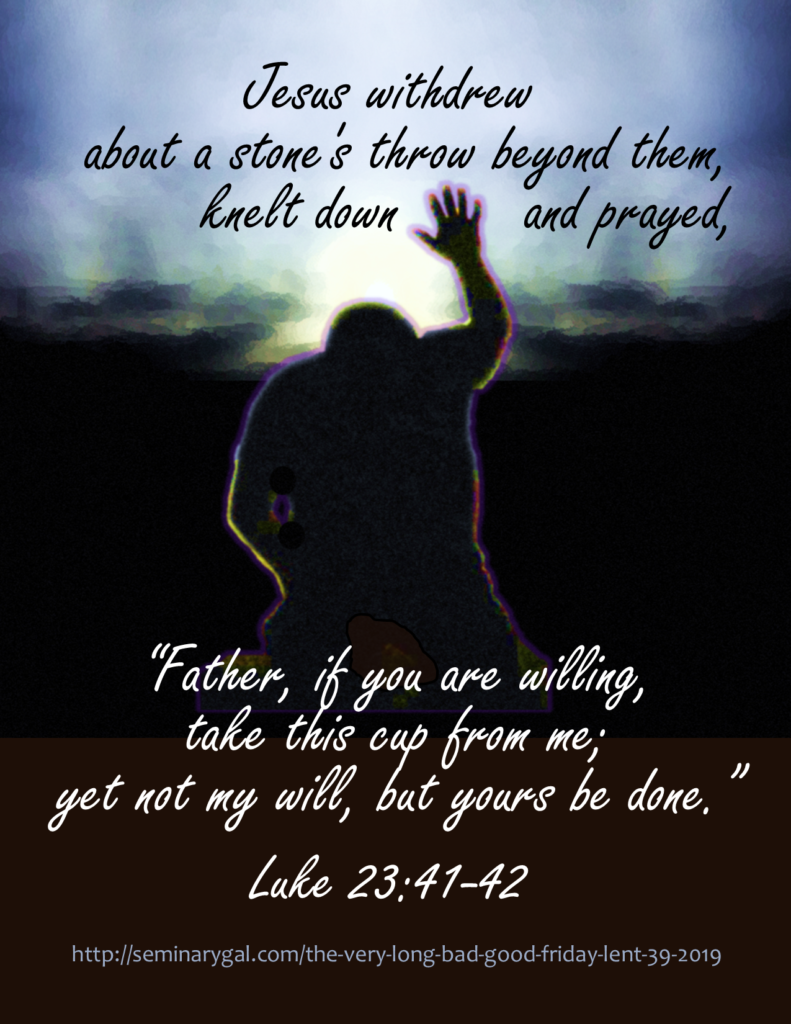
 Luke 23:41 “He withdrew about a stone’s throw beyond them, knelt down and prayed, 42 “Father, if you are willing, take this cup from me; yet not my will, but yours be done.”  43 An angel from heaven appeared to him and strengthened him.   44 And being in anguish, he prayed more earnestly, and his sweat was like drops of blood falling to the ground. 45 When he rose from prayer and went back to the disciples, he found them asleep, exhausted from sorrow.” 

There was no other way to pay for the sin of mankind.  It had to be this.  First the betrayer, then the apprehension before Jesus would say, 53 “Every day I was with you in the temple courts, and you did not lay a hand on me. But this is your hour– when darkness reigns.”

Indeed, celestial daylight may have broken on the very long bad Good Friday, but it was darkness–spiritual darkness–that reigned. Those in authority fraudulently tried, mocked, and beat Him. They blindfolded Him, demanded, “Prophesy! Who hit you?,” and insulted Him in every possible way.  They brought Him for sentencing before that double-minded Pilate who finally agreed to crucify Him to satisfy the crowd’s demands.  The Roman guards scourged Him and mocked Him with a crown of thorns and a robe before sending Him–bloody and weary, His back nearly skinless now–to carry His Cross to the place of crucifixion. 

As He went to Golgotha, Luke 23:27 “A large number of people followed him, including women who mourned and wailed for him.  28 Jesus turned and said to them, “Daughters of Jerusalem, do not weep for me; weep for yourselves and for your children.”” 

So, they wept for Him and for themselves.  Those in charge were so consumed with hatred that they had no idea of the battle in the spiritual realm Jesus had been fighting since His Incarnation and more earnestly since His being betrayed.  About the ones carrying out this excruciating execution,

Luke 23:34 “Jesus said, “Father, forgive them, for they do not know what they are doing.” And they divided up His clothes by casting lots… 38 There was a written notice above Him, which read: THIS IS THE KING OF THE JEWS… 44 It was now about noon, and darkness came over the whole land until three in the afternoon, 45 for the sun stopped shining. And the curtain of the temple was torn in two. 46 Jesus called out with a loud voice, “Father, into your hands I commit my spirit.” When He had said this, he breathed his last.”

The battle was fought.  The battle was finished.  The scattered disciples heard word that Jesus was dead, grieved that they’d fallen away in His hour of need, and assumed the overthrow—the war for vindication—was lost forever.  The women who had been watching the entire time wretched with complete anguish, choking on their tears, unable to stand or control their sobbing.

A rich man named Joseph of Arimathea watched in horror, too.  Being a member of the Council, he had sufficient authority to bravely go to Pilate as evening approached.  He asked for Jesus’ body since He was already dead.  Joseph took Jesus’ body down—it was already cold, lifeless, and Jesus’ final expression being an upward look at heaven and an open grimace of pain.  His eyes had not been closed at death.  Rather, they remained open, but their light was gone.  It was something Joseph would never forget.  That look of pain in death’s darkness layered over upward faith in the eyes of Jesus. 

Joseph had been accompanied by Nicodemus who brought myrrh and aloes to prepare the body in accordance with Jewish burial customs.  Together, they carefully wrapped Jesus’ body in linen cloth and placed it in a tomb cut in the rock, one in which no one had yet been laid.  The Sabbath was about to begin so they went home, each to his own, defiled now by touching death, horrified by the events, and remembering every detail of wrapping of Jesus’ dead body still bearing that look.  Before they left, they rolled the stone in front of the tomb, but they couldn’t seal away the memory of being the last ones to touch Jesus’ earthly body and look upon Jesus, this man of so much promise, this man who claimed He was God…a man faithful to the very end, and who died a death He didn’t deserve.

Think about it: 

  • How must Joseph and Nicodemus have felt to close the tomb by rolling the huge stone?  What kind of emotions and thoughts do you think they might have experienced as their Messianic expectations met the grave? 
  • The women too, the ones Luke 23:55 “who had come with Jesus from Galilee followed Joseph and saw the tomb and how His body was laid in it.”  How do you think they felt seeing the stone rolled, sealing Him in, and their having to wait until after the Sabbath to anoint His body?

“The people of Jerusalem and their rulers did not recognize Jesus, yet in condemning him they fulfilled the words of the prophets that are read every Sabbath. Though they found no proper ground for a death sentence, they asked Pilate to have him executed. When they had carried out all that was written about him, they took him down from the cross and laid him in a tomb” (Acts 13:27-29).  Forgive us, Lord, for our sins which made Your death necessary.  May we never take Your grace for granted. In the precious Name of Jesus, our Savior. Amen.

“More to the Easter Story” Lenten Devotionals conclude tomorrow, followed by an Easter greeting on Sunday. If you received these by logging onto the email sidebar of the Seminary Gal Home page or if you have Facebook and you “Liked” my page (Seminary Gal) where they’re always reprinted, I hope you’ll stay on for resuming our Joseph: A Life with Many Colors series which will continue after a short break. I appreciate your encouragement in this and my gardening ministry. I do this for you.


Continue Reading