When the Glitter Fades

Last night, the Oscars were on.  I rarely watch much of them.  Sure, I like the fashions and seeing if any movie I watched might have won something.  I just don’t like staying up late anymore.  But my husband asked me to stay up until after the In Memoriam section.

This year, I was struck by something.  As Bette Midler struggled through emotion to sing “You are the Wind beneath My Wings” during the In Memoriam, it occurred to me that she’d lost friends, probably plenty of them that year.  Picture by picture, the screen recorded how many of Hollywood’s notable people had their lives on earth conclude since the last Oscars.  As the parade of stars whose glitter faded as they hit the silver screen one last time, I turned to my husband and said, “Wow.  I wonder how many of them were Christians?”

There is a shallow immortality on a flat screen and its archives. 

All height and width–the depth is only illusory. 

Their lives had been spent portraying life–real life, historical life, fantasy life, animated life. 

But did they have true and eternal life when the glitter fades?

Hollywood is not known for its love of Christianity nor for honoring God Almighty.  Any of the stars who had faith in Jesus Christ probably kept it fairly close to the vest. 

Star light under a bowl.

I reflected back to earlier in the ceremonies on the bravery of Darlene Love, age 72, who was one of the actresses in the Best Documentary 20 Feet from Stardom.  Before exiting offstage with the rest of the Oscar recipients, she stepped up to the microphone to powerfully perform a cappella a short section of the gospel hymn His Eye Is on the Sparrow. She received a standing ovation.  Deservedly so.

I wonder how many of the people standing were doing this to honor the woman and her talent, how many might have been standing because it was African-American gospel and anything “black” is in right now, but also how many saw the bravery of a woman with conviction to stand and declare that God watches, that she knows what true freedom is, and that she knows what happens when the glitter fades.

By way of reminder, if you’re receiving these devotionals in your e-mail, keep watching for Be Still and Know that I AM God, the devotional series for Lent (2014) beginning March 5th, Ash Wednesday.


Mist

Continue Reading

Spiritual Lessons from Moneyball—Part 3

Finding value in others is a good trait to develop.  Showing grace where people need it.  Seeing that someone has worth and skill beneath the surface.  Noticing the diamond in the rough.  In the movie Moneyball, many of the scouts looked at players for their defects, failing to see them for their worth.  The use of sabermetrics cut through the subjective reasoning that scouts had traditionally used in player evaluations.

Peter Brand: People are overlooked for a variety of biased reasons and perceived flaws. Age, appearance, personality. Bill James and Mathematics cuts straight through that. Billy, of the twenty thousand knowable players for us to consider, I believe that there’s a championship team of twenty five people that we can afford. Because everyone else in baseball undervalues them. Like an island of misfit toys.

[to Billy, from his computer screen]
Peter Brand: Billy, this is Chad Bradford. He’s a relief pitcher. He’s one of the most undervalued players in baseball. His defect is that he throws funny. Nobody in the big leagues cares about him because he looks funny. He could not only be the best pitcher in our bull pen, but one of the most effective relief pitchers in all of baseball.

God records a similar inner-worth-finding in His choice of King David.  All of David’s brothers looked impressive.

1 Samuel 16:7 But the LORD said to Samuel, “Do not consider his appearance or his height, for I have rejected him. The LORD does not look at the things man looks at. Man looks at the outward appearance, but the LORD looks at the heart.”

Getting to the heart of the matter means that we see beyond the externals and look at things the way God sees them.  Humans dig around on the surface to locate defects.  God mines qualities found deep beneath the surface, things in the heart that only God can see.

Yes, there will always be people who’d prefer to look for defects instead of value.

Grady Fuson: Let me get this straight. So you’re not gonna bring in one, but three defective players to replace Giambi?

The scout Grady looked at players the sabermetrics said make sense and he saw 3 defective players that were being selected to replace one irreplaceable All-Star whose departure devastated the team.

Aren’t we all defective in some way, though?

1 Corinthians 1: 26 Brothers, think of what you were when you were called. Not many of you were wise by human standards; not many were influential; not many were of noble birth. 27 But God chose the foolish things of the world to shame the wise; God chose the weak things of the world to shame the strong. 28 He chose the lowly things of this world and the despised things– and the things that are not– to nullify the things that are, 29 so that no one may boast before him. 30 It is because of him that you are in Christ Jesus, who has become for us wisdom from God– that is, our righteousness, holiness and redemption.

When we judge the way God judges, see value in others the way God sees it, and moreover, when we see from the place of our own defects, we will see that we in the Church are a winning team, not because of how we look, or how righteous we are, or how devoid of defects we’ve been, but because He chose us to be His winning team.

[to the team in the locker room]
Billy Beane: Everybody, listen up! You may not look like a winning team, but you are one. So, play like one tonight.

To us in the Church, God would encourage us to play our hearts out like a winning team, to unabashedly advance the gospel, and to see the value in ourselves and others as being image bearers of God whose Image in us was worth sending Jesus to save.

* * *

This series included 3 Lessons from Moneyball

The Lord looks at the heart

Continue Reading

Spiritual Lessons from Moneyball—Part 2

There’s something to be said for taking a good hard look at what we’re doing in the church.  What are we doing with our pulpits?  What are we doing with our voices?  It’s worth each of us asking ourselves, “What are you afraid of?”

In Moneyball, Billy Beane and Peter Brand are meeting with the team’s owner, Steven Schott.  The team has been losing and is firmly planted in last place.  Announcers are already talking about why Billy Beane needs to be fired.

Billy Beane: Look, Steve, I believe in what we’re doing. I believe the record doesn’t actively reflect the strength of this team or where we’re gonna be at the end of the season. Now, Pete and I here, feel very strongly that we stay on the track we’ve chosen.
Peter Brand: Our sample size has just honestly been too small…
Billy Beane: It’s early. It’s too early. Where do we expect to be by the All Star break?
Peter Brand: Our goal and our expectation is by mid-July to be within seven games first. That would be this working.
Billy Beane: That keeps us in the hunt.  Exceptionally well.
Stephen Schott: By July.
Billy Beane: July.
Stephen Schott: And what’s gonna prevent you from accomplishing that? What are you afraid of?
Billy Beane: Nothing. That’s why we’re here, Steve.

Believing in God’s call should prompt us to have the same courage, the same almost irrational expectation that things are going to be successful.  Because we believe.

Sometimes doing things God’s way will involve hard choices and things that look upside down. 

Things that buck with tradition.  Things that represent a new way and require a moment of assessing where … and whose…we are. 

Are we going in tandem with God or are we headed away from His plan and His expectations?  When we have that “come to Jesus” moment and realize we’re off-track, will we have the courage to make the tough choices regardless of what it does to our reputations in ministry?

Peter Brand: Billy, I think you need to take a minute. I think you seriously need to just think about what you’re doing, because you’re upset.
Billy Beane: Okay. What am I missing?
Peter Brand: These are hard moves to explain to people.
Billy Beane: Why is that a problem, Pete?
Peter Brand: Don’t make an emotional decision, Billy.
Billy Beane [to Peter as Beane takes a call to work out trading Pena]: Look, we’re gonna shake things up.


Peter Brand: Billy, Pena is an All Star. Okay? And if you dump him and this Hatteberg thing doesn’t work out the way that we want it to, you know, this is…this is the kind of decision that gets you fired. It is!
Billy Beane: Yes, you’re right. I may lose my job, in which case I’m a forty-four year old guy with a high school diploma and a daughter I’d like to be able to send to college. You’re twenty-five years old with a degree from Yale and a pretty impressive apprenticeship. I don’t think we’re asking the right question. I think the question you should be asking is, do you believe in this thing or not?
Peter Brand: I do.
Billy Beane: It’s a problem you think we need to explain ourselves. Don’t. To anyone.
Peter Brand: Okay.
Billy Beane: Now, we’re gonna see this thing through, for better or worse.
baseball in tall weedsWe’re gonna see this thing through, for better or worse. 

Is that how you feel about your Christian convictions? 

If not, are they convictions at all?  Or are they Christian preferences, clichés, and whims?

Who are you afraid of?  What are you afraid of?  Why are you afraid when God is the One who assembled the team and is directing their role?  Are there people in your church you’re too afraid to use?  What does that say about your faith?

Do you believe in this thing or not?  All of these are good questions for every Christian to answer.

* * *

This series included 3 Lessons from Moneyball

Continue Reading

Spiritual Lessons from Moneyball–Part 1

I’m no fun to take to the movies.  I look at everything from a spiritual point of view which can either be a great asset or a real wet blanket depending on how you look at it.  Worse, I’ll watch the same movie dozens of times to milk every spiritual lesson from it that God wants to teach me.  Lately, I’ve been pondering spiritual lessons from the 2011 movie Moneyball, the story of the 2002 Oakland A’s whose general manager was Billy Beane and whose manager was Art Howe.  Incidentally, the script’s portrayal of a hard-headed Howe (played by the late Philip Seymour Hoffman) made Howe reflect upon the hard feelings resulting from the script’s rendition of the clear estrangement between himself and Beane.  There’s a lesson here too about what happens when people don’t work as a team.

Billy Beane: I should have made you a bigger part of the conversation from day one. That way we’d be clear what we’re trying to do here. That was my mistake, Art, and I take responsibility for that.
Art Howe: What are you trying to say?
Billy Beane: I’m saying it doesn’t matter what moves I make if you don’t play the team the way they’re designed to be played.
Art Howe: Billy, you’re out of your depth.
Billy Beane: Why not Hatteberg at first?
Art Howe: Because he can’t play first.
Billy Beane: How do you know?
Art Howe: It’s not my first baseball game. Scott Hatteberg can’t hit, he’s keeping us in the fences.

Billy Beane: Could this be about your contract?
Art Howe: No. This is about you doing your job and me doing mine. Mine’s being left alone to manage this team you assembled for me.
Billy Beane: I didn’t assemble it for you, Art.
Art Howe: No s**t.

This scene from Moneyball ought to speak volumes to every pastor and leader out there in the Church.  God made each leader a part of the conversation from day one by calling the person to leadership.

In our churches, if we aren’t playing the team the way God designed them to be played, we’re standing in the way of the success God wants to bring forth.  We simply cannot be a winning team—in our league or as World Series champions—if we’re constantly second-guessing what God wants to do.

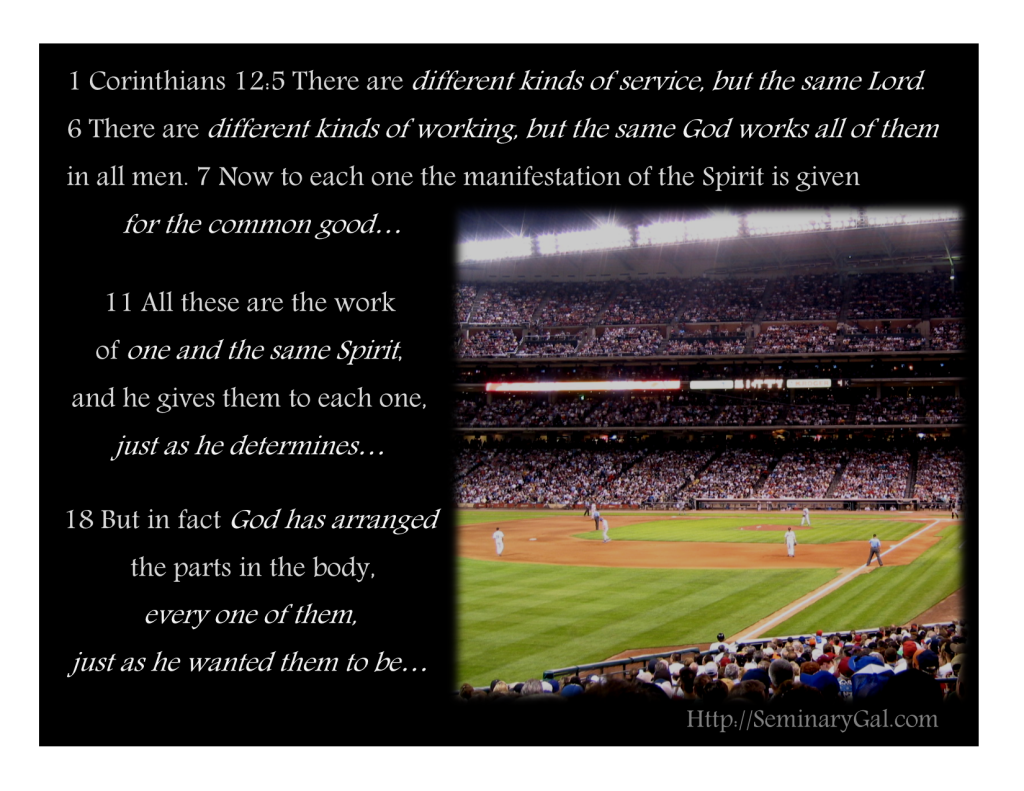
1 Corinthians 12:5 There are different kinds of service, but the same Lord. 6 There are different kinds of working, but the same God works all of them in all men. 7 Now to each one the manifestation of the Spirit is given for the common good…11 All these are the work of one and the same Spirit, and he gives them to each one, just as he determines…18 But in fact God has arranged the parts in the body, every one of them, just as he wanted them to be…22 those parts of the body that seem to be weaker are indispensable, 23 and the parts that we think are less honorable we treat with special honor. And the parts that are unpresentable are treated with special modesty, 24 while our presentable parts need no special treatment. But God has combined the members of the body and has given greater honor to the parts that lacked it, 25 so that there should be no division in the body, but that its parts should have equal concern for each other.

“I didn’t assemble it for you,” God might say to us.

Are you sitting in church waiting for a place to serve?  Get off the bench and do your job.

Are you a leader who is wearing blinders to God’s design, using your sight and your past experience to make decisions, negating and confounding what God wants to do in your church?  Remember your place is temporary and your vision is limited.  God, whose existence is eternal and whose vision is perfect, assembled this team for His own reasons.

Let’s remember Whose team this really is.  Pastors, leaders, how are you using the team God assembled?

* * *

This series included 3 Lessons from Moneyball


God has arranged

Continue Reading

Anything but Ordinary

The word ordinary isn’t one that we often view as a compliment or a plus.  Ordinary sounds plain, nondescript, almost a non-entity kind of deal.  Where is the worth in anything ordinary?

Don’t we all want to feel exceptional, valued, or special?  Ordinary just doesn’t cut it.

In the movie Money Ball, Pete, the Yale economics graduate is talking with Billy Beane, the general manager of the Oakland A’s.

Peter Brand: It’s about getting things down to one number. Using the stats the way we read them, we’ll find value in players that no one else can see. People are overlooked for a variety of biased reasons and perceived flaws. Age, appearance, personality. Bill James and mathematics cut straight through that. Billy, of the 20,000 notable players for us to consider, I believe that there is a championship team of twenty-five people that we can afford, because everyone else in baseball undervalues them. Like an island of misfit toys.

Pete describes his idea of a winning team: a group of underappreciated and undervalued individuals.  The world sees them as losers.  Pete sees them as champions.

Jesus looks at ordinary the same way.  Ordinary by the world’s standards means undervalued by God’s standards.  God finds great value in men and women that the world easily overlooks.  Overlooked because of bias or flaws.  Overlooked because of tradition.  Overlooked because of age, appearance, personality, and yes, even gender.

Oh no, not ordinary.  Undervalued in God’s sight…because He knows our hearts.

The disciples–“unschooled, ordinary men” (Acts 4:13)–were the rag-tag-team that God would choose and use to show that it’s

Not by might nor by power, but by my Spirit,’ says the LORD Almighty.” (Zechariah 4:6b)

The disciples then and disciples today?  Yes, we might be overlooked for all kinds of reasons.  But we are anything but ordinary in the eyes of God.

* * *

As a reminder Lenten devotionals, Be Still and Know that I AM Godbegin March 5th.  Won’t you please take a moment to tell someone about SeminaryGal?  I’d appreciate it.  Click the share FB tag or any of the others below and remind your friends to sign up on my Home page. Or click LIKE on Facebook and you can bless others if you’ve found yourself blessed today… in an anything but ordinary way.  Thanks!

not by might

Continue Reading

Gardening as an Act of Worship

I was thinking this morning, as I was praying about my day and asking God to order it in a way that pleases Him, that it can be an act of worship to do gardening.  Actually everything can be an act of worship if you’re doing it as unto the Lord.  Doing laundry for Jesus just isn’t as enjoyable for me as doing gardening for Jesus.

How can gardening be an act of worship?  Well, it’s planting seeds that God will grow into mature plants.  It reminds me of all the plants He created on “Day 3” with seeds in them so that they could reproduce. And that it was good.

Genesis 1:12 The land produced vegetation: plants bearing seed according to their kinds and trees bearing fruit with seed in it according to their kinds. And God saw that it was good.

It’s nurturing the Creation and taking care of the health of plants so they will mature and bear fruit and everything can flow from generation to generation.

Genesis 1:28 God blessed [Adam and Eve] and said to them, “Be fruitful and increase in number; fill the earth and subdue it. Rule over the fish of the sea and the birds of the air and over every living creature that moves on the ground.” 29 Then God said, “I give you every seed-bearing plant on the face of the whole earth and every tree that has fruit with seed in it. They will be yours for food. 30 And to all the beasts of the earth and all the birds of the air and all the creatures that move on the ground– everything that has the breath of life in it– I give every green plant for food.” And it was so.

It reminds me of the way God ordained the seasons and gives rain to water the earth so that plants will flourish.  As the seasons in Chicagoland move from what seems like the world’s longest winter into the coming spring, I rejoice in the angle of the sun changing so I can watch God’s faithful sunrises every morning and how the plants respond to the increased day length by flowering and sending forth new growth.  I rejoice that even the polar vortex cannot stand in the way of the growing intensity of the sun’s rays warming the air.

In remembering all this goodness of God and marveling at Him–how He designed and created such amazing and intricate things to reproduce for our enjoyment–what is this, but worship?  Yes, gardening can be an act of worship of God and I’m happy about that.

As a reminder, Lent begins March 5th.  Sign up today for the series “Be Still and Know that I AM God” on the space provided on the Home Page Get ready to Be Still.

trees bearing fruit with seed

Continue Reading

Drawn with Lovingkindness

As you read through this passage about being gathered into a people, vindicated and saved by God, look at the language of loving-kindness.  Meditate on what it means to be loved like this.

Jeremiah 31:1 “At that time,” declares the LORD, “I will be the God of all the clans of Israel, and they will be my people.” 2 This is what the LORD says: “The people who survive the sword will find favor in the desert; I will come to give rest to Israel.” 3 The LORD appeared to us in the past, saying: “I have loved you with an everlasting love; I have drawn you with loving-kindness. 4 I will build you up again and you will be rebuilt, O Virgin Israel. Again you will take up your tambourines and go out to dance with the joyful. 5 Again you will plant vineyards on the hills of Samaria; the farmers will plant them and enjoy their fruit. 6 There will be a day when watchmen cry out on the hills of Ephraim, ‘Come, let us go up to Zion, to the LORD our God.'” 7 This is what the LORD says: “Sing with joy for Jacob; shout for the foremost of the nations. Make your praises heard, and say, ‘O LORD, save your people, the remnant of Israel.’ 8 See, I will bring them from the land of the north and gather them from the ends of the earth. Among them will be the blind and the lame, expectant mothers and women in labor; a great throng will return. 9 They will come with weeping; they will pray as I bring them back. I will lead them beside streams of water on a level path where they will not stumble, because I am Israel’s father, and Ephraim is my firstborn son. 10 “Hear the word of the LORD, O nations; proclaim it in distant coastlands: ‘He who scattered Israel will gather them and will watch over his flock like a shepherd.’ 11 For the LORD will ransom Jacob and redeem them from the hand of those stronger than they. 12 They will come and shout for joy on the heights of Zion; they will rejoice in the bounty of the LORD– the grain, the new wine and the oil, the young of the flocks and herds. They will be like a well-watered garden, and they will sorrow no more. 13 Then maidens will dance and be glad, young men and old as well. I will turn their mourning into gladness; I will give them comfort and joy instead of sorrow.

loving kindness

Continue Reading

His Eye is on the Sparrow

Luke 12: 6 Are not five sparrows sold for two pennies? Yet not one of them is forgotten by God. 7 Indeed, the very hairs of your head are all numbered. Don’t be afraid; you are worth more than many sparrows.

These two verses are such an encouragement not to fear.  We do not fear because we matter greatly to God.  He cares what happens to us and watches…not just to be a casual observer, but to act in righteousness and justice toward us.  The timing God chooses might not be what we would choose for ourselves, but His character demands that He will–in the end–have done right by us in every way.

Ironically, these two verses are in a context we sometimes fail to see.  The context explains much:

Luke 12:4 “I tell you, my friends, do not be afraid of those who kill the body and after that can do no more. 5 But I will show you whom you should fear: Fear him who, after the killing of the body, has power to throw you into hell. Yes, I tell you, fear him. 6 Are not five sparrows sold for two pennies? Yet not one of them is forgotten by God. 7 Indeed, the very hairs of your head are all numbered. Don’t be afraid; you are worth more than many sparrows. 8 I tell you, whoever acknowledges me before men, the Son of Man will also acknowledge him before the angels of God. 9 But he who disowns me before men will be disowned before the angels of God. 10 And everyone who speaks a word against the Son of Man will be forgiven, but anyone who blasphemes against the Holy Spirit will not be forgiven.”

We are not forgotten by God and His intent is that we would not forget Him.  We would acknowledge Him and His care for us.  We would share His Good News with others and attribute all goodness, righteousness, and justice to Him.

When He looks down from heaven and His eye is on the sparrow, what does He see in you and me?

eye is on the sparrow

Continue Reading

Be Still, and Know That I Am God (Lenten Devotional Series 2014)

When is the last time you were still?

Ceasing the squirming…and the wrestling…and the constant planning in the turmoil of life.

Be Still

When is the last time you were still? Allowing yourself to be shielded by the mighty and comforting hand of God.

When is the last time you were still? Feeling refreshed and finding healing in the presence of the LORD.

When is the last time you were still? Taking the burden of carrying the world off your shoulders and trusting God to be your fortress.

When is the last time you were still? Confessing the sin that God knows you have (and you know you have) and finding forgiveness in Jesus Christ.

During the forty days of Lent this year, take time.  Be still.  And know that He is God.

Breathe deeply.  Take in all the fullness of life He gives.  Let the Living Water quench your every thirst.  Let the Bread of Life provide all the sustenance you need.

This devotional series is designed to bring you to that place of stillness, to the Cross where you can lay your burdens down, and in the stillness, know that He is God.

Psalm 46:1 For the director of music. Of the Sons of Korah. According to alamoth. A song. God is our refuge and strength, an ever-present help in trouble. 2 Therefore we will not fear, though the earth give way and the mountains fall into the heart of the sea, 3 though its waters roar and foam and the mountains quake with their surging. Selah 4 There is a river whose streams make glad the city of God, the holy place where the Most High dwells. 5 God is within her, she will not fall; God will help her at break of day. 6 Nations are in uproar, kingdoms fall; he lifts his voice, the earth melts. 7 The LORD Almighty is with us; the God of Jacob is our fortress. Selah 8 Come and see the works of the LORD, the desolations he has brought on the earth. 9 He makes wars cease to the ends of the earth; he breaks the bow and shatters the spear, he burns the shields with fire. 10 “Be still, and know that I am God; I will be exalted among the nations, I will be exalted in the earth.” 11 The LORD Almighty is with us; the God of Jacob is our fortress. Selah

You can receive these devotional studies in your email (Monday through Saturday during Lent) by entering your email address on the SeminaryGal.com home page in the space provided in the sidebar.  Ash Wednesday, the beginning of Lent, is March 5, 2014.  Get ready to be still.

===note:  You will find all the Be Still and Know that I AM God items archived beginning in March 2014.

Continue Reading

Hallelujah, What a Savior!

I find myself researching hymns for inspiration in writing sermons and to round out the volunteer worship services that I coordinate each week.  In thinking about the wisdom of God in the cross of Christ, I have been drawn this week to hymns depicting the sacrifice of Jesus Christ.

“Man of Sorrows,” What a Name (otherwise known as Hallelujah, What a Savior!) is one of those hymns. 

The composer, Philip Bliss (1838-1876), was taught to pray and sing by his father, a devout Methodist.  His mother educated him using the Bible.  His musical gift was first recognized at age 18 when he received his first formal voice lessons and wrote his first musical composition.

Bliss and his wife Lucy moved to Chicago and he took a position at Root and Cady Publishing House, a leading music publisher in Chicago.   In addition to being an itinerant music teacher and evangelist, Bliss had concert tours as a singer, while composing a number of hymns including the tune for Horatio Spafford’s  It is Well with My Soul.   He became a full-time evangelist in 1874 after forming an association with Dwight L. Moody.

Two years later, Philip and Lucy were aboard a Pacific Express train traveling through Ashtabula, Ohio. The trestle bridge beneath the train collapsed, sending all the carriages into a ravine, and a fire broke out in the wreckage.  While Philip initially emerged from the burning train, he ran back to find his wife and was never to be seen again.  They were counted among the ninety-two passengers who died in what is known as the Ashtabula River Railroad Disaster.  Their bodies were never found.

His trunk, however, survived both the crash and the fire.  It contained a manuscript with lyrics to the song that became I Will Sing of My Redeemer when James McGranahan set it to music in 1877.

You can listen to Bliss’ Hallelujah, What a Savior! on the cyberhymal  or hear a very nice modernized version of this classic hymn by Ascend the Hill.

man of sorrowsHallelujah, What a Savior!

Man of Sorrows! what a name
For the Son of God, who came
Ruined sinners to reclaim.
Hallelujah! What a Savior!

Bearing shame and scoffing rude,
In my place condemned He stood; Sealed my pardon with His blood.
Hallelujah! What a Savior!

Guilty, vile, and helpless we;
Spotless Lamb of God was He;
“Full atonement!” can it be?
Hallelujah! What a Savior!

Lifted up was He to die;
“It is finished!” was His cry;
Now in Heav’n exalted high.
Hallelujah! What a Savior!

When He comes, our glorious King,
All His ransomed home to bring,
Then anew His song we’ll sing:
Hallelujah! What a Savior!

Continue Reading