Empathy-a Tiny Virtue to Develop
 “You don’t know what it’s like because you’re not black,” he chided me angrily. I suggested to him that I could, however, empathize with the pain of discrimination because I have experienced it as a woman. Same sin, different target, I explained. He wasn’t buying it. Empathy is one of the Tiny Virtues for Exemplary Christian Living and it refers to the ability to connect personally with the issue at hand.
We are not born with empathy. We develop it as one of those exemplary heart virtues that we’ve been seeing under the microscope.
Empathy differs from sympathy in a heart location sense. Empathy is being present in the story—in the same pit– as if it were happening to you. Sympathy is looking down from the rim of the pit and having feelings about the pit and the people stuck in it.
Remember the 33 coal miners who were rescued in Chile?
There’s a great story in the Bible that exemplifies this virtue called empathy and its connection to rescue.
Mark 2:1 A few days later, when Jesus again entered Capernaum, the people heard that he had come home. 2 So many gathered that there was no room left, not even outside the door, and he preached the word to them. 3 Some men came, bringing to him a paralytic, carried by four of them. 4 Since they could not get him to Jesus because of the crowd, they made an opening in the roof above Jesus and, after digging through it, lowered the mat the paralyzed man was lying on. 5 When Jesus saw their faith, he said to the paralytic, “Son, your sins are forgiven.” … 13 Once again Jesus went out beside the lake. A large crowd came to him, and he began to teach them. 14 As he walked along, he saw Levi son of Alphaeus sitting at the tax collector’s booth. “Follow me,” Jesus told him, and Levi got up and followed him. 15 While Jesus was having dinner at Levi’s house, many tax collectors and “sinners” were eating with him and his disciples, for there were many who followed him. 16 When the teachers of the law who were Pharisees saw him eating with the “sinners” and tax collectors, they asked his disciples: “Why does he eat with tax collectors and ‘sinners’?” 17 On hearing this, Jesus said to them, “It is not the healthy who need a doctor, but the sick. I have not come to call the righteous, but sinners.”
The four men who carried the paralytic empathized with his plight. As true friends, they lowered him through the roof in order for him to be healed by Jesus. But in an interesting sense, the passage continues. It’s connected to what follows with the teachers of the law being disgusted that Jesus would fraternize with people they viewed as beneath them. The Pharisees might have sympathized with the plight of sinners and looked to the Law for ways of dealing with them, but Jesus—the Son of God—came down. Into our pit. He ate with sinners. He called them to Himself. He empathized with our plight as sinners though He never ever sinned. Not even once. That is how He rescued us.
Praise the LORD, O my soul, and forget not all his benefits–who forgives all your sins and heals all your diseases, who redeems your life from the pit. (Psalm 103:2-4)
Ponder today: how to develop empathy
Bible characters of the day: the friends of the paralytic
Nurturing-a Hallmark of Exemplary Christians
Nurturing is not a hallmark of wimps—it’s the calling card of the forever dedicated.
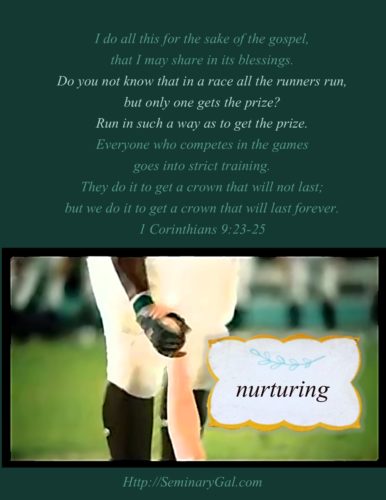 I have been thinking a lot about Colin Kaepernick and what he has brought on himself–the sadness and controversy he has thrust upon this nation–by his poor choice of timing. His actions needed nurturing by those around him so Colin would have chosen better– to make a huge difference instead of just a big stink. About his adoptive parents,
“They agree with what I’m standing for,” Colin Kaepernick told USA TODAY Sports Wednesday at the 49ers’ practice facility in Santa Clara, about a two-hour drive from his parents’ house.
“Once again, it’s not a protest against America. It’s a protest against oppression and injustices and the equality that’s not being given to all people.”
Kaepernick’s parents declined to comment, with Teresa Kaepernick saying,
It’s not in our best interest or Colin’s best interest.”
Hmmmm. Nurturing and training go hand in hand. Colin’s birth mother Heidi Russo has commented via Twitter that his desire to press for social justice can be better expressed in other ways and at other times.
Colin is in a position to do something meaningful about oppression, injustice, and inequality. He could take a page from LeBron James’ playbook “Cleveland Hustles” and be a role model, using his wealth and his celebrity to organize like-minded celebrity individuals to give those oppressed a hand of actual help up instead of a collective knee for the anthem. Protesting isn’t nearly as productive as nurturing. Protesting makes him a goat. Nurturing would turn him back to being a hero in his hometown.
Particularly in an age of absentee fatherhood, genuine nurturing is a biblical trait for men (and women)—it’s one of the Tiny Virtues for Exemplary Christian Living.. And that nurturing doesn’t stop when our children reach adulthood. A hands-off approach only fosters loveless actions but our continued hand up for the downed player coaches the best in our family members and it only makes us all better. It’s the goal of nurturing.
The Apostle Paul knew how to nurture. He wasn’t a pushover or neglectful. He was intentional about his nurturing in every way.
I do all this for the sake of the gospel that I may share in its blessings. Do you not know that in a race all the runners run, but only one gets the prize? Run in such a way as to get the prize. Everyone who competes in the games goes into strict training. They do it to get a crown that will not last; but we do it to get a crown that will last forever. (1 Corinthians 9:23-25)
Ponder today: the negativity inherent in protest and the positive impact of nurturing someone’s best interests
Bible character of the day: the Apostle Paul
Remembering 9/11 with a Tender Heart
 Today is the 15th anniversary of the terror attack upon the Twin Towers of the World Trade Center. Any of us alive and of an age to remember anything probably remember how we felt, where we were, and the deep, deep sorrow for a world that had-in a span of dark minutes-breached every code of human decency. Remembering this event arouses not only a righteous anger against that kind of evil, but it also stirs the wellspring of love and compassion in the soul and spirit of the tender-hearted. Of the exemplary Christian.
Tender-hearted people never grow stale in their love, their empathy, or their sorrow. The tiny virtue of a tender heart is the evergreen source of the bigger virtues of love and compassion.
A tender heart we cannot see but for its outflow.
And be kind to one another, tender-hearted, forgiving each other, just as God in Christ also has forgiven you. (Ephesians 4:32)
Mary Magdalene had that kind of tender heart. In John 20:1-18, she discovers that the stone has been removed from the entrance to the tomb in which Jesus was buried. She was so distressed, she ran all the way to tell the disciples Peter and John. They came, they saw, they left…confused. Mary didn’t leave. Her tender heart caused her to cry. Moved with love, overcome by sorrow, she just stood there weeping. Her heart reached beyond the fact of death and the reality of the grave. Jesus met her there and spoke the Good News to this beautiful woman that He is risen. Death and the grave couldn’t hold Him down. Because of His victory over evil, death and the grave can’t hold Christians down either.
As we continue to honor the lives of the men and women who died on 9/11, we will see the phrase #NeverForget. We remember the lives which have been lost, the bravery of those who loved others more than themselves, the people living through the daily hell of remembering that day in which their lives were forever changed, the children who have grown up with this as their family’s story, and the nation with deep wounds carved with a jagged knife of evil but capable of being healed by the powerful hand of God. Day by day, may God bless us with hearts that do not grow weary. Let us not grow cold. Let us not be moved from that powerful tiny place of a tender heart from which flows all kindness, love, compassion, and yes, forgiveness.
Ponder today: how a tender heart is evergreen
Bible character of the day: Mary Magdalene
Ten Traits of Virtuous Listening
 I cannot deny that Mary chose better. She chose listening (Luke 10:38-42). Of course way too many people in ministry like to take this story and turn it into the biblical equivalent of “Why can’t you be like your sister?” Martha was working out her faith while Mary was listening.
Being a task-oriented person myself, I can kind of relate to Martha. It takes effort to be a good listener (and not simply listen in order to problem solve or have an answer to offer). Jesus tenderly gives Martha the encouragement to make that effort. To listen while she has the once-in-a-lifetime opportunity. Martha can serve Christ forever, but listening to Him face-to-face? After He ascends to heaven, those opportunities vanish. Mary chose to listen. And listening was better.
Listening is one of the Tiny Virtues for Exemplary Christian Living. Most of us don’t listen well, but we would be served well by learning the virtue of listening.
We’re still magnifying the tiny virtue of friendship to see the inner workings of how to be an exemplary friend. Listening is a good friendship skill. Plenty of sources describe good listening as something like
- Stop talking, relax and come prepared to listen.
- Make the speaker feel comfortable by removing distractions.
- Get your attitude right. Empathize. Be patient. Avoid prejudice and judgment.
- Listen to the tone and ideas, not just words
- Observe non-verbal communication
Helpful in business or in counseling, perhaps, but it does nothing to help someone distinguish good listening from bad. Good listening is not to be confused with being a “vent-recipient” as someone calls just to spew their spleen and sin over the wireless and you just simply take it in, absorbing what they have to offer. That’s what the scapegoat was for. Good listening isn’t the precursor for good gossip. And good listening isn’t buying lies out of a misguided politeness or lack of discernment.
The Bible gives us some pretty clear instruction on listening…the dos and don’ts from God’s perspective.
- Prioritize listening– James 1:19 My dear brothers, take note of this: Everyone should be quick to listen, slow to speak and slow to become angry.
- Let go of pride– Philippians 2:3 Do nothing out of selfish ambition or vain conceit, but in humility consider others better than yourselves.
- Reject your inner apathy– 1 Corinthians 12:26 “If one part suffers, every part suffers with it; if one part is honored, every part rejoices with it.” Galatians 6:2 “Carry each other’s burdens, and in this way you will fulfill the law of Christ.”
- Listen to act– Luke 11:28 Jesus replied, “Blessed rather are those who hear the word of God and obey it.” James 1:22 “Do not merely listen to the word, and so deceive yourselves. Do what it says.”
- Listen to learn–Proverbs 16:20 “Whoever gives heed to instruction prospers, and blessed is the one who trusts in the Lord.”
- Be cautious with secrets- Luke 12:3 “What you have said in the dark will be heard in the daylight, and what you have whispered in the ear in the inner rooms will be proclaimed from the roofs.”
- Don’t gossip– Proverbs 11:13 “A gossip betrays a confidence, but a trustworthy man keeps a secret.” Proverbs 20:19 “A gossip betrays a confidence; so avoid a man who talks too much.”
- Distinguish the spirit of what you’re hearing. 1 Peter 3:15 “But in your hearts set apart Christ as Lord. Always be prepared to give an answer to everyone who asks you to give the reason for the hope that you have. But do this with gentleness and respect, 16 keeping a clear conscience, so that those who speak maliciously against your good behavior in Christ may be ashamed of their slander.”
- Put a stop to what is being spoken if it is ungodly or untrue. Don’t feed your mind what is evil. Ephesians 4: 21 Surely you heard of him and were taught in him in accordance with the truth that is in Jesus. 22 You were taught, with regard to your former way of life, to put off your old self, which is being corrupted by its deceitful desires; 23 to be made new in the attitude of your minds; 24 and to put on the new self, created to be like God in true righteousness and holiness. 25 Therefore each of you must put off falsehood and speak truthfully to his neighbor, for we are all members of one body. .. 29 Do not let any unwholesome talk come out of your mouths, but only what is helpful for building others up according to their needs, that it may benefit those who listen. 30 And do not grieve the Holy Spirit of God, with whom you were sealed for the day of redemption. 31 Get rid of all bitterness, rage and anger, brawling and slander, along with every form of malice.”
- Remember to listen to Jesus and hear what He says. Matthew 13: 13 This is why I speak to them in parables: “Though seeing, they do not see; though hearing, they do not hear or understand. 14 In them is fulfilled the prophecy of Isaiah: … 15 For this people’s heart has become calloused; they hardly hear with their ears, and they have closed their eyes. Otherwise they might see with their eyes, hear with their ears, understand with their hearts and turn, and I would heal them.’ 16 But blessed are your eyes because they see, and your ears because they hear. 17 For I tell you the truth, many prophets and righteous men longed to see what you see but did not see it, and to hear what you hear but did not hear it.
Listening can make or break a friendship. Sometimes a broken friendship among people must happen for a relationship of purity with God to continue. One thing’s for sure, if you hear the Master’s voice, listen and obey.
Ponder today: any instance of listening in which you should have stopped and instances where you could have listened better. Ask God to teach you to listen well.
Bible character of the day: Mary
Help-a Tiny Christian Virtue in 360 Exemplary Degrees
No one has to teach us how to cry for help. We need to make a concerted effort to offer it. Help is among the Tiny Virtues for Exemplary Christian Living and sometimes we need a little help learning how …to help.
- Help, I need somebody
- Help, not just anybody
- Help, you know I need someone, help
- When I was younger, so much younger than today
- I never needed anybody’s help in any way
- But now these days are gone, I’m not so self-assured
- Now I find I’ve changed my mind and opened up the doors
- Help me if you can, I’m feeling down
- And I do appreciate you being ‘round
- Help me, get my feet back on the ground
- Won’t you please, please help me
- And now my life has changed in oh so many ways
- My independence seems to vanish in the haze
- But every now and then I feel so insecure
- I know that I just need you like I’ve never done before
- Help me if you can, I’m feeling down
- And I do appreciate you being ‘round
- Help me, get my feet back on the ground
- Won’t you please, please help me
- When I was younger, so much younger than today
- I never needed anybody’s help in any way
- But now these days are gone, I’m not so self-assured
- Now I find I’ve changed my mind and opened up the doors
- Help me if you can, I’m feeling down
- And I do appreciate you being ‘round
- Help me, get my feet back on the ground
- Won’t you please, please help me, help me, help me
 According to the Beatles, we need help when we’re old, when we’re lacking confidence, when we’re lonely, when we’re down, when we have a tendency to rely only upon ourselves but suddenly find that we’re not enough, and when we lose our footing in life.
The exemplary Christian doesn’t need to be asked before offering help. Barnabas was such a man.
In Acts 4:32-37, we read that no one has any needs because these exemplary Christians helped in advance. Barnabas was so outstanding, his nickname is Son of Encouragement. He’s Mr. Joseph Helperson.
Acts 4:36 Joseph, a Levite from Cyprus, whom the apostles called Barnabas (which means Son of Encouragement), 37 sold a field he owned and brought the money and put it at the apostles’ feet.
He shows up repeatedly in the Book of Acts as a person who helps, who encourages, and whose life was extraordinary in this tiny virtue. Looking at help in 360 exemplary degrees, Barnabas lives it out in the fullest sense, helping those who need instruction, warning, encouragement, strength, resources, and patience.
He lives out this verse as an example to us: 1 Thessalonians 5:14 And we urge you, brothers, warn those who are idle, encourage the timid, help the weak, be patient with everyone.
So what about you? Which of those degrees of help is hardest for you to offer?
Ponder today: the 360 degree nature of help
Bible character of the day: Barnabas
Loyalty, a Tiny Virtue for a Changing World
What would Ruth be without Naomi? That’s how many people view the story. The real question is, “What would Naomi be without Ruth?” Mara. Bitter. (Ruth 1:20). Kind of a jerk, actually. Blaming God, shipping her loved ones back as rejected returns to the Moabite store, whining, playing the victim card, and then as the quintessential pessimist, seeing her future as “Life is hard. Then you die.” It takes significant time for her to see the glorious tiny virtue of loyalty exemplified in Ruth.
 We’re looking at the slide of friendship under the theological microscope and turning the magnification up to 100x. Loyalty. Why didn’t we see it before, among those Tiny Virtues for Exemplary Christian Living?
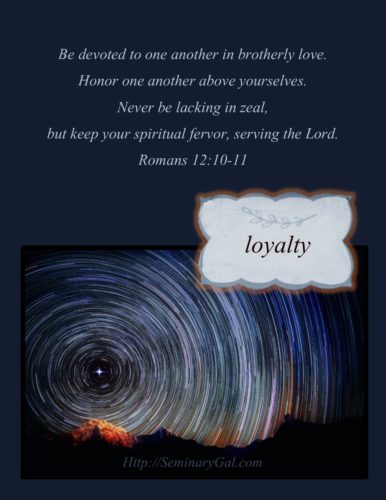
Maybe it’s because Loyalty is a stationary virtue best seen when everything else moves. It’s a tiny virtue for a changing world. It’s kind of like the North Star to guide us well.
Have you ever wondered why the North Star (Polaris) never moves?
It actually does, but only a fraction. We use it for guidance because its alignment is so close to the line of Earth’s axis projected into space. Therefore it seems to be the bright star that never changes. All the other stars appear to move greatly by comparison.
In the story of Ruth and Naomi, it is Ruth who refuses to move from her position of loyal love in order to be a help, to guide, to be a friend, a daughter even, to Naomi. Who I might add doesn’t deserve her at that time.
Who can forget Ruth’s famous oath of loyalty?
Ruth 1:16 But Ruth replied, “Don’t urge me to leave you or to turn back from you. Where you go I will go, and where you stay I will stay. Your people will be my people and your God my God. 17 Where you die I will die, and there I will be buried. May the LORD deal with me, be it ever so severely, if anything but death separates you and me.”
Yet as the story unfolds, Ruth’s loyalty is seen by her future husband and kinsman redeemer Boaz. It is Ruth’s exemplary loyalty that provides the vastly needed change of heart and rise of hope in Naomi. The Book of Ruth is a mere 4 chapters and a great story. It’s well worth the read for those who like to see the reward for loyalty, a tiny virtue for changing a bitter world.
Be devoted to one another in brotherly love. Honor one another above yourselves. Never be lacking in zeal, but keep your spiritual fervor, serving the Lord. (Romans 12:10-11)
Ponder today: Loyalty
Bible character of the day: Ruth
Availability in Friendship-a Tiny Virtue
Do you ever feel like that guy from the Comcast commercial who is moving and he checks on the availability of friends to help him move? Everyone has an excuse for not being available…when it’s something they don’t really want to do. Had it been free tickets to the World Series, or front row seats to see Clapton in a small venue, or skybox seats at the 50 yard line, they’d have been available, front-and-center, yes?
 We’re in a series on the Tiny Virtues for Exemplary Christian Living. Today, we’re going to take a magnifying glass to the tiny virtue of friendship and go even smaller.
Let’s magnify those traits within friendship to discuss the first of those even tinier virtues: availability.
Cornelius and Peter demonstrate this idea of availability…to God, to God’s work, and to each other. They are exemplary in it.
Both Cornelius and Peter in Acts 10 are surprised by visions. It’s like that call out of the blue that interrupts what you’re doing. But they make themselves open and available. Cornelius responds by sending the men just as the angel asked. Peter receives the men just as God had prompted him to do.
Could either of them come up with excuses? Sure. But they didn’t.
How are you at being available for others?
I ask that a lot, reminding myself that there’s a difference between being available and being an enabler. Between availability and armchair quarterbacking. Between availability and becoming a hindrance or downright annoying. How do we keep from the negatives? By being available first to God. It will help you to know if availability has become a one way street for you or for people you know. Availability with Cornelius and Peter went both ways. They each had to sacrifice things to be exemplary in the tiny virtue of availability. If you get a chance, read Acts 10 and think about the obstacles to availability which are amply present in the passage. How did they set an example for us that mirrors this Scripture?
Galatians 6:10 Therefore, as we have opportunity, let us do good to all people, especially to those who belong to the family of believers.
Ponder today: Your availability to God and friends
Bible characters of the day: Peter and Cornelius
The Tiny Virtue of Biblical Friendship
Think about a friend you have who is your best friend. What characteristics define that person and the bond of friendship you share?
True friends are hard to come by.
 Oh it’s not like the half a million friends some people have on Facebook that they managed to secure with the email address “friend finder.” I hesitate to see what “friends” might turn up if Facebook looked at email addresses to find friends for me. I’ve received emails from businesses, church leaders with whom I’ve disagreed, spammers, Internet trolls, Christ haters, etc., by answering Bible questions via email over the years. Yes, some would be genuine friends with whom I’ve had correspondence for a decade or more. Others, well, let’s just say the word “friend” would involve quite a stretch of the imagination.
Friendship cannot be mistaken for the cheap imitations of popularity and patronage.
It’s like the social media warping of Kennedy’s thought to make it “Ask not what your friend can do for you (popularity), ask what you can do for your friend (patronage).” Popularity and patronage are highly visible. True biblical friendship is deep and more hidden than wide.
People with genuine friendship skills are a rarity. This kind of biblical friendship is a tiny virtue that we see exhibited in exemplary Christian lives.
In the Bible, King David (before he was king) and Jonathan had such a friendship. It was a covenant of love in spite of Jonathan being the elder son of Saul who was the present king of Israel. Jonathan would have had accession rights to the throne as the firstborn son, but he saw God’s hand upon David ever since David returned victorious from the Goliath encounter. Jonathan gave David symbolic testimony of his covenant of friendship and devotion.
1 Samuel 18:1 After David had finished talking with Saul, Jonathan became one in spirit with David, and he loved him as himself. 2 From that day Saul kept David with him and did not let him return to his father’s house. 3 And Jonathan made a covenant with David because he loved him as himself. 4 Jonathan took off the robe he was wearing and gave it to David, along with his tunic, and even his sword, his bow and his belt.
Jonathan exemplifies characteristics of friendship. While he could be known as a daring man, one unafraid to place himself in harm’s way for the sake of his country Israel, it is his exemplary friendship that forms his most enduring legacy. He had an ardent brotherly love, an unselfish devotion to his friends, a willingness to sacrifice his right to be king, and he placed himself in danger to intercede for his father’s change of heart. In death, he was loyal to his father yet steadfast in friendship to David. It reminds us of Christ’s words,
My command is this: Love each other as I have loved you. Greater love has no one than this, that he lay down his life for his friends. (John 15:12-13)
Ponder today: the distinction between popularity, patronage, and genuine friendship qualities.
Bible character of the day: Jonathan –see 1 Samuel 13:2-31, especially chapter 20.
Tiny Virtues for Exemplary Christian Living
 It’s easy to be mediocre. It’s hard to be exemplary … especially at the virtues for Christian living. After all, we’re following Jesus–a guy who was perfect–and we’re trying to be like Him. I’ve been thinking a lot about what it takes to be exemplary, what virtues are required?
Looking at lists of virtues, there’s the usual big ticket items on every Christian list:
- Love,
- Grace,
- Hope,
- Compassion,
- Church Attendance.
Actually the last one isn’t there.
I was just checking to see if anyone reads my posts anymore after 15.3 items on politics. But part way through this new series, you’ll see why I did all 15.3.
Happily I now turn my mind to other things. One of which is that my husband and I both have annoying movie watching habits when it comes to DVDs. I watch everything for theology and when I spot it, I make him stop the movie and replay it so I can ponder its value as a sermon illustration or something. I can watch the same movie a bazillion times, even have parts of the script memorized (OK, the whole script memorized) and still enjoy it every bit as much. My husband has different movie watching habits. If he’s seen it once, he has already picked out what his favorite scene is and will use the scene selector option to skip over all the other scenes just to see his favorites. What makes them favorites, I don’t know unless there’s a car blowing up or something.
One of those scenes has no explosions, just really good acting and a script worth hearing.
They’re not that different from you, are they? Same haircuts. Full of hormones, just like you. Invincible, just like you feel. The world is their oyster. They believe they’re destined for great things, just like many of you, their eyes are full of hope, just like you. Did they wait until it was too late to make from their lives even one iota of what they were capable? Because, you see gentlemen, these boys are now fertilizing daffodils. But if you listen real close, you can hear them whisper their legacy to you. Go on, lean in. Listen, you hear it? – – Carpe – – hear it? – – Carpe, carpe diem, seize the day boys, make your lives extraordinary. (John Keating, a role by Robin Williams from Dead Poets Society)
Make your lives extraordinary. Exemplary. What does that mean to you?
So we begin a more interesting series today on Tiny Virtues for Exemplary Christian Living. Exploring the tiny little details that move a life from just good or even excellent in a Christian walk to being one that is truly exemplary. One worthy of the Savior we follow.
Ponder today: the particular value of details
Bible character of the day: Daniel
Daniel 6:3 Now Daniel so distinguished himself among the administrators and the satraps by his exceptional qualities that the king planned to set him over the whole kingdom.
God Bless America (Patriotic Hymn Series)
Today, I conclude our patriotic “hymn” series brought about because someone viewed my patriotism as a character flaw. I thought it would be fitting to end with one that has been dear to the hearts of Democrats, Republicans, and apolitical people alike. It’s not in any of my hymnals, even more contemporary ones, though it is far more God-honoring than our national anthem which shows up in about half of them. Perhaps you guessed that I’m talking about God Bless America.
God Bless America was written by Irving Berlin in 1939.
I’d like to write a great peace song,” Berlin said, “but it’s hard to do, because you have trouble dramatizing peace.”
It was also hard because Berlin had lived through one world war and he was seeing the rise of Nazi Germany through the lens of an American immigrant, a Russian Jew.
Patriotic songs were a dime a dozen at the time and it was surprising that Berlin, already so accomplished in the music industry, would go to his trunk where he’d tucked away God Bless America that he’d written 2 decades prior. He reworked the original verse “Stand beside her and guide her to the right with a light from above” because different political significance had been given to the word “right” and changed it to the iconic “Through the night with a light from above” which recalls imagery of God leading the Israelites by a pillar of fire at night.
Exodus 13:21 By day the LORD went ahead of them in a pillar of cloud to guide them on their way and by night in a pillar of fire to give them light, so that they could travel by day or night. 22 Neither the pillar of cloud by day nor the pillar of fire by night left its place in front of the people.
The song became popularized and a de facto national anthem after its first airing in an Armistice Day celebration (1939) when Kate Smith included the song in her program. The rest is history. It shows up at conventions and baseball games despite the clear appeal to God.
Enjoy this version sung by French Canadian Celine Dion in one of the loveliest renditions you will ever hear. She’s welcome to call my home her home any day of the week, especially after this Tribute to Heroes from September 11th.

While the storm clouds gather far across the sea,
let us swear allegiance to a land that’s free.
Let us all be grateful for a land so fair, as we
raise our voices in a solemn prayer.
God Bless America, land that I love.
Stand beside her and guide her
Through the night with a light from above.
From the mountains, to the prairies,
To the oceans white with foam.
God Bless America, my home sweet home.
God Bless America, my home sweet home.