A Tiny Virtue Called Contentment
The world is filled with people who don’t know contentment. They aren’t content with their jobs, their spouses, their children, their diets, their accomplishments, or their political candidates. (Figured I might as well add that one since everyone’s thinking it anyway.) In many cases, they feel as if they’re owed something better, something more.
What a difference it would make if we all excelled in one of Tiny Virtues for Exemplary Christian Living, the one called Contentment!
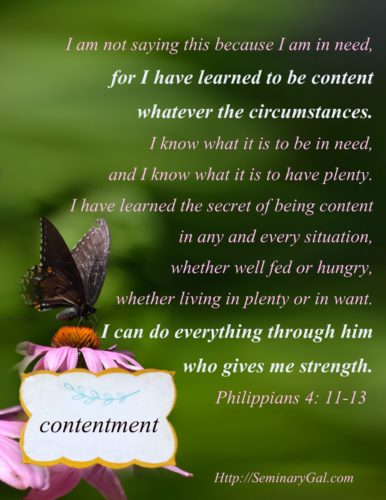 The Apostle Paul knew contentment and spoke about it often. Philippians 4: 11 I am not saying this because I am in need, for I have learned to be content whatever the circumstances. 12 I know what it is to be in need, and I know what it is to have plenty. I have learned the secret of being content in any and every situation, whether well fed or hungry, whether living in plenty or in want. 13 I can do everything through him who gives me strength.
Paul tells us the secret and it involves God and recognizing His provision. Yet so many people today refuse to embrace God and know the contentment He can cultivate in our hearts. Instead, they rely upon false doctrines, teaching them of what other people owe them. Some of these false doctrines are being taught by people who are supposedly pastors. God has something to say about that:
1 Timothy 6:3 If anyone teaches false doctrines and does not agree to the sound instruction of our Lord Jesus Christ and to godly teaching, 4 he is conceited and understands nothing. He has an unhealthy interest in controversies and quarrels about words that result in envy, strife, malicious talk, evil suspicions 5 and constant friction between men of corrupt mind, who have been robbed of the truth and who think that godliness is a means to financial gain. 6 But godliness with contentment is great gain. 7 For we brought nothing into the world, and we can take nothing out of it. 8 But if we have food and clothing, we will be content with that.
Ponder today: the connection between ongoing strife and the continual absence of God in one’s life
Bible character of the day: Paul
When Mindfulness is a Virtue
Mindfulness. It’s kind of popular these days to talk about being mindful, being present, but what all these gurus are talking about is different than biblical mindfulness.
Author Julie Beck parodies this concept of mindfulness in The Atlantic:
You probably see stories and tips about mindfulness online every day. But did you realize that reading these articles is also an opportunity to be mindful? How many people spend their lunch breaks and commutes mindlessly clicking on these links? If you do it mindfully, instead, clicking on a link can also mean clicking on happiness…Relax the muscles of your clicking finger. Move your cursor to the link. Deliberately press down with your finger on the screen, the trackpad, or the mouse. Physically feel the click in your body. Experience the choice to read this content as a sensation.
The column, of course, was a joke. But biblical mindfulness is a virtue. Biblical mindfulness involves seeing God’s presence in your “everyday.”
Rahab didn’t know the God of Israel at first, but she was mindful of His presence in her “everyday” and that led to faith. Rahab, once a prostitute and a pagan, ended up in the lineage of Jesus.
In Joshua 2, it tells the story of how Rahab took the men who were spies and hid them before they were even sought by the authorities.
 Why did she do this? Mindfulness.
Joshua 2:8 Before the spies lay down for the night, she went up on the roof 9 and said to them, “I know that the Lord has given you this land and that a great fear of you has fallen on us, so that all who live in this country are melting in fear because of you. 10 We have heard how the Lord dried up the water of the Red Sea for you when you came out of Egypt, and what you did to Sihon and Og, the two kings of the Amorites east of the Jordan, whom you completely destroyed. 11 When we heard of it, our hearts melted in fear and everyone’s courage failed because of you, for the Lord your God is God in heaven above and on the earth below.
Other people heard and their hearts melted in fear. She, on the other hand, was mindful of why she was melting in fear. She saw God’s presence in it and therefore she acted on it. We can too.
So what about you? Are you mindlessly clicking on links and chugging through your everyday life, or are you mindful in a biblical way? “Do not conform to the pattern of this world, but be transformed by the renewing of your mind” (Romans 12:2).
Ponder today: How biblical mindfulness can make you a better Christian and the dangers of not being mindful.
Hebrews 2:1 We must pay more careful attention, therefore, to what we have heard, so that we do not drift away.
Bible character of the day: Rahab
The Tiny Virtue of Forgetfulness
 Forgetfulness is not often seen as a virtue. It’s seen as evidence of mental decline into the sad world of dementia and the long goodbye of Alzheimer’s. But forgetting the right things can be a virtue to be gained.
The Apostle Paul thought so.
And God thinks so.
Forgetfulness?
“Don’t be silly!” Some of you may be thinking, “God doesn’t forget!”
Sure He does.
He’s just careful about forgetting what He intends not to remember.
Isaiah 43:25 “I, even I, am he who blots out your transgressions, for my own sake, and remembers your sins no more.”
Quoting from Jeremiah 31, the author of Hebrews speaks of God’s forgetfulness:
Hebrews 8: 10 This is the covenant I will make with the house of Israel after that time, declares the Lord. I will put my laws in their minds and write them on their hearts. I will be their God, and they will be my people. 11 No longer will a man teach his neighbor, or a man his brother, saying, ‘Know the Lord,’ because they will all know me, from the least of them to the greatest. 12 For I will forgive their wickedness and will remember their sins no more.”
Paul forgets too. Philippians 3:13 Brothers, I do not consider myself yet to have taken hold of it. But one thing I do: Forgetting what is behind and straining toward what is ahead, 14 I press on toward the goal to win the prize for which God has called me heavenward in Christ Jesus. 15 All of us who are mature should take such a view of things. And if on some point you think differently, that too God will make clear to you.
How many of us, though, after we’ve forgiven someone for a wrong still dredge up the past faults of the person we claim to have forgiven? Continually using it as leverage or a permanent sign of their shame? Could a certain forgetfulness of what we’ve forgiven make us more Christ-like? Yup.
And how many of us live in the glory days of the past, unable to let go of former laurels to press onward without being tethered to the past? We must learn to forget a reliance upon past achievements, too.
The Apostle Paul shows us how he forgets past wrongs and past victories. Paul and Barnabas had a disagreement over taking Mark on further ministry adventures. Paul wanted no part of having Mark along since he was a deserter as far as Paul was concerned (Acts 15:37-38). Yet, forgiveness worked its power and by the time of 2 Timothy 4:11, Mark was a beloved son again and useful in ministry. Regarding forgetfulness of past glories, Paul even says that it’s a sign of maturity (Philippians 3:15) and therefore, a virtue.
Ponder today: the connection between grace and forgetfulness
Bible characters of the day: Paul and Mark
Biblical Realism for Exemplary Christians
God is not a myth and Christians don’t live in a fantasy world. Sure, it’s easy to pass off a God we can’t see. But realism doesn’t ignore the spiritual. It’s a Tiny Virtue for Exemplary Christians who have one foot firmly planted on earth and one foot firmly planted in a spiritual world we see only with spiritual eyes. That’s genuine realism.
Stop and think about it for a moment: is it realism to limit our understanding to what we’ve personally observed and experienced? Is there not a wide world out there which we will never observe? Yet, we don’t doubt its reality.
 The self-imposed limitation of observation came up in discussion between Jesus and the unnamed Samaritan “woman at the well.” (John 4:4-30) She had many strikes against her in the real world. Jesus, fully aware of that and with full understanding of the spiritual realm calls out to her, kind of an opening serve in tennis,
John 4: 7 When a Samaritan woman came to draw water, Jesus said to her, “Will you give me a drink?” 8 (His disciples had gone into the town to buy food.) 9 The Samaritan woman said to him, “You are a Jew and I am a Samaritan woman. How can you ask me for a drink?” (For Jews do not associate with Samaritans.)
The volley of realism begins.
10 Jesus answered her, “If you knew the gift of God and who it is that asks you for a drink, you would have asked him and he would have given you living water.” 11 “Sir,” the woman said, “you have nothing to draw with and the well is deep. Where can you get this living water?
Realistic, practical even.
12 Are you greater than our father Jacob, who gave us the well and drank from it himself, as did also his sons and his flocks and herds?” 13 Jesus answered, “Everyone who drinks this water will be thirsty again, 14 but whoever drinks the water I give him will never thirst. Indeed, the water I give him will become in him a spring of water welling up to eternal life.”
Jesus is realistic.
He says you’ll be thirsty if you focus only on what’s physical and not on what’s spiritual.
She’s open to exploring the spiritual part of biblical realism as the volley continues.
15 The woman said to him, “Sir, give me this water so that I won’t get thirsty and have to keep coming here to draw water.” 16 He told her, “Go, call your husband and come back.” 17 “I have no husband,” she replied. Jesus said to her, “You are right when you say you have no husband. 18 The fact is, you have had five husbands, and the man you now have is not your husband. What you have just said is quite true.” 19 “Sir,” the woman said, “I can see that you are a prophet. 20 Our fathers worshiped on this mountain, but you Jews claim that the place where we must worship is in Jerusalem.” 21 Jesus declared, “Believe me, woman, a time is coming when you will worship the Father neither on this mountain nor in Jerusalem. 22 You Samaritans worship what you do not know; we worship what we do know, for salvation is from the Jews. 23 Yet a time is coming and has now come when the true worshipers will worship the Father in spirit and truth, for they are the kind of worshipers the Father seeks. 24 God is spirit, and his worshipers must worship in spirit and in truth.” 25 The woman said, “I know that Messiah” (called Christ) “is coming. When he comes, he will explain everything to us.” 26 Then Jesus declared, “I who speak to you am he.” 27 Just then his disciples returned and were surprised to find him talking with a woman. But no one asked, “What do you want?” or “Why are you talking with her?” 28 Then, leaving her water jar, the woman went back to the town and said to the people, 29 “Come, see a man who told me everything I ever did. Could this be the Christ?
In all the messages one can get from this Scripture, I love the confident volleying of realism in this passage. Like a parent watching a child reaching for something truly profound, I always imagine Jesus with a genuine twinkle in His eye as he meets a woman who likes to debate and doesn’t shy away from engaging His intellect. I’d like to think that Jesus got kind of a charge out of someone so steeped in realism that she wanted to know the real deal. And rewarding her efforts, Jesus said, “I who speak to you am he.”
Ponder today: how biblical realism can be a virtue
Bible characters of the day: the Samaritan woman at the well and Jesus Christ, the real deal
Caution-the Flip Side of Encouragement
 Caution is the flip side of encouragement.
Speaking a word of caution into someone’s life is never as welcome as speaking a word of encouragement. Never as welcome, but every bit as necessary.
How do you feel when someone offers you caution about an approach you’re taking or a risk you’re running?
It doesn’t take a Bible scholar to know the prophets spoke a message of caution, of warning, even of rebuke. Speaking a word of caution…when necessary…is one of the Tiny Virtues for Exemplary Christian Living. All Scripture is good for that, even if many people would rather ignore such caution and just do their own thing anyway. They did at Jesus’ crucifixion:
Luke 23:35 The people stood watching, and the rulers even sneered at him. They said, “He saved others; let him save himself if he is the Christ of God, the Chosen One.” 36 The soldiers also came up and mocked him. They offered him wine vinegar 37 and said, “If you are the king of the Jews, save yourself.” 38 There was a written notice above him, which read: THIS IS THE KING OF THE JEWS. 39 One of the criminals who hung there hurled insults at him: “Aren’t you the Christ? Save yourself and us!” 40 But the other criminal rebuked him. “Don’t you fear God,” he said, “since you are under the same sentence? 41 We are punished justly, for we are getting what our deeds deserve. But this man has done nothing wrong.” 42 Then he said, “Jesus, remember me when you come into your kingdom.” 43 Jesus answered him, “I tell you the truth, today you will be with me in paradise.”
Certainly it’s worth noting that speaking critical words for the sake of criticism is no virtue. But when a word of caution is necessary to keep someone from sinning or harming themselves or others, would you offer that caution? Would you receive it from a well-meaning brother or sister in Christ?
Ponder today: Whether you sneer at words of caution and warning or whether you take them to heart
“Therefore, you kings, be wise; be warned, you rulers of the earth. Serve the LORD with fear and rejoice with trembling.” (Psalm 2:10-11)
Bible character of the day: the criminal who understood, offered caution, and entered paradise
Attitude Characteristics for Exemplary Christians
 “I’ve had enough of your attitude!” How many moms can relate to having said that? And it probably isn’t in the context of children being angelic, winsome, agreeable, amenable, or compliant. Attitude probably conveys something more like sass, lip, disrespect, and rebellion. One’s attitude demonstrates the connection of one’s heart and one’s mind in clearer fashion than most attributes.
In its most positive sense, it’s one of the Tiny Virtues for Exemplary Christian Living . Our attitudes display on the outside what our hearts know on the inside. When I think of someone in the Bible whose attitude is virtuous in many ways, Esther is always one who immediately comes to mind. Maybe it’s because I’ve portrayed her character a few times when I’ve done first person narrative preaching (Bible character reenactment). There aren’t a whole lot of women in the Bible for me to do because most don’t come with such a bulk of Scripture to know much about their lives.
The Book of Esther shines with her virtuous attitude. If you get a chance, read the whole Book of Esther. It doesn’t take long and it tells a great story that encourages both men and women with this heroic exchange as the story’s climax:
Esther 4:9 Hathach [one of Esther’s attendants] went back and reported to Esther what Mordecai [Esther’s cousin] had said. 10 Then she instructed him to say to Mordecai, 11 “All the king’s officials and the people of the royal provinces know that for any man or woman who approaches the king in the inner court without being summoned the king has but one law: that he be put to death. The only exception to this is for the king to extend the gold scepter to him and spare his life. But thirty days have passed since I was called to go to the king.” 12 When Esther’s words were reported to Mordecai, 13 he sent back this answer: “Do not think that because you are in the king’s house you alone of all the Jews will escape. 14 For if you remain silent at this time, relief and deliverance for the Jews will arise from another place, but you and your father’s family will perish.
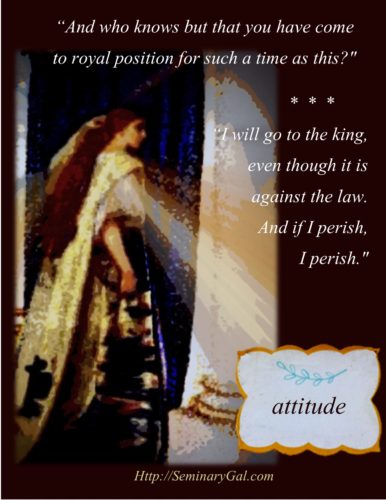
And who knows but that you have come to royal position for such a time as this?”
15 Then Esther sent this reply to Mordecai: 16 “Go, gather together all the Jews who are in Susa, and fast for me. Do not eat or drink for three days, night or day. I and my maids will fast as you do. When this is done, I will go to the king, even though it is against the law. And if I perish, I perish.” 17 So Mordecai went away and carried out all of Esther’s instructions.
Mordecai had been as a father to the orphaned Esther and he would not have been willing to sacrifice her. His attitude was protective of both his cousin and their people, the Jewish people. But characteristics of Esther’s attitude included her humility, winsomeness, respect, wisdom, bravery, selflessness, and compliance. Her character radiated in her every action and consequently, the king spared her life. Esther’s actions saved the Jewish people.
Ponder today: How a little bit of good attitude goes a long way in producing positive outcomes.
Bible characters of the day: Esther and her cousin Mordecai
Authenticity: a Genuine Virtue for Christians
 Authenticity is a most desired virtue. However desirable, one rarely sees it in the Church no matter how much we talk about it. All we end up with is the not-so-close facsimile of “too much information.”
Genuinely authentic people have nothing to hide, but it’s maybe not what you think.
Their lives are transparent because they’ve got a clear conscience and a sure foundation in the grace of God to cover their failures.
Authentic people do not scramble wildly for the nearest excuse. No need to cover their shame. God already did that. They know humans are prone to sin, yet forgiveness is possible by God’s grace. They try to keep from sinning and never parade their flaws as though a display of brokenness is a competitive goal.
In “Has ‘Authenticity’ Trumped Holiness?” the author Brett McCracken asks,
Evangelicalism—both on the individual and institutional level—is trying hard to purge itself of a polished veneer that smacked of hypocrisy. But by focusing on brokenness as proof of our “realness” and “authenticity,” have evangelicals turned “being screwed up” into a badge of honor, its own sort of works righteousness? Has authenticity become a higher calling than, say, holiness?
The Apostle Paul’s final encounter with the Ephesian elders points out how much Paul grasped of a genuine authenticity among the Tiny Virtues for Exemplary Christian Living. He also shows the inescapable connection of transparency to both grace and integrity.
- Paul authentically displayed his life and character: Acts 20:17 From Miletus, Paul sent to Ephesus for the elders of the church. 18 When they arrived, he said to them: “You know how I lived the whole time I was with you, from the first day I came into the province of Asia. 19 I served the Lord with great humility and with tears, although I was severely tested by the plots of the Jews.
- He taught fully. Acts 20:20 You know that I have not hesitated to preach anything that would be helpful to you but have taught you publicly and from house to house. 21 I have declared to both Jews and Greeks that they must turn to God in repentance and have faith in our Lord Jesus.
- He was open about facing hardship. Acts 20:22 “And now, compelled by the Spirit, I am going to Jerusalem, not knowing what will happen to me there. 23 I only know that in every city the Holy Spirit warns me that prison and hardships are facing me. 24 However, I consider my life worth nothing to me, if only I may finish the race and complete the task the Lord Jesus has given me– the task of testifying to the gospel of God’s grace. 25 Now I know that none of you among whom I have gone about preaching the kingdom will ever see me again.
- His authenticity was on display when he was bold in his preaching and protective in his shepherding. Acts 20:26 Therefore, I declare to you today that I am innocent of the blood of all men. 27 For I have not hesitated to proclaim to you the whole will of God. 28 Keep watch over yourselves and all the flock of which the Holy Spirit has made you overseers. Be shepherds of the church of God, which he bought with his own blood. 29 I know that after I leave, savage wolves will come in among you and will not spare the flock. 30 Even from your own number men will arise and distort the truth in order to draw away disciples after them. 31 So be on your guard! Remember that for three years I never stopped warning each of you night and day with tears.
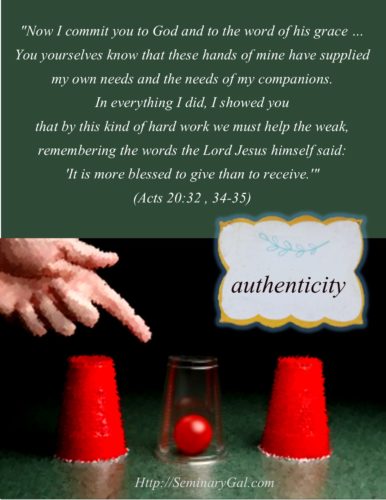
- His conscience was clear. Acts 20:32 “Now I commit you to God and to the word of his grace, which can build you up and give you an inheritance among all those who are sanctified. 33 I have not coveted anyone’s silver or gold or clothing. 34 You yourselves know that these hands of mine have supplied my own needs and the needs of my companions. 35 In everything I did, I showed you that by this kind of hard work we must help the weak, remembering the words the Lord Jesus himself said: ‘It is more blessed to give than to receive.'”
- His authenticity in life and in prayer made him all the more loved. Acts 20:36 When he had said this, he knelt down with all of them and prayed. 37 They all wept as they embraced him and kissed him. 38 What grieved them most was his statement that they would never see his face again. Then they accompanied him to the ship.
What holds you back from genuine authenticity, from knowing true grace, and from displaying integrity in all things?
Ponder today: the interconnection between understanding grace and displaying authenticity
Bible characters of the day: Paul and the Ephesian elders
Art of Savoring: a Tiny Virtue
I wish I were better at savoring life’s moments. How much of my life would have been different, better even, had I chosen to savor the moment I was in rather than wishing it away or looking perpetually ahead on the calendar of life? If only the babies would grow up and stop needing diaper changes. If only the kids could drive themselves to their activities. If only they would stop asking for homework help, just graduate and get a job. If only my degree was completed and I could do ministry. If only…
Never savoring the moment while I had it. It doesn’t mean I was loveless or totally devoid of gratitude or enjoyment. I just never truly savored…really treasured…that time the way I should.
There’s a scene in The Field of Dreams that I use for a lot of theological illustrations. Dr. Archibald “Moonlight” Graham reflects,
We just don’t recognize life’s most significant moments while they’re happening. Back then I thought, ‘Well, there’ll be other days.’ I didn’t realize that that was the only day.”
 Savoring Today. As we continue our look at the Tiny Virtues for Exemplary Christian Living, maybe savoring isn’t so much a lost art as it is the flipside of a human failing. Because we can only see the past and the present, the future is for romantics and dreamers. The past can be romantic, too, like nostalgia in which a lot of the bad melts away and we primarily remember the beauty and the good. But the present? Rather than savoring the moment, we seem to be…in it…only to endure it. Savoring is a tiny jewel among the virtues for exemplary Christians. It’s an art form in miniature.
Jesus and His mother Mary both understood savoring. I’d like to be better at savoring that way. Mary had a string of ponderings, astonishments, and savoring at the time of Jesus’ birth and throughout His early years. (Luke 2:1-51)
Jesus knew how to savor. Luke 22: 14 When the hour came, Jesus and his apostles reclined at the table. 15 And he said to them, “I have eagerly desired to eat this Passover with you before I suffer. 16 For I tell you, I will not eat it again until it finds fulfillment in the kingdom of God.” 17 After taking the cup, he gave thanks and said, “Take this and divide it among you. 18 For I tell you I will not drink again of the fruit of the vine until the kingdom of God comes.”
Ponder today: what you can savor in this moment and how to make savoring a part of your daily experience
Oh, how I love your law! I meditate on it all day long. How sweet are your words to my taste, sweeter than honey to my mouth! Psalm 119:97, 103
Bible characters of the day: Jesus and His mother Mary
Receiving Criticism Well–a Tiny Virtue
How good are you at receiving criticism? If you’re like me, that question brings a decided “Ouch!” As we transition from the tiny virtues of the heart to the tiny virtues of the mind, we cannot help but see that our hearts and our minds have a certain connection. Our minds do not exist independently from our hearts.
When someone has a critique to offer, what is your default response?
 To listen carefully and examine your heart to see if it applies?
- To reciprocate and find fault in the fault-finder?
- To lash out in anger?
- Or do you just feel wounded?
Sure, it can depend on who is offering the criticism and the heart (or lack of heart) with which the person offers it. But for some of us, it’s just really hard to accept criticism and let it change us for the better. I submit to you that chronically rejecting criticism is a pride-response.
The proud heart and proud intellect hate to admit that he or she is wrong.
That’s the bad news. But the good news is that we can grow in these Tiny Virtues for Exemplary Christian Living and learn how to receive criticism in a godly way.
* * *
He is on the path of life who heeds instruction, But he who forsakes reproof goes astray.” (Proverbs 10:17)
We could all learn from a man like Apollos about how to receive criticism.
Acts 18:24 Meanwhile a Jew named Apollos, a native of Alexandria, came to Ephesus. He was a learned man, with a thorough knowledge of the Scriptures. 25 He had been instructed in the way of the Lord, and he spoke with great fervor and taught about Jesus accurately, though he knew only the baptism of John. 26 He began to speak boldly in the synagogue. When Priscilla and Aquila heard him, they invited him to their home and explained to him the way of God more adequately. 27 When Apollos wanted to go to Achaia, the brothers encouraged him and wrote to the disciples there to welcome him. On arriving, he was a great help to those who by grace had believed. 28 For he vigorously refuted the Jews in public debate, proving from the Scriptures that Jesus was the Christ.
Apollos had every reason to reject criticism. He was learned with a thorough knowledge. He had been instructed and spoke with great passion and accuracy. But he was missing some details. Perhaps Priscilla and Aquila were gracious beyond words and encouraged him privately in the way of God. The Scriptures say they “explained…more adequately.” They didn’t admonish or correct with a heart of superiority. But they did offer criticism and instruction. And Apollos received it well.
Ponder today: how you can be better at offering and receiving criticism
Bible characters of the day: Apollos, Priscilla, and Aquila.
Respect: the Earned Virtue for Exemplary Christians
Respect is earned. That’s a tough lesson for many of us. It’s earned by position (e.g. parents, government officials, doctors, pastors, etc.) and it’s earned by people with their actions. Because respect is earned, it can be lost. It can be lost by individuals not acting in accordance with their position, abusing authority as it were. It can be lost by institutions through systemic corruption, chronic failure, or the high-visibility sinning of a prominent leader.
 There are a lot of people out there thinking that respect is owed no matter what. They demand it… from others… as if it’s only Romans 13:7 “Give everyone what you owe him: If you owe taxes, pay taxes; if revenue, then revenue; if respect, then respect; if honor, then honor” and has nothing to do with their actions. They forget the “if” precedes respect and integrity is the glue that holds institutions together when enough corruption has weakened the institution. For that reason, we can remove rogue policemen from the force without condemning all policemen. We can remove false teachers from the pastorate without bulldozing the Church.
Respect is one of the Tiny Virtues for Exemplary Christian Living seen best when we examine our hearts closely. The Bible tells the story of a woman who had been bleeding for twelve years. She’d lost all respect for the institutions that had taken her money but hadn’t given her any relief from her condition.
Mark 5: 26 She had suffered a great deal under the care of many doctors and had spent all she had, yet instead of getting better she grew worse. 27 When she heard about Jesus, she came up behind him in the crowd and touched his cloak, 28 because she thought, “If I just touch his clothes, I will be healed.” 29 Immediately her bleeding stopped and she felt in her body that she was freed from her suffering. 30 At once Jesus realized that power had gone out from him. He turned around in the crowd and asked, “Who touched my clothes?”
Maybe it was her desperation. Maybe she had tremendous faith and respect for Jesus as a healer of people. A respect that was both by His position as Rabbi but also earned by His reputation as Healer. She felt the power of Christ and knew He was worthy of respect.
The passage continues Mark 5: 31 “You see the people crowding against you,” his disciples answered, “and yet you can ask, ‘Who touched me?'” 32 But Jesus kept looking around to see who had done it. 33 Then the woman, knowing what had happened to her, came and fell at his feet and, trembling with fear, told him the whole truth. 34 He said to her, “Daughter, your faith has healed you. Go in peace and be freed from your suffering.”
Jesus wouldn’t let it go without commending her faith and sealing her healing. Jesus wanted to reward the respect she’d shown Him by her publically coming forward in truth, gratitude, and humility.
Ponder today: the foundation of respect and how you demonstrate it.
Bible character of the day: the woman who reached out for Jesus’ healing