No Condemnation, Just Forgiveness

One of the most remarkable exchanges in the Bible is from a controversial passage.  It is debated because it is missing from some of the earliest manuscripts of the Gospel of John.  I’m glad those who compiled our Bibles included it because it’s so beautiful.

John 8:1 But Jesus went to the Mount of Olives. 2 At dawn he appeared again in the temple courts, where all the people gathered around him, and he sat down to teach them. 3 The teachers of the law and the Pharisees brought in a woman caught in adultery. They made her stand before the group 4 and said to Jesus, “Teacher, this woman was caught in the act of adultery. 5 In the Law Moses commanded us to stone such women. Now what do you say?” 6 They were using this question as a trap, in order to have a basis for accusing him. But Jesus bent down and started to write on the ground with his finger. 7 When they kept on questioning him, he straightened up and said to them, “If any one of you is without sin, let him be the first to throw a stone at her.” 8 Again he stooped down and wrote on the ground. 9 At this, those who heard began to go away one at a time, the older ones first, until only Jesus was left, with the woman still standing there. 10 Jesus straightened up and asked her, “Woman, where are they? Has no one condemned you?” 11 “No one, sir,” she said. “Then neither do I condemn you,” Jesus declared. “Go now and leave your life of sin.”

It’s perfectly consistent with the rest of Scripture and for that reason, I find it encouraging.  God doesn’t desire to punish people.  He wants for us to turn from our sins and to pursue righteous living.

So it is consistent that Jesus doesn’t look for excuses to condemn people, to point out their failings, and dwell on their wrongs.  The teachers of the law and the Pharisees, the hyper-religious sorts rushed to judgment.  They looked for ways to point out problems with other people’s lives.

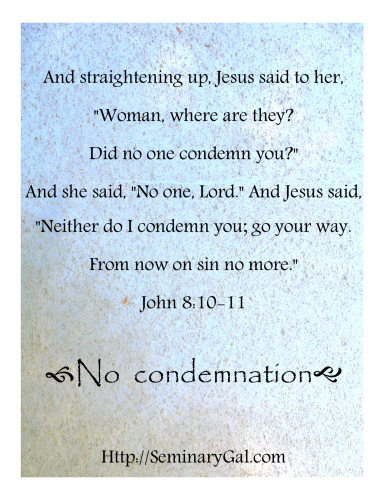
Jesus was different.  Even when confronted with someone whose failings were plain, Jesus’ response was to offer no condemnation, just forgiveness and an admonition to leave sins behind.


no condemnation

Continue Reading

On Hypocrisy, Forgiveness, and Paula Deen

I’ve been thinking on hypocrisy, forgiveness, and Paula Deen.

Let me see if I have the situation right:   Paula Deen swore to tell the truth in a deposition for a lawsuit.  In her telling the truth, she admitted that she had used the “N word” at some point in her life.   She told the truth, then her world came crashing down.  The Food Network dumped her.  Her sponsors dumped her.  Some of her fans have dumped her.  Anchors on news shows and pundits are all dumping on her for telling the truth.

Would they rather that she’d lied?  After all, in America, lies are the new truth.  Or so it seems when you’ve done something you can’t go back and undo.  She spoke the word so she had two choices: tell the truth or lie about it.  There was no going back.

Consider the hypocrisy, though, of what has been going on by all the people talking about it.  Those who ought to respond with forgiveness to her truth and her apology are refusing to forgive,  because apparently to them, the “N word” is the unforgivable sin.

When the truth is told before the Judge of the Universe, I wonder how the anchors and the fans and the sponsors and the Food Network executives will answer these questions regarding their entire life:

      1. Have you ever used the word faggot for any reason other than describing decorative stitching or bundles of sticks?
      2. Have you ever said, “That’s gay” but not in reference to something very cheerful?
      3. Have you ever called someone a “cracker” or a “geezer” or “ho”?
      4. Have you ever used words that aren’t fit for me to print in regard to someone, besmirching his or her character, referring to one of several body parts?

Or the one that will probably be most important to the Judge of the Universe who said this:

You shall not take the name of the LORD your God in vain, for the LORD will not leave him unpunished who takes His name in vain.” (Exodus 20:7)

Deposition time, anchors and fans and sponsors and executives and Paula Deen and you and me.  Time to tell the truth:

Have you ever said “Jesus Christ” as an exclamation of frustration or said “Oh my God” without reference to Him at all?

The Judge will look at each of us, knowing the truth.

So here’s the question each of us should be asking ourselves:

Someday will I want the forgiveness that I am so unwilling to extend to Paula Deen?

So whether the “N word” is an insult or a word beneath your consideration; whether you’re tired of being called a ho and take it to heart or let it pass by, the person who spoke these will be accountable for his or her words.

But what about you? 

Your real question will be whether you will extended forgiveness to those who apologized

or whether in your hypocrisy, you withheld it. 

Matthew 6:12 Forgive us our debts, as we also have forgiven our debtors…14 For if you forgive men when they sin against you, your heavenly Father will also forgive you. 15 But if you do not forgive men their sins, your Father will not forgive your sins.

Praying for forgiveness


Continue Reading

Forgiveness

Forgiveness is one of the most lacking things in American culture.  We—in our proud independence—do not want to believe that we must forgive others for their offenses against us.  Grudges are easier than forgiveness.

Many people will never apologize for the wrongs they’ve done to others.   They’ll withhold remorse when remorse is due.  They’d feel better for being honest with themselves and asking for forgiveness.

Sometimes people go half-way.  They’ll say they’re sorry.  The words are there, but it’s a veneer of regret.  We’ve seen it in testimony before Congress or in tweets or e-mails.  It’s as if saying the words is all it ought to require.  But forgiveness is something more.  It’s deeper than mere words.  It needs to be a heart attitude that we adopt for ourselves and our benefit, every bit as much as we do it for others and for making peace with them.

We need to understand forgiveness and the high standard we’re called to observe.

Jesus tells a story in Matthew 18: 21 Then Peter came to Jesus and asked, “Lord, how many times shall I forgive my brother when he sins against me? Up to seven times?” 22 Jesus answered, “I tell you, not seven times, but seventy-seven times. 23 “Therefore, the kingdom of heaven is like a king who wanted to settle accounts with his servants. 24 As he began the settlement, a man who owed him ten thousand talents was brought to him. 25 Since he was not able to pay, the master ordered that he and his wife and his children and all that he had be sold to repay the debt. 26 “The servant fell on his knees before him. ‘Be patient with me,’ he begged, ‘and I will pay back everything.’ 27 The servant’s master took pity on him, canceled the debt and let him go. 28 “But when that servant went out, he found one of his fellow servants who owed him a hundred denarii. He grabbed him and began to choke him. ‘Pay back what you owe me!’ he demanded. 29 “His fellow servant fell to his knees and begged him, ‘Be patient with me, and I will pay you back.’ 30 “But he refused. Instead, he went off and had the man thrown into prison until he could pay the debt. 31 When the other servants saw what had happened, they were greatly distressed and went and told their master everything that had happened. 32 “Then the master called the servant in. ‘You wicked servant,’ he said, ‘I canceled all that debt of yours because you begged me to. 33 Shouldn’t you have had mercy on your fellow servant just as I had on you?’ 34 In anger his master turned him over to the jailers to be tortured, until he should pay back all he owed. 35 “This is how my heavenly Father will treat each of you unless you forgive your brother from your heart.”

Verse 35 is a scary revelation from the lips of Jesus.  He’s completely serious that forgiveness needs to be from your heart—it’s a heart attitude.  And forgiving others as Jesus has forgiven us is a high standard indeed.  What do you need to forgive today?

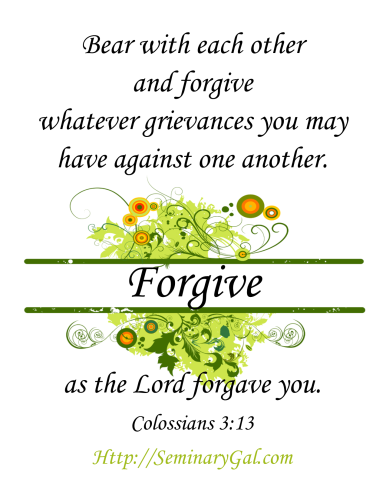
forgiveness

Continue Reading

Chapel Worship Guide 6.30.2013

Chapel Worship Guide for Sunday 9 AM—June 30, 2013

The Nemmers Family Chapel at Advocate Condell


Welcome—Barbara Shafer, Christ Church Highland Park

Worship in Song

Scripture Reading (Old Testament): 

Isaiah 32:17 The fruit of righteousness will be peace; the effect of righteousness will be quietness and confidence forever.

Scripture Reading (New Testament): 

Colossians 3:12 Therefore, as God’s chosen people, holy and dearly loved, clothe yourselves with compassion, kindness, humility, gentleness and patience. 13 Bear with each other and forgive whatever grievances you may have against one another. Forgive as the Lord forgave you. 14 And over all these virtues put on love, which binds them all together in perfect unity. 15 Let the peace of Christ rule in your hearts, since as members of one body you were called to peace. And be thankful. 16 Let the word of Christ dwell in you richly as you teach and admonish one another with all wisdom, and as you sing psalms, hymns and spiritual songs with gratitude in your hearts to God. 17 And whatever you do, whether in word or deed, do it all in the name of the Lord Jesus, giving thanks to God the Father through him.

Prayer

Message: 8 Simple Steps to Living in the Peace of God by Barbara Shafer

Song of Response

Benediction

Continue Reading

Secure the Borders?

Secure the borders!  That’s what so many people are talking about.  I am conflicted about this.  Does the Bible ask us to secure the borders?

Most Americans like keeping evildoers out of the country, establishing distance between us and terrorists, for example.  Most Americans probably cherish the idea of sharing freedom with the good people who want freedom and come to us for that reason, especially when there is no freedom in the country they’re fleeing.   Most Americans appreciate migrant workers who do the important work in the fields of the USA–work that many US citizens would refuse to do.

The question becomes “Will secure borders keep evildoers out and share freedom only with good people?”

Here’s a corollary question: Does building prisons for evildoers and lawbreakers increase the safety of the population at large?

I submit to you that it’s only to the extent we use the prisons for keeping all the evildoers locked up.  Yet plenty of criminals roam free because law enforcement has a monumental task and our judicial system is bogged down and often flaky in the decisions rendered.  Someone needs to determine who the evildoers are and someone needs to define lawlessness and evil.  Are Congress, the Department of Justice, and the US judicial system really designed to do this in an age of relative truth? Can an activist court overturn what the people say in direct votes, what Congress legislates, and what former Presidents sign?  This week should tell us “Yes, the Court can” and without really consulting the US Constitution above personal politics.

Secure the Borders? The Berlin WallSecure the borders never means a moral fence which is what the Bible advocates.

Borders are morality neutral: A mere fence or a prison keeps those inside in and those outside out irrespective of biblical moral judgments.  Without morality, a fence imprisons.  The Berlin Wall and the Holocaust teach us that.

In the course of history, have prisons been used by evildoers to lock up political enemies?

One doesn’t have to look too far back in history to see that Nazi Germany, the Soviet Union, Communist China, and Iran locked up people whose greatest crime was disagreeing with the status quo or who held to different religious or political ideas.  One doesn’t need to go overseas to see that who goes to prison is tied directly to who judges what constitutes a crime.  Yanira Maldonados could tell you that in Mexico, you’re guilty until proven innocent.  Jon Hammar could tell you the same thingEdward Snowden is a flawed hero to some and an evil mastermind of treason to others.  Will he get a medal of commendation or a death sentence?  Who will judge him?  And on what basis when–and if–he returns?

Whether we clamor for secure borders or open borders, we still have a morality problem. 

Maybe instead of looking for blanket amnesty or blanket deportation, we ought to be looking for who, among the illegal aliens, has a moral core.  Let them have work visas and pursue citizenship like anyone else if they even want to become a US citizen.  Or let them work here seasonally on a visa.  But for those intent upon doing evil, deportation is in order.   Keep evildoers out. That is the goal of those who want to secure the borders.

So I’m conflicted.  I’d never advocate letting all the prisoners go free from maximum security prisons because one among them may be wrongly convicted.   What may be necessary for the one unjustly held is not appropriate for all.  Nor would I advocate locking all of us up to have security so that those in charge can monitor who should remain locked up and who can be paroled with a surge of patrol officers to watch us all with surveillance and drones.

Illegal aliens are not all the same.  Some are good-hearted, hard-working family types.  Some are evildoers.  If they are not the same morally, why are we looking to treat them with a one-size-fits-all approach that ignores the very issue which concerns us all (including Hispanic citizens of the US)?

Evildoers exist within and without.  Should we secure the borders or commit instead to prosecuting all evildoers and insist upon valid visas for everyone who needs a visa?  Borders and fences are morality neutral.  Therefore, the danger when we secure the borders, as those in the former East Berlin could tell you, is that when enforced by evildoers the same secure borders that kept people out…can now keep people longing for the freedom outside…from escaping the bondage inside.

secure the borders


Continue Reading

Resetting Our Minds

In trying times, resetting our minds becomes even more imperative.  Keeping Christ first in our hearts and having a Kingdom perspective will be sure fire ways to overcome the discouragement of the moment.  No matter what comes our way, when we know Christ, His grace will overflow, resetting our minds on what is truly important.

Resetting Our Minds on Christ

Continue Reading

On Gay Marriage, the Real Judge Awaits

As a Christian, I do not despair at rulings like today’s Supreme Court decisions regarding gay marriage.  I know who the real Judge is and I know what He says true marriage is.  God issued commands and we will have peace so long as we live by them.

 If only you had paid attention to my commands, your peace would have been like a river, your righteousness like the waves of the sea. (Isaiah 48:18)

Controversial rulings on gay marriage by a U.S. Supreme Court
will someday come under real judicial scrutiny. 

Those in robes have been entrusted with upholding the law.  It’s a huge responsibility for which they will bear the consequences of their actions.  Those who ruled with justice and truth will be upheld for the righteousness they pursued.  Those who ruled by politics and pressure will find their judgments blown away like chaff.  Their robes will be taken away, they will be stripped of everything but shame, and then they will be held accountable for what they have done with the high privilege God gave to them.

Do not be deceived: God cannot be mocked. A man reaps what he sows. (Galatians 6:7)

To the gay “married” among the world’s citizens, you will know what you accomplished with all your activism.  You may get every court among men to say you’re married just like one man and one woman, but when the Real Judge issues His ruling on gay marriage, you will know that God does not, did not, and will not ever consider you married.  Picket and protest all you want.

He who is the Glory of Israel does not lie or change his mind; for he is not a man, that he should change his mind.” (1 Samuel 15:29)

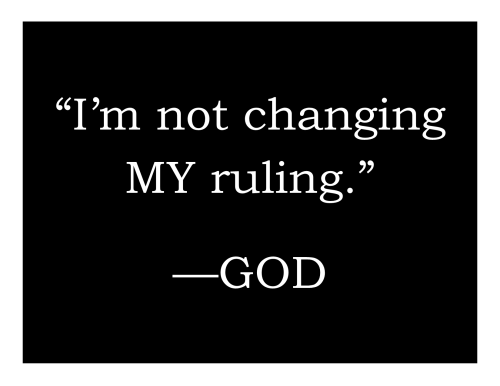
We are told that the last days of earth will be characterized by people doing what was right in their own eyes.  I, for one, am not at all surprised by the Supreme Court.  Had they sought God, they’d know He will never change His ruling.  I won’t fight it.  I won’t be discouraged by it because I know the Real Judge Awaits…

not changing

Continue Reading

Colors of Glass in Christian Light

Sunlight gets absorbed and bent as it passes through different colors of glass in a stained glass window.  We see a colorful pattern on the floor that resembles the image in the window.  Is it still light?  Absolutely!  Is it changed by the colors of glass in the window?  Yes.

Let’s say God sent the sunlight and erected the window. 

Who created the pattern on the floor: God or the window?

That’s how inspiration of Scripture works.  The window was necessary and only produced the pattern that the window was designed to give.  The human writers of the Bible are the window God erected to make the precise pattern on the floor God wants us to see.

God works similarly in the lives of people He calls.  Our personalities make a difference.  There’s a truth pattern evident, but the display is unique to each of us.  God uses each Christian’s life experiences to show the world God’s goodness and light through many colorful windows.

Now the difference between the truth shown through a stained glass window of Christian faith and colorful falsehood of the world is that the light is not evident in lies.  The liar’s “window” rather than translucent or transparent becomes opaque or cloudy or even completely blocks the light depending on how dark the person is in his or her heart.  It’s the difference between a stained glass window and an oil painting on the wall.  One lets light in.  The other blocks it out.  Both have colors, but one allows the light to pass through.

The Bible—and those who hold to it—let the light shine through.  Other books may be opaque or cloudy letting a bit of truth mix with whatever sells for the day as “self-help.” But keep this in mind:  Any book that does not point to the complete sufficiency of Christ and the total insufficiency of humanity is not telling you the whole truth, the full spectrum of light as presented in the many colors of glass in the Bible.

colors of glass in Christian light

Continue Reading

Critters in the Garden Part 1: Insects Eating Plants

It’s been a while since I wrote a gardening post.  My excuse? Aside from being busy writing other posts,  the truth is: I’ve been doing battle with critters, both animals and insects.

deer at the door w maskI knew I’d had enough when the deer was standing on my front porch eating a pot of tulips.  I thought I was safe only treating the plants in the gardens.  Now I’m starting to get concerned about the flowers on my kitchen table.  Next thing you know, the deer will be wearing ski masks, ringing the front doorbell, and telling me,

Hand over the good stuff and no one will get hurt!”

Good gardens attract many critters.  Some we’re happy to see.  Some are unwanted vandals and decimators of plant material.  Here are a few critters from the yard and solutions to them.  In Part 1, we’ll look at Insects, not that we want to see them.

Insects

Treatment of insects will largely depend on how “organic” you want to be and what type of plant material you’re protecting.  Taking more organic approaches will be wise with foods you’re growing.

Organic Approaches
  • You can use pieces of flat moist wood, lay them on the garden soil and daily scrape or stomp the earwigs, pill bugs, and other insects that hide in such places.  Slugs (while not an insect) can also be eliminated in this way.  Earwigs will also hide under pots on your deck.  Lifting the pots and crushing the runaway earwigs is a good daily practice because it reduces their numbers.   I feel guilty removing caterpillars from leaves and flowers, knowing that some are from butterflies, but I can try to relocate them to other plants I don’t care about instead of killing them if I know that they are from butterflies.  Tomato horn caterpillars are no friend and they meet their Maker.
  • You can reuse plastic-lidded trays like you sometimes get with Chinese food or deeper ones like you get in the lunchmeat section, cutting small holes to make openings for insects (and slugs) to crawl into a layer of beer.  The scent of beer actually attracts them.  Bury it slightly in the ground to keep it from blowing away and to make it easier for the insects to get in.  You’ll need to empty it quite often.
  • A cup of soapy water works well for Japanese beetle scouts and earwigs and other leaf/flower-eating insects.  Hand removal of pests is a tedious but good choice for organic gardeners.
  • Yellow sticky traps are great for flying insects like whitefly that love tomatoes.
  • Japanese beetle traps work really well, but it’s IMPORTANT to locate them far away from the gardens you wish to protect.  Otherwise you’re just inviting more to come devour your ornamentals.
  • Diatomaceous earth (crushed shell product) is great for killing a variety of crawling insects and slugs, however, the white powder is not attractive for curb appeal.
  • There are also natural alternatives like parasitic wasps (that kill caterpillars), insects that love to eat aphids (such as lady bugs and praying mantises), and Bacillus thuringiensis also known as Bt which is a bacteria that is completely harmless to non-target insects (like honeybees), birds and other wildlife, but is quite toxic to caterpillars, webworms, and leaf rollers, etc.
Chemicals

While I’m not a chemical person by nature, there are times chemicals are the better alternative.  I use chemicals on my roses and other prized ornamentals that will be decimated by insects.  Generally speaking, I prefer ones I incorporate into the soil immediately around the plant than ones sprayed, particularly when I’m dealing with small areas of flat terrain.  The reason is this: A systemic insecticide will kill only insects that eat the plants.  Sprays are—as a rule—more indiscriminate than systemics.  Sprays kill friendly insects like honey bees, praying mantises, and lady bugs every bit as easily as they kill dreaded pests.  I personally avoid sprays if I can help it.

Bayer makes a nice selection of soil-incorporated products that are systemic.  I use them on my roses and my gardenia and some non-flowering ornamentals.

The jury is still out regarding whether the chemicals enter the nectar that is eaten by honey bees and hummingbirds.  The company says it’s safe and I know that chemical companies need to go through many levels of testing to get approval for production and marketing of garden chemicals.  However, I will say that I have a special place in my heart for honey bees and am greatly concerned about their decline in numbers.  I do what I can to make sure they are protected.  Therefore, flowers that I know honey bees like (coleus and snapdragon flowers, for example) won’t get treated with a systemic or a spray.  I will try to find other alternatives among the organic group, particularly until I find that honey bees don’t like the plant.

One way that I am content to do sprays is as a barrier treatment.  So, for example, I have been known to spray a band around the pot with a contact insecticide.  As the earwigs try to get to the plant, they will cross the barrier and die.  By carefully doing the spraying on windless mornings or evenings, I can give the spray a chance to dry and avoid drift all at the same time, all of which are done to minimize damage done to insects that are not problems.

Physical Barriers

I have been known to use physical barriers as well although I have had less cause to use them in recent years.  For a few years, I participated in the County Fair through our garden club and wanted to have “show quality” blossoms and fruit.  Physical barriers can include netting, collars, plastic mulches, raised platforms, trellises, and sticky traps.

Overall, using an Integrated Pest Management Approach is probably the most environmentally conscious approach, reflecting the kind of wise stewardship that God gave to mankind as we “rule over” Creation.

Continue Reading