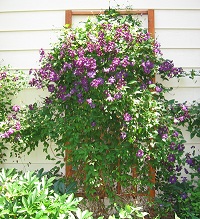
Genesis 1:12 The land produced vegetation: plants bearing seed according to their kinds and trees bearing fruit with seed in it according to their kinds. And God saw that it was good.
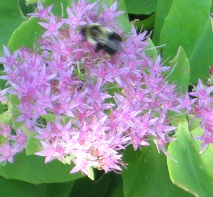 One of the miracles of plants is their ability to reproduce by means other than simply seed (which is miraculous in and of itself). While seeds form as a result of pollination of flowers (the plant’s natural sexual reproduction function—the birds and bees for the plant world), many of these same plants can also be grown from cuttings or divisions.
Moreover, some plants can only be obtained through asexual reproduction (by cuttings or divisions) because the seeds will produce flowers that are not true to their parentage. This happens because of genetic variability within a plant and the careful hybridization that was used in forming the original hybrid. Asexual reproduction is basically cloning because the resulting plant has the same genetic makeup as the parent.
Given the hard work involved in carefully breeding for special characteristics, many hybrids are patented which means that asexual reproduction cannot be used to make plants for sale without prior permission from the patent owner. My interest in propagating with cuttings or divisions is to increase my personal collection of certain plants or to make the overwintering of them easier indoors. You know how it is—so many plants, so few windows. Alas, I wish I had a greenhouse. There, I said it! A greenhouse would provide hours of entertainment and give me more space to fill with the plants I love. And I love lots of plants—which you can interpret either way and it’s a true statement.
Cuttings do not take up nearly the space of a whole end-of-the-season-plant and can be grown in a window with supplemental lighting to help them make it through the winter. I probably do this less because I want to multiply anything for my own garden and more because I like certain varieties and want to hold them over. My huge mother plant of Martha Washington geranium went out to the curb with a FREE sign on it because I have two baby plants in its place. I gave away one of my gigantic strawberry pots and will divide and repot my remaining strawberries next spring. I’m thinking of investigating one of the faddish “upside down planters” to see if they actually work. My hope is that it will work better than a strawberry tower at keeping birds and slugs from nibbling.
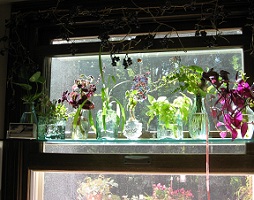 I have a couple of geranium varieties that will come indoors as well as some impatiens and coleus. Many cuttings will be started in vermiculite (as my post March into Spring illlustrated), but others will look simply lovely in little glass vases above my kitchen sink. They help to cheer a long winter during which I will look out my window and see day after day of snow and cold. But to see it, I’ll have to look beyond my indoor reminder of perpetual spring on my windowsill.
I have also separated and repotted my amaryllis bulbs for winter bloom. Some varieties of my amaryllis are oddballs and don’t leaf and flower when I expect them to. Others are as predictable as can be. I try to let the foliage die back at the end of summer by drying them out and then remove the spent foliage and let it rest in the dark. Then I repot them for this year’s flowering. It takes somewhere between 7-12 weeks after a rest for many amaryllis to bloom again.
As some of my cuttings take root and grow to sizeable plants themselves, they’ll become stock plants for next year’s garden and I will take cuttings all winter to have enough for planting in the spring. It’s part of how I can stay encouraged during the winter that hope springs eternal.
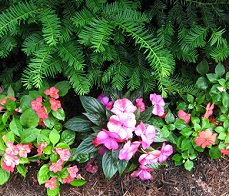
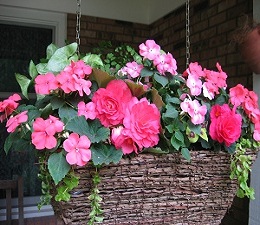
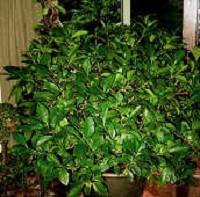 When the cold temperatures came, my plants were ready to come inside. I usually plan on doing the indoor-outdoor hokey-pokey dance for a week to ten days with my plants so that they can become acclimated to lower light conditions indoors. The plants come in. The plants go out. The plants come in and turn all about…
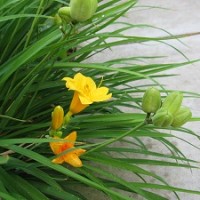 Of the frequently asked questions I received on the sales floor, people asked how to care for their daylilies. They’d bubble with excitement at seeing a big daylily that looked like this (right).
 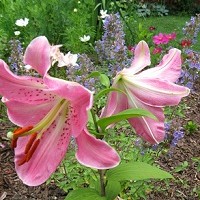 Plants have a legal name, if you will, that consists of a genus (larger group) and species (subgroup). Beyond that, certain cultivated varieties (cultivars for short) will have a name in quotes which makes it even more specific. The Oriental lily Lilium ‘Farolito’ shown here is a cultivar. Lilium x ‘Kiss Me Kate’ would be a hybrid lily denoted by an ‘x’ to show that it is a cross between a longiflorum lily (like an Easter lily) and an Asiatic lily.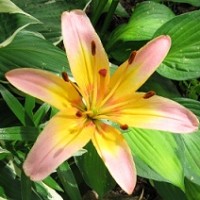
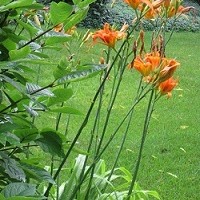 They grow differently in form—lilies (pictured on the left) are flowers emerging atop leafy stalks, daylilies (right) form clumps. They originate from different structures—lilies arise from bulbs, daylilies grow from fibrous root systems that will enlarge into spindle-like roots resembling tubers. Lily flowers are long lasting and open from the lower buds to the upper buds. When the buds have all opened, the flowering is completed for the year. Daylilies, on the other hand, have a short bloom—each lasting only a day, hence daylily, however the season of bloom may be quite extensive. Lily bulbs must be planted at a sufficient depth to protect them from the harsh winters, but not so deep that the plant must struggle through an endless stretch to reach the soil surface. Daylilies are planted so the crown is at the soil level with the fibrous roots and tuberous spindles are stretched out just below the soil surface. Lilies will grow larger clumps by growing increasing bulb sizes as well as by dropping bulbils (present after bloom in the leaf axils) off the stem onto the ground. Daylilies, depending on variety, can be downright invasive…emerging anywhere there’s an opportunity within the range of the mother plant.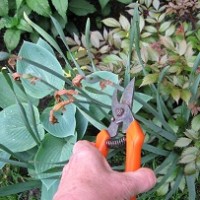
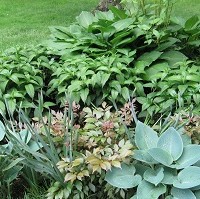 Pictured here are two instances of daffodil inter-planting. In the wet area of my yard, the hostas, astilbe, turtlehead have emerged and I can tuck the foliage behind these companion plants until it has completely died back. The foliage will continue to make food with plenty of sunlight and grow the bulk of the bulbs, then the summer perennials will fill the space left behind as the daffodils recede.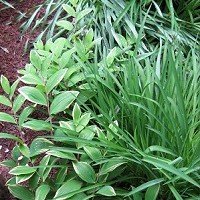
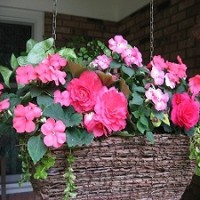 Since a container garden must share the same watering requirement and light level, taking care to select compatible companions is helpful. Consider these hanging baskets I made from two window boxes back to back. They are hung from their back loops by using chain link (painted with craft paint to reduce its sheen). The back window box has maidenhair fern, ivy, fittonia, and nepthytis and the front window box has creeping jenny/moneywort, coleus, tuberous begonia, and impatiens. Since I will never rotate these, the front box will get brighter light and the back box will be even more shaded and moist. I like the stewardship present as well since the maidenhair fern, ivy, fittonia and nepthytis are all houseplants that I’m summering outdoors and the creeping jenny was recycled from early spring pots. I enjoy creating beautiful things primarily from what I already have on hand, plus an added item or two. Beauty from season to season!
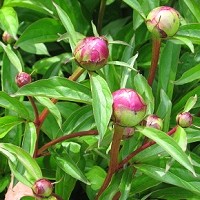 When I worked at Home Depot, I could guarantee this query at least a dozen times each weekend that the peonies were in bloom. Gardening has its share of pieces of Folk Wisdom and this isn’t one of them.
 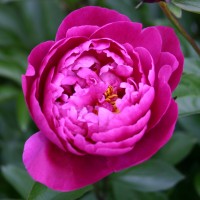 Peonies enjoy full to part sun, are heavy feeders, and come in singles and doubles as well a variety of colors. They can endure in the same location for decades and reward you with their beauty in the spring and their durable shrub-like foliage until the fall. They require some additional care with respect to planting depth and are best divided in the fall in order to bloom happily. They are some of the oldest cultivated plants for good reason—they are truly among the masterpieces of May.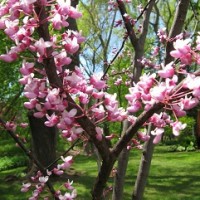
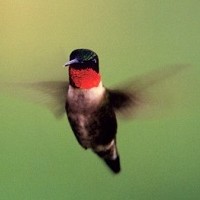 Part of the joy of gardening is the beauty of wildlife drawn to a well planned garden. I love birds. When I was a child, I kept a bird-watching journal and enjoyed identifying birds and their habitats. A long time ago, I abandoned the written journal, but mentally, I have a record of birds in the yard and when their seasons are.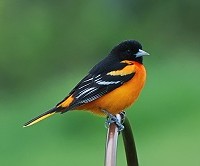
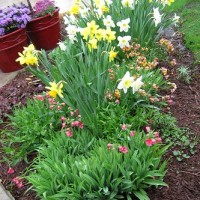 Real world gardening involves everything being beautiful its time (Ecclesiastes 3:11).
 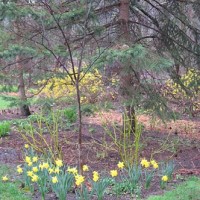 Even in the midst of dreary days, perennial features such as the cheerful yellow forsythia, “Cardinal” red-twig dogwood, and King Alfred daffodils lift one’s spirits.
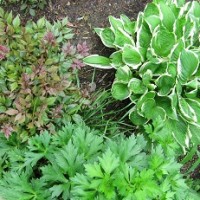
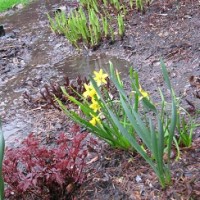 And look at the beautiful range of colors of emerging growth of turtlehead (Chelone obliqua), Astilbe ‘Fanal’, and hostas—all of which tolerate standing water for short periods. Good thing, since in every real world garden a little rain must fall. This particular garden is always among the last to be worked because it is a low spot in our yard. I find that working our higher front yard to the lowest back is always helpful since that’s how things aren’t worked when it’s too wet. Working the soil when it’s wet ruins the structure. Mulching when it’s raining causes the ground to retain the soggy conditions longer. It’s important with conditions like these to research carefully what plants will survive in such Out of Eden locations.
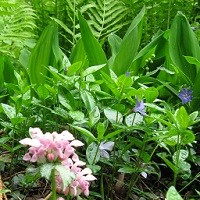
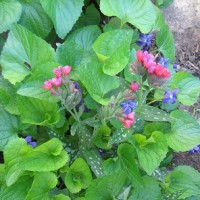
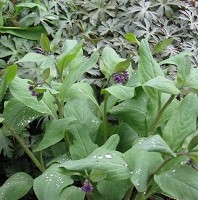 My bluebells (Mertensia virginica) are budding and my native cranesbill geranium (Geranium maculatum) won’t be outdone. Also in my woodland garden are lily-of-the-valley (Convallaria majalis) and sweet woodruff (Galium odoratum) which are not native but escaped cultivation and are real showstoppers. I like that phrase: escaped cultivation. Makes them seem like garden rebels…or too beautiful to be held captive.
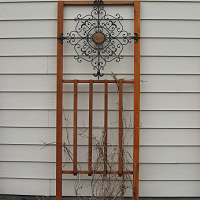 Since it’s early spring, I know now is the perfect time to make the change and to provide new garden structures. Originally, I bought some wrought iron wall art that I was going to hang on the wall and pull the clematis vines up to the ornamental plaques. But then, I began to think about rust stains developing on my siding and decided to consult my neighborhood Home Depot for better options instead.