Category: Articles and Devotionals
A selection of devotionals written by Barbara Shafer.
Making the Theological Understandable
A selection of devotionals written by Barbara Shafer.
Genesis 41:32 The reason the dream was given to Pharaoh in two forms is that the matter has been firmly decided by God, and God will do it soon.
Joseph follows up the interpretation with assurance this is a settled matter, one which is time critical. He then outlines a plan.
Genesis 41:33 “And now let Pharaoh look for a discerning and wise man and put him in charge of the land of Egypt. 34 Let Pharaoh appoint commissioners over the land to take a fifth of the harvest of Egypt during the seven years of abundance. 35 They should collect all the food of these good years that are coming and store up the grain under the authority of Pharaoh, to be kept in the cities for food. 36 This food should be held in reserve for the country, to be used during the seven years of famine that will come upon Egypt, so that the country may not be ruined by the famine.” 37 The plan seemed good to Pharaoh and to all his officials.
As much as Joseph wants to be out of prison for good and may have wanted to go back to Canaan to the Valley of Hebron and his father Jacob’s tent in the shade, he followed up the interpretation of Pharaoh’s dreams and assurance of their fixed future with a prompt proposal and a strategic plan to be implemented immediately. Timely intervention is evidence of God’s benevolence.

Think about it:
Genesis 41:25 Then Joseph said to Pharaoh, “The dreams of Pharaoh are one and the same. God has revealed to Pharaoh what He is about to do.
After hearing the dreams, there is no hesitation. Joseph explains what could have been bad news, except that it’s not. It’s advance warning, helpful intel for the purpose of planning.
Genesis 41:26 The seven good cows are seven years, and the seven good heads of grain are seven years; it is one and the same dream. 27 The seven lean, ugly cows that came up afterward are seven years, and so are the seven worthless heads of grain scorched by the east wind: They are seven years of famine. 28 It is just as I said to Pharaoh: God has shown Pharaoh what He is about to do.
It’s like Joseph is following a sermon outline, telling Pharaoh what the dream means, and then he says what it means again. And now again, just to make sure he drives the point home. “God has shown Pharaoh what He is about to do.” Got it.
Genesis 41:29 Seven years of great abundance are coming throughout the land of Egypt, 30 but seven years of famine will follow them. Then all the abundance in Egypt will be forgotten, and the famine will ravage the land. 31 The abundance in the land will not be remembered, because the famine that follows it will be so severe. 32 The reason the dream was given to Pharaoh in two forms is that the matter has been firmly decided by God, and God will do it soon.
That’s the bad news. The good news is “soon” is not immediate even if it is surely there. There’s time to plan, there’s advance intel so that Pharaoh can develop and implement the plan, and an opportunity to partner with a planner whose mind is tuned to the Planner. The Planner knows what He’s doing.
Isaiah 14:24 The LORD Almighty has sworn, “Surely, as I have planned, so it will be, and as I have purposed, so it will happen.”

Think about it:
Joseph, all cleaned up for his appearance before the one of the most powerful men in the world, is brought before Pharaoh to hear the perplexing dreams and asked to interpret them.
Genesis 41:16 “I cannot do it,” Joseph replied to Pharaoh, “but God will give Pharaoh the answer he desires.” 17 Then Pharaoh said to Joseph, “In my dream I was standing on the bank of the Nile, 18 when out of the river there came up seven cows, fat and sleek, and they grazed among the reeds. 19 After them, seven other cows came up– scrawny and very ugly and lean. I had never seen such ugly cows in all the land of Egypt. 20 The lean, ugly cows ate up the seven fat cows that came up first. 21 But even after they ate them, no one could tell that they had done so; they looked just as ugly as before. Then I woke up. 22 “In my dream I saw seven heads of grain, full and good, growing on a single stalk. 23 After them, seven other heads sprouted– withered and thin and scorched by the east wind. 24 The thin heads of grain swallowed up the seven good heads. I told this to the magicians, but none of them could explain it to me.” 25 Then Joseph said to Pharaoh, “The dreams of Pharaoh are one and the same. God has revealed to Pharaoh what he is about to do.”

Think about it:
Genesis 41:10 “Pharaoh was once angry with his servants, and he imprisoned me and the chief baker in the house of the captain of the guard. 11 Each of us had a dream the same night, and each dream had a meaning of its own. 12 Now a young Hebrew was there with us, a servant of the captain of the guard. We told him our dreams, and he interpreted them for us, giving each man the interpretation of his dream. 13 And things turned out exactly as he interpreted them to us: I was restored to my position, and the other man was impaled.”
A young Hebrew? Not a fellow prisoner but a “servant of the captain of the guard”? Other translations say a slave? Belonging to the captain of the guard? That’s the cupbearer’s recounting of Joseph’s profile.
Genesis 41:14 So Pharaoh sent for Joseph, and he was quickly brought from the dungeon. When he had shaved and changed his clothes, he came before Pharaoh.
Job interview time. Joseph doesn’t show up looking like a hairy Hebrew who’s been jailed for two full years beyond the arrival of the double dreamers. He is rescued out of jail and given new clothes to wear for the interview. After all, the appointment was with Pharaoh.
Genesis 41:15 Pharaoh said to Joseph, “I had a dream, and no one can interpret it. But I have heard it said of you that when you hear a dream you can interpret it.”
A glowing recommendation! All the stakes are high for unjustly imprisoned Joseph who desperately wants to be released from prison (and permanently). He’s been waiting at least two years for this big break. What would be wrong with a little fluffing one’s feathers in a job interview? Too much for a man of Joseph’s character.

Genesis 41:16 “I cannot do it,” Joseph replied to Pharaoh, “but God will give Pharaoh the answer he desires.”
Think about it:
Genesis 41:1 When two full years had passed, Pharaoh had a dream: He was standing by the Nile, 2 when out of the river there came up seven cows, sleek and fat, and they grazed among the reeds. 3 After them, seven other cows, ugly and gaunt, came up out of the Nile and stood beside those on the riverbank. 4 And the cows that were ugly and gaunt ate up the seven sleek, fat cows. Then Pharaoh woke up. 5 He fell asleep again and had a second dream: Seven heads of grain, healthy and good, were growing on a single stalk. 6 After them, seven other heads of grain sprouted– thin and scorched by the east wind. 7 The thin heads of grain swallowed up the seven healthy, full heads. Then Pharaoh woke up; it had been a dream. 8 In the morning his mind was troubled, so he sent for all the magicians and wise men of Egypt. Pharaoh told them his dreams, but no one could interpret them for him. 9 Then the chief cupbearer said to Pharaoh, “Today I am reminded of my shortcomings.”
Memory is a strange thing. Dementia aside, often we remember what we want to remember and recall what’s important to us. Memories can fade with time, but in the cupbearer’s case, he had every reason to remember Joseph earlier, but he didn’t. This memory had not faded, it was just not front-of-mind. Only when the Pharaoh was troubled by a dream, did the cupbearer remember. It’s as if God unleashed the memory in His perfect timing.

The artful use of time in God’s plan is evident as the cupbearer
finally remembers when it will make a true difference and accomplish God’s purpose.
Think about it:
Two full years and everyone was in the dark about God’s hidden working. Joseph was going about daily prison life. The cupbearer in forgetful living. Pharaoh had a dream.
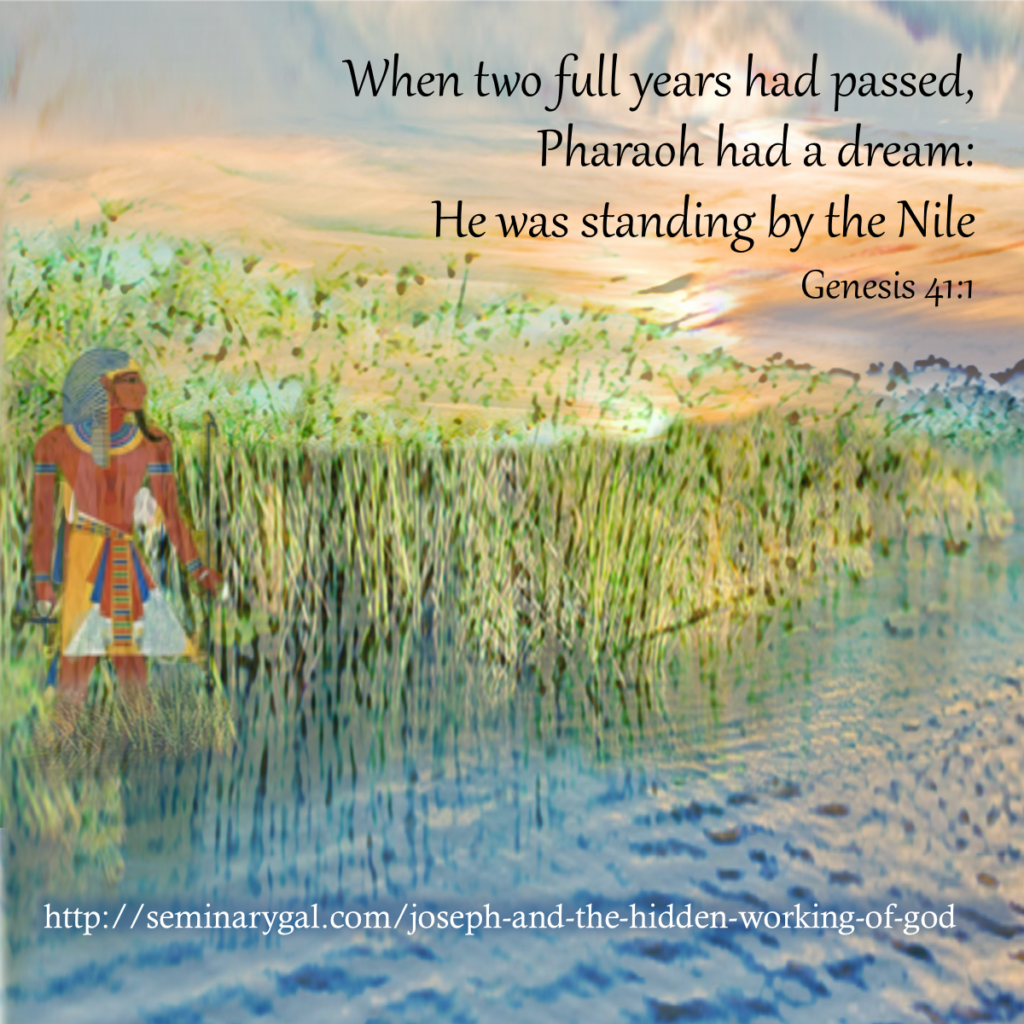
Genesis 41:1 When two full years had passed, Pharaoh had a dream: He was standing by the Nile, 2 when out of the river there came up seven cows, sleek and fat, and they grazed among the reeds. 3 After them, seven other cows, ugly and gaunt, came up out of the Nile and stood beside those on the riverbank. 4 And the cows that were ugly and gaunt ate up the seven sleek, fat cows. Then Pharaoh woke up. 5 He fell asleep again and had a second dream: Seven heads of grain, healthy and good, were growing on a single stalk. 6 After them, seven other heads of grain sprouted– thin and scorched by the east wind. 7 The thin heads of grain swallowed up the seven healthy, full heads. Then Pharaoh woke up; it had been a dream. 8 In the morning his mind was troubled, so he sent for all the magicians and wise men of Egypt. Pharaoh told them his dreams, but no one could interpret them for him.
Pharaoh’s mind was troubled. No wonder. What a backward, upside down, nonsensical dream! Doubled.
It must mean something, he thought. But what?
Think about it:
Joseph awoke every morning probably never knowing whether the cupbearer had said something (but Pharaoh did nothing), or whether the cupbearer had resumed his position, remaining ever silent about Joseph’s dream interpretation.
Genesis 41:1 When two full years had passed, Pharaoh had a dream.
Two full years. Watching. Waiting. Seeing if anything would change.
Two full years. Nothing to be seen. Nothing to happen. Nothing changed.
Two full years.
Two … full … years.

Think about it:
Joseph was probably both gratified and sad about the outcome. He was glad that the interpretations from God were correct, and happy also for the cupbearer’s being restored to serving Pharaoh. However, he must have been sad that the baker was killed. After all, relationships even in prison are relationships nonetheless, and they can be significant– especially when one has time in prison to think about it all.
Joseph had asked the cupbearer to remember him when restored to serving Pharaoh.
Genesis 40:23 The chief cupbearer, however, did not remember Joseph; he forgot him.
The chapter ends and Joseph remains in prison. Being forgotten stinks.
Think about it:
Time went by and relationships formed. Mundane, so they seemed. Commonplace is what they appeared to be. After all, what kind of relationships could exist among fellow prisoners? Actually, a shared road of suffering and common experience often form a foundation of deep friendship. The cupbearer and baker may have felt it for Joseph, and he felt it for them.
Genesis 40:4 After they had been in custody for some time, 5 each of the two men– the cupbearer and the baker of the king of Egypt, who were being held in prison– had a dream the same night, and each dream had a meaning of its own.
Take careful stock of the words. They, each, the same, and each.
Together but individual.
Genesis 40:6 When Joseph came to them the next morning, he saw that they were dejected. 7 So he asked Pharaoh’s officials who were in custody with him in his master’s house, “Why do you look so sad today?”
Joseph cared about them and wondered why they were sad. Genesis 40:8 “We both had dreams,” they answered, “but there is no one to interpret them.” Then Joseph said to them, “Do not interpretations belong to God? Tell me your dreams.”
The cupbearer went first. Genesis 40: 9 So the chief cupbearer told Joseph his dream. He said to him, “In my dream I saw a vine in front of me, 10 and on the vine were three branches. As soon as it budded, it blossomed, and its clusters ripened into grapes. 11 Pharaoh’s cup was in my hand, and I took the grapes, squeezed them into Pharaoh’s cup and put the cup in his hand.”
Joseph experienced God’s favor yet again with interpretation for the cupbearer. Genesis 40:12 “This is what it means,” Joseph said to him. “The three branches are three days. 13 Within three days Pharaoh will lift up your head and restore you to your position, and you will put Pharaoh’s cup in his hand, just as you used to do when you were his cupbearer.”
As added assurance, Joseph has a request.
Genesis 40: 14 “But when all goes well with you, remember me and show me kindness; mention me to Pharaoh and get me out of this prison. 15 I was forcibly carried off from the land of the Hebrews, and even here I have done nothing to deserve being put in a dungeon.”
Joseph hadn’t forgotten what happened to him…the wrongs perpetrated against him.
Their memory was with him in prison.
The chief baker probably sighed in deep relief that there was a happy ending to the cupbearer’s story and felt assured to tell his own dream. Genesis 40:16 When the chief baker saw that Joseph had given a favorable interpretation, he said to Joseph, “I too had a dream: On my head were three baskets of bread. 17 In the top basket were all kinds of baked goods for Pharaoh, but the birds were eating them out of the basket on my head.”
Again, Joseph experienced the favor of the Lord with interpretation. Genesis 40: 18 “This is what it means,” Joseph said. “The three baskets are three days. 19 Within three days Pharaoh will lift off your head and impale your body on a pole. And the birds will eat away your flesh.”
This was not the interpretation the baker wanted. The clock was ticking and there would be three days of anguish as he waited to see if Joseph was just making stuff up. He probably hoped that Joseph was wrong. The cupbearer, too, was probably on the edge of nervousness because Pharaoh’s birthday was coming up. What if Joseph wasn’t right and he was going to be killed too… or instead of the baker?
Genesis 40: 20 Now the third day was Pharaoh’s birthday, and he gave a feast for all his officials. He lifted up the heads of the chief cupbearer and the chief baker in the presence of his officials: 21 He restored the chief cupbearer to his position, so that he once again put the cup into Pharaoh’s hand– 22 but he impaled the chief baker, just as Joseph had said to them in his interpretation.

Think about it:
Genesis 40:1 Some time later, the cupbearer and the baker of the king of Egypt offended their master, the king of Egypt. 2 Pharaoh was angry with his two officials, the chief cupbearer and the chief baker, 3 and put them in custody in the house of the captain of the guard, in the same prison where Joseph was confined. 4 The captain of the guard assigned them to Joseph, and he attended them.
The favor of the Lord was upon Joseph in prison and the warden clearly noticed. Having a responsible, compliant, and hard-working person like Joseph in prison made the process of guarding a delight. The warden could delegate tasks, put things in Joseph’s hands, and not have to worry that they won’t get done or will become a secret means of revenge. Joseph was made responsible for all the prisoners and God gave him success and favor in everything he did.
One day, two new prisoners arrived, the chief cupbearer and the chief baker. Both were high level servants of the king of Egypt and had made the Pharaoh angry. So off to prison they went!
Little did Joseph know when he was falsely accused by Potiphar’s wife (and sent to prison) that jail would be the very place of God’s next intervention.
Little did two prisoners know when they were sent to prison, their story would be told in perpetuity because they encountered Joseph. They probably thought it was just another day, a bad one, and cursed Pharaoh under their breath for putting them in prison.

Little did they know that the moments of genuine importance and relationships of greatest significance often enter as a whisper so soft, they’re audible only in the soul. For them, a bad day—in the moment—would turn into a string of bad days and nights and eventually to a bad night’s dream. In the story of Joseph, however, these dreams would be predictive of life and death.
Think about it: