My People and the Just War

Last time in our study of My People/Not My People, we asked, “What is the difference between the wars to claim the promise of God through conquest, little by little, as opposed to ethnic cleansing or genocide?”  Is there such a thing as a Just War?  For that matter, “Why does God use war?”

Let’s take these one at a time.  In a 2013 post called Just War, I wrote,

So, why does God use war?  As a moral instrument.  When God made the covenant (regarding all the promises, not just the Land), Scripture says,

The Amorites.  Who are they and where were they located?  The Amorites were one of the major Canaanite ethnic groups, according to the Table of Nations (Genesis 10:6-19), descended from Canaan son of Ham and known for their goliath power and size. As such, they controlled important hill-country territories of Canaan on both sides of the Jordan.  They also were big-time sinners and idolaters, enough that God would single them out.  Notice the “full measure” God spoke about wasn’t the number of Amorites, but the sin of the Amorites.

Questions for further thought:

How does God’s use of war as a moral instrument require men to have a deep, prior understanding of God and His definition of morality?

How does God’s “Just War” require that war be done God’s way?  Why did God require circumcision of the Israelites before going to conquer Canaan (See Joshua 5)?

How did the siege of Jericho display conquest as God’s moral instrument, done God’s way (Joshua 6:1-16)?

Is it actually genocide when God spared an Amorite Remnant by faith (see Rahab, Joshua 6:17 and Matthew 1:5)?  How did that make the siege of Jericho a moral victory in a Just War?

Continue Reading

Nation-State in Formation

Integral to any discussion of the modern state of Israel as My People/Not My People, we must ask, “How do nation-states form?”  There are several ways:

Theologically, the Land of importance to the modern nation-state of Israel is grounded in a forever promise given by God to Abraham many thousands of years ago.  It remains as the only example of Promised Land of God… ever known to be given as an inheritance …or recorded to exist.  The only one.  If you believe in the God of the Bible, this promise endures. There is no expiration date on an eternal God’s forever promises.

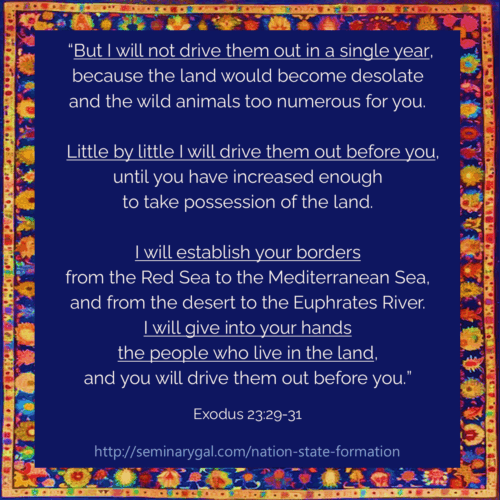
No one authoritatively promised (or could!) the US, Germany, Russia, or Venezuela, etc. their lands.  But, when God gave the Land as a promise to Israel, He was specific.  The boundaries were identified, and it was promised as an inheritance forever. (see Genesis 13:15; 15).  The Ottoman conquests from the 1500s did not invalidate that land grant because it was God’s land to give and to promise.

Historically, some other nations like the US, Germany, etc. got (or lost) their lands because wars were fought, and the winner takes all or makes treaties.  Those boundaries are subject to ongoing wars, agreements, invasions, and national defense. National boundaries are subject to these things because wars of man and manmade boundaries are limited by human nature.

The Promised Land was promised by God, dependent upon His eternal nature and His forever promise and yet, wars had to be fought. In our study of My People/Not My People as history proclaims them, this is where we are. 

Moses has died and Joshua (one of two faithful spies) takes over leadership.  Joshua 1:10 “So Joshua ordered the officers of the people:  11 ‘Go through the camp and tell the people, ‘Get your provisions ready. Three days from now you will cross the Jordan here to go in and take possession of the land the LORD your God is giving you for your own.'”

There were two and a half tribes which weren’t inheriting west of the Jordan.  Those east of the Jordan were still bound under the command of Moses.

Questions for further thought:

Do you think the Reubenites, Gadites, and the half-tribe of Manasseh, might have wanted to avoid helping since they were already living in their own land east of the Jordan?

What is it about God’s mandate made them obey the command of Moses which originated with God?  What does their obedience say about their being My People?

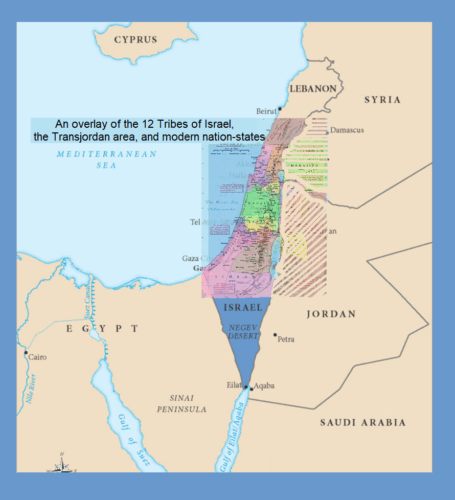
Today the land east of the Jordan River that had belonged to the Reubenites, the Gadites and the half-tribe of Manasseh is under the sovereign ownership of Jordan and Syria.

In fact, the full land outlined in Genesis 15:18-21 includes areas currently part of Egypt, Sudan, Syria, Turkey, and Iraq.  In Joshua chapters 15-19, there are allotments by tribe, the My People of Scripture.  They largely correspond to the area of the modern nation-state of Israel.

What is the difference between the wars to claim the promise of God through My People’s conquest of land inhabited by Canaanites (Not My People), little by little, as opposed to ethnic cleansing or genocide? We will address this subject more in the next installment.

Continue Reading

Sifted in the Wilderness

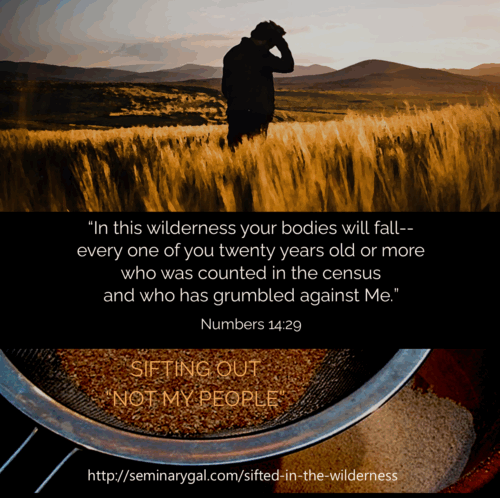
After the Passover, God gave the faithful Israelites safe passage out of Egypt …  through the Red Sea.  You’d think this “miracle beyond all miracles” they’d ever witnessed would have stuck with the travelers, but humanity is an ungrateful lot with short memories.

Israel is no exception.
It’s why they were commanded to observe the Passover every year.

The pack of grumbling ingrates complained non-stop and even wished to go back under slavery.  So, God used 40 years to sift them in the wilderness.

Questions for further thought:

These were all Israelites. Every last one of them. All of them survived the Passover of the destroying angel. All walked safely on dry land through the Red Sea and arrived on the far shore, then witnessing (with their own eyes!) the complete annihilation of the Egyptian oppressors who pursued them. These Israelites had it all! They’d seen it all! How on earth did they forget within the first 2 years, enough that God would sift them?

The forgetters’ children plus Joshua’s and Caleb’s families would be the only My People from among all those hundreds of thousands from the Exodus from Egypt.  All the other Israelites, the grumbling grown-ups, were Not My People. 

Does that seem like Chosen People to you when the faithless so outnumbered the faithful? After all that grumbling, did God still consider the Remnant entering the Promised Land to be His Chosen People?

Does that numerical proportion negate the existence of My People or the Chosen People? What does Jesus say about that principle? (Matthew 7:13-14

Are you beginning to see the pattern that it’s obedience to God which forms the distinction between My People and Not My People?  That it’s not a simple matter of heritage or majority rule? And that numerically speaking, Not My People will always far outnumber My People?

What is the distinction between obedient Chosen People and obedient My People from other nations? What did Jesus mean when He said, “I have other sheep that are not of this sheep pen. I must bring them also. They too will listen to my voice, and there shall be one flock and one shepherd” (John 10:16, emphasis added)?

Continue Reading

The Night of the Destroyer

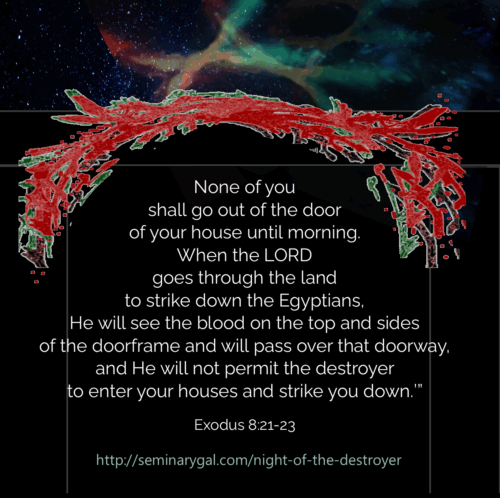
There are a few instances in the Bible where God makes a powerful statement about My People as distinct from Not My People by personally permitting “the destroyer” (an angel whose job is killing) to do his thing.  The Passover is one.

The Lord and His destroyer went through Egypt at midnight.  Only My People (who obeyed the Word of the Lord and stayed inside) were spared.  They were not spared by half measures, location changes, or philanthropic good works, but only by trusting and obeying the full Word of God.

Questions for further thought:

There’s a pattern.  Read Ezekiel 9.  Who were those whom the six destroyers/executioners permitted to strike? Who were those sealed to be spared? Who did the sealing?

We will revisit this passage again in our study. For now, look: Jerusalem. The house of Israel and Judah.  Are these not all Jews? 

Who is the man clothed in linen with the writing case?

In the Passover, if God’s instructions were not followed completely regarding the blood or staying inside, what was the destroyer permitted to do?  Would their heritage have mattered?

Continue Reading

Making a Distinction with My People

Within a family line, there are My People and Not My People.  This understanding will help us as we answer the issue of who are the “real Jews” especially as it relates to the nation-state of Israel and the Israel of the Bible. There is much debate in Christian circles about how to reconcile this.  This series is working toward illuminating that question.

For now, and for continuity’s sake, God also distinguishes between My People and people of other nations who are Not My People.  This is helpful for addressing why God has been the historical deliverer of His Chosen People over and again in history.

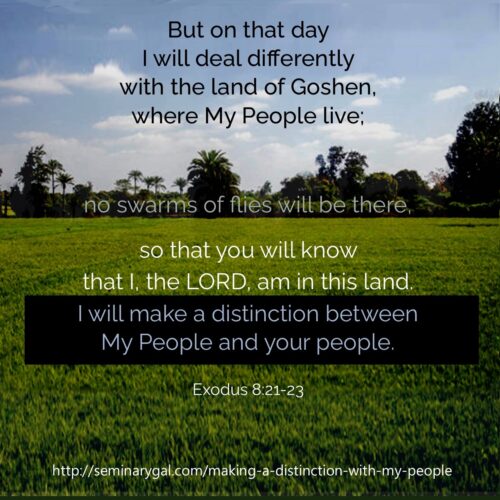
Perhaps you remember the story of the plagues in Egypt (that land we saw last time where the Israelites would be enslaved and mistreated for 400 years).  When it was time to go, it was time to go.  To get Pharaoh to release them, God sent ten plagues, with the fourth one being the start of God declaring that He’s making a distinction between My People and Not My People.

And it was so.
By the seventh plague, it becomes clear:
it’s about who believes God (My People) and who doesn’t (“your people”).

The officials of Pharaoh who heeded God’s order might be called “God-fearers” and the others learned a valuable lesson.

Questions for further thought:

Why was it important to distinguish My People before the Plague of the Firstborn (the tenth plague)?  To whom did it reinforce God’s commands?

Was four hundred years long enough for My People living amongst other religions to forget God’s promises?  Why didn’t they?  How were the plagues of distinction a good reminder?

What is God’s ultimate interest in preserving the Jewish people as it relates to Jesus?

Continue Reading

Never in Their Lifetimes

Last time, we looked at Genesis 22 where God ended up preserving the line of Isaac by supplying a ram for the sacrifice instead of Abraham’s beloved son.  As we keep investigating My People/Not My People as portrayed in the Bible, we’d think all should be going well! Passed that test! Promised Land, here we come for My People! 

Wait.  Let’s go back to Genesis 15 and take another look at what happens before the Promised Land.  There’s a significant detour, planned by God.

That “country not their own” would be the nation of Egypt.  Why would God plan such a delay, such a detour?

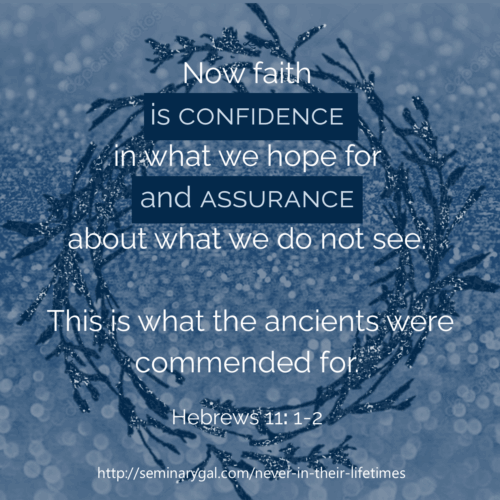
Four hundred years is a long time to wait, an even longer time to be enslaved and mistreated, and that means that Abraham’s immediate descendants, even among the Chosen People, would never in their lifetimes see the land that their future generations would inherit someday. Only enslavement and misery. Does that look like Chosen to you?

Hebrews 11:1 Now faith is confidence in what we hope for and assurance about what we do not see. 2 This is what the ancients were commended for.

Questions for further thought:

The fourth generation would mean that only those alive (who had been enslaved for 400 years) would begin to know the journey back.  It would happen after the time of Joseph (Jacob/Israel’s son and Abraham’s great-grandson) whose bones were brought back by Moses.  Do you think their national identity as descendants of Abraham and their faith in God were integral to their successfully remembering after 400 years of suffering?

For context, America is about to celebrate 250 years. What risk does America run in forgetting our founding principles and documents, including the part of our rights coming from God? Did our God-given rights play any part in ending America’s slavery issue? How does growing biblical illiteracy (unknown to our founders) jeopardize America’s future? About the Judeo-Christian religious underpinnings, Josh Hammer writes,

Why does it take faith in and believing God (credited as righteousness) to accept that the promise given you would begin to find fruition well after you died? That you’d never live to see it?

How do you think Abraham might have felt about knowing that his descendants, the My People of the Covenant, would be slaves?  Would it be reassuring enough to know that after that, God promised to bring them out to the Promised Land?

Jesus told the men on the Road to Emmaus, “Did not the Messiah have to suffer these things and then enter His glory?” And beginning with Moses and all the Prophets, He explained to them what was said in all the Scriptures concerning Himself (Luke 24:26-27). How does the pattern of suffering before glory show itself in the Covenant to Abraham? How might it express itself in the Chosen People today?

Continue Reading

Life and Trials for My People

Today, October 7th, is a somber reminder that being the Chosen People has never been a life of rainbows and unicorns, but persecutions and testing in addition to experiencing God’s favor, leading to the Messiah who also would suffer.  Continuing our look at My People/Not My People…

In the Covenant’s aftermath, the seeds of antisemitism have been sown.  Forever.  Because the Covenant is forever and as long as Not My People continue to live among My People, there will be animosity, hatred, and persecution.  Being set apart as My People doesn’t give you a Get of Jail Free card as a monopoly on God’s favor or an easy life. 

In fact, being set apart as My People comes with unique tests and trials and judgments to keep behavior in check, to keep the Messianic line pure, and to live righteously as is fitting for God’s people who are a testimony to the light (Isaiah 42:6).

Abraham was tested with an awful test (Genesis 22): sacrifice the child of promise and in doing so, all the My People who come from you and Sarah are finished.  Only Isaac’s line is My People and sacrificing him would end the line and put God’s covenant in jeopardy.  Why would God ask such a thing?

To be fair, Abraham’s culture performed child sacrifice all the time as religious ritual, so that wouldn’t have presented as horror to him as it does to us.  The test was one of allegiance, did Abraham love God more than Isaac, the boy, his son, my son (as Scripture repeats over and again in the story from Genesis 22)?  Was he willing to obey when every earthly instinct of familial love said, “No, please Lord, not this one”?  The fact that God specified “Take your son, your only son, whom you love– Isaac” meant that he couldn’t do a switcheroo with Ishmael instead and still be faithful.

Questions for further thought:

Four times in Romans 4, and once each in Galatians 3:6 and James 2:23, Scripture reminds us that this event in which Abraham believed God was “credited to him as righteousness.” What does it mean, “credited to him as righteousness”?

Abraham’s culture performed a great deal of child sacrifice, and we find that abhorrent.  How does child sacrifice differ from abortion that many consider to be no problem, even late term? 

What obstacles to Abraham’s faithfulness existed?  Is there any indication he consulted Sarah?  See Genesis 22.  By this time, Isaac wasn’t a baby or a toddler, but old enough to understand animal sacrifice, speak full sentences, and carry a heavy stack of wood on his back.  God only knows the conversation and confrontation in the binding of Isaac. Why do you think Scripture doesn’t record that?

Continue Reading

The Land of the Covenant

Just because a topic is controversial doesn’t mean we should ignore it.  In fact, its controversial nature is the most compelling reason to learn about it.  We’re still looking at My People/Not My People after God scattered everyone at Babel and Shem’s line becomes Eber’s line (the two names from which we get the words “Semite” and “Hebrew”).   Hundreds of years pass from Babel before a landmark event happens: a man named Terah settles in Harran.  Terah’s son and daughter-in-law (Abram and Sarai) have no children to carry on the legacy.

Look, there have been millions of childless couples throughout history.  But this one is different because today we come to the covenant through which God establishes My People and forever separates My People apart for His use and glory.

God makes Abram/Abraham a promise, a covenant, as God tells him, “Go from your country, your people and your father’s household to the land I will show you. “I will make you into a great nation, and I will bless you; I will make your name great, and you will be a blessing. I will bless those who bless you, and whoever curses you I will curse; and all peoples on earth will be blessed through you.” (Genesis 12:1-3)

Not all of those peoples will be My People, especially the cursing ones, even if Abraham would be their father.  Indeed, there would be 3 great Abrahamic religions arising that we still see today.  Ishmael would be the child of impatience (Hagar was his mother) as God kept Sarah barren until time arrived for the “child of promise” Isaac.  At Sarah’s age of 90 years old, Isaac was a miracle.

Ishmael was none-too-pleased that the baby of the family would inherit the blessings, in direct contradiction of the traditional expectations, and it’s been “division perfected” ever since, especially regarding the land. 

The blessings for Isaac’s line include great nation status, God’s favor, and the land of milk and honey, specifically Canaan…the greatly disputed land between Israel (Isaac’s line) and “the Palestinians” (descended from Ishmael). To reiterate that covenant of separation and blessing to ensure no one thinks it was a mistake, God repeats it 3 chapters later and again in Chapter 17. Do you see why there’s been an ongoing fight?

God said to Abraham, “The whole land of Canaan, where you now reside as a foreigner, I will give as an everlasting possession to you and your descendants after you; and I will be their God.” 9 Then God said to Abraham, “As for you, you must keep my covenant, you and your descendants after you for the generations to come. 10 This is my covenant with you and your descendants after you, the covenant you are to keep: Every male among you shall be circumcised.” (Genesis 17:8-10)

Questions for further thought:

Why do people avoid talking about controversial topics?

There are two phrases critical to the current land dispute.  “The whole land of Canaan” and “everlasting possession.”  How do those phrases determine whether one believes God at His Word or doesn’t? 

Are those who refuse to take God at His Word My People,  or Not My People?

Why did God establish the Chosen People/My People before Isaac was born and not wait to select him afterward?

How does God’s covenant and the long-delayed child of promise as Abraham’s second son codify faith (Romans 4:3), and create a wedge of separation, leading to “division perfected”?

In ancient times, the eldest son inherited double blessing (Deuteronomy 21:15-17) and had primacy over younger sons.  Why might Ishmael, the firstborn, have felt entitled based on this Scripture, particularly?

In what way does God’s election of Abraham’s second son before he was born point forward to rejecting tradition, man’s ideas of natural biological inheritance, or earning favor, and the world’s expectations?

Part of that blessing included property … the land.  Why might the people of Palestine feel entitled to the land when God promised it to Isaac, father of Jacob also known as Israel, and his descendants forever? Read the reiteration of the blessing in Chapter 15 to see the people groups to be displaced (especially verses 18-21).

Continue Reading

Unity Without Righteousness is Folly

Sometimes people say they want unity–it’s the best thing, even between us and our enemies and insist that’s what God wants. Ignore sin. “Pursue peace,” they say.  Then they quote cherry-picked Bible verses to prove their point, whether Christian or not.

That’s not how God works. God doesn’t want unity at the cost of righteousness.

Having taken some time to honor the life of Charlie Kirk, a true hero of the faith, it’s time to return to our look at My People/Not My People. Did you notice we witnessed those two groups in action?  In many regards, worldwide.

There can be no unity with people who hate you …unless you’re willing to compromise life, liberty, and righteousness.  Just sayin’.

The Table of Nations (sons of Noah, importantly all from the same Remnant of Adam’s son Seth) came together at a plain in Shinar (Babel), in unity, the sons of Noah, the whole world…before each got scattered and took his own path. 

God doesn’t want unity the world’s way.

Questions for further thought:

What is the world’s interest in unity (v 4)?  What is God’s plan for unity?

From the Table of Nations, only My People are followed in Scripture by specific genealogy.  The genealogy of Shem carries through to Jesus Christ. (Luke 3:36).  Why is it important that the genealogy of Shem is preserved?

What does it mean about those who are Not My People? Does God care about them? Does He care enough about them to ensure they do not continue to believe lies or live in a state of unrepentant sin? What did God do to show He cares about people who are still sinners? See Romans 5:8.

In Revelation 22:12-15, God makes it clear that division, being separate, is good thing when it comes to righteousness.  Only those who have washed their robes (believe upon Jesus Christ for remission of sin) enter heaven. Why would that be important for heaven to remain pure?

Continue Reading

Enemies Within

Continuing our look at My People, Not My People to understand current events, we’re at the point where only Noah’s son Shem would be the remnant…and his descendent that we’ll see soon is Abram/ Abraham, the first great patriarch of all 3 Abrahamic religions (Islam, Judaism, and Christianity). 

Just as Adam and Eve’s children were not the same, one going his own way, wandering the earth as Not My People and the other named Seth, going on to call on the Name of the Lord, we’ll see that Abraham’s children are not the same either.  We’ll get there. 

For now, let’s find out what happened to Noah’s other sons who’d been saved in the Ark.  They aren’t the same either.  Read their history in Genesis 10, a passage often called the Table of Nations. Even if genealogies are not your thing, if you’ve been a student of Scripture for a while or are simply aware of world geography or history, some names will probably pop out at you.

Perhaps you noticed Genesis 10:1 “This is the account of Shem, Ham and Japheth, Noah’s sons, who themselves had sons after the flood.” Japheth’s line included Magog, the sons of Ham: Cush, Egypt, Put and Canaan, and how they established famous political centers of Babylon … Assyria… building Nineveh, and then Canaan’s kids became the Hittites, Jebusites, Amorites, and Girgashites. Later the Canaanite clans scattered (verse 19) “and the borders of Canaan reached from Sidon toward Gerar as far as Gaza, and then toward Sodom [and] Gomorrah.”

Questions for further thought:

Do they pop out as My People or often enemies of My People?

How is this possible?  They shared the same Ark, were saved through the same flood, were born from the same stock and had the same upbringing!  It’s hard to say why some go astray and others do not.  That’s the danger of the enemy within. They’re kind of hard to see sometimes.

There was a righteous line: 21 “Sons were also born to Shem, whose older brother was Japheth; Shem was the ancestor of all the sons of Eber” [the beginning of the Hebrews], many of whom are listed in the genealogy of Jesus Christ from Luke 3.

Are all the Hebrews righteous?  Let me answer that: No. It’s not antisemitic to point out that among any people group there are the faithful My People and the Not My People enemies within.

Therefore, dear friends, since you have been forewarned, be on your guard so that you may not be carried away by the error of the lawless and fall from your secure position.  2 Peter 3:17

Why is the enemy within so dangerous?

Continue Reading