Category: Articles and Devotionals
A selection of devotionals written by Barbara Shafer.
Making the Theological Understandable
A selection of devotionals written by Barbara Shafer.
Yesterday we recalled that Jesus overcame the world (John 16:33). He sure didn’t do it the world’s way. His way reflected Kingdom vision and despite temptations, Jesus set before us the way of the Cross.
In the temptations of Jesus recorded in Matthew 4, we see several kinds of suffering and temptations to deal with it the world’s way.
 Are you hungry? The tempter says to ignore God’s ability to provide. Do whatever it takes to satisfy yourself. (Matthew 4:1-4)
Jesus didn’t buy all that self-satisfaction because He already had a Name and had Kingdom vision. And Kingdom vision applies no matter what kind of suffering we’re going through. It’s Kingdom vision that I want to establish as being paramount in our dealing with everything from injustice to illness, anger to adversity, and prejudice to persecution and every other kind of suffering you might imagine. It’s Kingdom vision that Jesus had. It’s Kingdom vision that we need as our Christian Guide to Overcoming Suffering.
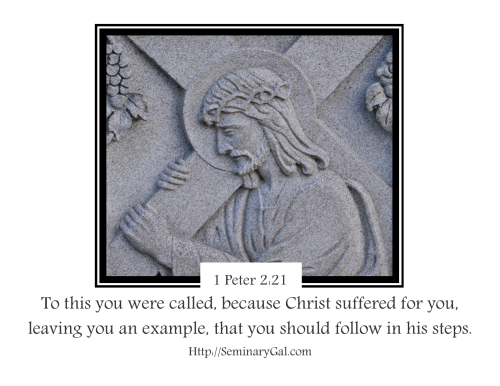
To this you were called, because Christ suffered for you, leaving you an example, that you should follow in his steps. “He committed no sin, and no deceit was found in his mouth.” When they hurled their insults at him, he did not retaliate; when he suffered, he made no threats. Instead, he entrusted himself to him who judges justly. (1 Peter 2:21-23)
What’s included in Kingdom vision of suffering?
Expectations: Jesus tells us time and again that in this world we will have troubles. Peter reminds us that suffering (even though we are doing good things) is to be expected; it’s not something strange that’s happening.
Perspective: When we expect to face troubles because we follow a Savior who faced our troubles for us and who set an example for us to follow, we can have the same perspective, adopt the same actions, be on the same time frame, and trust in the same power Jesus trusted.
Actions: Here is one of the keys for people who are doers by nature. We cannot do what our flesh tells us to do. We must rise above. Our actions must reflect the Christian way and not the world’s way of dealing with things.
Time Frame: This is where so many of us fall short in having the kind of Kingdom vision God wants as our Christian Guide to Overcoming. We want results and we want them now. We don’t want to stand in the place of discomfort or suffering.
Kingdom Power: So to the final step exemplified by Christ involves entrusting ourselves to the One who judges justly. Yes, it is hard to let go of our ideas of justice and our ideas of vindication and let God do what only God can reasonably do: Be the Perfect Ultimate Judge.
Yes, when we have Kingdom vision like Jesus—when we follow in His steps—we can overcome the sufferings of life. Over the next few posts we’ll see how Kingdom vision specifically applies to what you may be going through. But for today, it’s enough to remember that Kingdom vision like Jesus had is better by far than the world’s way. It is our Christian Guide to Overcoming.
Are you facing injustice? Adversity? Anger? Sadness? Disillusionment? Prejudice? Persecution? Frustration? Disenfranchisement? Are you tired of being misunderstood? Put down? Unappreciated? Pigeon-holed? Unwelcome? Judged? Are you waking up every day and looking in the mirror at an illness that threatens to rob you of all joy the same way it robs you of energy and stamina? Is it getting hard to persevere because of the pain, the sadness of the diagnosis, a fear of the future, or the uncertainty of a recovery? This post is for you. It will unfold over the next few days under the overall theme of A Christian Guide to Overcoming.
 We’ll start off with overcoming in general and work our way into overcoming difficult contemporary issues. I’ve decided to adopt this approach because:
I have asserted elsewhere that the Gospel is the only thing that will change people and/or their circumstances. External efforts, I’ve suggested, may have some ability to mask whatever is going on, but true change and genuine overcoming is an internal thing. It happens in our hearts. And it happens because of Jesus.
I have told you these things, so that in me you may have peace. In this world you will have trouble. But take heart! I have overcome the world.” (John 16:33)
I never stopped to pay attention before. It’s been there in front of my eyes all along.
“I have overcome the world.”
It sounds like it’s already been done.
But, wait! Jesus said this in His farewell discourse (John 13:31-17:26). Before the scourging. Before the crown of thorns. Before the Cross. Before Jesus’ death. Before His resurrection. Before the discovery of the empty tomb. Before Jesus’ ascension. Before all of this, “I have overcome the world.”
How is this possible?
Jesus says [comments inserted], I have told you… [in the past but you’ll carry these teachings with you] so that [here’s the purpose of all My teachings] in Me you may have peace [the result of My teaching you is so that you’ll be able to find peace that is only knowable in Me. Why will this peace of God and peace with God come in handy? Well, suffering and persecution are headed your way as Christians]. In this world, you will have trouble [in English it sounds future, but we can take it as a given, automatic! Trouble equals normal, it’s not just some avoidable future thing though the translation says “will have”…it’s really more expected than that] But [this is a command] take heart! [Our commanded to-do list is rather short in all of this. It’s variously translated, Take heart! Take courage! Be brave! Be encouraged! Be of good cheer! Take hope!] I have overcome the world.
But how? When did this happen? Why does it read as past tense, already accomplished, even when the Cross was yet ahead for Jesus?
The ministry of Jesus to an ailing world of humanity didn’t begin with His choosing disciples or changing water into wine. John tells us it started long before.
John 1:1 In the beginning was the Word, and the Word was with God, and the Word was God. 2 He was with God in the beginning. 3 Through him all things were made; without him nothing was made that has been made. 4 In him was life, and that life was the light of men. 5 The light shines in the darkness, but the darkness has not understood it. 6 There came a man who was sent from God; his name was John. 7 He came as a witness to testify concerning that light, so that through him all men might believe. 8 He himself was not the light; he came only as a witness to the light. 9 The true light that gives light to every man was coming into the world. 10 He was in the world, and though the world was made through him, the world did not recognize him. 11 He came to that which was his own, but his own did not receive him. 12 Yet to all who received him, to those who believed in his name, he gave the right to become children of God– 13 children born not of natural descent, nor of human decision or a husband’s will, but born of God. 14 The Word became flesh and made his dwelling among us. We have seen his glory, the glory of the One and Only, who came from the Father, full of grace and truth. 15 John testifies concerning him. He cries out, saying, “This was he of whom I said, ‘He who comes after me has surpassed me because he was before me.'”
Trouble started when we rejected God’s command in Eden. But the good news of the Gospel is that we will have peace in every trouble by looking to Jesus, and our being found in Him. He is the Word made flesh, the source of all overcoming, and the author and perfecter of our faith. Yes, there will still be troubles facing Christians and everyone else in the brotherhood of man, but the Gospel can answer each of these troubles. Over the next few posts, we’ll explore how.
The Word of God, Jesus Messiah, and our trusting in God have been our victory all along. It is the Word that creates and gives life. It is the Word that brings light and delivers us out of the darkest circumstances. It is the Word we must obey. It is the living Word–Jesus Christ, the Son of God–who gives us all we need to overcome.
I’m glad you all like the hymn series we’ve been doing lately. They minister to my soul as well. It also helps me to see how many Overcomers have been in this world. It’s kind of like what God says about our Christian faith:
Hebrews 12:1 Therefore, since we are surrounded by such a great cloud of witnesses, let us throw off everything that hinders and the sin that so easily entangles, and let us run with perseverance the race marked out for us. 2 Let us fix our eyes on Jesus, the author and perfecter of our faith, who for the joy set before him endured the cross, scorning its shame, and sat down at the right hand of the throne of God. 3 Consider him who endured such opposition from sinful men, so that you will not grow weary and lose heart.
The Christian life is difficult. But we can gain encouragement to keep the faith from saints and Overcomers who have gone before us.
Today, consider George Matheson who was blind and suffered from periods of mental suffering. Yet one of his hymns “O Love that Wilt Not Let Me Go” is one of the most beloved hymns of the Church. According to the cyberhymnal, Matheson said about this hymn:
My hymn was composed in the manse of Innelan [Argyleshire, Scotland] on the evening of the 6th of June, 1882, when I was 40 years of age. I was alone in the manse at that time. It was the night of my sister’s marriage, and the rest of the family were staying overnight in Glasgow. Something happened to me, which was known only to myself, and which caused me the most severe mental suffering. The hymn was the fruit of that suffering. It was the quickest bit of work I ever did in my life. I had the impression of having it dictated to me by some inward voice rather than of working it out myself. I am quite sure that the whole work was completed in five minutes, and equally sure that it never received at my hands any retouching or correction. I have no natural gift of rhythm. All the other verses I have ever written are manufactured articles; this came like a dayspring from on high.
O Love that wilt not let me go,
I rest my weary soul in thee;
I give thee back the life I owe,
That in thine ocean depths its flow
May richer, fuller be.
O light that followest all my way,
I yield my flickering torch to thee;
My heart restores its borrowed ray,
That in thy sunshine’s blaze its day
May brighter, fairer be.
O Joy that seekest me through pain,
I cannot close my heart to thee;
I trace the rainbow through the rain,
And feel the promise is not vain,
That morn shall tearless be.
O Cross that liftest up my head,
I dare not ask to fly from thee;
I lay in dust life’s glory dead,
And from the ground there blossoms red
Life that shall endless be.
The hymn “Joyful, Joyful, We Adore Thee” is actually a well-known classical composition by Ludwig van Beethoven (1770–1827) arranged with hymn lyrics.
The lyrics were written in 1907 by Henry J. van Dyke. About the lyrics, he wrote:
These verses are simple expressions of common Christian feelings and desires in this present time—hymns of today that may be sung together by people who know the thought of the age, and are not afraid that any truth of science will destroy religion, or any revolution on earth overthrow the kingdom of heaven. Therefore this is a hymn of trust and joy and hope.
This is the light in which I include “Joyful, Joyful” in Overcomer’s Week. Opposition to the Christian worldview can seem to come in the form of scientific discoveries or political realities, but the true Overcomer sees all of this in light of the Kingdom. We need neither to hide from these realities nor to fear them. We trust in God. We remain joyful in hope; patient in affliction; and faithful in prayer (Romans 12:12).
It is fitting, therefore, that Edward Hodges adapted Beethoven’s beautiful Symphony No. 9 in D minor, Op. 125, specifically the “Ode to Joy” to form the musical accompaniment to these van Dyke lyrics of hopeful joy. The original lyrics to “Ode to Joy” were from a poem by Friedrich Schiller on the universal brotherhood of man under a benevolent Creator.
But what’s beyond remarkable was the way in which this lovely symphony was composed by another Overcomer. Beethoven began to lose his hearing in 1796, at around age 26. By the time he composed Symphony No. 9 in D minor, Op. 125, he was completely deaf. Many music critics believe this final complete Beethoven symphony to represent the pinnacle of his symphonic achievements. Others believe that is too little praise for a work such as this. They consider “The Symphony of Joy” or simply “The Chorale” to be the greatest musical piece of all time.
Hymn or poem, set to the loveliest classical composition, it is among my favorites written by Overcomers.
Joyful, joyful, we adore Thee, God of glory, Lord of love;
Hearts unfold like flowers before Thee, opening to the sun above.
Melt the clouds of sin and sadness; drive the dark of doubt away;
Giver of immortal gladness, fill us with the light of day!
All Thy works with joy surround Thee, earth and heaven reflect Thy rays,
Stars and angels sing around Thee, center of unbroken praise.
Field and forest, vale and mountain, flowery meadow, flashing sea,
Singing bird and flowing fountain call us to rejoice in Thee.
Thou art giving and forgiving, ever blessing, ever blessed,
Wellspring of the joy of living, ocean depth of happy rest!
Thou our Father, Christ our Brother, all who live in love are Thine;
Teach us how to love each other, lift us to the joy divine.
Mortals, join the happy chorus, which the morning stars began;
Father love is reigning o’er us, brother love binds man to man.
Ever singing, march we onward, victors in the midst of strife,
Joyful music leads us Sunward in the triumph song of life.
If we’re going to talk about overcomers, let’s not forget William Walford who penned “Sweet Hour of Prayer”.
Christianity.com records his story this way:
William Walford was blind, but this did not make him worthless. On the contrary, as he sat by the fire in his English home in the mid-nineteenth century, his hands kept busy, whittling out useful objects, such as shoehorns. His mind was active, too.
Called on to preach from time to time in a rural English church, he composed sermons in his head to deliver on Sundays. He memorized a huge amount of the Bible which he quoted verbatim in his sermons. Some of his folk thought he had memorized the entire Scripture, cover to cover. William also composed lines of verse. And he prayed.
Thomas Salmon, a New York native, spent some time in Coleshill, Warwickshire, England, where he became acquainted with William. He tells this tale of what happened one day, while he was visiting the blind pastor:
“…He repeated two or three pieces which he had composed, and having no friend at home to commit them to paper, he had laid them up in the storehouse within. “How will this do?” asked he, as he repeated the following lines, with a complacent smile touched with some light lines of fear lest he subject himself to criticism. I rapidly copied the lines with my pencil, as he uttered them, and sent them for insertion in the Observer, if you should think them worthy of preservation.”
The Observer did consider them worth preserving, and they were published on this day, September 13, 1845, becoming a beloved hymn.
Sometimes those with the most to overcome have a connection to the spiritual realm in ways that people with more distractions and fewer genuine concerns do not. Imagine what the Scriptures would be like had there been no lame or blind or mute to heal.
John 9:1 As [Jesus] went along, he saw a man blind from birth. 2 His disciples asked him, “Rabbi, who sinned, this man or his parents, that he was born blind?” 3 “Neither this man nor his parents sinned,” said Jesus, “but this happened so that the work of God might be displayed in his life.”
Sweet Hour of Prayer is such a beautiful hymn–a work of God in the life of a blind man.
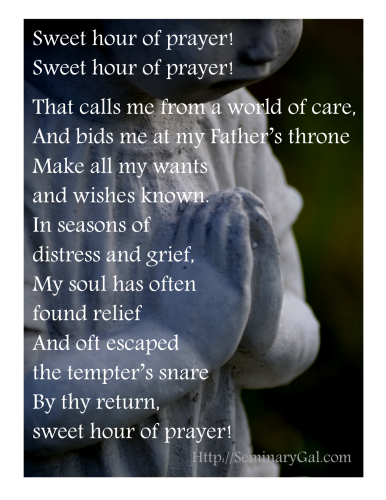
Sweet hour of prayer! sweet hour of prayer! That calls me from a world of care, And bids me at my Father’s throne Make all my wants and wishes known. In seasons of distress and grief, My soul has often found relief And oft escaped the tempter’s snare By thy return, sweet hour of prayer!
Sweet hour of prayer! sweet hour of prayer! The joys I feel, the bliss I share, Of those whose anxious spirits burn With strong desires for thy return! With such I hasten to the place Where God my Savior shows His face, And gladly take my station there, And wait for thee, sweet hour of prayer!
Sweet hour of prayer! sweet hour of prayer! Thy wings shall my petition bear To Him whose truth and faithfulness Engage the waiting soul to bless. And since He bids me seek His face, Believe His Word and trust His grace, I’ll cast on Him my every care, And wait for thee, sweet hour of prayer!
Sweet hour of prayer! sweet hour of prayer! May I thy consolation share, Till, from Mount Pisgah’s lofty height, I view my home and take my flight: This robe of flesh I’ll drop and rise To seize the everlasting prize; And shout, while passing through the air, “Farewell, farewell, sweet hour of prayer!”
As the next installment in my personal calendar’s Overcomer’s Week, I offer “Swing Low, Sweet Chariot.” The Encyclopedia of Oklahoma History and Culture recounts the story of how Wallis Willis (Uncle Wallace), a Choctaw freedman, and his wife (Aunt Minerva) came to have their “Swing Low, Sweet Chariot” transcribed as a hymn. Slaves and former slaves certainly had their share of overcoming to do. This historic Spiritual is widely thought to refer not only to the prophet Elijah’s being taken up into heaven by a chariot (2 Kings 2:11), but also to the Underground Railroad, the resistance movement helping many slaves overcome as they escaped from the South to the North (and Canada).
Wallis Willis composed other “plantation songs” as well. “Steal Away to Jesus” obviously speaking of going home to Jesus at the trumpet sound, but is also thought to refer to the Underground Railroad. Both were popularized by the Jubilee Singers from Fisk University who were raising funds for education among the Choctaw freedmen.
Music has a way of encouraging us as we persevere. Enjoy this version of “Swing Low, Sweet Chariot” sung by Kathleen Battle and the Boys Choir of Harlem.
Well, I looked over Jordan and what did I see, Comin’ for to carry me home, A band of angels comin’ after me, Comin’ for to carry me home.
Chorus: Swing low, sweet chariot, Comin’ for to carry me home, Swing low, sweet chariot, Comin’ for to carry me home.
Well, If you get there before I do, Comin’ for to carry me home, Tell all of my friends that I’m a-comin’ too, I’m comin’ for to carry me home. Chorus.
As you’ll soon be able to tell, I am embarking upon my unofficial “Overcomer’s Week.” It’s not on everyone’s wall calendar, but it sure is on my personal calendar these days. I cannot tell you how many people have recently asked me how I overcome disappointments, anger, stereotypes, etc. without giving in to the temptations to throw in the towel. I’m presently in the process of writing an article on overcoming difficulties by the Gospel, and I’m finding inspiration–not only in Scripture–but in classic hymns like “Just as I Am.” (click to listen).
The hymn’s writer, Charlotte Elliot, became an invalid at the age of 19. Joni Eareckson Tada tells the following story:
Charlotte Elliot had a severe illness early on in life which left her in great pain and often bedridden. As a young girl, she often became frustrated with her disability, and she would lament that her physical problems left her so out of sorts and irritable. When a visiting preacher shared the Gospel with her, she replied, “Oh, that’s not for me; I’m not worthy; I’m not a very pleasant person.” But the preacher told her, “Oh, Charlotte you should come just as you are.” “Just as I am?” she asked, amazed, which is why, after she opened her heart to Christ, one of the first hymns she wrote was, “Just as I Am.”
So at the age of 32, Charlotte wrote “Just As I Am” as she wrestled with her feelings about the Christian faith in light of her infirmity. William B. Bradbury set the lyrics to music and the hymn was published in 1849. This popular hymn has been translated into many different languages and is frequently played at revivals and crusades during which time many thousands of people have committed their lives to Jesus Christ. Not a bad legacy for a woman who spent the majority of her life suffering.
Just as I am, without one plea, But that Thy blood was shed for me, And that Thou bidst me come to Thee, O Lamb of God, I come, I come.
Just as I am, and waiting not To rid my soul of one dark blot, To Thee whose blood can cleanse each spot, O Lamb of God, I come, I come.
Just as I am, though tossed about With many a conflict, many a doubt, Fightings and fears within, without, O Lamb of God, I come, I come.
Just as I am, poor, wretched, blind; Sight, riches, healing of the mind, Yea, all I need in Thee to find, O Lamb of God, I come, I come.
Just as I am, Thou wilt receive, Wilt welcome, pardon, cleanse, relieve; Because Thy promise I believe, O Lamb of God, I come, I come.
Just as I am, Thy love unknown Hath broken every barrier down; Now, to be Thine, yea, Thine alone, O Lamb of God, I come, I come.
Just as I am, of that free love The breadth, length, depth, and height to prove, Here for a season, then above, O Lamb of God, I come, I come!
The songwriter of Victory in Jesus, Eugene Monroe Bartlett, Sr., was born on Christmas Eve of 1885. At an early age, he received Jesus Christ as his Savior and as he grew, he came to know his calling to publish hymns and teach singers to sight read.
At the age of 36, he established the Hartford Music Institute which was a shape-note school for teaching music. (Shape notes—notes in which the heads were different shapes–were thought at the time to help with congregational singing in churches, particularly if music reading skills were limited).
Bartlett wrote many gospel music favorites which were performed and popularized by leading gospel quartets of their day, including several African-American gospel groups, something quite notable given the day in which Bartlett lived.
His commitment to nurturing the next generation of gospel songwriters and singers was evident in his sponsorship of emerging talent. One of the best known shape note Southern gospel songwriters–Albert E. Brumley—got his start at Bartlett’s Hartford school and was eventually employed by Hartford Music.
In 1939, Bartlett became partially paralyzed due to a stroke, making it impossible for him to continue to perform and travel. However, as is the case with so many people who are devoted to their calling, they rise above their circumstances to create a crowning achievement. Bartlett wrote his last work—and arguably his most beloved song– “Victory in Jesus” while paralyzed. Read the lyrics below in a new light, knowing this backstory. Or listen to the great George Beverly Shea singing this gospel classic by clicking here.
Victory in Jesus
I heard an old, old story,
How a Savior came from glory,
How He gave His life on Calvary
To save a wretch like me;
I heard about His groaning,
Of His precious blood’s atoning
Then I repented of my sins;
And won the victory.
Refrain: O victory in Jesus,
My Savior, forever.
He sought me and bought me
With His redeeming blood;
He loved me ere I knew Him,
And all my love is due Him,
He plunged me to victory,
Beneath the cleansing flood
I heard about His healing,
Of His cleansing power revealing.
How He made the lame to walk again
And caused the blind to see;
And then I cried, “Dear Jesus,
Come and heal my broken spirit,”
And somehow Jesus came and brought
To me the victory.
Refrain
I heard about a mansion
He has built for me in glory.
And I heard about the streets of gold
Beyond the crystal sea;
About the angels singing,
And the old redemption story,
And some sweet day I’ll sing up there
The song of victory.
Refrain
The classic hymn, How Great Thou Art!, has long been many people’s favorite. It has been performed by choirs and popular musicians alike. Today I offer you two links–the cyber-hymnal as usual–and the version performed at the Academy of Country Music Awards with Carrie Underwood and Vince Gill.
(note: I left the link above which does not work because FB’s metaverse for How Great Thou Art says it has been removed for repetitive content. What a world. Try this link for Carrie Underwood and Vince Gill singing the repetitive How Great Thou Art…because God is just that great and we can’t say it or sing it enough!)
O Lord my God, when I in awesome wonder
Consider all the worlds thy hands have made,
I see the stars, I hear the rolling thunder,
Thy power throughout the universe displayed:
Refrain
Then sings my soul, my Savior God, to thee:
How great thou art! How great thou art!
Then sings my soul, my Savior God, to thee:
How great thou art! How great thou art!
When through the woods and forest glades I wander
And hear the birds sing sweetly in the trees,
When I look down from lofty mountain grandeur,
And hear the brook and feel the gentle breeze:
Refrain
And when I think that God, his Son not sparing,
Sent him to die, I scarce can take it in,
That on the cross, my burden gladly bearing,
He bled and died to take away my sin.
Refrain
When Christ shall come with shout of acclamation
And take me home, what joy shall fill my heart!
Then I shall bow in humble adoration,
And there proclaim, My God, how great thou art!
This hymn, Praise the Lord, God’s Glories Show, is a tutorial on praise. If you’re ever stuck in a rut, trying to think about new ideas for praise, this is a great start! Click here to listen.
Praise the Lord, God’s glories show, Alleluia! Saints within God’s courts below, Alleluia! Angels round the throne above, Alleluia! All that see and share God’s love, Alleluia!
Earth to Heaven and Heaven to earth, Alleluia! Tell the wonders, sing God’s worth, Alleluia! Age to age and shore to shore, Alleluia! Praise God, praise forevermore! Alleluia!
Praise the Lord, great mercies trace, Alleluia! Praise His providence and grace, Alleluia! All that God for us has done, Alleluia! All God sends us through the Son. Alleluia!
Strings and voices, hands and hearts, Alleluia! In the concert bear your parts, Alleluia! All that breathe, your Lord adore, Alleluia! Praise Him, praise Him evermore!