Social Justice: Jesus and the Poor Widow

Mark 12: 38 As he taught, Jesus said, “Watch out for the teachers of the law. They like to walk around in flowing robes and be greeted in the marketplaces, 39 and have the most important seats in the synagogues and the places of honor at banquets. 40 They devour widows’ houses and for a show make lengthy prayers. Such men will be punished most severely.” 41 Jesus sat down opposite the place where the offerings were put and watched the crowd putting their money into the temple treasury. Many rich people threw in large amounts. 42 But a poor widow came and put in two very small copper coins, worth only a fraction of a penny. 43 Calling his disciples to him, Jesus said, “I tell you the truth, this poor widow has put more into the treasury than all the others. 44 They all gave out of their wealth; but she, out of her poverty, put in everything– all she had to live on.”

 After Jesus excoriates the teachers of the law for devouring widows’ houses, why did Jesus let the poor widow put money into the temple treasury?  (It was all she had to live on.)

Jesus was not a disinterested observer.  He was watching the crowd put their money in and was carefully considering what was happening.

He saw rich people throw in large amounts of money, yet He didn’t say anything praiseworthy about their levels of contribution.  There were many rich people, yet He didn’t say anything comparing two rich people, assessing their relative levels of giving.

Then toddles up the poor widow.  She puts in a relative pittance—a fraction of a penny.  Why didn’t Jesus stop her?  Doesn’t He care about the poor?  If He knew it’s all she had to live on, why didn’t He tell her not to do it—to keep that money because she had nothing else?

The truth is that Jesus doesn’t view the poor the way we do. 

He doesn’t see rich as good and poor as bad (a status needing correction).  Nor does He condemn the rich as bad (needing to get religion) and glorify the poor as good (morally better). 

That’s a human assessment made by people preoccupied with money and engaging in prideful, often self-serving comparisons.  We categorize rich and poor and may even assign a morality to them basis the amount of money they have.

If anything, Jesus considers the rich to be under a far greater burden because the rich have the means not to depend on God at all.  The poor of our world are often far happier than the rich of our world.  Why is that?

Perhaps before we go beyond helping to alleviate poverty—which is definitely a Christian thing to do—and attempt to do something Jesus Himself did not do (though He is God, sinless and perfect) by giving them sufficient money to elevate their living status to middle-class or rich, maybe it’s good to ask ourselves why Jesus didn’t do that when He walked the earth.  Pause and think on that one awhile.

In the temptations of Jesus, we read:

 “Again, the devil took him to a very high mountain and showed him all the kingdoms of the world and their splendor.  “All this I will give you,” he said, “if you will bow down and worship me.”  Jesus said to him, “Away from me, Satan! For it is written: ‘Worship the Lord your God, and serve him only.'” (Matthew 4:8-10)

Desiring riches and splendor can lead to temptation and worship of the wrong things and that will only get any of us in trouble.  Jesus knew that for Himself.  Why not us?

The poor certainly hold a special place in God’s heart–I will not argue against that.  Christian compassion should compel us to meet their daily needs of sustenance as the Body of Christ.  However, there must be more to the issue than just money and maybe that’s why Jesus didn’t stop the widow or remove her from that place of dependence upon God.

Proverbs 30:8b “Give me neither poverty nor riches, but give me only my daily bread.”poverty nor riches
Continue Reading

12 Good Questions Everyone Should Ask About Social Justice

This Scripture below is one of the favorites of those whose primary passion is Social Justice.  Read this passage again and there are questions for reflection below.

Matthew 25: 31 “When the Son of Man comes in his glory, and all the angels with him, he will sit on his throne in heavenly glory. 32 All the nations will be gathered before him, and he will separate the people one from another as a shepherd separates the sheep from the goats. 33 He will put the sheep on his right and the goats on his left. 34 “Then the King will say to those on his right, ‘Come, you who are blessed by my Father; take your inheritance, the kingdom prepared for you since the creation of the world. 35 For I was hungry and you gave me something to eat, I was thirsty and you gave me something to drink, I was a stranger and you invited me in, 36 I needed clothes and you clothed me, I was sick and you looked after me, I was in prison and you came to visit me.’ 37 “Then the righteous will answer him, ‘Lord, when did we see you hungry and feed you, or thirsty and give you something to drink? 38 When did we see you a stranger and invite you in, or needing clothes and clothe you? 39 When did we see you sick or in prison and go to visit you?’ 40 “The King will reply, ‘I tell you the truth, whatever you did for one of the least of these brothers of mine, you did for me.’ 41 “Then he will say to those on his left, ‘Depart from me, you who are cursed, into the eternal fire prepared for the devil and his angels. 42 For I was hungry and you gave me nothing to eat, I was thirsty and you gave me nothing to drink, 43 I was a stranger and you did not invite me in, I needed clothes and you did not clothe me, I was sick and in prison and you did not look after me.’ 44 “They also will answer, ‘Lord, when did we see you hungry or thirsty or a stranger or needing clothes or sick or in prison, and did not help you?’  45 “He will reply, ‘I tell you the truth, whatever you did not do for one of the least of these, you did not do for me.’ 46 “Then they will go away to eternal punishment, but the righteous to eternal life.

So, to all you Political Social Justice folks out there, I have some questions:

  1. People will be separated, one from another.  How will Jesus judge those who paid their taxes and then stepped back, not wanting to get their hands dirty and instead, delegated it to the government to pay for food, water, clothing, housing, health insurance, and do prison visits?  Does delegation count?
  2. Who in the government bureaucracy will be the sheep: all the ones who touched the money all along the way, or only the last handler of it before it reached the hungry, thirsty, stranger, etc.?  Will it be fair that the last handlers would be in a job that allows them to be sheep while the rest of the people who cared just as much are punished for being earlier in the distribution process?  What happens if the last handler or anyone along the way didn’t really care, but it was just a job?  Do they get to be sheep, too?
  3. Does the Scripture passage say to alter the needy person’s station in life or simply provide for their needs-of-the-moment as a demonstration of love for the King?
  4. Does this passage tell us to take money from our neighbor’s bank account so they will do what we think they should do by caring for others?  Or does it adopt more of a “You feed them” approach where each of us takes a very individual, active, and personally sacrificial interest in our fellow man?  Furthermore, do our good intentions count if we use our neighbor’s money to do it instead of our own?
  5. What does it mean that these people being served are Jesus’ brothers?  Are we all Jesus’ brothers in the same way, or is there a family of man and a family of God?
  6. Each human is made in the image of God.  How does doing something for someone translate over to doing it for Jesus?
  7. Are there geographical lines to our helping in this situation above?  If Jesus died for the US government to provide for US citizens (and possibly illegal immigrants), why do we draw national boundaries in our provision?  Why not provide also for Canada, Mexico, Central and South America, etc.?  What is our Scriptural reason to draw the lines on the northern and southern borders of the US?
  8. If food stamps and mandated health insurance are Jesus’ preferred means of provision, how do you see the government giving God the glory?
  9. Where is the individual’s joy in all of this by being a cheerful giver?  Do charity and taxation provide equal levels of joy?
  10. We’re not all taxed equally.  Some pay higher rates and end up contributing more government revenue than others.  Will Jesus condemn the person who had no money to sacrificially give to another?  Does He give the poor person a bye because he’s poor in the passage above?
  11. Where is the government in the Scripture above?  Where is the Church?
  12. Does Jesus advocate political/governmental redistribution or charity?  Why?


These are important questions for the person being theologically consistent. 

Maybe today would be a good time to pray about what our obligations are in the brotherhood of man and what they are as Christians in the family of God.

sheep and goats

Continue Reading

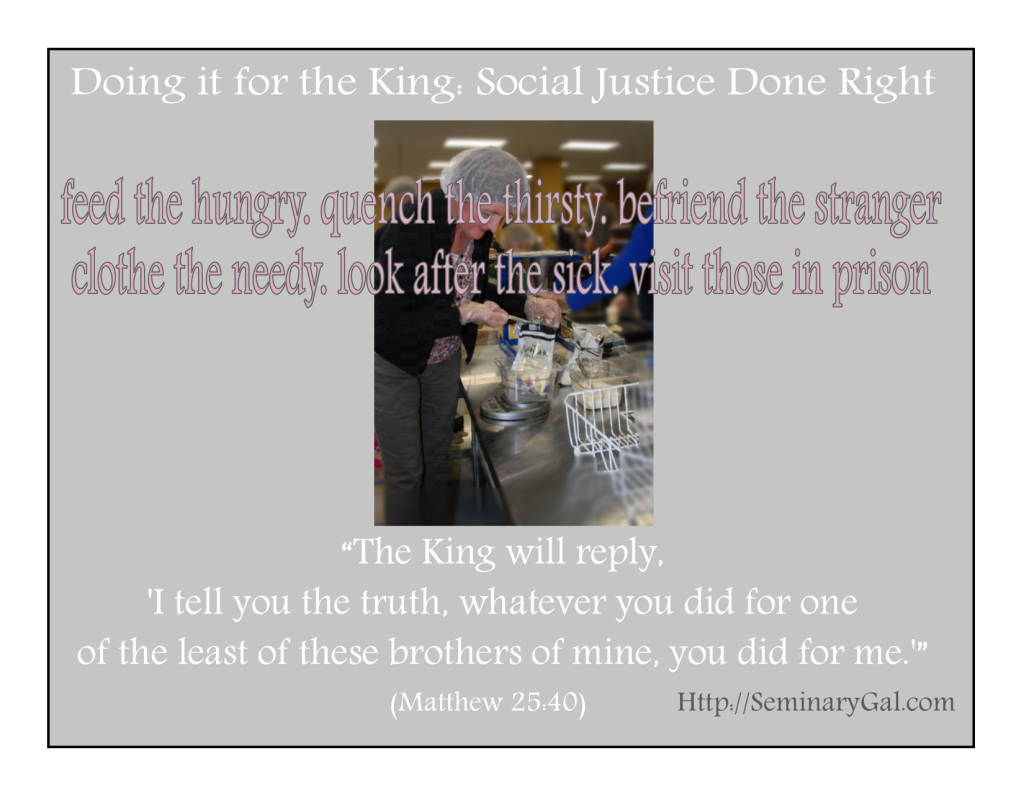
Doing it for the King: Social Justice Done Right

Well, I had a very interesting long weekend.  Not a typical weekend, but a very rewarding one.  I’ve been living in the grace of God, Doing it for the King, and engaging in Social Justice Done Right.

Amid all kinds of talk about whether pastors should be extolling from the pulpit the benefits of government and justice politics with respect to the poor, God has been revealing a better way.  God has been showing me the truly Christian way of Social Justice Done Right, Doing it for the King.

This past weekend was amazing.  It was a long weekend, not because I had time off, but because I had an extended time of active work for the Lord.

I was doing Social Justice Done Right.  As you read below, my point isn’t to brag because none of this stuff originated with me, but it does point out there are beyond ample ways that Christians can do Social Justice Right by Doing it for the King.

On Thursday, I engaged in my first opportunity to “Change the World” with my annual policy of finding whatever spare change is kicking around the house, my purse, the car, etc. and putting it in the Salvation Army buckets each and every time I find one whether anyone was ringing or not.  If I didn’t have any change, a bill of some type goes in.  I tell the ringers, “God bless you!” or “Jesus loves you!” and always “Merry Christmas” and “Thank you!”

Thursday night, my friend began her mission trip to Tanzania with funds many others and I donated throughout the entire year (including a check just this week) and a video on Overcoming Suffering that I made for her to use there since I couldn’t go personally.  The video had been a month in the making and to see it finished and on its way to blessing people encouraged my heart.  The afternoon before they left, I had prayed for my friend, the video, the people traveling, and the people to whom they were ministering.  As she rode to the airport that evening and was waiting to board the plane, I encouraged a few people I knew in their music ministry at my church.  It reminded me that people can be encouraged in many different ways.

Friday rolled around and I was shopping for food for the local food pantry, buying some of every item on the list they gave my husband’s employer for their collection purposes.  My heart was filled with gratitude to God because it is something I can do.  It reminded me of the moment that Jesus turned to the disciples and said,

 “They do not need to go away. You give them something to eat.” (Matthew 14:16)

Amazing!  There are things I can do to give people something to eat.  I could also share joy and the gospel with people as Friday continued with more “Change the World,” and buying toys, etc. for Operation Christmas Child (a ministry of Samaritan’s Purse).  The cashier and the people behind me (chuckling about the distinct groupings on the belt) were blessed by my words of gratitude for easy to read receipts and cash register subtotals as I explained I was shopping for people in need.  They all smiled as I said, “God bless you!”

I came home from shopping and unloaded the items onto the table.  I boxed and I sorted and I thought about each man, woman, and child who may come to the food pantry.  I thought about each child receiving a shoebox of happy stuff and the smiles on their faces.  I was happy, too.  I prayed over the items while sorting them into their boxes.  My heart swelled with joy in a way that paying a tax bill to be redistributed could never accomplish.  I was helping in a very direct fashion.

On Saturday, I got a chance to encourage another woman in ministry and did my volunteer work preparing for the chapel services at the hospital on Sunday morning before encouraging two dear friends at their 40th Birthday Bash Out Hunger held at Feed My Starving Children.  I was so excited about being a part of the volunteer ministry of preparing meals to feed the hungry around the world.  My friends chose to have their birthday party in a place where they, too, could do Social Justice Done Right by Doing it for the King.  They asked for no gifts for themselves, but made a point of mentioning the needs of this ministry to feed the poor.  I wrote out a donation check that would help FMSC meet their financial needs.  My friends–because of their beautiful Christian hearts–have a great many friends who joined them, all of us spending 2 glorious hours packing 106 boxes – more than 60,000 meals.  The meals, a Potato-D product, are going to help with feeding the hungry in the Philippines and managing side effects of diseases like cholera that can be deadly, particularly to children and the elderly there in the wake of the super typhoon.  It made me happy to do something for the Philippines.

It was while I was driving there to pack meals that it suddenly occurred to me that God was blessing me with a vision of what the Church—not the institutional church, but the organic church—can do when each person does what he or she can, Doing it for the King.

I don’t mean to imply that the institutional church cannot play a role here, too.  The institutional church can minister to needs by pooling resources and doing things that one individual cannot.  The institutional church can also inspire each of us to do our part in Social Justice Done Right–Doing it for the King by preaching Jesus who said,

 “The King will reply, ‘I tell you the truth, whatever you did for one of the least of these brothers of mine, you did for me.'” (Matthew 25:40)

That is why we also give to our local church even though I’m a self-supported missionary 52 weeks each year at our local hospital ministering to the sick.

I offer this recitation of my long weekend not to brag or to imply that this was a typical weekend by any stretch.  I share this personal vignette of my life because God designed it so beautifully and provided for it as only the King can.  It was a helpful instructive that millions of people–each of whom are doing what they can for the glory of God–can make an immediate and also eternal difference.  I was merely blessed by the many ways God could arrange for each of us to serve.  I remain in awe of the way they converged last weekend for special effect …and also for the joy I had in helping others.

You see, there is no shortage of ways we can help.

(A while back, I wrote a post outlining 50 different ways to live the Risen Life). 

Yes, the needs are great, but our King is greater.  His resources are never-ending. 

He’s just looking for an institutional and organic Church mobilized to take His hope, His help, His healing, His feeding the hungry, and yes, His gospel to a world in need.

doing it for the king pix

Continue Reading

Who is This King of Glory?

I’ve been thinking a lot about God as King.  I feel like we’re repeating history and it’s not good.

There are few passages of Scripture that cut me to the core as this one (especially verses 7 and 22):

1 Samuel 8:1 When Samuel grew old, he appointed his sons as judges for Israel. 2 The name of his firstborn was Joel and the name of his second was Abijah, and they served at Beersheba. 3 But his sons did not walk in his ways. They turned aside after dishonest gain and accepted bribes and perverted justice. 4 So all the elders of Israel gathered together and came to Samuel at Ramah. 5 They said to him, “You are old, and your sons do not walk in your ways; now appoint a king to lead us, such as all the other nations have.” 6 But when they said, “Give us a king to lead us,” this displeased Samuel; so he prayed to the LORD. 7 And the LORD told him: “Listen to all that the people are saying to you; it is not you they have rejected, but they have rejected me as their king. 8 As they have done from the day I brought them up out of Egypt until this day, forsaking me and serving other gods, so they are doing to you. 9 Now listen to them; but warn them solemnly and let them know what the king who will reign over them will do.” 10 Samuel told all the words of the LORD to the people who were asking him for a king. 11 He said, “This is what the king who will reign over you will do: He will take your sons and make them serve with his chariots and horses, and they will run in front of his chariots. 12 Some he will assign to be commanders of thousands and commanders of fifties, and others to plow his ground and reap his harvest, and still others to make weapons of war and equipment for his chariots. 13 He will take your daughters to be perfumers and cooks and bakers. 14 He will take the best of your fields and vineyards and olive groves and give them to his attendants. 15 He will take a tenth of your grain and of your vintage and give it to his officials and attendants. 16 Your menservants and maidservants and the best of your cattle and donkeys he will take for his own use. 17 He will take a tenth of your flocks, and you yourselves will become his slaves. 18 When that day comes, you will cry out for relief from the king you have chosen, and the LORD will not answer you in that day.” 19 But the people refused to listen to Samuel. “No!” they said. “We want a king over us. 20 Then we will be like all the other nations, with a king to lead us and to go out before us and fight our battles.” 21 When Samuel heard all that the people said, he repeated it before the LORD. 22 The LORD answered, “Listen to them and give them a king.”

How incredibly sad!  

Yet, how many of us want God to give us what we want instead of what is best for us?

Do we covet earthly power, forgetting that the sovereign power of God is far greater?  

The Israelites then and we, today, reject God all the time!

  • We reject Him every time we are not thankful for what abundance He has given us or envy what He’s given someone else.
  • We reject Him every time we do not live the way Scripture calls us to live,  passing judgment on His Word as outdated, irrelevant, old fashioned, or passé.
  • We reject Him every time we want to be lords over our own lives and do what we want, when we want.
  • We reject Him every time we hate another person who has been made in God’s image.
  • We reject Him every time we refuse to forgive other people.
  • We reject Him every time we succumb to greed or refuse to care for those whom we know we can (and ought to) help.
  • We reject Him every time we think we can outsmart God.
  • We reject Him every time we want our government to do for us what God wants to do for us when we come to Him in faith.
  • We reject Him every holiday season (whether that holiday is Christmas or Easter) by minimizing the religious significance and the holiness of that holy day, totally missing the etymology of the word itself is from the Old English haligdæg “holy day.”  Commercializing this holy time turns God into nothing more than an excuse to spend money and worship material things.

If Jesus were to return today…as King of Kings and Lord of Lords…would we know Him?  

He was rejected in His humanity in a way He will never be rejected when the last trumpet sounds at His return.  He will not be rejected when He returns in sovereign power with all authority.  

He will be King, Lord, and Judge.  There will be no more excuses to hold water on earth.  There will be no more rationalizations.  There will only be judgment for those of us who persisted in rejecting the King of glory while we had the opportunity in our lives to know Him as King.King of Glory sg

Continue Reading

Advent Devotional Series for 2013: Emmanuel: When LOVE Showed Up In-Person

I am pleased to announce the Advent Devotional Series for 2013 “Emmanuel: When LOVE Showed Up In-Person.”  In the Person of Jesus Christ, that is.

EmmanuelIt is far too easy to let the holidays—the secular term for the holy season of Thanksgiving, Advent, and Christmas—go by with very little thought as to what this time of year would be like had LOVE not shown up.


If Jesus didn’t become flesh. 

If He didn’t leave heaven behind to walk this earth as the man Jesus of Nazareth.

If He wasn’t the Son of God. 

If the manger was empty apart from hay or was filled with just another baby born into a humble existence in the likeness of Adam.

So during this season of Advent, we will walk through selections from the Gospel of John and remember what it means to us today that LOVE showed up, the definition of the first Advent of our Lord and Savior.

This devotional series begins December 1st and continues daily until Christmas.

If you haven’t signed up to receive the daily postings from SeminaryGal, you may sign up either on  Facebook SeminaryGal or use the space provided on the Home Page side bar.  If you already have signed up and are receiving these writings by email, I thank you for the encouragement you are to me!  I look forward to journeying together during Advent as we see “Emmanuel: When LOVE Showed Up In-Person.”

Continue Reading

Love with Actions and in Truth

1 John 3:16 This is how we know what love is: Jesus Christ laid down his life for us. And we ought to lay down our lives for our brothers. 17 If anyone has material possessions and sees his brother in need but has no pity on him, how can the love of God be in him? 18 Dear children, let us not love with words or tongue but with actions and in truth.

The days are short

Continue Reading

Bad Company Corrupts Good Character

We’ve talked so far about the Christian Left as distinct from the Political Left and the same applied to the Christian and Political Right.  There is a reason I’ve been using a train track analogy and today, we’ll explore a particular reason why train tracks accurately depict the interaction between people, God, and the culture.

In a speech to the Temple Israel of Hollywood, Dr. King is quoted as saying,

Oh, I know that there are still dark and difficult days ahead. Before we get there some more of us will have to get scarred up a bit. Before we reach that majestic land some more will be called bad names. Some will be called reds and communists simply because they believe in the brotherhood of man.

With acknowledgment that Dr. King was a man of God whose heart was in the right place and his own eyes were straight ahead, on track as a Christian with God Himself as the goal, the truth is that some in his company were called reds and communists…because they were. They proudly admitted they were.  Their preferences shouldn’t have rubbed off on Dr. King, but it is evidence of how easily Christians can be seen as getting off-track.  Perception–in the eyes of many people–becomes reality.

In a strange little discourse hidden in 1 Corinthians, the Apostle Paul describes what happens when Christians get off track.

1 Corinthians 15:30 And as for us, why do we endanger ourselves every hour? 31 I die every day– I mean that, brothers– just as surely as I glory over you in Christ Jesus our Lord. 32 If I fought wild beasts in Ephesus for merely human reasons, what have I gained? If the dead are not raised, “Let us eat and drink, for tomorrow we die.” 33 Do not be misled: “Bad company corrupts good character.” 34 Come back to your senses as you ought, and stop sinning; for there are some who are ignorant of God– I say this to your shame.

bad companyYou see, it’s really easy to find oneself so focused on the Christian Left rail or the Christian Right rail that we are completely unaware that those with totally different goals have swooped in alongside and thrown the switch on our train tracks until we are no longer headed toward God as a destination.
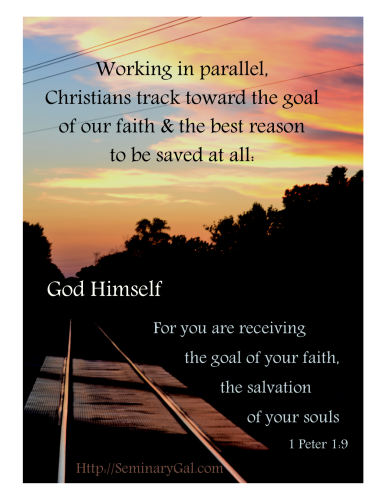
When the switch is thrown, we may not know this right away, but eventually we discover we have abandoned God in favor of different goals altogether.  Indeed, “Bad company corrupts good character.”

Follow the notion of Community—off the mainstream Christian ideal of community as the Church—and become so focused on the left rail instead of on God and where does it lead us?  It leads us aside to the Political Left for whom social justice, environmental stewardship, sexual freedom, and loving humanity, etc. become goals in themselves—apart from God.  It’s a human-centered idolatry that removes God from the center and corrupts good character.   Dr. Martin Luther King may have kept his own eyes on God at the end of the track, but those with whom he partnered carried a movement God was initially “in”—so far off-track—that civil rights and issues of fairness became the primary drivers instead of the God of Christianity.  The means had become the end and his partners had left Dr. King behind though he remained the figurehead.  It’s really sad on many different levels.

To all of us in the Christian mainstream, I implore you to keep your eyes on God Himself. 

Take stock of the track you’re following.  Keep careful guard over the company you’re keeping and who you allow to take the reins of the ministry work you do. 

Consider seriously this fact about confusing the ends with the means:

Take the Spirit of Life—Jesus Himself—out of an issue and frankly, it’s dead.

Yes, it applies to the Christian Left but it equally does to the Christian Right.  Follow the notion of Individual—off the Christian ideal of each member of the Body of Christ—and become so focused on the right rail instead of on God and where does this lead us?  Someone pulls the switch and it leads us to the Political Right for whom a human-centered selfish idolatry takes over.  Rugged individualism apart from God leads us way too easily to an “Am I my brother’s keeper?” mentality.  Individualism plus money minus God leads to greed.  It’s serving Mammon instead of God because you can’t serve both.  It leads us to not caring what happens to others so long as it doesn’t impact us.  Looking out for Number One was never Jesus’ motto.  Looking out for the interests of others is more like it.

When we get off-track, though, we can err on either side.  Sacrificing the community for the sake of the individual is every bit as wrong as caring so much about community that we sacrifice individuals for the sake of the many.

We must endeavor–as the Christian mainstream–not to get sidetracked onto other tracks with goals other than God.  It is not easy, particularly the better known and more effective the ministry or church gets.  But by keeping our eyes on the goal of God instead of on the rail, we won’t get carried off-track which happens easily because Bad Company Corrupts Good Character.

===

This series included

http://seminarygal.com/understanding-the-christian-left/

http://seminarygal.com/understanding-the-christian-right/

http://seminarygal.com/bad-company-corrupts-good-character/


Continue Reading

Staying on Track as Christians

Last week we were using a train track analogy to look at the priorities of the Christian Left and the Christian Right.  Both priorities are completely Christian and valid.  Both are necessary for the Body of Christ to do the work God has called us to do.  We cannot look at the rail opposite our own and believe those who follow it are unnecessary.  We cannot believe they are unbiblical simply because they are not like us.

 We need each other.  In the words of a few of my seminary professors, “We are better together.”

Yes, indeed, we are!  Furthermore, we need to be together in order to be better.

So, going back to our train track analogy, if there’s a left rail (Community) and a right rail (Individual), what holds the track together?  Jesus Christ, the Living Word.

In actual train tracks, what keeps the rails attached together?  The ties and the spikes.

But they must be secure upon a good foundation.  It needs to be solid as a rock. The rock foundation can withstand the weight of the freight.  Think about it: Rails secured to a foundation of shifting sand would never be able to keep the train from derailing.

The stability of the tracks depends on the foundation. 

What is our foundation?  The Word of God.

train1Building on a solid foundation, there are railroad ties that span the width of the tracks, in order to keep the rails parallel, heading toward the very same goal.  Railroad ties are like planks in our theology.  Like sound doctrine.
Tied together and working in parallel, we head toward the same goal of God Himself.  The Church makes progress toward doing God’s will—together!

With a solid foundation and precision ties that span the breadth, the rails are then secured to the ties-that-bind with spikes. Think of the spikes as the nails through Jesus’ hands.  If this is what it took on the Cross to secure the rails…onto the ties… built on the same foundation for the Christian Left and the Christian Right, shouldn’t we be willing to work together for His glory’s sake?

Jesus died for both the community of believers known as the Church, but also for the individual person who repents and confesses the Name of Jesus Christ as Lord and Savior.

Solid foundation of the Word of God. Ties of sound doctrine binding Christian to Christian.  Spikes securing us in the Body of Christ as community and as individuals.  This is how Christians can avoid derailing our faith.  We can be staying on track, all the way to the salvation of our souls.

1 Peter 1:8 Though you have not seen him, you love him; and even though you do not see him now, you believe in him and are filled with an inexpressible and glorious joy, 9 for you are receiving the goal of your faith, the salvation of your souls.

Continue Reading

Understanding the Christian Right

Most people don’t have a hard time acknowledging the existence of the Christian Right even if they find it irksome.  The Christian Right ranks in popularity along with Brussels sprouts and Lima beans among a wide swath of American culture.  If you stop to analyze it with civility—as we did with the Christian Left—we will find that this annoyance is really unfounded.

Just as we said regarding the Christian Left, the Christian Right should not be confused with the Political Right. 

To be fair in my exposition, the Political Right is comprised of those called right-wingers, conservatives, Tea Party activists, capitalists, nationalists, and yes, even fascists (which I personally don’t see, but on a traditional left-right spectrum of political ideology it’s shown as the far right and I’m trying to stay honest here).

Though the Political Right and the Christian Right are distinct, they too have certain things in common.  There is a notable exception: The Christian Right believes in Jesus Christ as their Lord and Savior.

Therefore, no matter how annoyed the Political Left gets with the Political Right, the Christian Left should do more than tolerate–they should embrace the Christian Right as the valued corrective to a view of the Christian faith that exalts community at the expense of the individual.

Going back to our train track analogy from yesterday, if the left rail could be labeled Community, the right rail could be labeled Individual.  To the Christian Right, the world isn’t divided into classes (e.g. rich, poor, Jew, Greek, slave, free), the world is comprised of individuals, each of whom matter to God.

Whereas the Christian Left is enamored with community, the Christian Right (populated significantly by Protestants) prioritizes individual decisions and each being born again into the family of Christ.  While Jesus is returning for a community of disciples, He is also returning for you and for me within that body called the Church.  It is significant that our names are listed individually in the Lamb’s Book of Life.

Because the right rail lifts the individual along the path to our common destination, God Himself, the Christian Right is deeply concerned with evangelization and the truth of the Gospel as the best way of growing the community, one soul at a time.  The Christian Right sees teaching, preaching, and evangelism as the best means to bring the individual to knowledge of Christ and a personal saving relationship.

The Christian Left needs the Christian Right to remind themselves that we’re not dealing with masses of people in a huddle to be fed with earthly food and that’s where compassion ends.  Rather, we minister to a mass of individuals who need spiritual sustenance as a valid priority.  Let’s face it: With or without salvation, death happens to everyone.  Whether one dies from starvation at age 12 or from diabetes at age 102, what the individual did with Jesus Christ makes an eternal difference.

Romans 2:6 God “will give to each person according to what he has done.” 7 To those who by persistence in doing good seek glory, honor and immortality, he will give eternal life.

Therefore, let’s not judge the Christian Right harshly for having each individual as a priority.  Charity alone isn’t the final measure of compassion.  Giving one person the Gospel truth can change that soul’s eternal destination in a way that a bowl of rice—while helpful in the moment of the flesh—cannot.

The Christian Left needs the Christian Right for this reason.  Arm in arm and shoulder-to-shoulder we can stay on track to our eternal goal: God’s presence.  We can help one another to stay focused on the author and perfecter of our faith—Jesus—as we build a community of individuals, ministering to their physical needs and giving them spiritual food that comes by way of teaching them eternal Truth.

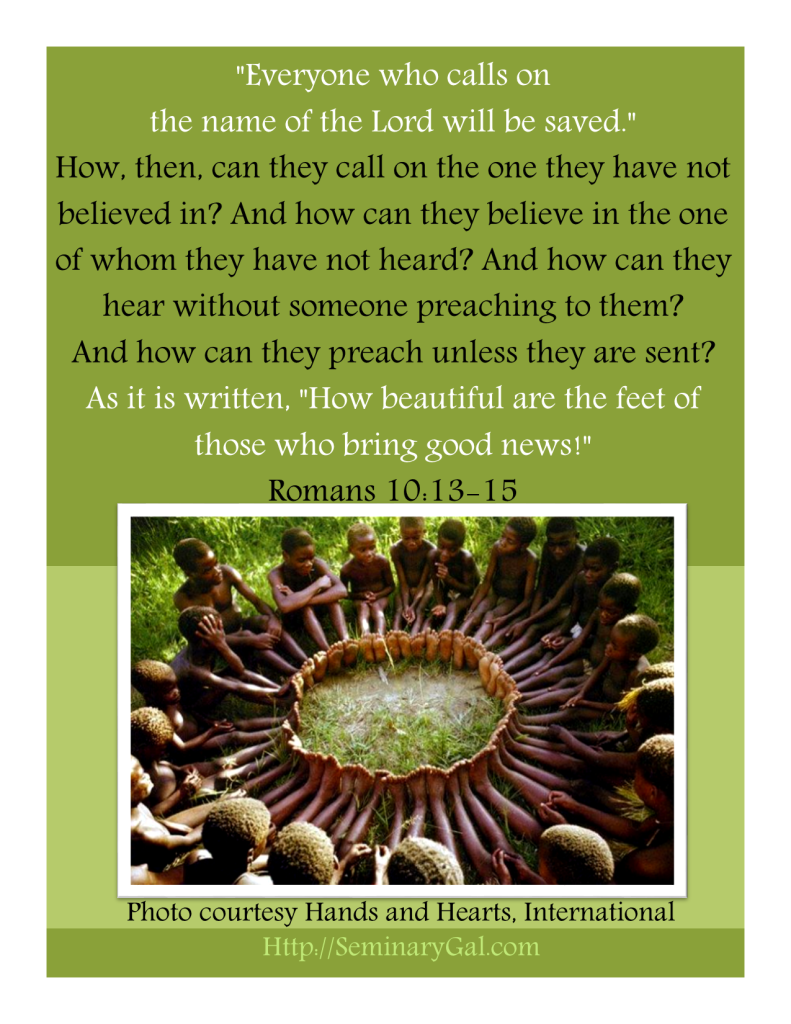
Romans 10:12 For there is no difference between Jew and Gentile– the same Lord is Lord of all and richly blesses all who call on him, 13 for, “Everyone who calls on the name of the Lord will be saved.” 14 How, then, can they call on the one they have not believed in? And how can they believe in the one of whom they have not heard? And how can they hear without someone preaching to them? 15 And how can they preach unless they are sent? As it is written, “How beautiful are the feet of those who bring good news!”

===

This series included

http://seminarygal.com/understanding-the-christian-right/

http://seminarygal.com/understanding-the-christian-left/

http://seminarygal.com/bad-company-corrupts-good-character/


beautiful feet

Continue Reading

Understanding the Christian Left

Does the Christian Left actually exist, or is it an oxymoron like “wise fool” or “jumbo shrimp”?

The Christian Left surely exists—it is no oxymoron—and today, I’d like to suggest that it’s a matter of Christian priorities.  Understanding the Christian Left benefits the Body of Christ as we embrace a wider theological perspective.

Let’s start with an important distinction: The Christian Left is not the same as the Political Left which frequently doesn’t like Christianity and the Bible a whole lot, in general. 

For the Political Left (often known as Liberals, Progressives, Greens, Lefties, Leftists, Socialists, Communists, etc) there is a priority of political power concerns in a world regardless of any involvement of any god.  They are characterized by their belief in the power of government to make the human condition better.

The Christian Left has some characteristics in common with the Political Left, with one important exception:  The Christian Left, being Christian, believes in Jesus as the Son of God.

In a separate post, I’ll elaborate on the problems we get when we conflate the Christian Left with the Political Left and do the same thing with the Christian Right and the Political Right.  We will also look at how politics and religion are lenses through which we see the world and how the priority and ordering of these lenses makes a significant difference.  Conflating politics and religion is poor policy and brings out the worst in people.  For now, I’d like to bring the discussion through the route of civility.

Let’s consider train tracks as an analogy:

There are two steel rails for most track trains (for our purposes, we won’t consider monorails).  There is a left rail and a right rail, both of which acting in parallel, head toward the same goal.  For the Christian, our Christian roundhouse is God Himself.  He is our goal; His presence is our destination; He owns the tracks; and He maintains the tracks in accordance with His best practices to ensure that no derailments occur.

For the Christian fellowship of believers, the left rail can be labeled “Community.”  The left rail cares deeply about the entire community of believers and those who will become believers.  The left rail is moved with great empathy and compassion for the poor and disenfranchised, desiring to bring them into community and to minister to their needs.  They are drawn to social causes and want to do good to the brotherhood of man.

When Jesus ReturnsIn his book, Five Great Catholic Ideas, Edward Wm. Clark outlines one of the central tenets of the Christian movement, embraced particularly by Roman Catholics (and I would add the Christian Left):

“We are saved in community.”

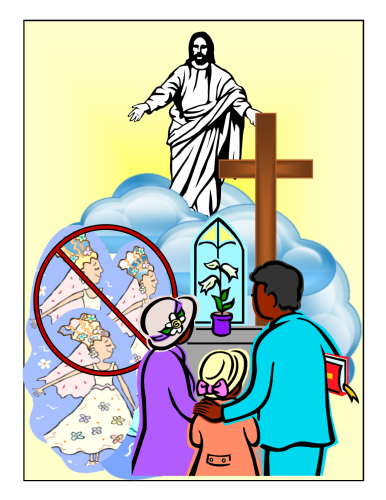
I say it is a Christian tenet because when Jesus returns, He’s not coming for a bunch of brides, but A Bride: His Church. 

He’s returning to gather a Community and bring us to be with Him forever.  Yes, the community has individuals and we’ll talk about that in another post, but for now, let’s just all agree that He’s not returning for one or many individuals acting in solo effort, but for one community of unified disciples known as the Body of Christ, or alternatively, the Church.

The Christian Left gets this. 

We’re a Community. We will be saved as a Community of followers. 

We should care about Community and about brothers and sisters, no matter where in the world they reside. 

It matters what happens to other people because it’s both our witness and an expression of our love.  The Christian Right needs the Christian Left’s heightened emphasis on community as a great reminder, holding the train on the track as together, we head toward the goal of Christlikeness.

Christian Left and Christian Right–we are one body.  And we are called to peace.

===

This series included

http://seminarygal.com/understanding-the-christian-left/

http://seminarygal.com/understanding-the-christian-right/

http://seminarygal.com/bad-company-corrupts-good-character/

one body called to peace


Continue Reading