The Lasting Fruit of Love

The Christian’s purpose in life is to bear lasting fruit of faith and love.  This next passage points that out and is a fitting conclusion to our look at “By Their Fruit.”

Abide in Christ, produce His fruit.
The Christian’s entire “purpose driven life” is stated in verse 16-17. 
If you’re a Christian, you’ve been appointed.  Be faithful.  Just do it. 
It’s your calling to love others as Jesus loved you.

The fruit that lasts is love, the visible evidence in our actions of our heart’s hidden faith.  You may have heard the song, “They’ll know we are Christians by our love…” or have heard that we can only bring 3 things into heaven: our testimony, our works of love, and other people who became disciples.  Any other fruit may disappear when our work is tested by fire.  Your job? Gone. Your investments? Gone. Your home decorating, cooking blog, or Etsy handiwork? Gone. Your exotic cars, your luxury wardrobe, your career?  Gone!  The earth? Gone!  

Yet, if social media is any indication, most people’s work won’t survive.

Years ago, I was on a platform called “AllExperts” answering people’s questions about the Bible and the Christian life.  One day, out of nowhere the new owners obliterated the entire site. There was no way to go back to retrieve or archive my eighteen years of work that people searched and valued.  It was gone. In a flash. I was devastated. 

But then, I prayerfully adopted a different view.  You see, all I have today on earth to show for that season (on this side of heaven) are the handful of people from around the world who I met there and still count as friends.  When the Day brings my work to light, these people stand as testimony of my work.  It partially explains why I value them so much.

So what about you?  What will withstand the fire of testing as your lasting fruit of love?
Continue Reading

Kinds of Fruit

We don’t really have an out like Dorothy in the Wizard of Oz. When Glinda asks, “Are you a good witch or a bad witch?” Dorothy replies, “I’m not a witch at all. Witches are old and ugly!” If only the world presented evil people as visibly old and ugly. (It doesn’t.) Satan himself masquerades as “an angel of light.” (2 Corinthians 11:13-15). The world continually deceives us into thinking of shades of gray goodness when God’s Word portrays good vs. evil as very much black and white.

In recent days, Dan Bongino (formerly a podcast host and Secret Service Agent) and now Deputy Director of the FBI startled many with this post on X.


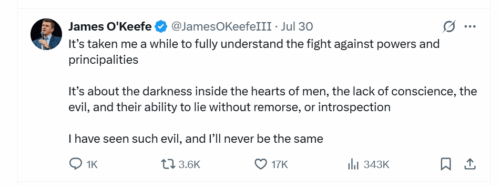
What “shocked [him to his] core” is likely the same thing that James O’Keefe (formerly of Project Veritas) mentioned as amplification within days.

There are two groups I’d like to discuss with respect to fruit, deceivers both…and the types of people that Bongino and O’Keefe likely encountered as they discovered the intensity of a spiritual battle before them.

First, there are those who look perfectly good on the outside but are rotten to the core. The same kind who can commit evil, atrocities even, with a smile on their face with a firm and friendly handshake that doesn’t hint at the evil within. What O’Keefe refers to as the lack of conscience and darkness in men’s hearts. It’s not just the hate mail, rage posts, and death threats that display an ugliness in the soul seeping through a highly polished exterior. No, it’s the evil in its purist form that remains hidden. Only when one ventures close enough can one sense it: the evil that remains hidden to visibility but is felt unmistakably in the spiritual realm. Yes, that’s the kind of moral betrayal that shakes one to his core, and after seeing its reality, one is forever changed in his views of good and evil. It’s this spiritual darkness that we do battle against as Christians.

Second, however, are those who are supposed to produce good fruit, but through a lack of abiding, and a lack of faithfulness, or through downright betrayal, they’re barren instead. They seem so benign, but they deceive as well. They are the Christian pretenders whose good fruit is not evident beyond, perhaps, some token bits. On one extreme, there are columnists, for example, who identify as Christian but out in the public square, they proclaim a very different message and side with the devil every chance they get. On the other extreme, there are the proclaimers of Christ who secretly betray us. Somehow, we’re still surprised when a Christian leader turns out to have committed great evil against his flock, his frock, and his God.

Each of those is the Judas in our midst, the same dark heart that would share in Jesus’ ministry but betray Him in the end. Sad to say, the devil still has his servants working in the world, producing evil fruit wherever they go, but managing to hide behind the smile, the pat on the back, the power, position, or prestige, and the fellowship of what portrayed itself as friendship. Only to be a betrayer of trust, a betrayer of Christ.

Remain vigilant, my friends. The battle is upon us. Bear fruit for Christ. Understand the times, and don’t let evil surprise you or shock you to your core. It’s more real … and black and white than we know on this side of heaven.

Continue Reading

Abiding Like Riding

All this ease of fully abiding in Christ like a vine, and the Holy Spirit will simply produce His fruit in our lives effortlessly, doesn’t mean we’re off the hook for our part.  Jesus doesn’t force us to abide (or remain) in Him. 

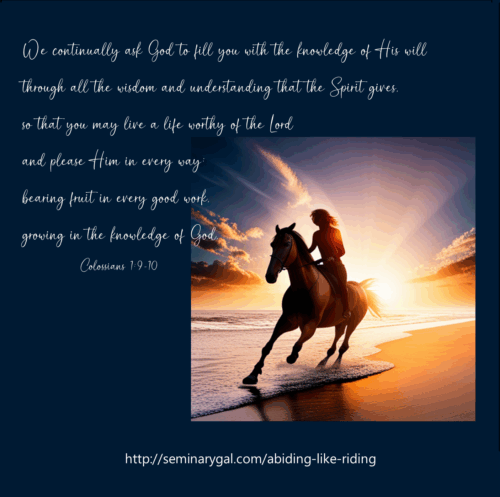
Abiding is kind of like riding a horse.  The horse will be moving, and its movement is dynamic, requiring a person’s coordination and effort to remain on its back and to work with the horse.   It’s not like sitting on a chair which is static.  A chair just sits there, and you sit on it.  It doesn’t go anywhere or do anything. Hold that thought.

A pastor I know sent out a “Friday Update” in which he had this statement:

Mike’s Friday update:  “After following Christ for ten years, many fail to see much change. Why? Because all they’ve done is repeat ‘year one’ ten times. Spiritual growth requires more discipline and sacrifice than most expect (or are willing to give). Reading the New Testament – e.g., 1 Cor. 9:27 –suggests that our options are limited. We face the pain of the disciplines we choose (prayer, sacrifice, etc.) or we live in the malaise of spiritual immaturity.”

There is engagement as a whole body activity in riding a horse.  Not so with riding a chair.  Is your spiritual growth a repeating of ‘year one’, more like riding a chair?

With a horse (abiding like riding), we have a living animal and in the Body of Christ we have a living organism called the Church, even in our prior vine and branches analogy.  With a chair, it’s just an object.  Are you interacting with the organic living church or content to sit in a pew or a chair and just go through the motions?

With a horse, it takes balance, skill, coordination, and accepting of risk of life to interact, remaining a rider instead of a faller or someone who never even tries.  With a chair, even a mannequin can sit on a chair.  Living is not required. Even if one were to name that mannequin “Christian”…it’s still not alive by name alone.

Riding a horse can also have a purpose of work or pleasure.  Not with a chair.  Sitting on a chair is a passive, stable activity focused on comfort or utility which is the sole purpose of a chair.  Repeating ‘year one’ of spiritual life ten times is a stable, reliable activity, but it’s one missing out on life’s exciting purpose and fruit-bearing to God’s glory.

“We continually ask God to fill you with the knowledge of His will through all the wisdom and understanding that the Spirit gives, so that you may live a life worthy of the Lord and please Him in every way: bearing fruit in every good work, growing in the knowledge of God.”  (Colossians 1:9-10)

Abiding is like riding, with effort and skill and living with purpose. Interacting with a living organism–the Church! When you’re abiding like riding, it is a fruit-bearing life. 

Continue Reading

A Father’s Day Prayer, 2025

Fatherhood isn’t celebrated in American culture nearly enough.  Sadly, the Hallmarking of a holiday contributes little to its meaning, but it complicates its celebration. Father’s Day brings joy, emptiness, or pain, depending on how it is internalized.  Here is my prayer for Father’s Day.

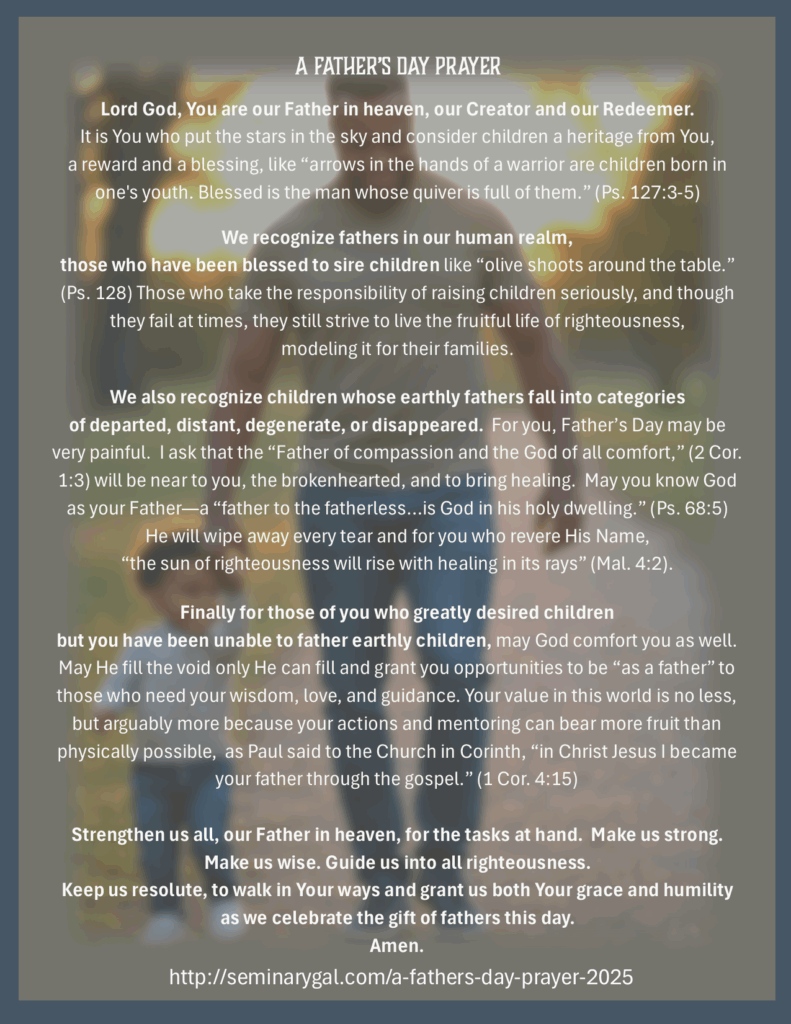
A Father’s Day Prayer

Lord God, You are our Father in heaven, our Creator and our Redeemer. 

It is You who put the stars in the sky and consider children a heritage from You, a reward and a blessing, like “arrows in the hands of a warrior are children born in one’s youth. Blessed is the man whose quiver is full of them.” (Ps. 127:3-5)

We recognize fathers in our human realm, those who have been blessed to sire children like “olive shoots around the table.” (Ps. 128) Those who take the responsibility of raising children seriously, and though they fail at times, they still strive to live the fruitful life of righteousness, modeling it for their families.

We also recognize children whose earthly fathers fall into categories of departed, distant, degenerate, or disappeared.  For you, Father’s Day may be very painful.  I ask that the “Father of compassion and the God of all comfort,” (2 Cor. 1:3) will be near to you, the brokenhearted, and to bring healing.  May you know God as your Father—a “father to the fatherless…is God in his holy dwelling.” (Ps. 68:5) He will wipe away every tear and for you who revere His Name, “the sun of righteousness will rise with healing in its rays” (Mal. 4:2).

Finally, for those of you who greatly desired children but you have been unable to father earthly children, may God comfort you as well.  May He fill the void only He can fill and grant you opportunities to be “as a father” to those who need your wisdom, love, and guidance. Your value in this world is no less, but arguably more because your actions and mentoring can bear more fruit than physically possible, as Paul said to the Church in Corinth, “in Christ Jesus I became your father through the gospel.” (1 Cor. 4:15)

Strengthen us all, our Father in heaven, for the tasks at hand.  Make us strong. Make us wise. Guide us into all righteousness. Keep us resolute, to walk in Your ways and grant us both Your grace and humility as we celebrate the gift of fathers this day. 

Amen.

Continue Reading

The Vine Does the Work

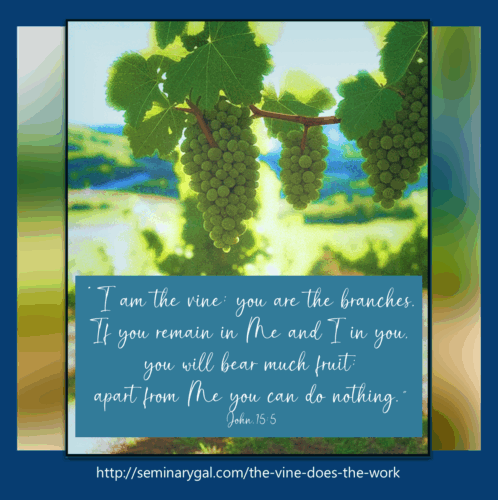
When it comes to the idea of bearing fruit and the effortlessness required from humanity, Jesus uses the analogy of a vine.

Having a horticultural background myself, I love it when Jesus references agriculture.  Here He’s talking about eliminating suckers so that the vine will be able to do the best work of fruit-bearing. 

In a world of work that exists for us now (outside of the perfect yielding-of-fruit Garden of Eden), suckers are branches that bear no fruit. They’re showy and bold, shooting up with fat stalks, and they have immature flourishes of foliage which rob the plant’s productive elements by using resources the vine could use for production of fruit. Fruiting is God’s means of reproduction, generation to generation. Robbing the vine of that is why they’re called suckers–all show and no go.

In verse 3 Jesus introduces the concept of being clean.  With the vine, it’s removing suckers to focus on productivity. For us, it’s a purity of having had distractions and impurities pruned out of one’s life.  Jesus introduced purity to their lives by His Word, and by remaining in Christ, they are able to produce fruit abundantly.

What types of things are “suckers” in our lives?

Is there a distinction between sin (which has no place in the Christian’s life) versus lesser priorities (which suck our energies into unproductive efforts and need to be brought to their proper place)?

In today’s passage, God does the pruning.  Does He make mistakes?  What tools and techniques will God use to prune our lives?

Continue Reading

Effortlessly

Oh the woes of the Type A person.  Striving, striving, striving.  Driven. Working harder, longer, faster, and still not feeling like you’re making enough progress.  You wake up like Alabama sings, in such a hurry, “shaking hand with the clock” that the first thing you think about is work.

Bearing fruit as discipleship isn’t meant to be that way.  Don’t get me wrong, it’s intentional.  And we’ll discuss effort soon enough.  But today, we’ll look at intentionally abiding (remaining) and by God’s activity, discipleship just happens. 

Effortlessly.  I like that word.

When I think of “effortlessly,” I think of a bird gliding on the wind, not like Forrest Gump’s feather drifting (for that has no aim and is carried along helplessly as the wind sees fit), rather there’s true power utilized in gliding.  It’s making the most of the wind by letting it move you…without trying to control it. The wind has all the power of agency, and the glide depends upon the power of wind for direction, even intention.  There’s movement in the glide that is a partnership of the wind and the wing.

Effortlessly is how discipleship can happen. 

“The wind blows wherever it pleases. You hear its sound, but you cannot tell where it comes from or where it is going. So it is with everyone born of the Spirit.” John.3:8

That partnership of a person born of the Spirit and the Holy Spirit’s agency is effortless when one is filled with the Holy Spirit. “Be very careful, then, how you live … making the most of every opportunity, …  understand what the Lord’s will is…be filled with the Spirit.” (Ephesians 5:15-18)

  • Is effortless how you would describe your growth to Christian maturity?
  • What about your outreach to make disciples of others?
  • What helps you? What gets in the way?
Continue Reading

Fruit to the Father’s Glory

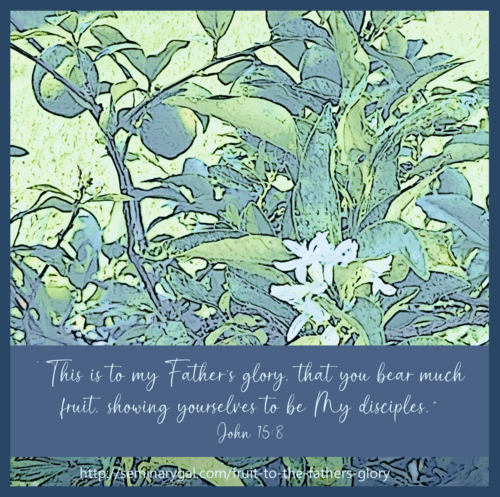
Jesus said, “This is to my Father’s glory, that you bear much fruit, showing yourselves to be My disciples.” (John 15:8)

He’s not talking about offspring and someone like Elon Musk who frequently quips about personally populating Mars or his fourteen-and-counting children saying, “Doing my best to help the underpopulation crisis. A collapsing birth rate is the biggest danger civilization faces by far.”

Not at all.  There are two ways to expand Image-bearing (which is fruit).

One is to give birth to them as new Image-bearers, expanding Image-bearing in numbers, or quantity.

The other is to form Image-bearing more fully by the maturing the seed to fruitfulness.  Expanding Image bearing in quality or maturity.  In other words, “make disciples.”

That is the Christian’s one job, according to the Great Commission (Matthew 28:19-20).  

  • In what ways does creating new Image-bearers bring glory to God?
  • In what ways does growing disciples in maturity and quality bring glory to God?
  • How can churches grow disciples in maturity and quality? 
  • How does that square with the concept of the “seeker church”?  Can a church be both a seeker church and at the same time, one with deep discipleship?  How might that happen?
Continue Reading

The Arc of Life

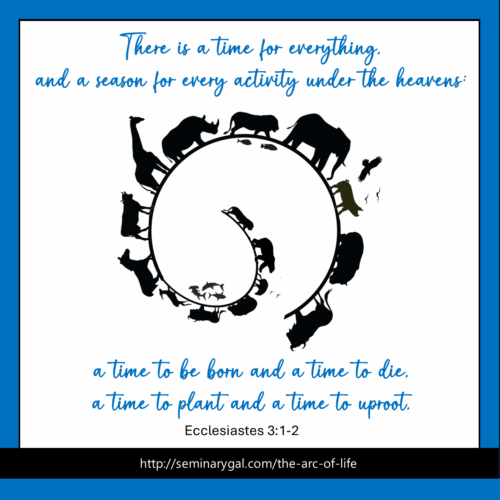
Death changed the course for both people and nature. Fruit-bearing ceased being a continuous cycle of fruiting, each according to its kind, forming an eternal circle within a spiral.

A broken circle became an arc with a beginning and an end.  None of this Disneyfied “Circle of Life” nonsense. It’s an arc, even for the death deniers who will know mortality someday, even on Mars.

In some cases the life is long, some olive trees are more than 2000 years old.  In other cases, it is short.  Adult Ephemeroptera (mayflies) live only 1-2 days and focus on… you guessed it … reproduction.

Plant and harvest.  Birth and death.  Beginning and end. Outside of Eden, that’s all we’ve got.

How ought the fact of mortality impact the urgency of bearing fruit of some good form?

“There is a time for everything, and a season for every activity under the heavens:  a time to be born and a time to die, a time to plant and a time to uproot” (Ecclesiastes 3:1-2)

Moses prayed, “Our days may come to seventy years, or eighty, if our strength endures; yet the best of them are but trouble and sorrow, for they quickly pass, and we fly away…Teach us to number our days, that we may gain a heart of wisdom.” (Ps. 90:10,12).

How does knowing we have a life span instruct us in wisdom?  How does that square with the adage “Youth is wasted on the young?”  

Is bearing fruit referring to physical reproduction only or could it also mean replicating our faith in Christ by making disciples among other people?

Continue Reading

Production vs. Destruction

“By their fruit you will know them.” Fruit-bearing is ultimately a production-oriented process.  It has been this way from the beginning. The living creatures, the plants, yes, even mankind were all intended to reproduce and by fulfilling God’s mandate, we collectively bring glory to God.

When sin entered the picture in the Garden of Eden, we had the introduction of mortality. 
Destruction.  


Death changed the course for both people and nature. Fruit-bearing ceased being a continuous cycle of fruiting, each according to its kind, forming an eternal, enlarging spiral … a perfection with only a beginning but no ending. But Death came, and life became an arc with both a beginning and an end. We now have a life span. In some cases, the life is long, in other cases short.

Birth rates in many Western countries have fallen below replacement levels.  Does this honor God and His “be fruitful” blessing? 

Why might some religious groups view birth control as inconsistent with God’s plan? Do you believe it’s irresponsible to have children beyond replacement levels? Now consider God’s command. How does that square with both stewardship responsibilities God gave us as well as the blessing upon mankind?

How does introduction of so-called Western values into more third-world countries risk destruction of their birth rates as well?

Is depopulation, a favored agenda of some to “save the earth,” a God-honoring thing?  If Satan is the enemy of God, hates life, and was the initial destroyer of an eternal existence, whose agenda does depopulation serve?

If God is both real and powerful, creating the heavens and earth from nothing (ex nihilo), is God unable to “save the earth” apart from human agency?

Continue Reading