Listen to Jesus, God reminds us we journey along. Our first pilgrim song reminds us to Expect Opposition. From the moment Jesus resolutely set out for Jerusalem, the opposition was an uninvited guest in the spiritual sidecar.
And he sent messengers on ahead, who went into a Samaritan village to get things ready for him; but the people there did not welcome him, because he was heading for Jerusalem. When the disciples James and John saw this, they asked, “Lord, do you want us to call fire down from heaven to destroy them?” But Jesus turned and rebuked them, and they went to another village (Luke 9:52-56)
 The Samaritans didn’t like the Jews very much. They especially didn’t like them when they were heading to Jerusalem for the feasts. Samaritans believed the presence of God was at Mount Gerizim, not in Jerusalem and the Jewish insistence otherwise by these pilgrims showing up made the Samaritans angry.
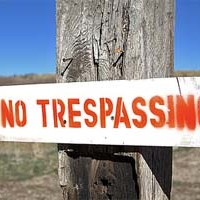
Jesus is walking with His disciples and the messengers return with the bad news: the Samaritans have yanked in the welcome mat, shut the windows, and bolted the doors. “No Trespassing” notices adorn every tree and “Keep off the Grass” signs have shown up on everyone’s front lawns. No hero’s welcome or room at the inn in Samaria for the Rabbi on the move.
James and John, the sons of thunder, were quite perturbed. This is Rabbi Jesus, we’re talking about coming through. Indignant, James and John wanted to show those Samaritans a thing or two, just like Elijah did in 2 Kings 1:1-17. Call down fire! Let’em burn. (Samaritan jerks.) Of course, it didn’t take much to stoke the flames of hatred against and by the Samaritans. Any gentle puff of wind will do, blowing any which way.
But Expect Opposition, the first Song of Ascents reminded us. Turn the other cheek. Trust in God. You’re a disciple of Jesus and the presence of God in heaven is your home. In this world, you’re aliens and strangers. So Jesus rebukes James and John. Isn’t this a bit unfair? They were only looking out for Jesus’ best interests and they had biblical precedent with the king of Samaria and Elijah. Why not fire from heaven to consume those Samaritans as a timely reminder?
Jesus knew and taught His disciples this: Expect Opposition. It comes with the territory. So long as it was mere rejection, just brush it off. Expect it. Jesus instructs His disciples to persevere and not to take rejection personally. After all, it’s really Jesus and His Father in heaven that are being rejected.
For the disciple walking with Jesus “Up to Jerusalem,” there will be other villages in which to stay. We’re just passing through. Rejection and discipleship go hand in hand.
Questions for meditation:
- Can you think of a time when you took others’ rejection of your beliefs personally?
- Do you ever feel like an alien and a stranger in this world?
- What types of things make persevering difficult?
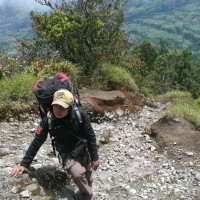 When I was in elementary school, we had music class and would sing songs. Isn’t it interesting how a song from decades ago can still be memorable? One song popped into my head instantly as I was thinking of pilgrims singing on their journey: The Happy Wanderer. The lyrics went, “I love to go a-wandering, along the mountain track. And as I go, I love to sing. My knapsack on my back.” The chorus was always our favorite: “Val-deri,Val-dera,Val-deri,Val-dera-ha-ha-ha-ha-ha.” We especially liked the ha-ha part and sang it with gusto even if the words were total gibberish.
 The discipleship lessons taught by these Songs of Ascents were well remembered, too. Psalm 120 is the first Song of Ascents and might be titled, “Discipleship Lesson 1: Expect Opposition.” Not exactly The Happy Wanderer as a subject for Psalm 120. So why start here?
 Offering sacrifices to God as a spiritual act of worship: Isn’t that the function of a priest in Old Testament language here in the New Testament? Doesn’t Scripture say that our bodies are the Temple of God (1 Corinthians 3:16)? By His Spirit dwelling in us, aren’t our bodies the place where God meets with us? If yes and Amen and Amen, then doesn’t it follow that when we serve God with our bodies as a spiritual act of worship, we are performing the function of a priest?
 I remember two instances in which the concept of pastor/priest hit home. The first one was when I was speaking with an individual who held a significant administration position in our community. He is Jewish and when he heard that I was in seminary, he asked if when I got out, I’d end up wearing one of those little white collars. We both laughed at the thought and I said that my denomination of church doesn’t do the little white collars…for that matter, women don’t do that kind of service. Then he asked, “Why go through with it then?” I responded, “I really don’t know. I guess, just because God is sending me.” Later on I thought, it doesn’t have to make sense to me. It’s not my role to pass judgment on God’s commission. My role is to do it.
 Love the Lord your God…and your neighbor as yourself. Being in community and FOR one another may involve risking any of these:
 This was brought home to me in a strange way. My husband and I have a dog named Harley—a smooth haired fox terrier. He attracts a lot of attention, particularly from children. Last evening, Harley was taking us for a walk when a little boy ran up and asked if he could pet our dog. The little boy smiled when I said “Yes” and then he looked at my face with the bandage from my surgery and asked, “What’s that?” I immediately thought of the medical answer and decided that wouldn’t be nearly as informative or age appropriate as the answer I gave him: “I had an owie on my face and so the doctor took it away.” The little boy said “Oh, that’s good.” While he was petting Harley, two little girls came running up to see Harley too, and one of them spoke for the pair and asked “What happened?” and they both pointed to their faces corresponding to where my bandage is. I gave them the same answer and they said, “Oh. OK.” After this episode, I talked with my husband about how I ran into a woman from church while I was at the store earlier and she also asked me “What happened?” I’m sure everyone I encountered was wondering about this prominent bandage, but only she—a friend—asked.
  Isn’t it wonderful that when God set out to create human beings, that He made us each to be individuals? No cookie cutter, mass-produced, dime-a-dozen clones. Each one of us is handcrafted.
 I’ve been thinking about this a lot. As of this writing, I’m recovering from having a basal cell carcinoma lesion removed from my face. Once the pain and swelling go away, there will be a scar (hopefully it will not be too noticeable). But for Christians, these scars are our stigmata—the marks of life—as we pick up our cross and follow Christ on a journey of BE-ing in a fallen world.