Just because a topic is controversial doesn’t mean we should ignore it. In fact, its controversial nature is the most compelling reason to learn about it. We’re still looking at My People/Not My People after God scattered everyone at Babel and Shem’s line becomes Eber’s line (the two names from which we get the words “Semite” and “Hebrew”). Hundreds of years pass from Babel before a landmark event happens: a man named Terah settles in Harran. Terah’s son and daughter-in-law (Abram and Sarai) have no children to carry on the legacy.
Look, there have been millions of childless couples throughout history. But this one is different because today we come to the covenant through which God establishes My People and forever separates My People apart for His use and glory.
God makes Abram/Abraham a promise, a covenant, as God tells him, “Go from your country, your people and your father’s household to the land I will show you. “I will make you into a great nation, and I will bless you; I will make your name great, and you will be a blessing. I will bless those who bless you, and whoever curses you I will curse; and all peoples on earth will be blessed through you.” (Genesis 12:1-3)
Not all of those peoples will be My People, especially the cursing ones, even if Abraham would be their father. Indeed, there would be 3 great Abrahamic religions arising that we still see today. Ishmael would be the child of impatience (Hagar was his mother) as God kept Sarah barren until time arrived for the “child of promise” Isaac. At Sarah’s age of 90 years old, Isaac was a miracle.
Ishmael was none-too-pleased that the baby of the family would inherit the blessings, in direct contradiction of the traditional expectations, and it’s been “division perfected” ever since, especially regarding the land.
The blessings for Isaac’s line include great nation status, God’s favor, and the land of milk and honey, specifically Canaan…the greatly disputed land between Israel (Isaac’s line) and “the Palestinians” (descended from Ishmael). To reiterate that covenant of separation and blessing to ensure no one thinks it was a mistake, God repeats it 3 chapters later and again in Chapter 17. Do you see why there’s been an ongoing fight?
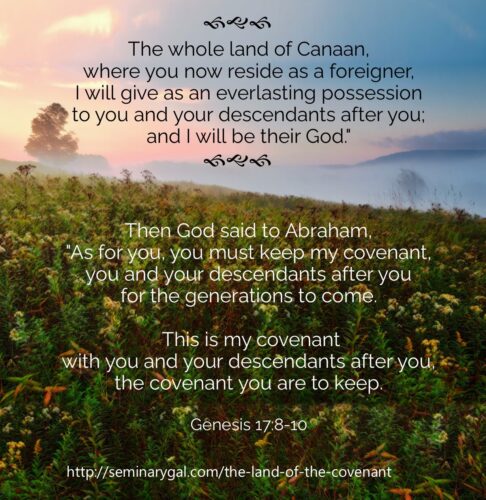
God said to Abraham, “The whole land of Canaan, where you now reside as a foreigner, I will give as an everlasting possession to you and your descendants after you; and I will be their God.” 9 Then God said to Abraham, “As for you, you must keep my covenant, you and your descendants after you for the generations to come. 10 This is my covenant with you and your descendants after you, the covenant you are to keep: Every male among you shall be circumcised.” (Genesis 17:8-10)
Questions for further thought:
Why do people avoid talking about controversial topics?
There are two phrases critical to the current land dispute. “The whole land of Canaan” and “everlasting possession.” How do those phrases determine whether one believes God at His Word or doesn’t?
Are those who refuse to take God at His Word My People, or Not My People?
Why did God establish the Chosen People/My People before Isaac was born and not wait to select him afterward?
How does God’s covenant and the long-delayed child of promise as Abraham’s second son codify faith (Romans 4:3), and create a wedge of separation, leading to “division perfected”?
In ancient times, the eldest son inherited double blessing (Deuteronomy 21:15-17) and had primacy over younger sons. Why might Ishmael, the firstborn, have felt entitled based on this Scripture, particularly?
In what way does God’s election of Abraham’s second son before he was born point forward to rejecting tradition, man’s ideas of natural biological inheritance, or earning favor, and the world’s expectations?
Part of that blessing included property … the land. Why might the people of Palestine feel entitled to the land when God promised it to Isaac, father of Jacob also known as Israel, and his descendants forever? Read the reiteration of the blessing in Chapter 15 to see the people groups to be displaced (especially verses 18-21).